





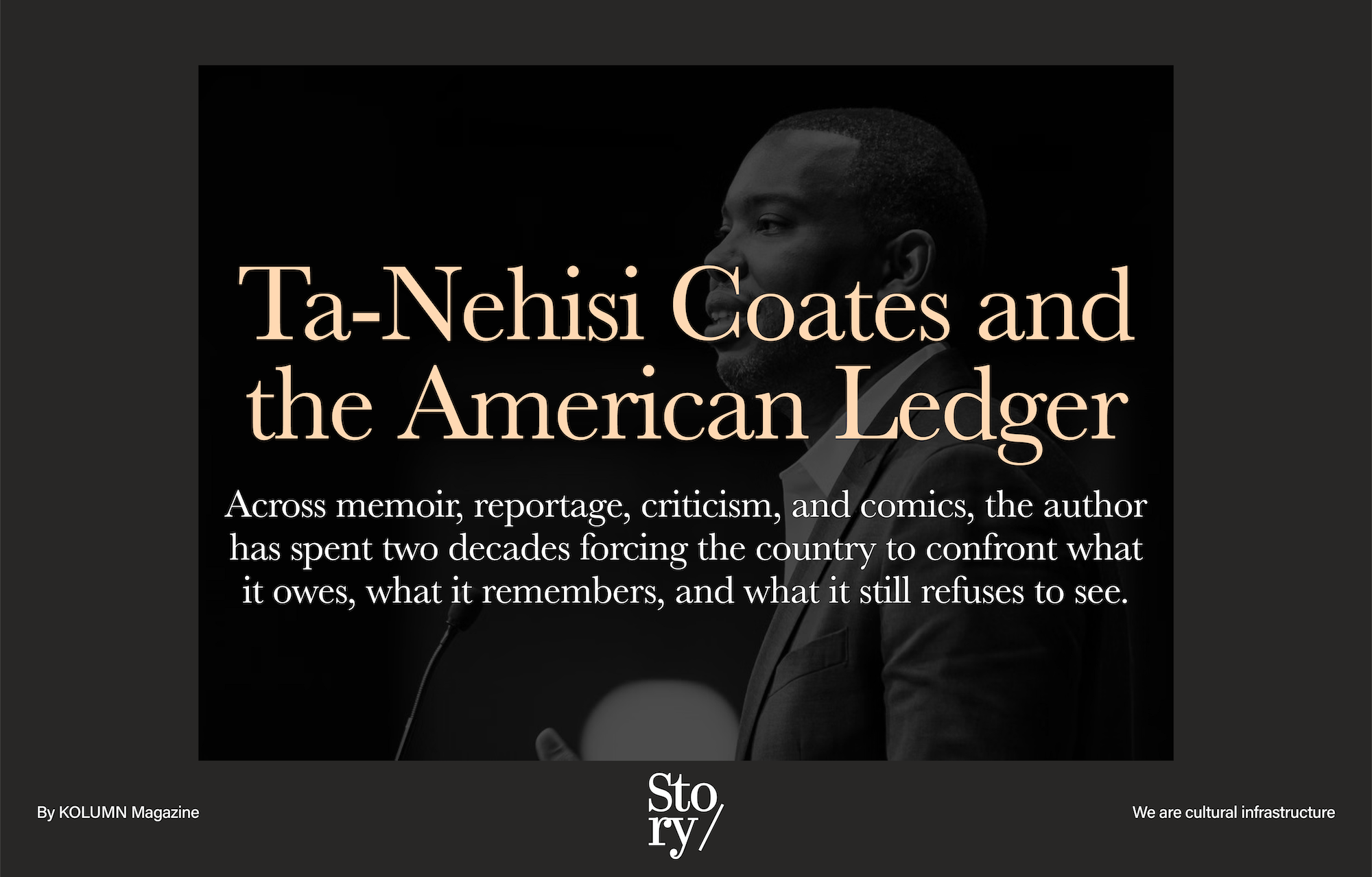
Coates’s great subject has never really been race in the abstract. It has been what power does to memory—and what memory does when it refuses to stay buried.
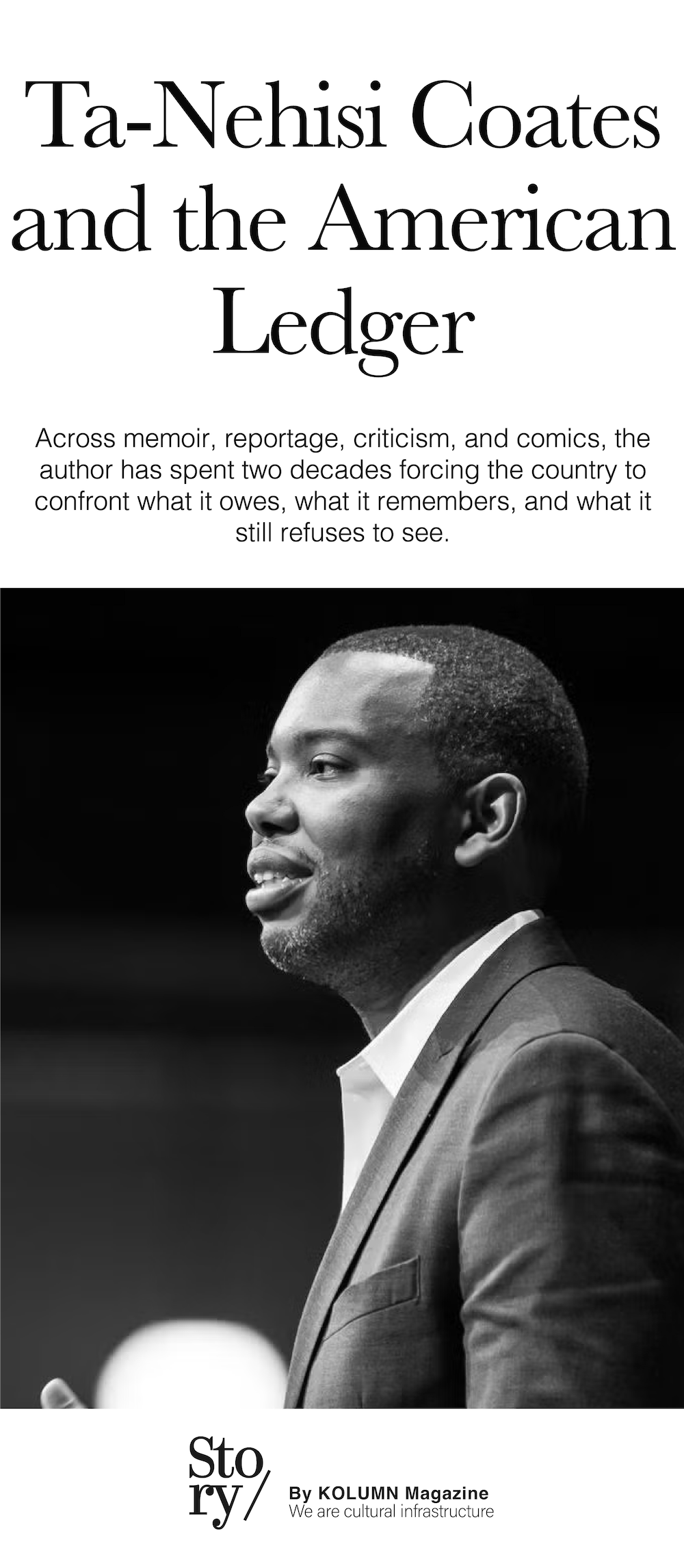
Coates’s great subject has never really been race in the abstract. It has been what power does to memory—and what memory does when it refuses to stay buried.
By KOLUMN Magazine
There are writers who explain a moment, and there are writers who rearrange the vocabulary a culture uses to describe itself. Ta-Nehisi Coates belongs in the second category. Over the last two decades, he has moved from memoirist to essayist to public intellectual, from Marvel comics writer to novelist to teacher, while keeping a remarkably consistent central concern: what America does to the Black body, what stories it tells to excuse that damage, and what honesty might require once the euphemisms are stripped away. His work has never been merely about race as a topic. It has been about power, inheritance, plunder, citizenship, and the stories a nation prefers over the record of what it has done.
That is one reason Coates has mattered so much. He did not simply enter public life as a commentator with sharp opinions. He arrived as a writer with an unusually disciplined prose style and a deep commitment to historical method. The essays that made his reputation, especially at The Atlantic, combined reporting, autobiography, archival excavation, and moral argument in ways that felt both literary and prosecutorial. His readers were not just being persuaded. They were being walked through evidence. They were being told, in effect, that sentiment would not save them from the historical record.
Coates’s significance also lies in timing. He rose to national prominence in the Obama years, when broad swaths of the country were eager to tell a triumphal story about racial progress. His work refused that comfort. Again and again, he argued that American democracy could not be understood apart from organized theft: slavery, segregation, redlining, housing discrimination, exclusion from wealth accumulation, state violence, and the routine conversion of Black precarity into white security. In an era hungry for uplift, Coates offered indictment. In a media environment built on speed, he made the long historical sentence his preferred instrument.
To understand his career, then, is to understand a writer who treated prose not as ornament but as evidence, and not as therapy but as confrontation. That approach has brought him admiration, institutional prestige, bestsellers, and influence. It has also brought criticism, sometimes thoughtful and sometimes plainly ideological, from readers who consider him too bleak, too centered on race, too skeptical of American innocence, or too willing to challenge dominant narratives abroad as well as at home. Those tensions are part of the story too. Coates has become important not because everyone agrees with him, but because it has become difficult to talk seriously about race, democracy, reparations, or historical memory in the United States without passing through terrain he helped define.
Baltimore, family, and the making of an intellectual temperament
Coates was born in Baltimore in 1975 and raised in a household shaped by books, political argument, Black nationalism, and exacting expectations. His father, Paul Coates, was a former Black Panther and later the founder of Black Classic Press, a publishing house devoted to preserving and circulating works by Black writers. His mother, Cheryl Waters Coates, was a teacher. Those biographical facts matter because they clarify something essential about the younger Coates’s sensibility: he did not come to Black history as a fashionable theme or a late scholarly discovery. He grew up inside an ecosystem where history, text, discipline, and political struggle were already daily realities.
That background helps explain the texture of his prose. Even at his most lyrical, Coates writes like someone who distrusts national myth and has been trained to ask who benefits from a given story. The voice that later became famous at The Atlantic did not emerge from nowhere. It was formed in Baltimore streets, in family argument, in his father’s publishing world, and in the kind of reading life that teaches a person early that official histories are often partial, self-serving, or false. When Coates later wrote about plunder, policy, and bodily vulnerability, he was not adopting an analytic frame for professional effect. He was extending a way of seeing he had been formed inside from childhood.
Howard University, where Coates studied journalism for several years without completing a degree, became another crucial site in his formation. He has often described Howard not simply as a school but as an intellectual world, a “Mecca” in the broader Black sense: a place where the diversity of Black life, thought, style, and history became newly visible to him. Howard sharpened both his ambition and his range. It also gave him relationships and experiences that would later reverberate through his work, most famously in Between the World and Me, where the killing of his Howard classmate Prince Jones becomes one of the book’s moral centers.
One of the enduring strengths of Coates’s career is the way he has refused the fantasy of self-invention detached from lineage. He is a deeply individual writer, but not a self-made mythmaker. In his memoir The Beautiful Struggle, published in 2008, he wrote directly about fatherhood, masculinity, Baltimore, and his family’s exacting internal world. The book did not yet make him a household name, but it announced several themes that would define his mature work: the instability of safety, the disciplinary force of American racism, and the strange intimacy between tenderness and fear in Black family life. It also introduced readers to a writer who could braid memory and argument without flattening either one.
The Atlantic years and the essay as national intervention
Before Coates became an author with bestseller status, he became a force in magazine journalism. His work for The Atlantic made him one of the defining nonfiction stylists of the 2010s. He wrote about Barack Obama, white supremacy, the Civil War, policing, housing, and the structure of American innocence with a combination of close reporting and intellectual ambition that stood out in a media culture increasingly optimized for quick takes. The Atlantic identifies him as a former national correspondent whose work on cultural, social, and political issues, especially those involving African Americans and white supremacy, reached a wide national audience.
His 2014 essay “The Case for Reparations” was the major break. It did not invent the reparations argument; Black scholars, activists, and organizers had been advancing that case for generations. What Coates did was force the subject into the center of mainstream American debate with a level of narrative power and documentary clarity that could not be easily waved away. The essay moved from slavery to Jim Crow to discriminatory housing policy, tracing how wealth was extracted from Black Americans not only through labor theft but through modern instruments of finance and public policy. It treated reparations less as a provocative slogan than as a test of whether the country could face its own balance sheet.
The impact was immediate and lasting. The Washington Post described the piece as a payoff for years of struggle and noted the power of Coates’s criticism of historical and contemporary decision-makers. Over time, the essay helped push reparations from the margins toward the policy mainstream. By 2019, when Coates testified before Congress in support of H.R. 40, the commission bill to study reparations proposals, he was no longer writing as a solitary magazine essayist throwing a flare into the dark. He was speaking as a figure whose work had altered the political terrain.
That hearing crystallized something important about Coates’s public role. He is often described as a moral voice, but just as often he functions as a historian of dispossession for a general audience. His testimony on Juneteenth 2019 emphasized that reparations are not only about slavery but about the long afterlife of theft, policy, exclusion, and civic betrayal. The conceptual move mattered. Coates persistently refuses any framing that isolates slavery as a closed chapter while leaving untouched the later systems that converted white advantage into ordinary American life.
At his best, Coates made the essay behave like an x-ray. He peeled back the familiar language of progress and revealed the structure beneath it: the state, the market, the police, the mortgage contract, the school district line. Many writers could describe racism as prejudice. Coates insisted on describing it as design. That insistence is one reason he became so influential among readers trying to understand how history survives inside institutions, and why he became so polarizing among readers invested in narratives of national redemption.
Between the World and Me and the transformation of witness into literature
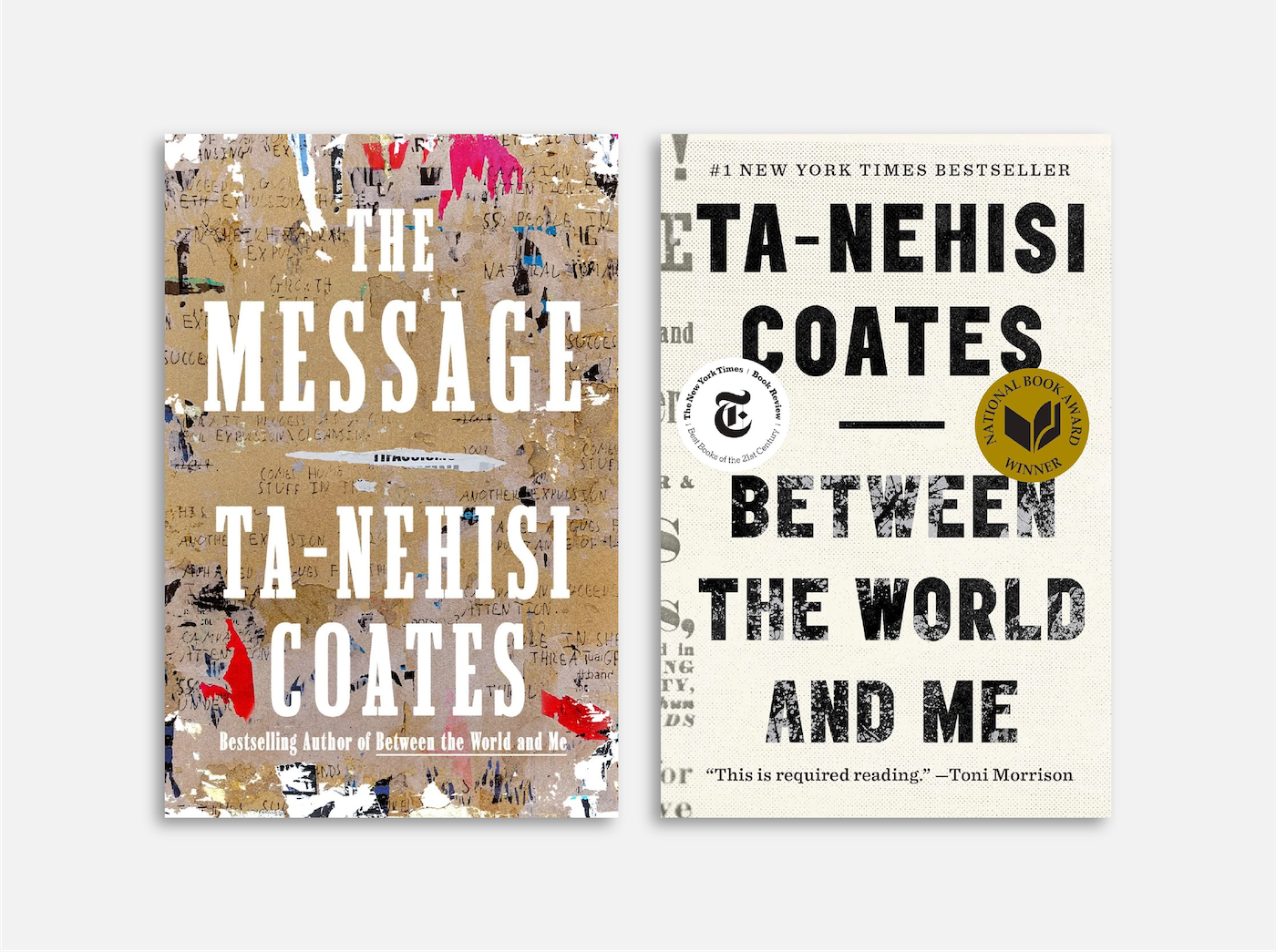
If “The Case for Reparations” established Coates as a major public intellectual, Between the World and Me made him a literary event. Published in 2015, the book took the form of a letter to his son and quickly became one of the most discussed works of nonfiction of the decade. The National Book Foundation notes that the book won the 2015 National Book Award for nonfiction, while Coates’s official site and publisher materials identify it as a #1 New York Times bestseller. The Guardian called it an urgent wake-up call; another Guardian piece described how a letter to his son became a bestseller and linked its power to James Baldwin and Coates’s father.
“What made Coates hard to ignore was not only what he wrote, but what he refused to offer: easy absolution, patriotic anesthesia, and the fantasy that history had somehow already been settled.”
The book’s argument is unsparing. Coates writes not about race as identity performance but about racism as a force visited upon the body: vulnerable, perishable, subject to the state and to vigilante power. He rejects the easy abstractions of national belonging and speaks instead about danger, fear, and the disciplined precarity of Black life. That language hit readers with unusual force because it declined so many conventional comforts. There is little interest in reassurance, almost no investment in patriotic uplift, and no sentimental claim that history bends on its own toward justice.
The timing mattered. The book arrived amid renewed public scrutiny of police violence and amid the growing visibility of Black Lives Matter. It felt both of its moment and larger than it. Toni Morrison famously praised Coates, and many readers treated the book as a bridge between Baldwin’s moral urgency and the contemporary vocabulary of structural racism. That comparison has sometimes been overused, but it is not baseless. Coates’s epistolary frame, his concern with history as intimate inheritance, and his willingness to write toward his son while also writing toward the nation place him in a recognizable Black essayistic tradition, even as his voice remains distinctly his own—cooler in some ways, more secular, and more suspicious of redemptive language.
Yet Between the World and Me also drew serious criticism, and those critiques should not be erased in any fair assessment. Some reviewers admired the book’s urgency while arguing that its framework risked narrowing the conversation, especially by foregrounding race more than class or by speaking in a register of near-total pessimism. The Guardian’s Sukhdev Sandhu praised Coates’s importance while asking where the discussions of class were and whether his outlook could become parochial. That criticism did not diminish the book’s achievement, but it did clarify the terms of debate around Coates: whether his relentless focus on anti-Blackness yields a deeper truth about America, or whether it can sometimes understate other structures of power.
That debate remains part of his legacy. Coates is not important because he resolved the American argument. He is important because he sharpened it. Between the World and Me made it much harder for mainstream discourse to pretend that racial violence was a matter of isolated incidents rather than an organizing principle of the republic. It also confirmed that literary nonfiction could still enter mass culture without surrendering density, seriousness, or style.
Beyond the essay: memoir, fiction, and the Marvel years
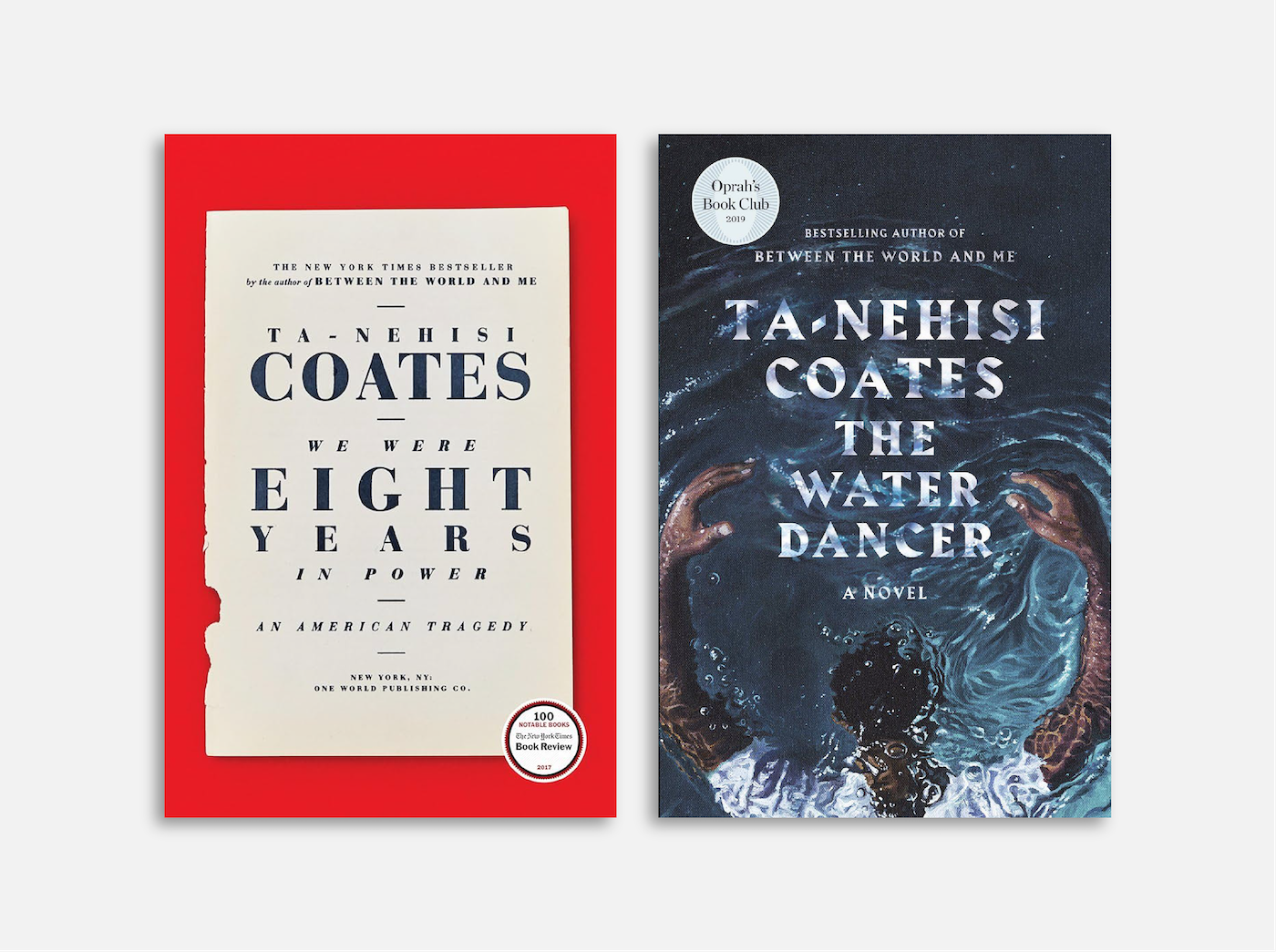
One of the more underrated aspects of Coates’s career is his formal restlessness. After his emergence as a leading essayist, he did not stay safely in the lane that had made him famous. He continued expanding. We Were Eight Years in Power gathered essays and reflections into a book-length account of the Obama era and the backlash surrounding it. Then, in 2019, he published The Water Dancer, a novel centered on an enslaved man with a powerful memory who becomes part of the Underground Railroad. His official site describes it as a boldly imagined work of magic and adventure, while major reference sources treat it as his first novel and a notable expansion into historical fiction.
That move into fiction was not a detour so much as a related experiment. Memory had always been central to Coates’s nonfiction. In The Water Dancer, memory becomes almost supernatural, a force with transportive power. Thematically, the novel remains recognizably Coatesian: slavery, rupture, the severed archive of Black family life, and the insistence that history remains active in the present. But fiction allowed him to stage those concerns through myth, image, and symbolic structure rather than direct argument. For readers who knew only the polemical or essayistic Coates, the novel was a reminder that his imagination had always been larger than punditry.
Then there are the comics, one of the more surprising and revealing chapters of his career. Coates wrote Marvel’s Black Panther from 2016 to 2021 and Captain America from 2018 to 2021, according to his official biography. Marvel’s own materials highlight his role in worldbuilding Wakanda and in rethinking the political stakes of the franchise. That assignment made sense for more than commercial reasons. Coates had long been interested in the uses and abuses of power, in leadership, legitimacy, myth, and the contradictions of empire. Black Panther gave him a pop-cultural arena in which to stage those concerns before a different audience.
His comics work also complicates any simplistic portrait of him as a writer of unrelieved severity. Yes, his nonfiction is often sober and prosecutorial. But the turn to Marvel revealed his love of genre, his interest in speculative architecture, and his willingness to work inside mass culture without flattening his politics. Scholars and critics have noted that his Black Panther run explored monarchy, resistance, and Afrodiasporic political imagination. Even when working in franchise storytelling, Coates gravitated toward questions of governance, dissent, and the ethics of rule. That continuity is telling. Across forms, he returns to power.
Teacher, public intellectual, and institutional presence
It is now possible to describe Coates not only as a writer but as an institution-building figure. Over the years he has held academic appointments at MIT, CUNY, NYU, and, most prominently in recent years, Howard University. Howard has identified him as an alumnus and the Sterling Brown Endowed Chair in the English Department; his official biography similarly notes that he is the Sterling Brown Endowed Chair and a contributing editor at Vanity Fair. This matters because it shows how his career has evolved from independent journalism toward a role in shaping younger writers and Black intellectual life more directly.
That development feels fitting. Coates has always been unusually attentive to craft, reading, and the practical labor of writing. Even in his most public-facing books, he often sounds like a writer thinking aloud about method: what can be known, what has been occluded, how language can reveal or disguise violence. Recent coverage of The Message emphasizes that the book opens as a letter to his writing students at Howard, suggesting a more explicit turn toward pedagogy. In that sense, Coates’s later career is not a retreat from public argument. It is a refinement of venue. He remains in the argument, but now also from the classroom.
He has also become a durable media presence without becoming fully absorbed by media logic. That is rarer than it sounds. Many high-profile public intellectuals either vanish into academic specialization or become brands optimized for constant reaction. Coates has resisted both. There have been periods of relative withdrawal, changes in institutional affiliation, and shifts in medium, but he has generally kept faith with long-form work. Even his public interventions tend to arrive as essays, books, hearings, or substantial interviews rather than the perpetual churn of hot takes.
The Message, Palestine, and the widening field of controversy
Coates’s 2024 book The Message marked another major turn, or perhaps an extension of an older impulse into a broader geography. According to the publisher and Coates’s official site, the book takes him to three resonant sites of conflict to examine how stories shape reality. Reviews and profiles describe those journeys as moving through Senegal, South Carolina, and Palestine, and framing the work as an inquiry into narrative, censorship, memory, and political power. The book is addressed in part to his students, and several critics have understood it as both travel writing and craft meditation.
The Palestine section in particular widened both his subject matter and the backlash he faced. Coates has said in interviews and reviews that he felt misled by dominant American media narratives about the region, and his book’s treatment of the occupied West Bank drew intense reaction. Supporters saw the work as a morally consistent application of the same anti-domination principles that informed his writing on the United States. Critics argued that his analysis was selective or under-attentive to Israeli history and security concerns. The controversy, including a widely discussed television interview, underscored how Coates’s stature now guarantees that his interventions will be read not merely as literary exercises but as geopolitical claims.
What matters for assessing his significance is not whether one agrees with every conclusion in The Message. It is that the book confirms the deeper structure of his project. Coates is obsessed with who gets to narrate violence and who is asked to accept those narrations as neutral truth. In America, that concern led him to housing policy, policing, and the grammar of white innocence. In The Message, it leads him across borders. The question remains familiar: what stories authorize domination, and what happens when a writer refuses those stories?
The mixed reception also reminds us that influence is not the same thing as consensus. Coates has always attracted readers who find in him an essential witness and readers who find in him a distorting severity. His recent work has only intensified that divide. But even that division is a measure of his stature. By this point, Coates is not simply participating in public discourse; he is one of the figures through whom the boundaries of acceptable discourse are being fought over.
Style, method, and the argument about pessimism
Any serious appraisal of Coates has to account for style. He is not just important because of the subjects he addresses. He is important because of how he writes them. His sentences often move with a tensile, deliberate cadence—lucid, rhythmic, wary of ornament for ornament’s sake. The MacArthur Foundation praised his measured style and his ability to bring personal reflection and historical scholarship to bear on contested American issues. That pairing is exactly right. The intimacy of Coates’s voice is never far from the archive. The lyrical passage is usually carrying a documentary burden.
“Coates’s prose has often been called bleak. A more exact word might be unseduced.”
This method has helped him reach readers well beyond the usual audience for policy analysis or academic history. He writes intellectually ambitious prose that still feels emotionally legible. That is a hard balance to strike. Too much abstraction and the argument dries out. Too much confession and the structure disappears. Coates’s best work maintains both pressure points at once. It can feel autobiographical without shrinking into memoir alone, and historical without becoming inertly encyclopedic.
Still, the longstanding critique of pessimism remains relevant. Coates has often been read as a writer who doubts redemption, mistrusts democratic uplift, and treats American innocence as more durable than American reform. For some readers, that refusal of hope is clarifying. For others, it risks collapsing political possibility into permanent indictment. This is not a trivial disagreement. It gets at the central tension of his career: whether moral seriousness requires a nearly unsentimental account of power, or whether such an account can inadvertently narrow the imagination of change.
Our own reading is that Coates’s tone is better understood as disciplined anti-sentimentality than simple despair. He is deeply suspicious of consolation unsupported by evidence. That can make him seem severe, especially in a culture that often mistakes optimism for depth. But his work is not devoid of value or attachment. It is full of care: for his son, for language, for Black history, for the dead, for the obligation to remember precisely. What he withholds is not love. What he withholds is premature absolution. That distinction is one reason his work endures. It asks readers to earn hope rather than inherit it cheaply. The interpretation here is ours, but it is grounded in the consistent pattern across his essays, books, and public statements.
Why Ta-Nehisi Coates matters now
Ta-Nehisi Coates matters because he changed the scale of the conversation. He helped move reparations into the policy mainstream. He made literary nonfiction about Black history and American plunder central to public debate. He brought a mass readership to an analysis of race grounded not in etiquette or interpersonal bias but in statecraft, economics, and historical continuity. He proved that a writer could be both widely read and formally serious, both accessible and unsparing.
He also matters because of the range of his practice. Memoir, reportage, political essay, congressional testimony, historical fiction, comics, pedagogy: these are not side quests but parts of a larger project. The project is to contest official memory. To refuse euphemism. To insist that the injuries of history are not atmospheric but material. And to remind readers that narrative itself is one of the main battlegrounds on which justice is either obscured or pursued.
There is a temptation, when discussing a writer as visible as Coates, to turn him into a symbol and leave it there: spokesman, prophet, provocateur, pessimist, conscience. Those labels all contain a sliver of truth and miss the larger point. Coates’s real achievement is literary and analytic. He developed a language capable of holding personal vulnerability, historical brutality, and institutional analysis in the same frame. He made many readers newly aware that the line between memoir and national history is thinner than they had imagined. And he did so while forcing the country to confront a deeply unfashionable possibility: that the central American problem is not forgetting the past, but continuously misnarrating it.
Whether his long-term legacy rests most securely on The Case for Reparations, Between the World and Me, his fiction, or some synthesis of the whole body of work, one thing already seems clear. Ta-Nehisi Coates has become one of the indispensable writers for understanding how Black history, American democracy, and narrative power intersect. He is a writer of witness, yes, but also of method: a writer who keeps asking what the evidence shows, what the archive hides, and what it would cost to tell the truth without flinching. In a country built on eloquent evasions, that remains a radical job description.
More great stories
Claude Clark Painted a Black World Too Often Left Unseen
April 7, 2026
No Comments
Before History Smoothed the Edges, There Was C.T. Vivian
April 6, 2026
No Comments