




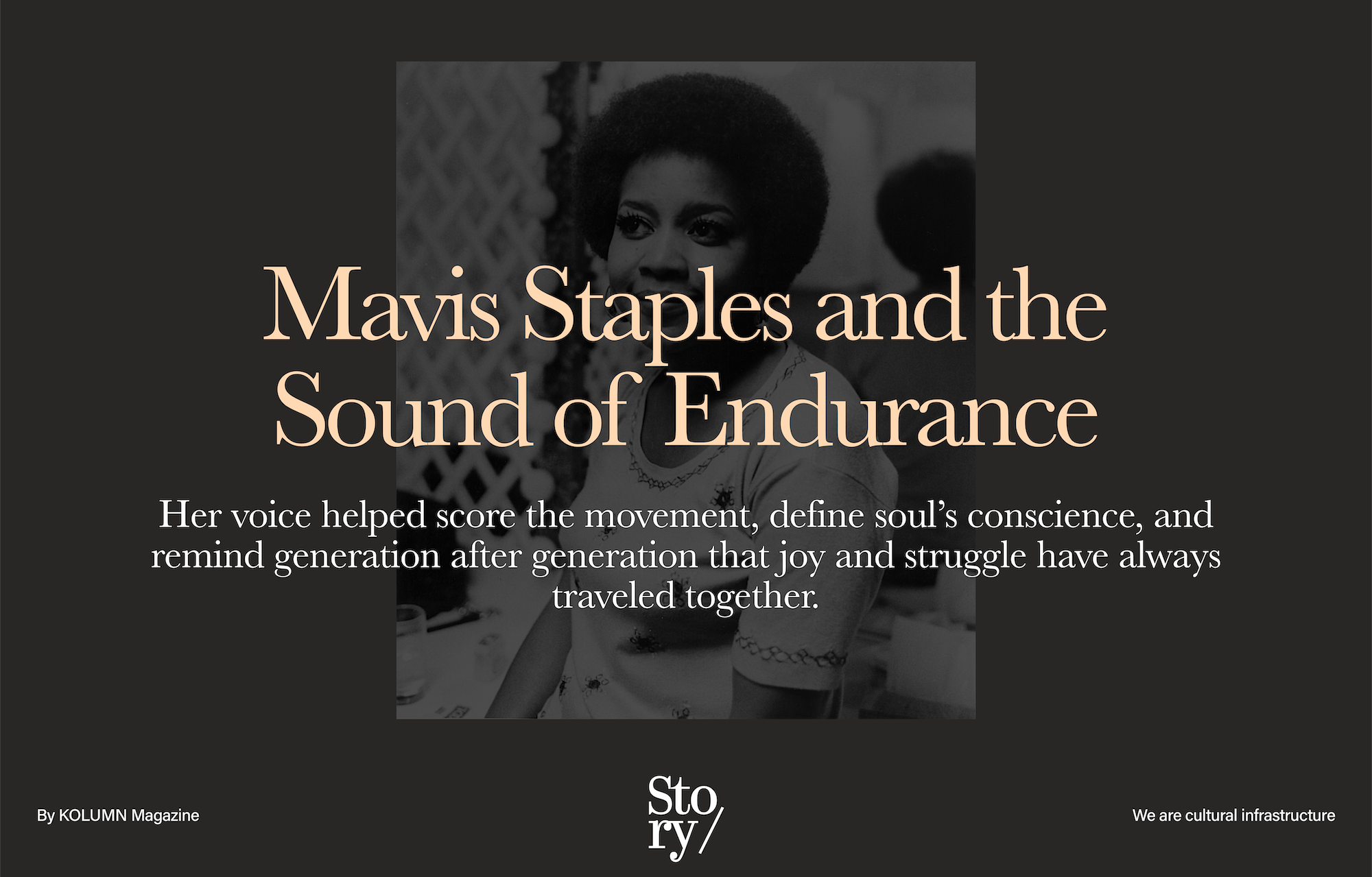
Mavis Staples is what happens when a great singer becomes more than a performer: she becomes a living archive of Black American struggle, faith, and creative survival.
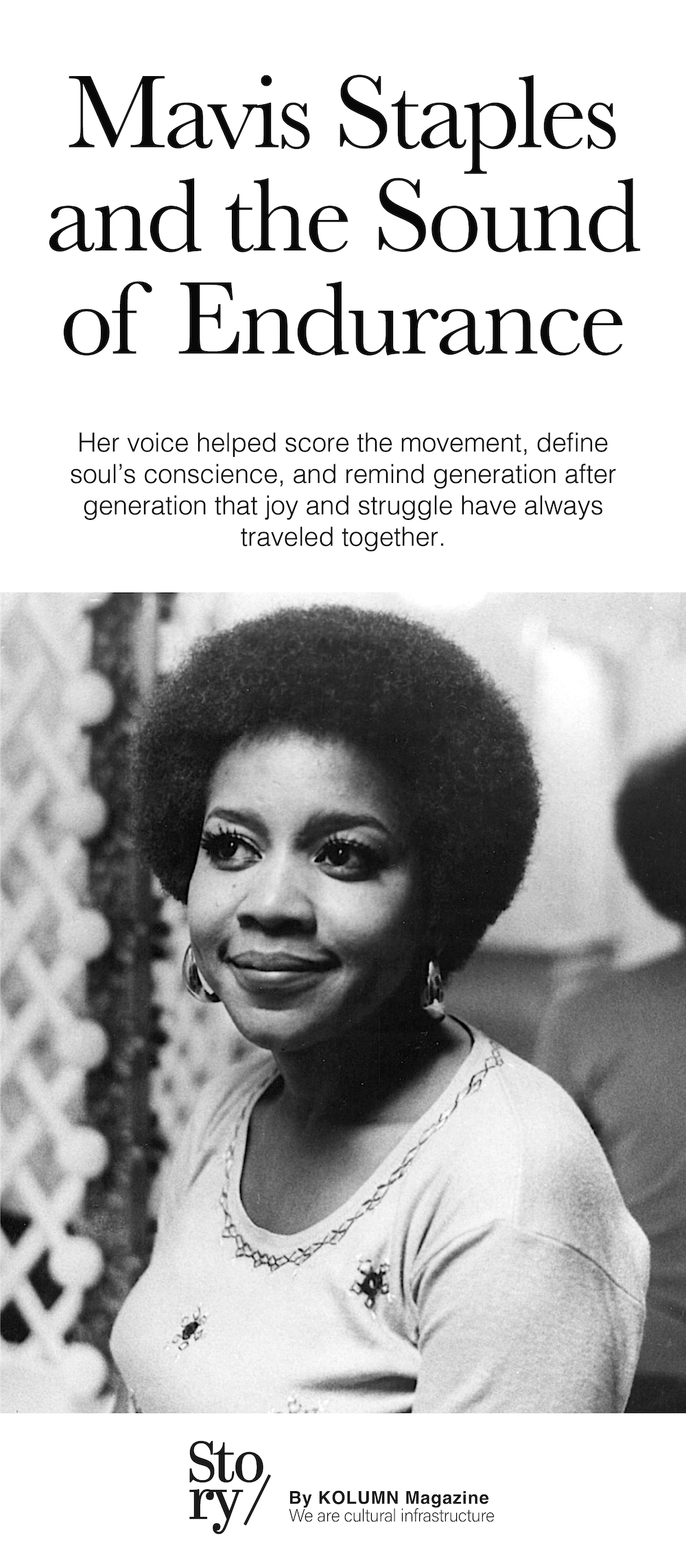
Mavis Staples is what happens when a great singer becomes more than a performer: she becomes a living archive of Black American struggle, faith, and creative survival.
By KOLUMN Magazine
There are singers who interpret songs, singers who dominate them, and then there are singers who seem to carry an entire historical tradition inside their voice. Mavis Staples belongs in that last category. Her contralto is one of the most recognizable instruments in American music: grainy, warm, amused, bruised, steady, sanctified without ever becoming precious. When she sings, you hear the Black church, Chicago gospel, Mississippi memory, civil-rights resolve, Stax soul, working-class endurance, and a stubborn kind of joy. You also hear something rarer than technique or style. You hear moral authority.
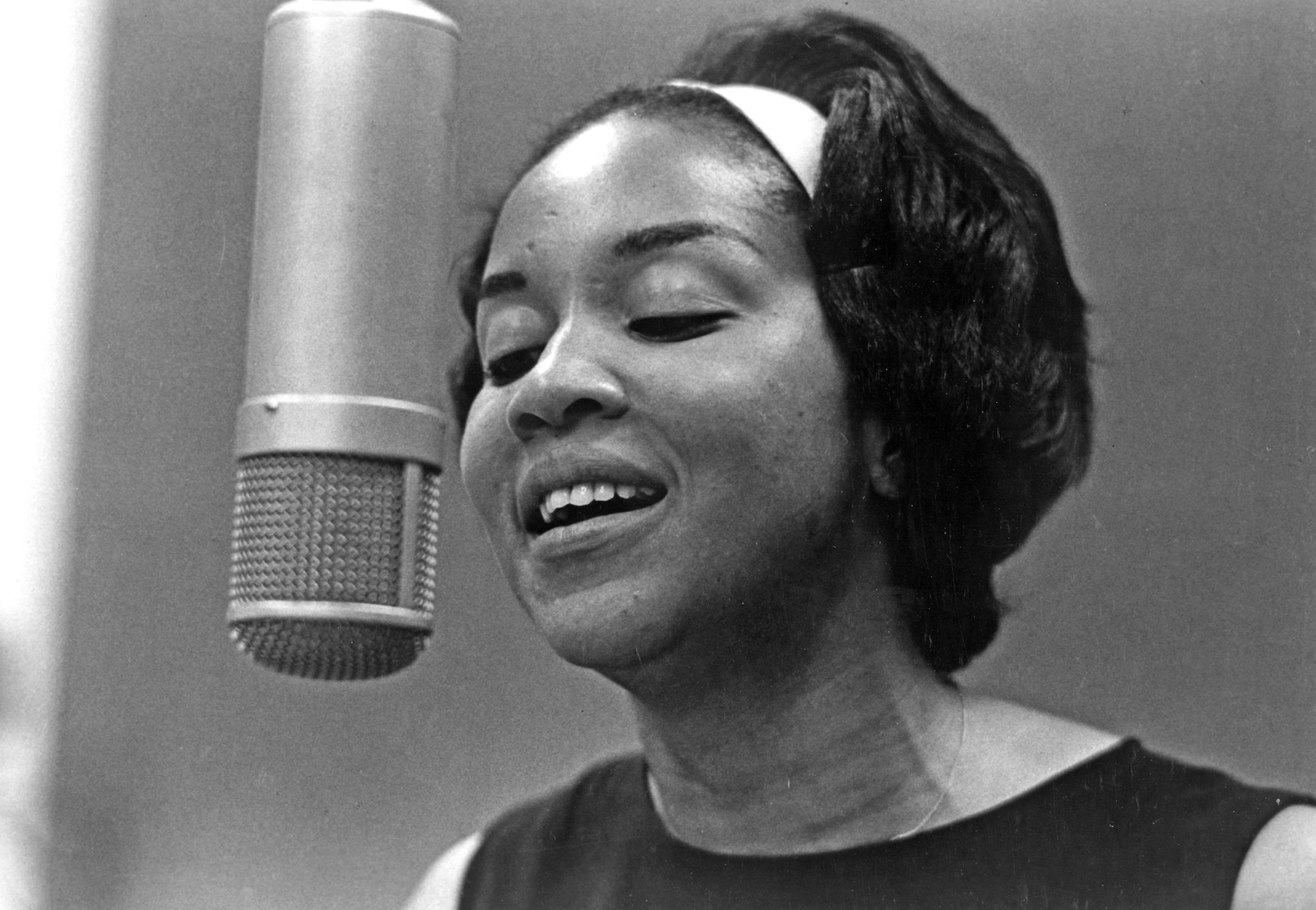
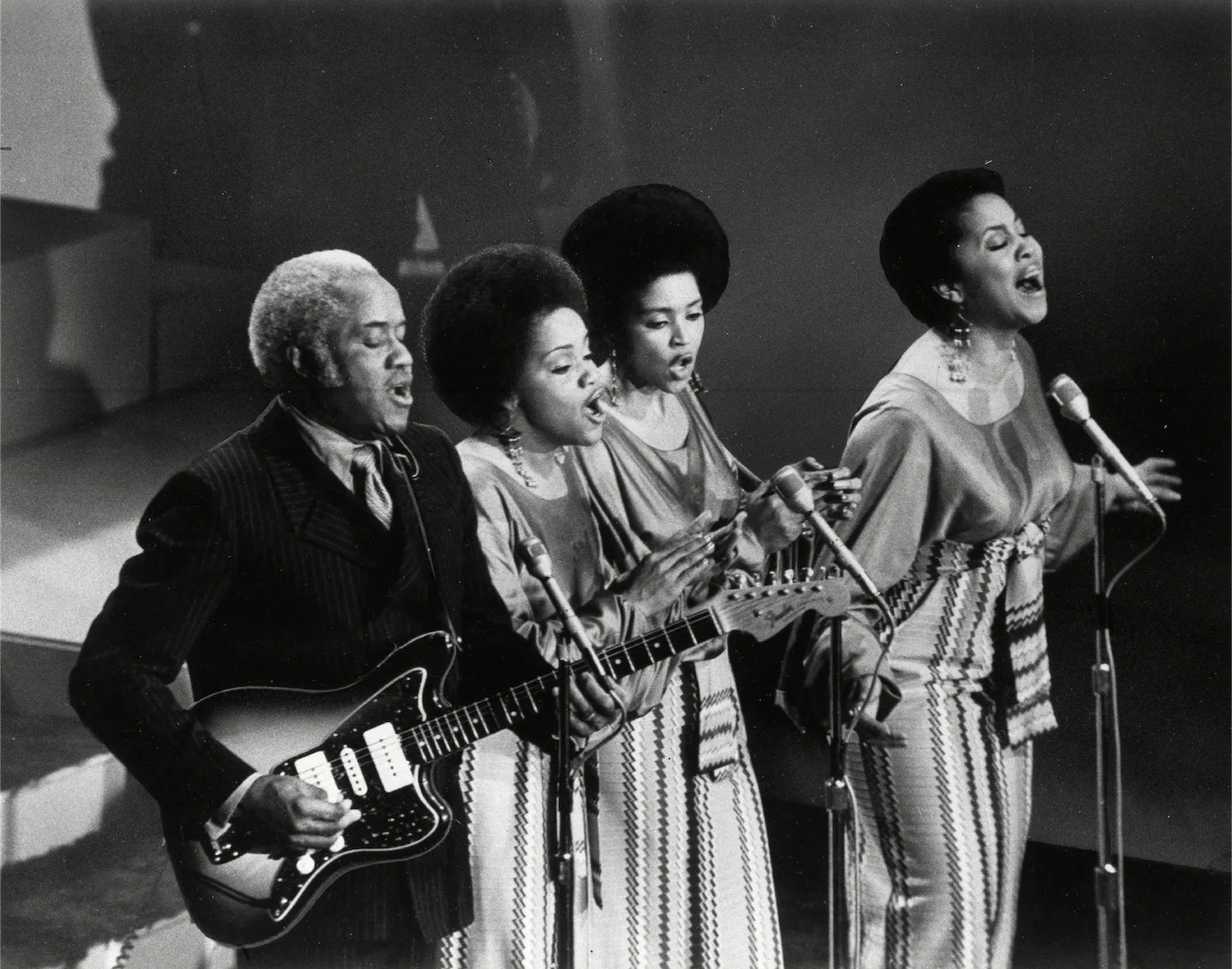
That authority was not manufactured by the music industry and it was not bestowed by critics after the fact. It was earned in churches, on Southern roads, in movement spaces, in recording studios, and across a performing life that began in the 1950s and, remarkably, is still active now. Staples first became known as the lead voice of the Staple Singers, the family group founded by her father, Roebuck “Pops” Staples, alongside siblings Cleotha, Pervis, and Yvonne. Over time, the Staples became one of the few acts in modern American music who could move from straight gospel to freedom songs to soul-pop hits without ever sounding like they had abandoned themselves in the process.
That is one reason Mavis Staples matters so much. She is not simply a singer with an extraordinary catalog. She is a connective figure. In her life and work, several major American stories meet: the Great Migration, the rise of recorded gospel, the Black freedom movement, the crossover years of soul music, the commercial tensions between sacred and secular art, and the late-career possibility of artistic renewal. Most legends become symbolic. Staples somehow remained practical. She kept singing, kept touring, kept collaborating, and kept insisting that music should still mean something.
A Chicago childhood, a Mississippi inheritance
Mavis Staples was born in Chicago in 1939, but her sound begins before Chicago. It begins in Mississippi, in the world that formed Pops Staples, whose experiences with Jim Crow, labor, religion, and danger would shape the emotional architecture of the Staple Singers’ music. The family’s migration north placed them inside one of the central demographic and cultural shifts of twentieth-century Black life. Chicago gave them urban opportunity, radio exposure, and access to a flourishing gospel culture. Mississippi gave them memory, gravity, and the knowledge that Black life in America was never just a regional story..
The Staples family started singing together when Mavis was young. Her father’s guitar lines did not sound exactly like church accompaniment; they carried the sting and minimalism of Delta blues, transformed through sanctified intention. That fusion became foundational. Long before “roots music” became a prestige term, the Staple Singers were already demonstrating how porous the categories were. Gospel, blues, folk, and soul were not separate boxes so much as neighboring dialects. Mavis’s voice sat at the center of that grammar, rough enough to suggest the blues, disciplined enough for gospel, direct enough for folk, and commanding enough for soul.
Early hits like “Uncloudy Day” established the group in gospel circles, but even then there was something unusual about the Staples. They were never flashy in the conventional way. Their power came from steadiness, from groove, from the sensation that conviction itself could swing. In later years, critics would rightly marvel at the group’s ability to sound both intimate and immense, familial and historical. But the roots of that power lay in the discipline of singing together as kin, with the sense that the music had a use beyond applause.
Chicago also mattered because it placed Staples in a Black cultural ecosystem that was not just musically rich but politically formative. The city’s churches, neighborhoods, and performance spaces helped shape a generation of artists whose work could not be cleanly separated from questions of race, citizenship, and public voice. Staples grew up in that atmosphere. She did not arrive at activism as an accessory to fame. The political stakes were embedded in the world that produced her.
“If he can preach it, we can sing it”
Any serious account of Mavis Staples has to reckon with the civil-rights movement not as backdrop, but as one of the central theaters of her artistic becoming. The Staple Singers became closely associated with Dr. Martin Luther King Jr. and with movement culture more broadly. Staples has repeatedly described the family’s early encounter with King in Montgomery in 1961, after Pops had heard him on the radio and wanted to meet the preacher whose message resonated so deeply with his own moral instincts. That meeting became transformative. As the family later framed it, if King could preach the message, they could sing it.
“Before Mavis Staples became an American legend, she became something harder to be: useful to a movement.”
This was not empty symbolism. The Staple Singers’ repertoire shifted in ways that made their political commitments audible. Songs like “Freedom Highway,” “Why? (Am I Treated So Bad),” “Long Walk to D.C.,” and “When Will We Be Paid” did not merely borrow movement language; they helped circulate it. The group’s music became part of the emotional infrastructure of the era. It did what great movement art does: it gave people language, rhythm, dignity, and stamina. It helped turn pain into collective motion.
There is a tendency in retrospective cultural writing to romanticize the relationship between music and protest, as if all politically adjacent songs automatically acquire depth. The Staples were different. Their work had depth because it came from proximity to the struggle and from lived exposure to racism on the road. They were not narrating a cause from a safe distance. They were singing out of a shared condition. That is one reason their best “message music,” as the family called it, still avoids the feeling of slogan. The songs are too grounded, too musical, too emotionally exact for that.
Staples herself has often recalled King not only as an icon but as a human presence, and one of her most memorable recollections centers on his laughter. That detail matters. It suggests the intimacy of movement culture and the way memory works for artists who lived history rather than inherited it secondhand. In Staples’s telling, the freedom struggle was not merely a tableau of speeches and martyrdom. It was also made of rooms, greetings, moods, friendships, fatigue, and faith. Her gift as a public figure has been to carry that human scale forward.
From gospel royalty to soul hitmakers
What the Staple Singers accomplished commercially in the late 1960s and early 1970s remains one of the more remarkable pivots in popular music. They did not simply “cross over.” Plenty of artists crossed over by sanding down their identities or by accepting the marketplace’s demand for dilution. The Staples managed something more difficult. They moved into secular soul and pop success while preserving the seriousness, restraint, and communal ethic that defined their gospel years.
Their move to Stax was crucial. In that environment, the family’s music found a new rhythmic and commercial setting, and Mavis Staples’s voice found a larger mainstream audience. Hits such as “Respect Yourself,” “I’ll Take You There,” “If You’re Ready (Come Go With Me),” and later “Let’s Do It Again” became durable entries in the American songbook. But they were not generic hits. “Respect Yourself” distilled ethical self-possession into radio-ready form. “I’ll Take You There” turned promise into groove. Even the most accessible Staples recordings retained an understructure of testimony.
This was where Mavis Staples became unavoidable as a singular star, even inside a family act. Her phrasing could be teasing one moment and near-apocalyptic the next. She did not oversing. She pressed meaning into syllables. On “I’ll Take You There,” she sounds like a guide. On “Respect Yourself,” she sounds like somebody who has already tested the principle in real life. Pop audiences heard a hitmaker. Other singers heard a master class in gravity.
The Rock & Roll Hall of Fame’s description of the Staple Singers as artists who delivered “music with a message” is accurate, but maybe still too tidy. The message was never the only thing. The miracle was the balance. The Staples were one of the few acts able to make social conscience feel pleasurable without trivializing either side of the equation. Their music could move bodies and sharpen minds at once. That is why the songs have lasted. They are not just documents of an era; they remain functional music for people trying to live with dignity.
Commercial success also widened the interpretive burden on Staples. As the most distinctive voice in the group, she became a vessel for the family’s values and its contradictions. The Staples had to negotiate the old sacred-secular debate, the demands of labels, the shifting tastes of Black radio, and the challenge of staying morally legible in a business built on novelty. Mavis learned how to carry all of that without sounding defensive. She sounded grounded. That grounding became one of her greatest artistic assets.
The solo artist in the shadow of the family legend
For all her fame, Mavis Staples’s solo career did not unfold in a simple upward arc. That part of the story matters, because it complicates the standard legend narrative. She released solo work as early as 1969, and she collaborated with major artists across decades, but for a long time the dominant public frame remained the Staple Singers. In another artist’s case, that might have become a trap: forever celebrated, never fully reintroduced. Staples lived inside that tension for years.
“What makes Mavis Staples extraordinary is not only that she endured. It is that, with age, her voice began to sound even more like history speaking in the first person.”
Part of the issue was structural. Family groups often produce an imbalance in public memory. Audiences remember the collective sound and the patriarchal story, then under-credit the specific labor of the singer who made the songs unforgettable. Part of it was also aesthetic timing. Staples’s strengths did not always align with the market’s dominant fashions. Her voice was too rooted, too textured, too adult to be easily slotted into every contemporary cycle. Yet those same qualities would later fuel one of the most admired late-career renaissances in modern American music.
That renaissance became visible after a difficult stretch following Pops Staples’s death. The Washington Post described her in 2016 as being in a late-career resurgence after depression and career malaise, a framing that captures something essential about the period: Staples did not simply age into reverence. She worked her way back into artistic centrality. The comeback was real, but it was never a nostalgic act. It depended on new collaborations, renewed critical attention, documentary treatment, and, most importantly, the discovery by younger musicians and listeners that her voice was not a relic but a living force.
If there is a through line in Staples’s solo work, it is her refusal to treat maturity as diminishment. Many singers lose range or sheen and retreat into symbolism. Staples converted age into interpretive power. The older she became, the more her voice seemed to gather weather, and the more those songs about struggle, mercy, memory, and insistence acquired weight. Her records stopped sounding like career continuations and started sounding like dispatches from a witness.
Prince, Bob Dylan, and the art of improbable collaboration
One of the pleasures of writing about Mavis Staples is seeing how many different corners of American music she connects. Bob Dylan admired her deeply; by Staples’s own later recollection, he even proposed marriage when they were young, though she turned him down because she felt she was too young to marry. The anecdote tends to circulate as charming legend, but it also says something larger: serious artists recognized her seriousness very early. Dylan did not gravitate to singers who merely sounded good. He was drawn to singers who seemed to carry an older truth.
Her work with Prince created a different kind of intrigue. On paper, Prince and Mavis Staples looked like an unlikely pairing: his sensual maximalism beside her rooted gospel-soul directness. In practice, the collaboration made sense because Prince revered tradition even when he was exploding it. He understood what Staples represented. She, in turn, brought substance and grain to his material. The result was not always commercially dominant, but it expanded the map of what a Mavis Staples solo record could be.
Then came Jeff Tweedy, whose partnership with Staples proved especially fruitful. Their 2010 album You Are Not Alone won a Grammy and helped launch the late-career chapter that younger listeners often know best. The Atlantic’s assessment of her Tweedy era was perceptive: Staples had not stopped singing about a better world, but she also had not stopped naming the political reality that made such songs necessary. That combination, idealism without denial, became one of the signatures of her later work. (The Atlantic)
Tweedy seemed to understand that the task was not to modernize Staples by disguising her roots. It was to build frames sturdy enough for her voice and worldview. On If All I Was Was Black, that approach reached perhaps its clearest statement. The songs addressed racial violence, empathy, exhaustion, and civic fracture without sacrificing groove or warmth. Staples did not posture as a nostalgic elder scolding the present. She sounded like someone who had seen a version of this before and refused both cynicism and sentimentality.
Her collaborator list now reads like a condensed history of postwar American popular music: Dylan, Prince, Ry Cooder, Jeff Tweedy, Hozier, Arcade Fire, Jon Batiste, and many others. On one level, this reflects reputation. On another, it reflects utility. Artists keep seeking Staples out because she brings more than prestige. She brings interpretive truth. She can make a song feel accountable.
The voice: force, intimacy, command
Critics sometimes struggle with singers like Staples because the available vocabulary for vocal beauty is often too clean. Her voice has never been conventionally delicate. It is textured, weathered, conversational in one register and commanding in another. It can sound like a moan, a warning, a prayer, a joke, or a hand on your shoulder. That roughness is not incidental. It is central to why the voice communicates trust. She sounds lived-in.
There is also an unusual tensile balance in her singing between intimacy and projection. Even on large stages, Staples can make a line feel as though it is being offered directly to one listener. Yet she never collapses into inwardness. Her singing remains public in the best sense: communal, invitational, aware of history beyond the self. This may be one of the clearest traces of the church tradition in her work. The voice is personal, but it is rarely private. It seeks response.
Another aspect of her greatness is timing. Staples understands where to place a word so that it lands with emotional and rhythmic consequence. This is especially evident in songs of exhortation. She does not just sing commands like “respect yourself” or promises like “I’ll take you there.” She inhabits them as speech acts. The line becomes a social force. That ability helps explain why so much of her catalog feels perpetually reusable by new generations facing old problems.
Her voice also carries gendered significance within Black musical history. Staples has often been grouped with powerhouse Black women vocalists, and rightly so, but her particular register of authority is distinct. She does not primarily perform glamour, heartbreak, or virtuosic flourish, though she can handle all three. Her default mode is steadier and more communal. She sounds like a woman who knows the room, knows the stakes, and has no interest in shrinking to fit expectation.
Faith without naïveté
The easiest mistake to make with Mavis Staples is to flatten her into an icon of uplift. She absolutely is an artist of uplift, but not because she denies catastrophe. Quite the opposite. The power of Staples’s music lies in how fully it acknowledges grief, cruelty, and fatigue without surrendering to them. This is where her grounding in gospel matters most. In the Black sacred tradition, hope is not mere optimism. It is discipline. It is a decision made under pressure. Staples sings hope that way.
That theological and emotional posture helps explain why her later political songs do not sound didactic. Even when she is explicit about injustice, there is room in the music for tenderness and human complexity. If All I Was Was Black was received in part as a response to the racial and political climate of the late 2010s, but the album’s deeper strength was that it refused to choose between clarity and compassion. The Atlantic aptly called it a revolution of compassion. That phrase gets at something crucial: Staples’s moral witness has always been inseparable from her insistence on human relation.
She has also been unusually effective at speaking across generations without sounding like she is trying to be generationally branded. Younger audiences hear authenticity in her because there is no visible calculation in the presentation. She is not retro; she is original. She does not chase relevance; she reveals how shallow the term can be when applied to artists whose work never stopped addressing the basic conditions of public life.
In that sense, Staples belongs to a tradition of Black artists whose faith is inseparable from social ethics. The songs are rarely just about heaven. They are about how to live, how to treat one another, how to keep walking, how to remain human in systems built to degrade. Even her most joyful performances carry that undertow. The joy is never frivolous. It is earned.
A late-career renaissance that became a second canon
By the time many artists enter their seventies and eighties, the terms of their public reception are mostly fixed. For Staples, those years opened rather than closed the field. The documentary Mavis!, critical reappraisals, new collaborations, festival appearances, and award recognition all helped recast her not simply as a surviving legend but as an actively evolving one. David Remnick’s New Yorker profile captured this beautifully, portraying a singer who, even after enormous loss, remained animated by joy, faith, and the necessity of song.
“Mavis Staples did not become relevant again. She revealed that she had never stopped being relevant at all.”
Institutional honors followed or caught up. The Staple Singers were inducted into the Rock & Roll Hall of Fame in 1999. The family received a Recording Academy Lifetime Achievement Award in 2005. Mavis Staples herself became a National Heritage Fellow through the National Endowment for the Arts, a recognition the agency describes as the nation’s highest honor in the folk and traditional arts. In 2016, she was named a Kennedy Center Honoree, one of the clearest signs that the American cultural establishment had finally acknowledged what audiences had known for decades.
And still the story did not freeze. According to the Recording Academy’s current artist page, Staples has 5 Grammy wins and 16 nominations through the 2026 awards, including two wins at the 68th Grammys for “Beautiful Strangers” and “Godspeed.” That level of continuing recognition matters less as trophy count than as proof that Staples remains artistically present, not simply historically revered. She is still making work that enters the conversation as new work.
Recent celebrations reinforce the point. Her 85th birthday was marked in 2024 with an all-star concert featuring artists including Hozier, Chris Stapleton, Jeff Tweedy, Norah Jones, Taj Mahal, and others, a lineup that effectively doubled as testimony to her cross-generational reach. Artists from rock, soul, folk, Americana, and roots traditions keep circling back to Staples because she represents not just influence but a standard.
Why Mavis Staples still matters now
It is tempting, especially in anniversary-minded culture, to discuss a figure like Mavis Staples in the past tense while politely noting that she is still with us. That would miss the point. Staples matters now because the contradictions she has spent a lifetime singing about are still with us now. Race and democracy, faith and public morality, joy and grief, memory and action, commerce and conscience: these are not resolved American themes. They remain live wires. Staples is one of the artists who can touch them without reducing them.
She also matters because she offers a model of artistic longevity that is not based on self-caricature. Staples has never needed to become a tribute act to her younger self. She can sing the old songs because she still believes them, and she can sing new ones because the world keeps producing reasons for them to exist. That is a profound difference. Longevity here is not maintenance. It is continued usefulness.
There is another layer too. In a fragmented media culture, where historical memory is often shallow and politics is often theatrical, Staples brings something stabilizing. She represents continuity without complacency. She does not let the audience forget that Black music has always been intellectually and morally serious, that entertainment and witness have long been intertwined, and that the American songbook is unimaginable without the Black sacred tradition that shaped her.
Her significance is therefore larger than genre. She is not just important to gospel, soul, Americana, or civil-rights memory, though she is essential to all of them. She is important to the question of what an American artist can be when popularity, principle, and spiritual discipline are allowed to coexist. That combination is rare enough in any era. In this one, it can feel almost radical.
The measure of the woman
Mavis Staples has now lived long enough to become, in effect, a custodian of several disappearing proximities. She knew the movement not as curriculum but as life. She knew the transition from gospel circuits to soul radio not as musicological narrative but as labor. She knew the family band form from the inside. She knew what it meant to be a Black woman carrying sacred inheritance through secular markets. And she has survived long enough to watch those histories be rediscovered, packaged, argued over, sampled, canonized, and sometimes misunderstood.
Yet if there is one striking thing about Staples in interview after interview, profile after profile, it is her lack of bitterness as a governing tone. Not innocence. Not passivity. Certainly not political quietism. But a refusal to let injury become her entire public language. That refusal may be one of her deepest artistic teachings. She has never denied the wound. She has simply declined to make the wound the only thing she sings from.
That is why her performances can feel both ancient and startlingly current. The technical facts of the career are already extraordinary: more than seven decades of work, foundational recordings with the Staple Singers, major solo albums, landmark collaborations, the highest levels of institutional recognition, and a catalog that moves from church pews to protest lines to festival stages. But the deeper measure is this: she has made a life in which artistic excellence and ethical seriousness did not have to cancel each other out.
In the end, Mavis Staples’s life and significance come down to something both simple and difficult. She kept the message intact while letting the music grow. She preserved history without embalming it. She found a way to sound like tradition and like presence at the same time. Plenty of artists leave behind hits. Fewer leave behind a method for living. Staples, through song, has offered both.
And that may be the clearest explanation for why she still lands with such force. When Mavis Staples sings, the past does not feel over. It feels summoned. The old freedom songs sound less like memorials than instructions. The soul hits recover their ethical backbone. The newer records remind listeners that tenderness is not weakness and endurance is not passivity. In a culture that often confuses loudness for conviction, Staples still sounds like the real thing: a witness, a worker, a believer, and one of the great American voices.
More great stories
Tomorrow Belongs to Us
April 5, 2026
No Comments
C.K. Steele and the Freedom Infrastructure of the South
April 5, 2026
No Comments