





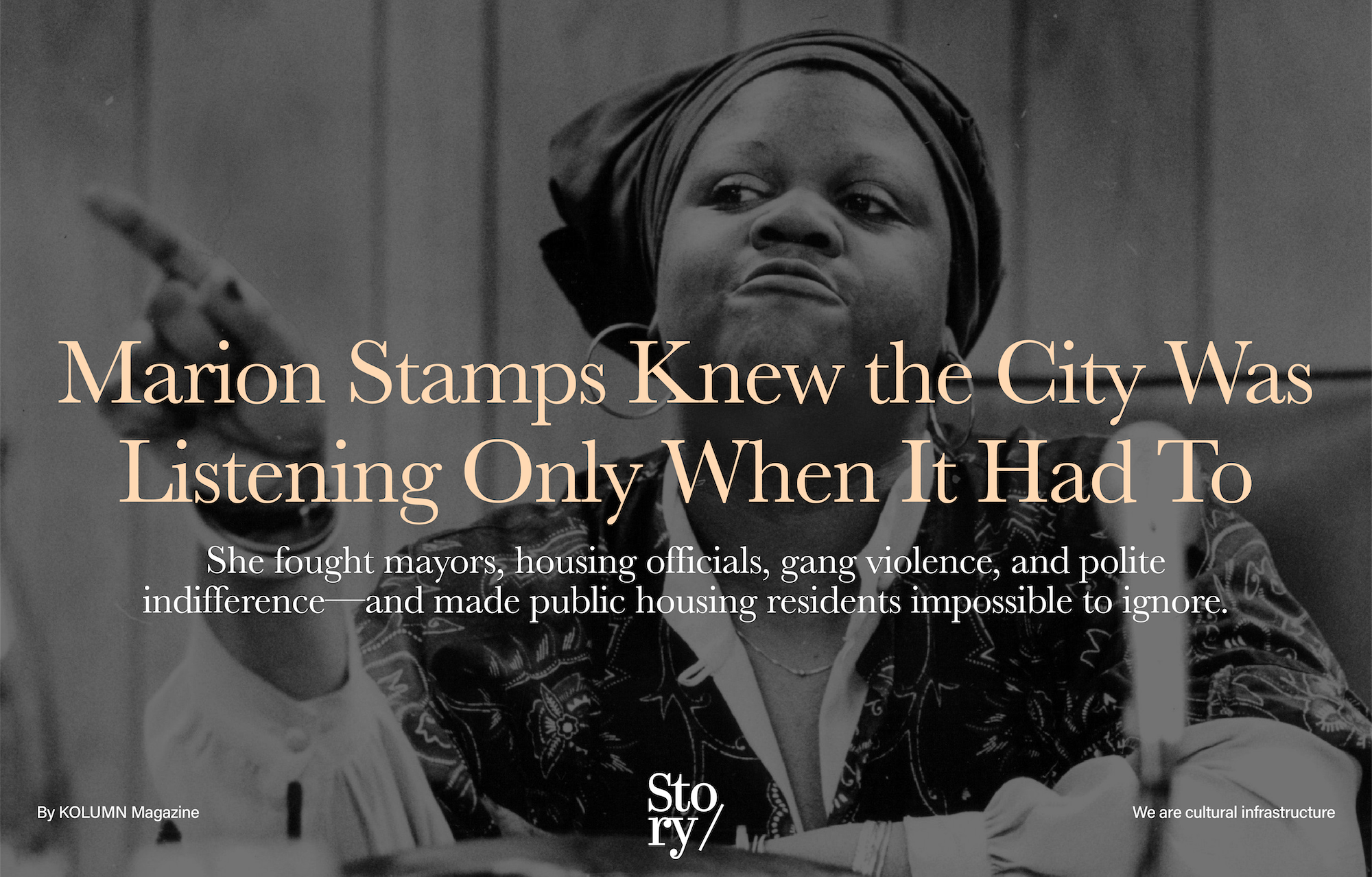
Marion Stamps understood that the fight over housing was never just about apartments. It was about who counted as fully human in the city.
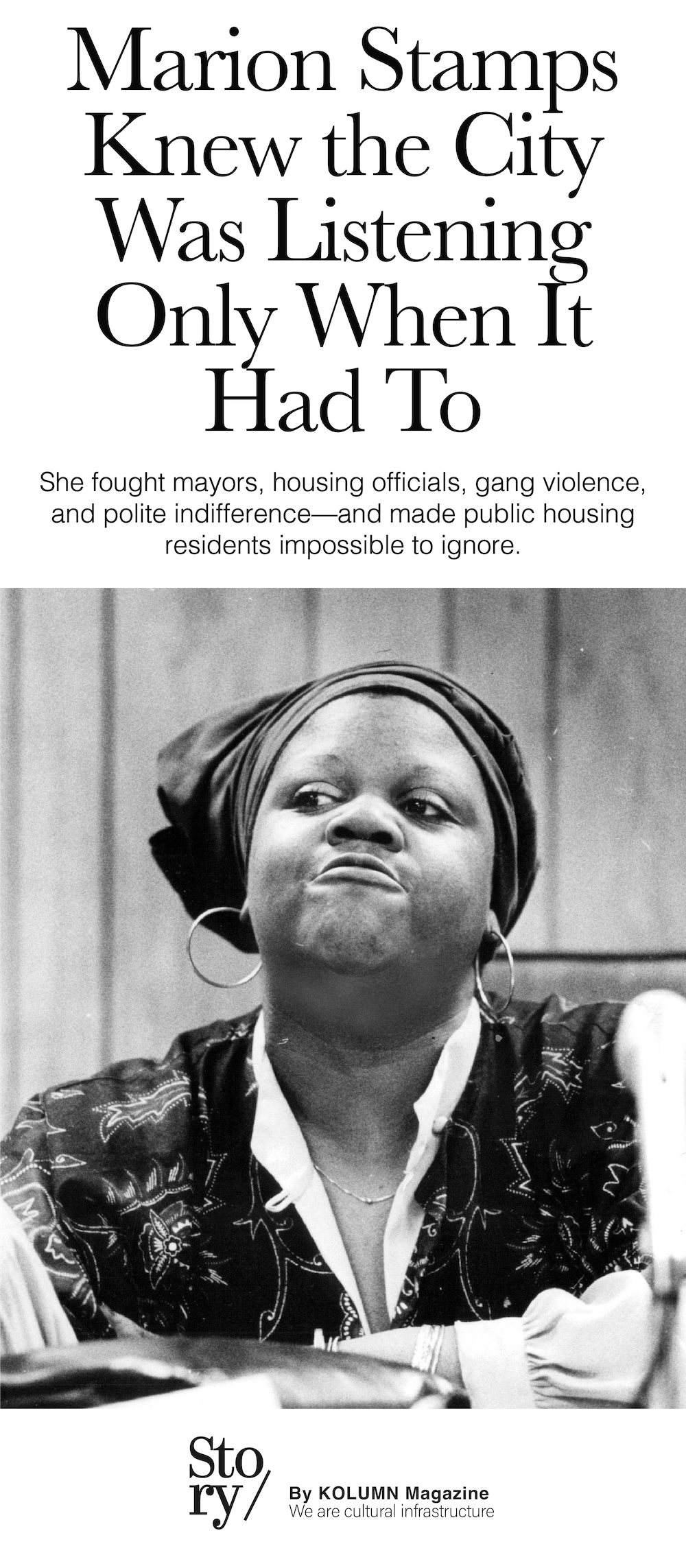
Marion Stamps understood that the fight over housing was never just about apartments. It was about who counted as fully human in the city.
By KOLUMN Magazine
There are some activists whose reputations settle into a tidy phrase after they die. They become “community leaders,” “civil rights veterans,” “advocates,” or “organizers,” titles broad enough to honor them while sanding away what made them dangerous. Marion Stamps does not fit neatly into that kind of memorial language. She was too disruptive, too confrontational, too rooted in the daily insult of American urban life to be remembered politely. In Chicago, and especially in the long shadow of Cabrini-Green, Stamps mattered because she refused the terms offered to poor Black residents: gratitude for neglect, patience in the face of degradation, and silence whenever power preferred a cleaner narrative. She was not merely an activist who lived in public housing. She was one of the people who insisted that public housing residents had political intelligence, institutional memory, and the right to fight back in full public view.
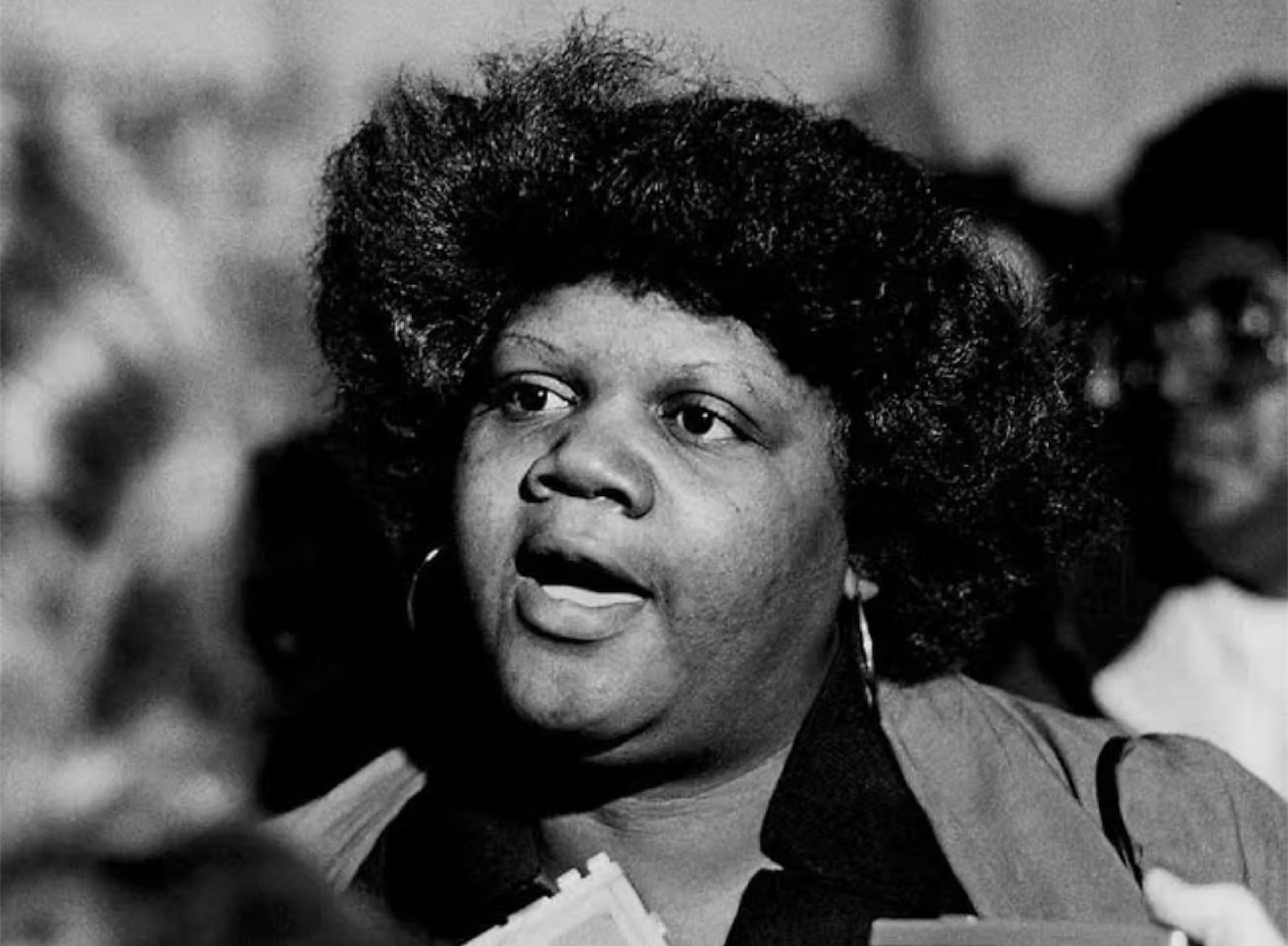
That insistence is a big part of why Marion Stamps still feels contemporary. Long before housing justice became a familiar phrase in philanthropy decks, campaign speeches, and urban-policy panels, Stamps understood that housing was never just about shelter. In Chicago, it was about race, surveillance, patronage, public disinvestment, policing, schooling, access to health, and the city’s endless habit of treating Black neighborhoods as places to be managed rather than communities to be governed with. Stamps moved through all of those arenas. She was a tenant leader, a movement organizer, a political actor, a critic of mayors, a defender of children, a public witness to state neglect, and, by many accounts, a woman so forceful that even those who disagreed with her had to organize around her presence.
To understand Marion Stamps, you have to begin with the fact that she did not come to politics as an abstraction. Chicago Magazine’s reporting on Cabrini-Green notes that she was born in Jackson, Mississippi, in 1945, picketed a segregated public library as a girl, and was trained as an organizer by Medgar Evers before moving to Chicago as a teenager. That trajectory matters. It placed her within a Black Southern freedom tradition before she ever became associated with the brutal urban politics of Chicago. Her later militancy did not materialize out of nowhere. It grew out of a childhood encounter with segregation in one of the most fiercely contested terrains of the civil rights era, then hardened in a Northern city that marketed itself as modern while maintaining old racial boundaries through housing policy, school policy, policing, and machine power.
From Mississippi to Cabrini-Green
When Stamps arrived in Chicago, she entered a city that loved to congratulate itself for not being the South. But Black Chicagoans knew better. By the time she came north, residential segregation had already been engineered through public policy and private terror alike. Public housing became one of the city’s most visible instruments of containment: a way to warehouse Black families, concentrate poverty, and preserve racial boundaries while describing the arrangement as administrative necessity. WTTW’s historical account of Cabrini-Green notes that the Chicago Housing Authority had been found liable in 1969 for racially discriminatory practices, and that by the Byrne era the development had become a symbol not only of concentrated deprivation but of official indifference.
For Stamps, though, Cabrini-Green was not just a symbol. It was home, and that distinction is everything. Chicago Magazine reported that when she got an apartment there in the mid-1960s, she described public housing as “a godsend” compared with the slum housing she had known before. That is one of the crucial truths often lost in popular memory: residents did not experience public housing only as dystopia. They also experienced it as refuge, community, and material improvement over private-market exploitation. Stamps understood both realities at once. Cabrini-Green could be a place of possibility and a place of brutal neglect. That dual understanding made her a sharper critic than outsiders who saw only pathology or politicians who saw only optics.
She became one of the founding figures of the Chicago Housing Tenants Organization, and that role placed her at the center of a broader argument about who had the authority to interpret public housing life. PBS’s Eyes on the Prize materials identify Stamps as director of the Chicago Housing Tenants Organization and a resident of Cabrini-Green who later ran for alderman to spotlight housing issues. WBEZ would later describe her as one of the organization’s founding members. In other words, Stamps was not simply reacting to conditions. She was building institutional forms through which residents could advocate for themselves, challenge city agencies, and translate daily grievance into collective leverage.
That work is part of what made her politically inconvenient. The city had long preferred versions of Black civic participation that were legible to power: pastors who could negotiate quietly, precinct operatives who could deliver votes, appointed intermediaries who would absorb anger and redirect it into procedure. Stamps did something rougher and more democratic. She amplified resident fury. According to the Eyes on the Prize interview archive, she described the core responsibility of the Chicago Housing Tenants Organization this way: to act as advocates for tenants in public housing. It sounds straightforward, but in the Chicago of the 1970s and 1980s, advocacy from below could look a lot like insubordination.
A Politics That Didn’t Ask Permission
One reason Marion Stamps continues to resonate is that she embodied a strand of Black political life often flattened in mainstream retellings. She was connected to the civil rights tradition, but she was also shaped by Black Power. Search records from the Washington University archive for Eyes on the Prize II describe her interview as centering on the Black Panther Party in Chicago, the murder of Fred Hampton, and public housing activism. A Brandeis thesis on Black Power politics similarly describes Stamps as both a housing-rights organizer and a Black Panther, arguing that her life illustrated what Black Power activists could do in community campaigns and electoral politics.
That combination matters because Stamps was not a neat fit for the tired binary between “civil rights” respectability and “Black Power” militancy. Her politics braided together tenant organizing, anti-racist critique, electoral work, and self-determination. She was willing to work inside campaigns when it served her community. She was also fully prepared to denounce public officials in language that made them—and polite liberals around them—deeply uncomfortable. She was interested in results, not in performing moderation for elite approval.
This is part of why her voice carried so far in Chicago. Dr. Conrad Worrill, writing in the Chicago Crusader, remembered her as an “In-Your-Face Activist,” a phrase that is admiring but also analytically useful. Stamps did not confuse access with power. She knew that city officials often listened only when made to. Her style was confrontational because the structure she confronted was indifferent by design. In that sense, her political temperament was not excessive. It was proportional to the violence of the conditions she was fighting.
That confrontationalism could make her polarizing, and it is worth saying plainly that not everyone liked how she operated. But likability is a poor measure of movement importance. Stamps’s significance lies partly in the way she disrupted the city’s preferred emotional order. Public housing residents were expected to endure, mourn, plead, or disappear. Stamps argued, yelled, organized, embarrassed officials, and pushed residents toward collective action. She helped make public housing not just a social-service issue but a political crisis.
The Jane Byrne Moment
If Marion Stamps is remembered nationally at all, it is often through the story of Jane Byrne’s notorious move into Cabrini-Green in 1981. Byrne’s three-week stay has entered Chicago folklore as a bizarre mix of spectacle, opportunism, and temporary service delivery. WTTW’s historical account says Byrne and her husband moved into Cabrini on March 31, 1981, drawing national attention while workers fixed elevators, cleaned trash, and temporarily tamped down violence. Chicago Magazine’s richly reported reconstruction adds what many residents already knew: once the mayor arrived, city services suddenly materialized in abundance—repairs, cleanup, security, programming—precisely because power had physically entered the space.
That contradiction was tailor-made for Marion Stamps. If Byrne’s move was meant to showcase empathy and decisiveness, Stamps made sure the public also saw the performance underneath it. Chicago Magazine identifies Stamps as one of Byrne’s fiercest critics during the episode, noting her leadership, her relationships with families across Cabrini, and her refusal to accept the mayor’s visit as benevolence. WTTW records that while some observers called Byrne’s move bold, others saw it as a gimmick. Stamps belonged firmly to the second camp. She recognized that temporary attention, even when materially useful in the short term, could also normalize the underlying scandal: that basic city responsiveness was being treated like a special event.
The Easter protest during Byrne’s stay remains one of the clearest windows into Stamps’s political method. Chicago Magazine recounts the mayor’s “Spiritual Easter Celebration” as a heavily staged event full of games, celebrities, religious imagery, and hopeful messaging. Stamps and other protesters responded with a message much less marketable and much more exact: “We need jobs, not eggs.” It was a line sharp enough to survive decades because it captured what Byrne’s spectacle could not. Residents did not need a symbolic visit, a festival, or a burst of cameras. They needed structural investment, jobs, services, and an end to being governed theatrically.
What made Stamps so effective in that moment was her refusal to let the city narrate Cabrini-Green as a passive backdrop for mayoral courage. She treated the mayor’s presence as an opportunity for exposure. If paint appeared only when Byrne moved in, that said something. If evictions accelerated under the glare of law-and-order politics, that said something too. Chicago Magazine reports that Stamps’s organization counseled dozens of residents who were evicted during the Byrne episode and helped reverse nearly all of those cases. That is a crucial detail. Stamps was not just denouncing symbolism; she was also doing the patient work of defense, paperwork, pressure, and case-by-case intervention that made denunciation credible.
She did not let the city turn Cabrini-Green into a stage set for political redemption.
The Byrne episode also clarified something larger about Marion Stamps’s politics: she would not permit Black suffering to be rebranded as white civic bravery. Chicago Magazine reports that she explicitly rejected the idea of Byrne as a “white savior.” That phrase still lands because it names a recurrent American pattern: institutions neglect Black communities, then celebrate themselves for temporarily noticing them. Stamps had no patience for that cycle. She wanted the city judged not by gestures but by whether residents could live in safety, dignity, and self-determination after the cameras left.
Housing as a Base of Power
One of the easiest mistakes to make about Marion Stamps is to think of her as only a neighborhood fighter, as if Cabrini-Green were the full horizon of her politics. In fact, her work radiated outward. The Chicago Sun-Times reported in 2018 that an item displayed by the National Public Housing Museum—a leather motorcycle jacket owned by Stamps—helped tell the story of a woman who lived in Cabrini-Green for decades and helped organize what the paper called the first and only successful nationwide rent strike against the U.S. Department of Housing and Urban Development. Bloomberg, writing in 2025 about the museum’s opening exhibits, likewise described Stamps as a Cabrini resident who negotiated gang truces and led a rent strike against HUD.
That detail should complicate any provincial reading of her life. Stamps was deeply local, but she was not parochial. She understood that the crisis in Chicago public housing connected to federal housing policy, urban disinvestment, and national patterns of racialized neglect. Her organizing demonstrated a core principle of Black urban politics: the neighborhood is often the place where national structures become impossible to ignore. Stamps fought locally because that is where people were living and dying, but the systems she confronted were much larger than any one development.
This is also why public memory about Stamps should not stop with the imagery of protest. She was a strategist of resident power. Tenant organizations, rent strikes, public forums, confrontations at housing meetings, campaigns over schools, resistance to displacement—these were not isolated episodes. They were parts of an infrastructure of survival and influence. The Chicago History Museum’s image archive includes a photograph of Stamps speaking with other community leaders at a public forum about Chicago Housing Authority plans. Even in that small archival trace, you can see the deeper pattern: she kept showing up at the sites where bureaucratic decisions translated into lived consequences.
Her advocacy also moved through institutions that do not always get centered in simplified activist biographies. Chicago Magazine notes that she pushed for a new school in the community, one she helped get named for Sojourner Truth, and that she ran a program for expectant mothers in a place where infant mortality rates were alarmingly high. These details matter because they reveal a politics wider than protest choreography. Stamps was fighting the conditions under which Black family life was devalued—education, maternal health, youth support, neighborhood investment—while also contesting the terms of public representation.
Harold Washington and Black Electoral Power
Marion Stamps was also part of one of the most important political transformations in modern Chicago: the rise of Harold Washington. Multiple sources credit her with helping mobilize residents around Washington’s 1983 mayoral campaign. Public summaries of her life describe her as organizing a major voter-registration drive that helped elect Chicago’s first Black mayor, and the Chicago Public Library’s Harold Washington archive underscores how central voter-registration work was to the campaign’s records and strategy. For Stamps, electoral politics was not separate from housing politics. It was one more arena in which poor and working-class Black Chicagoans could convert presence into leverage.
This is one of the more revealing aspects of her career. Activists are often sorted into rigid categories: street organizers over here, campaign people over there. Stamps moved between them. A Brandeis study on Black Power’s rise in Chicago explicitly argues that her life showed what that political tradition could do for campaigns and politicians, and that she later tried to convert her own community experience into a run for office. That framing is useful because it places Stamps inside a broader Black political ecosystem rather than outside it as a perpetual dissenter. She could challenge power and build it. She could support a mayoral insurgency and still hold city hall accountable afterward.
PBS’s materials on civil rights groups in Chicago also place her alongside Lu Palmer as one of the key activists aiming to change the conditions of Black life in the city’s public housing landscape. That pairing is telling. It suggests that Stamps was not a peripheral footnote to Chicago’s Black political ascent. She was in the thick of a movement trying to convert Black demographic presence into governing influence. And because she came out of public housing organizing, she carried into that project the uncompromising knowledge that symbolic Black representation without material change would never be enough.
That helps explain why her relationship to public officials could be both collaborative and adversarial. She was not anti-politics. She was anti-empty politics. If electoral victories did not improve repairs, safety, schooling, or resident voice, she would say so. If a politician earned support and then failed to respect the community, she would say that too. It was a harder line than the one many machine cities reward. It also made her more durable as a moral force.
Violence, Truce, and the Refusal of Simplistic Narratives
Marion Stamps’s later work around violence is one of the most striking—and still underappreciated—parts of her legacy. Public accounts of her life note that in the early 1990s she began working with gang leaders to try to reduce escalating violence in Chicago. Bloomberg’s 2025 account of the National Public Housing Museum described her as someone who negotiated gang truces, while other public summaries of her career state that she helped navigate what remains the only citywide gang truce in Chicago’s history. Even if the full details of that truce deserve more archival excavation than they usually receive, the broad outline is clear: Stamps was willing to engage actors whom mainstream politics preferred either to demonize or exploit.
Stamps never confused moral clarity with social distance. She could name harm without abandoning the people living inside it.
That choice was consistent with the rest of her politics. Stamps did not romanticize violence. Chicago Magazine records that she condemned the “street organizations” that sold drugs to children and coerced youth into gang life. But she also understood that simply condemning young Black men in abandoned neighborhoods solved nothing. The city had already tried punishment, containment, and neglect. Her approach suggested a harder truth: if you want violence to end, you have to deal with the people inside it, the conditions producing it, and the institutions profiting from it.
This, too, is part of what made her politically unusual. Stamps was not interested in innocence politics—the demand that Black communities present themselves as pure victims in order to deserve relief. She knew communities contained contradiction, pain, danger, and damaged people trying to survive. Her politics were not sentimental. They were relational. She built authority in part because people knew she understood the neighborhood as it actually was, not as foundations, newspapers, or city agencies wanted it described.
Running for Office, Then Staying in the Fight
By the mid-1990s, Stamps’s political life had expanded enough that she sought elected office herself. Public summaries and scholarship note that she ran for alderman in Chicago’s 27th Ward in 1995, losing to Walter Burnett Jr. The Brandeis thesis on Black Power politics uses that campaign to illustrate how Stamps tried to turn years of grassroots organizing into formal political power. That she lost does not diminish the significance of the run. In some ways it clarifies her legacy. Stamps was never just trying to pressure politicians from the outside. She was also testing whether a resident-organizer from public housing could force the city to take a different kind of leadership seriously.
And even in defeat, she did not disappear. Accounts of her life emphasize that she continued fighting on behalf of tenants and residents. The common obituary frame around her—visible in later tributes and public summaries—is that she kept advocating for others even after moving out of Chicago Housing Authority housing. That continuity matters. Stamps was not a single-issue figure bound only to one address. Cabrini-Green shaped her politics, but her politics were always about a broader public: poor Black Chicagoans, housing residents, families facing displacement, children inheriting the consequences of decisions made far above them.
She died on August 28, 1996, at age 52. The Chicago Crusader later marked that date as a tremendous loss, and public accounts note that she had lived for years with a heart condition. The age is hard to ignore. Fifty-two is old enough to have built a serious body of work and young enough that the sense of interruption remains acute. One cannot read her story without wondering what she might have done in the years of CHA demolition, mixed-income redevelopment rhetoric, voucher displacement, neoliberal urban branding, and post-1990s policing politics that followed. She died before many of Chicago’s most dramatic redevelopment battles fully matured, but not before identifying the logics driving them.
Why Marion Stamps Still Matters
Marion Stamps matters now because so many of the questions she fought over remain unresolved. Who gets to stay in the city? Who receives investment only after attracting elite attention? Who is portrayed as the problem when institutions fail? What counts as civic leadership when the people most affected by policy are the least listened to? Her life sits at the intersection of all those questions. She understood that residents of public housing were routinely spoken about, researched, policed, relocated, and remembered—without being treated as authoritative witnesses to their own lives. Her activism was one long argument against that arrangement.
She also matters because she offers a corrective to the way Black women’s political labor is remembered. Men in berets, charismatic mayors, famous ministers, and scandal-plagued machine bosses often dominate Chicago’s political mythology. But the city has also been shaped by women who built the connective tissue of movement life: tenant groups, school fights, registration drives, local institutions, public confrontations, emergency coalitions, care networks, and the everyday insistence that the city answer for what it had done. Stamps belongs in that lineage. A 2023 study of Black women’s activism in Chicago describes her as exemplifying forms of community bridge leadership and indigenous leadership. That language may be academic, but the point is simple: she was trusted because she came from the people she fought for, not because she was assigned to speak on their behalf.
And then there is the question of memory itself. The National Public Housing Museum’s use of Stamps’s clothing and story is fitting because her life forces a confrontation with what public housing memory should be. Too often Cabrini-Green is recalled in one of two flattened forms: either as a shorthand for urban crisis or as a nostalgic symbol emptied of conflict. Stamps disrupts both versions. She reminds us that public housing was a site of state abandonment and of Black political creation; a place of danger and of community; a terrain where residents suffered, organized, laughed, raised children, buried loved ones, fought city hall, and tried to imagine futures wider than the ones planned for them.
In the end, Marion Stamps’s life resists tidy closure because she never offered the city any. She did not perform uplift in a way that made power comfortable. She did not translate injustice into a language mild enough for everybody to applaud. She understood that being heard often required being disruptive, and that poor Black residents deserved not just sympathy but power. If Chicago has a habit of celebrating its insurgents only after they are gone, Stamps is a good test of whether the city means what it says. To honor her seriously is not just to praise her courage. It is to revisit the structures she named—housing inequality, racial containment, political spectacle, displacement, punitive governance—and admit how much of her indictment still stands.
Marion Stamps was never interested in becoming a sanitized monument. She was interested in making people move. That is why her legacy has endured in daughters, organizers, museum exhibits, school histories, archives, and neighborhood memory. The point of remembering her is not nostalgia. It is instruction. She teaches, still, that a city does not become just because it speaks the language of reform. It becomes just when the people it once treated as disposable can force it to answer back.
More great stories
Mavis Staples and the Sound of Endurance
April 5, 2026
No Comments
Tomorrow Belongs to Us
April 5, 2026
No Comments