




Nothing could stop the people.
Nothing could stop the people.
By KOLUMN Magazine
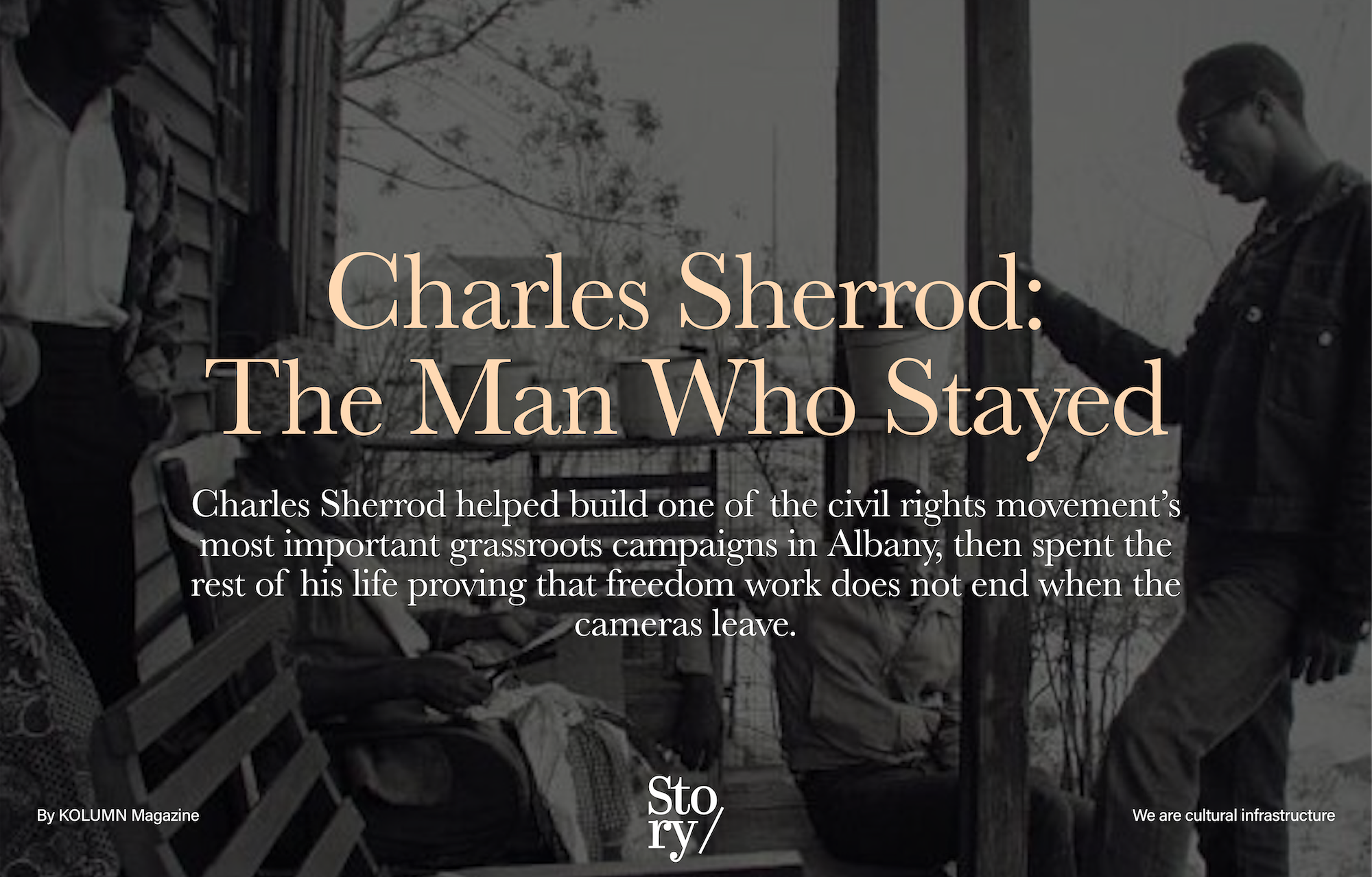
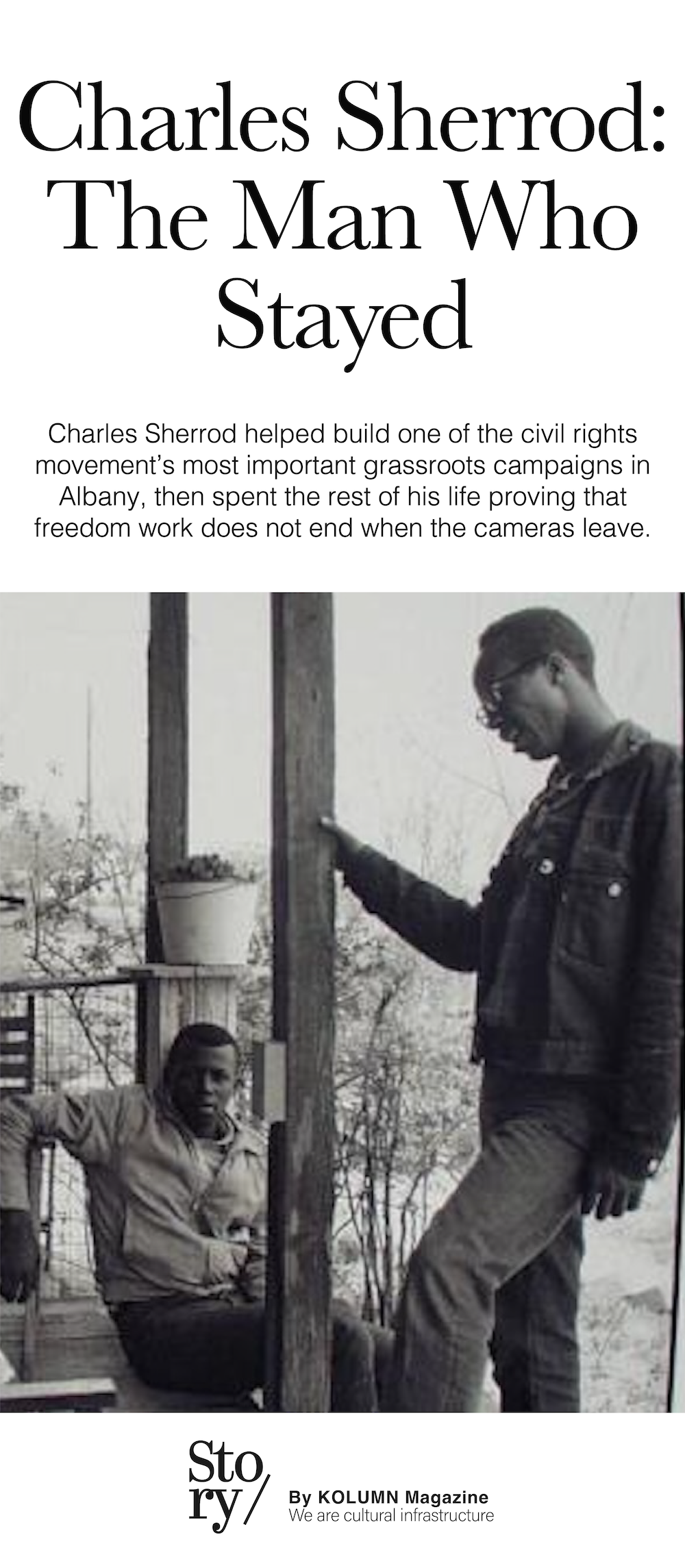
Most Americans know the civil rights movement through a familiar cast of giants and flashpoints. They know the soaring cadences of Martin Luther King Jr., the ferocity of Birmingham, the bridge at Selma, the lunch counters in Greensboro. Charles Sherrod fits inside that history, but not neatly. He was there in the movement’s student insurgency, in the theology of nonviolence, in the tactical innovation of “jail, no bail,” in the rural voter-registration drives that made democracy concrete, and in Albany, Georgia, where one of the era’s most debated campaigns unfolded. Yet the real measure of Sherrod’s significance is not that he participated in famous moments. It is that he kept working after the famous moments passed.
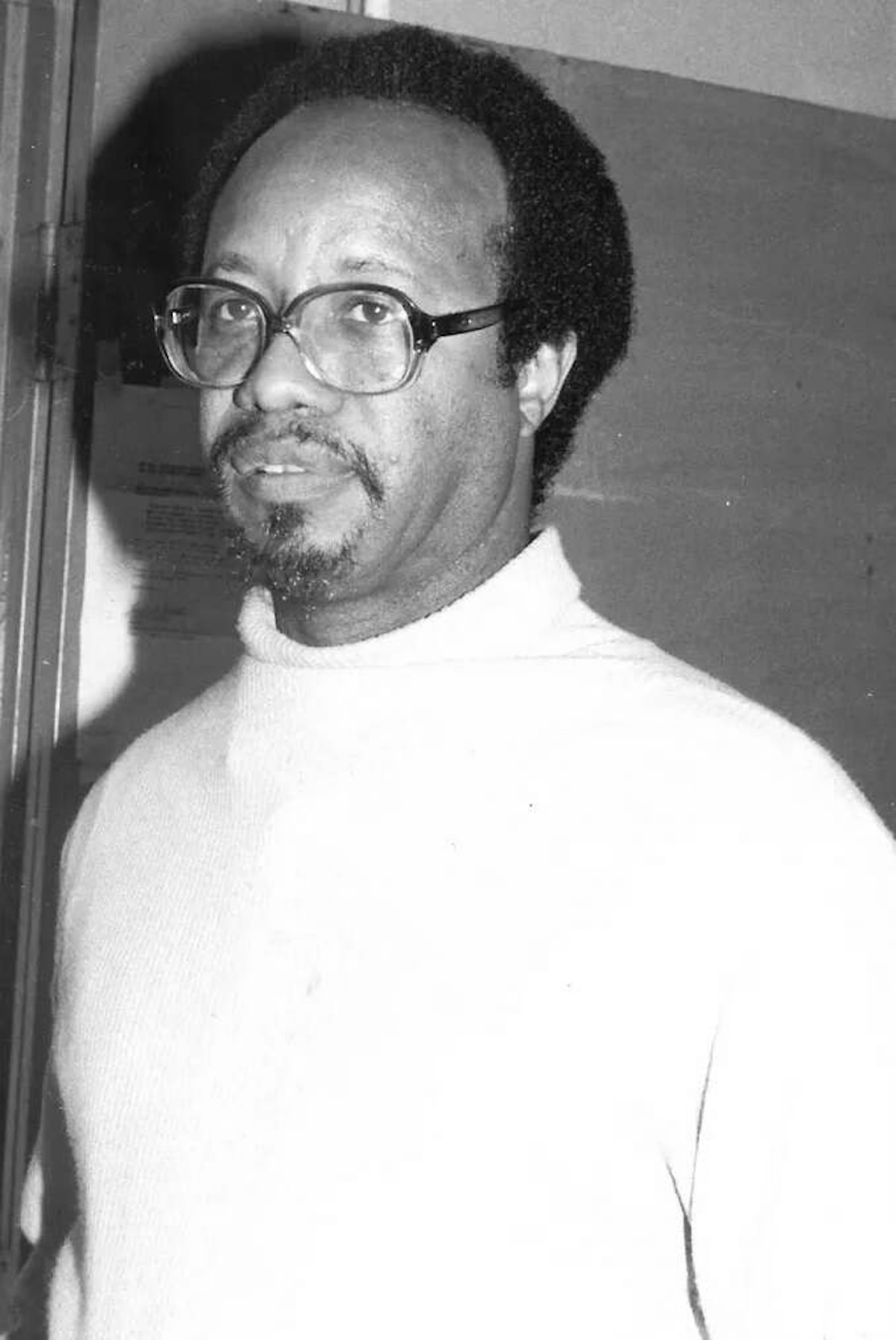
That is what makes Charles Sherrod so essential, and so easy to understate. He belongs to the class of civil rights leaders whose names do not always appear first in textbook shorthand but whose labor made the movement durable. He was a preacher with an organizer’s patience, a strategist with a moral vocabulary, and a local institution-builder who understood that desegregation alone would never be enough. Voting rights mattered. Land mattered. Schools mattered. Local government mattered. The long arc of Sherrod’s career suggests a broader, richer definition of activism than the one Americans often inherit from black-and-white photographs.
Sherrod died on October 11, 2022, at his home in Albany, the southwest Georgia city where he had spent more than sixty years working for Black political power, economic independence, and interracial democracy. By then he had been a founding SNCC activist, the organization’s first full-time field secretary, a leading figure in the Albany Movement, a co-founder of the Southwest Georgia Project, a driving force behind New Communities, and one of Albany’s first Black city commissioners. The breadth of that record matters because it reveals a man who did not treat the movement as a season of youth, but as a way of life.
A preacher before he was an organizer
Sherrod’s public life made more sense because of his private formation. He was born on January 2, 1937, in Surry, Virginia, and raised primarily in Petersburg by his grandmother in a deeply religious environment that centered church life, song, scripture, and communal obligation. PBS’s This Far by Faith notes that he grew up singing in the choir, attending Sunday school, and even preaching to other children. Ansley Quiros, writing in The Washington Post, describes him as someone who developed “a deep faith in God and a precocious theological imagination” early in life. That language is useful, because Sherrod was not merely a religious man who later became political. His politics emerged from his theology.
He also learned the grammar of American racism young. PBS recounts a searing childhood memory: at age two, he was pulled from the front seat of a bus to the back. Quiros reports that he came of age amid poverty and the daily humiliations of Jim Crow, even as he excelled in school, serving as student body president and chaplain at the all-Black Peabody High School. These biographical details are not ornamental. They help explain both his seriousness and his stubbornness. Sherrod’s later activism had a pastoral cast to it, but it was never soft. It was forged in places where the law was selective and Black dignity was meant to be conditional.
At Virginia Union University, where he studied sociology and religion, that moral seriousness became action. SNCC Digital notes that he joined local sit-ins at department stores in Richmond while still a student. PBS records that he had earlier taken part in a 1954 challenge to segregation in white churches, years before the sit-in movement would become nationally iconic. He was, in other words, already experimenting with embodied protest before the movement’s best-known cycle had fully crystallized. He was not waiting for history to call his number.
SNCC, Rock Hill, and the discipline of risk
In 1960, Sherrod attended the Shaw University gathering that led to the founding of the Student Nonviolent Coordinating Committee. SNCC appealed to him because it fused moral witness with grassroots action. The organization was less hierarchical than the better-known civil rights bodies and more willing to place its faith in local people, student initiative, and direct confrontation. Sherrod became one of the young organizers who gave that philosophy real shape. According to SNCC Digital, he became the group’s first full-time field secretary in June 1961.
Before that formal title, though, there was Rock Hill. In February 1961, after Black students in Rock Hill, South Carolina, were arrested during sit-ins, SNCC sent Sherrod, Diane Nash, Ruby Doris Smith, and Charles Jones to join the demonstrations. Stanford’s King Institute notes that Martin Luther King Jr. wrote to Nash and Sherrod after their arrests, praising their decision to remain in jail. SNCC Digital and PBS both identify Sherrod as an early practitioner of the “jail, no bail” strategy, in which demonstrators refused to pay fines and instead served time to dramatize the injustice of segregation and refuse financial cooperation with it.
That tactic can sound almost ceremonial in retrospect. It was not. Going to jail in the Jim Crow South was a wager with one’s body. It involved beatings, chain gangs, humiliation, and the constant possibility of escalation. But “jail, no bail” also showed something fundamental about Sherrod. He believed that courage had to be organized. He was not interested in suffering for suffering’s sake. He was interested in turning moral witness into leverage. The student movement was trying to convert the daily brutalities of segregation into a crisis the nation could no longer politely ignore, and Sherrod understood that such conversion required disciplined risk, not just noble feeling.
The King letter matters here for another reason. It is a reminder that Sherrod was not marginal to the movement’s internal life. He was in the stream of strategic conversations that defined the period. He was close enough to the center of events that King took time to address him directly, praising the jailed students’ witness. Sherrod’s story therefore complicates a too-simple civil rights narrative in which charismatic national leaders make history and local organizers merely execute it. The relationship ran both ways. Sherrod and others like him were producing the field conditions in which national leadership could function at all.
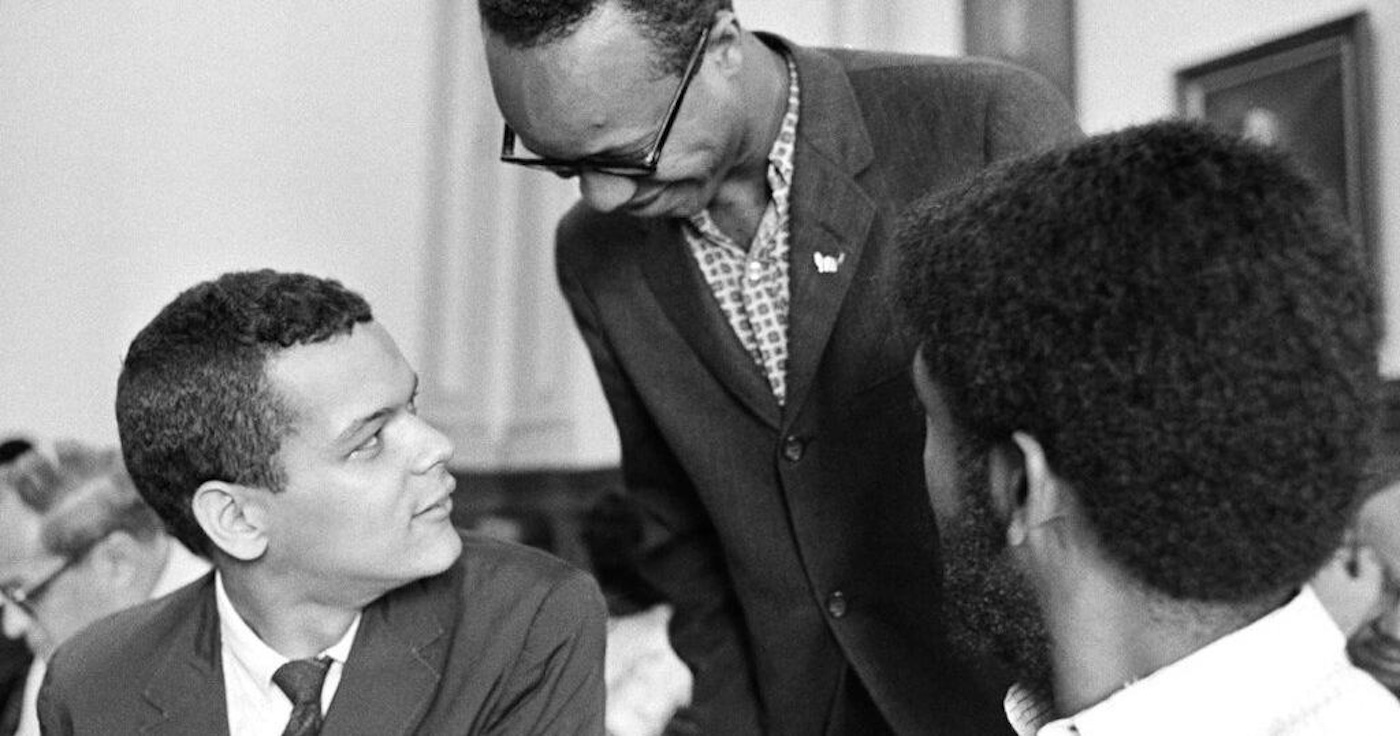
Albany was not a footnote
If Rock Hill established Sherrod’s tactical mettle, Albany made his historical reputation. In the fall of 1961, Sherrod and Cordell Reagon began working in Albany, Georgia, as SNCC field secretaries. SNCC Digital says Sherrod saw the city as a base for voter registration throughout southwest Georgia, a region notorious for anti-Black terror. The New Georgia Encyclopedia describes the Albany Movement as the first mass movement of the modern civil rights era to aim at desegregating an entire community, and notes that more than 1,000 African Americans were jailed in Albany and surrounding counties.
Albany is often remembered, especially in older movement lore, as a failure because King left frustrated and Police Chief Laurie Pritchett proved adept at avoiding the spectacular public violence that had generated national sympathy elsewhere. The standard interpretation runs like this: Albany taught King what not to do, and Birmingham later benefited from those lessons. That reading is not wholly wrong, but it is narrow. The New Georgia Encyclopedia explicitly notes that newer historians have argued for seeing Albany on its own terms, as a local movement with deep roots rather than simply a stage in King’s evolution. Quiros makes a similar point in The Washington Post, arguing that Albany looks like failure mostly from King’s vantage point; from Sherrod’s, it was part of a longer struggle that continued after King departed.
Sherrod’s genius in Albany was not just that he could organize a protest. It was that he could help build a constituency. SNCC Digital describes his effort to break what he saw as the community’s ingrained fear, and it highlights how young people, especially students, became the opening wedge. Once students were arrested, parents and other adults increasingly rallied behind them, and the movement widened. Bernice Johnson Reagon later described Albany as “the mother load,” a phrase SNCC Digital preserves to capture the extraordinary density of Black community energy there. Albany became a place where youth insurgency, church networks, local leadership, and national attention collided..
That line, attributed to Sherrod by Quiros, is short but revealing. It does not place the organizer at the center of the frame. It places the people there. This was classic SNCC thinking at its best: the point was not to substitute heroic activists for passive communities, but to help communities discover their own political force. Sherrod’s work in Albany therefore belongs to a larger Black organizing tradition often obscured by leader-centered storytelling. He was a catalyst, yes, but also an organizer in the strict sense: someone who believed that durable change depended on local people becoming protagonists.
At the same time, Albany brought danger into close focus. Sherrod and fellow activists faced arrests, beatings, and daily threats. The Washington Post obituary describes him as braving beatings and death threats while trying to desegregate a deeply repressive Southern stronghold. In later reflections, preserved by SNCC Digital, Sherrod emphasized how fear shaped the work and how slowly trust had to be built. None of this reads like romantic uplift, and that is important. Sherrod’s activism was hopeful, but it was never naive. He knew what southern white supremacy looked like at street level.
The moral and strategic split
Sherrod’s place in civil rights history becomes even more interesting when the movement begins to change. By the mid-1960s, SNCC was wrestling with the psychic and political costs of nonviolence. Ta-Nehisi Coates, in The Atlantic, notes that Charles and Shirley Sherrod were among those who rejected SNCC’s later movement away from integration and nonviolence toward Black nationalism and more militant positions. Quiros similarly writes that Sherrod saw the end goal as not merely political but moral: a society in which Black and white Americans could live and work together in peace.
This is one of the places where Sherrod can be oversimplified. To say he remained committed to nonviolence is true, but incomplete. His nonviolence was not passive moderation. ASALH described it as “militantly confrontational,” and the phrase fits. Sherrod believed in confrontation, direct action, and power-building; he simply refused to sever those things from a moral vision of shared humanity. That distinction matters. Too much popular memory flattens nonviolence into gentility. Sherrod’s version was harder-edged than that. It demanded discipline, danger, and institutional commitment.
“I didn’t leave SNCC, SNCC left me.”
That line, also preserved by Quiros, captures both the sadness and the clarity of the break. Sherrod did not stop believing in transformation. He just believed the terms of that transformation were changing in ways he could not accept. The result was not retreat. It was rechanneling. After studying at Union Theological Seminary in New York, he and Shirley Sherrod helped found the Southwest Georgia Project for Community Education, continuing voter registration and community development work outside SNCC’s evolving framework. The movement for him was not a brand to defend. It was labor to continue.
Shirley Sherrod and a shared political life
It is impossible to write honestly about Charles Sherrod without writing about Shirley Sherrod. Their partnership was political as much as personal, and the historical record consistently treats them as collaborators in the deepest sense. The SNCC Legacy Project recounts that they met in 1965 and married in 1966. Coates, in The Atlantic, places them together at the hinge between civil rights activism and later battles over land, agriculture, and federal discrimination. Their lives were twinned by commitment to southwest Georgia and by the refusal to abandon nonviolence even after racist violence had left deep scars on Shirley’s family.
That partnership enlarged Sherrod’s significance because it pushed his activism beyond protest in the narrow sense. Together the Sherrods helped make visible something Black freedom movements have always known: formal civil rights without economic security is fragile. People could win the right to register and still be evicted. They could desegregate public life and still be starved of credit. They could vote and still lose land. The Sherrods spent decades translating that insight into practice.
From civil rights to land rights
This is where Charles Sherrod’s legacy gets even larger than Albany. In 1968, he and several others traveled to Israel to study kibbutz and land-trust models. SNCC Digital reports that the trip helped inspire New Communities, founded in 1969 in southwest Georgia. The project was conceived as a way to protect Black farmers and farmworkers who were being displaced, punished, or made economically vulnerable as a consequence of activism and structural racism. Sherrod and his colleagues wanted land not as symbolism, but as infrastructure for freedom. .
SNCC Digital describes New Communities as the largest Black-owned farm cooperative in the United States at its founding. The SNCC Legacy Project says Sherrod acquired 5,735 acres in neighboring Lee County and led what became the nation’s first community land trust and largest Black-owned farm, at least until drought and discriminatory loan practices contributed to its collapse in 1985. The project was radical in a very practical way. It tried to solve a problem Sherrod had seen over and over: Black people who pushed against white supremacy could be economically retaliated against with devastating ease. Land could blunt that vulnerability.
“With land, a man holds in his hand the mechanism to control his destiny.”
That line, quoted by SNCC Digital, should sit near the center of any assessment of Sherrod. It shows how far his political imagination extended beyond integrationist cliché. He was thinking not just about access but about autonomy. In a 1982 interview archived by the International Center for Community Land Trusts, Sherrod said New Communities’ founding principles were, first, “to hold land” and, second, to become self-sustaining. He spoke about shared equipment, reduced costs, transportation, market stability, and housing. This was not a pastoral fantasy. It was movement strategy translated into economic design.
The significance of New Communities in American history is difficult to overstate. Today community land trusts are widely discussed in housing and land-justice circles, but the model’s Black freedom genealogy is often missing from mainstream accounts. Sherrod helps restore that genealogy. He understood that civil rights required material bases: land tenure, cooperative capacity, and insulation from racist lenders and political retaliation. He was effectively arguing that democracy without economic foothold is vulnerable to sabotage. That insight remains uncannily current.
The violence of bureaucracy
New Communities also exposed a subtler form of white supremacy: administrative discrimination. The project did not collapse simply because of bad luck or bad weather. It was battered by drought, yes, but also by unequal treatment from institutions that were supposed to provide agricultural support. The SNCC Legacy Project says discriminatory loan practices helped bring about the loss of New Communities. Coates wrote in The Atlantic that Reagan-era USDA decisions favored smaller white farmers while New Communities struggled to secure the loan support it needed.
This part of the Sherrod story matters because it widens the definition of civil rights harm. Public memory is good at recognizing billy clubs and snarling sheriffs. It is worse at recognizing the violence of paperwork, delay, denial, and official indifference. Sherrod’s life spanned both. He fought the overt apartheid of Jim Crow and the quieter discrimination of federal agricultural systems. The latter could look bloodless, but its consequences were severe: land loss, foreclosure, family instability, and generational setbacks. Sherrod understood that racism did not disappear when it stopped shouting. Sometimes it just moved behind a desk.
The eventual legal reckoning underscored the point. Quiros notes that the Sherrods filed a claim connected to the Black farmers discrimination litigation and were awarded a settlement for the wrongful dispossession of New Communities, after which they purchased a new farm. Coates wrote that New Communities received nearly $13 million, validating the claim that USDA discrimination had destroyed the project. The money mattered, but so did the admission embedded within it: what happened to New Communities was not merely unfortunate. It was unjust.
Local office, local power
One of the striking things about Sherrod is that he never romanticized outsider status. Many activists are remembered for protest but not governance. Sherrod did both. According to the SNCC Legacy Project, he served as one of Albany’s first Black city commissioners from 1976 to 1990. The Washington Post obituary similarly notes that he entered politics after years of movement work. That transition is important because it reveals a theory of change broader than perpetual resistance. Sherrod wanted institutions contested from without and remade from within.
There is a temptation in some political storytelling to treat entry into local government as the cooling-off phase of radical life. Sherrod’s career resists that reading. His movement work had always involved concrete questions of local power: schools, jails, transportation, voting access, land, and rural development. Serving in city government was not a retreat from those concerns. It was another arena in which to pursue them. He also taught, served as a prison chaplain, and remained embedded in the civic life of southwest Georgia. He did not build a national celebrity platform. He built a local political ecosystem.
That localism is part of why his national profile remained relatively modest. As Harrison Smith wrote in The Washington Post, Sherrod was one of those movement veterans who stayed. Clayborne Carson, quoted in that obituary, called him an exemplar of the people who did not leave the movement behind. This is, in some ways, the deepest truth about him. He was not chasing historical immortality. He was pursuing the slower, less glamorous work of transforming place.
Why Charles Sherrod is more important now, not less
Charles Sherrod’s story feels newly urgent because it touches several debates that remain unfinished. One is the meaning of movement success. Albany is a useful corrective to the American hunger for instant victories and neatly packaged failures. Sherrod’s life suggests that even campaigns widely deemed unsuccessful can build capacity, leadership, and tactical knowledge that matter for decades. The New Georgia Encyclopedia explicitly points to Albany’s significance both as a movement in its own right and as a source of lessons later applied elsewhere. Sherrod’s career reminds us that historical value is not always visible on deadline.
A second debate concerns the geography of Black freedom struggle. Sherrod’s work was rooted in southwest Georgia, in small cities, rural counties, farmland, and community institutions far from the metropolitan glamour that tends to dominate national memory. Quiros stresses that his story shows the struggle occurring in rural spaces as much as urban ones. That matters today, when so much commentary still treats Black politics as if it lives mainly in big cities. Sherrod belonged to a rural Black organizing tradition with enormous national consequence.
A third debate is about the relationship between civil rights and political economy. Sherrod did not stop at access. He kept moving toward ownership, sustainability, and institutional control. In that sense, he prefigured current conversations about racial wealth gaps, land loss, cooperative economics, and the structural fragility of formal equality. The Sherrod model says that democracy requires more than rights recognized on paper. It requires conditions under which people can exercise those rights without being economically destroyed.
And finally there is the moral question. Sherrod’s life keeps pressing on the same issue: how do you confront monstrous systems without becoming governed by hatred? That is not an abstract question in his biography. He and Shirley Sherrod had ample reason for rage. Yet both remained committed to interracial democracy and nonviolence. Coates, who is not sentimental about American racism, found that commitment significant enough to emphasize repeatedly. Sherrod’s ethic was not softness. It was discipline in the service of a world larger than vengeance.
The man who stayed
There is something moving, and instructive, about the fact that Charles Sherrod went to Albany in 1961 and never really left. He could have become a more mobile kind of public figure. He had the credentials, the movement pedigree, and the moral authority. Instead he remained attached to a place that had tested him, jailed him, threatened him, and, in time, depended on him. That decision says a lot about his understanding of leadership. He did not think justice work was complete once a national audience had taken notice. He understood that the headline moment is often the beginning, not the end.
For KOLUMN’s purposes, Charles Sherrod is especially resonant because his life defies the tendency to flatten Black history into commemorative shorthand. He was not just “a civil rights activist.” He was a theorist of freedom in practical form. He thought in sermons, but also in turnout, land tenure, farm debt, housing plans, local office, and youth mobilization. He belongs in the lineage of Black builders who understood that dignity has to be defended simultaneously in the streets and in the institutions that shape everyday life.
His significance, then, lies partly in what he did and partly in what he reveals. He reveals that the movement was bigger than its icons. He reveals that Albany was bigger than a so-called failure. He reveals that rural Black politics mattered profoundly to modern democracy. He reveals that nonviolence could be militant, local office could be movement work, and land could be as politically charged as a ballot. He reveals, too, that some of the most important freedom fighters are not the ones who move through history like comets, but the ones who stay long enough to change the weather.
In the end, Charles Sherrod’s life offers a rebuke to shallow memory. It asks us to stop treating the civil rights movement as a museum of isolated triumphs and start seeing it as an ecosystem of long labor carried by people whose names did not always become shorthand. Sherrod was one of those people. He helped make the movement think harder, dig deeper, and last longer. And in an era still haunted by old inequities in new forms, that may be the most consequential legacy of all.
More great stories
Mavis Staples and the Sound of Endurance
April 5, 2026
No Comments
Tomorrow Belongs to Us
April 5, 2026
No Comments