
The message is the message
The message is the message
By KOLUMN Magazine
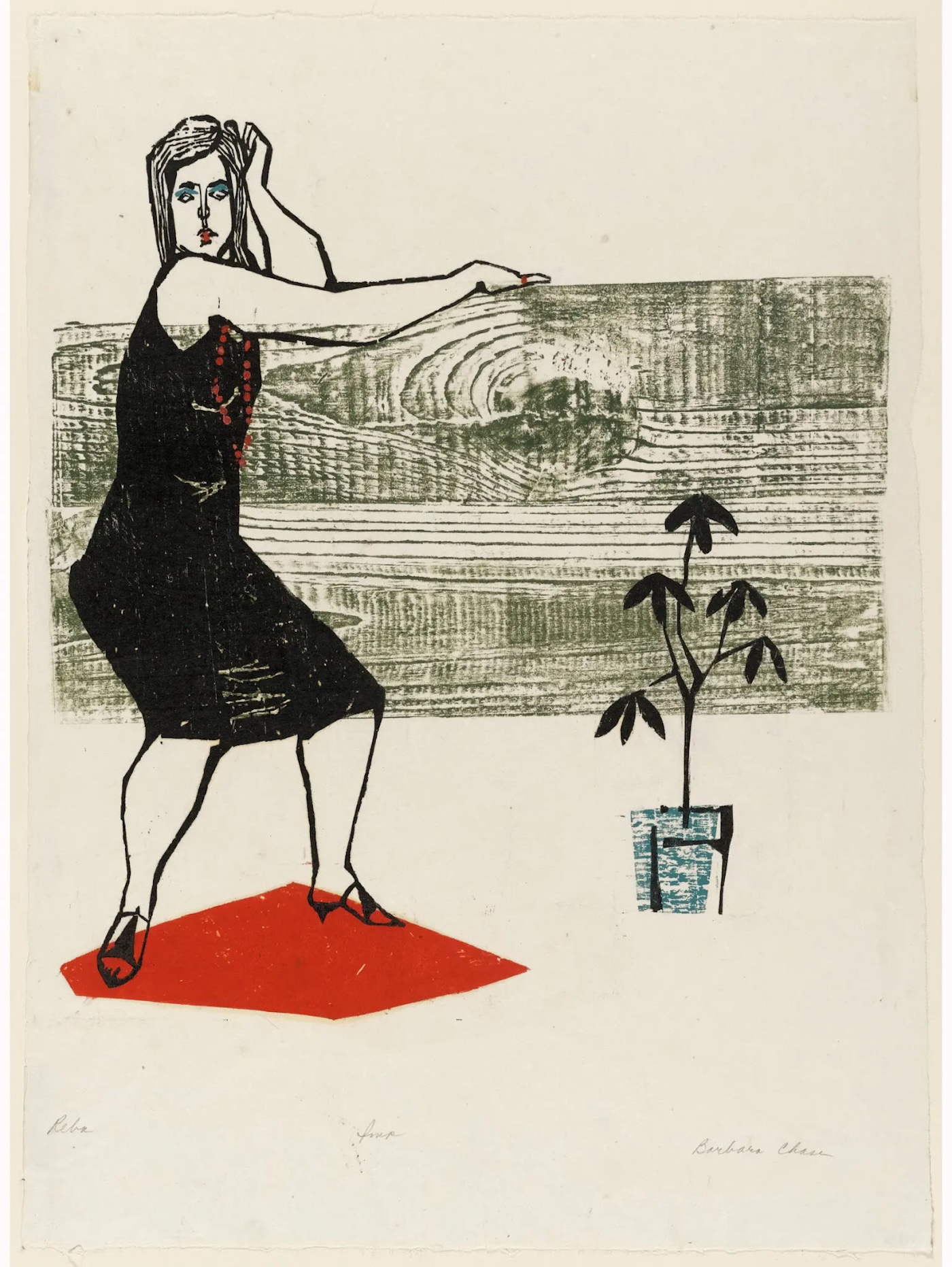
Barbara Chase-Riboud has one of those careers that makes the usual cultural labels look flimsy. Sculptor, yes. Novelist, certainly. Poet, absolutely. But those nouns, stacked politely beside one another, still do not quite explain the scale of what she has done. Over more than seven decades, Chase-Riboud has built a body of work that moves between bronze and silk, drawing and fiction, formal invention and historical excavation. Born in Philadelphia in 1939, trained early in art, educated at Temple and Yale, and based for decades in Paris and Rome, she has developed a practice that is at once rigorously modernist and deeply haunted by the afterlives of empire, enslavement, race, gender, and cultural memory. In her hands, sculpture is never just sculpture. It is argument, memorial, provocation, and witness.
What makes Chase-Riboud so significant is not simply that she mastered multiple disciplines, though she did, or that recognition has finally begun to catch up with her, though it has. It is that she persistently asked a larger question than many of her contemporaries dared to ask: who gets remembered, in what form, and by whose authority? That question runs through the best-known arcs of her career, from the Malcolm X steles to the Monument Drawings, from Africa Rising to her literary work on Sally Hemings, Sarah Baartman, and the Amistad rebellion. She is one of those rare artists whose formal language and moral vision are inseparable. The folds of metal, the ropes of silk, the monumental silhouettes, the imagined memorials, the bodies half-present and half-withheld: all of it works on the same problem of history.
The timing of her broader institutional recognition is its own story. The Pulitzer Arts Foundation mounted the first retrospective of her work in more than 40 years in 2022, calling it the largest monographic exhibition of her career to date. That same year, London’s Serpentine opened her first UK solo exhibition, a survey that emphasized just how radically she had reshaped sculptural language through the interplay of cast bronze or aluminum with knotted wool and silk. In 2023, MoMA paired her with Alberto Giacometti in an exhibition rooted in a formative 1962 meeting in Paris. In 2024 and 2025, Paris staged an extraordinary multi-museum tribute across eight major institutions, while 2025 also brought a Josephine Baker-focused exhibition in Monaco and the presentation of Africa Rising II in the Jardin des Tuileries. None of that feels like a late-career victory lap. It feels more like the art world finally admitting it had taken far too long to understand what was already there.
A prodigy from Philadelphia
The origin story matters here, in part because Chase-Riboud’s later cosmopolitanism can make it easy to forget how early her gifts announced themselves. As a child in Philadelphia, she took art classes at the Philadelphia Museum of Art. Before she even began graduate study at Yale, her work had already been acquired by the Museum of Modern Art, and she had won a John Hay Whitney Fellowship to the American Academy in Rome. Yale later recalled that William Lieberman, then director of MoMA’s new department of prints and drawings, bought one of her prints off the wall without knowing who she was, how old she was, or that she was Black. It is one of those stories that sounds mythic because it is so cleanly dramatic, but it also illuminates something important: Chase-Riboud’s ability was visible early, even when the institutions around her were not structured to make room for someone like her.
Her training was no less formidable. Temple’s Tyler School of Art lists her as a 1956 BFA graduate, and the Studio Museum notes that at Yale she studied with Josef Albers, Philip Johnson, and Paul Rand. Frieze identifies her as the first Black woman to graduate from Yale School of Architecture and Design in 1960, while Yale’s own account remembers her as one of only two women in the school at the time and one of very few Black women at the university. These are not just résumé items. They reveal how Chase-Riboud learned inside institutions that were prestigious, male-dominated, and structurally exclusionary, while never allowing those institutions to define the perimeter of her ambition..
That period in Rome was decisive. Hauser & Wirth’s biography notes that the fellowship introduced her to a foundry and to a new variation on the ancient lost-wax process, one in which pliable sheets of wax could be bent, folded, and bunched before being cast into metal ribbons that would later become a signature of her work. Yale adds another key detail: the Roman fellowship set in motion the trip to Egypt that profoundly influenced her practice. Artnet, writing last year, treated that Egyptian journey almost as a hinge in her life, a foundational encounter with ancient form, scale, and symbolic power. It is tempting to think of Chase-Riboud becoming herself only once she left the United States, but that is not quite right. A better way to put it is that travel gave her a wider vocabulary for what she had already begun to imagine.
Exile, freedom, and the making of a transnational artist
Chase-Riboud has long been described as an expatriate, but that word can sound softer and more decorative than what her life actually represented. She moved through Europe, North Africa, West Asia, and Asia not as a tourist collecting impressions but as an artist testing where she could live, think, and work with the most freedom. The Serpentine described her practice as committed to transnational histories and cultures, shaped by years of living, working, and traveling across Western and Eastern Europe, West Asia, North Africa, and South-East Asia. Frieze quotes her saying she was the first American woman invited to China after the revolution, recalling a May Day banquet with Mao Zedong and describing those years of travel as the apex of a broader adventure through Africa, Eastern Europe, and India.
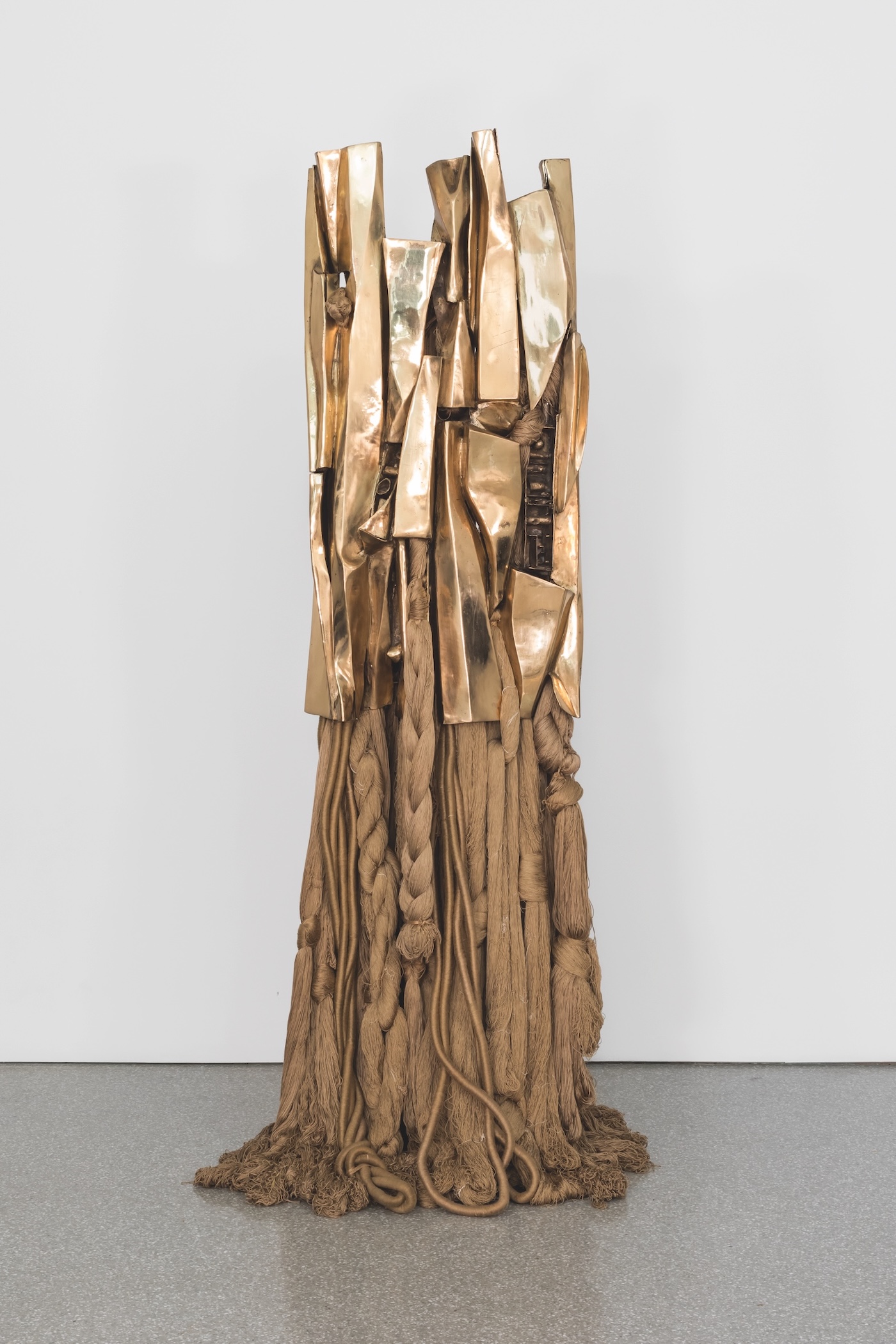
That mobility was not incidental to the work. It was the work’s condition of possibility. The same artist who encountered Giacometti in Paris also absorbed funerary steles in China and Cambodia, studied ancient architecture in Egypt, and developed a sensibility that treated Western and non-Western histories not as separate silos but as materials in active dialogue. In her sculpture, that dialogue becomes formal: hard and soft, vertical and flowing, permanence and ephemerality, monument and drapery, abstract structure and bodily suggestion. The Serpentine called attention to exactly that interplay, describing the way cast metal and braided textile create a tension between heavy and light, rigid and tactile. Her work often looks like it is holding two incompatible conditions together. That is partly why it feels so alive.
There is also a racial and psychological dimension to that self-exile. Chase-Riboud has spoken across interviews about the different consciousness that came from living outside the United States, even while remaining in intense conversation with American history. The result was not escape from Black America but a re-angled way of seeing it. From Paris, she could make Malcolm X steles. From Europe, she could write Sally Hemings. Distance sharpened, rather than softened, her sense of the historical violence embedded in American identity. Artnet’s recent profile captured that paradox well, describing her as a kind of omniscient narrator watching America and the world from Paris, while Hauser & Wirth emphasizes that her practice has consistently engaged transcultural histories with unusual fearlessness.
The cosmopolitanism was real, but so was the loneliness that came with pioneering. Frieze’s interview is revealing on this point. When discussing Yale, Chase-Riboud remembered that in the whole graduate school there were only three Black women, one each in philosophy, law, and art or architecture. She describes assuming a persona, “Miss Chase,” because nobody else had to navigate the same institutional terrain. That sense of strategic self-fashioning would recur throughout her life. She learned early that talent alone would not protect an artist from racialization, diminishment, or category confusion. She needed authority, bearing, and control over her own narrative.
The sculpture: bronze, silk, and an anti-monumental monumentality
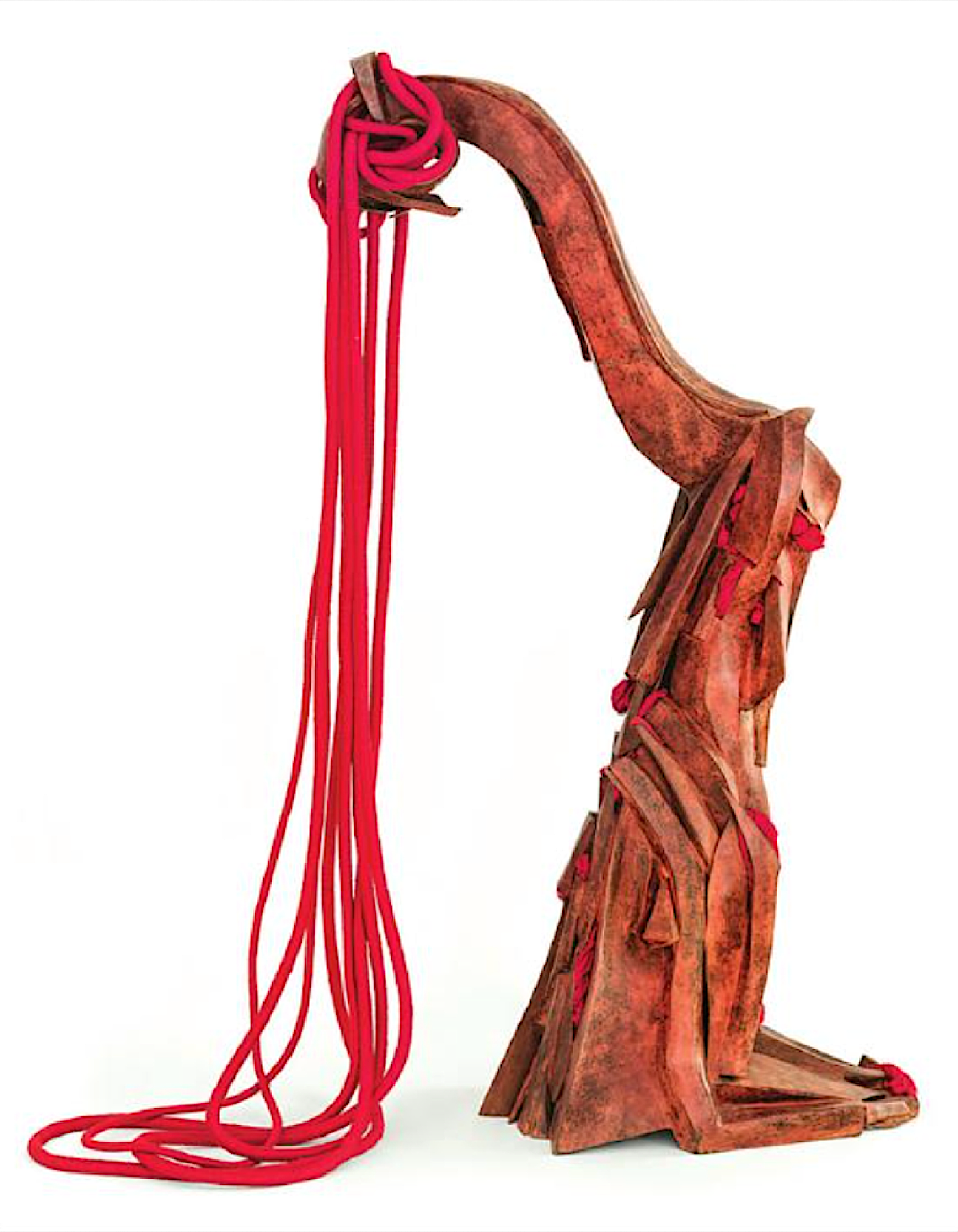
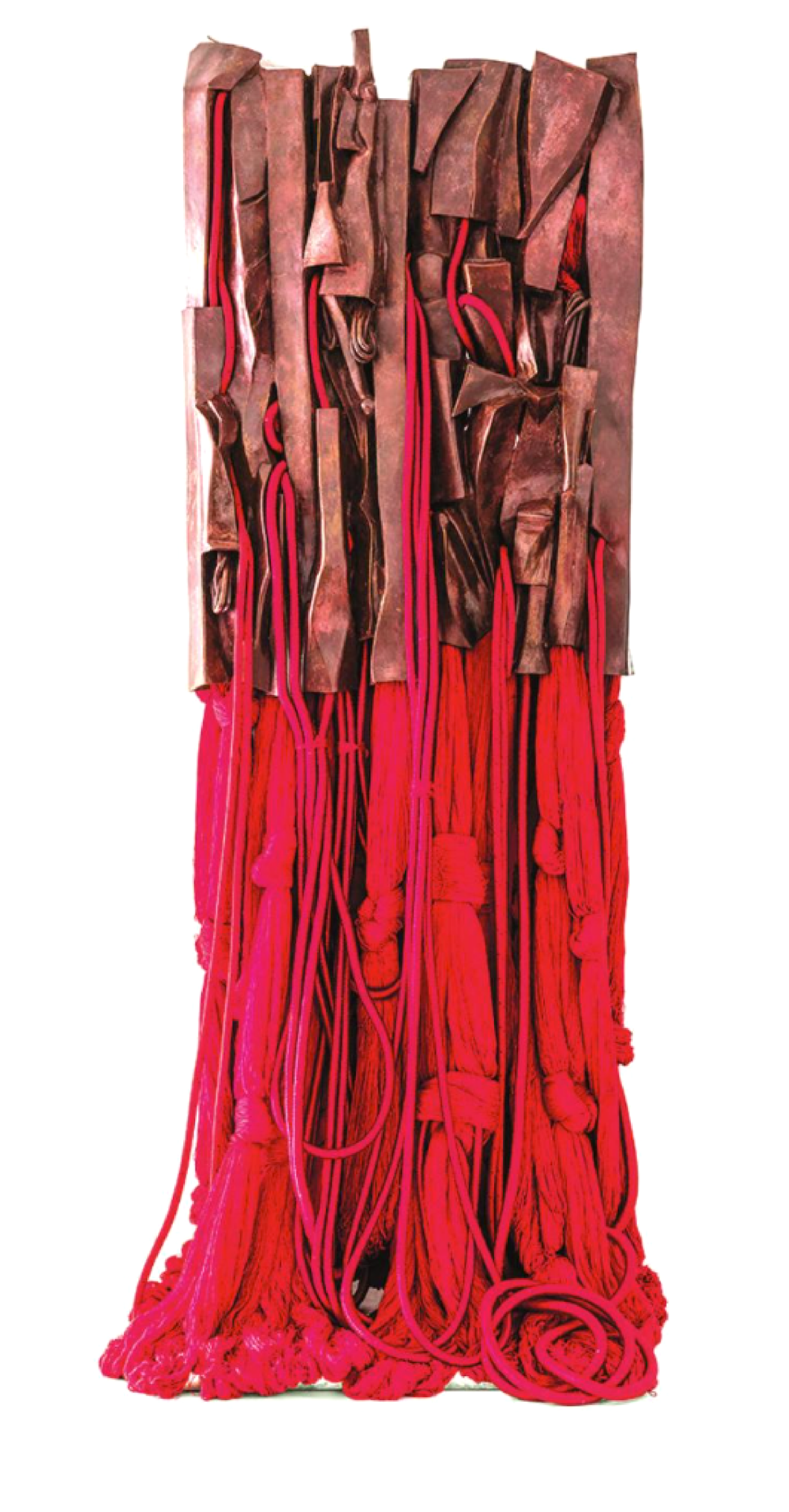
On first encounter, Barbara Chase-Riboud’s sculpture can seem contradictory in the most thrilling way. The metal looks ancient and futuristic at once. The ropes of silk and wool read as luxurious, tactile, almost ceremonial, but also unstable. The works have the vertical conviction of monuments yet often resist the literalism people expect from monumental art. They are abstract, but not evasive. They are sensuous, but not merely decorative. They often withhold the body while making the viewer feel a bodily presence all the same. That withholding is part of their authority. Chase-Riboud does not illustrate history; she summons it.
The Malcolm X series is the clearest example. Temple describes these sculptures as abstract bronze works with knotted and braided silk and wool fibers, likened to contemporary interpretations of ancient steles built to honor important people and events. Frieze lets Chase-Riboud explain the series in her own terms. She recounts how, frustrated by the interference of legs in her increasingly abstract sculptural language, she transformed the figure in the Malcolm X works by replacing the legs with a curtain or skirt. Malcolm X #3 rose up as the first stele, with power seeming to move from bronze to fabric and back again, the metal held up impossibly by bundles of silk. The inspiration, she says, also came from funerary steles she saw in China and Cambodia. That is a typically Chase-Riboud move: a monument to an African American political figure, built through a formal language informed by transnational ancient sources rather than by the usual conventions of Western memorial statuary.
Philadelphia Museum of Art’s account of Malcolm X #3 adds the biographical and political charge. By the late 1960s, Chase-Riboud was already living in Paris, yet the events of the civil rights movement in the United States continued to affect her deeply. Malcolm X’s assassination in 1965 prompted her to begin the abstract sculptural series dedicated to his life and legacy. Berkeley Art Museum similarly described the steles as monumental sculptures marked by the dynamic interplay of material and thematic opposites. That phrase gets to the heart of the work. The Malcolm X series is political, but it is political through tension, not slogan. It uses abstraction to create a memorial language sturdy enough for grief, dignity, and unresolved struggle.
This is where Chase-Riboud breaks a false choice that often structures conversations about Black art. The false choice says an artist must either foreground political content or commit to formal beauty, but cannot do both without compromise. Chase-Riboud has refused that binary for decades. Temple quotes her bluntly: “Most activism sacrifices the aesthetic part of making art for the message. I never do that.” The line is useful not because it rejects politics, but because it rejects bad politics masquerading as urgency. Chase-Riboud’s sculptures insist that rigor, seduction, craft, and conceptual precision are not bourgeois distractions from historical seriousness. They are part of how seriousness enters form.
Chase-Riboud’s great wager has always been that abstraction can remember the dead without flattening them.
The “pantheon of invisibles”
A number of institutions and critics have converged on the same insight: Chase-Riboud repeatedly returns to figures history has neglected, distorted, or inadequately commemorated. Serpentine’s exhibition text notes that her monuments and memorials honor figures including Sarah Baartman, Malcolm X, Peter Paul Rubens’s mother, Josephine Baker, the Queen of Sheba, King Solomon, Cleopatra, Anna Akhmatova, and Lady Macbeth. ARTnews, as quoted on Hauser & Wirth’s page, described her as building a “pantheon of invisibles.” Artnet, writing in 2025, said she had made a career of being a monument-maker “to the forgotten, the unseen, and those who are widely visible but viewed through a distorted lens.” These are all versions of the same claim: Chase-Riboud is less interested in official history than in what official history excludes or mishandles.
That helps explain why Cleopatra, Josephine Baker, and Malcolm X belong in the same imaginative universe for her, even if they seem to come from wildly different historical and symbolic registers. Chase-Riboud is drawn to figures whose meaning has been overproduced yet under-understood. She is not rescuing obscure people from total obscurity so much as refusing bad visibility. Malcolm X in her work is not the frozen icon of schoolbook militancy. Josephine Baker is not only the banana-skirt fantasy manufactured for Europe’s appetite. Cleopatra is not merely pop seductress or imperial cliché. Chase-Riboud re-monuments them through abstraction, through motion, through material conflict, and through the dignity of scale.
The Monument Drawings extend this project in another key direction. The Met’s 1999 press release for Barbara Chase-Riboud: The Monument Drawings describes a series of 23 original works shown in the museum’s Lila Acheson Wallace Wing. Hauser & Wirth says the series began in the late 1990s as ink and charcoal drawings of imagined monuments to literary and historic figures such as Cleopatra, the Marquis de Sade, Nelson Mandela, the Queen of Sheba, and Anna Akhmatova. These drawings are crucial because they reveal Chase-Riboud thinking monumentality not just as built form but as proposition. What would it mean to imagine a monument before the state, before the plaza, before the commissioning body, before public consensus? The drawings feel like counter-archives. They are plans for a world with different heroes.
The significance of her 1999 Met exhibition has itself become part of the story. Musée Guimet, the Quai Branly Museum, and the Louvre have all described Chase-Riboud as the first living female artist to have a solo exhibition at the Metropolitan Museum of Art. Whether one stresses “living female artist” or “woman and living artist,” the point is the same: she broke a major institutional barrier. Yet even that milestone now feels almost secondary to what the exhibition represented. Chase-Riboud did not arrive at the Met by shrinking her ambition into something legible and safe. She arrived with imagined monuments and with a sensibility already committed to the unstable border between art history and political history.
Writing as a second practice, and never a side hustle
One of the most remarkable things about Chase-Riboud is that the literary career is not a charming add-on to the visual one. It is a second major practice. Serpentine notes that she gained literary success with Sally Hemings, published in 1979, and that she has since produced more than ten novels and collections of poetry, including Echo of Lions, which was adapted for screen and became associated internationally with Amistad. Hauser & Wirth adds that her 1974 poetry collection From Memphis & Peking was edited by Toni Morrison, and that Sally Hemings, encouraged by Morrison and Jacqueline Kennedy Onassis, won the Janet Heidinger Kafka Prize. Philadelphia Museum of Art also identifies her as an award-winning writer and poet, still best known in literary culture for Sally Hemings.
“Sculpture must not sit still.”
That body of writing matters because it clarifies Chase-Riboud’s central method. She is not interested in history as inert fact. She is interested in history as contested inheritance, especially where race, gender, sexuality, and power have warped the archive. Sally Hemings did not simply revisit an old American scandal. It intervened in a national mythology. Hottentot Venus and The Great Mrs. Elias similarly center women whose stories expose the intimate machinery of race and empire. In prose as in sculpture, Chase-Riboud gravitates toward people who have been narrated by others into caricature, silence, or spectacle. Her work tries to restore depth without pretending innocence.
Frieze is especially useful on the long relationship between the writing and the sculpture. Chase-Riboud says that for many years she insisted there was no relation between the two practices. She did not want people assuming she wrote a poem in the morning and ran downstairs to make a sculpture in the afternoon. Only now, she says, near the end of her career, do those two things seem to be meeting. Artnet makes a similar observation, noting that she deliberately kept the parallel careers apart because she did not want to be known as a great writer who was a lousy sculptor or vice versa. That decision now looks less defensive than strategic. She refused to let institutions collapse her into novelty. She would be excellent twice, separately, until they were forced to deal with the full complexity of the record.
Her 2022 memoir, I Always Knew, brought those two worlds into more public contact. The book, as Princeton-linked descriptions and the Pulitzer shop page note, is built from letters she wrote to her mother between 1957 and 1991, recounting her artistic development, romances, travels, and encounters across Europe, Africa, the Middle East, the Soviet Union, China, and Mongolia. The Guardian called the book gossipy, intimate, glamorous, and full of extraordinary encounters, including with James Baldwin, Giacometti, and Jacqueline Kennedy Onassis. The memoir does something that Chase-Riboud’s public image had long resisted: it lets the world see the personal velocity beneath the finished body of work. Not to domesticate the artist, but to show how wide the life has been.
Public memory, public space
Chase-Riboud’s importance is especially clear when her work enters literal civic space. Her 1998 public commission Africa Rising, installed at the Ted Weiss Federal Office Building near the African Burial Ground National Monument in Lower Manhattan, is one of her most eloquent statements about what public art can do. The General Services Administration’s official description quotes Chase-Riboud calling it “an ark of collective history, a vessel of contemplation afloat on an ocean of time and space.” The work’s base takes the form of an African headrest, a personal object associated in many parts of Africa with burial possessions, while above it rises a winged African female figure echoing the posture of the ancient Greek Winged Victory of Samothrace. That is classic Chase-Riboud: Africa and Greece, shrine and boat, mourning and triumph, Lower Manhattan and ancient form, all held together in one structure.
What makes Africa Rising so effective is that it refuses the sentimental or the merely didactic. It acknowledges the African Burial Ground through symbol, scale, and formal intelligence rather than through a literal reenactment of suffering. The monument does not reduce the dead to evidence. It offers them architectural dignity. It also shows Chase-Riboud’s fluency in the politics of placement. She understands that public sculpture is never just an object. It is a negotiation with site, with bureaucracy, with the state, and with the narratives already attached to a place. If much of her studio practice imagines alternative monuments, Africa Rising demonstrates that she can also intervene within official civic memorial culture without surrendering complexity.
That concern with the monument as a problem, not just a form, runs through the whole career. The Serpentine’s framing of her work as a meditation on memory, history, and power is apt, but Chase-Riboud goes further than that. She does not simply ask who is remembered. She asks what kind of monument is adequate to a fractured history. Figurative statuary, in her hands, often becomes too stable, too finished, too sure of itself. Her answer is the quasi-monument: upright, commanding, commemorative, but also folded, braided, unstable, and full of motion. A Chase-Riboud sculpture stands, but it also seems to be becoming. That refusal of complete stillness is one of the most intelligent things about it.
The long overdue “moment”
By now it is common to say that Barbara Chase-Riboud is finally having her moment. The phrase is true enough, but it risks sounding too neat, as if the culture simply woke up one day and discovered an overlooked genius. What actually happened is more instructive. Museums, galleries, and critics have been forced by the evidence of the work to enlarge their frameworks. The Pulitzer retrospective called her trailblazing and groundbreaking. Serpentine emphasized seven decades of innovation. MoMA positioned her not as a footnote to Giacometti but as a sculptor whose encounter with him opened a meaningful cross-generational dialogue. Paris’s eight-museum celebration effectively announced that Chase-Riboud’s career could not be contained by one institution’s walls or one department’s category system.
Recent honors reinforce that shift. AWARE named her the 2021 laureate of its Outstanding Merit Prize. Musée Guimet and the Louvre both note that she was made Chevalier de l’Ordre des Arts et des Lettres in 1996, received the AWARE prize and the Simon and Cino Del Duca artistic award in 2021, and received a lifetime achievement award from the International Sculpture Center in 2022. The list matters, but less as a trophy case than as evidence of institutional correction. For a long time, Chase-Riboud seemed too many things at once for art history’s bureaucratic habits. Black and expatriate. sculptor and novelist. formally experimental and historically explicit. glamorous and scholarly. politically acute without being reducible to protest aesthetics. That complexity, once treated as a problem, now reads as one of her greatest strengths.
Artnet reported in May 2025 that an additional major retrospective was planned for 2026, and Hauser & Wirth has highlighted both the eight-museum Paris exhibition and her Monaco presentation of The Josephines. Meanwhile, the Louvre’s press materials show Africa Rising II installed in the Tuileries from May to November 2025. These developments suggest that the current visibility is not a one-season spike. It looks more structural than that. Chase-Riboud has moved from admired insider’s figure to an artist institutions increasingly treat as essential to the larger story of postwar and contemporary art. That feels right. It also raises an uncomfortable question: why did it take so long?
Why Barbara Chase-Riboud matters now
The simplest answer is that Chase-Riboud matters because her work helps explain the present without being trapped in it. We live in an era obsessed with monuments, memory, erasure, archive, restitution, and the politics of public space. We also live in an era suspicious of beauty when beauty appears detached from accountability, and suspicious of overt politics when politics appears to flatten art into message. Chase-Riboud anticipated those tensions and solved many of them before the culture had language for them. She made abstraction answer to history. She made memorial form hold contradiction. She moved fluently between official recognition and insurgent remembrance. She made work about Black life and Black loss that did not need to announce itself as pedagogical in order to be ethically serious.
She also matters because she expands what a Black woman artist’s career can look like in the historical record. Not exemplary in the flattening sense, but expansive in the liberating sense. Her life includes Philadelphia discipline, Yale rigor, Roman foundries, Egyptian revelation, Parisian cosmopolitanism, literary acclaim, institutional neglect, public commissions, cross-genre mastery, and late recognition. The Guardian’s portrait of her childhood desire for the Légion d’honneur, fulfilled in the same historical moment that Josephine Baker entered the French Panthéon, has the symmetry of a novel, but Chase-Riboud’s actual achievement is harder and stranger than symbolism. She made herself into an artist equal to the scale of the histories she wanted to touch.
In one sense, Barbara Chase-Riboud has always been making monuments. In another, she has been dismantling the monument as we inherited it. Her greatest works stand upright, but they refuse rigidity. They honor the dead and the overlooked, but they do not embalm them. They are sensuous without being soft, political without being crude, learned without being bloodless. They ask the viewer to accept that memory is not fixed stone; it is knot, fold, fiber, pressure, and release. The title of her Paris celebration, translated from the French, says it beautifully: every time a knot is undone, a god is released. That may be as good a key as any to the whole enterprise. Chase-Riboud has spent a lifetime untying the knots that keep history from breathing.
And that is why she is not simply an important artist who deserves more credit, though she is certainly that. She is one of the clearest examples we have of how art can enlarge the historical imagination. She shows that remembrance need not be literal to be precise, that abstraction can bear testimony, and that the most radical monument may be the one that refuses to pretend history was ever simple in the first place. Barbara Chase-Riboud did not just join the conversation about memory. She re-engineered the form in which that conversation could happen.
More great stories
Afro Sheen, Wall Street, and the Architecture of Black Possibility
July 6, 2026
No Comments
The Fire Inside the Fourth
July 5, 2026
No Comments