




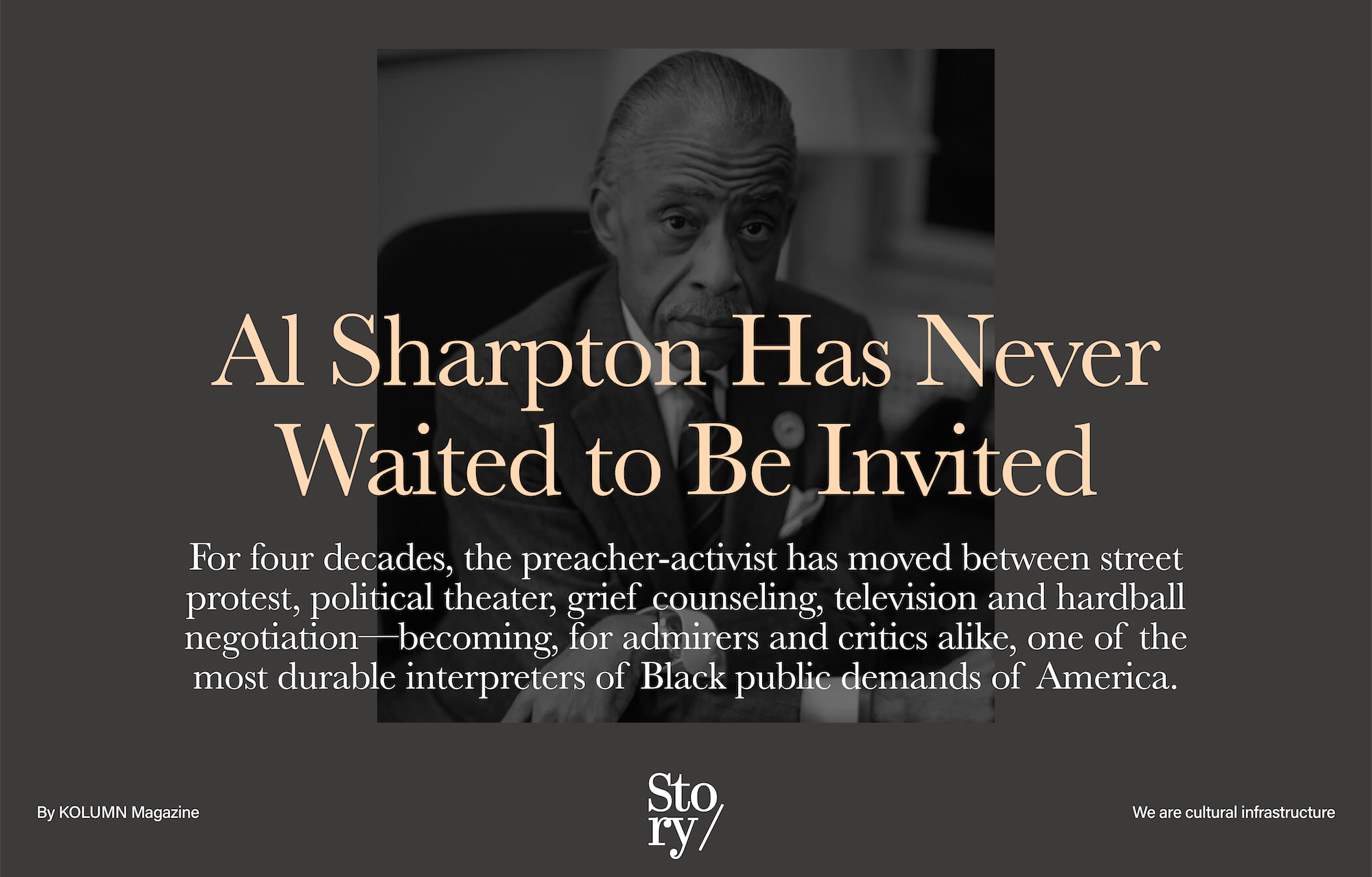
Not less of an agitator, but a refined agitator.
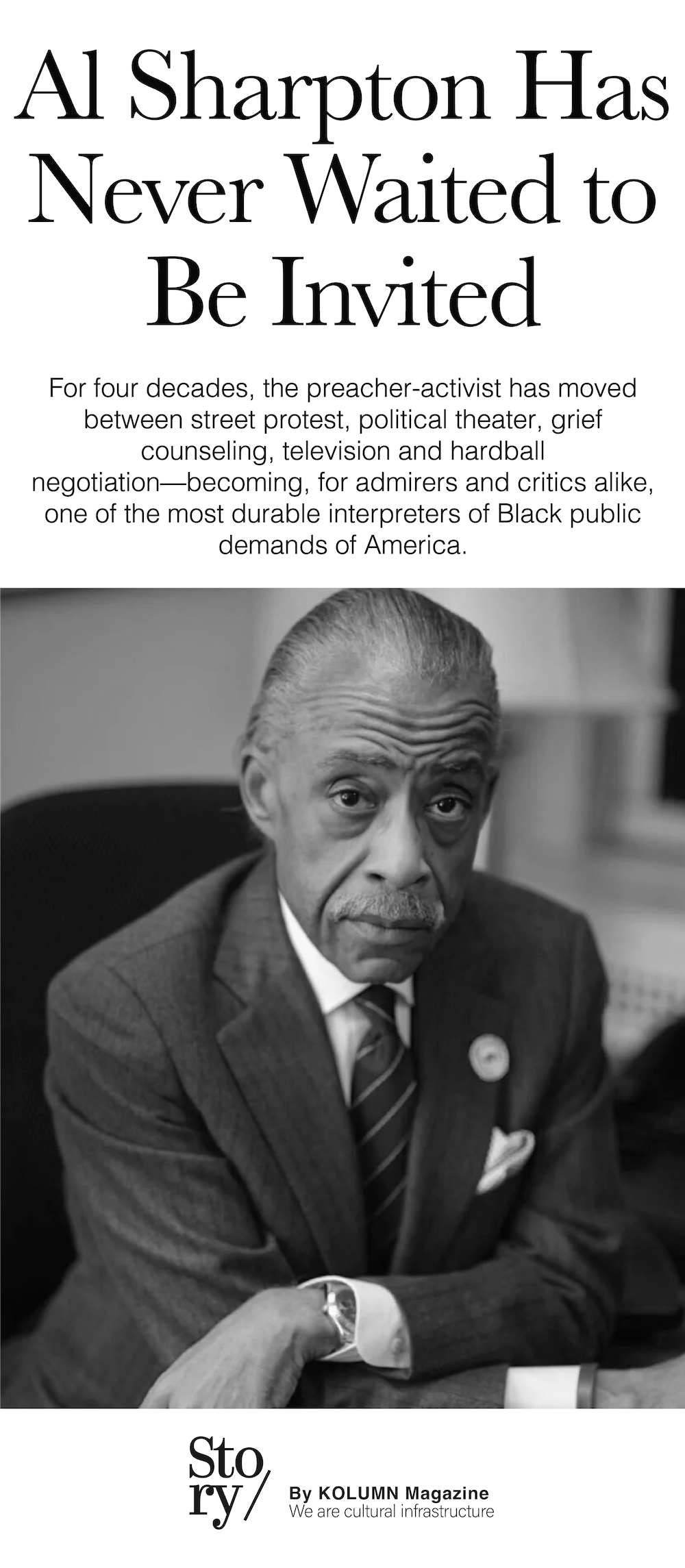
Not less of an agitator, but a refined agitator.
By KOLUMN Magazine
There are public figures who seem to arrive fully formed, and then there is Al Sharpton, whose public life has always looked more like improvisation under pressure. He has been, at different moments, a child preacher, a protégé of Jesse Jackson, a racial provocateur, a protest organizer, a presidential candidate, a cable-news host, a funeral eulogist for the dead of the modern police violence era, and the founder of one of the country’s most durable activist organizations, the National Action Network. Britannica identifies him in the broadest terms—minister, politician and civil-rights activist—but that label barely captures the churn of reinvention that has defined him. Sharpton began preaching at four, became a Pentecostal minister at 10, founded a youth organization in the early 1970s, and later built the National Action Network in 1991 into a national civil-rights platform with more than 100 chapters.
To write about Al Sharpton seriously is to resist two temptations. The first is hagiography. The second is caricature. He has mattered too much to be flattened into either saint or con man, civil-rights heir or tabloid opportunist. A fair account has to hold several truths at once: that he gave public language and visibility to Black grievance in places where mainstream institutions preferred euphemism; that he often understood, earlier than his peers, the strategic value of media in racial politics; that he has made real organizational gains and served as a key interlocutor between grieving families and power; and that his record includes episodes of reckless judgment, inflammatory rhetoric and lingering ethical questions that still shape how even sympathetic observers talk about him.
That tension is the point. Sharpton is not simply a man with a long résumé. He is, more than that, a running argument about what modern Black leadership should sound like in a country that often only notices Black protest when it becomes impossible to tune out. For decades he has wagered that moral suasion alone is not enough, that somebody has to force the scene, fill the camera frame, seize the microphone and dare America to look at what it would rather not see. In later years he softened some edges and refined some methods, but even Sharpton’s own description of that evolution is telling: not less of an agitator, but a “refined agitator.”
Brooklyn Beginnings and a Theology of Visibility
Sharpton’s beginnings help explain both his confidence and his appetite for stagecraft. Born in Brooklyn on October 3, 1954, he was preaching before most children can spell their names and was ordained young enough to become a novelty in the Black church world. Britannica notes that he graduated from Tilden High School in Brooklyn and briefly attended Brooklyn College, but formal education is not really the central fact of his formation. The church was. So was performance. By adolescence he had crossed into movement politics through Operation Breadbasket, the economic arm associated with Martin Luther King Jr. and the Southern Christian Leadership Conference, and by his own later recollection he absorbed lessons from older civil-rights figures as well as from Black entertainment culture. The result was a politics that was never purely clerical and never purely electoral. It was sermonic, theatrical, strategic and combative all at once.
If Sharpton inherited anything durable from the classical civil-rights movement, it was less its decorum than its understanding of leverage. Operation Breadbasket was built around economic pressure—rewarding businesses that hired Black workers and penalizing those that did not. That framework would follow him for decades. It appears in his early organizing, in National Action Network’s structure, and even in his latest campaigns, including his 2025 pressure campaigns on corporations retreating from diversity, equity and inclusion commitments. When Target scaled back DEI efforts, Sharpton met with its chief executive under threat of consumer action; when PepsiCo did the same, he publicly warned of a boycott. Even in old age, he remains committed to a civil-rights politics that is not only about symbolism or speeches but about access, patronage and pressure.
From Local Agitator to National Flashpoint
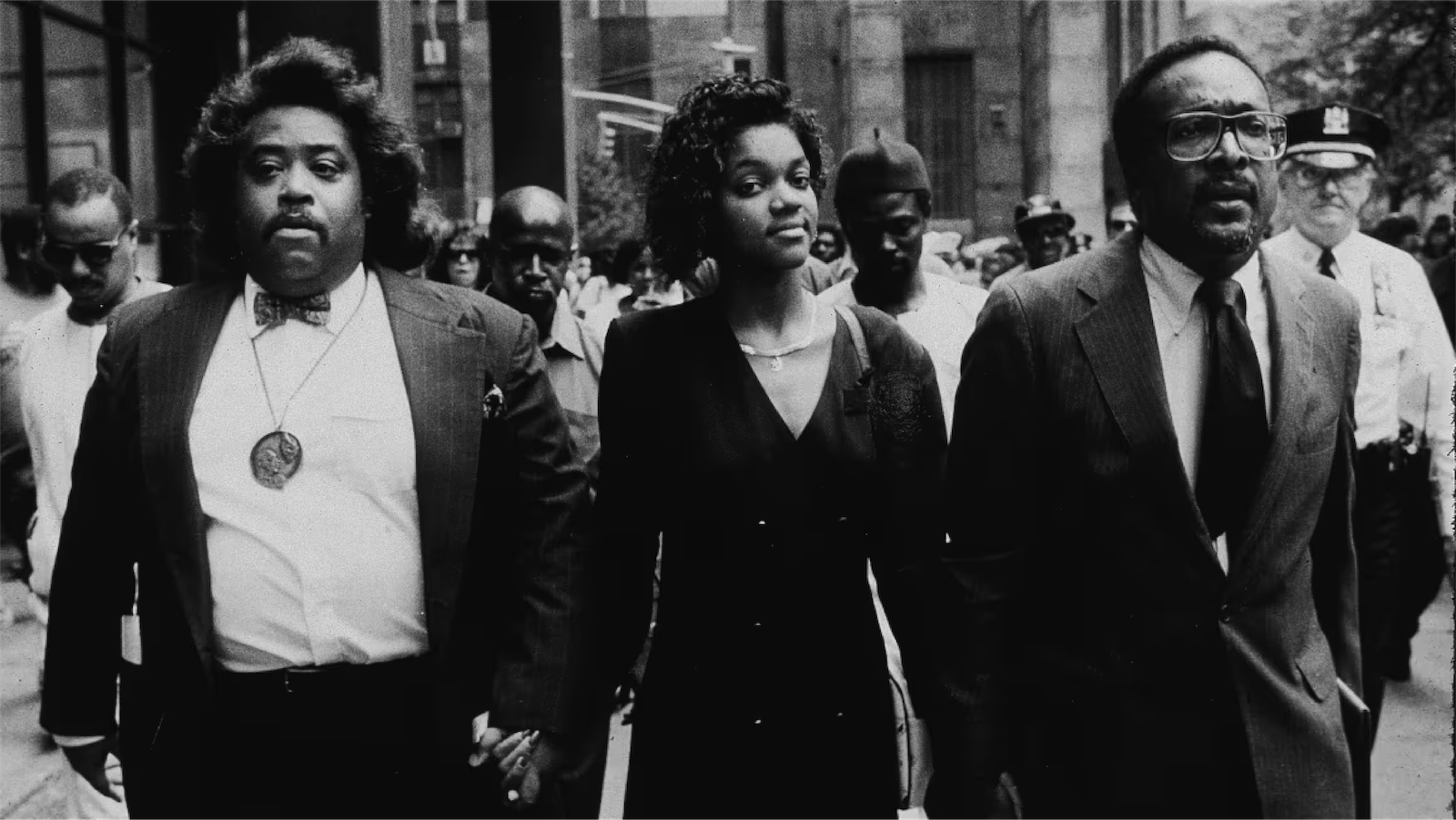
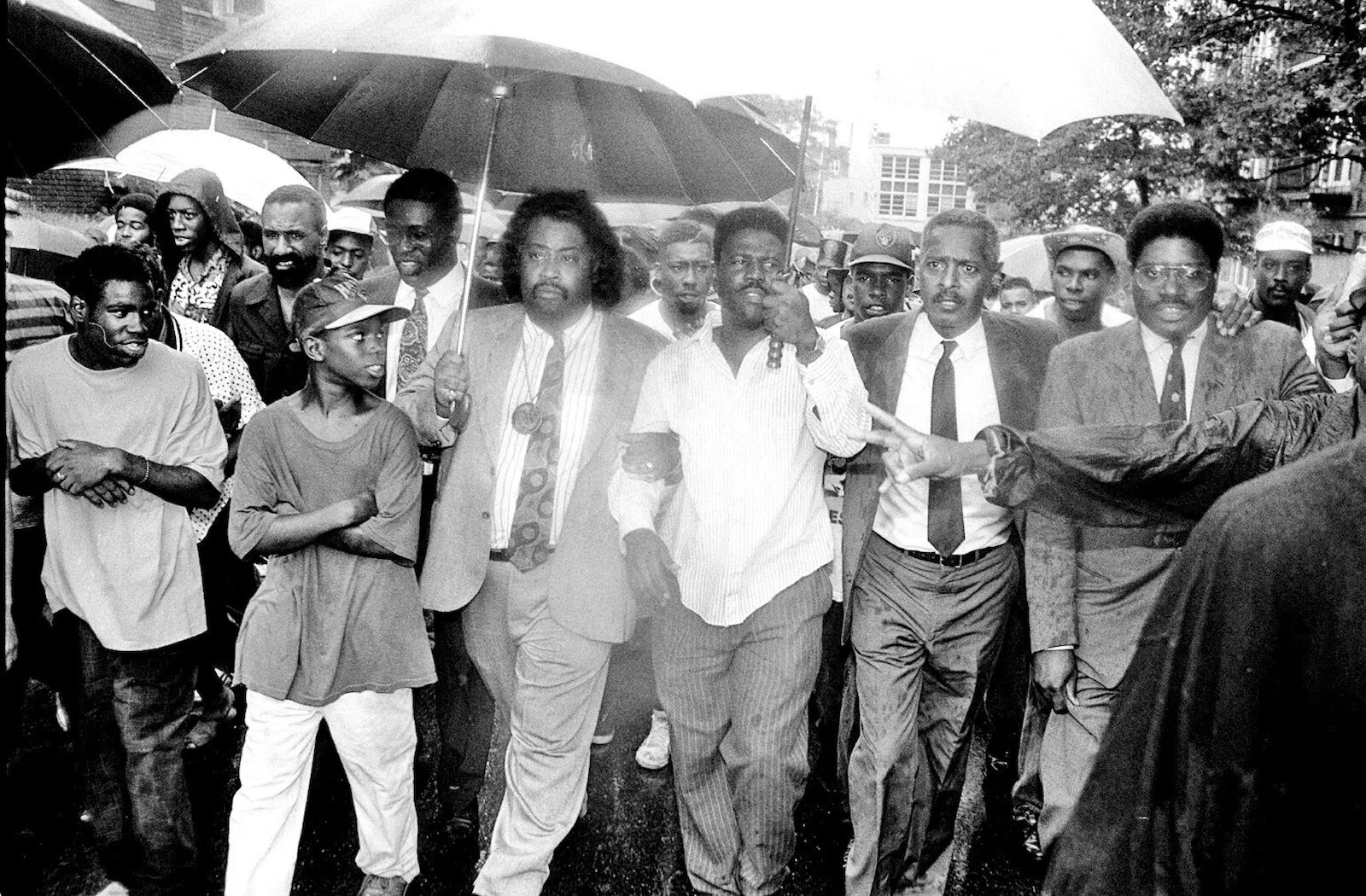
Still, Sharpton first became nationally famous not as an institution builder but as a racial fire alarm. In the 1980s and 1990s, he emerged in New York as the man who showed up where racial conflict was already combustible and often made it more visible, more emotionally legible and, at times, more volatile. The Washington Post’s 1990 profile captured the split-screen version of Sharpton that would define his early public image: a preacher with a relatively small formal following but an uncanny ability to command headlines, pull cameras and turn protest into spectacle. The paper described a media class both irritated by and addicted to him, unsure whether he was exposing real injustice or merely mastering the economy of outrage. That ambiguity became part of his power.
The Brawley Case and the Risks of Advocacy
One of the most notable cases of Sharpton’s early career remains Tawana Brawley. In 1987, Brawley, a Black teenager from upstate New York, alleged that she had been abducted and raped by white men, some of them law enforcement officers. Sharpton became one of her most visible defenders, helping transform the case into a national racial flashpoint. When a grand jury later found the allegations to be fabricated, Sharpton did not retreat. A decade later, a jury found Sharpton and two lawyers liable for defaming former prosecutor Steven Pagones by falsely accusing him of raping Brawley. The Washington Post reported that the verdict followed years of racially charged fallout and that jurors concluded Sharpton had made multiple defamatory statements. This was not a minor footnote. It became Exhibit A for critics who argued that Sharpton could not be trusted as a steward of racial grievance because he had helped elevate a false story into a national indictment.
Yet Brawley also reveals why Sharpton endured when more cautious leaders did not. He grasped something about Black distrust that respectable institutions routinely missed. In the late 1980s, many Black Americans were not reacting only to the factual specifics of one case; they were reacting to a deeper archive of disbelief, abuse and selective credibility. Sharpton read that mistrust correctly, even as his handling of the case remains one of the clearest examples of his willingness to outrun evidence. That duality—diagnostically sharp, evidentially reckless—would haunt him for years. On PBS’s Firing Line, decades later, Sharpton was still defending his advocacy for Brawley in broader moral terms, a sign that he sees the episode less as disqualifying error than as an extension of his instinct to side first with the vulnerable against institutions that had historically lied to them.
Crown Heights and the Burden of Visibility
Sharpton’s role in Crown Heights in 1991 can be described, objectively, as that of a high-visibility community advocate who stepped into a moment of intense grief and anger after the death of Gavin Cato. He publicly voiced the frustrations of many Black residents who believed the community was being treated unequally, and he helped bring national attention to those concerns through marches, speeches, and media pressure. In that sense, Sharpton functioned as a forceful spokesman for people who felt unheard by city institutions.
His role in the 1995 Freddy’s Fashion Mart dispute in Harlem can be understood, in an objective framing, as that of a community advocate responding to concerns about economic fairness and displacement in a changing neighborhood.
The conflict began as a landlord-tenant dispute involving a Black-owned record store that faced eviction after tensions with a neighboring business. Sharpton became involved at the request of local activists and used protests, rallies, and public messaging to highlight what many in the community viewed as unequal treatment and the vulnerability of Black-owned businesses in Harlem. In doing so, he helped elevate what might have remained a localized dispute into a broader conversation about economic justice, gentrification pressures, and community control.
Sharpton’s presence also brought media attention to Harlem residents who felt marginalized in decisions affecting their livelihoods. His advocacy fit within a longer tradition of civil-rights organizing that links economic opportunity with racial equity—an approach he had developed through earlier work influenced by initiatives like Operation Breadbasket.
It is also part of the historical record that the situation later escalated tragically when an individual unaffiliated with Sharpton’s organization carried out a deadly arson attack. In reflecting on the episode in later years, Sharpton has emphasized the importance of peaceful protest and responsible leadership, reinforcing his broader evolution toward combining activism with efforts at mediation and dialogue.
Sharpton’s record is hard to summarize because his challenges and his intuitions often came from the same impulse: refuse the quiet version of events.
Policing, Protest and a Shifting National Mood
What changed Sharpton’s standing was not a sudden personality transplant but the slow convergence of events. The country moved toward him on policing, race and inequality. He, in turn, became more strategic, more selective and more organizationally disciplined. By the late 1990s and early 2000s, his activism around police violence in New York began to look less like fringe agitation and more like an early warning system. After the 1999 killing of Amadou Diallo, an unarmed Guinean immigrant struck by 19 of 41 police bullets, Sharpton became one of the most visible protest leaders in the city. The case produced mass arrests, national attention and wider scrutiny of the NYPD’s Street Crime Unit. In retrospect, the Diallo protests look like a bridge between the old New York racial-politics theater and the modern movement against police violence.
There is a reason Diallo matters so much in the Sharpton story. It was one of the first moments when the country at large began to catch up with what Sharpton had long been saying about policing in Black communities. He had spent years being mocked for being too loud, too racial, too local, too theatrical. Then an unarmed immigrant was shot 41 times by police, and suddenly the old script no longer fit so neatly. Sharpton was still outspoken, yes, but the grievance was undeniable. That pattern would recur again and again: in the names that would later define the era—Sean Bell, Trayvon Martin, Eric Garner, Michael Brown, George Floyd—Sharpton kept appearing not merely as a commentator but as a broker of mourning, pressure and attention.
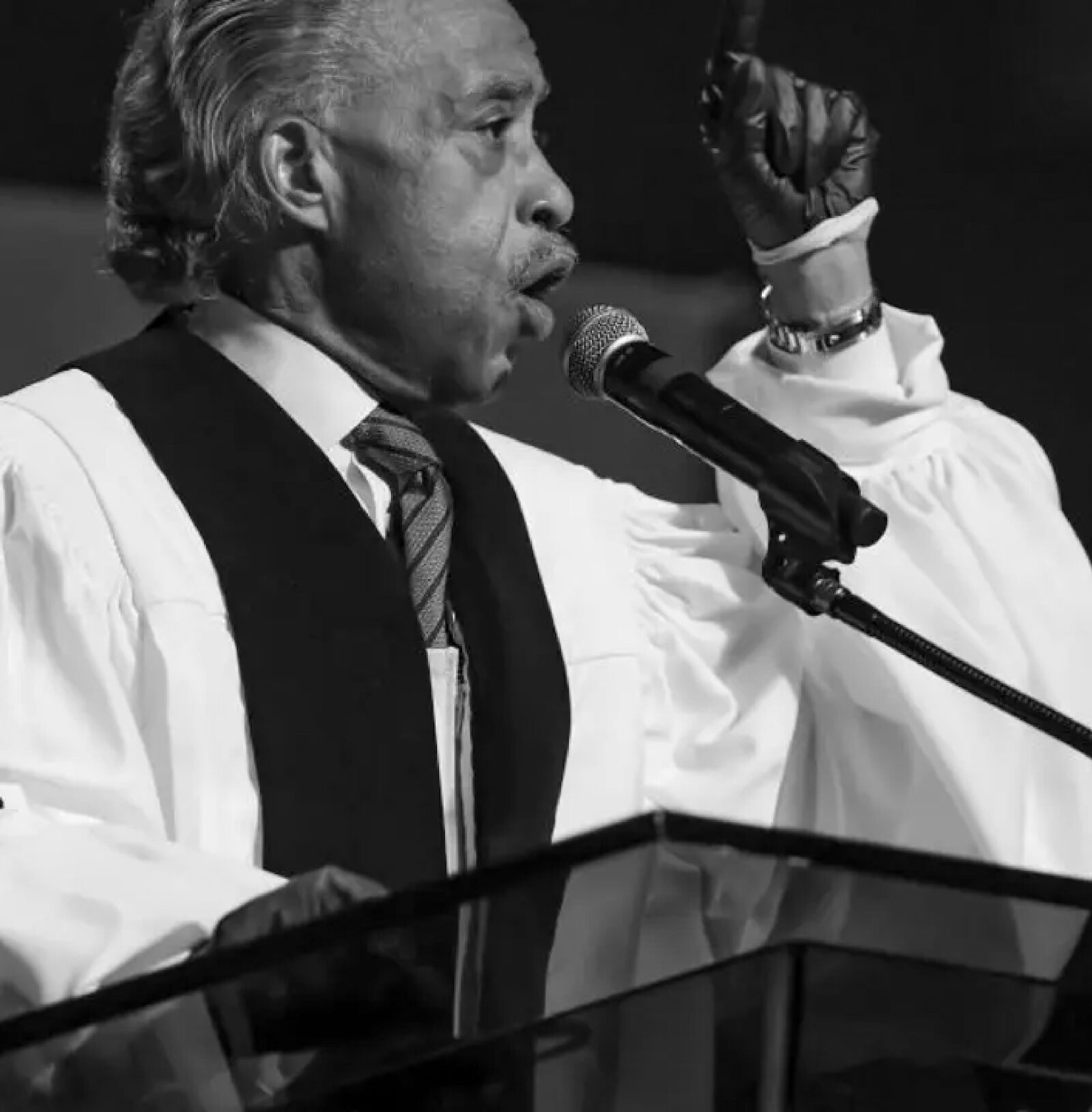
His role in the deaths of Eric Garner and George Floyd especially cemented his modern relevance. Garner’s 2014 killing on Staten Island, captured on video as he repeated “I can’t breathe,” helped propel a broader uprising against police violence. Sharpton delivered a passionate eulogy at Garner’s funeral, with reporting at the time noting his call for accountability and prosecution. Reuters later described Garner’s death as one that fueled the rise of Black Lives Matter, while Sharpton remained one of the most persistent public advocates for the family. Six years later, during the wave of protests after George Floyd’s murder, Sharpton again took center stage, delivering eulogies that connected Floyd’s death to a much longer history of Black suffocation under American institutions. At Floyd’s memorial in Minneapolis, he demanded that America “get your knee off our necks,” a line that captured both his oratorical force and his instinct for compressing structural critique into unforgettable cadence.
These funeral appearances are not incidental to Sharpton’s importance. They are part of how he remade his role. He became, in effect, the movement’s chief eulogist and translator, the person who could move between the idiom of the Black church, the fury of the street, the language of civil-rights precedent and the optics of national television. In moments of acute grief, families often turned to him because he could do several things at once: offer ritual, attract cameras, pressure prosecutors and convert private loss into public indictment. That is real political labor. It is also a form of leadership that sits somewhere between pastor, strategist, impresario and emergency responder.
Building an Institution: The National Action Network
The National Action Network made that role durable. Founded in 1991, NAN gave Sharpton something beyond personal celebrity: a repeatable institutional platform. Its website describes a modern civil-rights agenda rooted in the tradition of Martin Luther King Jr., with more than 100 chapters nationwide. Over time, the organization became a place where politicians, clergy, grieving families, union leaders and activists intersected. That matters because one of the common critiques of Sharpton in his earlier years was that he generated heat but not infrastructure. NAN was his answer. Whether or not one admires every tactic, it is difficult to deny that he built an apparatus capable of surviving beyond a single protest cycle.
His transition from activist to media figure also changed everything. By the time MSNBC launched his program in 2011, Sharpton had already spent years learning how television metabolizes conflict. Hosting PoliticsNation did not remove him from movement politics; it expanded his venue. MSNBC’s current program page still identifies him as the host of the weekend show, and he has used that perch to remain a regular presence in national political discourse. Critics have long argued that cable news domesticated Sharpton, turning him from insurgent into insider. There is some truth there. But media visibility also gave him access that earlier Black protest leaders often struggled to maintain once cameras left the street. Sharpton effectively built a pipeline between live conflict and permanent punditry.
Kingmaker Politics and Proximity to Power
The 2019 Atlantic profile about Sharpton’s “bid to be a 2020 kingmaker” showed just how far that transformation had gone. Democrats seeking credibility with Black voters were meeting with him, appearing at NAN events, and treating his approval as politically useful. The article described Sharpton not just as a protester but as a “kingmaker and validator,” someone presidential hopefuls courted because he could confer movement legitimacy—or at least the appearance of conversation with Black political constituencies. That was a long way from the tabloids and trial headlines of the late 1980s. It also reflected a broader truth about Democratic politics: no matter how many elites once dismissed Sharpton, few were willing to ignore him once he became a fixture at the junction of media, clergy, electoral politics and racial justice.
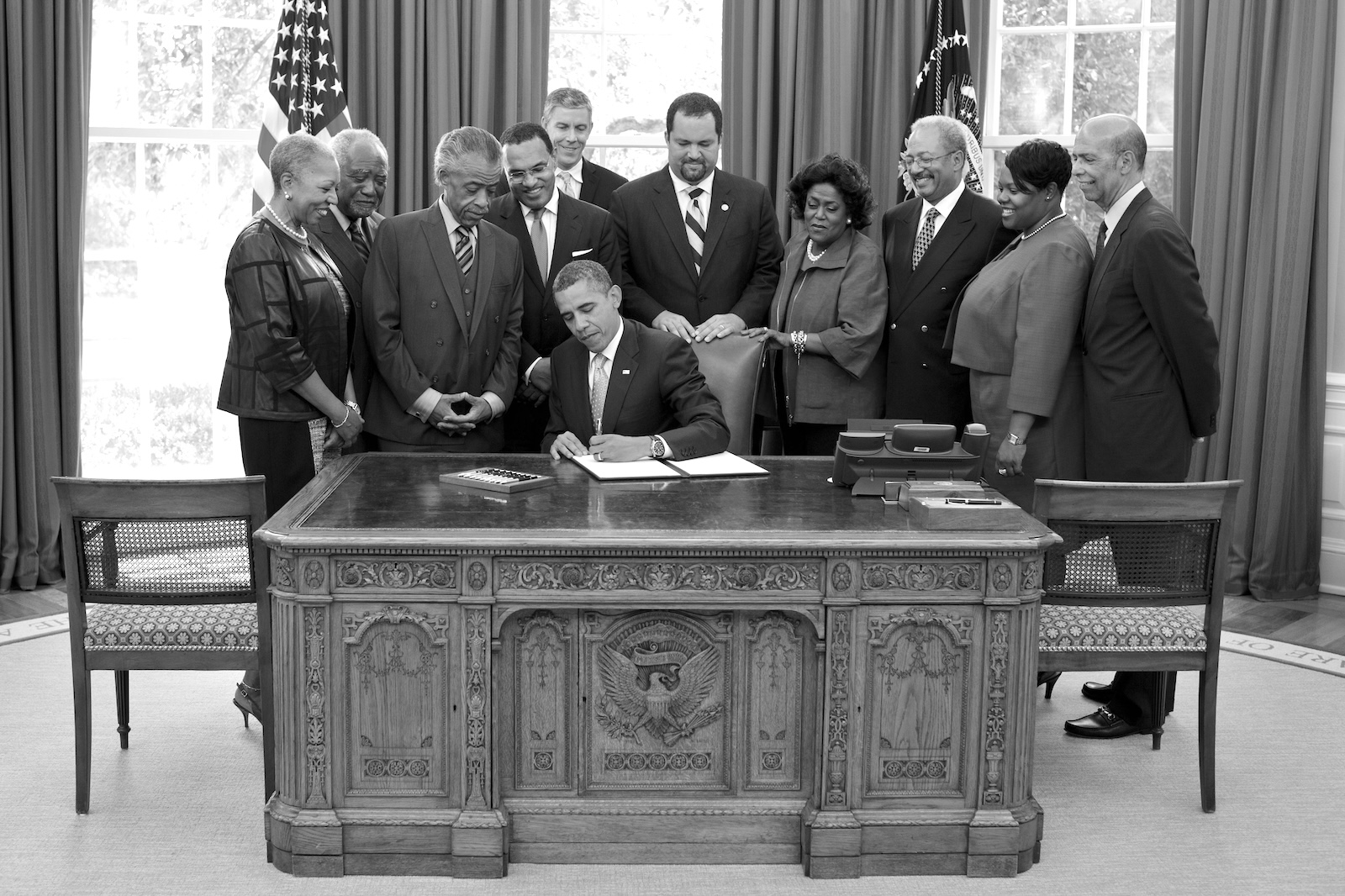
Still, the insider turn produced new criticisms. Sharpton’s detractors have long argued that proximity to power blunts his radical edge. Admirers reply that access is not betrayal if it produces leverage. Both arguments have evidence. He could bless Barack Obama while also pressing the administration on voting rights and criminal justice. He could maintain ties to Democratic elites while publicly criticizing stop-and-frisk and punitive crime politics. He could appear on TV with establishment politicians and then stand outside a funeral telling America it had a blood debt to pay. This ambiguity is not accidental. It is Sharpton’s operating method: stay close enough to power to make demands, but public enough in dissent to keep the movement credentials alive.
His more recent activism shows that the old economic-pressure politics never really disappeared. In 2025, after several large companies retreated from DEI commitments amid political backlash, Sharpton re-entered the corporate accountability arena with the same basic logic that animated Operation Breadbasket decades earlier: if institutions change because of market incentives, then civil-rights pressure must organize the market too. AP and the Guardian both reported on his meetings with Target and his pressure on PepsiCo, including explicit boycott threats. And in August 2025 he led a “March on Wall Street” timed to the anniversary of the 1963 March on Washington, linking racial justice to corporate power and economic inequality. In other words, Sharpton’s late-career relevance is not just about police killings. It is also about reviving the old Black freedom struggle’s economic flank for a new corporate age.
Between King and Malcolm: A Hybrid Ideology
There is also the question of ideology. Sharpton is often placed in the tradition of King rather than Malcolm, yet his own comments suggest something more layered. In a 2025 interview with The Guardian marking Malcolm X’s 100th birthday, Sharpton said Malcolm gave Black Americans “a sense of pride and self-definition” and argued that Malcolm’s influence reached beyond nationalist circles. That admission is useful because it clarifies a long-standing misunderstanding. Sharpton is not a simple inheritor of the classical civil-rights center. He has always been a hybrid figure: church-rooted but media-savvy, electoral but not reducible to elections, integrationist in many aims but formed in a Black political culture that understood self-definition, pride and confrontation as nonnegotiable.
Performance as Strategy
Sharpton himself seems to understand that his reputation has always rested on a fragile balance between moral force and personal controversy. The 2023 documentary Loudmouth, highlighted by WNYC and discussed by Sharpton in multiple interviews, effectively made that tension its subject. Sharpton embraced the term “loudmouth,” arguing that he had to be loud to draw attention to racism in a northern city where Black suffering was easy to ignore. That self-reading is more than brand management. It is a theory of activism. The idea is that respectability is often a luxury denied to people who are fighting for notice in a media system that values spectacle. Sharpton learned early that performance is not the opposite of politics in America; it is often the vehicle through which politics is forced into public consciousness.
Legacy and the Utility of Presence
That does not mean all spectacle is justified. But it does help explain why Sharpton has outlasted so many of the figures who once mocked him. He understood the modern attention economy before that phrase existed. He understood that television did not simply document racial conflict; it selected, framed and rationed it. He understood that families in crisis needed more than moral support—they needed amplification. He understood that politicians who publicly ignored Black pain might privately respond if enough cameras were present. And he understood, perhaps better than many of his contemporaries, that the line between movement and media was dissolving.
The harder question is whether Sharpton changed America or merely changed the way America talks about itself. The answer is both. He did not single-handedly create modern racial justice politics, and he certainly did not resolve it. But he helped keep certain issues alive through years when national attention wandered. He stood in the breach between old civil-rights institutions and the decentralized protest eras that followed. He connected the language of church and movement to the grammar of cable news. He made sure some funerals became national reckonings. He gave Democratic politicians a place to prove, perform or fake their racial conscience. And he kept insisting, sometimes brilliantly and sometimes maddeningly, that Black grievance was not a boutique issue but a central measure of American democracy.
If there is a final irony in Sharpton’s life, it may be this: a man once dismissed as a creature of hype became indispensable precisely because the country kept producing the conditions that made his style of leadership legible. Had policing become just, had racial inequality truly narrowed, had American institutions earned Black trust, Sharpton might have become a historical curiosity. Instead, the deaths kept coming, the inequities kept metastasizing, the symbolic gestures kept outrunning structural repair, and Sharpton remained unquestionably significant… A hard-edged sense of a public figure who knows how to turn grief into pressure and pressure into visibility.
More great stories
Afro Sheen, Wall Street, and the Architecture of Black Possibility
July 6, 2026
No Comments
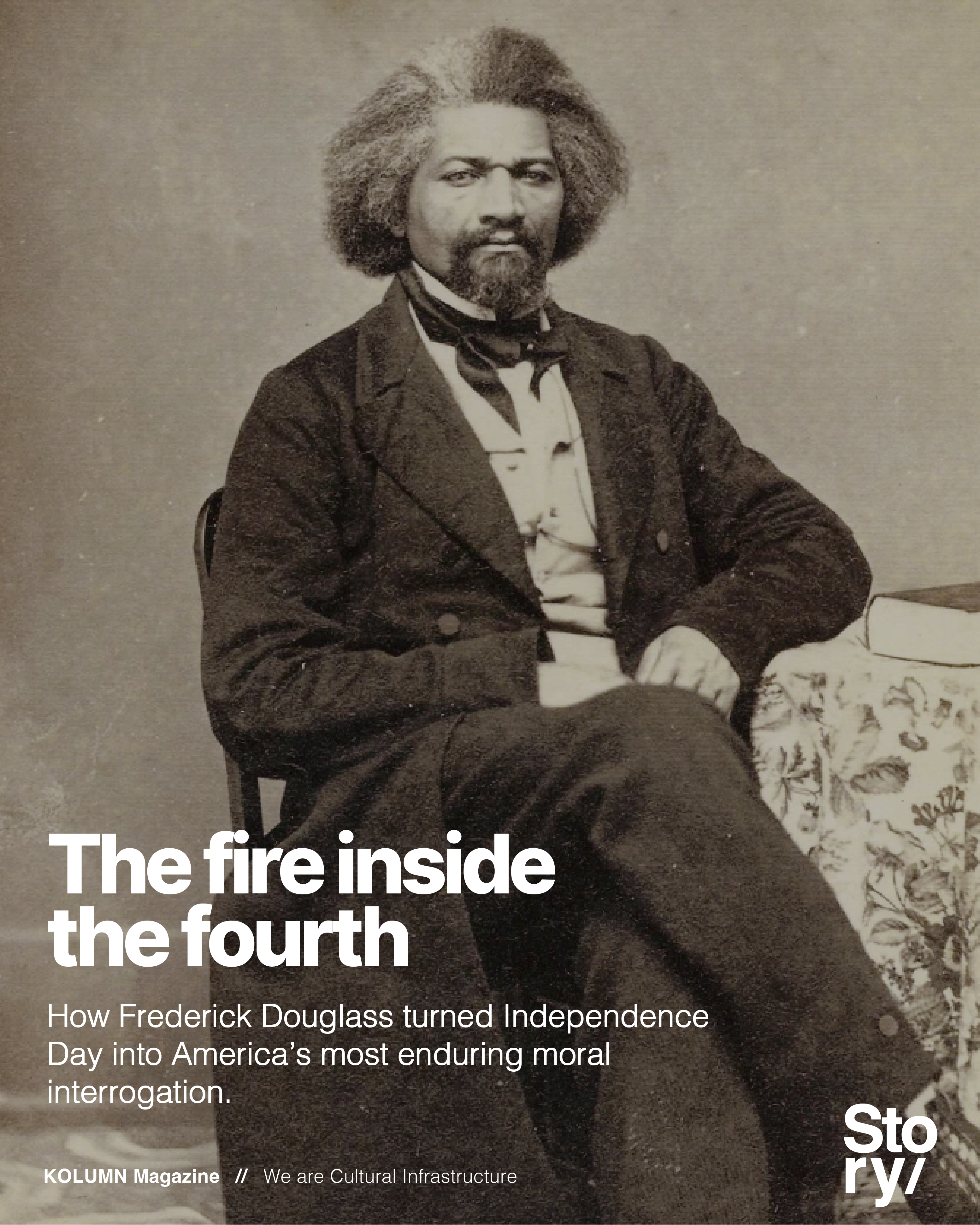
The Fire Inside the Fourth
July 5, 2026
No Comments