


He showed up to vote and kept showing up, kept participating, kept faith in the system despite those reversals.
He showed up to vote and kept showing up, kept participating, kept faith in the system despite those reversals.
By KOLUMN Magazine
Thomas Mundy Peterson is one of those Americans who should be instantly recognizable and somehow still is not. His name ought to sit easily alongside the canonical figures of Reconstruction, voting rights, and Black political life. Instead, he usually appears as a historical footnote: the man from Perth Amboy, New Jersey, who cast a ballot on March 31, 1870, and became the first African American known to vote under the authority of the Fifteenth Amendment. That description is true, but it is also too small. It captures the headline and misses the life.
Peterson’s significance is not just that he arrived first at one narrow constitutional threshold. It is that his life clarifies the distance between legal recognition and lived freedom. He was born in 1824 in New Jersey to Lucy Green, an enslaved mother, and Thomas Peterson Sr.; he grew into adulthood in a state whose racial politics were far uglier, more contradictory, and more northern than many Americans now remember. He voted at a time when the Reconstruction amendments were rewriting the nation on paper even as white resistance was reorganizing itself in law, politics, and custom. And unlike the flattened version of him that survives in many commemorations, Peterson did not simply cast one symbolic ballot and disappear. He kept participating. He served on a committee to revise Perth Amboy’s city charter. He worked, raised a family, remained active in civic life, and kept showing up in a democracy that did not consistently honor his presence.
That may be the most useful way to understand Peterson now. He was not just the first man through a newly opened door. He was an early witness to a durable American pattern: breakthrough, backlash, persistence, and the long argument over who counts.
The man before the milestone
Peterson was born on October 6, 1824, in what is now Metuchen, New Jersey. The historical record around his family reflects the same messiness that shadows so much Black life in the early republic: unstable naming conventions, incomplete documents, and the tendency of official archives to notice Black people most clearly when law, labor, or property required it. The Library of Congress notes that Peterson was born to Lucy Green, who was enslaved, and to Thomas Sr.; later commentary by historian Gordon Bond adds that Peterson’s father was not enslaved at the time of his son’s birth and that the “Mundy” name came from the farm on which he was born, not from a formal surname as we would understand it now. Bond argues that “Thomas Henry Peterson” was closer to his actual name in contemporary records, and that “Thomas Mundy Peterson” became the conventional historical rendering later.
This matters for reasons beyond trivia. The instability of Peterson’s name tells a larger truth about Black historical memory in America. Before he became a symbol, he was a man whose identity moved through systems designed by white ownership, white recordkeeping, and white political power. His “Mundy” was a trace of geography and labor. His “Peterson” belonged to family continuity. His life, like the lives of many Black Americans before and after emancipation, existed at the intersection of official designation and selfhood.
By age four, according to an older Perth Amboy history that preserved a newspaper interview and family details, Peterson’s father had moved the family to Perth Amboy. In 1844, Peterson married Daphne Reeve, whose family, like his, had roots in enslavement in New Jersey. That detail is important because it punctures one of the most persistent myths in American public memory: that slavery was a purely southern institution and that the North’s moral role in the nation’s racial story was mostly heroic. New Jersey was late to abolition, deeply compromised on Black citizenship, and hostile enough to Black equality that its legislature rejected or attempted to rescind key Reconstruction-era constitutional measures. Peterson’s life unfolded inside that contradiction.
He worked a range of jobs. The Library of Congress notes labor on ships, in sewer trench digging, and in lawn and farm maintenance. A historical account out of Perth Amboy also records that he served for years as janitor of the public school, and that he later participated in Republican political life as a county convention delegate. He was not a national officeholder, not a polished public intellectual, not a movement celebrity in the way later civil-rights memory tends to prefer. He was something more ordinary and, in its own way, more revealing: a working Black citizen trying to live fully inside a republic that had only reluctantly admitted him.
The Fifteenth Amendment and the luck of timing
The Fifteenth Amendment was passed by Congress in 1869 and ratified on February 3, 1870. Secretary of State Hamilton Fish officially certified it on March 30, 1870. The amendment prohibited the denial or abridgment of the right to vote “on account of race, color, or previous condition of servitude.” President Ulysses S. Grant called its adoption “the greatest civil change” since the nation’s founding. It was the last of the Reconstruction amendments, meant to transform emancipation from a negative freedom from slavery into a more active political citizenship.
“He came to be that first voter under the Fifteenth Amendment by dumb luck, but everything else he did after was a matter of his own agency.”
The next day, March 31, 1870, Perth Amboy held a local election over whether to revise the city charter or abandon it for township government. Peterson, who later recalled that he had not initially thought about voting that morning, was encouraged by local men including J. L. Kearny to go to the polls and exercise what one of the sources calls “a citizen’s privilege.” He chose the “revised charter” ballot. His side won, 230 to 63. Later, he was appointed to the committee of seven tasked with revising the charter itself.
There is something almost cinematic about the timing. The amendment is certified on March 30. A municipal referendum takes place on March 31. Peterson goes to vote. History, looking backward, assigns inevitability to events like this. But they were not inevitable. They were contingent. Local. Slightly improvised. Dependent on calendars, personalities, political moods, and the fact that one Black man decided to take up a right newly secured in law.
That contingency has sometimes made Peterson’s story vulnerable to misunderstanding. Some accounts call him the first Black voter in American history. That is not accurate. Black men had voted in some northern jurisdictions before 1870, including in New Jersey itself under earlier property-based rules before those rights were stripped in 1807. Black political participation had also occurred during Reconstruction before Peterson’s ballot; the deeper point is that Peterson was the first African American known to cast a ballot under the newly operative authority of the Fifteenth Amendment. That distinction is not a demotion. It is a precision. And precision matters, especially in a historical landscape where Black achievements are often either inflated into legend or minimized into obscurity.
Peterson’s case illustrates a subtler truth. The amendment did not create Black political aspiration from scratch. It nationalized a principle that Black Americans had been asserting for generations: that citizenship without the ballot was structurally incomplete. Peterson’s significance lies in embodying that transition point between Black struggle before constitutional recognition and Black struggle after it.
New Jersey’s dirty little secret
Thomas Mundy Peterson’s story also forces a reckoning with New Jersey. Popular memory often places the fiercest resistance to Black citizenship below the Mason-Dixon Line, but New Jersey’s record complicates that comfort. The state did not initially ratify the Thirteenth Amendment abolishing slavery. It ratified and then tried to withdraw its ratification of the Fourteenth Amendment. It voted against ratifying the Fifteenth Amendment in 1870, even though Peterson cast his famous ballot in Perth Amboy the day after the amendment became operative nationally. The state legislature would not ratify the Fifteenth Amendment until 1871.
That contradiction is not incidental; it is central. Peterson’s vote did not occur in a state leading the country toward racial justice. It occurred in a state being dragged there by federal constitutional change. New Jersey’s ambivalence reveals how deeply anti-Black politics extended across the North and how incomplete any moral geography of the Civil War era becomes if it imagines white northern resistance as marginal.
This is part of why Peterson matters so much beyond the novelty of “firsts.” His ballot exposes the way federal progress and local prejudice can coexist. Formally, the Constitution had changed. Socially, the country had not changed enough. Peterson himself later recalled one white man seeing him vote, tearing up his own ballot, and declaring the franchise worthless if a Black man could participate. That image is almost too perfect as a snapshot of white reaction: not merely disagreement, but the belief that democratic value is diminished when Black people access it.
And yet the scene did not end there. Peterson voted anyway. His side won anyway. He was appointed to a charter-revision committee anyway. That “anyway” is the heartbeat of the story.
What his vote actually meant
It is easy to over-romanticize a first ballot. A single act at the polls does not dissolve structures of racial power. The Fifteenth Amendment itself would prove painfully vulnerable in practice. Within a generation, white supremacist governments across the South and beyond had built a machinery of disenfranchisement through violence, literacy tests, poll taxes, administrative sabotage, and open terror. The National Archives describes the Reconstruction amendments as protections that quickly eroded into “second class” civil rights under Jim Crow. Histories of voting rights routinely show that the promise of 1870 was not meaningfully enforced for many Black Americans until the Voting Rights Act of 1965, nearly a century later.
So Peterson’s vote was not the arrival of full democracy. It was evidence that the constitutional battlefield had shifted. Before the amendment, Black suffrage could be treated as a local exception or revocable privilege. After the amendment, the exclusion of Black voters was placed in direct conflict with national constitutional language, even if the nation often failed to enforce its own promise. Peterson’s ballot was a tiny public demonstration of that new terrain.
This is also why the distinction between “first Black voter ever” and “first Black voter under the Fifteenth Amendment” matters in a richer way than fact-checking alone suggests. The second phrasing locates him where he belongs: at the hinge between emancipation and Reconstruction citizenship. Peterson becomes legible not as an isolated curiosity, but as part of the larger legal and political architecture of a country trying, and often failing, to reinvent itself after slavery.
He did not vanish after the applause
One of the most frustrating habits in American public history is the way it freezes Black people inside their most convenient symbolic moment. Peterson voted, so he becomes The Voter. Rosa Parks sat, so she becomes The Woman on the Bus. The simplification makes commemoration easier and citizenship harder to understand.
Peterson’s life after March 31, 1870, is therefore essential. Historical sources indicate that he stayed active in Perth Amboy civic life, continued voting, worked as the custodian of School No. 1 from the early 1870s into the decade, served as a delegate to a Republican county convention, and maintained a visible place in the local community. One New Jersey state educational resource notes that he remained active in civic affairs throughout Middlesex County and Perth Amboy for the rest of his life.
The detail about the school matters more than it may seem. Public schools are where democratic states reproduce themselves, where civic belonging is ritualized, sorted, and narrated. That the first Black man known to vote under the Fifteenth Amendment later worked in Perth Amboy’s first public school building is almost too neat as a metaphor, but the fact is real enough. The building eventually became the Thomas Mundy Peterson School, linking his name not just to voting but to the local infrastructure of public life.
There is also a political maturity in what followed his famous ballot. Peterson did not treat voting as a one-off performance of personal dignity. He participated in the unglamorous work that makes self-government real: charter revision, party activity, jury service in some accounts, local labor, church life, neighborhood presence. He embodied something that current political discourse often forgets: democracy is not only about breakthrough elections or national heroes. It is also about people who keep participating after the cameras leave.
The medal and the politics of recognition
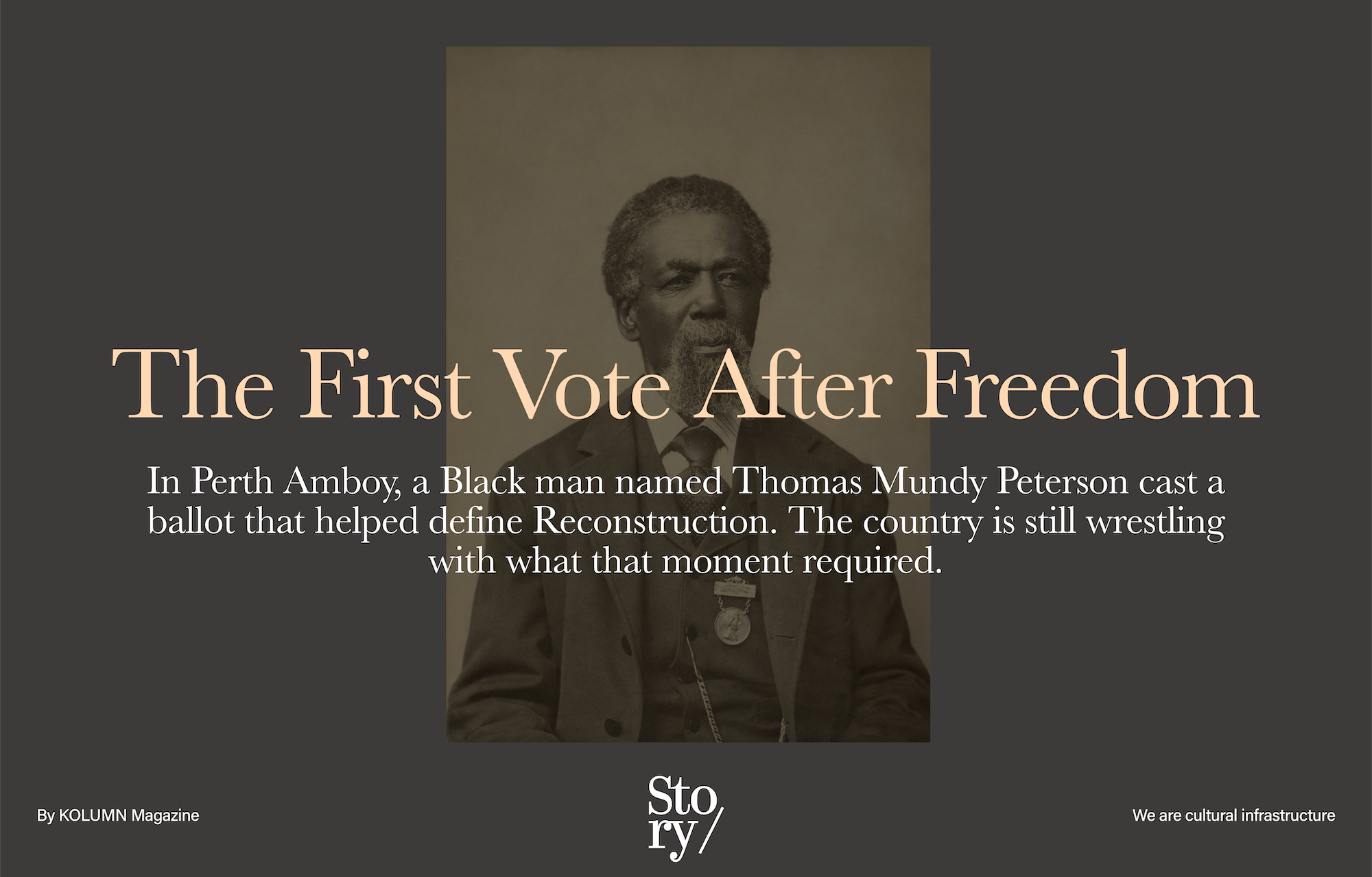
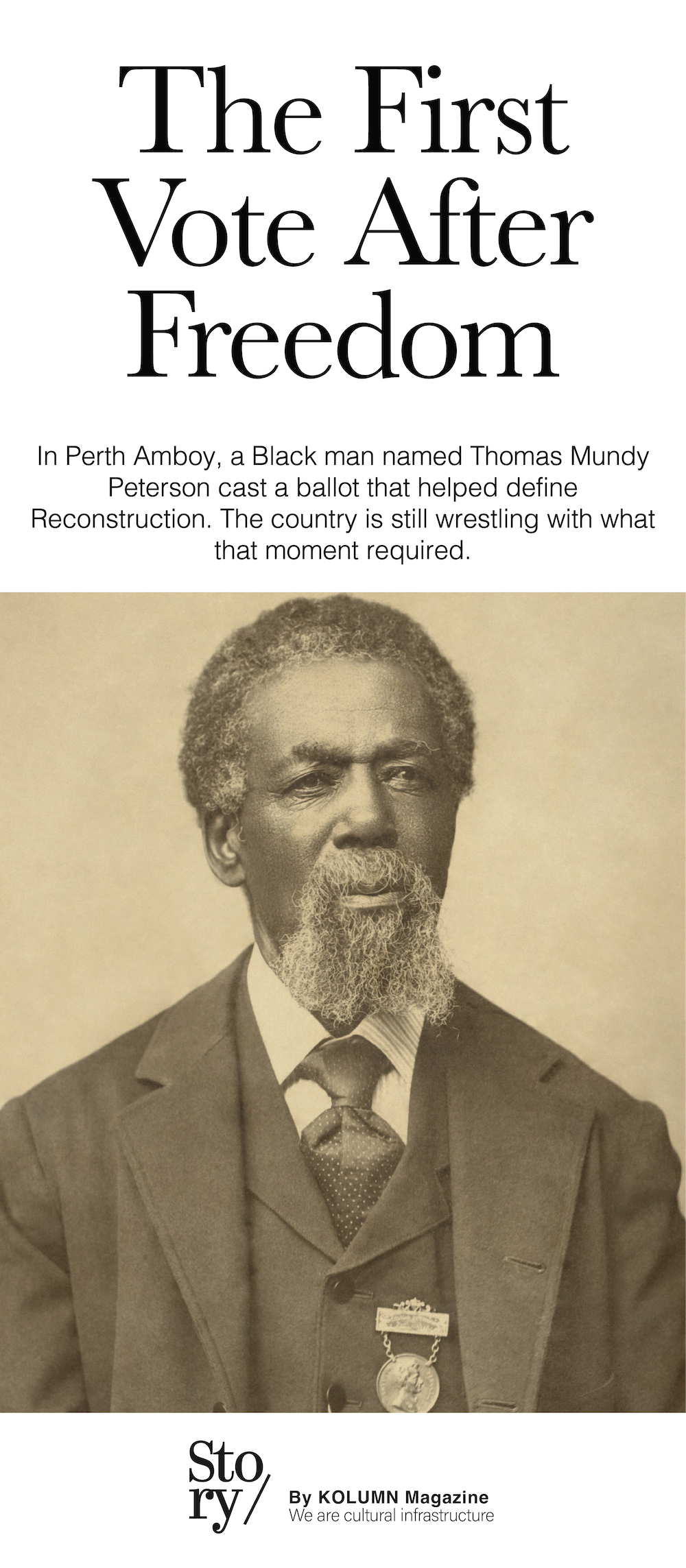
In 1884, the citizens of Perth Amboy presented Peterson with a medal commemorating his historic vote. Smithsonian records describe the cabinet-card portrait made that year: Peterson appears in a three-piece suit with the medal attached to his vest, a dignified image that is now part of the collection of the National Museum of African American History and Culture. The reverse inscription identified him as “the first colored voter in the United States under the provisions of the Fifteenth Amendment.” The medal itself eventually made its way to Xavier University of Louisiana.
“Thomas Mundy Peterson’s vote marked the beginning of a political, social, and cultural shift in the United States of America.”
The medal is fascinating because it is at once honorable and revealing. On one level, it is a genuine civic tribute. On another, it highlights the paternalism of postwar recognition. Peterson received a formal token for doing something that should have required no civic bravery at all: voting. Gordon Bond, the historian who has done substantial work on Peterson’s life, put it memorably in a Library of Congress comment: people in Perth Amboy were pinning a medal to his coat for having done something that in other parts of the country might have gotten him lynched.
That line is brutal and clarifying. It tells us that recognition and danger were never far apart. Peterson’s medal was not just a local bauble; it was evidence of the strange American habit of ceremonially honoring Black democratic participation while failing to secure it as ordinary. To celebrate a Black man’s right to vote as extraordinary is, in part, to admit how non-normal that right remained.
And yet one should not dismiss the medal entirely as hollow symbolism. Symbolic objects matter. They encode public memory. They create archives. They force future generations to ask why this man, on this date, mattered enough to preserve in silver, gold, bronze, or photographic paper. The trouble is not that Peterson was commemorated. The trouble is that for so long he was commemorated locally while remaining nationally obscure.
Poverty, memory, and the American afterlife
For all the civic praise attached to Peterson’s name, his later years and his family’s circumstances complicate any triumphal reading of his life. The Library of Congress account notes that because of his family’s financial instability, his grave went for decades without a gravestone until members of St. Peter’s Episcopal Church dedicated a marker in 1959. That delay is telling. Americans are often skilled at posthumous praise and uneven at material care. Peterson could be historic enough to remember and still poor enough to be neglected.
He died on February 4, 1904. His wife, Daphne Reeve Peterson, had died in 1891. Their shared gravestone now identifies him by the achievement that made him historically legible to the nation: first Black voter in the United States under the Fifteenth Amendment, member of the committee to revise the city charter. There is dignity in that inscription, but also a kind of compression. A life of work, marriage, local participation, and survival narrows into a few lines carved in stone.
Maybe that is inevitable. Tombstones are short. But journalism does not have to be. Historical writing does not have to be. That is partly why Peterson deserves fuller treatment now. He belongs to a lineage of Black Americans whose lives are usually invoked only when the nation wants a quick usable past. He deserves something more difficult: a place in the broader narrative of how Black citizenship was built, contested, mocked, institutionalized, and repeatedly attacked.
Why Peterson still feels current
To write about Thomas Mundy Peterson in 2026 is not merely to tell a Reconstruction story. It is to confront the endurance of the Reconstruction argument. The legal architecture changed in 1870, and yet the right he exercised still sits inside a political system that repeatedly tests, narrows, or burdens access to the ballot. The Voting Rights Act of 1965 addressed many of the obstacles that emerged after Reconstruction, but later court decisions and state-level policy shifts have weakened key protections. The Atlantic warned a decade ago that the Voting Rights Act’s anniversary offered “not a lot to celebrate” because new local election laws were making it harder for Americans of color to vote. More recently, CREW reported that the loss of preclearance protections created risks for millions of Black voters in Georgia, showing how voting rights remain vulnerable not only to old suppression tactics but to new administrative threats.
That continuity is what makes Peterson more than a ceremonial figure for Black History Month posts or civic-anniversary speeches. His life marks the opening move in a constitutional struggle that still has not ended. The question in 1870 was whether Black male citizenship would have enforceable political substance. The question now is different in form but related in substance: whether the nation treats the franchise as a right to be broadly secured or a battlefield to be constantly narrowed.
And there is another current quality to Peterson’s story. He represents a kind of citizenship that contemporary American politics often undervalues because it is neither spectacular nor cynical. He did not become iconic by rejecting the system wholesale; he became significant by entering it, insisting on his place in it, and continuing to act like his participation mattered. In a moment when democratic exhaustion is common and performative disengagement can masquerade as sophistication, Peterson offers a different grammar of political seriousness.
The danger of “firsts”
American journalism loves a first. The template is irresistible: identify barrier, narrate breach, celebrate progress. But “firsts” can be misleading if they become a substitute for structural analysis. A first can suggest that the hard part is over, when in fact the hard part may have just begun. Peterson’s ballot is a perfect case. It was a milestone, yes. It was also an opening scene in a much longer national conflict over Black suffrage, federal enforcement, racial violence, and democratic legitimacy.
There is also a risk that “firsts” individualize collective struggle. Peterson mattered because of what he did, but also because millions of Black people before him and around him made his action historically meaningful. The amendment he voted under was not a gift from above; it emerged from Black resistance, military service, political organizing, abolitionist pressure, and the remaking of national power after the Civil War. Peterson’s first ballot belongs inside that collective story.
Seen this way, Peterson’s obscurity is not just an oversight. It reflects a broader discomfort in American memory with Reconstruction itself. Reconstruction asks too much of national mythology. It insists that democracy was fundamentally revised by the claims of formerly enslaved people. It requires acknowledging that Black Americans were not passive recipients of freedom but active authors of new constitutional meaning. And it forces Americans to admit how quickly white institutions moved to sabotage those gains. Peterson is a doorway into all of that, which may be one reason he is still not more widely known.
What Perth Amboy remembered that the nation did not
To the credit of Perth Amboy and New Jersey institutions, Peterson has not been entirely forgotten. The city has marked Thomas Mundy Peterson Day, installed plaques, renamed a school in his honor, and supported commemorative programming. A park now bears his name, and state historical materials continue to teach his story. The local memory work matters. In many cases, local institutions preserve what national narratives neglect.
But local preservation is not the same as national integration. Peterson remains too absent from the mainstream story Americans tell about voting rights. The usual chronology leaps from emancipation to the Fifteenth Amendment to disfranchisement to Selma, often leaving out the human beings who occupied the fragile in-between period when Black political citizenship was newly constitutional and deeply contested. Peterson belongs in that middle. He humanizes a transition that can otherwise seem abstract.
He also complicates the clean regional story the nation prefers. His life says that the North was not innocent, that New Jersey was not especially enlightened, and that Black civic advancement often took place in spaces where law and resentment lived side by side.
The enduring lesson
The cleanest way to misunderstand Thomas Mundy Peterson is to treat him as the answer to a trivia question. Who was the first African American to vote under the Fifteenth Amendment? Thomas Mundy Peterson. Fine. Correct. Incomplete.
The better way to understand him is as a measure of the American democratic project itself. He was born into the afterlife of slavery in a northern state. He came of age in a nation where Black freedom existed in unstable fragments. He cast a ballot at the start of Reconstruction citizenship. He endured racist contempt in the very act of voting. He participated in local government anyway. He was honored, then under-remembered. He was turned into a symbol, though his real importance lies in how stubbornly human his story remains.
His legacy is not simply that he voted first under a new amendment. It is that he understood, instinctively or explicitly, that citizenship had to be practiced to become real. He did not wait for perfect conditions. He did not mistake backlash for defeat. He took the ballot seriously before the nation had learned to do the same for him.
That is why Peterson belongs in the present tense. Every new debate over voter access, every attempt to narrow participation, every pious speech about democracy that avoids naming who has historically been excluded from it, returns us to the ground he stood on in Perth Amboy in 1870. His life reminds us that democracy in America has rarely expanded because exclusion faded naturally. It expanded because people entered institutions that were not built for them and acted as though they had every right to be there.
Thomas Mundy Peterson did that the day after the Fifteenth Amendment became operative. The country has been arguing with his ballot ever since.
More great stories
Afro Sheen, Wall Street, and the Architecture of Black Possibility
July 6, 2026
No Comments
The Fire Inside the Fourth
July 5, 2026
No Comments