






I represent all of my figures with dignity and regal opulence.
I represent all of my figures with dignity and regal opulence.
By KOLUMN Magazine
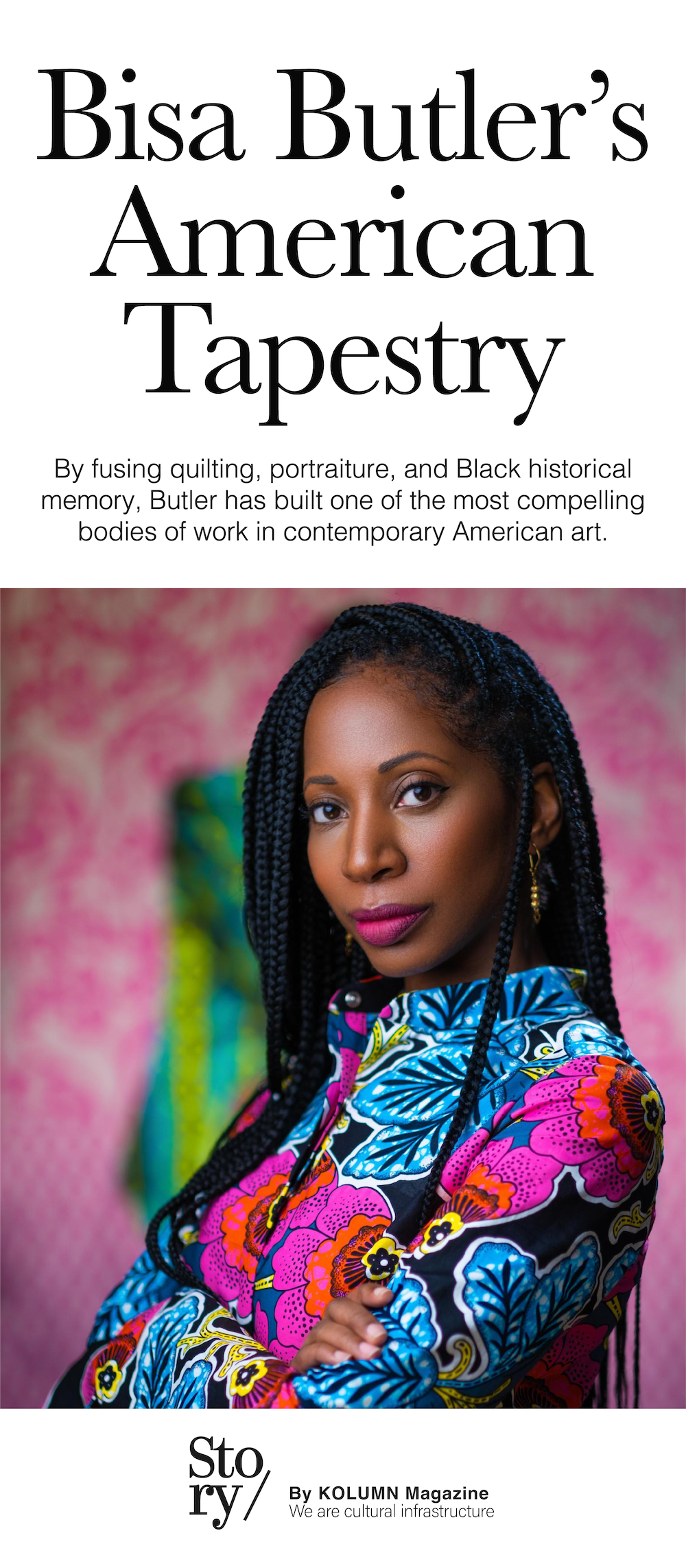
There is a tempting, tidy way to talk about Bisa Butler. You may say she “elevated quilting.” You may say she “blurred the line between art and craft.” You may say she makes portraits out of fabric that look almost impossibly alive. All of that is true. It is also incomplete. Butler’s real significance lies not simply in technique, though her technique is staggering, or in medium, though she has forced museums and critics to take quilting more seriously. It lies in what she does with visibility itself. She takes people who were flattened by history, overlooked by institutions, or never identified in the first place, and gives them scale, texture, color, and presence. She makes them impossible to pass by.
Born in 1973 in Orange, New Jersey, Butler came to art through painting, earned a BFA at Howard University, later completed an MA in arts education at Montclair State University, and spent more than a decade teaching high school art before becoming a full-time studio artist. The story matters because it helps explain the unusual authority of her work. She was trained in formal art discourse, steeped in Black visual traditions at Howard, shaped by family practices of sewing and storytelling, and sharpened by years in classrooms where art had to communicate, not merely impress. Butler did not stumble into quilting as a charming detour. She arrived there through family memory, institutional study, and aesthetic conviction.
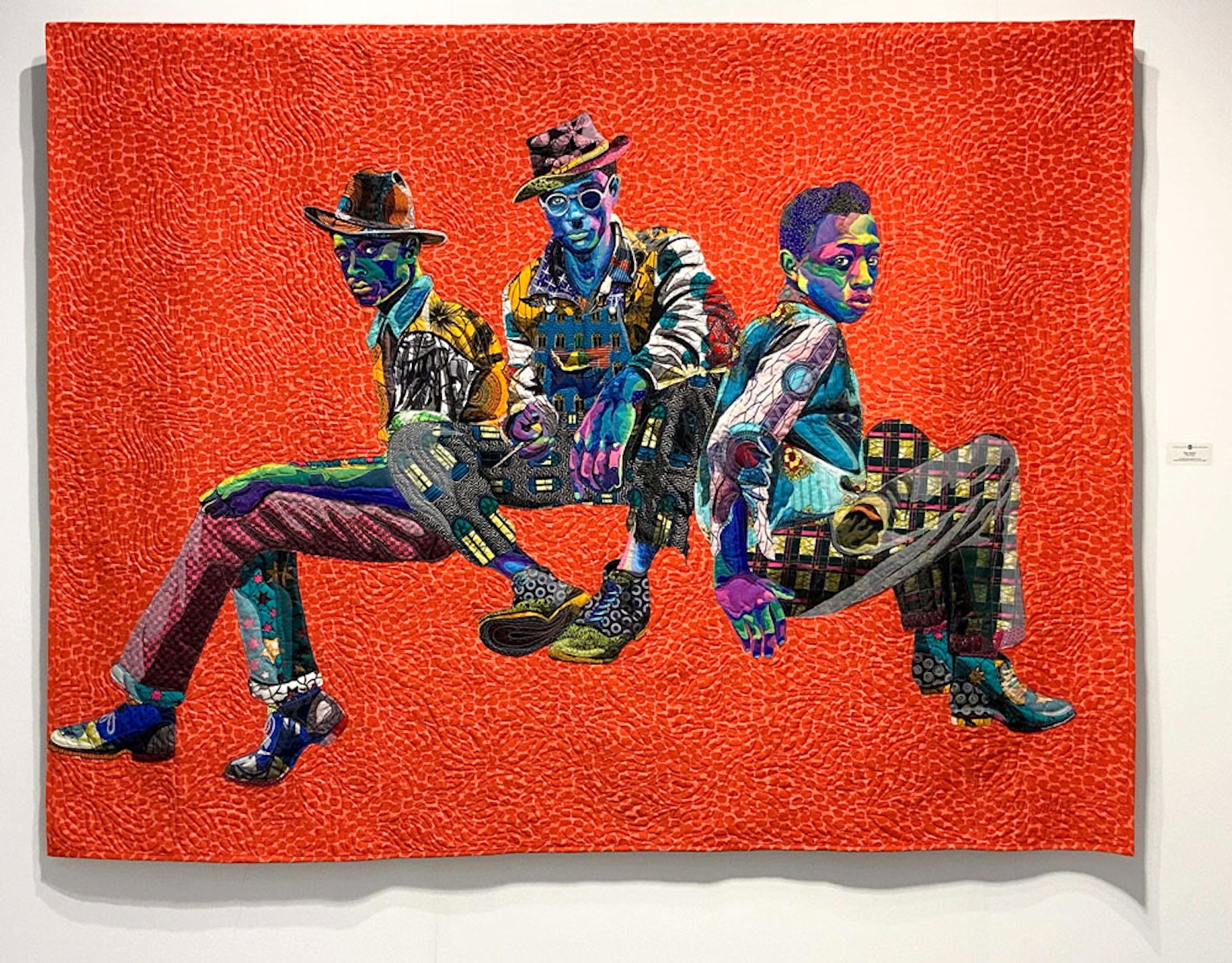
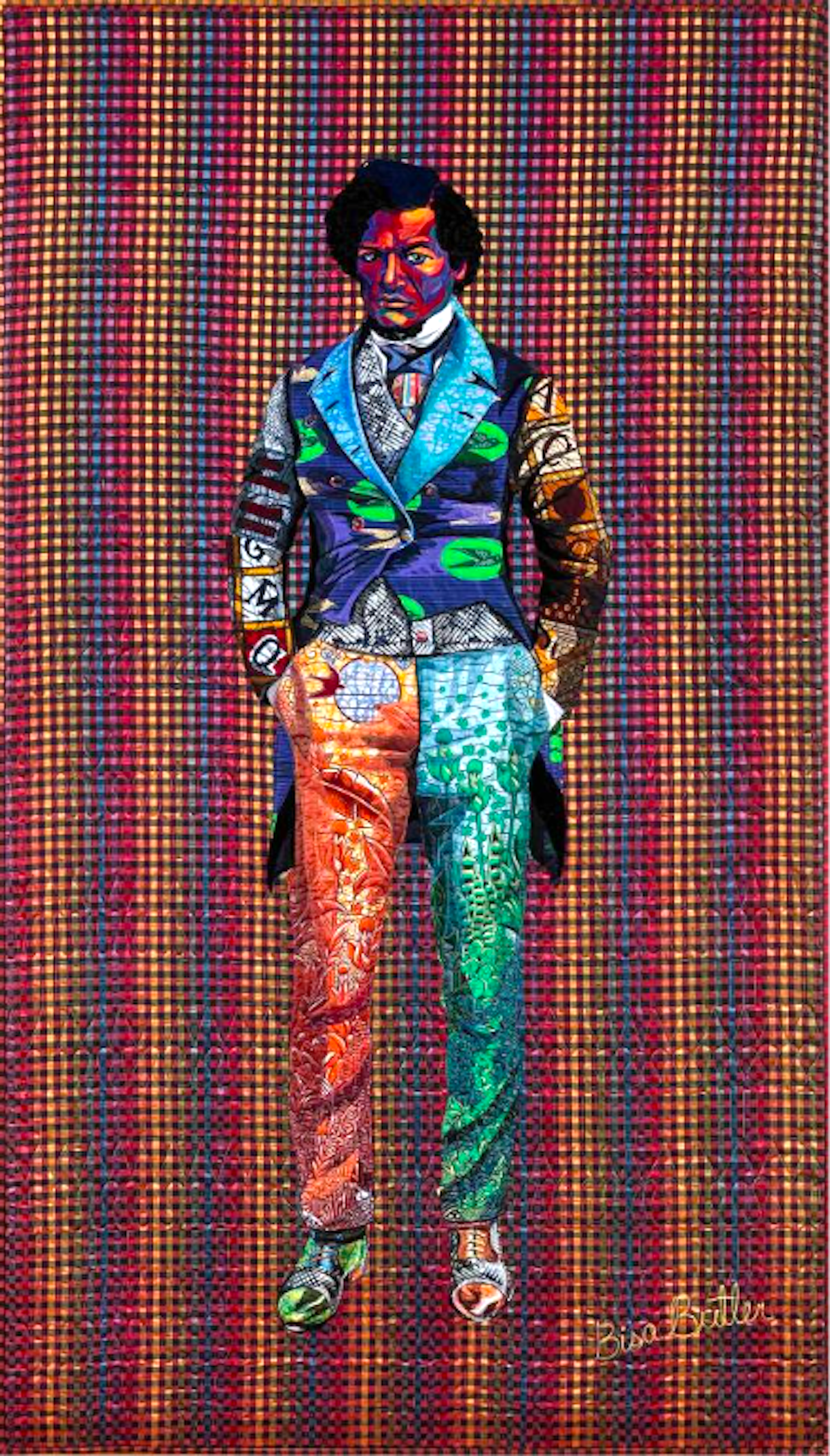
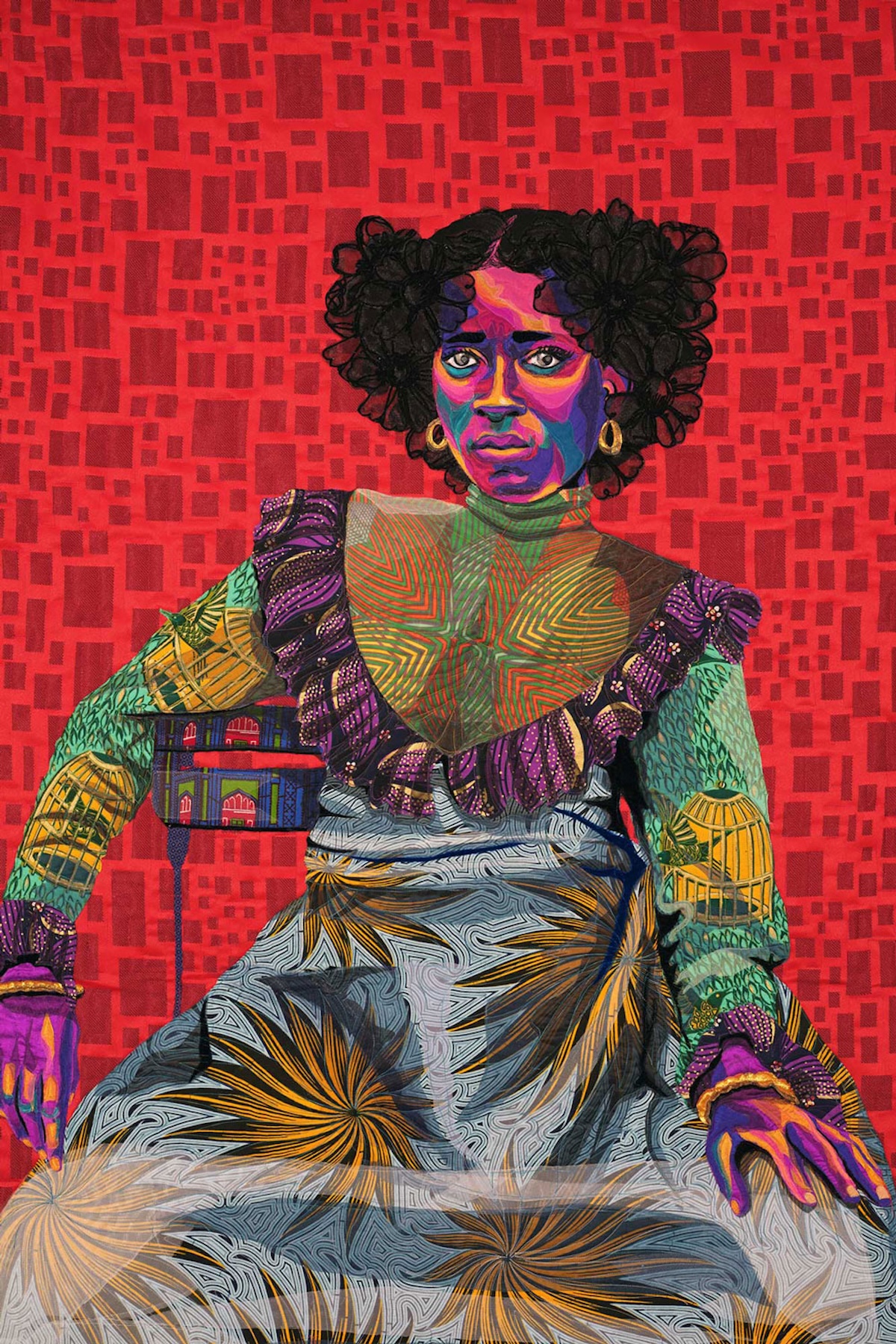
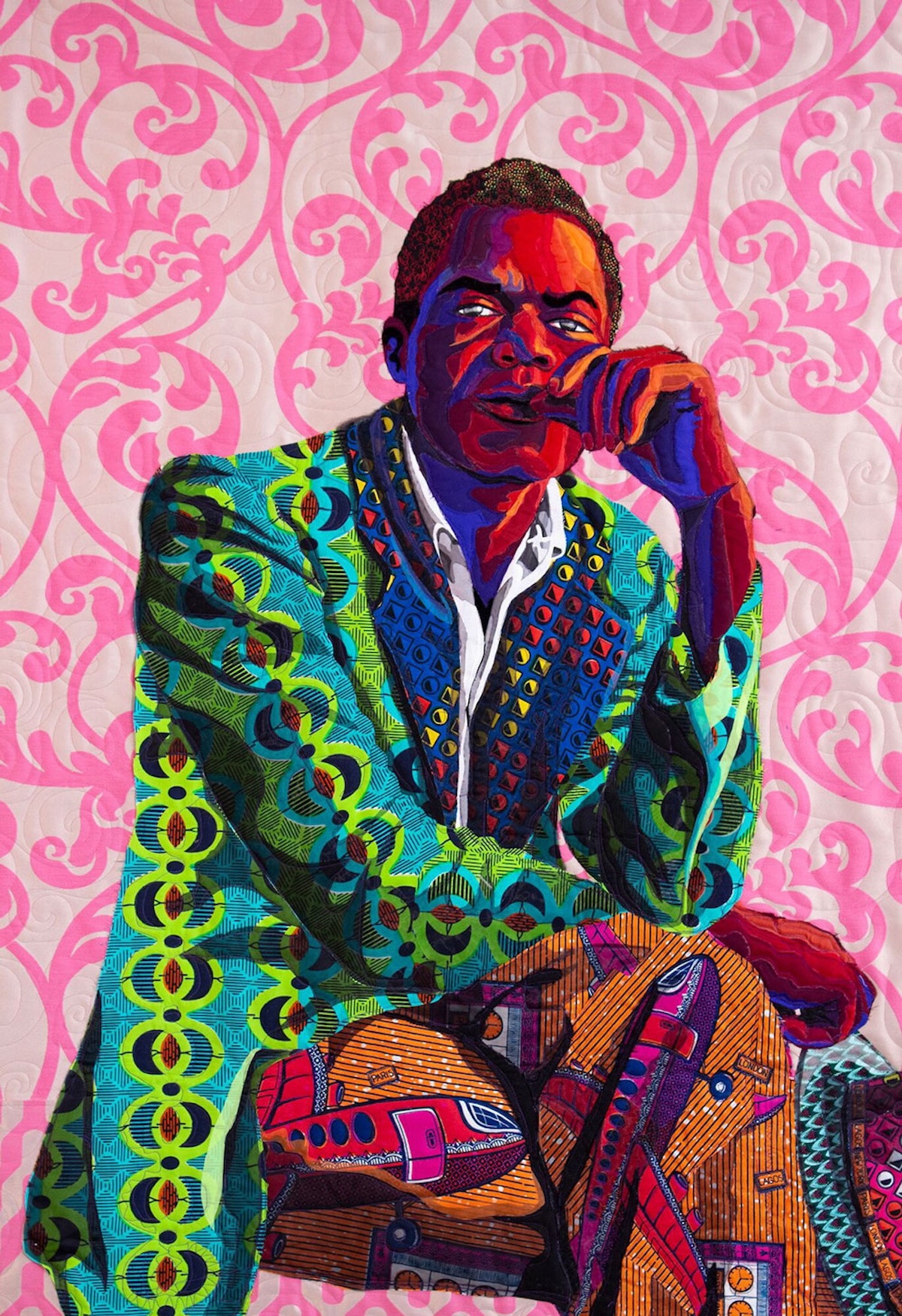
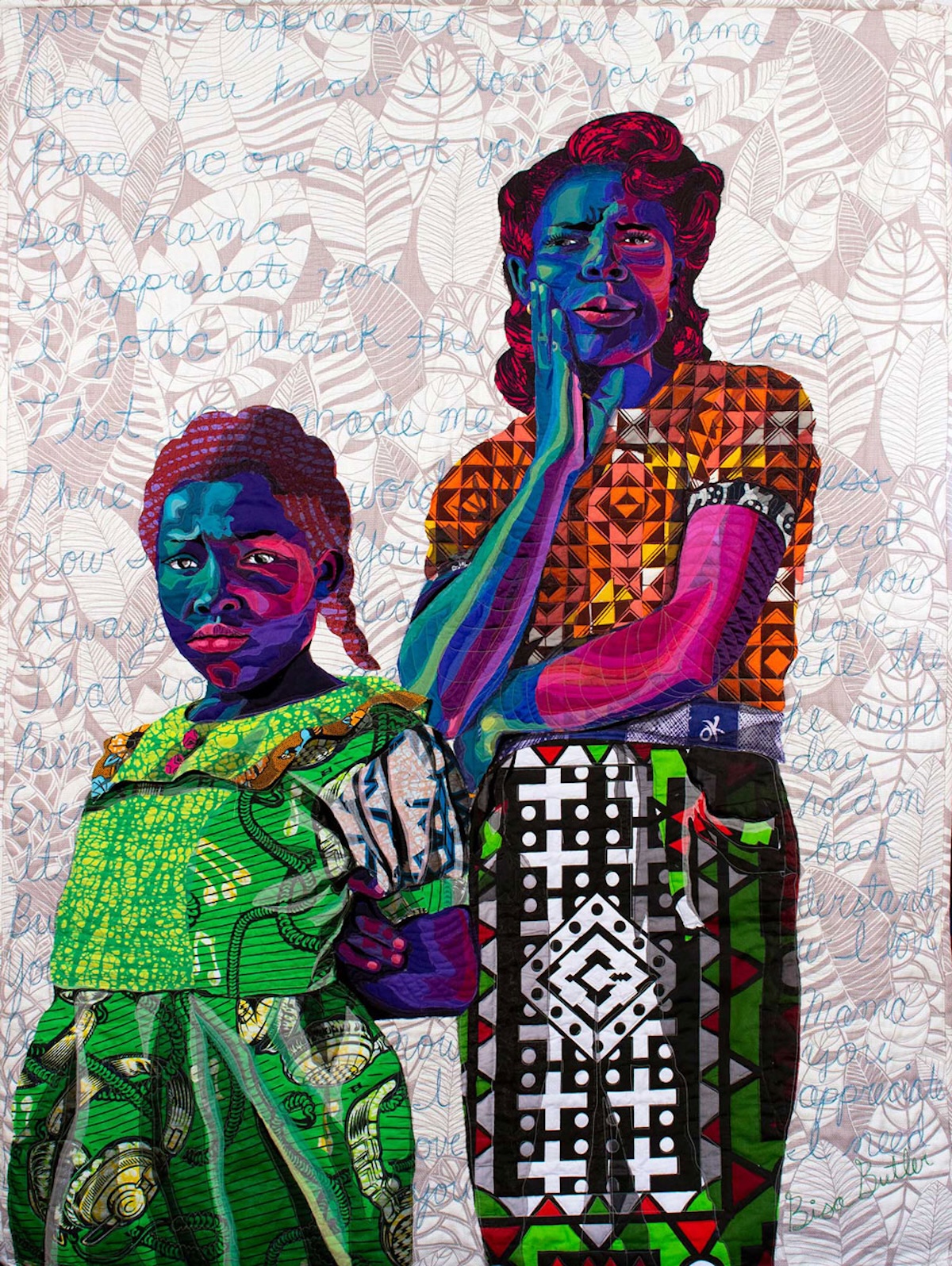
Her portraits are often based on historical photographs, but they are not nostalgic exercises. They are acts of reanimation. Butler enlarges black-and-white images into works that pulse with saturated purples, acid greens, flaming oranges, cobalt blues, lace, velvet, chiffon, kente cloth, and Dutch wax prints. In her hands, fabric behaves like paint, thread behaves like line, and the quilt becomes both archive and argument. She has described her work as telling the African American side of the American story, and the consistency of that mission is what turns her oeuvre from visually dazzling to culturally consequential.
“I represent all of my figures with dignity and regal opulence.” (Toledo Museum of Art eMuseum)
That sentence is one of the cleanest keys to Butler’s art. Dignity is not an accessory in her work; it is the organizing principle. Regal opulence is not just an aesthetic choice; it is a corrective. In a culture where Black life has so often been documented through injury, deprivation, criminalization, or sociological distance, Butler insists on splendor. Even when she addresses pain, she refuses degradation. Her people stare back. They do not beg for entry into the canon. They arrive as if they owned the room all along.
The making of an artist, and the making of a language
Butler’s biography is unusually revealing because the themes in her work are braided directly into her life. Her father was born in Ghana and served as a college president; her mother, a French teacher, was from New Orleans and was raised in Morocco. That family background gave Butler what might be called a diasporic literacy long before the art world had a neat phrase for it. In a 2023 NPR interview, she described growing up around silk, satin, lace, gabardine, woven African prints, and Dutch-African wax fabrics, and spoke of her portraits as, almost inevitably, portraits of the diaspora. The textiles in her work do not function as decorative excess. They are biography, geography, inheritance, and language.
Howard University was central to that formation. Butler studied painting there, but Howard also gave her an intellectual and aesthetic framework rooted in Black art history rather than in the default hierarchies of white institutions. Howard’s own profile of Butler notes the importance of AfriCOBRA’s influence on her practice, especially the movement’s insistence on positive, self-defined images of Black life. You can see that influence in Butler’s fearless palette and in the ideological clarity of her portraits. The color is not incidental. It is philosophical. It refuses the assumption that realism must mean obedience to literal skin tone. Instead, emotion, spirit, ancestry, and inner life take precedence.
That philosophy deepened when Butler shifted from painting to quilting during graduate study. According to the Gordon Parks Foundation and museum materials, the pivot came when she made a quilt based on a wedding photograph of her grandparents while in a fiber arts class. That work, Francis and Violette (Grandparents), has become foundational in telling her story, and for good reason. It was not simply an early experiment. It was a revelation. Through fabric, Butler found a way to combine portraiture, family memory, inherited domestic skill, and Black cultural history in one form. What had seemed separate in painting became united in cloth.
There is something almost poetic about that origin point. Butler had grown up looking at black-and-white photographs with her grandmother, hearing stories about the people in them. Those scenes of family narration later became formal method. Her mature work often begins with photographs, many vintage and some anonymous, but she does not treat them as dead documents. She treats them as openings. The gap between what the archive records and what the archive withholds is where her imagination moves in. Cloth lets her fill silence without falsifying history. The result is not documentary reproduction. It is interpretive restoration.
What Butler does to the black-and-white photograph
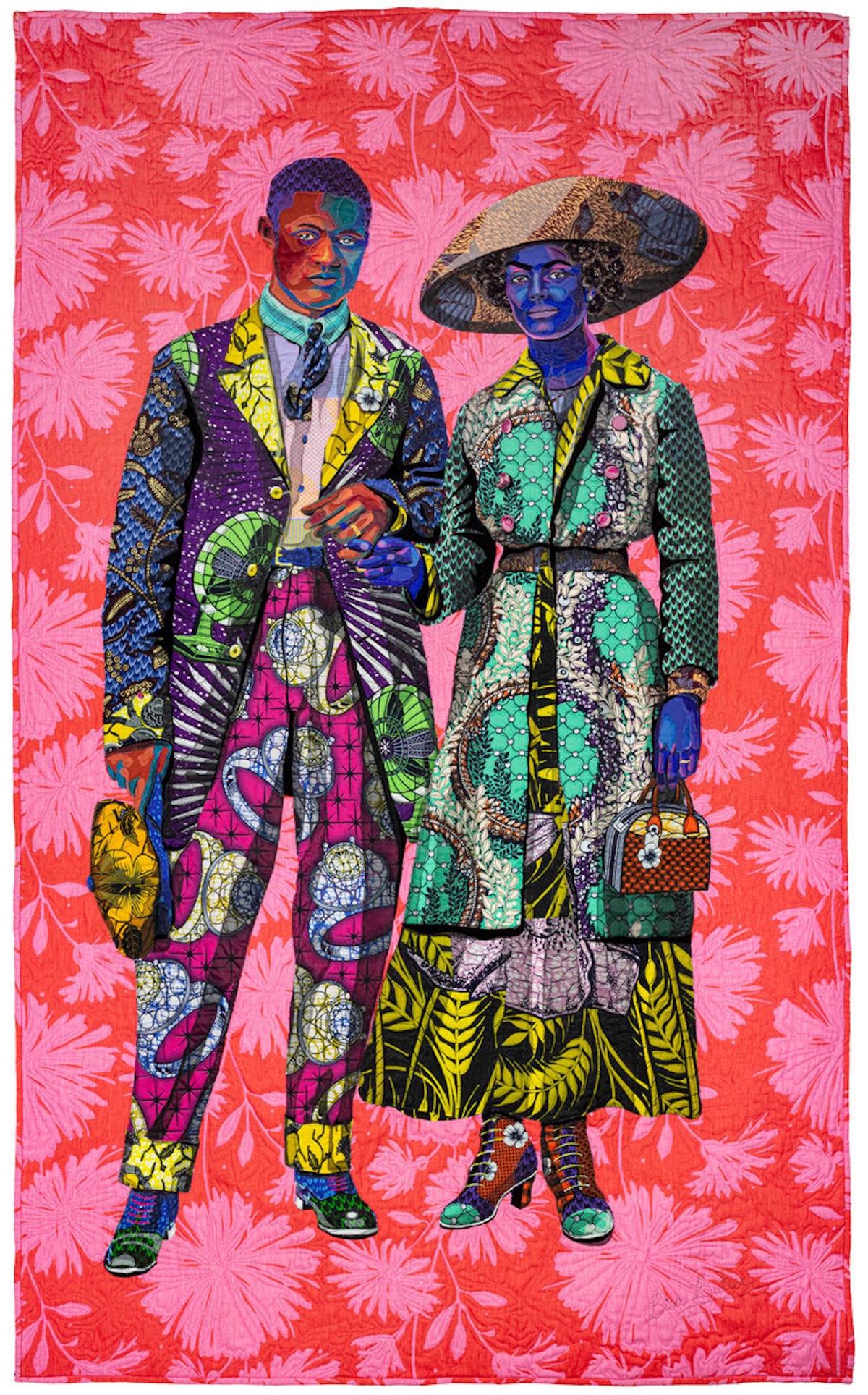
One of the most remarkable things about Butler’s work is the way it changes the emotional temperature of historical photography. So many of the source images she uses were originally monochrome, modest in scale, or shaped by documentary conventions that can feel cold to contemporary viewers. Butler enlarges them, saturates them, and gives them tactile complexity. A cheek may be cut from magenta silk, a forehead from blue velvet, a jacket from patterned wax print, a background from floral brocade. Every decision asks the viewer to see beyond the flatness of the original record. She is not denying history; she is refusing history’s visual austerity.
The Harriet Tubman portrait, I Go To Prepare A Place For You, is a particularly sharp example. The National Museum of African American History and Culture describes the work as based on a carte-de-visite photograph of Tubman and notes Butler’s own symbolic use of color: cool blues to convey Tubman’s need to hide and evade capture, reds to suggest determination and force, and sunflowers to signal the North Star as well as Tubman’s faith. In other words, Butler is not merely “colorizing” Tubman. She is composing a theology and psychology of freedom through textile choice.
That method helps explain why Butler’s portraits can feel at once intimate and monumental. Human scale matters. The Toledo Museum of Art notes that her figures are often rendered at human scale and engage viewers eye to eye. That physical relationship changes the ethics of looking. A small archival photograph can be consumed quickly, even casually. A near life-size quilted figure occupying museum space asks for a slower, more reciprocal encounter. The viewer is no longer inspecting a subject from a safe historical distance. The viewer is being met.
Butler’s portraits do not just depict people. They stage an encounter with them.
This is where Butler becomes especially important in the broader landscape of Black portraiture. Painters like Amy Sherald and Kehinde Wiley have reshaped how Black subjects occupy the museum wall, each through different strategies. Butler does something equally radical through cloth. Because quilting carries long histories of domestic labor, women’s work, survival, and African American cultural practice, her portraits arrive carrying those histories with them. The medium is never neutral. It insists that memory can be pieced, stitched, mended, layered, and handed down.
Quilting, art, and the argument about value
It is impossible to understand Butler’s significance without dealing with the long, condescending history of how quilting has been discussed in American art. For generations, quilts were often relegated to the category of craft, domestic handiwork, or decorative labor rather than granted the full status of fine art. The scholarly catalogue for Bisa Butler: Portraits addresses that history directly, arguing that Butler’s work challenges hierarchies that positioned quilts, especially appliqué quilts, outside the boundaries of art. The catalogue is blunt: her practice disturbs staid notions of art and takes advantage of the productive tension between art and craft.
That tension is not merely academic. It has shaped what gets collected, what gets taught, what gets reviewed, and who gets canonized. Butler enters that history with unusual force because she does not reject quilting’s lineage in order to gain legitimacy. She does the opposite. She explicitly situates herself within the African American quilting tradition while taking it “into the future,” as the exhibition catalogue quotes her saying. That is a crucial distinction. Butler’s achievement is not that she made quilting respectable by making it look enough like painting. Her achievement is that she compelled major institutions to reckon with quilting on its own expansive terms.
Smithsonian Magazine made a similar point when it argued that Butler has helped shatter the barrier that long dismissed quilting as decorative craft or domestic labor. That assessment can sound celebratory to the point of cliché, but in Butler’s case it lands because the work itself keeps forcing the issue. Her pieces are technically intricate, compositionally sophisticated, iconographically rich, and emotionally direct. They occupy museum space with total confidence. To stand in front of one is to realize how impoverished the old craft-versus-art binary always was.
There is also a racial dimension to that hierarchy that should not be smoothed over. The undervaluing of quilting has never been separable from the undervaluing of women’s labor, Black making, and forms of creativity associated with the domestic sphere rather than the supposedly heroic arena of male studio art. Butler’s practice makes those biases harder to sustain. The catalogue for Bisa Butler: Portraits explicitly links the reception of quilts to entrenched prejudices about race and gender. Her work does not politely request inclusion in a preexisting hierarchy. It exposes the hierarchy as intellectually flimsy and historically biased.
The people in the portraits, famous and otherwise
A lazy reading of Butler would focus only on celebrity or iconic figures: Harriet Tubman, Frederick Douglass, Jean-Michel Basquiat, Nina Simone, Chadwick Boseman, Questlove. Those works matter, and they have helped broaden her public recognition. But the deeper power of her art may be in the people whose names are less familiar or entirely unknown. Butler repeatedly returns to anonymous historical photographs and everyday scenes. Children lined up in The Safety Patrol. A baseball team in To God and Truth. Family members. Couples. Young men dressed with care. Girls rendered with grace and gravity. These are not filler subjects between the “important” ones. They are the point.
That focus on ordinary Black life is politically sharp without becoming didactic. American visual culture has often required Black subjects to be exceptional, tragic, or infamous to merit wide attention. Butler pushes against that by lavishing the same formal seriousness on schoolchildren and relatives that other artists might reserve for presidents or saints. The grandeur is distributed democratically. Her unnamed sitters are not stand-ins or types; they are singular presences. Even when she works from anonymous photographs, she builds them into portraits that feel specific, not generic.
That instinct also helps explain the emotional pull of works like To God and Truth, now in the Museum of Fine Arts, Boston. The MFA notes that the quilt is based on a photograph of the Morris Brown College baseball team that was shown by W. E. B. Du Bois at the 1900 Paris Exposition as part of a visual argument for Black progress after emancipation. Butler is not just remaking an old team photo. She is reentering an older battle over representation, respectability, and the visual evidence of Black achievement. The work turns a historical document into a contemporary statement about who gets seen in full color and full scale.
Her piece Black Is King, acquired by Pérez Art Museum Miami, works on a different but related register. The museum identifies the sitter as Trevor Stuurman, the South African multimedia artist who worked closely with Beyoncé on the 2020 film of the same name. The portrait’s infrared-like skin tones and lavish combination of kente cloth, wax prints, brocade, velvet, lamé, and lace feel contemporary, even futuristic. Yet the work still sits inside Butler’s larger concern with diaspora, style, Black self-fashioning, and visual sovereignty. The title announces majesty, but the fabric delivers it.
History, but not as museum dust
A lot of contemporary art claims to “engage history.” In practice, that can mean vague citation, detached irony, or a pile of references that never quite cohere. Butler’s relationship to history is more intimate and more demanding. She does not approach the past as a warehouse of content. She approaches it as a field of interrupted lives. In interview after interview, she returns to the idea of recovering stories that have been forgotten, marginalized, or incompletely told. That is why so many of her works feel like acts of care rather than exercises in quotation.
Consider her treatment of the Harlem Hellfighters, the Black regiment whose World War I service has long been celebrated yet still insufficiently absorbed into mainstream American memory. The Washington Post’s conversation with Butler centered in part on her work depicting the segregated infantry division and her broader interest in reckoning with history through art. NPR similarly described her art as bringing past and future, history and hope, into the same frame. That pairing is useful. Butler’s history is never embalmed. It is activated. Her portraits say that the past is not behind us so much as under our feet, stitched into the present.
Her choice of fabric is central to that activation. West African textiles, kente cloth, lace, netting, velvet, and patterned cotton do more than beautify. They establish lineage. They conjure migration. They complicate time. A 19th-century abolitionist can appear in a composition that feels at once historical and Afrofuturist. A 20th-century photograph can be pulled into a 21st-century conversation about identity, freedom, and global Blackness. Butler’s portraits often feel temporally plural: grounded in specific historical records but alive with contemporary visual codes.
This is one reason her work resonates so strongly with viewers who may not know much quilt history. The pieces are accessible without being simplistic. You can respond first to the color, the charisma, the scale, the expression. Then the historical layers come into view. Then the textile language. Then the institutional critique. It is sophisticated art that does not require the viewer to perform expertise before feeling something. That combination—formal rigor plus legibility—is rarer than critics sometimes admit.
Butler makes history feel less like a chapter to be memorized than a person standing in front of you.
The exhibition that changed the scale of the conversation
Artists often work for years before the wider culture suddenly calls them an overnight success. Butler fits that pattern, with emphasis on the “suddenly” and skepticism toward the “overnight.” Her first solo museum exhibition, Bisa Butler: Portraits, originated at the Katonah Museum of Art and then traveled to the Art Institute of Chicago. The exhibition catalogue notes that the show included more than two dozen works and that institutional enthusiasm for Butler’s work had been building quickly. By the time the exhibition reached Chicago, the conversation around her had clearly shifted from promising textile artist to major American portraitist.
That exhibition mattered not just because it increased visibility, but because it gave viewers a concentrated sense of the breadth of her project. A single viral image can flatten an artist into a style. A museum exhibition can show method, repetition, evolution, variation, and seriousness. In Butler’s case, the museum setting made it possible to see how family portraits, historical subjects, political memory, children, musicians, and ordinary Black scenes all belong to one coherent inquiry: who gets pictured with dignity, and what stories attach to that picture.
Major museum acquisitions reinforced that shift. Butler’s work has entered the collections of institutions including the Smithsonian American Art Museum, the National Museum of African American History and Culture, the Art Institute of Chicago, the Museum of Fine Arts, Boston, and Pérez Art Museum Miami. Those holdings are not just résumé lines. They mark the degree to which institutions have had to acknowledge that Butler is not peripheral to the story of contemporary American art. She is helping rewrite it.
And still, one should be careful not to make institutional acceptance the only measure of her importance. Butler mattered before the museums caught up. What the institutional embrace really demonstrates is that a body of work rooted in Black domestic tradition, Black portraiture, and textile practice became too strong, too popular, and too formally undeniable to ignore. The museums did not create her significance. They finally ratified what the work had already established.
Popular culture, magazine covers, and the reach of her imagery
Part of Butler’s unusual cultural footprint comes from the way her work has moved beyond museum walls without losing seriousness. In 2020, she created cover art for TIME’s “100 Women of the Year” project and later for the magazine’s Person of the Year issue, including a portrait of racial-justice organizer Porche Bennett-Bey. TIME’s behind-the-scenes coverage of those commissions is revealing. Butler explained symbolic choices in the Bennett-Bey portrait, from West African “Speed Bird” fabric suggesting change and freedom to black stars on the subject’s shirt signaling leadership. Even in editorial illustration, Butler approached portraiture as layered visual storytelling rather than simple likeness.
That matters because magazine commissions can sometimes flatten artists into brandable style. Butler resisted that trap by bringing the same symbolic density to editorial work that she brings to museum pieces. Her Wangari Maathai cover for TIME’s “100 Women of the Year” project likewise connected the subject’s historical stature to Butler’s textile vocabulary. For Butler, visibility in mass media did not require simplification. It became another arena in which Black subjects could appear with complexity, beauty, and deliberateness.
Her reach into popular culture also clarifies something about the current moment: there is a real public appetite for work that is aesthetically generous and historically grounded. Butler’s portraits are instantly appealing, but they are not empty spectacle. They circulate well because they are beautiful; they endure because they are thoughtful. That balance has helped her become one of the relatively few contemporary artists whose work resonates across museum audiences, Black cultural institutions, editorial platforms, public television, and mainstream press.
Why Bisa Butler matters now
It would be easy to say Butler matters because she makes beautiful quilts. She does. It would also be easy to say she matters because she honors Black history. She does that too. But neither sentence is enough. Bisa Butler matters because she has built a visual practice that treats Black life as inherently worthy of grandeur, intricacy, tenderness, and historical depth. She matters because she uses a medium long coded as minor and feminine to create work that feels anything but minor. She matters because she can take an archival fragment and turn it into an encounter. And she matters because she has expanded the terms on which American art gets discussed.
Her work arrives in a country still fighting over history—over what should be remembered, who belongs in public memory, and whether Black life is to be framed primarily through trauma or through full humanity. Butler’s answer is subtle but firm. She does not ignore trauma; many of her historical subjects passed through terror, loss, segregation, or state violence. But she refuses to let those conditions define the total image. Her portraits restore ceremony to people history often handed to us in fragments. They say that survival deserves splendor, that ordinary people deserve monumentality, and that the archive is not finished.
There is, too, a lesson in her insistence on fabric. Cloth carries memory differently than paint. It has touch built into it. It implies hands, labor, patience, inheritance, repair. In Butler’s work, those associations deepen the portrait rather than distracting from it. The medium reminds us that identity is assembled, that history is pieced together, and that beauty can emerge from fragments without pretending the fragments were ever whole. That is not just good formal thinking. It is a profound cultural metaphor.
In the end, Butler’s art does something many artists aspire to and few actually manage: it changes perception. After seeing her work, it becomes harder to look at quilts as secondary, harder to look at anonymous photographs as mute, harder to look at Black history as monochrome, and harder to pretend the American canon was ever complete without the lives she stitches into view. Her portraits do not merely hang on walls. They revise the room.
That may be the most precise way to understand Bisa Butler’s place in American art. She is not simply preserving a tradition. She is extending it, enlarging it, and insisting that its future belongs in the center of the frame.
More great stories
The Color of Command
March 27, 2026
No Comments
Ed Bullins Wrote Black America Without Asking Permission
March 27, 2026
No Comments