
The
Sherald
Effect
How One Artist Is Reimagining Black Presence in American Art
By KOLUMN Magazine
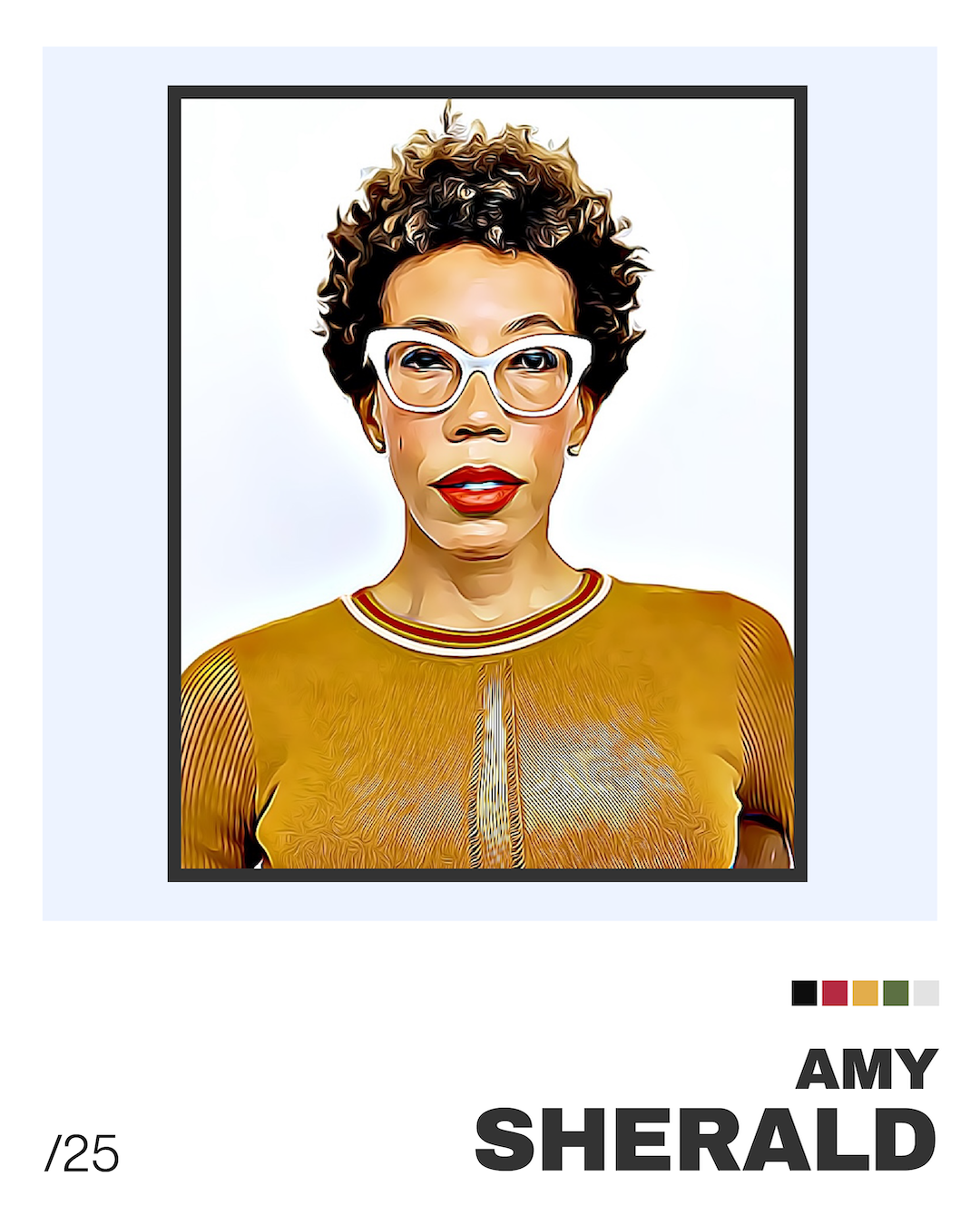
Amy Sherald likes to say she paints “the American Realist pictures I wish I’d seen growing up.” That simple line contains almost everything you need to know about her approach to art: a stubborn devotion to ordinary Black life, an insistence on beauty as a form of protection, and a quiet but resolute refusal to compromise on what—and who—belongs at the center of American visual culture.
Today, Sherald is best known as the artist behind Michelle Obama’s official portrait, the six-foot-tall image that helped double attendance at the Smithsonian’s National Portrait Gallery and turned museum-going into something like a block party pilgrimage. But the canvas that made her famous is only one stop on a journey that runs from a childhood in Georgia to a near-fatal heart condition in Baltimore, to the commanding museum surveys of American Sublime now traveling across the country.
That journey also threads through a quieter story—of Black Americans whose relationships with banks, credit and capital have so often been fraught, and who now encounter Sherald’s paintings not just as images on a wall but as assets on balance sheets, collateral for loans, and proof that their stories, too, have value.
Growing up looking for herself
Sherald was born in Columbus, Georgia, in 1973. In interviews, she has recalled being one of just a few Black children at her private school, hyper-aware of how she spoke and dressed. “I learned very young how much performance was attached to being acceptable,” she has said—language that echoes contemporary theories of race as something enacted rather than fixed.
Her early encounters with museums reinforced that lesson by omission. Gallery walls were crowded with white subjects: farmers, mothers, soldiers, children at play. They were not painted as symbols. They were simply people. That unmarked ease—what it means to look like the default setting of a nation—is part of what Sherald’s later work sets out to disrupt.
She studied painting at Clark Atlanta University and took classes at Spelman College, both historically Black institutions where the art departments doubled as unofficial counter-archives. There she met the work of William H. Johnson, Archibald Motley and Laura Wheeler Waring—artists who had tried, in their own eras, to wedge Black figuration into a canon that often pretended not to see it.
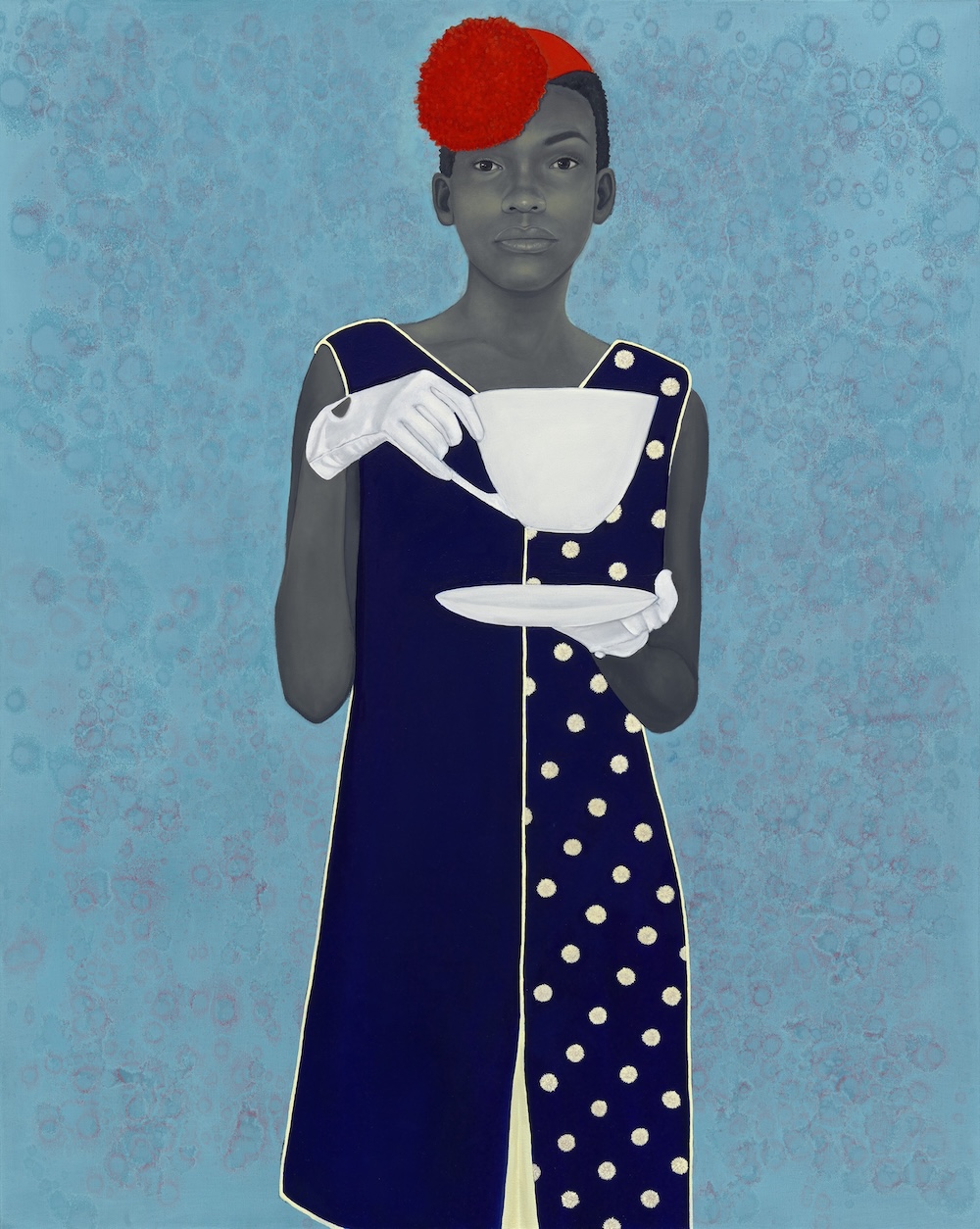
Like many young artists, Sherald supported herself by waiting tables and taking odd jobs. Even as she developed her style—flat, candy-colored backgrounds; exquisitely styled clothing; faces rendered in a cool gray she adopted from early Black photography—she lived close to the line. She has described being uninsured, maxing out credit cards, and relying on friends to float her until the next check arrived.
For many Black Americans, that story is intimately familiar, rooted in a financial ecosystem that has long made borrowing more expensive and saving more difficult. The difference is that in Sherald’s case, the scarcity coexisted with an asset whose value had not yet been recognized: her own vision.



A heart rebuilt, a gaze sharpened
In 2012, while picking up a prescription at a Rite Aid in Baltimore, Sherald collapsed. She had been diagnosed years earlier with idiopathic cardiomyopathy, a weakening of the heart muscle, but had largely pushed it aside as she worked toward her MFA at the Maryland Institute College of Art and trained for a triathlon. This time, she could not. Doctors told her she needed a transplant.
The wait for a new heart plunged her into suspended animation: work slowed, income dried up, and the already-precarious math of an artist’s life became brutal. She has spoken about friends covering bills, about the humbling experience of accepting help, about the way illness clarifies what you want your work to do in the world.
When a donor heart finally arrived and the transplant succeeded, Sherald emerged with what she has called a sharpened sense of time. “I realized I didn’t have forever,” she said later. “So if I was going to paint, I needed to paint the world as I knew it, and as I wanted to see it.”
That urgency shows in the portraits that followed: composed, almost meditative figures whose stillness hums with the knowledge that everything—jobs, health, even freedom—is more contingent than we like to admit.
The gray that refuses to explain itself
Even before the Obama commission, Sherald’s paintings had a distinctive signature: Black sitters rendered in grayscale, their skin echoing the tonal range of early 20th-century photographs shown by W.E.B. Du Bois at the 1900 Paris Exposition.
“I use gray because I want you to look past the brown of the skin and into the person,” she’s explained. “Color can codify someone before they get to speak.”
Critics sometimes read the gray as a kind of neutralizing filter, but in practice it does the opposite: it shines a spotlight on how much of Black life has historically been seen only through racial shorthand. By stripping away that shorthand, the gray insists that the viewer do more work. Who is this person? What might she love, fear, dream about? What bills is he worrying over?
The rest of the canvas is anything but subdued. Sherald’s backgrounds are often flat planes of blue, pink or lavender, against which patterned dresses, striped shirts and sneakers pop like punctuation marks. Reviewers have called the effect “electrically colorful” and “otherworldly,” a surreal realism in which the everyday feels both grounded and slightly unmoored.
Where traditional portraiture often foregrounded wealth through props—pearls, mahogany furniture, pastoral estates—Sherald’s symbols are subtler: the graphic swirls of a maxi dress, the chrome of a bicycle handlebar, the tilt of a baseball cap. They are the visual equivalents of line items in a household budget: aspirational yet attainable, the kinds of things bought on layaway or with a carefully managed credit card.
Choosing who gets to be seen
Sherald’s process begins not in the studio but in the world. She meets potential sitters in grocery stores, on sidewalks, at community events, then asks if she can photograph them. “I look for presence,” she told one curator. “A quiet magnetism that pulls me in.”
Those sessions are long—an hour or more until her subjects relax into themselves. She might ask them to bring their favorite clothes or style them herself, often combining high fashion with everyday garments in a way that collapses the distance between runway and church pew.
In the finished paintings, we seldom learn the sitters’ names. This anonymity is deliberate. Each person is specific—a certain set of features, a particular body—but also open enough to hold the viewer’s projection. You could imagine them as a cousin who works the morning shift at a credit union, an aunt who spent years rebuilding her credit score after a predatory loan, a neighbor who finally saved enough for a down payment.
Sherald has said she wants her paintings to “invite people into an interior space, not just of the sitter but of themselves.” For Black viewers especially—many of whom have learned to brace themselves for images of trauma—this interiority can feel like a luxury purchase that should have been standard issue all along.
The Michelle Obama portrait and the price of visibility
When Michelle Obama chose Sherald to paint her official portrait, the artist was 43 and still, by her own account, “hustling.” She had recently won the National Portrait Gallery’s Outwin Boochever Portrait Competition—a $25,000 prize that offered welcome breathing room but not security.
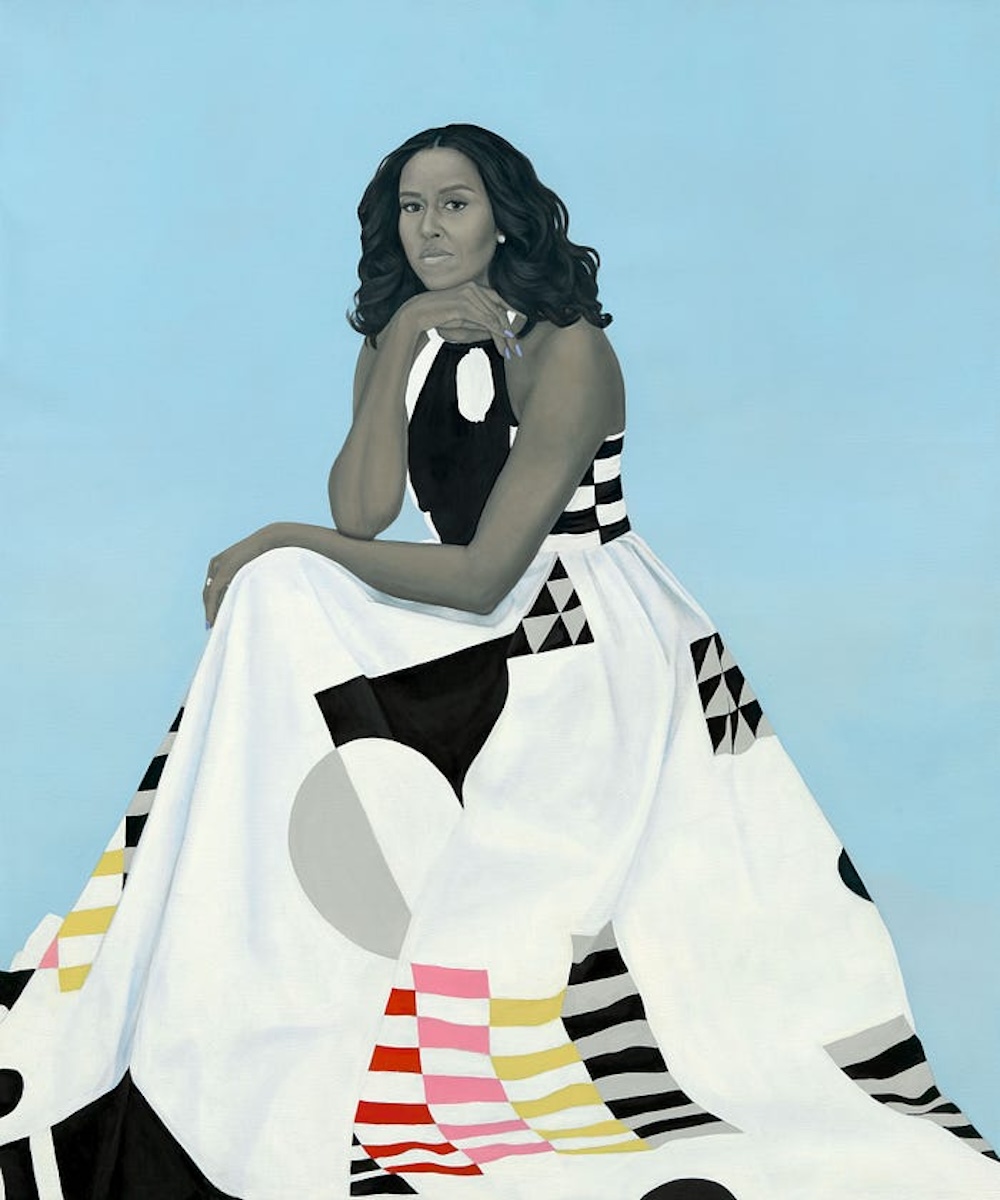
The Obama commission changed that calculus. Sherald spent two 90-minute photo sessions with the former First Lady, sifting through dresses with stylist Meredith Koop before settling on the now-famous Milly gown with its bold black-and-white geometrics and pastel stripes.
She rendered Obama in grisaille, seated against a robin’s-egg blue field, hand resting lightly under her chin. Critics praised the portrait as “haunting and human,” noting how it captured both the vulnerabilities and the steel beneath Obama’s public composure.
The public responded with its own verdict: attendance at the National Portrait Gallery doubled in the two years after the unveiling. Lines of visitors became an attraction in themselves; families posed for selfies in front of the painting, school groups filed in, and social media turned the portrait into a kind of secular pilgrimage image.
Behind the scenes, the work also became part of a different story, one of institutional capital and corporate sponsorship. The Obama Portraits Tour—which sent Sherald’s and Kehinde Wiley’s paintings across the country—was underwritten in part by Bank of America, among other donors.
For the bank, the sponsorship was a brand investment: associating itself with a historic moment of Black representation. For the communities that turned out, it was something more intimate. Visitors included federal workers just coming off a government shutdown and families still repairing credit after the Great Recession—people who knew Bank of America less as a logo on a press release and more as a monthly line on their bank statements.
Many of them, interviewed by local papers along the tour, described seeing the portrait as “paying respects” or “checking in with family.” They were not collectors. They were customers—of banks, of public transit, of an America that has not always marketed itself with their images. The portrait, free to view in museum galleries, offered a different kind of return.
Everyday people, extraordinary stakes
The bulk of Sherald’s work, now gathered in American Sublime at the Whitney Museum of American Art, SFMOMA and the Baltimore Museum of Art, focuses on everyday Black subjects: bikers mid-wheelie against a limitless sky, a man perched on a tractor, a woman in a blue dress holding a torch, kids at rest and at play.
Curators have framed the show as a redefinition of the “sublime,” applying a word once reserved for mountains and seascapes to the scale of ordinary Black life. The result, wrote one reviewer, is “a resonant ode to the multiplicity and complexity of American identity” that quietly insists on Black presence as central rather than marginal.
The financial stakes of that insistence are not abstract. Large paintings by Sherald now sell for seven figures on the secondary market; they anchor museum shows and private collections for celebrities and financiers. Articles in the art press describe collectors who leveraged early purchases into loans, using Sherald canvases as collateral for new ventures.
Those stories echo a longer history: Black cultural production—jazz, hip-hop, fashion, painting—often moves from underfunded community spaces to boardroom assets, sometimes leaving the people who nurtured it with little equity in the end. Sherald is acutely aware of this dynamic. She has spoken about wanting her work to benefit the communities it depicts, donating portions of her proceeds to causes like health equity and criminal-justice reform, and supporting institutions that first showed her work when sales were uncertain.
In 2020, her portrait of Breonna Taylor—painted for Vanity Fair and later acquired jointly by the Speed Art Museum and the National Museum of African American History and Culture—became both memorial and asset, raising difficult questions about how museums, donors and insurers value Black death in financial as well as symbolic terms.
For the bank tellers, loan officers, branch managers and customers who see her paintings in touring shows or magazine spreads, those questions are not theoretical. They live inside mortgage applications, student-loan forbearance forms, overdraft notices—documents that determine who gets to build wealth and who remains exposed. Sherald’s insistence on showing Black subjects at ease—leaning against a bike, reclining in a hammock, staring levelly back—offers a counter-image to systems built on perpetual precarity.
Censorship, credit and walking away from the deal
In 2025, Sherald’s relationship with institutions was tested in a very public way. Her largest-ever survey, American Sublime, was slated for a triumphant run at the Smithsonian’s National Portrait Gallery. Instead, she pulled the show after the museum raised concerns about Trans Forming Liberty, her 10-foot portrait of a Black trans woman as a reimagined Statue of Liberty, modeled by artist Arewà Basit.
Museum officials suggested removing or “contextualizing” the painting, citing fears of political backlash from the Trump administration, which had escalated attacks on what it called “divisive ideologies” in cultural institutions. Sherald rejected what she saw as censorship. “You don’t ask an artist to soften a statement about who belongs in the image of freedom,” she argued, and withdrew the exhibition rather than compromise.
The decision cost her in the short term—lost institutional fees, disrupted timelines, the logistical expense of moving a massive show. But it also made clear how she thinks about credit and trust. An institution that asks you to mortgage your principles, she suggested, is not one you should be in business with.
“We don’t quietly disengage when someone tries to erase us,” Basit later said of the controversy. “Our existence is not something to be negotiated.”
In that stance, many ordinary bank customers heard an echo of their own negotiations—over loan terms, overdraft fees, wealth-stripping fines disguised as policy. Sherald’s refusal to make her work palatable for political comfort suggested another way to approach contracts: some deals simply are not worth the cost.
Inside the frame, outside the ledger
For all the high drama of commissions and controversies, Sherald’s paintings themselves are remarkably quiet. They invite a kind of long looking that is rare in an economy built on scrolls and swipes. This, too, is part of her philosophy. “I’m an empath,” she once said. “Portraiture works for me because I’m interested in how people carry themselves through the world.”
The people in her canvases could be anyone: a woman in a striped dress balancing a torch; a man in a Stetson, hands in his pockets; two bikers midair between asphalt and sky. Their exact biographical details remain unknown. We are left to imagine: Do they pay a mortgage or rent? Are they saving for a child’s college fund, sending remittances to family, arguing on the phone with a collections agent?
What Sherald offers is not those answers but an insistence that such questions do not exhaust who they are. Her sitters have inner lives, private jokes, complicated desires. They might be bank customers, borrowers, investors, workers in financial institutions. But in the frame, they are not reduced to “accounts.” They are, in the fullest sense, people of means—meaning, history, and possibility.
The art of rebalancing
There is a temptation, when writing about an artist as visible as Amy Sherald, to treat her career as a tidy story of triumph: Southern girl makes good, beats illness, paints First Lady, conquers museums, stands up to power. Parts of that story are true. But they can obscure the less glamorous work of rebalancing that her paintings perform every day.
Consider what happens, for example, when a major museum acquires one of her canvases. An asset moves from a white cube gallery into an institution whose budget is often backed by wealthy donors, corporate sponsorships, and, in some cases, the very banks that have historically denied capital to Black neighborhoods. The work is insured, catalogued, and perhaps, someday, leveraged in fundraising.
Meanwhile, the communities whose likenesses Sherald paints continue to navigate payday lenders, student-loan servicers, and the everyday arithmetic of not having a financial cushion.
Sherald cannot, by herself, fix that equation. But she can—and does—shift some of the cultural capital. Her portraits place Black subjects in spaces of quiet abundance: time to sit, to pose, to be looked at without being policed. Her refusal to flatten them into symbols is a kind of anti-extraction: she takes their image seriously enough not to make it stand in for all Blackness, all struggle, all hope.
In interviews, she often returns to a simple mission statement: “My work is about putting more complex stories of Black life in the forefront of people’s minds.”
Those stories include mourners and activists, but also nurses, teachers, grocery clerks, bank tellers and customers—people who know how much a surprise fee can sting, who’ve watched their neighborhoods fight redlining and disinvestment, who have waited decades for institutions to see them as something other than risk.
In Sherald’s paintings, they are already there: not as line items, but as protagonists. That, in the end, may be her most radical approach to art—not just changing what hangs on the wall, but who, finally, gets to see themselves as priceless.