


The blame belongs to a society that tolerates inadequate and often wretched housing, inadequate and inefficient schools … unemployment … discrimination … brutality and lack of courtesy of the police.
The blame belongs to a society that tolerates inadequate and often wretched housing, inadequate and inefficient schools … unemployment … discrimination … brutality and lack of courtesy of the police.
By KOLUMN Magazine
In quick retellings, the 1935 Harlem Riot is usually described as a disturbance caused by a false rumor that a Black boy had been beaten or killed after shoplifting from a store on 125th Street. That is factually true as far as it goes. But it does not go nearly far enough. What happened in Harlem on March 19 and into March 20, 1935, was not simply the story of a rumor spinning out of control. It was the story of a neighborhood that had been forced to carry too much for too long: Depression misery, racial exclusion, cramped housing, abusive policing, retail exploitation, and the bitter insult of watching white-owned stores take Black dollars while shutting Black workers out. When the explosion came, the city could no longer pretend it had not been warned.
That is one reason historians keep returning to 1935. The uprising is often described as the first “modern” race riot, not because racial violence in America was new, but because this episode looked different from the white pogroms and mob assaults that had marked earlier eras. In Harlem, much of the destruction targeted property rather than people, and especially white-owned businesses. Observers at the time and scholars since have treated the event as a hinge point, a moment when the geography and logic of racial unrest in the United States visibly changed. Harlem was not an outlier at the margins of national life. It was the country’s most famous Black neighborhood. If Harlem erupted, it meant something had shifted in plain sight.
To understand why the Harlem riot mattered, it helps to start with what Harlem represented before the glass shattered. By the 1920s and early 1930s, Harlem had become the symbolic capital of Black urban America, a place associated with the New Negro, the Harlem Renaissance, literary brilliance, music, style, migration, and possibility. But by the middle of the Depression, that symbolic glow sat uneasily beside brutal material realities. The clubs and entertainment venues that had once employed many Black residents were hit hard. Southern Black migrants kept arriving as part of the Great Migration, and Puerto Rican migration into New York also accelerated, adding to neighborhood density and to the complexity of Harlem’s racial world. Public infrastructure lagged. Housing was overcrowded. Jobs were scarce. City neglect was visible in the physical landscape and in the experience of daily life.
The commission created after the riot said the quiet part out loud. Its findings did not blame Harlem for being volatile by nature or predisposed to disorder. Instead, it described “years of unemployment and insecurity,” discrimination in employment, discrimination in schools, police mistreatment, overcrowding, unfair rents, and inadequate public services as the real preconditions of the uprising. The report’s most enduring line remains devastating in its clarity: the blame, it argued, belonged to a society that tolerated all of that. It is hard to read those words now and not recognize how rare such official candor was, and how often American commissions have diagnosed structural causes only to watch political systems ignore them.
A neighborhood running on contradiction
Harlem in the 1930s was not simply poor; it was exploited. That distinction matters. Economic life in the neighborhood often depended on Black consumers sustaining businesses that were not equally committed to Black employment or dignity. One of the recurring grievances documented by investigators involved stores that profited from Harlem’s shoppers while refusing to hire Black workers in meaningful numbers. This was more than a labor complaint. It was an everyday theater of humiliation, the sort of thing residents saw each time they spent money on streets where they remained unwelcome behind the counter.
The physical environment deepened the strain. The commission’s subcommittees examined housing, education, policing, discrimination in employment, relief, and health. That institutional breadth is important because it shows the riot was not understood, even by serious contemporaries, as a single-issue event. Harlem’s problems were interlocking. Overcrowded apartments shaped health outcomes. Weak public services shaped neighborhood frustration. School inequality shaped life chances. Police hostility shaped whether residents believed authorities when officials said, in effect, trust us, nothing bad happened in the store. By 1935, too many people in Harlem had too much reason not to trust.
There was also a psychological dimension that the official report captured with unusual force. Harlem residents were not just economically pressed; they were emotionally worn down. The report described “nervous strain,” insecurity, and pent-up feeling among people who believed, with cause, that they were victims of gross injustice and prejudice. That wording matters because it refuses the lazy language of irrationality. The report did not suggest Harlem residents panicked for no reason. It suggested they were primed by experience to read danger into ambiguity. A city that behaves unjustly for years should not be shocked when its reassurances stop carrying weight.
The spark on 125th Street
On March 19, 1935, Lino Rivera, a 16-year-old Black Puerto Rican teen, tried to steal a penknife from the S.H. Kress five-and-dime store at 256 West 125th Street, across from the Apollo Theater. Store personnel stopped him. In the scuffle, Rivera bit an employee. Police were called. The store manager ultimately declined to press charges, and Rivera was released through the back door. The facts, in other words, were mundane by the standards of city policing and retail petty theft. But that mundanity never made it outside in usable form.
Outside, the scene looked ominous. A crowd formed. Witnesses believed Rivera might be taken to the basement and beaten. An ambulance arrived, apparently to treat the bitten store employee, but for onlookers it seemed to confirm serious violence inside. A hearse parked nearby added another visual cue that rumor could seize. A woman who had been raising alarm was arrested. Police told people to move along and, according to the commission account, responded in a way that intensified rather than defused resentment. The crowd did not see Rivera leave safely. They saw authority, secrecy, impatience, and the familiar possibility that a Black child had been brutalized with impunity.
This is where the standard “false rumor” framing becomes too neat. Yes, the rumor was false. Rivera had not been killed. But rumors do not travel on their own. They travel on the tracks laid by prior experience. The commission later concluded that the police had a chance to stop the story from spreading and failed partly because Harlem residents already regarded the police with distrust and hostility built over many years. That is a very different interpretation from saying irrational crowds merely got carried away. The key issue was credibility. The city had spent years squandering it.
Street-corner agitation added force to the moment. Organizers circulated leaflets denouncing the brutal beating of a child and tying the incident to wider injustice in Harlem. Authorities and later commentators often highlighted the role of Communist organizers, and communist-affiliated groups did indeed mobilize around the event. But even that detail is frequently handled poorly in popular summaries. Organizers did not create Harlem’s grievances out of thin air. They plugged into them. Political actors can accelerate unrest; they cannot invent the underlying social chemistry that makes a neighborhood receptive to their message.
Harlem did not erupt because one rumor was persuasive. Harlem erupted because official truth had become unbelievable.
From crowd to uprising
As evening deepened, a window at the Kress store was smashed. Then another. Disorder spread along 125th Street and beyond, moving east and west and then north and south. White-owned businesses were hit hardest. Some merchants reportedly tried to protect themselves by posting signs indicating that their stores were Black-owned or that they employed Black workers. That detail tells you almost everything about how people in the street were reading the neighborhood economy: this was not random destruction; it was selective, moralized, and aimed at visible symbols of extraction and exclusion.
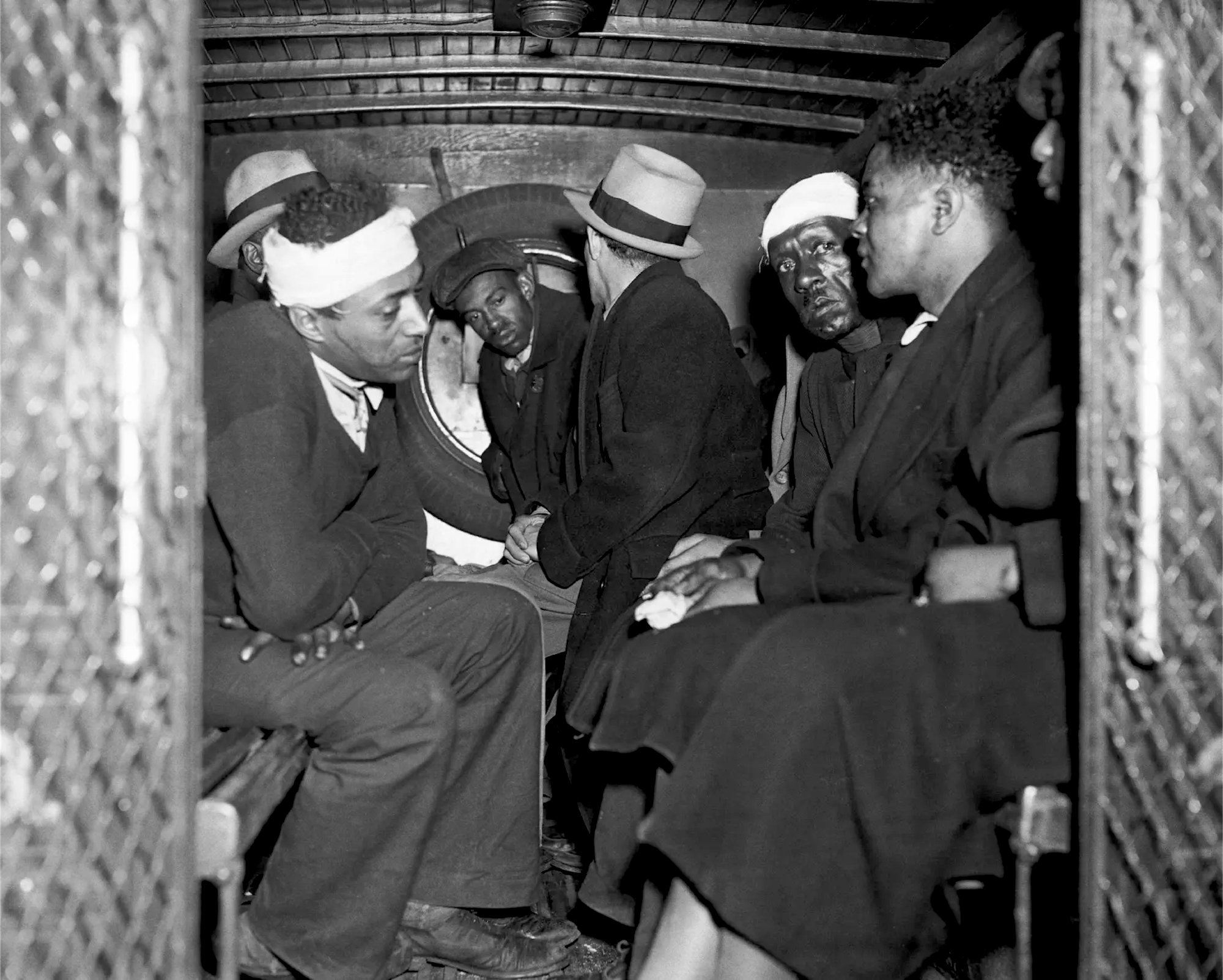
By the time the unrest ended, the toll was severe. Sources vary slightly in their counts, but they broadly agree on the scale: more than 100 people were injured, roughly 100 to 125 people were arrested, around 200 to 250 stores were damaged, and three Black men were killed. Property losses exceeded $2 million, a staggering sum in Depression-era dollars. Every death is worth pausing over. This was not a case of communal rage somehow floating above bodily harm. Black residents died in the confrontation, including people not centrally involved in whatever original street dispute had begun the night.
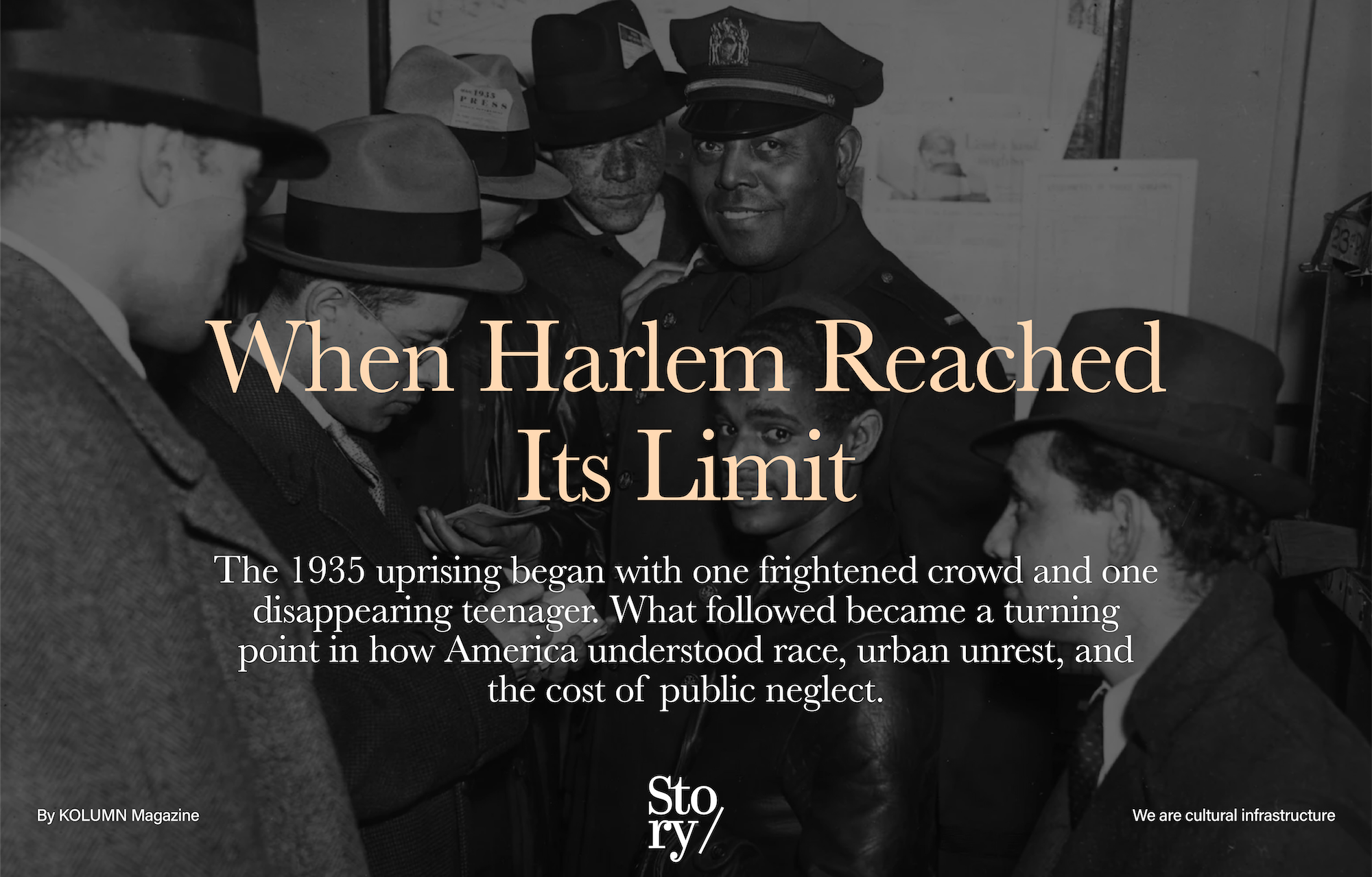
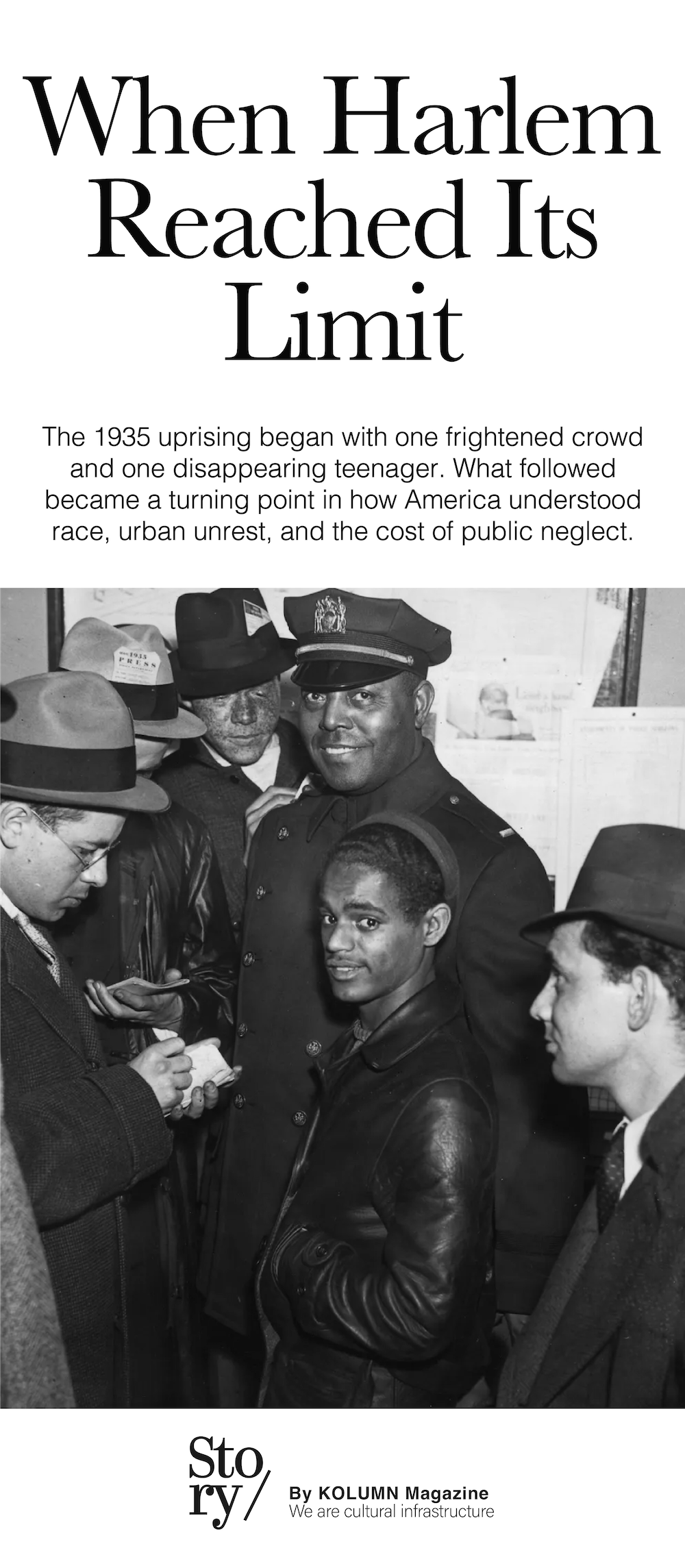
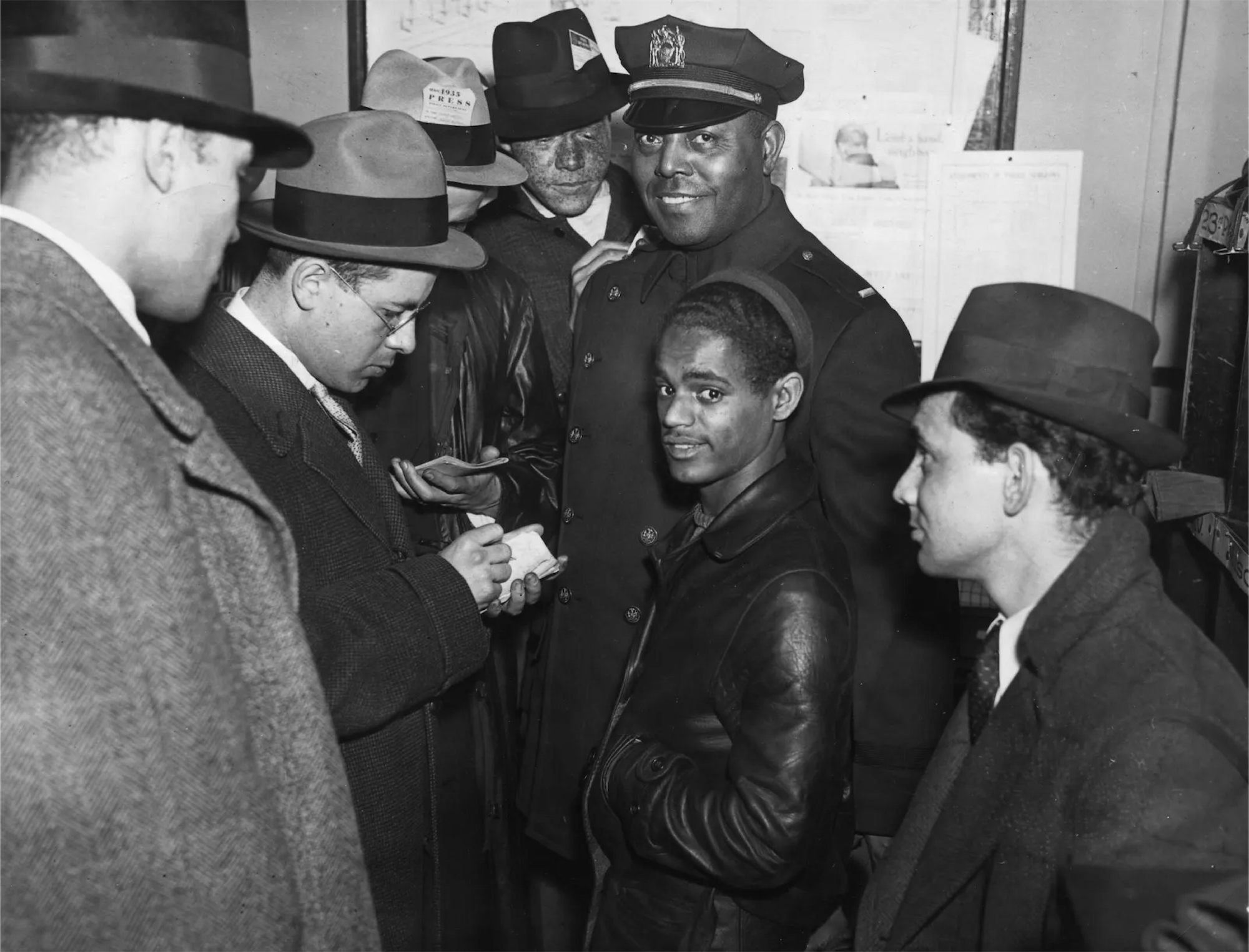
One of the more revealing episodes came after the violence had already begun, when police sought to produce Rivera alive to disprove the rumor. By then it was too late. Officers eventually located him and took a photograph with Lieutenant Samuel J. Battle, the first Black officer in the NYPD, to show the public that the teenager was unharmed. The image is historically striking, but it also underscores the earlier failure. Authorities had waited until after the neighborhood had already crossed the threshold from suspicion into upheaval. In crises of trust, delay is gasoline.
The police response during the riot hardened existing grievances. The all-white police force that moved to regain control encountered a community already inclined to see law enforcement as coercive rather than protective. The official Harlem Conditions project, built from the commission’s findings, is explicit that lack of confidence in the police was evident “at every stage” of the event. This is one of the reasons the 1935 riot still feels contemporary. Again and again in American history, urban unrest follows not only an incident but a longstanding relationship in which law enforcement is experienced as occupation, contempt, or danger. Harlem in 1935 fits that pattern with unnerving precision.
Why scholars call it “modern”
The label “modern race riot” can sound clinical, even sterile, but it is trying to describe a real historical shift. Earlier race riots in the United States were often straightforward assaults by white mobs on Black people and Black neighborhoods, frequently with official complicity. The 1935 Harlem event still involved racialized power and police violence, but the social form of the violence differed. It unfolded inside a Black neighborhood, with much of the destruction directed at property and commercial targets identified with economic exploitation. Scholars and reference works alike have marked the event as a turning point for that reason.
This distinction should not be overdrawn. “Modern” does not mean cleaner, more justified, or less tragic. It means that the grammar of unrest changed. Instead of an external white mob descending in open terror, Harlem presented a case in which structural racism, economic abandonment, neighborhood rumor, and antagonistic policing combined inside an urban Black community to produce an uprising that attacked the storefront face of inequality. The targets mattered. So did the fact that Black-owned businesses were often spared when identified as such. That selectivity revealed both grievance and political consciousness.
The historian Stephen Robertson’s Harlem in Disorder project makes this point especially well, arguing that the 1935 violence was “not a race riot” in the older sense and that racial violence had taken a new form. That matters because the later uprisings Americans associate with the 1960s did not come from nowhere. Harlem in 1935 was an early warning about the future of urban unrest in the North: property-centered, locally rooted, shaped by labor exclusion and police conflict, and explained too easily by outsiders as pathology rather than politics.
The 1935 Harlem riot was less a breakdown of order than a revelation of what the existing order actually was.
The commission that told the truth
Mayor Fiorello La Guardia responded to the riot by appointing a biracial commission to investigate conditions in Harlem. Its structure alone set it apart from the city’s usual reflexes. The commission created six subcommittees—on crime and police, education, housing, discrimination in employment, health and hospitalization, and relief—and gathered testimony through public and closed hearings. According to the city’s later digital presentation of the report, 160 witnesses testified across 21 public and four closed hearings. The inquiry was broad, empirical, and, notably, not universally welcomed by city officials; Police Commissioner Louis Valentine, for example, refused to participate.
The commission’s conclusions now read like a suppressed map of the modern metropolis. It found that Harlem’s breach of public order arose from years of unemployment and insecurity, discrimination in stores that depended on Black customers, discrimination in schools, police abuses, dreadful overcrowding, unfair rents, and inadequate care and facilities. The report was not content with hand-waving about “tension.” It named institutions. It named sectors. It named policy failures. That level of diagnostic precision is one reason the 1935 report continues to echo in later writing about race, riot commissions, and state evasion.
But the afterlife of the report is nearly as important as the report itself. Despite the force of its findings, little changed quickly enough or deeply enough to answer what Harlem residents had said. A New Yorker essay on the history of riot reports makes the pattern plain: commissions often produce sober and even morally accurate analyses, only for those analyses to be filed away while the underlying structures remain intact. Harlem’s report, in that sense, belongs to a long American tradition of officially confirmed truths that go under-enforced.
There is something haunting about that cycle. The state asks why people are angry. The state receives an answer. The answer is concrete, actionable, and unambiguous. Then the state behaves as though the answer were either too politically inconvenient or too expensive to honor. That rhythm did not begin in Harlem, and it did not end there. But Harlem gives it one of its clearest early New Deal-era expressions.
Harlem after the riot
The riot mattered because it punctured fantasy. To many outside observers, Harlem had functioned as a symbol—of Black modernity, of nightlife, of artistic brilliance, of glamorous urban Black life. The 1935 uprising forced a harder reckoning with the neighborhood as a place of underemployment, municipal neglect, and social strain. In that sense, the riot helped shift public understanding of Harlem away from Renaissance mythology and toward the harsher political economy of Black northern urban life during the Depression. Some contemporaries and later writers even treated the riot as a marker of the end of the Harlem Renaissance era’s optimism.
It also reset how officials, journalists, and scholars talked about Black protest in northern cities. Harlem in 1935 demonstrated that severe racial grievance was not a purely southern story and not limited to formal Jim Crow geographies. Northern liberalism could congratulate itself all day; Harlem still had overcrowded housing, discriminatory employment, hostile policing, and schools that residents experienced as unequal. The riot shattered any easy regional moral map in which northern cities stood above the race problem.
That point deserves emphasis because it remains one of the riot’s biggest historical contributions. Much of the national imagination has long treated racism as most legible when it wears a southern accent. Harlem in 1935 insisted that Black urban suffering in the North had its own architecture: less formalized than Jim Crow in some respects, but no less punishing in the aggregate. The commission’s findings on housing, schools, police, employment, and relief are a reminder that segregation and discrimination did not need a southern courthouse to produce a combustible civic order.
The politics of naming it
Was it a riot, a rebellion, an uprising? The terminology remains contested, and the disagreement is not semantic trivia. “Riot” often centers disorder and criminality; “rebellion” or “uprising” can foreground grievance, power, and structure. Contemporary official language used “riot,” and most reference works still do. But some later scholars have pushed toward terms like “racial uprising” or treated the event as a form of collective protest shaped by conditions that were plainly political. That debate matters because names determine what part of the story feels primary: smashed windows or the world that made the smashing thinkable.
There is no need to romanticize violence to understand that political language matters. Property destruction is real. Fear is real. Injury is real. So is the longer violence of joblessness, rent gouging, neglect, humiliation, and police abuse. The 1935 Harlem event sits right at that difficult intersection, where public discussion is tempted to separate “real violence” from “background conditions” as if one were immediate and the other abstract. Harlem residents did not experience those conditions abstractly. They experienced them in rooms too crowded to breathe in, in schools too neglected to trust, in job markets closed to them, and in encounters with police that taught them contempt could wear a badge.
The long shadow to 1943, 1964, and beyond
The 1935 uprising did not stand alone. Harlem would erupt again in 1943 and 1964 under different immediate triggers but with familiar background themes, especially around police violence and racial frustration. That continuity is one reason 1935 matters so much: it established a template that later urban unrest would repeat. The incident that lights the fuse may vary. The underlying stockpile—mistrust, inequality, and institutional contempt—remains recognizable.
Seen from that longer arc, the 1935 riot reads like prologue. Before the “long hot summers” of the 1960s, before the Kerner Commission would famously warn of a nation moving toward “two societies,” Harlem had already staged an earlier confrontation between Black urban life and a state unwilling to treat structural inequality as an emergency. The neighborhood’s residents did not need a later commission to tell them what they were living through. They had already testified to it in 1935.
Why the Harlem riot of 1935 still matters
The most important thing about the Harlem riot of 1935 may be that it refuses comforting stories. It will not let us say that disorder appears from nowhere. It will not let us claim that rumor alone explains collective explosion. It will not let us pretend northern cities were innocent of the racial structures they so often projected onto the South. And it will not let officialdom off the hook, because the city’s own investigation documented the causes with startling clarity.
Its significance is historical, political, and methodological all at once. Historically, it marks a turning point in the form of racial unrest. Politically, it exposes how deeply Black communities in the urban North were failed during the Depression. Methodologically, it teaches a lesson that journalists, historians, and policymakers keep relearning: if you only begin your story at the moment of broken glass, you have already misunderstood the event.
That lesson remains current because the ingredients recur. A disputed encounter. An authority structure with no reserve of trust. A community trained by experience to expect mistreatment. A system that mistakes its own denials for evidence. A city that reacts to eruption more urgently than to the years of smaller injuries that precede it. Harlem in 1935 is not just a historical case study. It is a durable American pattern.
And yet there is something else in the record, something that deserves notice alongside the devastation. The post-riot investigation preserved the voices and grievances of Harlem residents in unusually direct form. It documented, in institutional prose, that Black anger was not a mystery. It came from material conditions. That matters. Even when reform lagged, the archive refused the lie that nobody knew why Harlem burned. They knew. Harlem told them. The commission told them again.
In the end, the Harlem riot of 1935 was significant not because a rumor got out of hand, but because the rumor found a neighborhood already prepared by history to believe the worst. That preparation was the real scandal. A 16-year-old named Lino Rivera walked out of the store alive. The city’s credibility did not.
More great stories
Afro Sheen, Wall Street, and the Architecture of Black Possibility
July 6, 2026
No Comments
The Fire Inside the Fourth
July 5, 2026
No Comments