





He was not merely seeking admission. He was testing whether American citizenship meant what the Constitution said it meant.
He was not merely seeking admission. He was testing whether American citizenship meant what the Constitution said it meant.
By KOLUMN Magazine
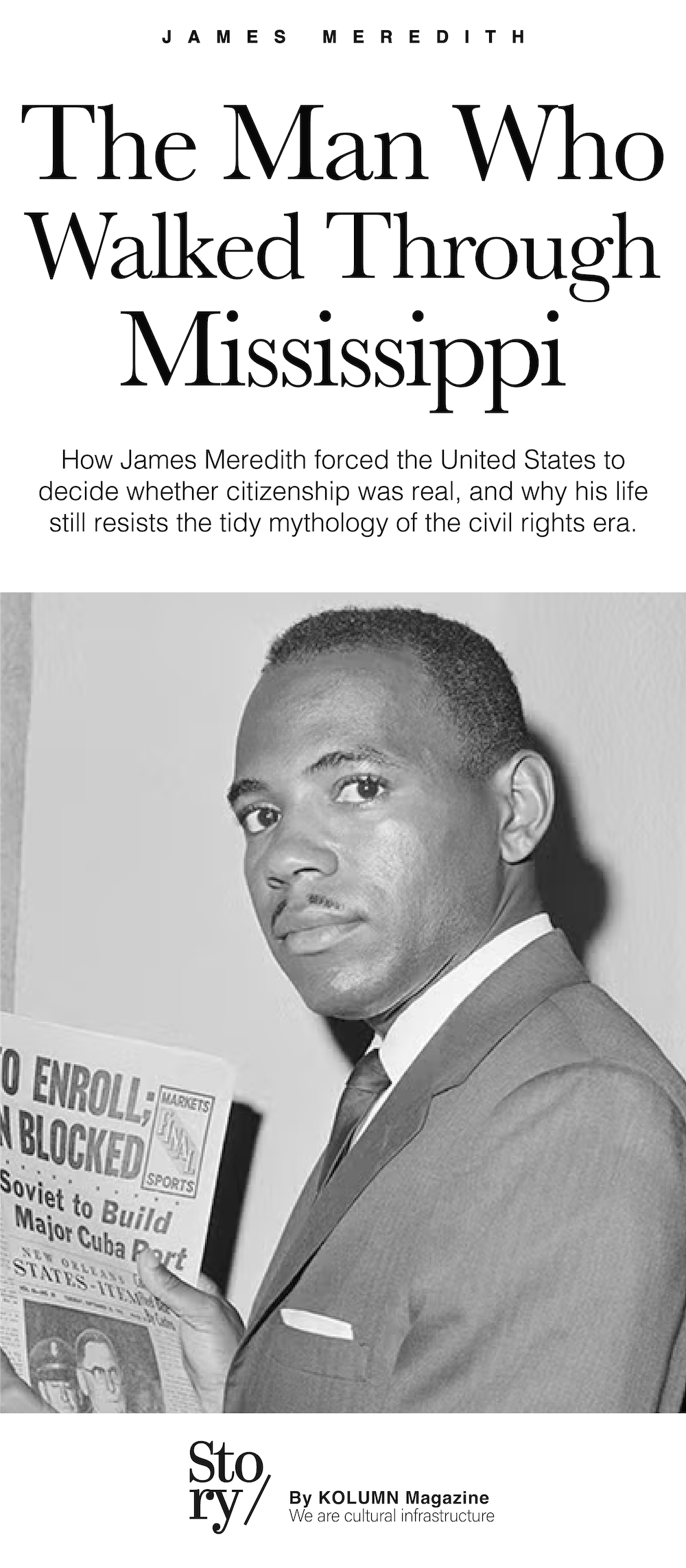
James Howard Meredith occupies a strange and essential place in American history. He is one of the most famous figures of the Black freedom struggle, yet he has spent much of his life resisting the labels that history tried to hand him. He is widely remembered as the first Black student to integrate the University of Mississippi in 1962, an act that triggered one of the most violent confrontations of the civil rights era. But that description, while true, is incomplete. Meredith was not just a student who desegregated a campus. He was a tactician who understood that the university was a pressure point, a place where the mythology of white supremacy, states’ rights, and federal authority could be forced into direct collision. His decision to apply to Ole Miss was not symbolic in the casual sense. It was a constitutional challenge, designed to compel the federal government to act.
That is one reason Meredith remains difficult to flatten into a familiar hero narrative. He has never been especially interested in making himself easy to admire. He has spoken in ways that irritated liberals, baffled journalists, and frustrated those who wanted a more straightforward civil rights saint. He has rejected the phrase “civil rights” itself as inadequate, even insulting, because he believed it implied a lesser category of citizenship rather than the full rights already guaranteed to Americans. In his own telling, he was not asking for something special. He was forcing the country to honor what it had already promised.
That stubbornness is central to his significance. Meredith’s life makes more sense when understood not as the story of a man trying to be accepted by white institutions, but as the story of a man testing whether the United States would enforce its own laws when a Black citizen insisted on them. In that sense, Ole Miss was not only a school. It was a battlefield, and Meredith knew it.
To understand James Meredith, it helps to begin before Oxford, before the riot, before the television cameras and the marshals and the troops. He was born on June 25, 1933, in Kosciusko, Mississippi, and grew up in the deeply segregated world of Jim Crow. Britannica notes that he gained national prominence in 1962, but his formation began in a Mississippi where race dictated nearly every public possibility. He later served in the U.S. Air Force from 1951 to 1960, a period that shaped both his discipline and his sense of himself as an American entitled to the rights he had defended in uniform. After leaving the service, he enrolled at Jackson State College, the historically Black institution now known as Jackson State University.
That military service matters. Meredith did not emerge from nowhere as a supplicant at the gates of Ole Miss. He emerged as a veteran, as a Mississippian, and as a man increasingly convinced that segregation was not simply immoral, but fraudulent. He had worn the uniform of a nation that still allowed his home state to deny him equal treatment. By 1961, inspired in part by President John F. Kennedy’s inaugural rhetoric and by the legal openings created by Brown v. Board of Education, Meredith decided to apply to the University of Mississippi, the state’s flagship white institution. His application was not just personal ambition. He wrote that he sought admission for his country, his race, his family, and himself.
The legal fight that followed revealed just how much machinery Mississippi was willing to deploy to preserve segregation. Constance Baker Motley of the NAACP Legal Defense Fund represented Meredith in the battle, and the case became a major test of whether federal courts could actually desegregate the South when a state chose open resistance. Columbia Law Review’s reconstruction of the case makes plain that Meredith was plainly qualified and that the university’s denials were rooted in race, however carefully that reality was dressed up in administrative language. Mississippi officials, including Governor Ross Barnett, treated Meredith’s admission as a political and ideological emergency. This was massive resistance in a concentrated form: not abstract principle, but active defiance.
Barnett, of course, was not merely a bystander to the drama. He made himself its theatrical face. Meredith’s case became a public referendum on segregationist power in Mississippi, and Barnett worked hard to turn it into exactly that. What could have been handled as compliance with federal law was instead transformed into a standoff over race, sovereignty, and humiliation. The state’s message was clear: if Meredith entered Ole Miss, white Mississippi would regard it as an invasion.
The showdown came at the end of September 1962. Meredith arrived on campus under federal protection after courts ordered his admission. What followed remains one of the most explosive nights of the civil rights era. According to the U.S. Marshals Service, 160 deputy marshals were injured, including 28 by gunfire, as violent mobs attacked federal officers assigned to protect Meredith. Two civilians were killed during the riot: French journalist Paul Guihard and Ray Gunter, a white jukebox repairman who had come to campus. President Kennedy ultimately invoked federal authority and sent in troops to restore order and secure Meredith’s enrollment.
This is one of the reasons Meredith’s story cannot be reduced to a campus first. Ole Miss was not only desegregated; it was militarily integrated. The federal government had to demonstrate, in visible and overwhelming terms, that a state university could not remain white by custom and violence. The confrontation forced the Kennedy administration to move from rhetorical support for civil rights toward unmistakable enforcement. In retrospect, that shift looks pivotal. Subsequent Southern integrations still faced resistance, but Ole Miss established that defiant state officials could be overruled by federal power. Meredith had forced that clarification.
“At Ole Miss, Meredith did not simply enter a university. He forced a government to decide whether it would defend a Black citizen in public.”
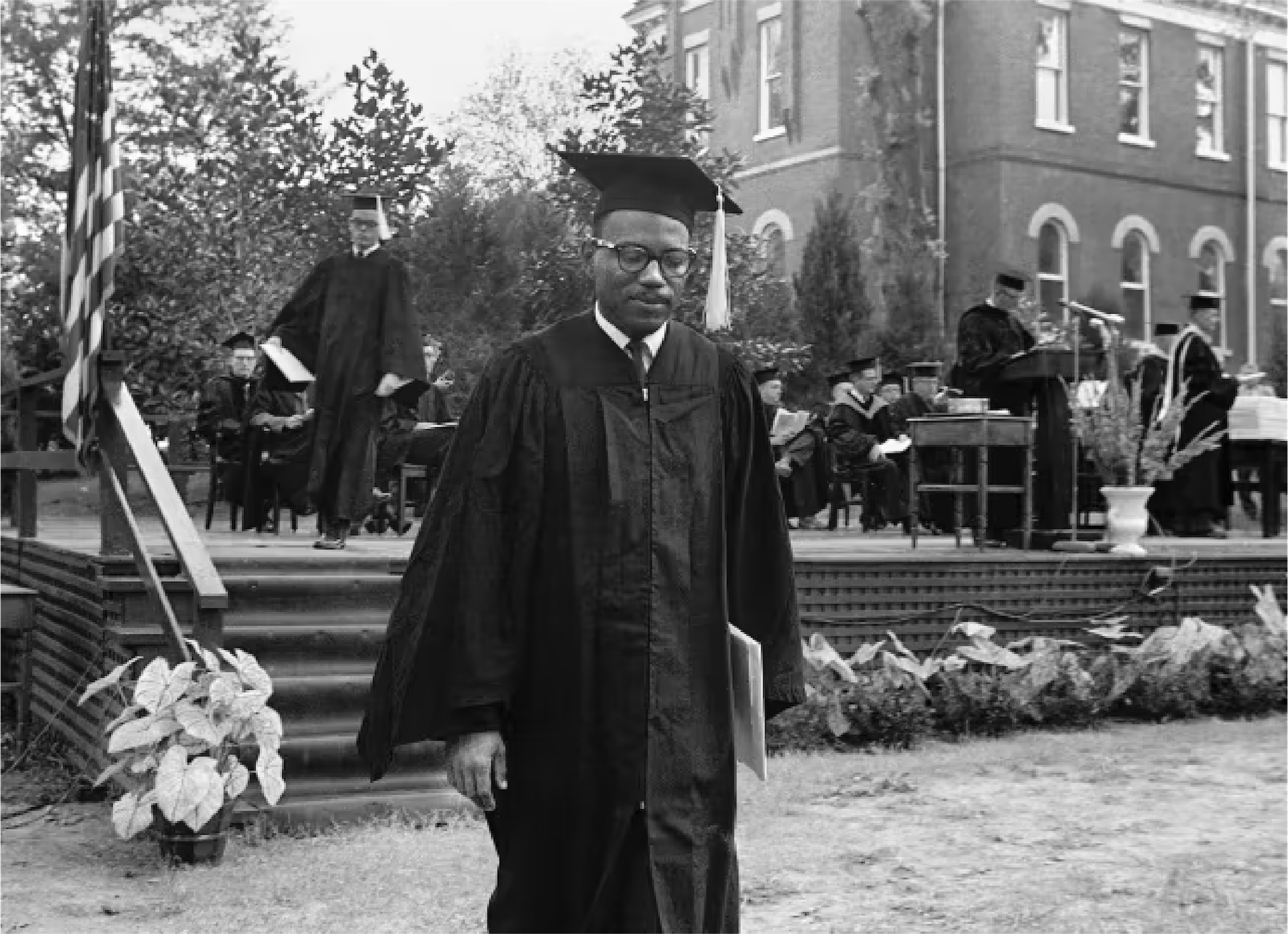
And then came the part that popular memory often understates: the loneliness. After the riot, after the headlines, Meredith still had to live there. The symbolic victory gave way to the daily strain of isolation. Accounts from the period describe the constant harassment, the social ostracism, and the atmosphere of siege that followed him through campus life. Federal marshals provided around-the-clock protection for months. Students taunted him, shunned him, and treated his presence as contamination. This was not a triumphant integration in the sentimental sense. It was endurance. And Meredith endured long enough to graduate from the University of Mississippi in August 1963 with a degree in political science.
That graduation matters as much as the admission. It is one thing to breach a barrier. It is another thing to survive inside it. Meredith did both. His degree represented not just personal achievement but the completion of the test he had set in motion. Mississippi had tried to declare him impossible. He left with credentials from its flagship institution. He had made the state yield, whether it wished to or not.
After Ole Miss, Meredith did not disappear into the safe afterlife of honorary status. He continued studying, spending time at the University of Ibadan in Nigeria before returning to the United States and earning his law degree from Columbia in 1968. Columbia Law School later noted that even his arrival there was newsworthy. That trajectory, from Jim Crow Mississippi to Columbia Law, underscored the breadth of his ambition. He was not a single-issue protester. He was building an intellectual and political life on top of the rupture he had already caused.
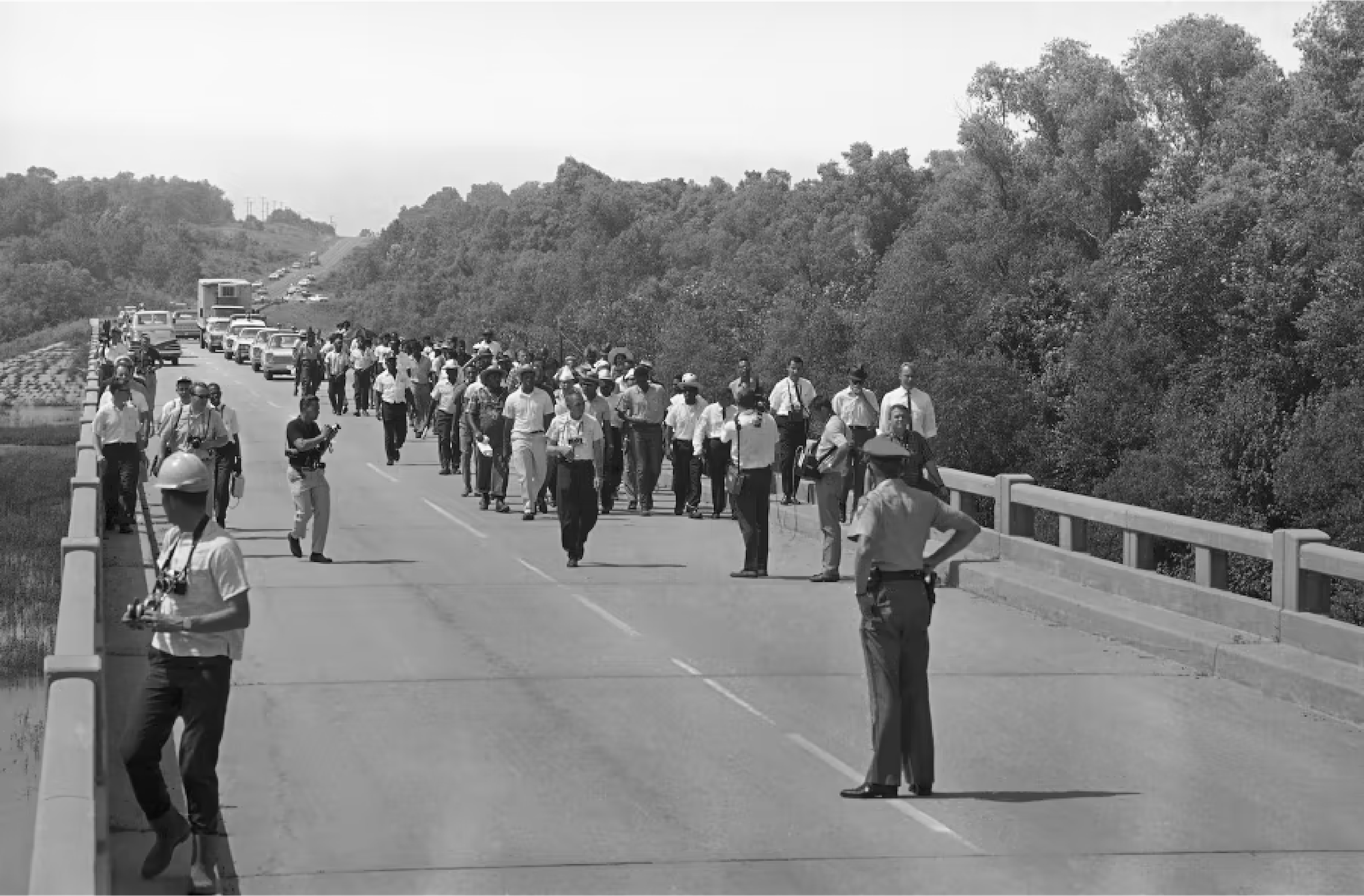
But the second great chapter of Meredith’s public life came not in a classroom but on a highway. In June 1966, dissatisfied with the slow pace of change in Mississippi even after landmark federal legislation, he began what he called a “March Against Fear,” a planned walk from Memphis to Jackson intended to challenge the climate of terror that still surrounded Black voter registration in the South. SNCC Digital Gateway notes that Meredith’s purpose was “to challenge the all-pervasive overriding fear” that remained among Black Mississippians when they tried to register and vote. This march was classic Meredith: personal, disciplined, provocative, and strategic. He intended to show that a Black man should be able to walk through Mississippi without being murdered.
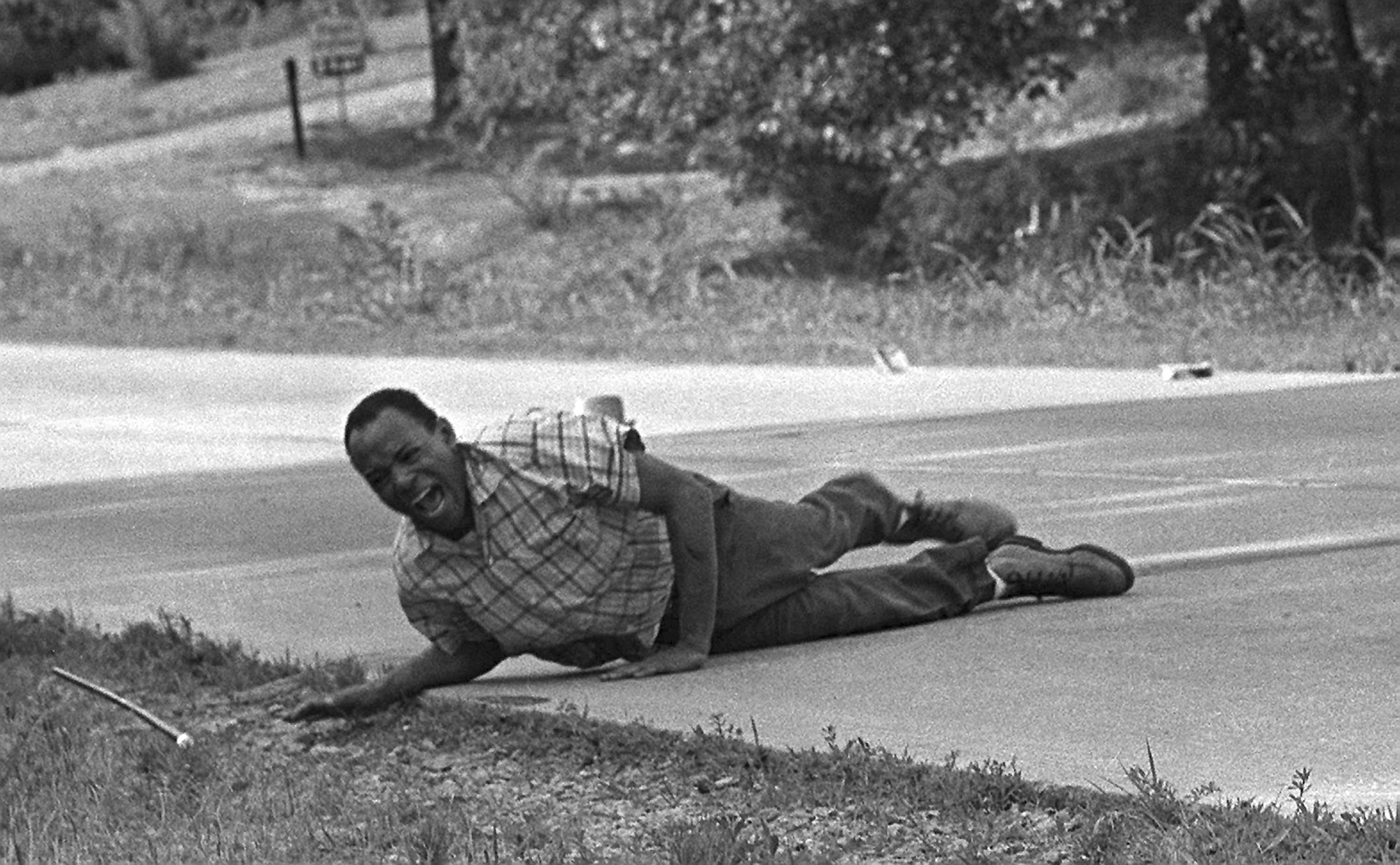
On the second day of that march, he was shot by a white gunman, Aubrey James Norvell. The shooting, captured in a famous photograph, became another national shock point. Meredith survived, but the attack transformed the march. Major civil rights organizations, including SNCC, SCLC, CORE, and others, stepped in to continue it in his name. By the time the march reached Jackson later that month, it had drawn thousands of participants and helped register thousands of Black voters. The march also became a critical stage in the emerging tensions between nonviolent integrationism and the growing Black Power tendency, especially after Stokely Carmichael’s now-famous use of the phrase “Black Power” during the campaign.
This is where Meredith’s importance expands beyond Ole Miss. If his 1962 struggle helped dramatize the federal enforcement of desegregation, the 1966 march helped mark the transition into a different political moment. Britannica’s account of the later civil rights movement places the wounding of Meredith at the center of the ideological conflict that sharpened in 1966, as Black activists increasingly pressed beyond narrow civil-rights reform toward broader political, economic, and cultural self-determination. Meredith did not create that turn by himself, but his march became one of its catalytic settings.
It is also here that Meredith’s distinctiveness becomes impossible to ignore. He was adjacent to the movement and vital to it, but never fully of it in the organizational sense. He was not built for committee politics, consensus language, or institutional branding. Even sympathetic observers often describe him as solitary, idiosyncratic, and difficult. The Stanford King Institute notes that he stood apart from major movement organizations and that his March Against Fear was initially conceived as a solitary action. That distance was not incidental. It was part of his politics. He thought in terms of manhood, discipline, citizenship, and self-command more than coalition ritual or liberal moral appeal.
“Meredith belongs to the freedom struggle, but he never fit comfortably inside its approved scripts.”
That independence helps explain why Meredith has often unsettled admirers. Over the decades, he has made statements and political associations that many found confounding or offensive. He has aligned at times with conservative figures, ran for office as a Republican, and later worked for Sen. Jesse Helms. Stanford’s King Institute notes his unsuccessful political bids, including a run in the Republican primary for U.S. Senate in Mississippi. Those decisions did not erase his earlier role, but they complicated the way the public wanted to remember him.
Some accounts treat those later choices as evidence of contradiction. But contradiction is not quite the right word. Meredith’s career makes more sense if one understands that his governing idea was never liberal coalition politics. It was a fierce and often rigid belief in citizenship, self-respect, and confrontation with power on his own terms. His rejection of the term “civil rights” came from that worldview. In a CNN interview around the 40th anniversary of his Ole Miss enrollment, he described himself as having been “engaged in a war” against white supremacy. Elsewhere, he dismissed the phrase “civil rights” as a formulation that implied inferior standing. These views have made him polarizing, but they also reveal how profoundly he resisted the notion that Black Americans should have to petition for a lesser category of justice.
That insistence has intellectual force even when Meredith’s rhetoric veers into provocation. He was making a distinction many Americans still avoid: the difference between inclusion as symbolism and equality as enforceable power. He did not want mere recognition. He wanted the state to act. In this respect, he was one of the clearest practitioners of a truth that runs throughout the Black freedom struggle: rights become real only when institutions can be compelled to honor them. Meredith understood compulsion. Ole Miss was a compulsion campaign. So was the March Against Fear.
His legacy at the University of Mississippi reflects both change and tension. The university has commemorated Meredith’s enrollment with anniversary events, a statue, and formal recognition of its history. Yet those commemorations have also exposed the limits of institutional memory. Meredith himself was skeptical of some anniversary celebrations, suggesting they misunderstood the actual meaning of what happened. CBS reported in 2012 that he had little interest in participating in official observances of his history-making enrollment. That response was vintage Meredith: suspicious of sentiment, alert to self-congratulation, unwilling to let the institution convert conflict into easy redemption.
He had a point. Universities are very good at domesticating the people who once threatened them. A statue is not the same thing as institutional honesty. A commemoration is not the same thing as reckoning. Meredith’s presence on campus in 1962 exposed not just student prejudice but the collaboration of state power, university authority, and public culture in maintaining segregation. Any honest legacy has to preserve that discomfort. The point is not that Ole Miss eventually changed. The point is how much violence it took to force the first crack.
The scale of Meredith’s historical importance becomes even clearer when viewed against the architecture of the civil rights era. There were many brave students, many local organizers, many legal strategists, many clergy leaders, and many mass campaigns. Meredith belonged to that larger ecosystem, but his intervention had an unusually sharp constitutional edge. He targeted the flagship university of one of the most segregationist states in the country and forced a choice that could not be indefinitely delayed. The resulting confrontation did not simply advance school integration. It helped clarify the post-Brown order: federal court rulings would eventually require enforcement, and states could not permanently nullify them through theater and mob violence.
There is also something distinctly modern about Meredith’s story. He understood image, timing, and national pressure. He knew that where he chose to stand mattered. Ole Miss was more potent than a less prominent institution because it condensed Mississippi’s identity. Likewise, the March Against Fear was not a random protest route. A solitary Black man walking Mississippi roads after the Voting Rights Act was a test of whether legal victory had actually changed social reality. Meredith grasped that politics is often the art of turning contradiction into spectacle until the country can no longer pretend not to see it.
He also reminds us that movement history is full of people who do not behave as later generations wish they would. The temptation in public memory is to sort figures into reassuring categories: hero or villain, radical or conservative, integrationist or nationalist, noble or compromised. Meredith resists all of that. He can be deeply admirable and deeply frustrating in the same frame. He can sound morally exacting in one moment and politically bewildering in the next. But that resistance to simplification is part of why he still matters. History is more useful when it leaves some splinters in the hand.
“James Meredith’s life is a warning against easy memory. The man who changed the country never agreed to become simple.”
His later public work broadened beyond race in the narrow sense. The Washington Post published his arguments on public education, showing that even in later life he remained committed to systemic critique rather than ceremonial legacy. That continuity is easy to miss because the public tends to freeze him in 1962. But Meredith never saw his life as completed by Ole Miss. He kept pressing on what he regarded as fundamental civic failures. The specific issues changed; the adversarial civic posture did not.
So what, finally, is James Meredith’s significance? It lies partly in the fact that he desegregated the University of Mississippi, yes. It lies partly in the March Against Fear, and in the way that march foreshadowed the ideological shifts of the late 1960s. It lies partly in his role as a living rebuke to the polite idea that progress comes mainly through consensus. But his deeper significance may be this: Meredith showed that one person, armed with legal clarity and relentless nerve, could force a democracy into open confrontation with its own lies.
That achievement did not solve America. It did not even solve Mississippi. But it altered the field of possibility. After Meredith, segregation in public higher education looked less like inherited custom and more like organized lawlessness. After Meredith, federal hesitation became harder to defend. After Meredith, the nation had one more undeniable example that white supremacy depended not only on private hatred but on public institutions willing to back it.
And Meredith himself remains, in some ways, the best argument against reducing freedom struggles to slogans. He did not fit the mold, and maybe that is precisely why he was able to do what he did. He was too stubborn to wait for permission, too severe to be satisfied with symbolism, and too certain of his standing as a citizen to accept Mississippi’s arrangements as fixed. In a century full of charismatic leaders and mass mobilizations, James Meredith stands out as a reminder that history can also turn on the cold, disciplined will of a single person who refuses to bend.
That may be the most durable lesson of his life. Not that America inevitably progresses. Not that institutions naturally improve. Not even that courage alone is enough. The lesson is harsher than that. Rights mean little until someone is prepared to force the country to honor them. James Meredith did exactly that. The rest of the nation has been catching up ever since.
More great stories
Before Integration, There Was Institution-Building
March 19, 2026
No Comments
When Samuel L. Jackson Locked the Doors
March 19, 2026
No Comments