




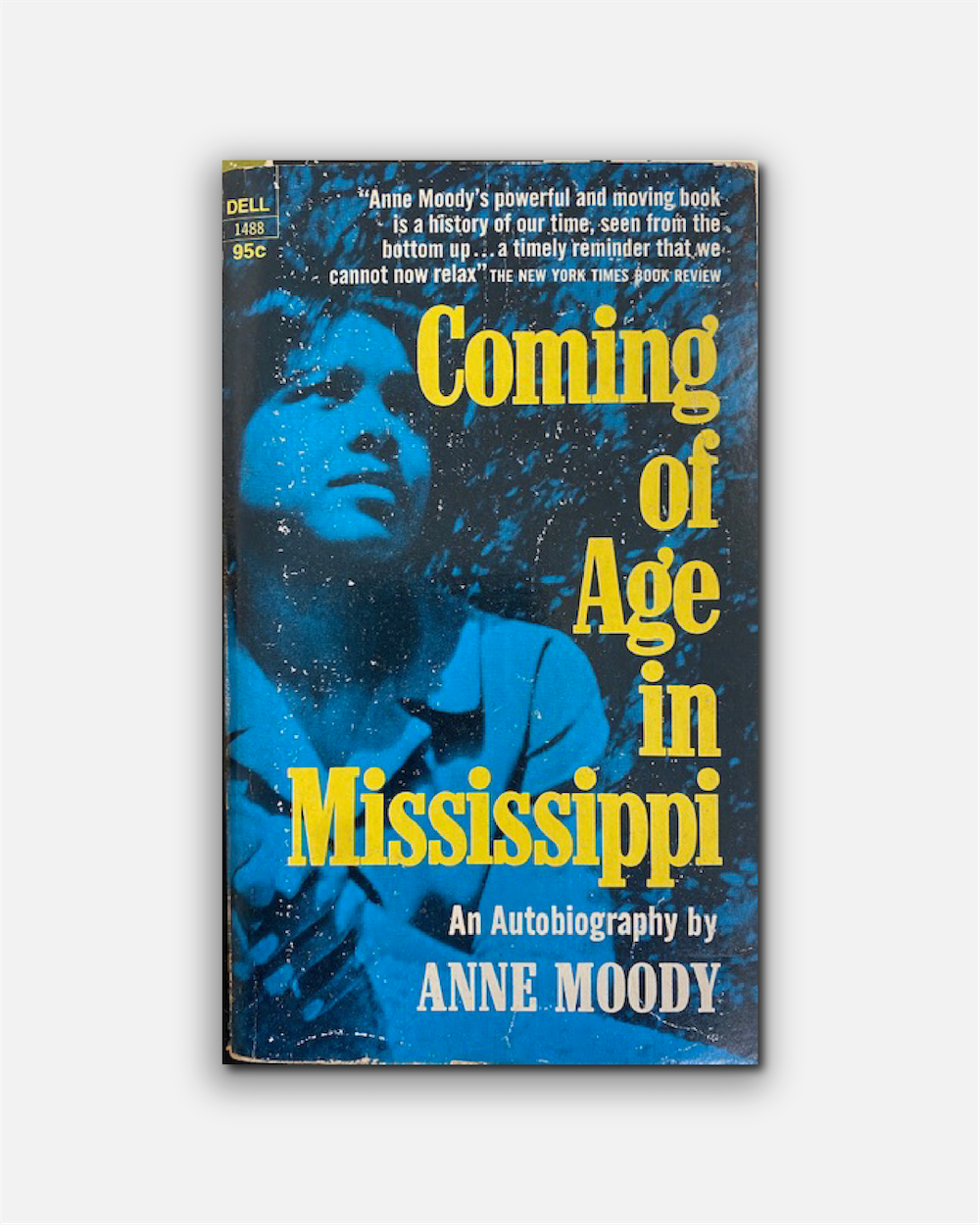
If the civil rights movement has a canon of indispensable texts, Coming of Age in Mississippi belongs near the center of it.
If the civil rights movement has a canon of indispensable texts, Coming of Age in Mississippi belongs near the center of it.
By KOLUMN Magazine
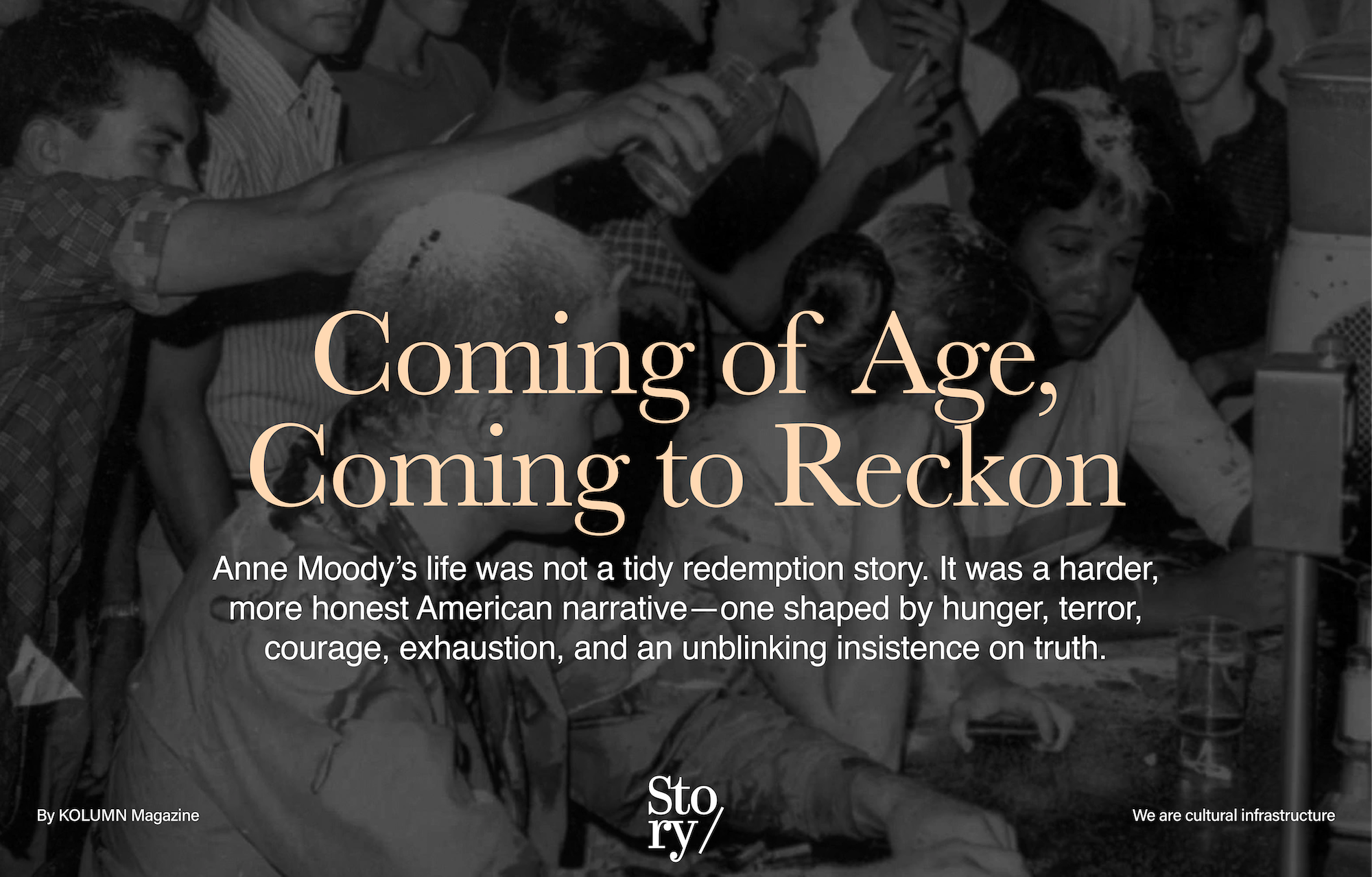
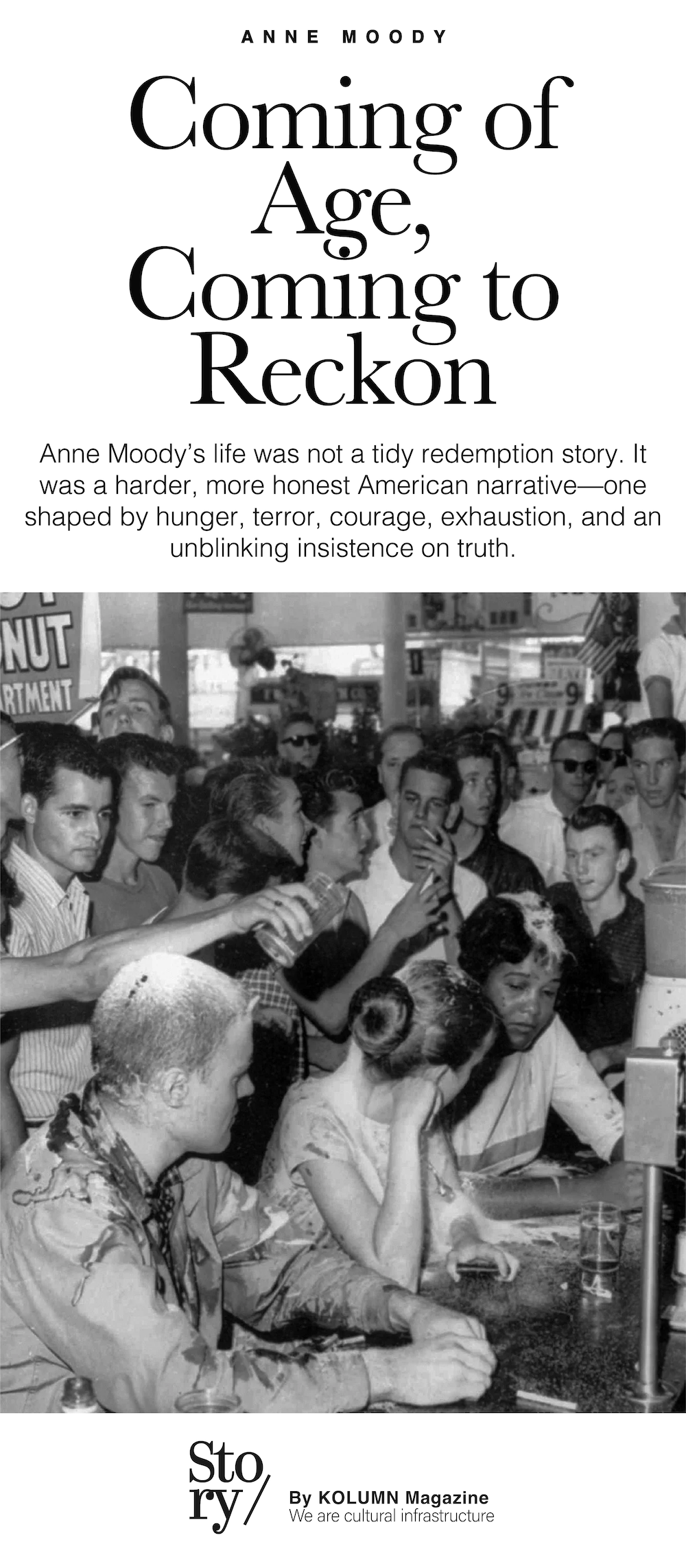
Anne Moody occupies a singular place in the history of the civil rights movement: she was both a frontline activist and one of its most devastating narrators. Many people know the photograph from the Woolworth’s sit-in in Jackson, Mississippi, where Moody sat beside other demonstrators as a white mob closed in with fists, taunts, and condiments. Many know the title of her 1968 memoir, Coming of Age in Mississippi, a book that remains widely taught and deeply admired. But Moody’s significance runs deeper than a single iconic image or a single classic text. Her life forces a harder understanding of the movement itself. It was not merely a procession of soaring speeches and legislative wins. It was also hunger, fatigue, terror, grief, and the emotional toll of trying to be fully human in a system built on your diminishment.
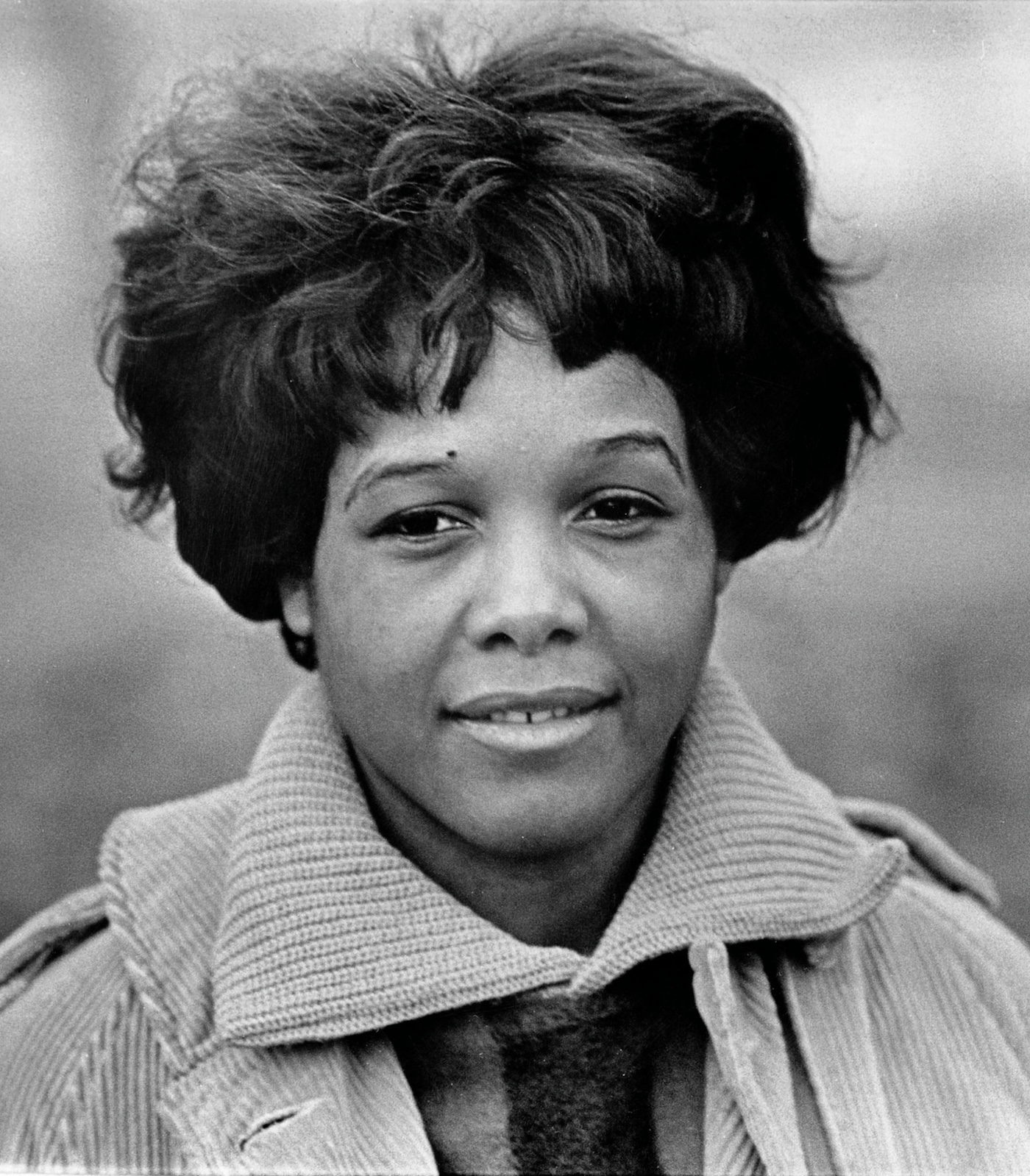
Moody mattered because she wrote from what might be called the underside of history. She did not describe segregation as an abstract injustice, or even only as a legal regime. She wrote it as a child who saw electricity glowing in a white landowner’s house while her own family made do with candles and oil lamps. She wrote it as a girl pushed into domestic labor. She wrote it as a young woman whose political awakening was inseparable from poverty, gender, fear, and the daily humiliations of Jim Crow Mississippi. That perspective remains one of her great contributions. As later scholars and teachers have noted, Moody’s memoir upended more polished, male-centered, triumphalist stories of the movement by centering a poor Black Southern girl whose consciousness sharpened into political clarity.
Anne Moody’s power was not only that she endured history. It was that she explained what history felt like while it was still happening.
Born Essie Mae Moody on September 15, 1940, in Wilkinson County, Mississippi, she came into a world structured by agricultural exploitation and racial terror. Her parents were sharecroppers on white-owned land, and the conditions of her childhood made plain that emancipation had not dissolved the economic logic of white supremacy in the rural South. Mississippi Encyclopedia notes that she was the eldest child in a struggling family and that, by age nine, she was already working for white women to help support her siblings. That biographical fact is not incidental. It tells you almost everything about the speed with which Black children in her world were made legible to labor before they were allowed the softness of childhood.
What distinguished Moody early was not that she escaped that world cleanly—she did not—but that she studied it with unusual intensity. She began calling herself Anne as a teenager, a small but meaningful act of self-definition. She attended Natchez Junior College and later Tougaloo College, the historically Black institution in Jackson that would become one of the movement’s most important nerve centers in Mississippi. At Tougaloo she joined the NAACP, worked as an organizer and fundraiser for CORE, and entered the movement more fully just as Mississippi became one of its most dangerous theaters.
If there is a decisive thread running through Moody’s life, it is the way political consciousness emerged not from theory first but from accumulation. In her story, racism is learned first as atmosphere and then as structure. It is there in the movie theater seat, the back door, the casual inequality of white employers, the economic dependency that leaves Black families vulnerable to both exploitation and retaliation. The 1955 murder of Emmett Till was one of the events that intensified her sense that the world around her was not merely unfair but organized around violence. Mississippi Encyclopedia highlights Till’s killing as a pivotal shock in her awakening, and her memoir later turned that awakening into prose that still stings.
That is part of what makes Moody so important to read now: she refused the comforting fiction that racism was only a matter of bad attitudes. In her life, the lines between economic deprivation, white terror, state neglect, and social custom were seamless. The DIG history podcast’s discussion of her work gets at this well, emphasizing that Coming of Age in Mississippi helps readers see the political, economic, and social dimensions of the civil rights era all at once. Moody’s genius was to make those dimensions visible through a single life. She let readers see how a child grows into a dissenter because the society around her has made dissent a condition of survival.
Tougaloo changed her, but it did not rescue her from reality. It sharpened her vocabulary and widened her network, yet it also placed her closer to organized confrontation. Washington Post reporting on her death recalled that Medgar Evers, then the NAACP’s Mississippi field secretary, urged young people into the campaign against segregation. Moody was among those who answered. That decision placed her inside the disciplined, improvisational, youth-driven wing of the movement that often carried extraordinary risk with comparatively little public glamour. The national mythology of the civil rights era still tends to privilege the podium. Moody’s life reminds us that the counter, the bus station, the jail cell, and the canvassing route mattered just as much.
The Jackson Woolworth’s sit-in of May 28, 1963, remains the most famous single episode of Moody’s activism, and it deserves the attention it gets. At that sit-in, Moody joined other demonstrators at a whites-only lunch counter in downtown Jackson. The abuse they faced became legendary: slurs, threats, punches, food and condiments smeared across their bodies, hair pulled, blood drawn. The image of Moody sitting amid the violence became one of the enduring photographs of the movement in Mississippi. Mississippi Encyclopedia notes that she and her colleagues were abused for nearly three hours. The Washington Post situates the protest within a longer sit-in tradition, but what makes Jackson distinct is the spectacular viciousness of the white reaction and the clarity with which the moment exposed the moral rot of segregation to the wider country.
Still, to reduce Anne Moody to that lunch counter would be to flatten her. She was not simply a symbol of stoic endurance. She was a worker in the movement—organizing, fundraising, canvassing, registering voters, and trying to connect Black Mississippians to power in a state designed to deny it. The DIG discussion of her memoir notes her work in Canton and her frustration that voting-rights efforts alone could not solve the crushing material deprivation of rural Black life. She tried to organize practical relief as well, including clothing distribution and efforts to help Black people borrow money to purchase farms. That detail matters. Moody understood, before many commentators did, that civil rights without economic transformation could feel heartbreakingly incomplete.
For Anne Moody, segregation was never only about lunch counters. It was about land, money, safety, schooling, work, and whether Black life would ever be allowed to breathe.
This is one reason her memoir still lands with such force. It refuses to separate the question of rights from the question of living conditions. Before “intersectionality” became an academic commonplace, Moody was already writing a life in which race, class, gender, and geography locked together. She was poor. She was Black. She was female. She was from Mississippi. None of those conditions can be peeled away from the others in understanding either her activism or her prose. Historians discussing the memoir have stressed precisely this point: Moody’s story disrupts simplified movement narratives by centering poor Black womanhood as a source of political insight rather than as a marginal footnote.
That insight also helps explain why Coming of Age in Mississippi became such a landmark when it was published in 1968. Britannica describes it as an eloquent and poignant account of Moody’s impoverished childhood, her encounters with Southern racism, and her work in the movement. The book arrived at a moment when the country was still convulsing over race, violence, and the meaning of freedom. But its staying power comes from something more durable than timeliness. It offered a first-person account of the movement “from the bottom up,” as the Washington Post noted in quoting Ted Kennedy’s review in The New York Times. That phrase remains useful. Moody wrote without institutional insulation. She wrote from below—below power, below comfort, below the national romance about itself.
The book’s structure is part of its achievement. Scholars discussing it point out that much of the memoir is devoted to Moody’s childhood and adolescence, not just her movement years. That decision was aesthetically shrewd and politically radical. It told readers that activism does not emerge out of nowhere. It is formed through family rupture, work, humiliation, small observations, and the dawning realization that what adults call “the way things are” is in fact a system somebody built and somebody could challenge. Too many movement narratives begin at the moment of protest. Moody began far earlier, where the damage was already being done.
It also made the memoir unusually legible to generations of students. The book has been taught for decades in high schools and colleges, and scholars continue to note its broad classroom reach. DIG describes it as a staple in advanced high school and college courses; Binghamton historian Leigh Ann Wheeler, who is completing a biography of Moody, has said she long wondered what happened beyond the ending of the famous memoir because students kept reading it and asking those questions. The memoir survives in part because it is not embalmed by reverence. It feels alive, immediate, unfinished. It asks readers not merely to admire history but to inhabit it.
Yet Moody’s story after the memoir is almost as revealing as the book itself. Mississippi Encyclopedia records that after graduating from Tougaloo in 1964, she spent a year coordinating a civil rights project at Cornell University. She married Austin Straus in 1967, had a son, and later divorced. By the later 1960s, she shifted away from formal activism and toward writing. In 1972 she received a German Academic Exchange Service grant and spent time in Berlin as an artist; in 1975 she published Mr. Death: Four Stories. She also worked in New York City in antipoverty programs and other jobs. This post-movement life complicates the public habit of treating activists as permanently available symbols. Moody was trying to live, not just to signify.
That effort to live outside the glare of history is central to understanding her. Recent reporting from Binghamton on Wheeler’s research suggests that Moody found fame burdensome, retreated from media attention, and at times fled the United States for Europe partly to escape the demands that followed publication of her memoir. Wheeler says Moody did not really want to be famous. That matters because the public often rewards witness and then punishes the witness by demanding endless accessibility. Moody had given the country a searing account of itself. The country, or at least the reading public, then expected her to remain available as an explanatory figure. She resisted that expectation.
There is a tragic intelligence in that withdrawal. Moody’s memoir already contained deep frustration with the movement’s limits and with the nation’s violence. Mississippi Encyclopedia notes that she grew exhausted after the deaths of Medgar Evers, the girls killed in the Birmingham church bombing, and President John F. Kennedy. The book ends not in uncomplicated triumph but in skepticism and fatigue. On a bus headed toward Washington, D.C., while others sang “We Shall Overcome,” Moody recorded an ache of uncertainty rather than victory. Wheeler’s Radcliffe biography description goes further, suggesting that Moody’s later life also reveals the emotional and psychological costs of racism in ways older movement stories often ignore.
That refusal of a neat ending is precisely why Anne Moody belongs in any serious conversation about civil rights memory. She does not fit comfortably into the redemptive national script. In that script, the movement progresses, the law changes, the heroes are vindicated, and the nation learns. Moody’s life interrupts that sequence. She tells us that legal progress can coexist with trauma; that courage can coexist with despair; that being right does not protect you from being worn down. To put it plainly: Anne Moody’s life does not flatter America. It tells the truth about what America asked of Black people who tried to transform it.
What makes Moody unforgettable is that she never confused visibility with victory.
Her gender is crucial here too. Moody has often been celebrated as a “foot soldier,” and while the phrase honors her labor, it can also obscure the specifically gendered texture of her experience. Women in the movement were routinely essential and routinely under-credited. Moody’s memoir, as later scholars have emphasized, helps recenter Black women as agents of history rather than background figures in male-led narratives. She also wrote with acute attention to bodily vulnerability—how danger feels in a dress, in a room full of white men and boys, in spaces where sexual threat, racial threat, and public humiliation blur into one. Her prose contains that knowledge without overstating it, which makes it all the more powerful.
That is one reason her work still speaks beyond the era that produced it. Recent scholarship has argued that Coming of Age in Mississippi has renewed relevance in a moment of renewed attacks on Black history and public reckoning. A 2025 Journal of Critical Race Inquiry abstract notes increased interest in Moody’s work amid legislative backlash against teaching critical Black history. Even apart from that contemporary framing, the point stands: her account of structural denial, community vulnerability, and the limits of national innocence feels disturbingly current. The details are mid-century Mississippi. The logic is not confined there.
The public memorialization of Moody has grown in recent years, though still less than her stature warrants. Mississippi Encyclopedia notes efforts in Centreville to honor her legacy through Anne Moody Day, a street sign, and the Anne Moody History Project. Local and regional reporting also shows continuing recognition, including her 2023 induction into the Tougaloo College National Alumni Association Hall of Fame. In 2025, a Mississippi Freedom Trail marker honoring her was unveiled in Centreville. These tributes matter, not because memorials are enough, but because they counteract a long period in which Moody’s later life was poorly understood and her public memory remained strangely thin relative to the importance of her book.
Still, a marker or a ceremony cannot fully capture what Moody offered. Her legacy is not merely commemorative; it is interpretive. She helps explain the movement to us differently. Read Martin Luther King Jr. and you hear moral architecture. Read Fannie Lou Hamer and you hear prophetic testimony. Read Anne Moody and you get something else: the granular interior record of how oppression enters a young life and how resistance gathers within it. She is one of the indispensable writers of the movement because she documented not just events but consciousness. She showed how a person comes to understand the system enclosing her and then decides, at enormous risk, to confront it.
Her prose also remains a challenge to journalists and historians. It demands accuracy about suffering without voyeurism, moral seriousness without sanctimony, and attention to ordinary people without flattening them into symbols. Moody herself was often described through the most dramatic images of violence—the Woolworth’s counter, the mob, the blood, the mustard. But the real achievement of her memoir is that it holds onto texture beyond spectacle: family tensions, ambition, shame, humor, teenage uncertainty, exhaustion, loneliness. That fullness is what makes her more than a civil rights icon. It makes her a writer.
And as a writer, she did something rare: she created a work that entered the canon without losing its edge. Some books are canonized by being softened, made respectable, stripped of their threat. Coming of Age in Mississippi has not entirely suffered that fate. Even now, it can feel uncomfortably intimate. It does not let readers hide behind distant admiration. It asks what kind of society produces a child like Anne Moody and then requires that child to become brave far too soon. That question lands in classrooms, in public memory debates, in contemporary discussions of race, and in any honest account of American democracy.
It is also worth saying that Moody’s legacy is not only sorrowful. Courage can be over-romanticized, but it should not be under-described either. She was brave in the obvious sense—sitting at that lunch counter, entering hostile territory, risking assault and arrest. But she was also brave on the page. She wrote without smoothing out contradictions in herself or in the movement. She did not pretend that all elders were wise, or that all activists agreed, or that suffering automatically made people noble. She wrote a movement crowded with doubt, ego, idealism, and grief. That honesty is one reason the book remains so durable. It feels lived, not staged.
Leigh Ann Wheeler’s ongoing biographical work may deepen public understanding of the decades after the memoir, especially the parts of Moody’s life that remained obscured for so long. Wheeler’s public descriptions suggest a figure who wanted the book to change white readers in particular and who later grappled with fragile mental health, fame’s burdens, and the complicated afterlife of becoming a civil rights witness. Those details should make us more careful, not more prurient. The point is not to turn Moody into a mystery to be solved. It is to understand that the making of public testimony often carries lifelong private cost.
There is a moment in the recent Binghamton reporting that feels especially telling: Wheeler recounts that after Barack Obama’s 2008 election, Moody turned to one of her sisters and said, “This is why we did it.” Even if one resists making too much of a single recollection, the line carries weight. It suggests that Moody, for all her skepticism and pain, did not believe the struggle had been meaningless. That matters because her memoir is often remembered for its difficult ending, its refusal of easy uplift. But difficulty is not nihilism. Moody’s realism was severe, not empty. She doubted the nation’s moral pace, but she did not deny the value of fighting it.
Anne Moody died on February 5, 2015, at her home in Gloster, Mississippi, at age seventy-four. Reporting at the time noted that she had dementia. Obituaries rightly recognized her as both activist and chronicler. Yet even that pairing does not quite capture her. She was not just a participant who later wrote, nor simply a writer who once marched. In Anne Moody, action and narration belonged to the same moral project. She confronted white supremacy in public and then refused to let the country remember that confrontation in sanitized terms.
That may be the deepest reason her life still matters. America is perpetually tempted by cleaner stories about itself—stories in which injustice is acknowledged just enough to be overcome rhetorically, stories in which the past is brutal but finished, stories in which courage is admired without requiring structural change in the present. Anne Moody disrupts all of that. She insists that poverty and racism belong in the same frame. She insists that Black girls from rural places are historical thinkers. She insists that movements have limits as well as victories. She insists, above all, that witness is work.
If the civil rights movement has a canon of indispensable texts, Coming of Age in Mississippi belongs near the center of it. Not because it is comforting. Because it is clarifying. Moody gave the nation a memoir that still refuses sentimentality, still illuminates the architecture of Jim Crow from within, and still reminds readers that the struggle for dignity is lived first in bodies, homes, schools, buses, stores, fields, and families before it ever arrives in textbooks. She remains, in that sense, not only a witness to history but a guide to reading America honestly.
And that honest reading is the beginning of any serious legacy. Anne Moody’s life was not neat, not mythic, not easily containable. It was larger and harder than that. She came from a Mississippi childhood shaped by deprivation, helped push the civil rights movement forward in one of its fiercest battlegrounds, wrote one of the movement’s essential books, and then lived long enough to demonstrate that making history does not spare you from its consequences. Her significance lies not only in what she did, but in the clarity with which she told us what doing it cost.
More great stories

Before Integration, There Was Institution-Building
March 19, 2026
No Comments
When Samuel L. Jackson Locked the Doors
March 19, 2026
No Comments