




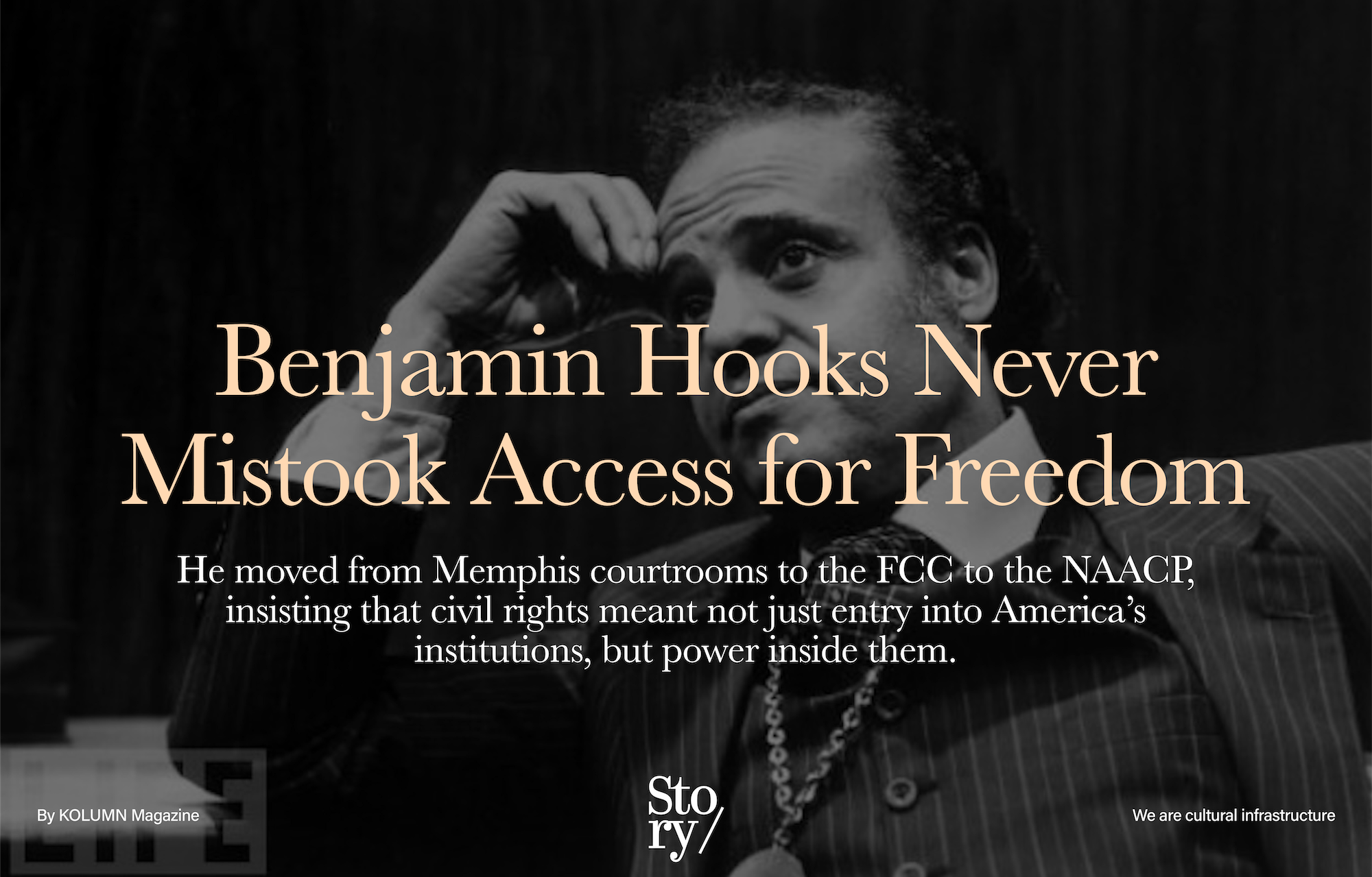
He was a calm yet forceful voice for fairness, opportunity and personal responsibility.
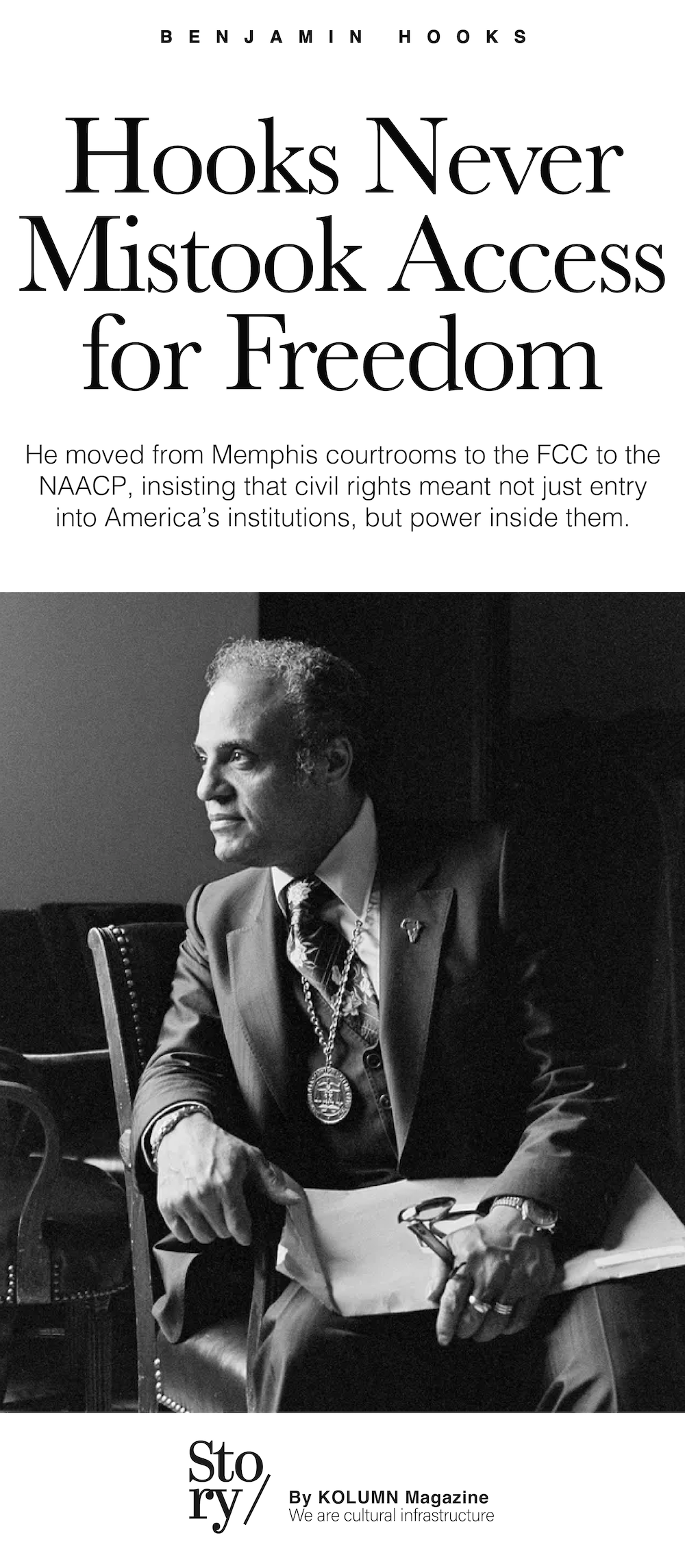
He was a calm yet forceful voice for fairness, opportunity and personal responsibility.
By KOLUMN Magazine
Benjamin Lawson Hooks belonged to that generation of Black public figures who refused to stay in one lane because the times did not permit it. He was, depending on the year and the crisis, a lawyer, minister, judge, businessman, broadcaster, federal regulator, civil rights strategist, fundraiser, public moralist, and institutional repairman. Most Americans remember him as the executive director of the NAACP, the man who led the organization from 1977 to 1992, after the peak years of the classical civil rights movement and before the language of “diversity” became corporate common sense. But reducing Hooks to that title undersells both the breadth of his life and the sharpness of his political imagination. He understood earlier than many that the fight for racial justice would not end with desegregated lunch counters or even with landmark legislation. The battleground was shifting toward employment, media ownership, economic access, educational opportunity, and the survival of Black institutions in a more conservative age. Hooks did not merely witness that shift. He tried to build a strategy for it.
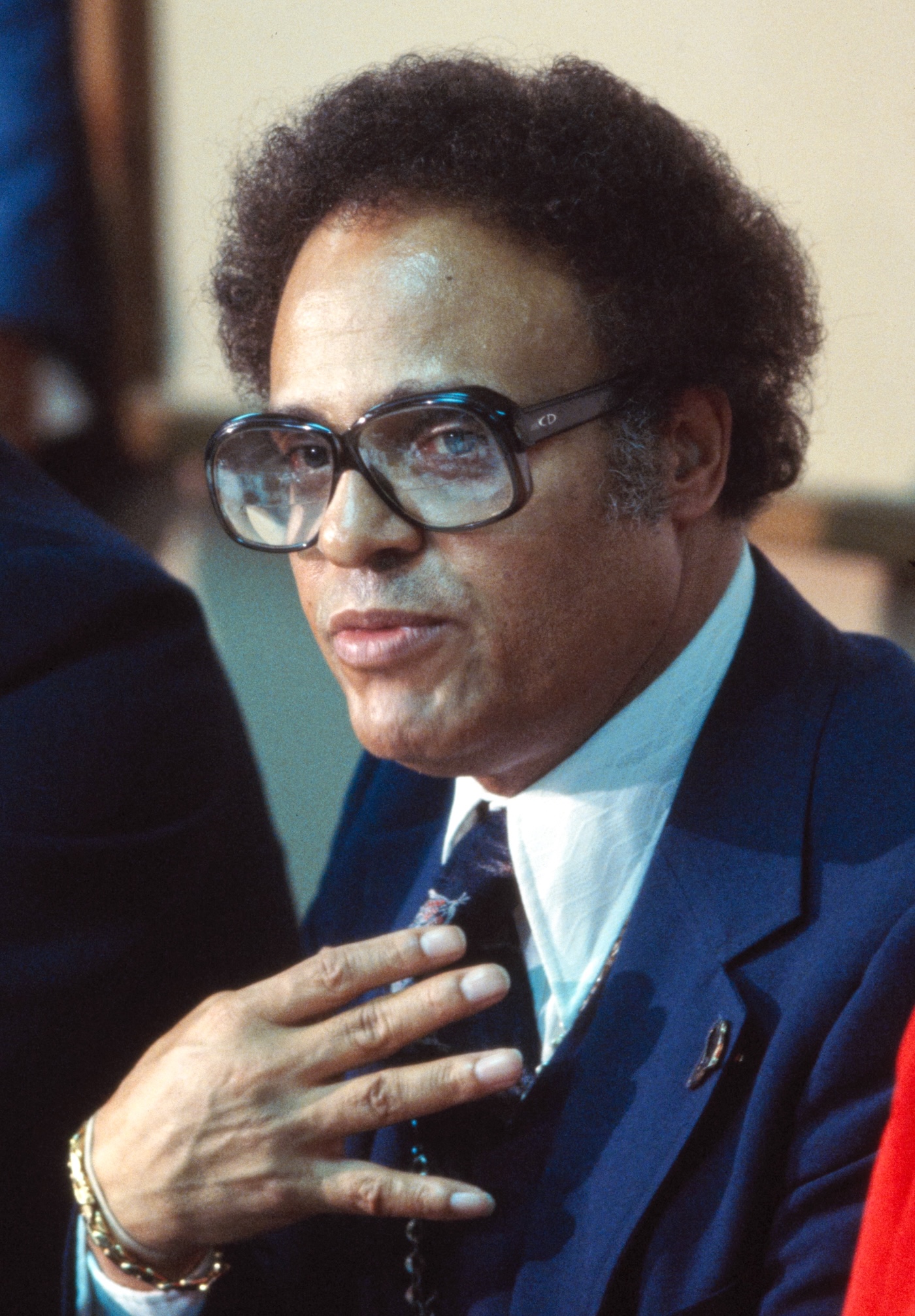
That is part of what makes him so significant now. Hooks was not just a bridge figure between the movement era and the Reagan-Bush years. He was one of the people who helped explain what the movement had to become once the old legal architecture of segregation had formally cracked but the country remained deeply unequal. He could sound like an old-school integrationist one minute and an economic nationalist the next. He defended affirmative action, pushed for minority hiring in media, backed entrepreneurship, preached self-help, and still insisted that the state had obligations to the poor and to the victims of discrimination. He was not easy to flatten into a slogan, which is another way of saying he was serious.
Hooks was born in Memphis on January 31, 1925, the fifth of seven children in a family that prized education, discipline, and uplift. He came from a Black world that had already been making excellence under pressure for generations. His paternal grandmother, Julia Britton Hooks, is widely remembered as one of the earliest Black women to graduate from Berea College, and the family’s example gave him more than pride; it gave him expectation. In the historical record around Hooks, there is a recurring sense that he grew up understanding accomplishment not as an ornament but as an obligation. He was expected to do something with his mind, and eventually with his voice.
He studied pre-law at LeMoyne in Memphis, then served in the Army during World War II. One of the decisive humiliations of his life came there. Hooks later recalled the bitter absurdity of guarding Italian prisoners of war who were permitted to eat in restaurants that would not serve him. It was one thing to know segregation as a Southern fact. It was another to experience, in wartime, that enemy prisoners could enjoy a dignity denied to a Black American in uniform. That contradiction stayed with him. It hardened his determination to study law and to attack white supremacy not as a mere personal insult but as a system.
After the war, Hooks completed studies at Howard and then earned his law degree from DePaul in 1948, because Tennessee’s law schools would not admit Black students. That detail matters because it tells you what kind of life he was entering. Hooks did not choose law in a neutral marketplace of opportunity. He chose it in a country where even training for the profession required leaving home to escape racial exclusion. He returned to Memphis anyway, passed the Tennessee bar, and opened a practice in a world that still had no intention of treating him as an equal professional. He later spoke about being insulted by clerks and called “boy,” but he kept building. What makes Hooks notable is not only that he endured racism. Many did. It is that he kept converting exclusion into institutional footholds.
Before he became a national figure, Hooks was already accumulating firsts in the South. He practiced law from 1949 into the mid-1960s, served as assistant public defender in Shelby County, and in 1965 was appointed to the Shelby County Criminal Court, becoming the first African American criminal court judge in Tennessee and, as some institutional histories note, the first Black criminal court judge in the South since Reconstruction. He then won election to the post. That rise did not mean the South had become fair. It meant that Hooks had become impossible to ignore. The courtroom, like every other American institution he entered, became a site where precedent and symbolism met.
But Hooks was never only a legal man. He was ordained as a Baptist minister in 1956, and the ministry was not a side hobby attached to a respectable career. It was central to the way he understood public life. He preached at Greater Middle Baptist Church in Memphis, later served other congregations, and brought the cadence of the pulpit into civil rights advocacy without letting it slide into vague uplift. In Hooks, one sees a distinctly Black Protestant tradition at work: moral seriousness joined to organizational discipline. He could thunder, but he also budgeted. He could sermonize about dignity and then turn to membership numbers, hiring pipelines, or statutory enforcement. That combination made him unusual. Many leaders could inspire. Hooks could also administer.
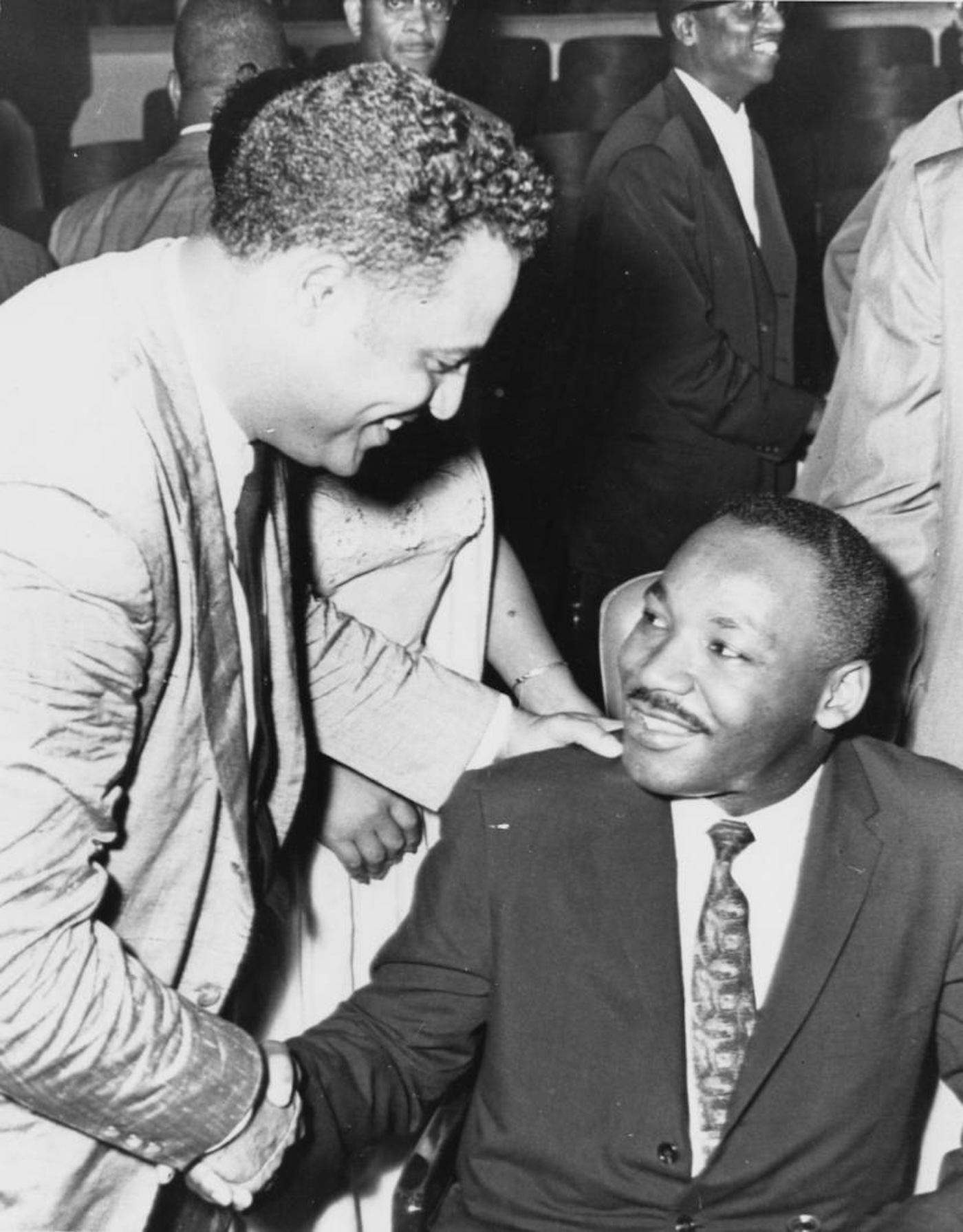
His relationship to the broader movement was also deeper than a tidy résumé can capture. Hooks joined the Southern Christian Leadership Conference orbit and served on the SCLC executive board. Martin Luther King Jr. himself praised one of Hooks’s sermons for making a “tremendous impact.” He participated in sit-ins and boycotts and remained active in direct-action politics even as he built careers in law and the judiciary. In other words, he was not one of those later institutional leaders who admired the movement from a safe distance. He was in it. Yet his path also diverged from the public archetype of the movement hero. He was not mainly remembered through one iconic march, one jailhouse letter, or one martyr’s death. His genius was durability. He kept working once the cameras moved on.
That durability helps explain why his 1972 appointment to the Federal Communications Commission was so consequential. Hooks became the first African American FCC commissioner, entering a federal body that, to many Americans, might have seemed distant from the urgent moral theater of civil rights. Hooks understood otherwise. He knew that media was not peripheral to racial power. Who owned stations, who got hired in newsrooms, which lives were shown as ordinary and which as pathological, whose children saw professionals who looked like them on television, all of that mattered. At the FCC, he pressed the case for minority inclusion in broadcasting and for more equitable employment practices. University of Memphis archival material summarizes his tenure as one focused on confronting longstanding race and gender inequities in communications policy and industry practice.
Hooks spoke about media with the practical clarity of someone who knew representation was not just symbolic. In one archived account, he argued that minorities needed positive models they could “govern themselves on,” adding that a child watching television ought to be able to imagine becoming a lawyer or doctor, not just an entertainer or athlete. That may sound familiar now, almost commonplace, but in the early 1970s it was a sharp challenge to an industry that routinely flattened Black life into stereotype, novelty, or absence. Hooks’s intervention at the FCC belonged to a longer Black freedom tradition that treated communications infrastructure as part of democracy itself. Civil rights, in this framework, meant access not only to schools and jobs, but to the means by which a society pictures reality.
One measure of his impact, cited by institutional biographies and the Associated Press obituary material, is that minority employment in broadcasting rose substantially during his tenure, from roughly 3 percent to 15 percent. Metrics like that should always be treated with care; one man does not singlehandedly transform an industry. But the number captures something important about Hooks’s career. He repeatedly went where procedure lived. He was drawn to the hinge points where policy, enforcement, and public pressure could force old systems to open a little wider. He wanted more Black participation in media ownership, management, and newsroom work because he understood that democracy becomes very brittle when whole communities are talked about but rarely allowed to speak with institutional power.
If the FCC years expanded Hooks’s national profile, the NAACP years made him a defining figure of post-1960s civil rights leadership. He was elected to lead the organization in 1976 and took office in 1977, succeeding Roy Wilkins at a difficult moment. The movement had won epochal victories, but victory had not delivered equality. The NAACP itself was burdened with debt, declining membership, internal strain, and a changing political climate. By one AP account, the organization he inherited was roughly $1 million in debt and down to about 200,000 members from the far higher levels it had seen in earlier decades. It was not dead, but it was vulnerable, and critics wondered whether old-line civil rights organizations still knew how to matter. Hooks answered that question not by apologizing for the NAACP’s methods, but by intensifying them.
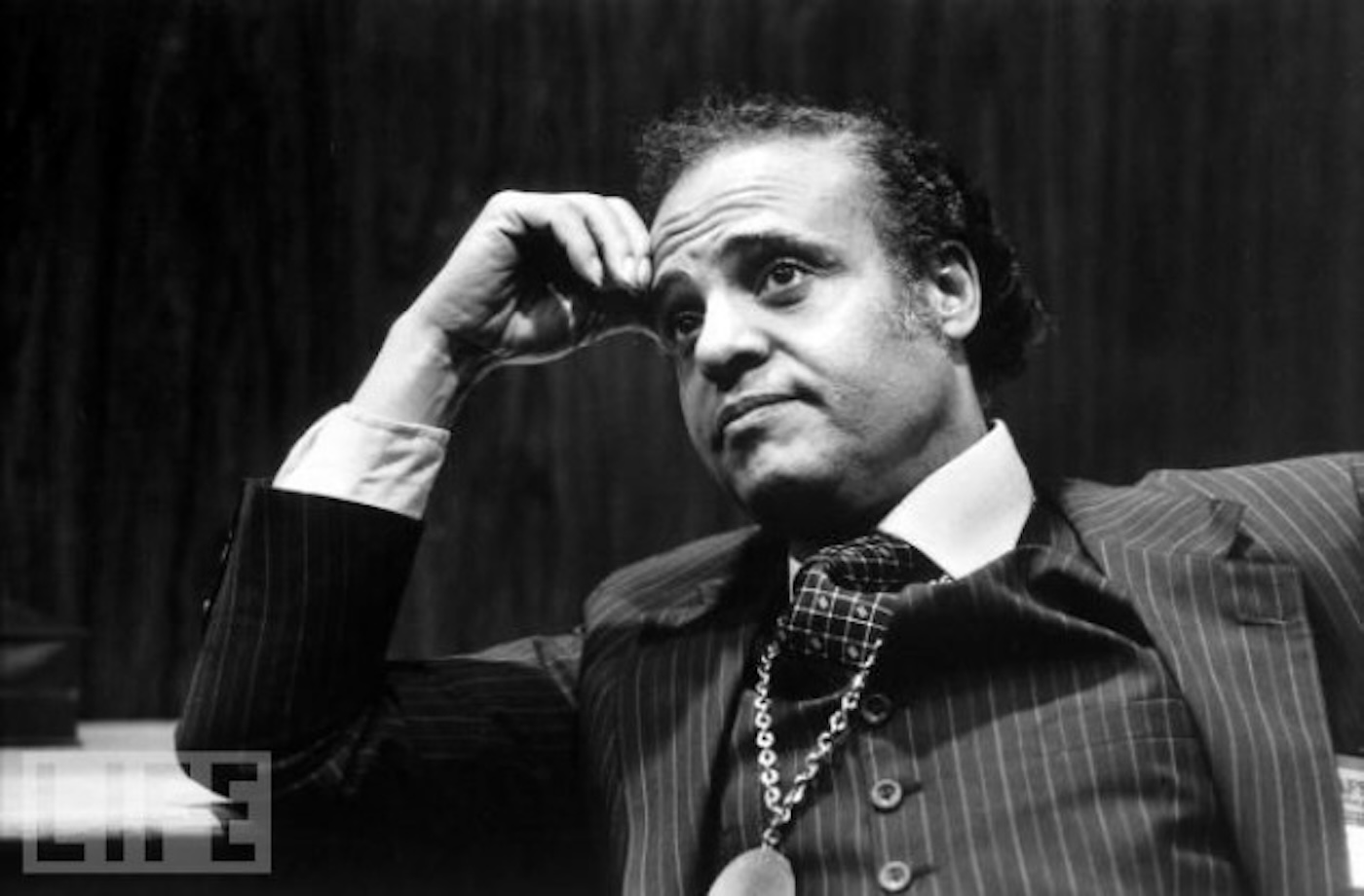
His public statements from the period remain striking. “Black Americans are not defeated,” he told Ebony in 1977. “The civil rights movement is not dead.” Then came the line that still crackles: if anyone thought Black people were going to stop agitating, litigating, demonstrating, and protesting, they “had better roll up the sidewalks.” The phrasing was pure Hooks—Southern, funny, defiant, and institutionally literate all at once. He was telling the country that the NAACP would not be trapped in nostalgia and would not be shamed out of confrontation. The organization, under him, would sue, lobby, demonstrate, and fundraise with renewed aggression.
“If anyone thinks that we are going to stop agitating, they had better think again.” (Benjamin Hooks)
Hooks also understood that survival required programmatic reinvention. During his tenure, the NAACP expanded or institutionalized initiatives that still define its legacy. The Library of Congress credits his era with reviving membership, eliminating debt, and launching or advancing programs such as ACT-SO, the Afro-Academic, Cultural, Technological and Scientific Olympics, and Fair Share, an initiative aimed at increasing employment and economic opportunity through partnerships and pressure on private firms. The broader NAACP institutional history also places Women in the NAACP in the Hooks years, with Frances Dancy Hooks playing an important founding role. These were not ornamental programs. They reflected Hooks’s reading of the era: Black advancement would require youth development, economic leverage, and stronger organizational infrastructure, not just reactive protest.
ACT-SO, in particular, deserves attention because it shows something important about Hooks’s politics. He was a civil rights leader who wanted the movement to defend the brilliance of Black children as aggressively as it defended their basic rights. The program, first nationally staged in 1978, treated academic and artistic achievement with the pageantry usually reserved for sports. That was not accidental. Hooks and his colleagues were pushing back against a culture that often made Black excellence visible only when it could be consumed as entertainment or exceptionalized as a miracle. ACT-SO said, in effect, that intellect, creativity, and study belonged in the center of Black public celebration. It was a freedom program with a scholar’s spine.
Fair Share, meanwhile, reflected his insistence that civil rights had to move into the corporate and labor markets with more strategic focus. The old fights over access to lunch counters had not disappeared morally, but they no longer described the whole field. As Hooks argued in one 1990 interview, there was a difference between winning the right to eat at the hot-dog stand and winning the right to own it. That line remains one of the cleanest descriptions of the movement’s post-civil-rights dilemma. Formal inclusion without ownership, employment power, or wealth creation leaves inequality structurally intact. Hooks was hardly alone in making that argument, but he made it from the helm of a venerable legal-rights organization, which gave the point special force. (Los Angeles Times)
“Now we’re talking about owning the hot-dog stand.” (Benjamin Hooks)
His tenure also placed him squarely in some of the most bitter ideological battles of the late 1970s and 1980s, especially around affirmative action. After the Supreme Court’s decision in Regents of the University of California v. Bakke in 1978, which preserved the principle of affirmative action while rejecting rigid quota systems, the NAACP under Hooks moved quickly to study the implications and defend the underlying need for race-conscious remedies. Hooks was especially effective at translating legal abstraction into political common sense. In a speech preserved by American RadioWorks, he explained “goals and timetables” not as reverse discrimination but as necessary enforcement mechanisms in a nation where law without penalty becomes mockery. He argued that the law may not change hearts immediately, but it can change conduct. That was a classic civil rights insight, and Hooks wielded it with both lawyerly precision and preacherly bite.
What made Hooks especially important in this period was his refusal to let the country rename its history. He did not accept the emerging conservative language that framed modest corrective efforts as racial favoritism. He insisted that Black Americans were not asking for an inversion of discrimination but for the reversal of exclusion. This was more than rhetoric. It was an attempt to defend historical memory against political amnesia. Hooks knew that once the nation forgot what had been done, it would begin treating any remedy as overreach. The fight over affirmative action was therefore also a fight over whether the United States would remember segregation as a structural system or reduce it to a regrettable mood from the past.
This put him on a collision course with the Reagan era, and he did not hide it. Archival material from the Hooks papers at the University of Memphis shows him warning after Reagan’s election about hysteria in Black communities and arguing that Black Americans and their allies were once again being asked to defend constitutional democracy against reactionary forces. At the same time, Hooks maintained dialogue with political opponents, including the White House, because he believed institutions still had to be pressured from inside and outside. That combination—moral alarm paired with tactical engagement—was one of his hallmarks. He was no separatist romantic. He was a fighter for leverage.
The 1990 Los Angeles Times profile of Hooks caught another central tension in his worldview. He could sound conservative when he discussed family breakdown, moral values, or self-help, yet he remained a staunch defender of government responsibility, affirmative action, and anti-discrimination law. Some observers found this contradictory. It was not, at least not in his tradition. Hooks came out of a Black institutional culture that expected discipline from the community and obligation from the state. He could say, as he did in 1990, that Black America needed “a moratorium on excuses,” while also castigating administrations that abandoned the poor or weakened civil rights enforcement. He believed self-help and structural critique were both necessary. To contemporary ears, accustomed to neatly branded ideological camps, that can sound messy. In practice, it was often more truthful than the simplified binaries that replaced it.
Hooks’s language about poverty was especially prescient. In 1990 he spoke about the structural transformation of the American economy, noting that deindustrialization was destroying pathways that had once allowed people with limited formal education to earn decent wages. That analysis matters because it shows he was not merely moralizing about individual behavior. He understood that Black suffering in the late twentieth century had to be read against economic restructuring, not only against personal failure. He recognized what would become increasingly obvious in later decades: that a service economy, a weakened labor base, and segregated educational inequality were producing a chronic underclass the country preferred to blame rather than understand.
If Hooks did not always receive the same popular adoration as some movement icons, part of the reason is that he led during an era when civil rights work looked less cinematic. The stakes were still enormous, but the images had changed. The 1960s offered television-ready moral dramas: lunch counters, buses, bridge crossings, firehoses. Hooks’s era often involved debt restructuring, employment negotiations, judicial fights over policy design, and the slow maintenance of an old organization in a hostile political climate. That work is harder to mythologize, but it may be closer to the daily reality of democracy. Hooks specialized in the unglamorous middle distance between protest and policy.
He also paid the price of visibility. In the wave of racist bomb attacks around 1989 and 1990, Hooks and other civil rights leaders were among those threatened. He responded publicly, saying intimidation would not succeed and that the NAACP would continue its work while taking precautions. The incident is a reminder that the post-civil-rights era was not post-terror. White supremacist violence did not disappear because the legal order changed; it adapted, persisted, and looked for new symbols to strike. Hooks understood that too. He knew the movement’s old victories had not immunized Black leaders from mortal danger.
By the time he retired from the NAACP in 1992, Hooks had helped stabilize and reenergize the organization. The Library of Congress credits him with erasing debt and reviving membership, while other accounts note that membership grew by several hundred thousand under his leadership. The specifics of institutional recovery matter because they reveal a dimension of civil rights leadership that often goes underappreciated: stewardship. Hooks was a movement man, but he was also a custodian of a national Black institution. He inherited fragility and left behind renewed capacity. In many ways, that is one of his major legacies.
His later honors reflected the breadth of that life. He received the NAACP’s Spingarn Medal in 1986 and the Presidential Medal of Freedom in 2007. When President George W. Bush presented the latter, he described Hooks as a “calm, yet forceful voice” who never tired of demanding that America live up to its ideals. When President Barack Obama marked Hooks’s death in 2010, he called him a trailblazer who gave “a voice to the voiceless.” Those presidential tributes, across party lines, are notable not because they settle his politics but because they show how difficult it became to deny the scale of his public service. Hooks had outlasted caricature.
Still, the most interesting part of Hooks’s legacy is not that presidents praised him. It is that he remains useful for thinking through the unfinished arguments of American democracy. He forces a set of questions that still have not gone away. What does civil rights leadership look like after the most obvious formal barriers fall? How do Black institutions survive in periods of backlash? What balance should exist between protest, litigation, market pressure, and self-critique? Can one argue for personal responsibility without accepting structural abandonment? Can one defend integration while also insisting on Black ownership and institutional power? Hooks did not resolve all of these tensions. But he inhabited them honestly, and that honesty is part of his value.
He also reminds us that there was never a neat dividing line between the “movement” and what came after. The story many Americans prefer tells us that the movement climaxed in the mid-1960s and then slowly dissipated into either fragmentation or symbolic commemoration. Hooks’s life argues otherwise. The freedom struggle kept moving—into courts, regulatory agencies, corporate boardrooms, annual conventions, youth competitions, White House meetings, and local branches that still needed dues-paying members and operating budgets. Hooks spent his life in those spaces, insisting that civil rights was not a mood or a memory but a set of ongoing demands on institutions.
There is also something instructive in his style. Hooks was not cool in the contemporary sense. He was not trying to perform ideological purity or generational branding. He sounded like a preacher because he was one. He sounded like a lawyer because he was one. He sounded like a bureaucratic repairman because he was that too. Sometimes he could be sharp to the point of abrasion. Sometimes he could sound old-fashioned. But his public voice was anchored in the conviction that Black freedom required institutions sturdy enough to outlive charisma. That may be the least glamorous lesson of all, and one of the most important.
Benjamin Hooks died in Memphis on April 15, 2010, at age 85. By then he had become the kind of figure American history produces only through long service: not simply famous, not merely symbolic, but infrastructural. He had helped make room in the law, in the church, in the media state, and in the nation’s oldest civil rights organization. He was part strategist, part sentinel. If his significance is sometimes overlooked, it may be because he spent so much of his career doing maintenance on democracy after the nation congratulated itself for progress. But maintenance is where republics either hold or fail. Hooks knew that. He kept saying, in one form or another, that rights must be enforced, institutions must be strengthened, and memory must not be surrendered. In that sense, his life was not an afterword to the civil rights movement. It was a manual for what came next.
More great stories
Afro Sheen, Wall Street, and the Architecture of Black Possibility
July 6, 2026
No Comments
The Fire Inside the Fourth
July 5, 2026
No Comments