



When photography was becoming one of the country’s new civic languages.
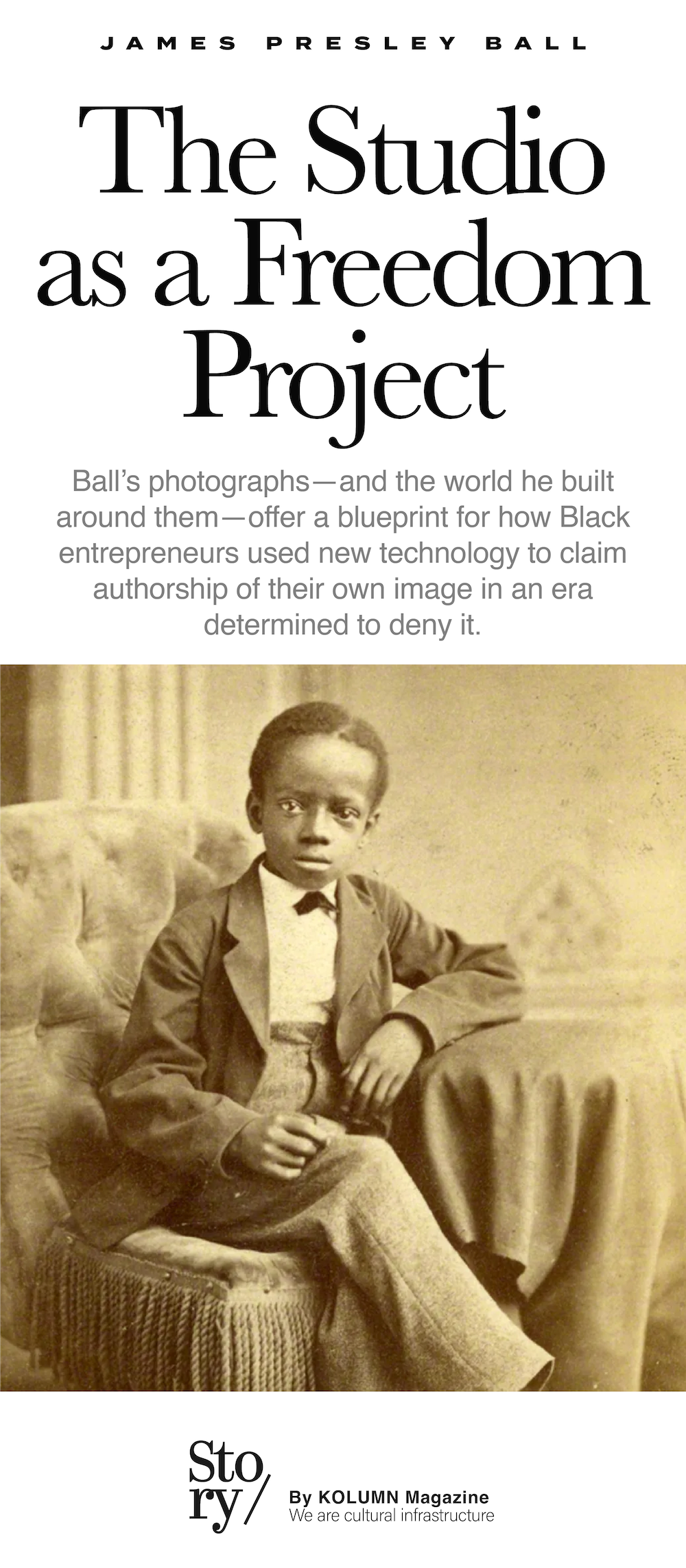
When photography was becoming one of the country’s new civic languages.
By KOLUMN Magazine
The first photographs were small miracles with sharp edges. A face arrived out of chemistry and patience—exposed, developed, sealed behind glass—then handed across a counter as proof that you had existed on a particular day in a particular outfit, with a particular set to your mouth and a particular steadiness in your eyes. In the middle decades of the 19th century, when the United States was expanding and splitting at once, a photographic portrait could be both a luxury and a declaration: I am here. I am legible. I will not be erased.
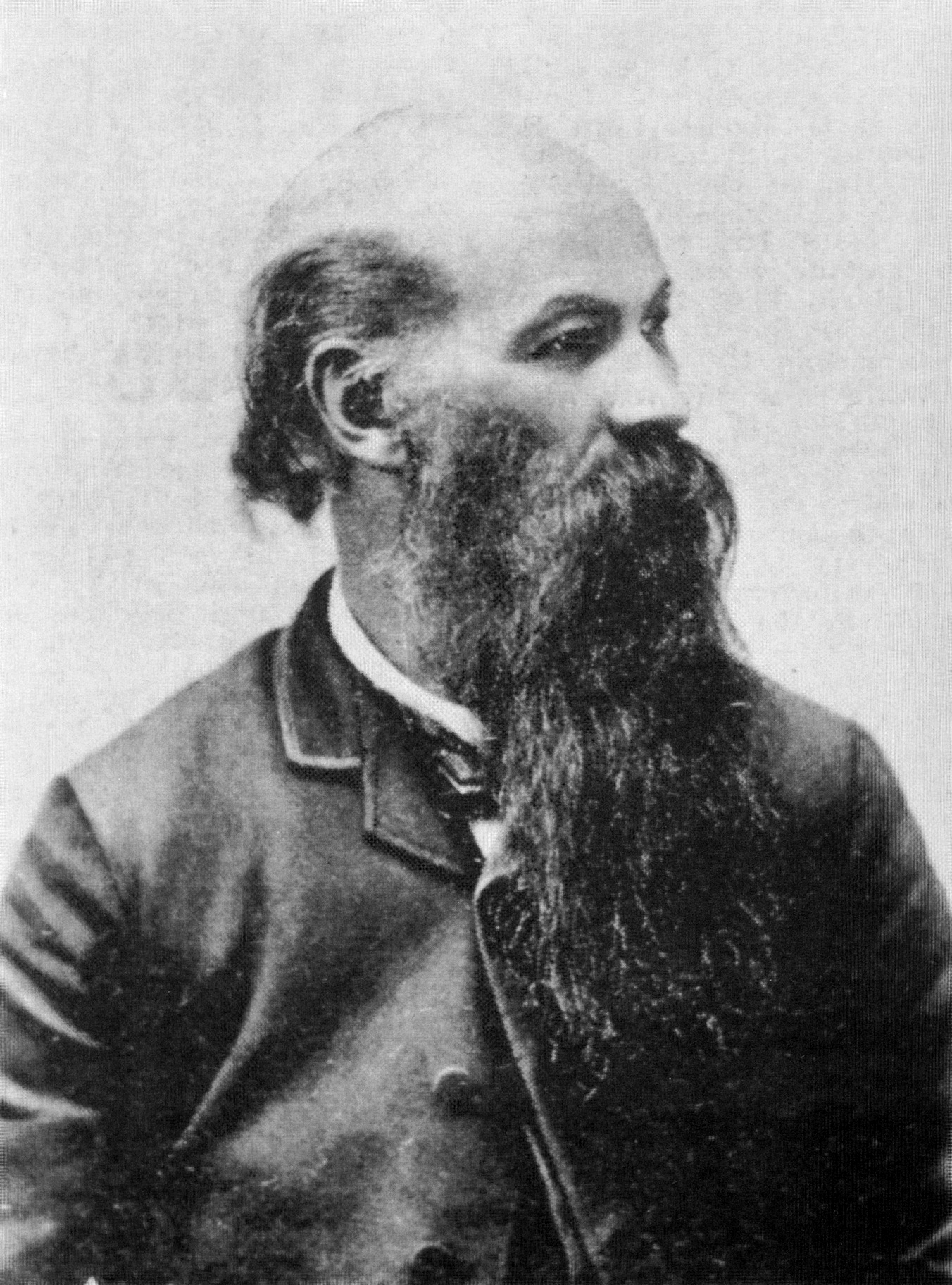
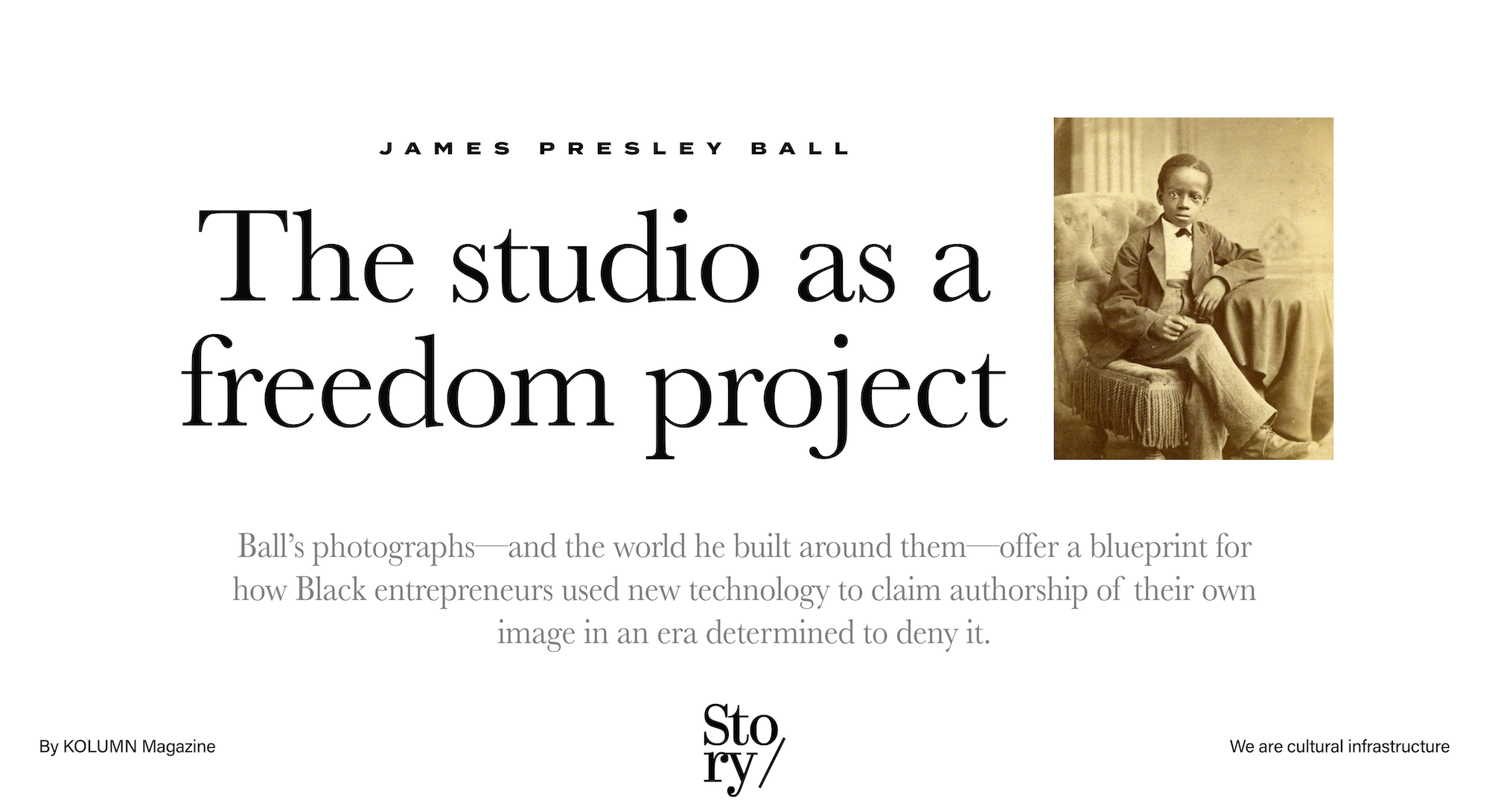
James Presley Ball understood this early, and not only as a technician. He grasped that photography was becoming one of the country’s new civic languages, a way Americans argued about who belonged—quietly, even when the argument was loud. Ball’s achievement was to make that language available on a scale that surprised even his contemporaries. He became one of the best-known Black photographers of the medium’s early era, building a Cincinnati studio celebrated for its elegance and reach, producing portraits for Black and white clients, and extending his practice into antislavery visual culture through a massive panorama and related publication that attempted, in sweeping sequence, to show the brutal mechanics of slavery and the moral stakes of emancipation.
But “pioneer” can flatten a life like his into a single heroic line. Ball was not simply first at something. He was prolific, adaptive, entrepreneurial, political, restless. He worked through photography’s shifting technologies, from daguerreotypes—expensive, luminous objects meant to be handled like jewelry—to paper prints that could circulate widely and cheaply by the late century. He built businesses, employed artists, cultivated a gallery that functioned like a parlor and a showroom, and made images in places where Black mobility itself was contested. He also leaves a central problem that any honest profile must confront: much of Ball’s story is recoverable only in fragments, the way early photography is often recoverable—through a surviving print here, a catalog entry there, a newspaper description, an institutional label, an advertisement, an echo. The work survives more reliably than the full contours of the man.
And yet the outlines are clear enough to matter. Ball’s life shows how a Black artist-entrepreneur could use a new technology not merely to earn a living, but to help construct a counter-archive—an argument in images—at a moment when the country was trying to decide whether Black people would be citizens, property, or something in between.
From Virginia to the camera’s frontier
Ball was born in Virginia in 1825, in an America where Black life was divided by law into categories of enslavement and precarious freedom. His early years, like those of many free Black Virginians of the period, are difficult to fully reconstruct from public records alone, and the available sources summarize more than they narrate. Still, the broad trajectory is consistent across major institutional accounts: Ball learned daguerreotype photography and began opening studios in the 1840s, at the dawn of a medium that was itself still learning what it could do.
To start a daguerreotype practice then was to enter a trade that mixed chemistry with theater. The client sat under a skylight. The operator arranged the chair, the pose, the head clamp that helped keep a body still. Exposure times were improving but still demanded discipline. The resulting image, formed on a polished metal plate, offered an uncanny clarity. A daguerreotype did not reproduce easily; each one was an object, singular, and therefore costly. It was also, crucially, persuasive. People believed photographs.
For a Black man to stake a professional claim in that economy required more than skill. It required navigation—of customers, of credit, of physical safety, of white curiosity and white resentment, of the shifting boundaries between free states and slave states. Ball’s early career involved movement and experimentation, the rhythm of an itinerant professional trying to find a market and a foothold. By the late 1840s and into the 1850s, he became most associated with Cincinnati, a city whose geography made it a hinge of the nation’s contradictions.
Cincinnati and the border-city imagination
Cincinnati sat across the river from Kentucky, close enough to slavery that its shadow fell over daily life. It was also a place with significant free Black communities, abolitionist networks, and intense conflict over the Fugitive Slave Act and the rights of Black residents. In other words: a market for portraits and a battleground over the meanings of Black presence.
Ball opened and developed a studio there that would become famous: Ball’s Great Daguerrean Gallery of the West, described in period accounts and later institutional summaries as a lavish space—mirrors, paintings, elegant furnishings—constructed to signal refinement, taste, and modernity. The details matter because the gallery’s aesthetic was not incidental; it was part of the argument. A photographic studio, especially a well-appointed one, was a machine for producing a certain kind of citizen: a sitter who could be seen as respectable, composed, worthy of attention. Ball’s studio offered that machine to people whom the broader culture worked to render unworthy.
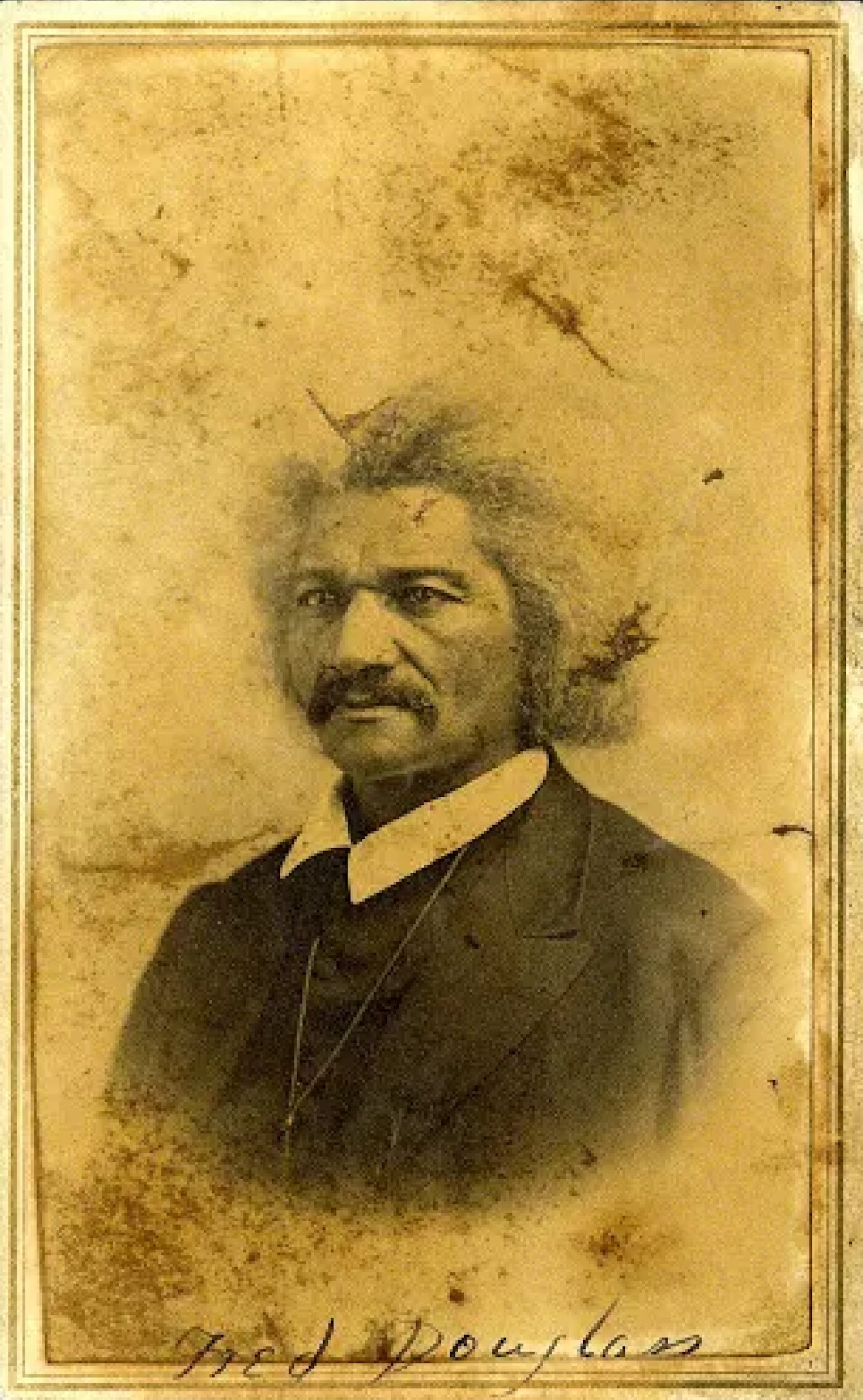
In the mid-1850s, the gallery’s reputation was such that it attracted not only local clients but broader notice, and Ball’s sitters included prominent figures in American life. Smithsonian Magazine, writing about an archive of early Black photographers, notes that Ball photographed well-known people including Frederick Douglass and P.T. Barnum, and even the family of Ulysses S. Grant. The National Portrait Gallery, in the context of its exhibition materials on Douglass, points to Ball’s Cincinnati studio and its standing.
There is a temptation, when listing notable sitters, to treat photography as a kind of celebrity adjacency. But for Ball, these names suggest something else: the studio as a place where Black professionalism could become unavoidable to white patrons, and where the making of images became a negotiated encounter across race and class. The camera’s “objectivity” masked the fact that a portrait is a collaboration shaped by power: who is allowed to commission one, who is allowed to make one, whose labor is recognized, whose authorship is remembered.
Ball’s authorship was widely known in his time; it became easier to forget later.
The gallery as institution, the gallery as strategy
Ball’s studio was not simply a room with a camera. It was a cultural institution—a space that combined photographic production with display, sociability, and sometimes spectacle. The Smithsonian’s holdings include a period illustration of Ball’s gallery that conveys the room’s ambition: walls lined with framed images, visitors circulating, a sense that photography belonged to public culture, not only private memory.
The Cincinnati operation also drew other Black artists into its orbit. Accounts of the studio’s practice note that the painter Robert Seldon Duncanson worked there, retouching and coloring photographs. If you want to understand Ball as more than a lone genius, this is one of the ways: his studio was a site of collaboration and employment, part of a Black creative economy that crossed mediums. Photography in the 19th century often borrowed from painting—poses, lighting conventions, even the idea that an image could be “finished” by hand. Ball’s business recognized that the market wanted photographs that carried painterly authority and polish.
The significance here is twofold. First, Ball’s gallery demonstrates that early Black image-makers were not marginal artisans; they were sophisticated participants in the era’s visual marketplace. Second, it reminds us that “Black photography” was not only documentation of Black life; it was also a profession that served multiple communities and functioned within the commercial and aesthetic standards of its day—while also offering tools for political work.
The abolitionist panorama and the question of scale
Ball’s most explicitly political project, and the one that most clearly announces his ambition to shape public perception, was not a single portrait but a sprawling visual narrative: “Ball’s Splendid Mammoth Pictorial Tour of the United States,” associated with an antislavery panorama and a publication. Harvard’s library catalog describes an 1855 work under that title, emphasizing that it comprised views of the African slave trade as well as Northern and Southern cities and landscapes, suggesting a comprehensive national sweep that placed slavery at the center of the American story rather than at its periphery. WorldCat similarly catalogs an 1855 publication with the same title and points to its Cincinnati printing.
Panoramas were the 19th century’s immersive media: vast painted scrolls unspooled before audiences, accompanied by lecture and narration. They were entertainment, education, persuasion. In a culture saturated with traveling shows and moral exhibitions, a panorama could serve as a kind of moving argument. Ball’s choice to work at that scale suggests he did not see photography’s political potential as limited to portraiture. He wanted to narrate the nation.
This matters for how we interpret his practice. It is easy to place Ball in a lineage of studio photographers—people who built businesses by making likenesses. The panorama places him in a lineage of visual propagandists and public intellectuals as well, using images to intervene in the moral debates of the era. When Ball tried to show the slave trade, plantations, cities, rivers, Niagara Falls, and more in a single narrative arc, he was asserting that American beauty and American brutality belonged in the same frame. The “tour” was not neutral sightseeing; it was an indictment.
Cincinnati was an ideal launching point for such a project. Border cities specialized in contradiction. They produced the kind of public that could be persuaded—or at least confronted—by visual arguments about slavery’s realities.
Portraits as counter-archive
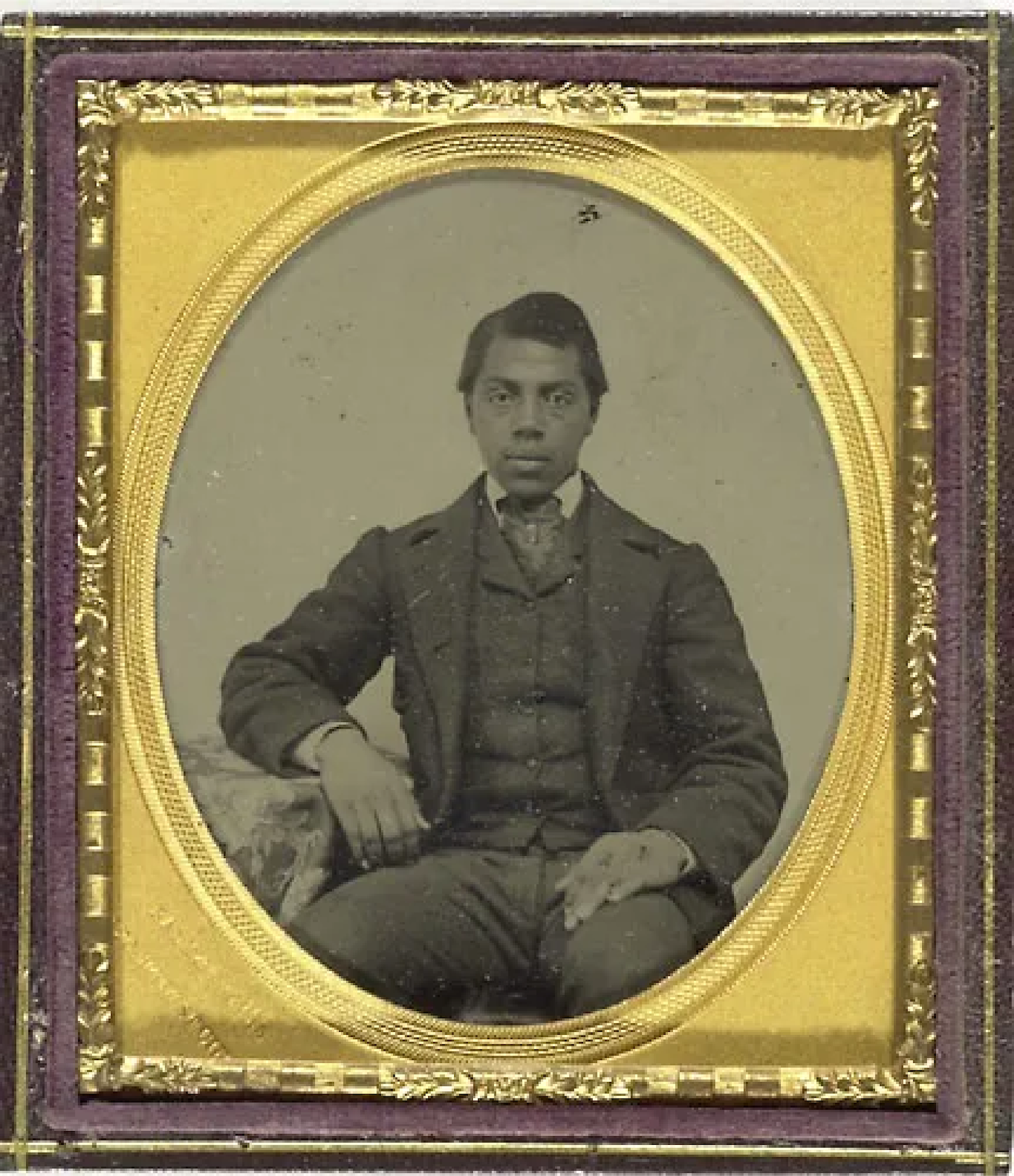
If the panorama was Ball’s loudest political gesture, the quieter one was the daily accumulation of portraits. Consider what it meant, in the 1840s and 1850s, for Black clients—free, formerly enslaved, or living in the perilous middle ground of “free” status that could be contested—to commission portraits. These images were objects of inheritance, proof for descendants, tokens exchanged among loved ones, material evidence of dignity. They also, at times, became documentary resources for historians and museums.
Institutions today hold Ball’s work in collections that help us see the breadth of his subjects. The Cincinnati Art Museum, for instance, lists daguerreotypes attributed to Ball, including intimate portraits that demonstrate his technical command and the era’s visual language of domestic respectability. The Museum of Fine Arts, Houston, points to Ball’s photographic record intersecting with Underground Railroad history, including an image captioned “Levi Coffin and Underground Railroad Passengers,” dated to the 1860s.
The existence of such an image—Levi Coffin, a well-known white abolitionist often called the “president” of the Underground Railroad, pictured with Black passengers—illustrates both Ball’s proximity to abolitionist networks and the complex representational politics of the period. A photograph like that can be read as evidence of interracial collaboration, as a testimonial image meant to validate a moral narrative, and as a reminder that the documentation of Black fugitivity often filtered through white names that were easier to celebrate publicly. Ball’s authorship complicates that: the image was mediated through a Black professional eye and a Black-owned studio, even if the subject matter includes a celebrated white figure.
Photography and the Underground Railroad are linked by more than romance. The Underground Railroad required secrecy; photography required visibility. The overlap—when it occurred—reveals careful choices about what could be shown, when, and for what purpose. Ball’s work sits near that tension: the camera as witness, but also as risk.
The myth of neutrality and the reality of the studio
The daguerreotype’s cultural authority in Ball’s era came partly from the belief that it was “truthful.” But Ball’s career illustrates how photographic “truth” is constructed. Studios were designed environments. Backdrops, props, light, pose: each decision shaped how a sitter would be seen and remembered. For Black sitters in a racist society, these choices could counter prevailing caricatures. They could also, conversely, reproduce class hierarchies within Black communities—privileging those who could afford the attire and time that the portrait demanded.
Ball’s gallery, by all accounts, was also designed to impress. Smithsonian Magazine’s description of the space—with mirrors, a piano, and an atmosphere meant to evoke high culture—makes clear that Ball understood image-making as an ecosystem: the client’s experience of the studio shaped the value of the final image. In a period when Black refinement was routinely mocked or denied, the gallery’s elegance was itself a form of insistence. It said: this is what we build; this is how we receive you; this is the level of our craft.
This insistence was also a business strategy. Respectability sold. But the story is not reducible to a “politics of respectability” lecture. It is, instead, a portrait of how Black entrepreneurs navigated a racist marketplace by mastering its symbols while also creating spaces of self-definition.
An artist in a moving medium
One of Ball’s underappreciated achievements is his longevity across photography’s technological shifts. Google Arts & Culture, in a Cincinnati Museum Center feature, emphasizes that Ball “mastered constantly evolving technologies,” moving from daguerreotypes in the 1840s to later forms that were cheaper and reproducible by 1900.
This adaptability is not merely technical. Each new photographic process changed the economics and social meaning of images. Daguerreotypes were precious objects. Albumen prints and cartes de visite were shareable, collectible, portable—photography as social media of the 19th century. The rise of prints expanded photography’s democratic potential while also enabling new forms of surveillance and typology. A photographer who lasted through those transitions had to keep re-learning not just chemistry, but the market’s evolving desires.
Ball did. And he did so while carrying the added burden of being a Black businessman in a country that alternated between needing Black labor and rejecting Black autonomy.
The West, the promise, and the complication
Ball’s life also intersects with the longer story of Black migration and the contested idea of the American West as a site of possibility. A recent essay on Curationist, published in the context of considering Ball’s significance, frames him as part of “Black image making and the promise of freedom in the American West,” suggesting that his movement and work beyond Cincinnati belong to the broader narrative of Black Americans seeking space—literal and figurative—outside the strictures of the eastern states’ racial regimes.
The “promise of freedom” is an intentionally cautious phrase. The West was not free of racism; it often reconfigured it. But it did offer different geographies of power: new towns, new markets, new kinds of mobility. Ball’s work and movements in that direction align him with other Black figures who saw western migration as an avenue toward economic independence and personal safety, even as they faced new exclusions.
If you want the significance in one sentence: Ball’s career demonstrates that Black modernity in the 19th century was not only an eastern, urban phenomenon. It traveled. It adapted. It built institutions wherever it could.
The archive that almost wasn’t
There is another reason Ball’s name has returned more forcefully in recent years: archival recovery. Smithsonian Magazine has written about a “massive archive” of early African American photographers, emphasizing how collecting, conservation, and institutional attention have helped correct the assumption that early photography was an almost exclusively white practice. The National Gallery of Art, discussing the Ross J. Kelbaugh Collection, situates Ball among celebrated early Black photographers and underscores the importance of these works as rare early photographs of African American life and artistry.
This matters because Ball’s legacy, like the legacy of many Black artists, has been shaped not only by what he made, but by what institutions and collectors valued long after he was gone. When a Washington Post feature from the 1990s notes that one of Ball’s Cincinnati views sold at auction for nearly $64,000 in 1992—then a record price for a daguerreotype—it is describing a moment when the market suddenly recognized, in dollar terms, what had long been true in cultural terms: these objects were historically and artistically significant.
But monetary recognition is not the same as understanding. A record auction price can make a photograph a trophy without making its maker legible.
Ball’s importance lies not just in rarity, but in what the work reveals: Black entrepreneurship; interracial and intraracial social worlds; the aesthetics of self-presentation; and the struggle over how the nation would visualize itself.
A photographer of white America and Black America
One of the persistent misconceptions about early Black photographers is that they worked only within Black communities. Ball’s clientele and subject list complicate that. The Smithsonian account that lists sitters like Barnum and Douglass suggests that Ball operated in a mixed world, and that white patrons sometimes sought out Black photographers for reasons that ranged from abolitionist sympathy to simple recognition of talent and reputation.
This dual clientele is central to his significance. It positioned Ball as a mediator of American self-image across race. He photographed white Americans who likely did not think of themselves as participating in Black history when they walked into his studio. Yet by choosing Ball, they contributed—knowingly or not—to Black economic and cultural power. Meanwhile, Ball’s studio offered Black clients a space where they could author their own appearance within the era’s dominant visual codes.
The studio, then, becomes a lens on a question that still haunts American culture: who gets to produce the images that define a people?
The politics of looking, then and now
To write about Ball today is also to write about what we expect photography to do. In contemporary conversations, the documentary photograph is often treated as evidence—proof of injustice, proof of humanity, proof that something happened. Ball’s era was an earlier stage of that impulse. His abolitionist panorama and his portraits were arguments. They asked viewers to see slavery, to see Black dignity, to see the nation whole.
But there is a risk in making Ball into a simple moral emblem. He was also a businessman who needed customers, a craftsman who worked within conventions, a figure navigating a society structured to limit him. His studio’s elegance can be read both as aspiration and as strategy. His photographs of prominent white clients can be read both as professional triumph and as evidence of the compromises required to thrive.
That complexity is not a flaw. It is the point. Ball’s life is significant precisely because it refuses the neat division between “art” and “activism,” between “commerce” and “principle.” In the 19th century, Black survival itself often required that these categories blur.
The man, the family, the afterlives
Ball lived long enough to see the United States transformed by Civil War and Reconstruction and to witness the hardening of Jim Crow. He died in 1904, far from the Cincinnati gallery that helped define his public reputation. The distance between where he built his fame and where he died invites speculation about the later chapters of his life—about mobility, about searching for safety or opportunity, about the personal costs of being perpetually in motion. Even when records outline the endpoints, they rarely preserve the textures: what he feared, what he hoped, what he believed the camera could still do at the end of the century.
And yet Ball’s afterlife has grown. His work is held and interpreted by institutions; his name appears in museum labels and exhibitions about Frederick Douglass and about early Black photographers; his studio is invoked as an emblem of Black enterprise in the antebellum Midwest.
A legacy, finally, is not only what a person accomplished in their lifetime. It is what later generations can do with the evidence they left behind.
What Ball left behind are images that resist the lies of his century.
Why James Presley Ball matters now
Ball matters because photography remains one of America’s primary battlegrounds over truth and belonging. We still argue—constantly—over which images represent “real America,” whose pain counts as evidence, whose joy is allowed to be public, whose dignity is treated as ordinary rather than exceptional. In that sense, Ball is not only a figure of the past; he is an ancestor of the ongoing struggle to control representation.
Ball matters, too, because his career offers a corrective to the way technological history is often told. The standard story of photography’s early years tends to orbit European inventors and white American entrepreneurs, as if Black participation arrived later. The archival work highlighted by Smithsonian and the collecting and exhibition efforts at major museums demonstrate that Black photographers were present at the creation—and that their work shaped the medium’s social meaning from the start.
And Ball matters because he shows how an artist can build infrastructure. His “Great Daguerrean Gallery” was not merely a workplace; it was a civic space that made images, employed talent, hosted viewing, and projected a sense of Black capability into a culture trying to deny it. Infrastructure is a quieter form of genius than the solitary masterpiece, but it is often the form that makes communities endure.
Finally, Ball matters because his life insists on a kind of historical humility. The record is incomplete. The temptation is to fill gaps with romance. Better is to let the gaps speak: to recognize how many Black lives of the 19th century survive only in partial traces, and to treat each surviving photograph as both artifact and accusation—evidence that someone was here, and that a nation’s archive tried, in countless ways, to forget.
Ball did not let the nation forget in his own time. He built a business around remembrance. He made a gallery into a declaration. He used the camera not only to capture faces, but to propose a future in which those faces would be recognized as American.
That proposal is still unfinished.
More great stories
Proof of Freedom
February 26, 2026
No Comments
The Education of Survival
February 26, 2026
No Comments