



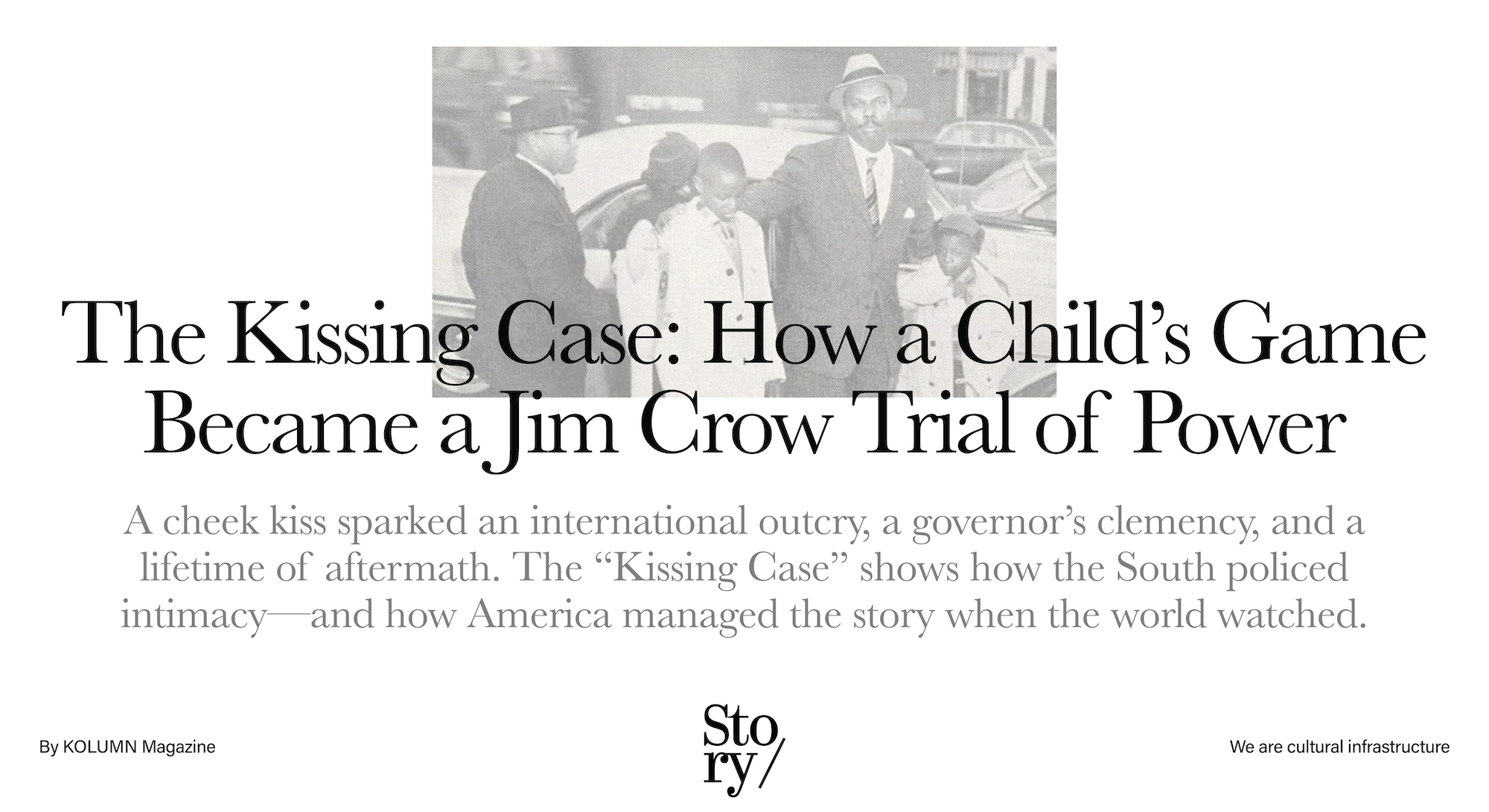
A case that once provoked international outrage that later “all but disappeared” from public view, surviving primarily in the lives of those who carried its trauma.
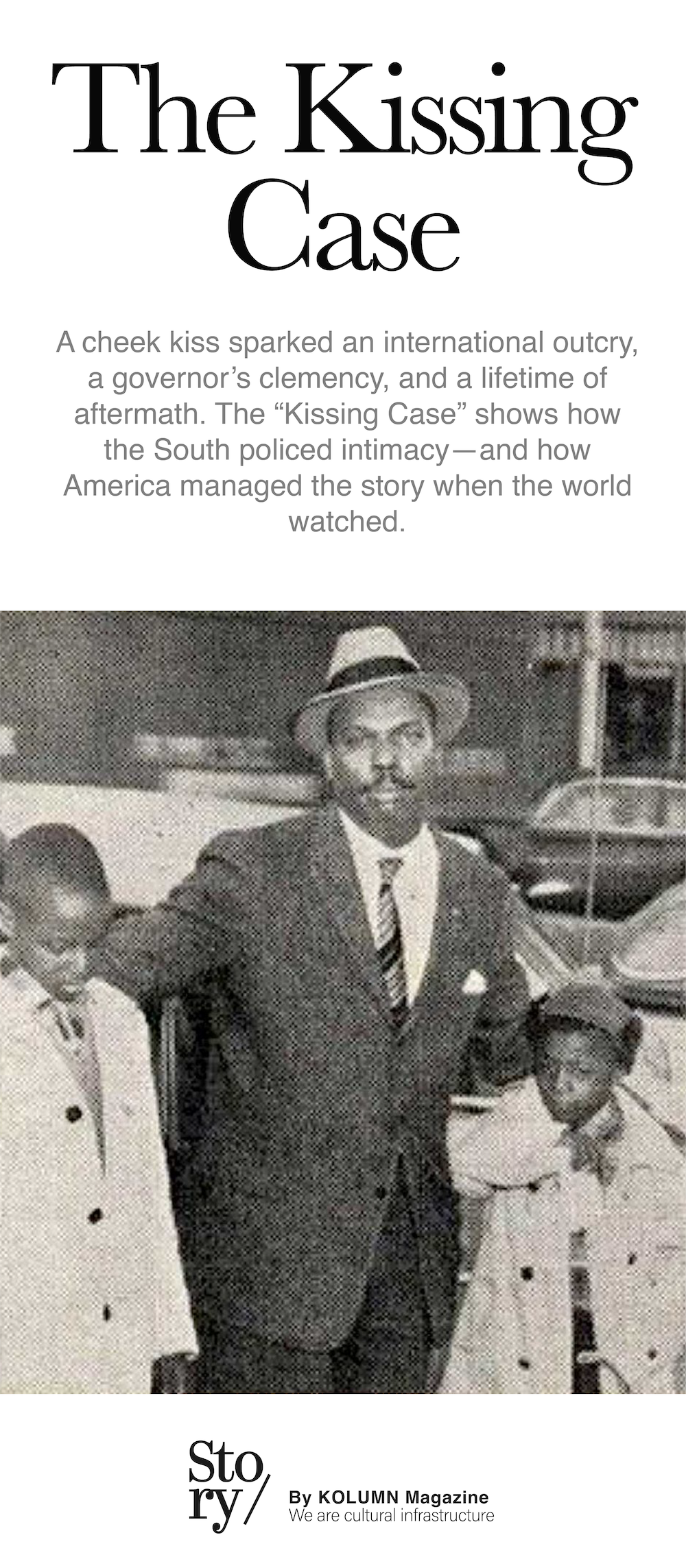
A case that once provoked international outrage that later “all but disappeared” from public view, surviving primarily in the lives of those who carried its trauma.
By KOLUMN Magazine
On a warm afternoon in late October 1958, in Monroe, North Carolina, the world of children—its dares, its invented rules, its casual experiments with attention—collided with the adult world of segregation, fear, and the law.
James “Hanover” Thompson was nine. David “Fuzzy” Simpson was seven. They were playing outside with a mixed group of neighborhood kids when a white girl—accounts vary slightly on her exact age—kissed them on the cheek. The gesture was, by every credible recollection, the kind of playful contact that belongs to childhood: a quick peck, part of a game, part of the social learning kids do before they understand how much meaning grown-ups can force onto a moment.
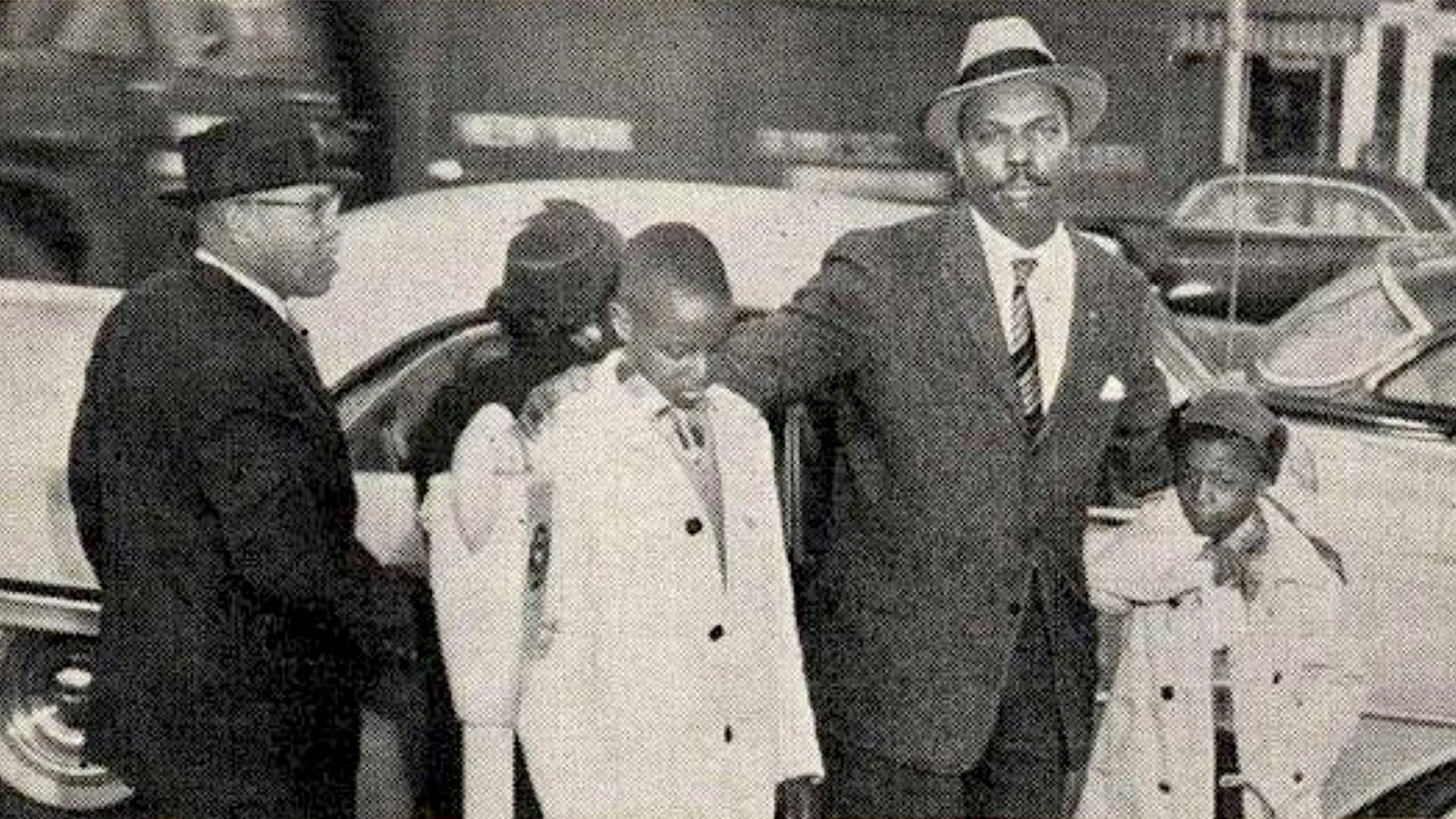
But Monroe in 1958 was not built to grant Black children the presumption of innocence—especially not in any scenario involving white girlhood. What happened next would become known, almost too neatly, as the “Kissing Case,” a label that risks understatement. Because what unfolded was not simply an episode of overreaction or a local miscarriage of justice. It was a demonstration of how Jim Crow’s systems—police, courts, employers, newspapers, and white civic life—could move in concert to turn a Black child into a sexual suspect, to translate a kiss into a crime, and to use the language of “protection” as a weapon.
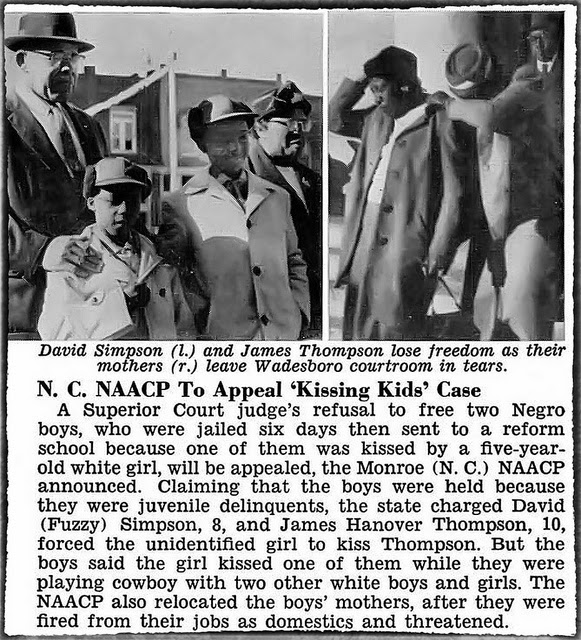
The boys were arrested. They were jailed. They were accused in terms that belonged to adult criminality. A juvenile court judge sentenced them to a reformatory that could hold them until age 21—an astonishing penalty that effectively threatened to erase their adolescence. Their families were destabilized. Their mothers lost work. Their community absorbed the message: the smallest contact across the racial line could trigger state punishment.
And then something unusual happened for a case rooted in the intimate brutality of a small Southern town: the story traveled. Not just to the big Northern papers and civil rights networks, but across the Atlantic, into European streets and foreign headlines—until the United States, locked in a Cold War contest for moral credibility, found itself embarrassed by the image of two little boys in a cage for a kiss.
The Kissing Case matters because it sits at the crossroads of several American histories at once: the policing of interracial contact; the mythology of white female purity used to justify racial terror; the strategic dilemmas inside the civil rights movement; and the global optics of American democracy during the Cold War. It is also a story about memory—how a case that once provoked international outrage could later “all but disappear” from public view, surviving primarily in the lives of those who carried its trauma.
Monroe, before the kiss: A town primed for an example
To understand why a child’s kiss could become a criminal case, you have to understand Monroe.
Monroe is the seat of Union County, in the Piedmont region of North Carolina, closer to Charlotte than to the coastal South that many Americans picture when they think of Jim Crow. But in the 1950s, the legal architecture of segregation—enforced by custom, backed by law, and guarded by violence—was thoroughly at home there.
Local civil rights organizing in Monroe was active and increasingly confrontational. Robert F. Williams, a Marine veteran and the head of the Monroe NAACP chapter, became a central figure in the town’s Black freedom struggle. He and other organizers pushed desegregation campaigns aimed at public facilities and the everyday humiliations that defined segregated life. In that climate, white backlash was not incidental; it was anticipated, cultivated, and often armed.
Williams would later become famous—and controversial—for advocating armed self-defense against racist violence, a stance that placed him at odds with the dominant public image of the civil rights movement as strictly nonviolent. Long before “Black Power” became a national slogan, Monroe was one of the places where the limits of nonviolence were debated in real time, under real threat. The Kissing Case erupted in a town already teetering with racial tension, one in which Black assertiveness was being met with intimidation.
That matters because the boys’ arrest was not simply about the kiss. It was also about power: the power to discipline a Black community, to warn it, to remind it that the state could reach into a child’s life and destroy it—and do so under the respectable cover of “law and order.”
The incident and the charge: How innocence becomes “molestation”
The basic facts, across the most credible accounts, are consistent. On October 28, 1958, a white girl kissed the two boys on the cheek during play. Later, the girl told her mother. The mother went to authorities, and the boys were arrested. The language attached to the incident escalated rapidly. What began as play became an allegation framed in the idiom of sexual violence—an especially lethal category in the history of American racism.
In the American South, accusations involving Black males and white females—whether boys or men—carried an inherited mythology: the lie of Black hypersexual predation and the purported fragility of white female innocence. That mythology had justified lynchings, riots, and legal persecution for generations. It also provided a convenient moral alibi for white supremacy. The state did not punish Black people because it was racist, the story went; it punished them to protect women and children.
That old script was imposed onto two children.
In later retellings and interviews, including the StoryCorps conversation recorded decades after the event, the case is described for what it was: a situation in which the boys were “arrested and accused of rape” in the wake of the kiss—an absurd escalation that nonetheless carried real consequences once the criminal legal system embraced it.
Authorities ultimately pursued charges described as “molestation” in several summaries of the case—again, an adult category applied to child behavior, and one that signaled how determined the system was to treat Black boyhood as inherently suspect.
The boys were taken from their families. In several accounts, they were held without access to parents or counsel for days. In the kind of detail that turns a historical episode into a lived horror, retellings include the claim that they were beaten and threatened during interrogation—an allegation consistent with the coercive policing practices of the era, and with how little procedural protection Black children could expect in the segregated South.
Juvenile court as Jim Crow theater
If the arrest was the town’s first assertion of power, the juvenile court decision was its most explicit.
A juvenile court judge found the boys delinquent and imposed a sentence to a reformatory that, in effect, threatened to keep them confined until they reached adulthood. One widely circulated account—repeated because it captures the moral logic of the ruling—attributes to the judge a rationale that treated the boys’ silence as confession: because they “stood silent,” the judge concluded guilt.
That detail matters not only because it is chilling, but because it points to a structural truth. The law did not operate neutrally; it operated narratively. It required a story in which two Black boys could be framed as sexual aggressors and punished accordingly. Their silence—whether born of fear, confusion, or the natural shock of being interrogated as children—was made to serve that story.
Juvenile justice, at least in its public rhetoric, is supposed to be rehabilitative. But in the Kissing Case, the reformatory sentence looks less like rehabilitation than like banishment: a warning to the community that Black children could be removed from the world for violating a racial boundary they did not create.
The collateral punishment: Families, jobs, and the economics of intimidation
One of the most revealing aspects of the Kissing Case is that the punishment extended well beyond the boys.
Their mothers, according to multiple accounts, were fired from their domestic work after the arrests. The message was unmistakable: involvement in a public controversy, especially one that suggested white wrongdoing or state injustice, would be met with economic retaliation.
This is a familiar pattern in civil rights history. White supremacy was not enforced only through spectacular violence; it was enforced through employment, housing, credit, and social exclusion—the daily levers that kept Black families precarious. By targeting the mothers’ jobs, the community signaled that even to defend your child could endanger your livelihood.
Accounts also describe intimidation directed at the families and the broader Black community—forms of terror that were depressingly common in the era. In at least one retelling rooted in family memory, there are images of violence so routine they become domestic: sweeping bullets off a porch; seeing burning crosses.
The Kissing Case, then, was not merely a court proceeding. It was a community-wide enforcement action.
The activists’ dilemma: A case too “small” to ignore
Civil rights organizations faced strategic decisions in the 1950s about where to invest limited resources. The NAACP, in particular, was engaged in large-scale litigation and voter registration battles. A small-town juvenile case involving children might not, at first glance, have seemed like the central front.
And yet the case became impossible to ignore—precisely because its cruelty was so naked, and because it exposed something essential: the racial order could not tolerate even the most innocent form of interracial contact.
Local NAACP leaders in Monroe, including Robert F. Williams, pushed hard. Activists connected to the case sought legal aid and appealed decisions. In many retellings, Conrad Lynn, a prominent Black civil rights attorney from New York, emerges as a key figure in the defense effort and the broader public campaign.
The organizing was not only legal; it was also political and media-savvy. A New York–based group, the Committee to Combat Racial Injustice, formed to support the boys through fundraising, securing counsel, and mobilizing moral pressure.
This is where the case becomes a lens on mid-century movement strategy. The civil rights struggle was not only a courtroom battle or a march; it was also an information war. Activists needed the story to travel—because local justice systems could ignore local outrage, but they could not always ignore national and international scrutiny.
The story crosses the Atlantic: The Cold War and the price of embarrassment
The Kissing Case might have remained a local atrocity—like so many others—if it had not become an international story.
Coverage in the international press and activism abroad turned the case into a global embarrassment for the United States. In the Cold War, America sold itself as the leader of the “free world,” contrasted against Soviet authoritarianism. Segregation and racial violence complicated that narrative, and Black activists understood that global opinion could be leveraged as pressure.
Scholarly and journalistic accounts describe international protests and widespread outrage, including demonstrations in European cities. Whether every specific episode is perfectly documented in surviving summaries, the broader point is well supported: the case became an international cause célèbre, and the U.S. government took notice because it threatened America’s moral branding abroad.
This dynamic—civil rights as foreign policy liability—shows up repeatedly in the era, from the federal government’s anxieties about Little Rock to the propaganda value of lynching stories. The Kissing Case belongs in that lineage: it was a reminder that local Jim Crow decisions could echo globally.
Eleanor Roosevelt, federal pressure, and a governor’s clemency
As pressure mounted, high-level figures became involved. Multiple accounts report that former First Lady Eleanor Roosevelt urged action and that President Dwight D. Eisenhower pressed North Carolina Governor Luther H. Hodges behind the scenes.
The mechanism here matters. There was no triumphant court victory that declared the boys’ treatment unconstitutional. There was, instead, clemency—a discretionary act that ended confinement without necessarily acknowledging wrongdoing.
In early 1959, after the boys had spent months detained, Governor Hodges granted clemency (often described as a pardon or release) that freed them from the reformatory. Accounts emphasize that the release came without a meaningful apology or admission of harm from the state or local authorities.
That refusal to apologize is part of the case’s enduring significance. It reflects a classic pattern of racial governance: when injustice becomes too visible to maintain, power yields just enough to reduce pressure—but not enough to concede that the system itself is illegitimate.
The attempted waiver: “Freedom” offered at the price of confession
One of the most morally clarifying moments in the case, in several retellings, is the report that officials asked the boys’ mothers to sign a waiver as a condition for release—language that would have required admitting guilt. The mothers refused.
Whether every detail of that negotiation is preserved in the record, the logic is unmistakable and familiar: the state sought to reframe clemency not as a correction but as mercy, and to secure that framing through a coerced confession.
The mothers’ refusal stands as one of the case’s quiet heroic facts. In a world where their jobs were threatened and their children were in captivity, they declined to accept “freedom” if it meant participating in the lie that justified the boys’ imprisonment.
After the headlines: Trauma as the long sentence
The Kissing Case is often summarized in numbers: ages, dates, months detained. But the deeper sentence was psychological.
Decades later, in recorded interviews and family recollections, the case is described as something that permanently altered lives. In the StoryCorps interview, the event is framed not as a resolved injustice but as a trauma that stayed present. The fact that the case “became known around the world” and then was “largely forgotten” is, in itself, part of the injury: the public moved on; the individuals did not.
That tension—between collective forgetting and personal endurance—is central to why EJI and other institutions have returned to the story in recent years. When EJI revisited the case, it emphasized not only the injustice but the shattering effect on the boys, their families, and the Black community.
It is worth pausing on the cultural logic that allows such forgetting. The Kissing Case is not obscure because it lacked significance; it is obscure because it complicates comforting narratives. It reveals that the policing of Black bodies did not require adult behavior; it could be triggered by childhood play. And it shows that “justice” in Jim Crow America could be less about adjudicating harm than about maintaining a racial boundary.
Robert F. Williams and the question of self-defense
The Kissing Case also matters for how it shaped movement debates.
Robert F. Williams’s involvement in Monroe civil rights struggles—including the publicity around the Kissing Case—helped propel him into national attention, and into conflict with the NAACP’s more cautious leadership. Scholarly work on Williams emphasizes his role as a precursor to later Black Power politics and his insistence that Black communities had the right to defend themselves against racist violence.
This is not a side plot. It is part of how the Kissing Case functioned as a pivot point. The case revealed a system in which the state could brutalize Black children and then claim legitimacy. For activists like Williams, that reality raised urgent questions: If the legal system is an instrument of racial control, what does protection look like? What do communities owe themselves when the law refuses to recognize their humanity?
Those questions did not begin in Monroe, and they did not end there. But the Kissing Case made them impossible to dodge.
The media’s role: Amplification, distortion, and the power of framing
Every major civil rights story is also a media story: what is reported, what is omitted, what language is used, and whose emotions are centered.
In the Kissing Case, media coverage served multiple roles at once. Local narratives could inflame white fear or justify punitive action. National civil rights networks could mobilize outrage. International coverage could turn a local injustice into a diplomatic liability.
This is why the case has become of interest not just to historians of civil rights, but to scholars of public relations and political communication. Analyses of the Kissing Case have examined how pressure campaigns and global attention functioned as instruments that could sometimes force state actors to change course—without the state ever conceding moral error.
The Kissing Case, in that sense, is an early illustration of something modern audiences recognize instantly: the struggle over narrative can be as consequential as the struggle over law.
Why the Kissing Case is not an anomaly
It is tempting to treat the Kissing Case as a singular horror—so extreme that it feels exceptional. But its deeper lesson is the opposite: it was extreme and it was structurally legible.
The case fits within a long American tradition of criminalizing Black intimacy, Black childhood, and Black proximity to whiteness. It also demonstrates how the myth of “protecting” white femininity could be weaponized even when the supposed “threat” was a child.
The sentencing logic—removing children from their families, placing them into institutions, threatening them with years of confinement—also anticipates later critiques of the juvenile justice system and the broader carceral state. The Kissing Case shows that “youth” has never been a uniformly protective category; it has been racialized, with Black children often treated as older, more dangerous, more culpable than their white peers.
In this sense, the Kissing Case is not only about 1958. It is about the continuing question of who gets to be presumed innocent.
The limits of resolution: Clemency without repair
Clemency ended the boys’ confinement, but it did not undo the harm.
There was no official apology. No meaningful restitution. No public reckoning by Monroe’s institutions. Instead, the system resumed, the story faded, and those most affected carried the consequences.
This dynamic—partial relief without repair—echoes in other American histories of racial violence and state wrongdoing. Public institutions often prefer “closure” to accountability, and they frequently define closure as the moment the public stops paying attention.
That is one reason the modern reemergence of the Kissing Case matters. When institutions like EJI revisit the story, they are not merely preserving a historical anecdote. They are challenging the idea that time itself is an adequate substitute for justice.
And it is also why contemporary movements for truth-telling commissions and reparative policies continue to face resistance: acknowledgment creates obligations.
A case study in America’s racial imagination
The Kissing Case endures because it reveals how racial power is reproduced in the smallest moments.
A kiss is not just a kiss when a society has trained itself to see Blackness as threat. A child’s game is not just a game when the law is prepared to convert play into “molestation.” A juvenile court is not a sheltering institution when its purpose is less rehabilitation than boundary enforcement.
It is also a case that forces an uncomfortable recognition about American exceptionalism. The United States did not change because it suddenly realized it was wrong. The state of North Carolina did not free the boys because it affirmed their innocence in some newly enlightened moment. The pressure that made clemency politically useful was, in large part, the pressure of reputation—what the world would think of a “free” nation that jailed children for a kiss.
That should not diminish the activism that saved the boys from years of confinement. It should sharpen our understanding of what activists were up against: a system that could withstand local outrage indefinitely, but that could sometimes be moved when injustice threatened America’s global image.
What the Kissing Case asks of us now
In recent years, Americans have become more fluent in the language of systems—how injustice can be produced not only by individual prejudice but by institutions designed to distribute vulnerability unequally. The Kissing Case is an early, vivid demonstration of that systemic operation.
It also raises a question that is as current as any headline: What happens when society refuses to recognize a child as a child?
The answer, in Monroe, was a jail cell. A courtroom. A sentence that threatened to consume a childhood. And a lifetime of aftermath narrated in the voices of survivors decades later—still explaining that a kiss “made civil rights history,” not because it should have, but because the country demanded it.
The Kissing Case is not simply a story of the past. It is a mirror held up to the present, reflecting how quickly innocence can be revoked when race dictates the terms of perception—and how much work it takes, even now, to convert outrage into remedy.
More great stories
Afro Sheen, Wall Street, and the Architecture of Black Possibility
July 6, 2026
No Comments
The Fire Inside the Fourth
July 5, 2026
No Comments