

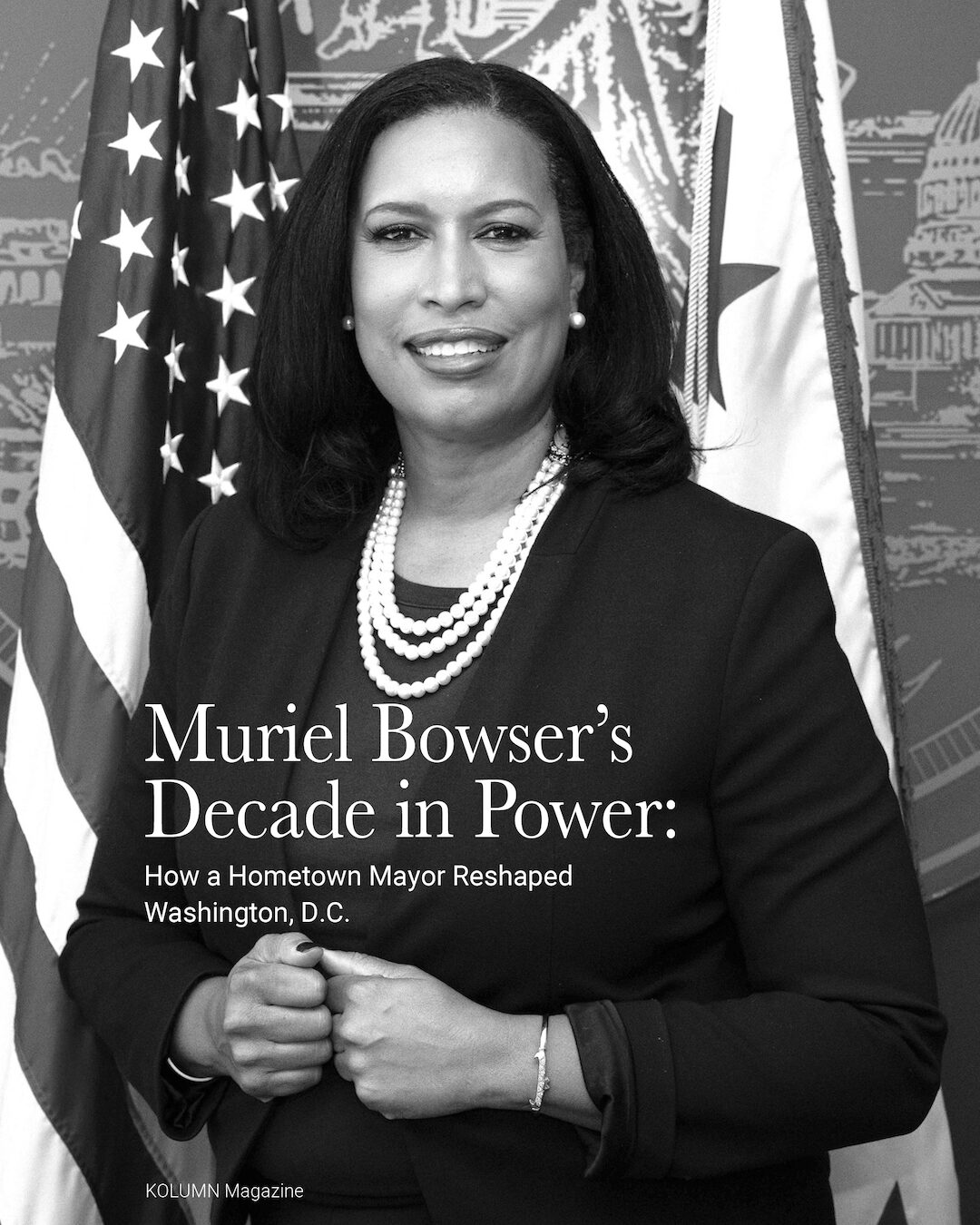
Muriel Bowser’s Decade in Power:
How a Hometown Mayor Reshaped Washington, D.C.
By KOLUMN Magazine
On a late-November afternoon in 2025, Muriel Elizabeth Bowser sat in her Ward 4 living room and did something she has rarely done in public life: she talked about stepping away. After more than a decade as Washington, D.C.’s mayor, she announced she would not seek a fourth term, bringing an end to one of the longest and most consequential mayoralties in the city’s modern history.
Her decision came just months after perhaps her most controversial and defining victory: a $3.7 billion deal to bring the NFL’s Washington Commanders back to the District, anchored by a new stadium and mixed-use development at the RFK Stadium site — a project supporters hail as a generational economic engine and critics deride as an enormous public subsidy for a billionaire-owned team.
Bowser’s tenure has been marked by sharp contrasts: record housing investments alongside deepening displacement, bold symbolic gestures on racial justice and bitter disputes with local Black activists, confrontations with two very different presidents and, ultimately, a negotiated coexistence with a resurgent Donald Trump and a hostile Congress determined to test the limits of D.C. home rule.
As the city begins to imagine life after Bowser, her record reveals both the possibilities and limits of pragmatic, business-friendly governance in a majority-Black city struggling with inequality, crime, and the unfinished project of democracy itself.
From Riggs Park to the Wilson Building
Muriel Bowser likes to say she is “D.C. born and bred,” and that’s not campaign boilerplate. Born in 1972, the youngest of six children in a working- and middle-class family, she grew up in North-east Washington’s Riggs Park neighborhood. Her father, Joe Bowser, was a local activist and ANC commissioner; her mother, Joan, worked in schools.
Bowser left the city for college, earning a history degree from Chatham University in Pittsburgh and a master’s in public policy from American University back home in D.C. Those credentials, combined with her family’s deep neighborhood roots, helped shape a politician comfortable speaking both the language of technocratic governance and the idioms of longtime Washingtonians watching their city transform around them.
Her formal political career began where her father’s had: at the hyper-local Advisory Neighborhood Commission. In 2004, she won an uncontested race to represent ANC 4B09 — Riggs Park. She ran unopposed again in 2006, a sign of both low-profile neighborhood politics and her ability to move through D.C.’s insider networks without making enemies she didn’t need.
In 2007, fate and timing delivered her first big break. When Ward 4 Councilmember Adrian Fenty became mayor, Bowser ran in the special election to replace him on the D.C. Council. Backed by Fenty’s network and business interests eager for continuity, she won and quickly became known as a reliable vote for development and school reform.
The alliances she cemented on the Council — with developers, business leaders, and political bundlers — would become both her governing base and one of the sharpest lines of attack against her for the next 15 years. In a 2012 reelection race, challengers criticized her for accepting large corporate donations; Bowser defended the practice as transparent and preferable to opaque money flows through outside groups.
The Mayor Who Promised “A Fair Shot”
In March 2013, Bowser announced her run for mayor, positioning herself as a reformer who would preserve D.C.’s economic momentum while promising longtime residents they would not be left behind. Her slogan — “A Fair Shot” — framed prosperity as something to be managed and distributed, not reversed.
She defeated incumbent Vincent Gray in the 2014 Democratic primary amid a shadow of federal investigations into Gray’s earlier campaign. In January 2015, Bowser was sworn in as the city’s seventh elected mayor and only its second woman to hold the job.
Bowser quickly made clear that, in a city with limited autonomy and no vote in Congress, she saw the mayor’s job as equal parts governor, county executive, and big-city mayor — because legally, it is. Her administration set out a three-part focus:
Make D.C.’s economic boom more inclusive
Keep the city safe and “ready for opportunity”
Advance D.C. statehood and protect home rule from federal interference
In the first years, her approval ratings benefitted from strong job growth, an influx of new residents, and booming commercial corridors from the Wharf to H Street. But the same forces that filled city coffers — rising property values, luxury development, a surging restaurant and tech scene — were also accelerating displacement in historically Black neighborhoods east of the Anacostia River and in parts of Ward 1 and Ward 4.



Housing: “36,000 by 2025” and the Politics of Growth
If there is a single policy area where Bowser staked her legacy, it is housing. Her administration set an ambitious goal: 36,000 new housing units by 2025, including at least 12,000 affordable units, with explicit targets for each planning area to prevent all new affordable housing from being pushed into the city’s poorest wards.
Under Bowser, D.C. dramatically increased annual contributions to the Housing Production Trust Fund and used public land deals to leverage mixed-income projects. By her own telling — and by independent analyses — the city approved or financed tens of thousands of units, with substantial growth east of the river, where unemployment fell from double-digit levels before she took office to single digits in Wards 7 and 8.
Her administration also pursued more creative strategies: partnering with faith institutions that own underused land to build affordable housing on church parking lots and campuses, backed by technical assistance from nonprofits like Enterprise Community Partners. The initiative appealed to pastors who saw aging congregations and shrinking budgets, and to parishioners who wanted to keep their communities intact as property values soared.
“I don’t want to have to drive back into the city I grew up in just to go to church,” one Ward 7 congregant told a local outlet when her church signed on to Bowser’s faith-based housing partnership. For residents like her, the program offered a tangible way to stay rooted in D.C. while welcoming new neighbors.
But for every story of a family moving into deeply affordable units at a new project, others saw a familiar pattern: politically connected developers benefiting from public land and subsidies. Recent investigations have documented how firms led by longtime Bowser allies received free or discounted city land in exchange for building subsidized housing — and then collected profits well beyond what housing finance experts consider typical.
Business groups, including the DC Chamber of Commerce, have publicly praised Bowser’s rental and housing legislation as “key pillars for sustainable economic growth,” commending her attempts to stabilize the rental market while maintaining tenant protections. Yet tenant organizers and some neighborhood activists argue that the policies don’t go far enough — and that the city’s own financing tools often prioritize large, politically favored developers over smaller, community-based groups.
The result is a complex housing legacy: by most metrics, Bowser presided over significant increases in total and affordable housing production. But she also deepened D.C.’s reliance on a development model that makes equity contingent on the very real estate interests fueling gentrification and displacement.
The Mayor, the Protests, and the Plaza
For many outside Washington, Bowser’s national debut came not with a budget announcement or a stadium negotiation, but with a mural. In June 2020, after the murder of George Floyd and amid a tense standoff with the Trump White House over protest policing, Bowser ordered city workers to paint “BLACK LIVES MATTER” in giant yellow letters across 16th Street NW leading to Lafayette Square. She also renamed that block “Black Lives Matter Plaza.”
Television cameras captured the moment as a cinematic rebuke to a president who had just used federal police and tear gas to clear demonstrators from the same area. Newspapers and magazines described Bowser’s move as a viral act of resistance, a visual message to Trump that the city’s streets — if not its ultimate sovereignty — belonged to D.C. residents.
But at home, the reaction was more complicated.
Black Lives Matter DC and allied organizers condemned the mural and renaming as “performative” — a branding exercise that did not address demands to cut police funding, end over-policing in Black neighborhoods, or reinvest in community-based safety programs. On the same pavement the city had just painted, activists added their own words in equally bold yellow: “DEFUND THE POLICE.”
For some Black Washingtonians, particularly younger residents who had clashed with the Metropolitan Police Department (MPD), the mural embodied their frustration with Bowser’s incrementalism. They pointed to her proposals to increase the MPD capital budget, expand the police cadet program, and maintain a force size many activists considered excessive — even as she championed some violence prevention and restorative justice programs.
Bowser, for her part, insisted that public safety required both reform and a well-resourced police department. She rejected calls to dramatically defund MPD, arguing that, in neighborhoods where gun violence is a daily reality, residents want accountable officers and faster response times, not fewer cops.
That tension — between symbolic alignment with national racial justice movements and a more conventional approach to policing — would become a defining feature of her relationship with progressive activists throughout her tenure.
Governing Through Crisis: Trump, Jan. 6, and the Pandemic
Bowser’s mayoralty sits at the crossroads of local and national politics in ways that few other jobs do. D.C.’s lack of statehood means Congress has veto power over its budget and laws, and the president can override local decisions or deploy federal forces without the mayor’s consent.
Under Donald Trump’s first presidency, Bowser clashed repeatedly with the administration over issues ranging from protest policing to federal park control to D.C.’s pandemic response and school funding. On January 6, 2021, she faced an unprecedented test as pro-Trump rioters stormed the U.S. Capitol. Bowser imposed a citywide curfew and pushed for a stronger federal security response, though legal restrictions meant she had limited authority over Capitol grounds and the D.C. National Guard.
The COVID-19 pandemic brought a different kind of strain. Bowser instituted business closures, capacity limits, and mask mandates; she stood at podiums flanked by health officials and flags, reporting infection rates and death counts to a city already burdened by stark racial health disparities. In 2022, she publicly announced her own positive COVID diagnosis, underscoring the virus’s reach even into the city’s highest office.
At the same time, the District’s dependence on federal workers and tourism made it especially vulnerable to shutdowns. Bowser used her national profile to lobby for federal relief and preserve funding streams, weaving pandemic management into her larger narrative about D.C.’s need for full statehood and budget autonomy.
The return of Trump to the presidency in 2025 — and his decision to again test the city’s autonomy by federalizing aspects of crime policy — forced Bowser into a more delicate dance. Initially, she appeared open to National Guard support to address rising homicide rates, but as the scope of federal intervention became clear, she publicly condemned what she called an “authoritarian push,” urging residents to defend home rule and lobby for a Democratic House.
For some Washingtonians, particularly those worried about violent crime, cooperation with federal law enforcement seemed pragmatic. For others, especially those suspicious of both Trump and over-policing, Bowser’s willingness to even temporarily align with the administration felt like a betrayal — another example of a mayor who, in their view, only drew red lines after political pressure mounted.
Vision Zero and the Limits of Technocratic Reform
Early in her first term, Bowser embraced “Vision Zero” — a global traffic-safety framework aiming to eliminate traffic deaths through redesigning streets, lowering speed limits, and changing enforcement. She signed an initiative in 2015 pledging to end all traffic fatalities by 2024 and appeared at intersections waving green safety signs alongside staff and volunteers.
But despite some localized safety improvements and a later decision to lower default speed limits to 20 mph, traffic deaths in the city continued to climb in subsequent years, particularly among cyclists and pedestrians. After a series of high-profile biking fatalities, advocates flooded hearings and protests, accusing the administration of preferring glossy plans over concrete changes like protected bike lanes and reduced car travel lanes on dangerous corridors.
That pattern — ambitious, often nationally lauded plans that struggled in implementation — recurred in other areas, from public education reforms to small-business aid. Supporters argue that in a city constrained by federal oversight and a complex web of advisory commissions and neighborhood politics, Bowser delivered remarkable progress. Critics counter that her administration too often relied on top-down initiatives that looked better in press releases than on the ground.
Statehood, Home Rule, and the Democracy Question
Few issues have animated Bowser’s rhetoric more consistently than D.C. statehood. She has framed the lack of voting representation in Congress as a civil-rights, racial-justice, and democracy issue, noting that a majority-nonwhite city of more than 700,000 people has less formal power than the smallest state.
Under her leadership, the District adopted a new “state” constitution, lobbied aggressively for statehood legislation on Capitol Hill, and branded city vehicles and communications with slogans like “Taxation Without Representation.” When Congress threatened to overturn local criminal code reforms or block abortion protections, Bowser cast the fights as proof that Washingtonians could not fully control their own laws.
Yet, despite a brief window of hope when Democrats controlled both chambers of Congress and the White House in the early 2020s, statehood legislation stalled. Bowser leaves office having elevated the issue in the national conversation — “more Americans nationwide understand that DC statehood is a voting rights issue, a civil rights issue, and a racial justice issue,” her campaign argued — but without securing the structural change she sought.
A Historic Third Term and a Contested Legacy
In 2018, Bowser was reelected, becoming the first woman ever to win a second term as D.C. mayor. Four years later, in 2022, she again won handily, making her the first African American woman to be elected to three consecutive terms as mayor of a major American city.
Her third term has been dominated by three interlocking challenges: public safety, post-pandemic economic recovery, and the politics of symbolic space.
Public Safety: Homicide rates spiked to levels not seen in nearly two decades, driven by gun violence. Residents in Wards 7 and 8 described the constant fear of stray bullets and the frustration of seeing investments in their communities overshadowed by nightly shootings. Bowser poured resources into violence interruption and youth programs but resisted slashing the police budget, arguing that the city needed both prevention and enforcement.
Economic Recovery & Inequality: Downtown vacancies, remote federal work, and lingering pandemic disruptions forced Bowser to launch a new “Comeback Plan,” combining tax incentives, small-business supports, and attempts to convert office space to housing. Her team touted drops in unemployment east of the river and new investments in neglected corridors; critics noted that many longtime residents still struggled with housing costs and low-wage work.
Black Lives Matter Plaza Revisited: In 2025, under pressure from a Republican-controlled Congress threatening to strip D.C. of federal transportation funds unless it renamed Black Lives Matter Plaza, Bowser announced plans to redesign the space as part of a broader mural initiative. The original street mural is now being dismantled, to be replaced by new artworks tied to the America 250 commemoration. Activists, including BLM DC, have blasted the move as capitulation to conservative intimidation and another example of Bowser treating racial justice as negotiable symbolism.
Yet even as she drew fire from both left and right, Bowser landed the Commanders stadium deal — a generational project that could reshape the Anacostia riverfront and, with it, the map of power in the city. The agreement, passed 11–2 by the D.C. Council, commits over $1 billion in public funding alongside $2.7 billion from the team, and promises thousands of jobs and new housing, retail and park space.
For supporters, including many in the business community and residents hoping for reinvestment east of the river, it’s the kind of big swing only a seasoned mayor could pull off. For skeptics — who see echoes of past stadium deals that overpromised and underdelivered — it’s the capstone of an administration too comfortable putting public money behind private ventures.
The Personal Mayor in an Impersonal City
Beyond policy, Bowser cultivated a personal brand as “Muriel, our mayor”: a D.C. daughter who stayed, rose, and never left. Early in her first term, she held an open house at the Wilson Building, greeting a steady line of residents asking for selfies, favors, and fixes — the back-and-forth of retail politics in a city more often associated with the distant spectacle of Congress.
Her decision in 2018 to adopt a daughter, Miranda, added another dimension to her public image. Bowser frequently referenced motherhood when talking about education, public safety, and neighborhood design, aligning herself with thousands of Black women raising children in a city where affordability and safety are daily concerns.
Residents’ stories about Bowser are as varied as the city itself. Some longtime homeowners in Ward 4, where she still lives, recall her as the councilmember who answered phone calls about trash pickup and alley repairs — and later, as the mayor who helped their property values skyrocket but made it impossible for their adult children to buy nearby.
In Southeast, tenants who moved into deeply subsidized units credit Bowser-backed deals with keeping them housed after years in shelters or couch-surfing. Others in those same neighborhoods see rising rents around new construction and wonder whether the city’s big-ticket investments are ultimately for them or for the next wave of, disproportionately white and wealthier, residents.
Business owners across the city tell another story: of a mayor who listened when they cried out about crime, empty downtown offices, and the need for targeted tax relief — and who, in their telling, was willing to endure progressive criticism to keep the city “open for business.”
What Comes After Bowser?
Muriel Bowser will leave office in January 2027, still in her mid-50s, with a young daughter at home and a résumé that makes her an immediate contender for national roles, from cabinet posts to high-profile nonprofits or corporate boards.
Her departure opens a wide-open race in a city where the political establishment she helped build will now have to defend its record without its central figure. Progressive councilmembers who challenged her from the left, business-oriented moderates who served as her allies, and new voices shaped by the upheavals of 2020 and 2025 will all vie to define what comes next.
Bowser’s legacy will ultimately be judged not just by stadiums, murals, and housing targets, but by how the Washington she leaves behind treats the people who have the least. She came into office promising that every Washingtonian would get “a fair shot” at the city’s prosperity.
Ten years later, Washington is richer, more globally visible, and in many ways more functional than the city of her childhood. It is also more unequal, more heavily surveilled, and more contested — a capital that remains both symbol and battleground.
Whether Muriel Bowser will be remembered as the mayor who managed Washington’s ascent or the leader who failed to bend that ascent toward true equity depends largely on what her successors learn from her time in power — and whose stories they choose to center when they, too, stand at the microphones and say, “My fellow Washingtonians…”