

Twin Eyes on Harlem
The Enduring Legacyof Morgan and Marvin Smith
On a summer walk through Harlem’s St. Nicholas Park and Jackie Robinson Park in 2024, passersby were greeted by towering black-and-white images of leaping tennis players, sliding baserunners and focused quarterbacks. The outdoor banner exhibition, FLY BALL: Vintage Snapshots of Black Athletes by Twin-Brother Photographers, Morgan & Marvin Smith, transformed the parks into open-air archives of Black athletic grace. Curated by Kimberly Annece Henderson and presented by the Schomburg Center for Research in Black Culture with Photoville, the show drew from thousands of negatives and prints the Smith brothers made between the 1930s and 1950s.
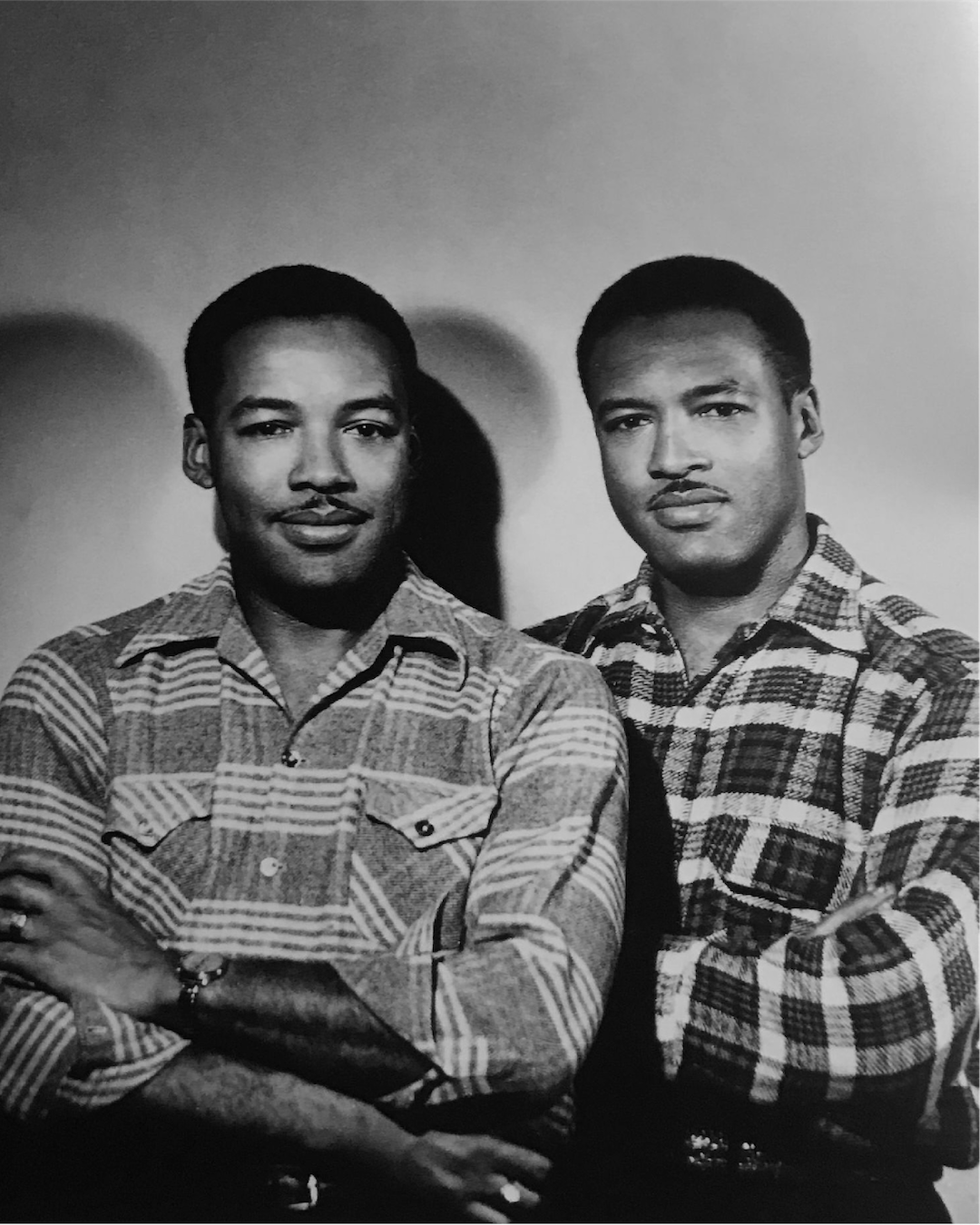
For many visitors, the name “Morgan and Marvin Smith” was new. For Harlem, and for the history of Black photography, it should not be. Their cameras were once as present on 125th Street as the Apollo Theater marquee. Their work, largely made in and around their M & M Smith Studios next door to the Apollo, documented Black middle-class life, celebrity glamour, street scenes, protests and joy at a time when mainstream media rarely granted Black Americans that kind of visibility—or complexity.
Today, three decades after the last of the twins died, museums, scholars and archivists are quietly—and increasingly publicly—re-centering Morgan and Marvin Smith as key figures in both Harlem’s visual memory and the broader story of Black American studio photography.
From Kentucky Fields to Harlem Streets
Morgan and Marvin Smith were born on February 16, 1910, in Nicholasville, Kentucky, to sharecroppers Charles and Allena Smith. The family later moved to Lexington, where the twins’ early creativity took shape: they sketched by tracing Sears catalog illustrations, molded sculptures from soap and clay, and experimented with oil painting.
A turning point came when a local white photographer gave them their first camera. The twins taught themselves to use it while working odd jobs that brought them into contact with Lexington’s white elite, building social connections they leveraged to further their art. They turned down football scholarships to several historically Black colleges, choosing art instead—a radical decision for young Black men in Jim Crow Kentucky.
In 1933, searching for opportunities unavailable in the South, the brothers joined the Great Migration to New York City. In Harlem, they worked for the Works Progress Administration, building gardens and painting murals, while sharpening their skills in free art classes taught by renowned sculptor Augusta Savage at her 306 West 141st Street art center.
Savage’s classroom was a crucible of Black modernism. There, the twins met fellow artists including Jacob Lawrence and Romare Bearden—all of them experimenting with new ways to represent Black life.
By 1937, Morgan had become the first staff photographer for the New York Amsterdam News, then the city’s leading Black newspaper. Two years later, the brothers opened M & M Smith Studios on 125th Street, just steps from the Apollo Theater. The studio soon became the Apollo’s official photography house and a social hub for performers, politicians, athletes, and everyday Harlemites.
The Studio on 125th: A Black Lens on a Black Metropolis
Between the late 1930s and 1950s, the Smiths’ studio produced tens of thousands of images. A 1933–1968 collection preserved at the Schomburg Center’s Photographs and Prints Division—along with associated portrait and paper collections—documents politicians, labor leaders, businesspeople, entertainers, sports teams, weddings, protests, street life and religious gatherings.
Their sitters ranged from George Washington Carver and Billie Holiday to Joe Louis, Lena Horne and countless unnamed Harlemites dressed in their Sunday best.
Morgan and Marvin’s aim, as later described by scholars, was to show the full spectrum of Black life: not only protest and deprivation, but style, romance, success and everyday routine. They photographed anti-lynching demonstrations and civil rights rallies; they also photographed barbershops, beauty salons, Black college athletes, and debutantes, creating a counter-archive to racist caricatures in mainstream media.
Their images circulated widely. The New York Public Library’s archival catalogue shows the brothers’ work appearing in publications including Ebony, Color and other African American magazines, alongside Black newspapers across the country.
In the words of a 1996 Washington Post feature on Black photography, the Smiths’ work captures “Harlem’s sophisticated black bourgeoisie” alongside the performers who packed the neighborhood’s theaters and ballrooms.
War, Separation and a Changing Medium
World War II briefly split the twins’ paths. Marvin enlisted in the U.S. Navy, becoming the first Black student at the Naval Air Station School of Photography and Motion Pictures in Pensacola, Florida. Morgan stayed in New York, where he continued freelancing for Black newspapers and in 1942 joined Adam Clayton Powell Jr.’s left-leaning paper The People’s Voice.
The war years were crucial for their technical and political development. Marvin’s training exposed him to advanced photographic and motion picture equipment. Morgan’s association with a militant Black newspaper sharpened his sense of photography as a tool of critique and documentation, even as the paper drew mixed reviews in Harlem for its biting criticism of the U.S. government.
By the 1950s, the brothers began shifting from still photography toward film and television. They did work in sound engineering and set decoration; Morgan eventually became a sound technician for ABC News, while Marvin studied in France with Romare Bearden and modernist painter Fernand Léger before returning to a career in television.
In 1968, the Smiths closed their studio at 141 West 125th Street—by then a Harlem landmark. They retired from television in 1975.
“For Posterity’s Sake”: Archives, Books and a Late-Life Spotlight
If their cameras went quiet, the significance of their earlier work did not. In the 1990s, the Schomburg Center organized a major exhibition, Harlem: The Vision of Morgan and Marvin Smith, which ran at the New York Public Library from late 1997 through spring 1998 and later traveled to other institutions, including the Pensacola Museum of Art and the University of West Florida.
The exhibition coincided with the publication of Harlem: The Vision of Morgan and Marvin Smith by the University Press of Kentucky, featuring nearly 150 photographs and a foreword by Gordon Parks Sr., who had himself chronicled Black life with an empathetic lens.
Around the same time, a PBS documentary, M & M Smith: For Posterity’s Sake, narrated by Ruby Dee, aired on public television. The film traced the brothers’ lives and work and screened at institutions like the Smithsonian’s National Museum of African Art, part of programming that paired it with a documentary on fellow photographer Roy DeCarava.
Obituaries and profiles in outlets such as The New York Times, Los Angeles Times, Jet and regional papers further cemented their legacy. A widely cited Times obituary for Marvin Smith, who died in 2003, described him as a photographer “whose images defined Harlem life,” emphasizing both the breadth of his subjects and the centrality of the Schomburg archives.
Crucially, the Schomburg Center not only preserved their photographs but also their papers and a large body of audio and film recordings. A 2013 Smithsonian blog post noted that the Morgan and Marvin Smith audiovisual collection—held at the Smithsonian’s National Museum of African American History and Culture—requires extensive preservation work due to obsolete formats, underscoring the fragility of mid-20th-century Black media archives.
Rediscovery in the 21st Century
While the Smith brothers never entirely disappeared from scholarly work on Harlem and Black photography, the last decade has brought renewed attention.
Called to the Camera
In 2022–23, the New Orleans Museum of Art mounted Called to the Camera: Black American Studio Photographers, billed as the first major exhibition to center Black studio photographers from the 19th century onward. Morgan and Marvin Smith were among the featured artists. A 1940 gelatin silver print—Untitled [Marvin and Morgan Smith and Sarah Lou Harris Carter]—from the Schomburg collection appeared alongside works by James Van Der Zee, Gordon Parks and others.
Curator Brian Piper framed the exhibition as a corrective, highlighting how Black studio photographers shaped visual culture while navigating segregation and economic constraints. That framing naturally encompasses the Smiths, who operated a commercial studio while producing images that now serve as crucial historical documents.
Digital Schomburg and Online Access
The Schomburg Center’s “Digital Schomburg” initiative, launched to expand online access to its collections, has made portions of the Morgan and Marvin Smith holdings viewable worldwide. The project includes a dedicated “FLY BALL” digital exhibition and other curated features that spotlight their sports photography and portraiture.
Finding aids for the brothers’ papers and photographic collections—available through NYPL’s online catalogue—detail the breadth of their work, with subject headings ranging from “sports – baseball, basketball, football, tennis” to labor unions, religious leaders, parades, and street scenes.
Sports, Representation and the 2024 “Fly Ball” Banners
The 2024 FLY BALL banner exhibition is perhaps the most visible recent celebration of the twins’ work. Installed on fences and along park pathways in Harlem, the images—Negro League players, Black collegiate stars, women leaping over tennis nets—bring the brothers’ archive into the daily life of the neighborhood they documented.
In accompanying texts, the Schomburg Center contextualizes the photographs as both sports history and social history, capturing an era when Black athletes often played in segregated leagues but still commanded enormous community pride.
Essays in publications like Southern Cultures have used individual Smith images—such as Marvin Painting a Self-Portrait—to discuss broader themes of Black self-representation, double consciousness and the possibilities of the studio as a space of experimentation.
How the Twins Saw Harlem
Morgan and Marvin’s photography sits at the intersection of commerce, artistry and activism.
A commercial studio with radical implications. Like other Black studio photographers of the early and mid-20th century, they ran a business—taking portraits, school photos, and event pictures for paying clients. But at a time when Black people were often portrayed in mainstream media as caricatures or threats, simply offering dignified, stylish portraits was itself a radical act. In this sense, the Smiths were aligned with contemporaries like James Van Der Zee and Addison Scurlock, whose studios also doubled as community institutions.
A wide lens on class and everyday life. Their Harlem images cut across class lines. They documented Harlem’s Black bourgeoisie—doctors, lawyers, business owners—as well as factory workers, domestic workers and unemployed men on street corners. Wedding portraits, local parades and neighborhood kids share the same careful lighting and composition as photographs of famous entertainers.
Politics in the frame. The Smiths’ cameras were present at anti-lynching protests, campaign rallies and meetings of organizations like the Brotherhood of Sleeping Car Porters, capturing the political ferment of mid-century Harlem. The Schomburg finding aid lists subjects like “parades and processions,” “rallies,” “voting,” and “Scottsboro defendants,” signaling how often their lenses turned toward activism.
Sport as a stage. The recent emphasis on their sports photography highlights another dimension: athletics as a site of Black excellence, risk and aspiration long before desegregation in major leagues. Images of Negro League baseball teams, semi-pro football squads and young basketball players in “Renaissance” uniforms echo later debates about representation, labor and the commercialization of Black bodies in sport.
Memory, Access and the Work Ahead
As with many Black visual archives, the survival of the Smith brothers’ work is precarious and incomplete. The core photography and paper collections are stable at the Schomburg Center, but large portions of their audio and film work—interviews, performances, ambient recordings—are trapped on obsolete formats. Archivists at the Smithsonian and NYPL have emphasized the need for preservation funding and technical expertise to digitize and catalogue these holdings before they physically deteriorate.
At the same time, the digital era has allowed a more democratic rediscovery. Social media accounts by curators, historians and younger photographers regularly repost Smith images from the Schomburg archives, often framing them as inspiration for contemporary Black visual storytelling.
Separate from the question of preservation is the issue of credit. Because many of their photographs appeared in magazines and newspapers with minimal attribution, some of their work circulates online without their names attached. Projects like Called to the Camera and FLY BALL explicitly restore authorship, and recent essays on Black studio photography have taken care to situate Morgan and Marvin Smith alongside better-known figures such as Parks and Van Der Zee.
The Twins’ Shared Legacy
Morgan Smith died in 1993 at 83; Marvin Smith followed a decade later at 93. In later interviews, Marvin often emphasized the impossibility of disentangling their work as individuals. “Whatever we did, we did for the both of us,” he told one reporter. “The work is not mine; it’s ours.”
That “ours” now extends far beyond the brothers themselves. Their photographs underpin books on the Harlem Renaissance, appear in museum exhibitions on Black modernism and studio photography, and anchor teaching materials used in classrooms exploring African American history and visual culture.
The 2024 banners fluttering in Harlem’s parks—archival images reprinted at monumental scale—are a reminder that the story they told is still unfolding. Children race past photos of athletes from their great-grandparents’ generation. Locals recognize churches, streets and buildings that have changed and changed again. Tourists learn that Black Harlem was never just a backdrop; it was an epicenter, seen and recorded by people who lived there.
In the end, the twins from Kentucky gave Harlem something it had always deserved: the chance to see itself, in all its complexity, through its own eyes.