




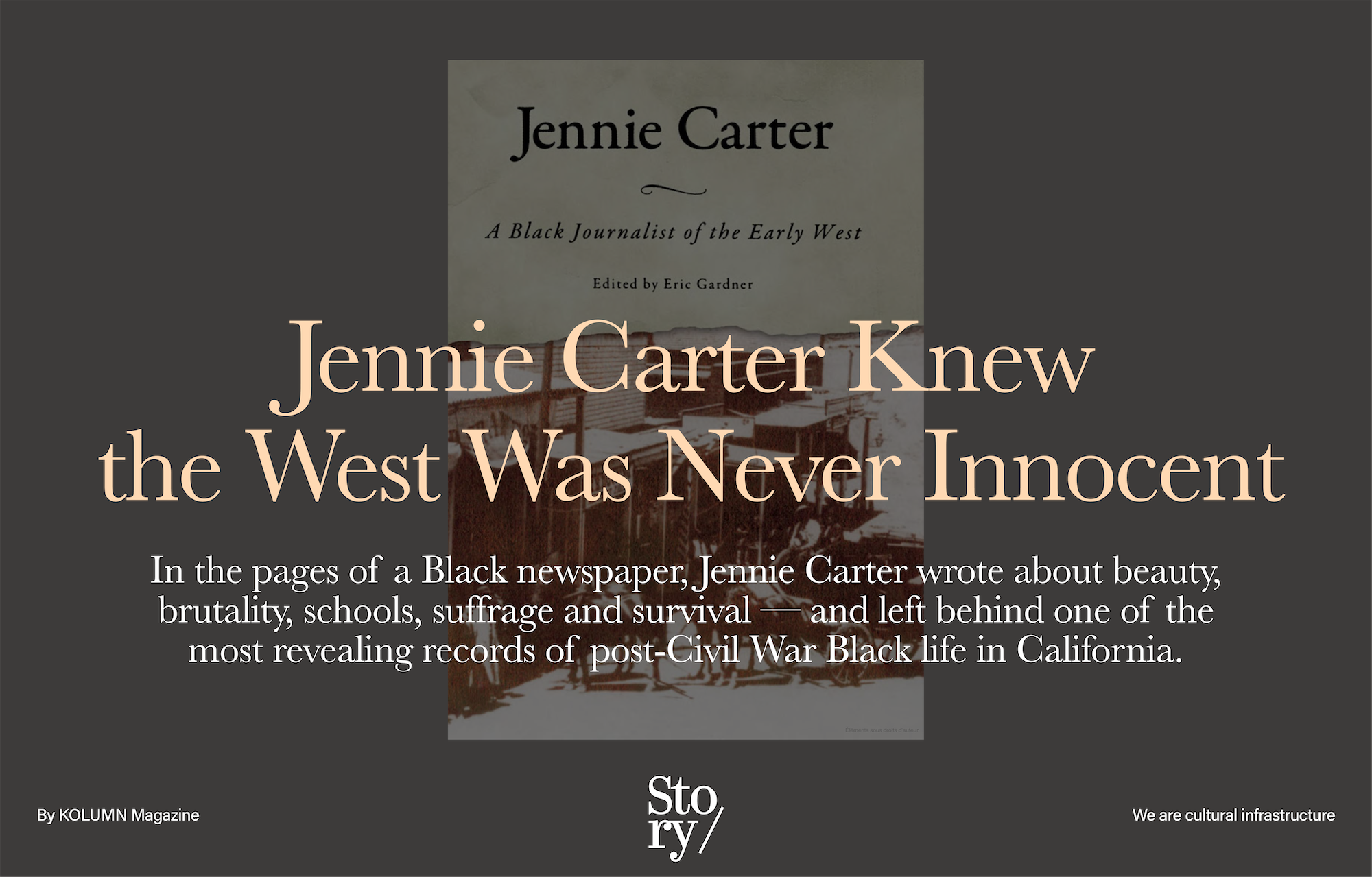
They cannot prevent me from talking and writing, and my tongue and pen shall be busy.
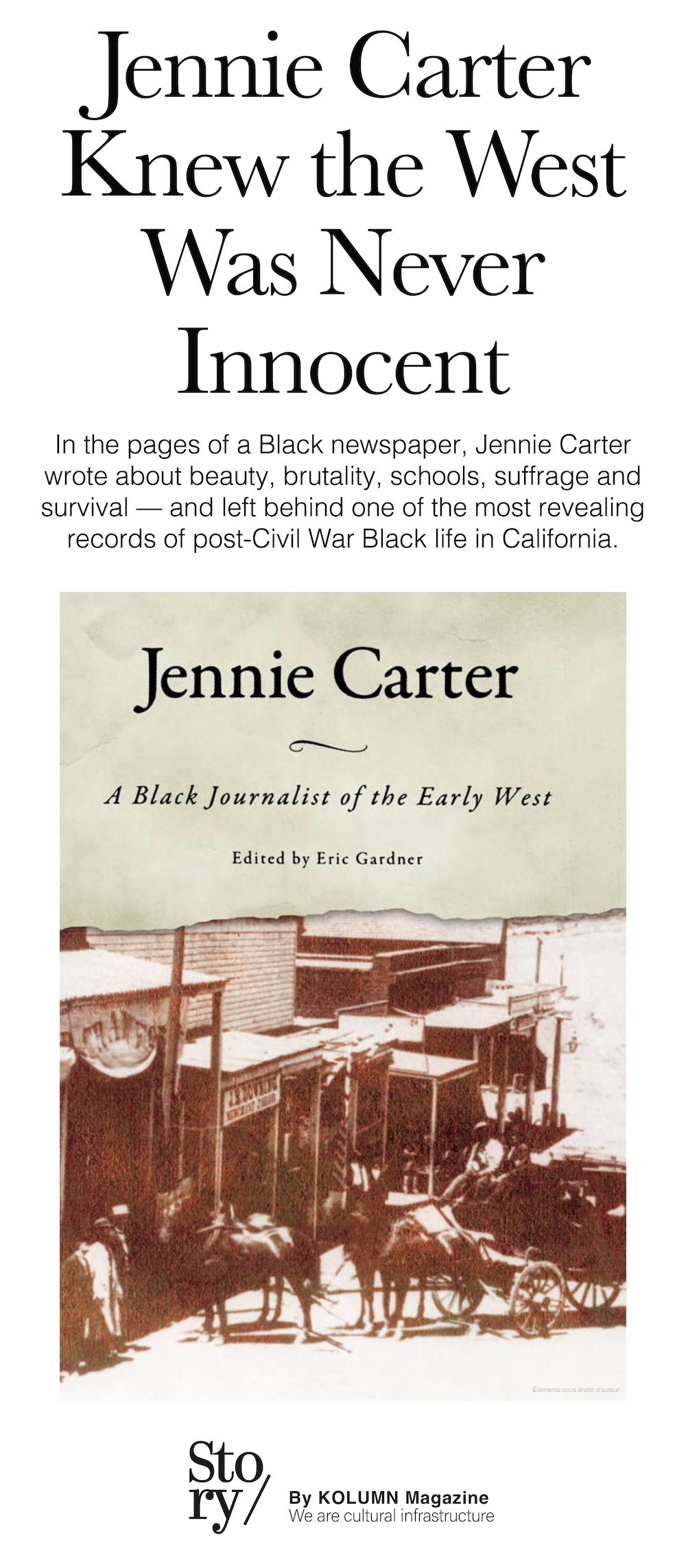
They cannot prevent me from talking and writing, and my tongue and pen shall be busy.
By KOLUMN Magazine
Jennie Carter is the kind of American writer who makes you wonder how many foundational figures have been hiding in plain sight. She did not leave behind a famous portrait, a shelf of bound books published in her lifetime or a household name that passed cleanly from one generation to the next. What she did leave was something, in its own way, even more revealing: a body of newspaper writing that caught the Black West in motion. From Nevada County, California, during and after the Civil War, Carter wrote essays and letters for The Elevator, a major Black newspaper in San Francisco, on subjects ranging from racism and education to women’s rights, temperance, memory, landscape and the daily negotiations of dignity. In those columns, she emerged as a literary stylist, a moral critic and a political observer with a voice at once intimate and unsparing.
That alone would make her important. But Jennie Carter matters for a larger reason too: she helps correct the geography of Black intellectual history. The dominant map of 19th-century African American thought still tends to run through Boston, Philadelphia, New York, Washington and, understandably, the post-slavery South. Carter reminds us that the Black political imagination was also alive in the Sierra foothills, in gold-rush counties, in western newspapers and in communities usually treated as peripheral to the main national story. Her work forces a re-centering. The West was not merely a destination or backdrop for Black life. It was an arena where Black people argued about freedom, citizenship, education, race pride, class aspiration and public morality in real time.
What makes Carter especially compelling is that she was both grounded and elusive. Scholars still disagree on major details of her life. Census records and later reconstructions point to a free Black woman born around 1830 or 1831, possibly in New Orleans and possibly in New York, with later ties to Wisconsin and Kentucky before she arrived in California around 1860. Even her maiden name remains unknown. That uncertainty is not incidental. It is part of the archival condition Black women writers have long faced: a public voice preserved unevenly, a private life scattered across partial records, and a reputation that had to be recovered rather than inherited.
Still, what survives is enough to see the shape of a serious mind. Carter wrote first under the name Ann J. Trask and later as Semper Fidelis. She began by offering The Elevator stories and didactic pieces for children, but over the next seven years she published dozens of essays, letters and poems that widened into commentary on California politics, anti-Black discrimination, women’s public role, local celebrations of emancipation, migration, schooling and the strained ethics of American democracy. Eric Gardner, whose 2007 collection brought Carter’s work back into broader view, has argued that her writings constitute one of the most significant bodies of African American women’s writing from Reconstruction and one of the richest archives of Black life in the early West.
“Civility to all, servility to none.”
That line, perhaps Carter’s most memorable, reads today like both a personal ethic and a program for political life. It is concise, moral and unsentimental. It rejects humiliation without endorsing theatrical bravado. It names the tension that structured so much Black life in the 19th century: how to navigate a society demanding deference without surrendering self-respect. In that sense, Carter was not simply describing her world. She was furnishing a language for surviving it.
A Black Woman in Gold-Rush California
To understand Carter, it helps to understand the place from which she wrote. Nevada County, in the Sierra Nevada region, was shaped by the afterlife of the Gold Rush. By the time Carter was publishing in the late 1860s and early 1870s, it held a small but significant Black population embedded in a wider world of mining camps, commercial towns and reform associations. Black residents in northern California were not passive observers of history; they built churches, organized conventions, pressed for testimony rights, fought exclusion and developed their own newspaper culture. The Black press in California had already become an instrument of civil-rights advocacy before Carter joined it.
That press culture matters because The Elevator was not a minor local sheet. Founded in San Francisco by Philip Alexander Bell in 1865, it served one of the largest Black populations in the American West and made voting rights, equality before the law and educational access central to its mission. Bell himself had roots in abolitionist journalism, and the paper became a forum where western Black communities debated policy, strategy and respectability. Carter’s appearance in its pages linked the supposedly remote foothills of Nevada County to a much larger Black public sphere stretching across California and beyond.
She also appears to have been deeply embedded in community life. Before her best-known literary period, she was associated with church work, and later she married Dennis Drummond Carter, a musician, teacher and civil-rights advocate whose own public life connected the couple to Black associational culture in northern California. Local historical research in Nevada County has emphasized that the Carters were visible figures in the area and that their homesite has since been recognized as historically significant. That local afterlife is telling: long before national institutions caught up, regional historians and community researchers understood that Jennie Carter was not a footnote.
How a Children’s Column Became a Political Platform
One of the most interesting things about Carter’s career is the way it evolved. She did not debut as a grand public intellectual. She entered The Elevator through a familiar and gendered route: writing for children. That entry point matters because it reflects the limited pathways through which many women, especially Black women, could claim public authority in the 19th century. Advice literature, moral instruction and educational writing were seen as acceptable extensions of womanly duty. Carter used that opening, but she refused to stay inside it.
At a certain point, she recognized the shift herself. In a remark that still feels delightfully dry, she admitted that she had begun by writing for children and ended up writing for everybody. That sentence captures something essential about her prose: the wit never cancels the seriousness, and the seriousness never entirely suppresses the wit. Carter could sound like a schoolmarm, a humorist, a town correspondent, a reformer and a theorist of race all within the same general body of work. She moved between the domestic and the political without treating them as separate worlds.
Scholars have noted that Carter crafted a semi-autobiographical public persona, often presenting herself as older than she really was. Lapham’s Quarterly, drawing on Gardner’s recovery work, notes that she sometimes added roughly two decades to her age, perhaps to gain authority or to preserve privacy. That was not mere eccentricity. It was a tactical performance. A Black woman writing boldly about public life in Reconstruction California had reason to manage how she appeared on the page. Age, maternal wisdom and moral steadiness could function as credentials in a culture eager to dismiss women’s public voices.
Race, Color and the Discipline of Self-Respect
Carter’s writing on race is among her most durable contributions because it joins political critique to the ethics of everyday conduct. In a piece written for younger readers, she warned against the social habits of color hierarchy and flattery toward whiteness. The argument is striking not just because it condemns racism, but because it also condemns internalized deference and colorism. Carter was alert to the way hierarchy reproduced itself in ordinary behavior — in who was admired, who was ignored, who was treated as ornamental and who was treated as expendable.
That insight gave her work a precision that still feels modern. She understood that oppression is never only institutional. It also lives in habits of valuation, in social mimicry and in the learned instinct to grant whiteness more grace than it deserves. Her answer was not separatist grandstanding but disciplined dignity. That is what makes “civility to all, servility to none” so resonant. It establishes a standard of conduct that rejects both abasement and cruelty. Carter was not asking Black readers to become saints; she was asking them to refuse psychic surrender.
That declaration, quoted in a University of Florida study of Carter’s work, gets at the muscular quality of her public voice. She understood writing as action. Not as a substitute for politics, but as one mode of politics. In Carter’s hands, the newspaper column became a place to record injustice, mobilize feeling and pressure a community to think harder about its obligations to itself.
Education, Citizenship and the Refusal of Inferiority
Among Carter’s recurring concerns was education, especially Black children’s access to it. One of the most memorable examples comes from 1868, when she responded to the refusal to reopen San Francisco’s Black public school alongside the others. Her indignation was not abstract. She understood schooling as one of the key mechanisms by which a society either ratifies or contests the lie of Black inferiority. To deny education was to stage inequality as destiny.
Her language on the subject is revealing. She asked how long Black people must “tamely submit” to such injustice and worried that children would “grow up in ignorance” only to confirm the low estimate others had of them. That is classic Carter: morally outraged, rhetorically direct and fiercely attentive to the way institutions manufacture public meaning. She did not treat schools merely as services. She treated them as battlegrounds where the civic value of Black life was being decided.
This concern fit within a larger Black western struggle for rights. California’s Black communities had already spent years organizing around testimony rights, suffrage and equal access to public institutions, and the Black press served as a coordinating apparatus for those efforts. Carter’s writing did not emerge from nowhere; it joined an existing civil-rights ecosystem. But her contribution was distinctive because she translated public disputes into felt, domestic and moral terms. She wrote as someone who knew that policy becomes personal very quickly when your child is the one being told to wait.
Was Jennie Carter a Feminist? The Better Question Is Harder
Modern readers often want a clean answer to whether a figure like Carter was “for” women’s rights in a contemporary sense. The real answer is more interesting than a yes or no. Carter wrote in a period when Black women’s public voices were constrained by intense expectations around respectability, femininity and moral decorum. Vanessa Attia’s study argues that Carter borrowed from the discourse of respectable womanhood even as western conditions allowed her somewhat more room than many eastern counterparts to improvise. In other words, Carter worked within the idioms available to her, but she also stretched them.
That stretch was sometimes subtle and sometimes obvious. On the one hand, Carter could sound conventionally 19th century in her descriptions of women’s moral role and in her discomfort with some forms of electoral roughness. On the other hand, the fact that she stood firmly within debates about schools, public behavior, race, reform and civic responsibility is itself a challenge to any narrow idea of women’s place. Even when she framed her authority through maternalism or moral uplift, she was still acting as a public thinker.
This is why it is more useful to read Carter historically than to force her into a modern purity test. She was a Black woman writer in Reconstruction California fashioning a voice that could be heard, trusted and circulated. That required negotiation. Respectability was not simply a belief system; it was also a survival technology and a publishing strategy. Carter’s achievement lies partly in how much she managed to say within those constraints.
The West in Her Writing: Beautiful, False, Possible
Carter also wrote about place with a sensitivity that helps explain why scholars have come to see her as essential to western literary history. She did not reduce the West to a simple landscape of promise, but neither did she surrender it to cynicism. In her work, California can be beautiful, ridiculous, muddy, aspirational and morally compromised all at once. Shirley Ann Wilson Moore’s National Park Service study notes that Carter acknowledged the opportunities African Americans found in the West while also criticizing the barriers that kept them from full participation. That balance is key. She neither romanticized nor dismissed the region. She read it.
That ability to hold contradiction is one reason Carter feels so contemporary. She could admire the aesthetic appeal of western life while insisting that scenery is not justice. She could understand why Black migrants invested the West with hope while documenting the ways that hope was fenced in by racism, exclusion and fragile belonging. In that sense, Carter belongs with the sharpest chroniclers of American regional life: writers who know that landscape is never innocent because power is always already inside it.
“Old ladies are garrulous, and I am no exception.”
That line, preserved through a Carter piece republished by Lapham’s Quarterly, captures another side of her method. She could enter through anecdote, self-mockery and personality, then pivot toward social analysis. The charm was real, but it was never aimless. Carter understood that readers come to arguments more readily when they arrive disguised as conversation.
Why She Was Forgotten
There is a temptation, when a writer is recovered, to act as though history simply overlooked a genius by accident. The truth is usually harsher. Jennie Carter was easy to lose because the institutions that create literary permanence were not built to preserve Black women writing in newspapers on the far side of the continent. She published largely in periodicals, sometimes under pseudonyms, in a region that mainstream literary history long treated as secondary and in a Black press tradition that scholars only belatedly began to mine seriously. Missing issues of The Elevator further thinned the archival trail.
There is also the genre problem. Carter wrote short essays, letters and commentary — forms that can shape public thought enormously yet are often ranked below the novel, the speech or the major book in literary prestige. Gardner’s recovery of her work mattered not only because it restored a single writer, but because it challenged the hierarchy that had rendered such writing marginal in the first place. Reviews of his edition emphasized that Carter complicates assumptions about Black middle-class life in the late-19th-century West and enriches the record of West Coast journalism after the Gold Rush.
And then there is the matter of the archive itself. No known photograph of Carter has surfaced. Much of what we know comes through her published persona, later scholarly reconstruction and local historical work. That absence might seem like a problem, but it is also a lesson. Black women have often had to enter history through the texts they left behind rather than the memorabilia elite culture likes to preserve. Carter’s invisibility in one register makes her visibility in another all the more powerful. She can still be heard.
Why She Belongs in the American Canon
Jennie Carter deserves a broader readership not out of sentiment, but because she enlarges the terms of American literature and American political history. She shows that Black western writing during Reconstruction was not a curiosity. It was intellectually serious, stylistically flexible and politically alert. She shows that the Black press in California was not simply reporting events; it was making arguments about citizenship and collective life. And she shows that Black women in the West were not merely symbolic bearers of virtue or victims of erasure. They were theorists of survival, critics of public culture and architects of community discourse.
She also complicates familiar literary lineages. Carter has been discussed alongside major Black women writers and reformers of the 19th century because her work raises similar questions about public voice, respectability and race uplift. But she was not merely a western echo of eastern figures. Her setting changed the stakes and the texture of her writing. California’s racial order, small Black population, Gold Rush afterlife, anti-Chinese hostility, suffrage debates and developing institutions gave her a different angle of vision. She was watching an America still inventing itself and already reproducing its inequalities.
The best reason to read Jennie Carter now may be that she understood something the country still struggles to learn: progress without dignity is unstable, inclusion without equality is a performance and public memory is a political battlefield. Her essays on emancipation celebrations make this plain. She did not want the past embalmed in empty ceremony, but neither did she accept the idea that painful history should simply be forgotten for the sake of comfort. Memory, for Carter, was a civic resource. People who forget the cost of freedom are in danger of treating freedom as cheap.
In that way, Carter speaks uncannily to the present. We are still arguing about what schools owe children, what public commemoration means, how race is reproduced through ordinary behavior and whether civility can coexist with uncompromising self-respect. Carter did not solve those arguments. What she did was write them down with intelligence, humor and moral clarity before the nation had fully admitted that someone like her should count as an authority at all. That is not a minor legacy. That is a national one.
The Unfinished Recovery
There is something fitting about the fact that Jennie Carter’s reputation is still being assembled. A county homesite recognition here, a scholarly essay there, a republished column in a literary magazine, a digitized newspaper, a recovered edition, a line that suddenly feels fresh again. Her afterlife has come in pieces, which is often how recovery works for Black women of the 19th century. The archive does not open all at once. It is rebuilt through editorial labor, local memory and a willingness to take seriously what prior generations discounted.
But piece by piece is still enough. We can now say with confidence that Jennie Carter was not merely an interesting regional voice. She was a Reconstruction-era Black journalist and essayist of real consequence, one who documented the textures of Black western life while interrogating the republic’s failures. She wrote with the authority of someone who knew that everyday life was political life. She understood that tone matters, that humor can disarm, that children are an audience worth fighting for and that a sentence can carry both manners and revolt.
The canon has room for her. More to the point, it has needed her for a long time. Jennie Carter wrote from a place the country has often mistaken for the edge of the story. What her work proves is that the edge was never the edge at all. It was one of the places where America was being most honestly described.
More great stories
Afro Sheen, Wall Street, and the Architecture of Black Possibility
July 6, 2026
No Comments
The Fire Inside the Fourth
July 5, 2026
No Comments