




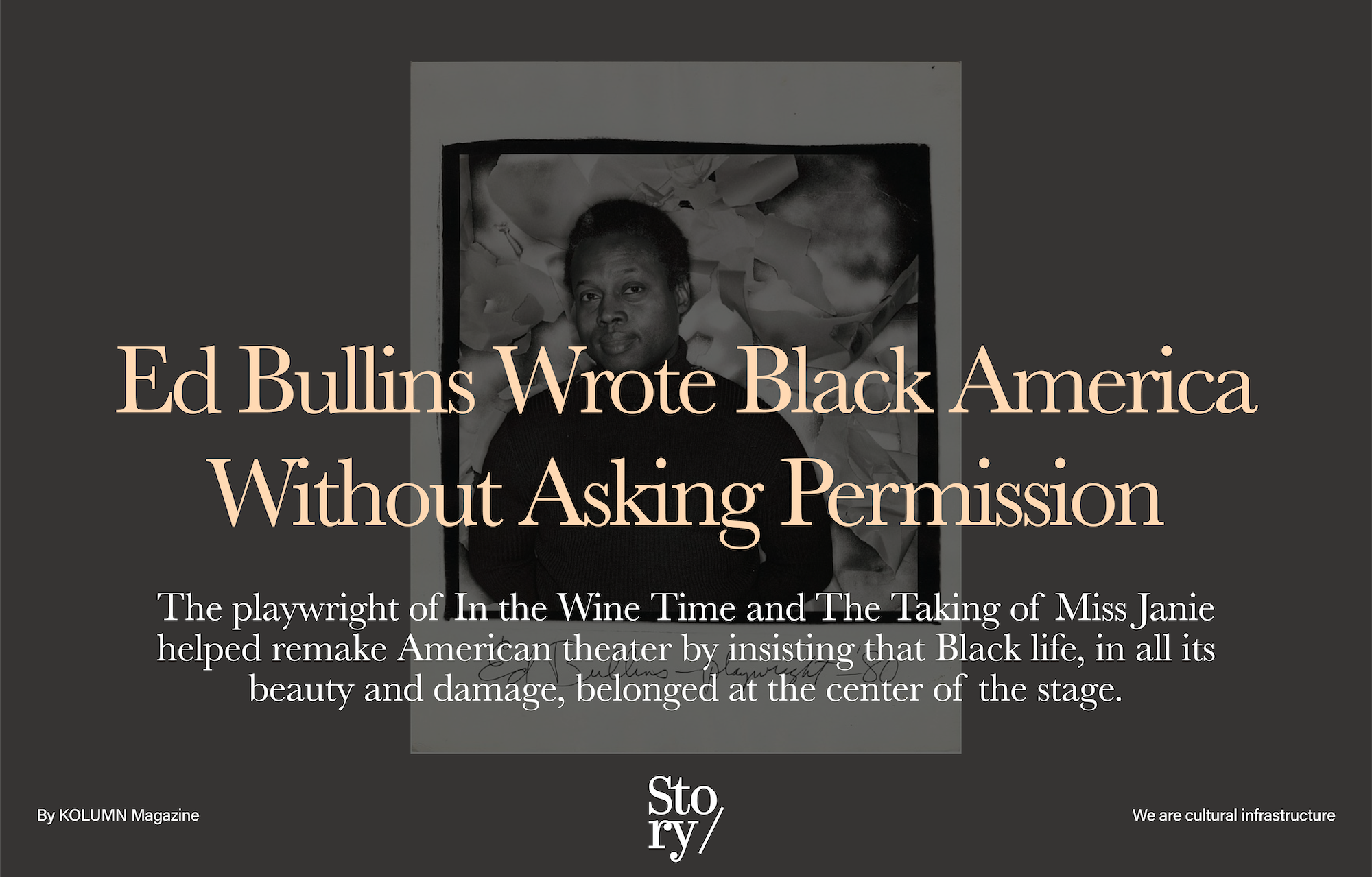
We had to raise the consciousness.
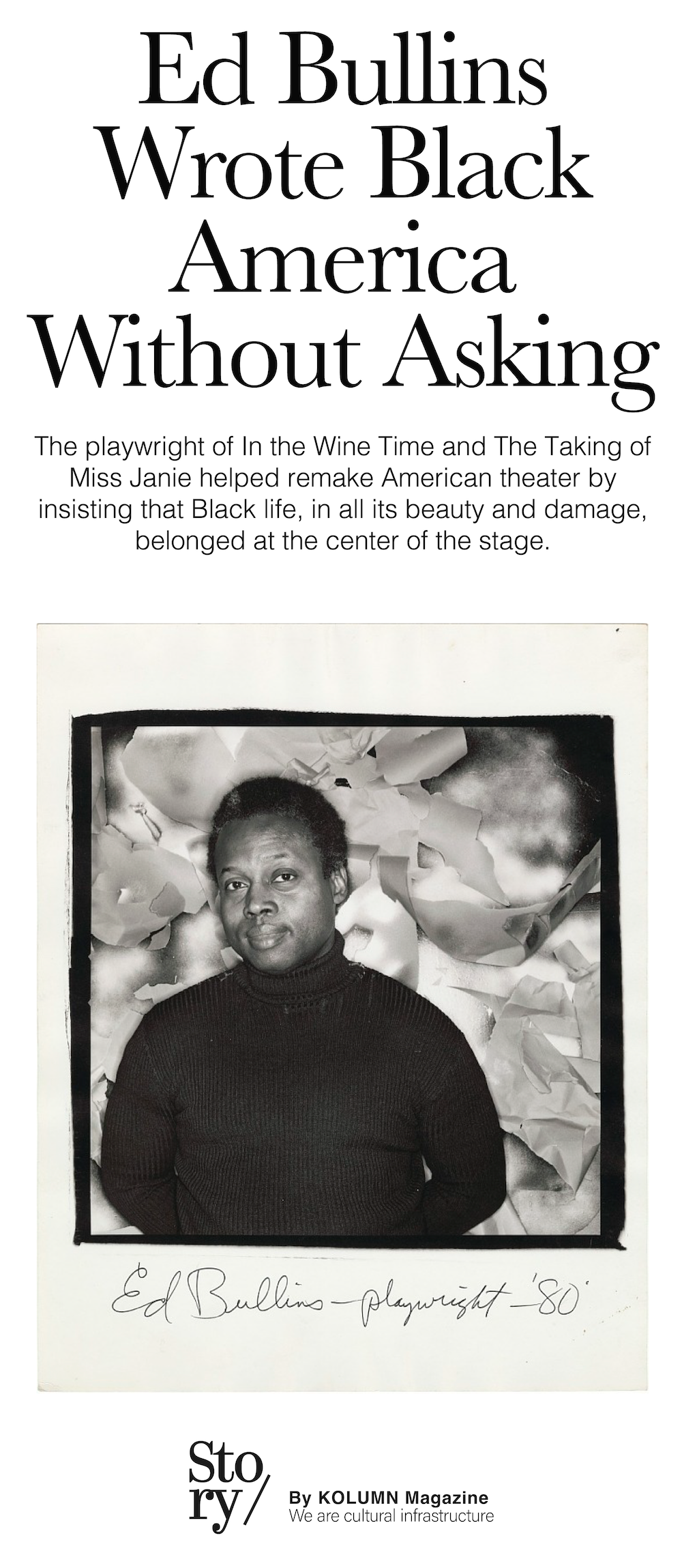
We had to raise the consciousness.
By KOLUMN Magazine
Ed Bullins occupies a strange place in American cultural memory: central to the history of modern Black theater, deeply influential on later playwrights, and still too often treated like a figure best known to specialists rather than the broader reading public. That mismatch says as much about American institutions as it does about Bullins himself. He was one of the most prolific dramatists to come out of the Black Arts Movement, wrote nearly 100 plays across a career spanning more than half a century, won major honors including Obies and the New York Drama Critics’ Circle Award, and taught generations of younger writers. Yet the scale of his importance is still easy to miss if your map of American theater is drawn mainly through Broadway, film adaptation, and the familiar roll call of canonized names. Bullins was never exactly built for easy canonization. He wrote fast, hard, and close to the nerve. He wrote for Black audiences on purpose. He wrote characters who could be wounded, funny, hustling, cruel, visionary, ordinary, and impossible to flatten into uplift. He was not interested in behaving for the gatekeepers.
A life shaped by rupture and reinvention
Born in Philadelphia on July 2, 1935, Bullins came out of a life that was neither genteel nor cleanly linear. Archival and reference sources agree on the broad contours: he was raised largely by his mother, Bertha Marie Queen Bullins; he was an excellent student early on; he became entangled in gang life after being transferred to an inner-city school; a near-fatal stabbing altered his outlook; and he then served in the U.S. Navy from 1952 to 1955. That sequence matters because Bullins did not arrive at literature through the familiar prestige pipeline. He came to it after violence, military service, and self-reinvention. Britannica notes that he was a high-school dropout who resumed his studies later, eventually attending Los Angeles City College and San Francisco State before earning a B.A. from Antioch in 1989 and an M.F.A. from San Francisco State in 1994. His life, in other words, never matched the tidy arc institutions prefer: precocious talent, elite training, orderly ascent. Bullins was forged in motion, in interruption, in self-education, in recovery.
The Black Arts Movement as context—and constraint
That biography helps explain why Bullins’s work so often feels allergic to politeness. His plays know the street, but they are not romantic about it. They know aspiration, but they are suspicious of easy uplift. They know politics, but they do not always trust movements to save the people speaking in their name. This is part of what makes Bullins lastingly interesting: he belonged to the Black Arts Movement and helped define it, yet he also resisted becoming a slogan machine. The Oxford Research Encyclopedia describes the Black Arts Movement as the aesthetic sibling of Black Power, a movement that insisted Black artists had a political responsibility and that Black creative values had to break from white artistic control. Bullins absolutely worked inside that insurgent frame. But he also pushed beyond dogma, insisting on contradiction, appetite, emotional damage, and class friction as part of Black reality.
San Francisco, Black Power, and a theater of liberation
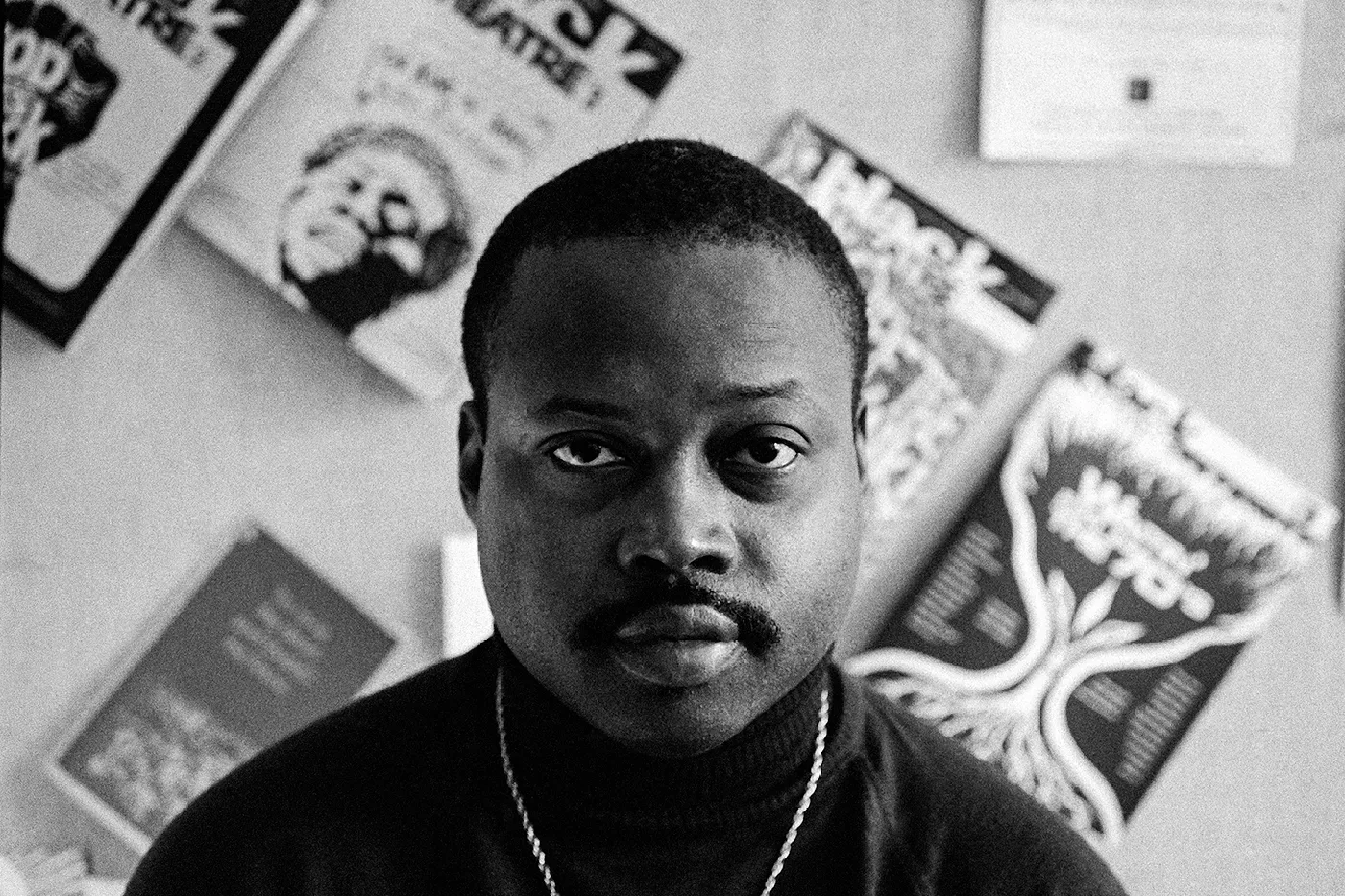
By the mid-1960s, Bullins had moved west and was writing in San Francisco, where his political and artistic lives became inseparable. Encyclopedia.com and the Syracuse finding aid both place him among the leaders of the West Coast Black Arts scene, noting that he was a founder and producer of Black Arts/West, a cofounder of Black House, and briefly a minister of culture for the Black Panthers in California. Those affiliations are important, but they can also become reductive if they are treated as the whole story. Bullins was not simply a playwright who happened to be politically active. Nor was he merely a cultural appendage to Black Power. He saw theater itself as a site of struggle, a place where Black people could encounter themselves outside the distortions of white expectation. In a later interview, he described the mission of Black theater in the 1960s and 1970s as bound up with liberation and consciousness. That statement is not incidental. It is the key to understanding why he chose drama over prose as his primary medium and why performance, with its immediacy and collective charge, suited him so well.
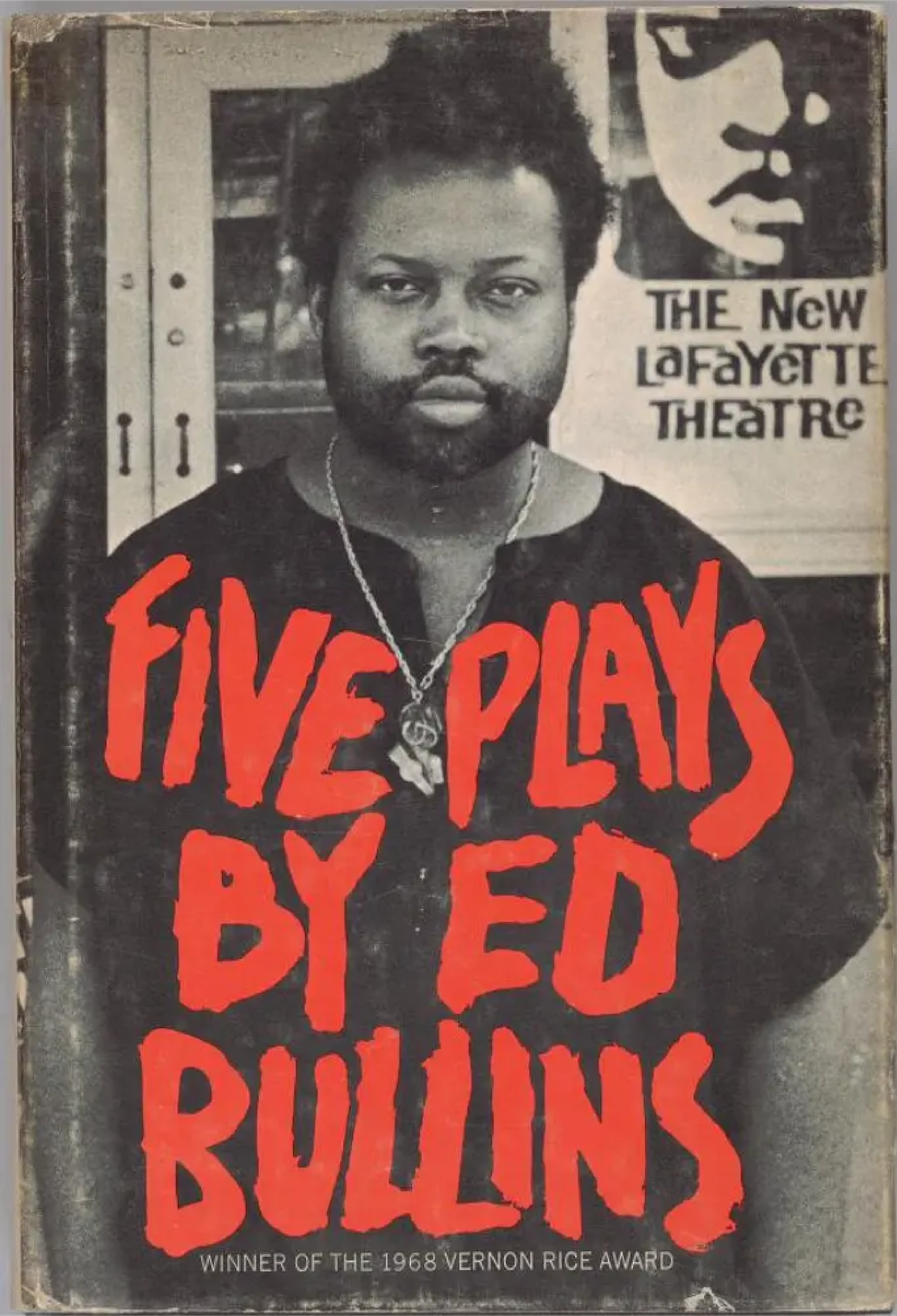
His early plays arrived with remarkable force. The Dramatists Guild and Concord Theatricals biographies both trace his professional breakthrough to San Francisco productions of How Do You Do, Dialect Determinism (or The Rally), and Clara’s Ole Man. Soon after came works such as Goin’ a Buffalo, In the Wine Time, A Son Come Home, and The Electronic Nigger. The Smithsonian entry for Five Plays by Ed Bullins is useful not simply as museum cataloging, but as evidence of how quickly Bullins’s work cohered into a body: by 1969, a first-edition collection was already packaging five major plays together, all explicitly identified within the museum record as part of the Black Arts Movement. These were not isolated experiments. Bullins was building a world, title by title, character by character, through a dramatic practice that fused realism, satire, street language, ritual, and a sharp ear for how people in conflict actually sound.
Writing Black life as lived reality—not translation
What distinguished him from many contemporaries was not just militancy or productivity, though he had both. It was his attention to ordinary Black life as dramatic substance. Britannica notes that his naturalistic plays combined Black nationalism, interracial tension, and what it calls “street” lyricism. That phrase gets at something essential. Bullins wrote from the textures of urban Black experience without translating them into respectability. His people talk like people. They seduce, posture, betray, clown, drift, dream, and self-mythologize. There is often politics in the room, but politics rarely purifies the room. In Bullins, ideology collides with rent, sex, class, ego, loneliness, and sheer survival. That is one reason his work still feels fresher than some more pious art of the era. He understood that a movement can give language to a time, but the stage still has to hold a living human mess.
The New Yorker, in a 1973 profile headline deck, put it succinctly: Bullins’s “fierce devotion to black theatre” helped reshape American drama while testing its gatekeepers. That framing lands because it captures both his achievement and the friction around it. Bullins was never simply trying to enter existing institutions on their terms. He was trying to reorder the relationship between theater and audience. A Washington Post review from 1977 quoted him as saying that his work and that of his peers was “attempting to answer questions concerning black survival and future,” and the reviewer observed that by writing for Black audiences first, Bullins achieved the force of an “honest reporter.” That phrase matters too. Reporter is not the first word people reach for with Bullins, but it fits. He documented a world that elite American theater had routinely distorted, minimized, or treated as sociological material instead of dramatic center.
“He was a Black playwright who spoke to the values of the urban experience.”
If there is a single work that most clearly crystallizes Bullins’s public reputation, it is The Taking of Miss Janie. Britannica describes it as the play for which he received major critical acclaim in 1975, centered on the failed alliance of interracial political idealists in the 1960s. Concord and the Dramatists Guild both note that it won an Obie and the New York Drama Critics’ Circle Award. In his 1997 interview with Kim Pearson, Bullins described the play as a metaphor for race relations and group antagonism during the civil-rights and Black Power period. That combination of critical success and conceptual ambition explains why the play still stands as the easiest point of entry into his work. But it can also obscure the fact that Bullins was never a one-play figure. The Taking of Miss Janie matters because it condensed many of his obsessions—failed liberalism, interracial desire, political disillusion, the emotional wreckage left by the 1960s—into a single high-profile work. It does not exhaust him.
Disillusionment, intimacy, and the aftermath of the 1960s
What The Taking of Miss Janie did, though, was reveal how unsentimental Bullins could be about the mythology of the era. In the Kim Pearson interview, he described Monty and Janie not as simply realistic individuals but as figures through whom the antagonisms of the period could be staged. That distinction is crucial. Bullins was not writing a museum diorama of activism. He was writing a drama about what political eras do to intimacy, fantasy, power, and the stories people tell themselves about their own goodness. It is one thing to support justice in principle; it is another to confront the erotic and social hierarchies one still carries inside. Bullins understood that the 1960s did not fail only because institutions pushed back. They also failed because people brought vanity, desire, fear, and domination into the movement space. That is one reason the play still bites. It refuses nostalgia.
The broader body of work makes the same refusal in different keys. In the Wine Time, Goin’ a Buffalo, The Duplex, The Fabulous Miss Marie, In New England Winter, The Corner, and Salaam, Huey Newton, Salaam each map different zones of Black life and disillusion. Some are tighter and more naturalistic; some lean more overtly ritualistic or confrontational. But across them runs a through-line: Bullins’s determination to stage Black reality without cleaning it up for white reassurance. History News Network’s excerpt of the New York Times obituary emphasized that he wanted to reflect the Black urban experience “unmitigated by the expectations of traditional theater.” It also notes that he often said he wrote for “strivers, hustlers and quiet sufferers,” not for white or middle-class approval. That artistic stance was aesthetic, political, and commercial all at once. It gave his work its authority; it also likely narrowed the institutional pathways through which his reputation would later circulate.
Recognition, awards, and institutional limits
That narrowing matters. American culture is often generous with praise after the fact but stingy with structural support in the moment. Bullins did win serious recognition. Syracuse’s archival biography notes three Off-Broadway awards for distinguished playwriting, the Drama Critics Circle Award, and Guggenheim and Rockefeller support. Concord and the Dramatists Guild list additional grants and fellowships. Yet Bullins never occupied the same mainstream cultural space as later playwrights whose work was carried by Broadway visibility, corporate regional theater, or film. Part of that had to do with race; part had to do with the historical marginalization of Black theater institutions; and part had to do with Bullins’s own refusal to smooth out his work for cross-market palatability. The result is a familiar American pattern: a foundational artist becomes indispensable to the field while remaining under-known to the broader public.
That does not mean he lacked influence. Quite the opposite. The New York Times obituary excerpt, as preserved by History News Network, includes Ishmael Reed’s observation that Bullins brought grassroots audiences into the theater, people who “had probably never seen a play before.” GBH’s 2021 remembrance ties Bullins directly to later playwrights, with Bates professor Cliff Odle arguing that contemporary American theater would look different without him and naming writers such as Suzan-Lori Parks and Lydia Diamond in the lineage of what his work made possible. You do not have to accept every genealogical claim in a strict academic sense to see the larger point. Bullins helped normalize Black theater as a site of formal ambition and community address at the same time. He made it harder for later institutions to pretend that Black life onstage had to pass through white mediation to count as art.
There is also his role as builder. Bullins was not just writing plays in isolation; he was helping construct the ecosystem through which Black theater could circulate. At Harlem’s New Lafayette Theatre, Encyclopedia.com says, he served as playwright-in-residence and later associate director, while editing Black Theatre magazine. The Dramatists Guild adds that he headed the Black Theatre Workshop there, giving starts to younger writers including Richard Wesley, OyamO, and Martie Charles. Later he directed workshops for Joseph Papp’s Public Theater and Woodie King Jr.’s New Federal Theatre. These details can sound administrative, but they are central to his legacy. Bullins understood that talent alone is not enough. Institutions matter. Workshops matter. Editorial platforms matter. A movement survives only if there are places where work can be made, argued over, revised, and produced. He built those places or helped build them.
One of the more revealing things Bullins said in the 1997 interview is that the mission of Black theater changes over time. In the 1960s, he framed it as a matter of liberation and consciousness. Later, he suggested, it became more about art and culture as part of education, self-worth, and understanding. That is a sophisticated answer, and a useful one now. It acknowledges that art made under urgent political conditions cannot remain frozen inside those same tactical demands forever. But it also refuses the false binary that says politically rooted Black art must choose between movement work and artistic complexity. Bullins insisted on both. He could speak the language of struggle and still remain alert to stereotype, sentimentality, and the dangers of mass-media caricature. His attack on what he called the “new minstrel shows” in that interview shows a writer still thinking critically about representation decades after the initial heat of Black Arts militancy. He did not stop asking who art was for, who it humiliated, and who it allowed to appear in full.
Representation, audience, and artistic responsibility
That question—who gets to appear in full—may be the cleanest route into Bullins’s continuing significance. The American theater has often accepted Black characters on two conditions: either they are legible to white liberal sentiment, or they are elevated into emblematic greatness. Bullins could write major political allegory, yes, but he also insisted that everyday Black life was itself sufficient dramatic material. He did not need sainthood, singular genius, or tragedy-by-lesson-plan to justify the stage. His characters could be grubby, horny, compromised, aspirational, bored, verbally dazzling, or morally unpleasant. In that sense he helped widen the representational bandwidth of American drama. Later playwrights would push this further in many directions, but Bullins belongs among those who made such widening thinkable.
He also kept evolving. Reference and institutional sources track his move from New York’s theater world back into academia and, eventually, Boston. Concord notes that he completed his B.A. in 1989 and M.F.A. later, before becoming a distinguished artist-in-residence at Northeastern. Northeastern’s own remembrances say he taught there from 1995 to 2012, mentoring students to be true to themselves and find their own voices. GBH adds that after arriving in Boston in 1995, he founded Roxbury Crossroads Theatre in 2006. That late-career chapter can look, at first glance, calmer than the San Francisco and Harlem years. It was not less important. Bullins had moved into the role of elder, teacher, and local institution-builder without surrendering the principles that had animated his earlier work. He was still making room for Black voices to speak on their own terms.
“Ed Bullins’s fierce devotion to black theatre… reshaped American drama.”
Still, any honest assessment of Bullins has to admit complication. His life and work do not lend themselves to purely celebratory flattening. His artistic militancy could harden into separatist rhetoric. Some critics found the sheer volume and unevenness of his output difficult to assess. His work with gender and sexual violence, especially in a play like The Taking of Miss Janie, remains unsettling by design and should remain so. His personal life also included serious allegations of violence from poet Pat Parker, to whom he was once married, a matter reflected in biographical summaries. None of this erases the work. It does mean that writing about Bullins responsibly requires resisting the temptation to turn him into a frictionless icon. He was a major artist, and major artists are not improved by sanitizing what made them difficult.
That difficulty is part of why Bullins still feels contemporary. We are living in a moment when institutions love to celebrate “boundary-breaking” Black artists in retrospect, especially once the sharpest edges of their critique can be converted into curriculum or commemorative language. Bullins resists that taming. His plays are too suspicious of innocence, too alive to class fracture, too uninterested in easy reconciliation. He understood that Black representation is not automatically liberation. It matters who controls the frame, who is imagined as audience, and whether the work tells the truth about power inside as well as outside the community. Those are not old questions. They are current ones—current in publishing, film, theater, streaming television, and the nonprofit arts economy. Bullins’s career keeps returning us to the same test: is the work trying to be accepted, or is it trying to reveal?
The final measure of Ed Bullins
There is another reason Bullins matters now. He offers a model of Black artistic seriousness that does not depend on mainstream legibility. Too often, American culture treats institutional visibility as proof of importance. Bullins’s career argues the opposite. An artist can be indispensable to the development of a form and still remain under-publicized outside it. The fact that he wrote more than ninety plays, shaped workshops, edited magazines, helped build Black theater institutions, won major prizes, influenced peers and successors, and still remains only partially known outside theater circles is not evidence of minor stature. It is evidence of how American recognition works. Bullins was not peripheral. He was made to seem peripheral by a cultural system that is more comfortable rewarding Black art once it becomes easily marketable, legible to predominantly white institutions, or detached from the communities that first gave it urgency.
When Bullins died in Roxbury on November 13, 2021, at 86, the obituaries described him as a leading playwright of the Black Arts Movement. That is true, but it is also slightly too small. He was not only a movement playwright. He was one of the crucial architects of a Black theatrical modernity that refused apology. He helped establish that Black urban life could be rendered with aesthetic ambition, political intelligence, formal variety, and zero interest in begging for translation. He showed that the Black stage could be tender without becoming sentimental, militant without becoming static, and critical without becoming bloodless. He built worlds for audiences who were too often told the theater did not belong to them. Then he helped build the institutions where those audiences and younger artists could keep showing up.
Ed Bullins should be remembered, then, not as a footnote to more famous names, nor only as a relic of a militantly creative era, but as a writer who changed the terms of the stage. He understood that representation without truth is decoration. He understood that politics without human complexity becomes theater in the worst sense. And he understood that Black audiences deserved more than moral instruction or symbolic inclusion; they deserved art that sounded like life, argued like life, sweated like life, and refused to look away from the contradictions inside it. That may be the cleanest summary of his legacy. He did not write Black life as an exhibit. He wrote it as drama—alive, dangerous, unresolved, and fully worthy of the stage.
More great stories
Afro Sheen, Wall Street, and the Architecture of Black Possibility
July 6, 2026
No Comments
The Fire Inside the Fourth
July 5, 2026
No Comments