




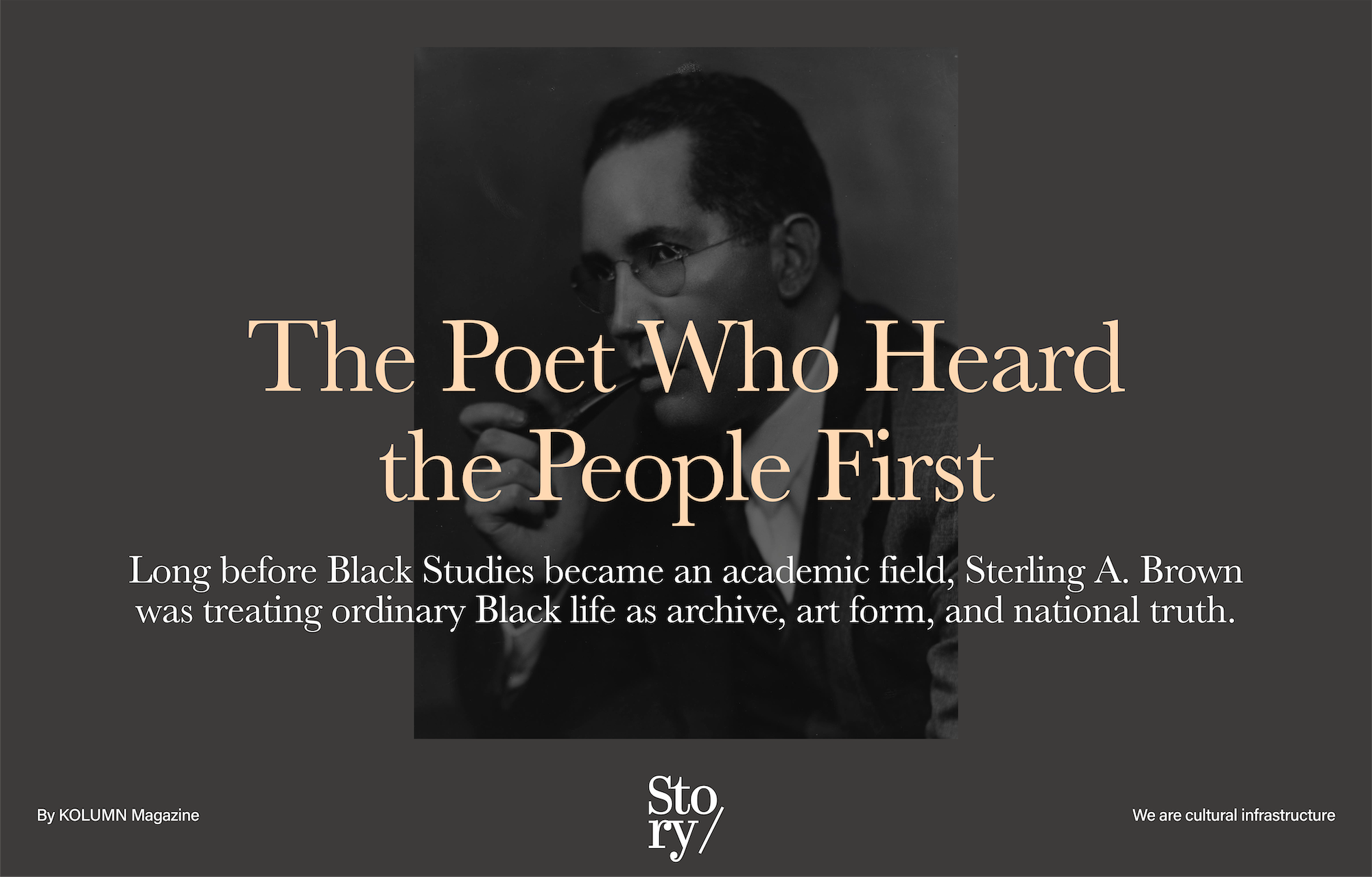
Brown’s genius was not that he wrote about ordinary Black people. It was that he refused to treat them as ordinary subjects of minor consequence.
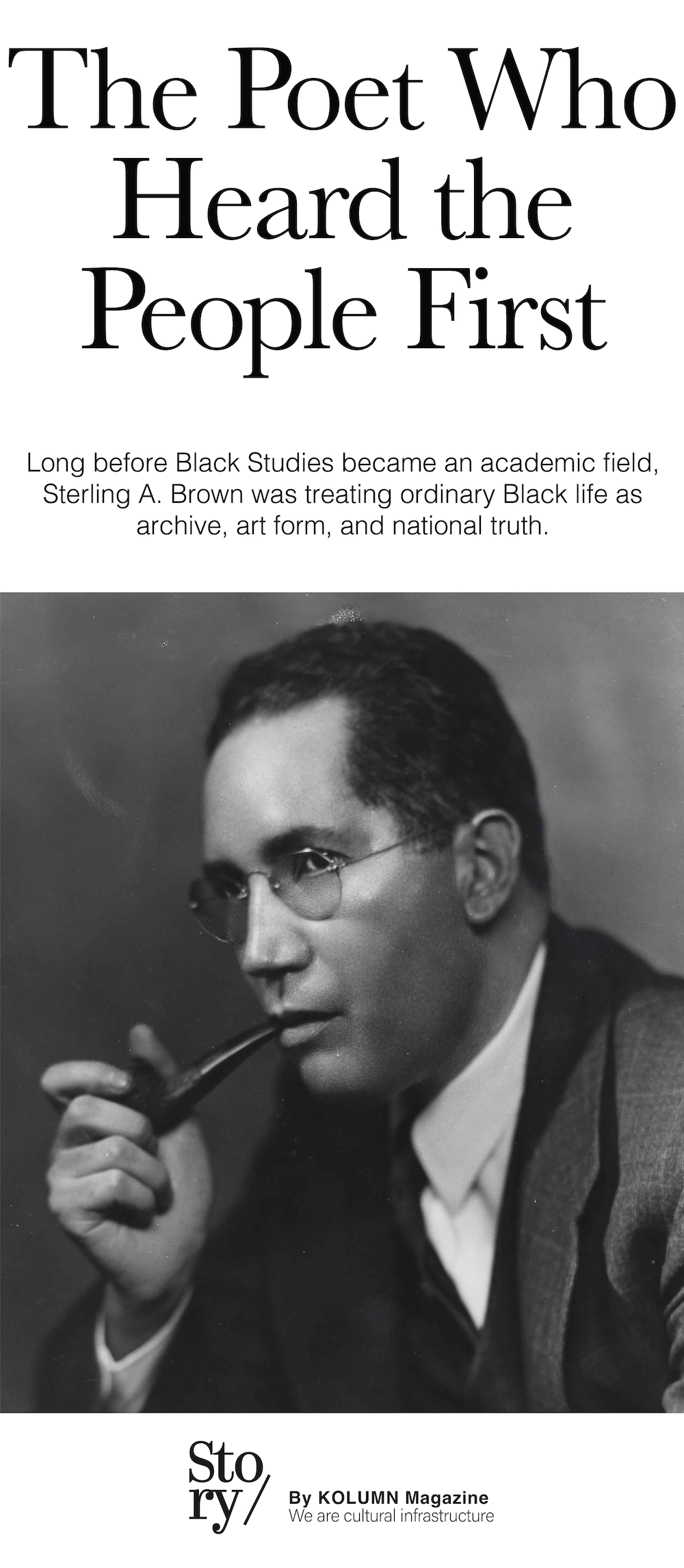
Brown’s genius was not that he wrote about ordinary Black people. It was that he refused to treat them as ordinary subjects of minor consequence.
By KOLUMN Magazine
Sterling A. Brown belongs to that small class of American writers whose influence has been so deep that it can almost disappear into the foundation. His fingerprints are all over the way Black literature is taught, studied, heard, and valued in the United States, even when his name is not the first one offered in casual conversation. He was a poet of the folk, a critic of distortion, a folklorist who knew better than to treat living culture like museum glass, and a teacher whose authority was felt across generations. He was also something more difficult to summarize: a writer who understood that Black life did not need literary permission to become meaningful. It was already meaningful. The task, as he saw it, was to hear it clearly and render it with rigor.
Born on May 1, 1901, in Washington, D.C., Brown entered the world on Howard University’s campus, an origin story that almost sounds too neat for a man who would later become one of Howard’s great intellectual presences. His father, Sterling Nelson Brown, was a professor in Howard’s Divinity School; his mother, Grace Adelaide Brown, was an accomplished educator who taught in the D.C. public schools for decades. Brown was educated at Dunbar High School, then earned his bachelor’s degree from Williams College, where he was elected to Phi Beta Kappa, before completing a master’s degree in English at Harvard in 1923. Those credentials mattered, but not because they made him respectable. They matter because Brown’s eventual devotion to vernacular Black culture came from a man who knew formal literary traditions cold. He did not turn toward Black folk culture out of ignorance of the canon. He turned toward it after mastering the canon and understanding its exclusions.
That dual grounding, elite training and radical listening, helps explain why Brown remains so important. He could read the most elevated English verse and still hear in a Southern Black laborer’s cadence a poetic force the academy was not yet prepared to honor. He studied Ezra Pound and T. S. Eliot, but the Academy of American Poets notes that he was more drawn to writers like Amy Lowell, Edgar Lee Masters, Robert Frost, and Carl Sandburg. That preference tells you something. Brown was interested in writers attentive to speech, place, labor, and the local textures of people’s lives. He was already moving toward a poetics in which Black expressive culture would not be treated as crude material to be refined by somebody else. It would be treated as art with its own authority.
Born into institution, drawn toward the people
It would be easy to overstate the symmetry of Brown’s life and call him destined. He was born into a Black intellectual household, trained in elite institutions, and eventually returned to Howard, where he taught for roughly 40 years. But “destiny” makes it sound too effortless. Brown’s achievement was not merely that he occupied prestigious roles. It was that he used those roles to challenge prestige itself. He understood that American literary culture had long confused polish with truth and had repeatedly used “proper” language as a sorting mechanism for humanity. Brown was interested in another question: what happens when you take Black vernacular seriously not as anthropological evidence, not as comic relief, not as regional garnish, but as a bearer of memory, music, irony, pain, and philosophical precision?
Before Brown settled into Howard’s faculty in 1929, he taught at Virginia Seminary and College, Lincoln University, and Fisk University. These early teaching years mattered because they widened his contact with Black communities beyond Washington and deepened his relationship to the South as lived experience rather than literary abstraction. Brown would become one of the great interpreters of Black Southern culture, but he never approached the South as mere scenery. In his work, the South is labor regime, memory field, language reservoir, spiritual theater, and emotional inheritance. That complexity came from attention, not romantic distance.
Sterling A. Brown did not beg American literature to include Black life. He showed that Black life was already one of its deepest sources.
At Howard, Brown became more than a professor. He became a formative force. Obituaries and tributes in The Washington Post described him as a legend among educators and a towering authority on American Negro literature, tradition, heritage, and thought. That language can sound ceremonial when used after death, but in Brown’s case it tracks with the record. He taught through the Depression, World War II, Jim Crow, the civil rights era, and into the years that would incubate Black Studies. He was a bridge between major periods of Black intellectual life, and he served as living evidence that scholarship, creative writing, and cultural advocacy did not have to be kept in separate boxes.
A Harlem Renaissance figure who never fit the easy stereotype
Brown is typically placed within the Harlem Renaissance, and that is correct, but the shorthand can also be misleading. The popular imagination often reduces the Renaissance to cosmopolitan nightlife, metropolitan wit, and urban modernist style. Brown participated in that larger flowering of Black art and thought, but his center of gravity was different. He was deeply invested in folk forms, in Southern speech, in laboring people, in the blues and the sermon, in the way Black people talked when they were not trying to satisfy the ear of power. That gave his work a different texture from some of his better-known contemporaries, and it helps explain why he has sometimes been more revered than popularly celebrated. Brown was not interested in being fashionable. He was interested in being true.
That truthfulness arrived with full force in Southern Road, Brown’s 1932 debut collection. The book established him as a major poet and remains the work most closely associated with his name. Yet even now, Southern Road can be underestimated if readers approach it as merely a collection of dialect poems. What Brown achieved there was much more demanding. He took forms and voices that American literature had routinely demeaned and made them vehicles for emotional power, historical witness, and formal invention. Poems like “Southern Road,” “Strong Men,” and “Old Lem” do not simply imitate folk speech. They orchestrate it. Brown’s ear for rhythm, repetition, compression, and tonal turn lets these poems move like work songs, blues laments, spoken testimony, and dramatic monologue all at once.
“Southern Road” is a particularly sharp example. The poem channels chain-gang labor with a pounding intensity that makes the body feel the repetition. “Strong Men,” one of Brown’s most anthologized pieces, traces Black endurance across generations with a restraint that gives it even more force. Brown’s art is often strongest where it refuses overstatement. He knew that too much rhetoric could flatten the people he was trying to honor. So instead he lets rhythm do part of the speaking, lets voice carry history, lets understatement cut. That composure is one reason the poems endure. They are furious, but they are not sloppy. They are humane, but they are not sentimental.
Brown’s use of dialect has long required careful reading because dialect in American literature has so often been tied to ridicule. White writers frequently used Black speech to mark inferiority, childishness, or comic primitiveness. Brown walked into that treacherous terrain and reversed its logic. He used Black speech not to diminish Black people but to reveal their intelligence, irony, weariness, humor, and spiritual force. This was a literary intervention and a political one. Brown was effectively saying that the language American culture treated as evidence of lack was, in fact, evidence of cultural richness.
When folklore became a serious method
One of the most revealing descriptions of Brown, from the Poetry Foundation, is that he was among the first to identify folklore as a vital component of the Black aesthetic. That framing matters because folklore has often been treated as charming but secondary, the stuff of appendices and sidebars rather than central artistic knowledge. Brown rejected that hierarchy. He believed folklore was not the leftover residue of “real” culture. It was culture in motion. Songs, jokes, ballads, sermons, sayings, tall tales, spirituals, and stories passed hand to hand were not primitive material awaiting refinement by literary professionals. They were already sophisticated forms of communal intelligence.
That belief shaped not only Brown’s poetry but his larger intellectual project. He understood that folklore records a people’s methods of survival. In Black communities shaped by slavery, disenfranchisement, terror, migration, and economic exploitation, folklore preserved forms of knowledge that official institutions either ignored or actively suppressed. Brown did not romanticize this. He knew folklore emerged under pressure. But he also knew that people make beauty and wit under pressure, and that any serious account of American literature had to make room for that fact.
Brown’s investment in folklore also helped him hear music structurally. His poems are often described as drawing on spirituals, blues, work songs, and jazz. That is true, but the connection goes deeper than subject matter. Brown understood musical repetition, tonal shifting, refrain, break, timing, and the power of a line to carry more than one emotional register at once. His poems often feel built to be spoken aloud because, in a real sense, they are. The Library of Congress preserved recordings of Brown reading his own work, and those recordings underscore how central sound was to his craft. He did not write language as dead print. He wrote it as voiced life.
This is part of what makes Brown feel contemporary. In an age obsessed with “voice,” he remains one of the few writers for whom the word still means something substantial. Voice, for Brown, is not branding. It is social history in acoustic form. It is what happens when class, region, memory, labor, and emotion shape the sentence. His poems do not simply describe Black communities. They carry the sound of Black communities arguing, enduring, joking, mourning, boasting, remembering.
The critic who changed the terms of the conversation
If Brown had written only Southern Road, he would still deserve a place in American literary history. But his criticism is just as crucial to his legacy. In works such as Negro Poetry and Drama and The Negro in American Fiction, Brown helped lay the groundwork for modern African American literary criticism. He examined how Black people had been depicted in American letters, how stereotypes had hardened into conventions, and how Black writers had worked within, against, and beyond those limiting frames. He was not content simply to celebrate Black authors. He wanted a serious accounting of representation itself.
This was pioneering work. Brown was writing before Black Studies had institutional legitimacy, before there was a broad academic infrastructure ready to support sustained study of African American literary traditions. He was helping create the field while also contributing major creative work to it. That dual labor is easy to overlook because institutions tend to separate makers from theorists, poets from critics, classroom figures from artistic ones. Brown was all of those at once. He could write a blues-inflected poem one moment and produce a rigorously historical critique of American literary racism the next.
What Brown understood especially well was that representation is never just an aesthetic matter. It is tied to power. The Black figure in American fiction had long been burdened by plantation fantasy, comic minstrelsy, white guilt, white fear, and sentimental falsehood. Brown read those distortions not merely as offensive but as intellectually corrosive. They prevented literature from apprehending Black people as full human beings. His criticism, then, was not just corrective scholarship. It was a broader demand for artistic truth.
He also refused the false split between politics and craft. Brown did not believe that to talk about race and power was to abandon literary standards. Quite the opposite. He believed bad racial thinking often produced bad literature. Flat stereotypes make for flat art. Romantic evasions produce dishonest narratives. To insist on fuller Black representation was not to lower the bar of criticism. It was to raise it.
Brown the anthologist, Brown the canon-maker
In 1941, Brown joined Arthur P. Davis and Ulysses Lee in editing The Negro Caravan, a landmark anthology that gathered Black writing into a powerful, teachable, circulable body of work. Anthologies rarely get the glamour of poems or novels, but they shape literary history in quiet, durable ways. They determine what gets assigned, reprinted, remembered, grouped, and passed along. The Negro Caravan did not simply collect texts; it made an argument. It said African American writing was not scattered exception but tradition, not isolated brilliance but ongoing record.
That editorial labor fits perfectly within Brown’s larger mission. He knew talent alone does not secure legacy. Works survive because someone organizes them, defends them, teaches them, and insists on their relation to one another. In that sense Brown was not just participating in Black literary history. He was actively building its infrastructure.
The importance of that work becomes even clearer when you remember the fragility of Black archives. So much African American cultural production has been lost, dispersed, trivialized, or preserved only under hostile interpretive conditions. Brown was one of the people trying to intervene before the losses became permanent. His poetry listened to the people; his criticism interpreted the record; his anthologies helped keep that record from vanishing into institutional neglect.
A teacher whose influence outlived the classroom
Writers are often remembered by books alone. Brown must also be remembered by testimony. The Howard professor who lectured on Black literature, folklore, and American letters became one of those rare educators whose students carried him into their own work. Public remembrances consistently stress how beloved and formidable he was. The respect did not come from celebrity performance. It came from depth. Brown knew the field because he had helped make the field. He was not repeating settled knowledge; he was transmitting a method of reading.
That method combined scholarship with listening. Brown taught that Black culture could not be understood if it was stripped of speech, region, and social circumstance. He taught that literature was not merely text floating free of history. He taught that one had to pay attention to the grain of a line, the politics of a phrase, the burden carried by a joke, the seriousness hidden in a song. That kind of teaching does not vanish when the semester ends. It becomes part of how later writers hear the world.
The fact that Brown taught at Howard from 1929 to 1969 means his influence overlapped with an enormous sweep of Black intellectual history. He stood between the Harlem Renaissance and later generations that would push harder on Black autonomy, Black aesthetics, and Black institutional power. He made continuity visible. He showed that Black literary tradition was not a sequence of disconnected moments but a conversation, one in which the folk, the scholar, the artist, and the activist were always nearer to one another than the academy liked to admit.
The trouble with recognition, and the lateness of praise
Brown’s career also contains a quieter tragedy, one familiar to many Black artists: major influence, insufficient institutional reward. Southern Road was admired, but his publishing path afterward was uneven. The Poetry Foundation notes that Harcourt, Brace declined a second printing of Southern Road and later rejected his manuscript No Hiding Place. That mattered. Publishing neglect can distort a reputation just as surely as hostile criticism can. Brown did not stop writing important poems. The system stopped carrying them forward at the level it should have.
This is one reason Brown can feel oddly absent in public literary conversation relative to his actual stature. He was central without always being marketed as central. He was foundational without becoming fully mainstream. He was a writer other writers knew they owed. That kind of legacy is powerful, but it can also be precarious. It depends on teachers, scholars, critics, and institutions continuing to do the work of naming what was there all along.
The publication of The Collected Poems of Sterling A. Brown in 1980 helped redress some of that neglect. The book gathered the scope of his achievement into fuller view and won the Lenore Marshall Poetry Prize in 1982. By 1984, Brown had been named the first poet laureate of the District of Columbia. These were meaningful honors, not just ceremonial gestures. They signaled official recognition of a writer whose influence had long exceeded the visibility granted to him by the marketplace. Still, the timing carried a familiar sting. America had again taken its time catching up to a Black artist who had already changed the landscape.
Brown also received honorary doctorates from numerous institutions, including Howard, Harvard, Yale, Williams, and others, further evidence that the academic world increasingly understood the magnitude of his contribution. Yet even that acknowledgment is best read not as the creation of his stature but as the delayed confirmation of it. Brown’s authority did not begin when institutions finally decorated him. It began when he started telling the truth about Black language, Black culture, and Black representation in a country organized to evade all three.
What made his poems different
Brown’s poetry is often praised for dignity, and that is right, but the word can be too smooth if left alone. Brown did give dignity to figures American literature had often denied it to, but he also gave them mischief, impatience, sexuality, cunning, fatigue, timing, skepticism, and swagger. He did not make saints. He made people. That is a more radical gift.
This is where Brown differs from both racial caricature and uplift propaganda. Caricature flattens Black people into types; uplift writing can flatten them into moral examples. Brown was wary of both. He knew Black life in its fullness included contradiction. His speakers complain, sing, laugh bitterly, remember old wounds, size up exploiters, keep moving, and sometimes crack jokes in the very shadow of hardship. That tonal range makes the poems feel inhabited rather than programmatic.
He also had a rare sense of scale. Brown could move from the intimate to the historical without making the shift feel forced. In “Strong Men,” for instance, Black history is not abstract chronology. It is felt as weight in the body, insult carried across generations, resilience compressed into rhythm. Brown understood that the broad story of Black America was always being lived in singular voices. His poems keep both truths in frame.
Brown and the Black South he refused to stereotype
Brown’s relationship to the South deserves special emphasis because it sits at the center of his literary achievement. He wrote about the Black South at a time when it was easy for Northern readers, including liberal ones, to treat Southern Black life as either backward relic or racial tragedy. Brown refused both simplifications. He saw brutality clearly. Jim Crow, labor exploitation, violence, and humiliation are everywhere in the background and foreground of his work. But he also saw complex communities, dense traditions, and cultivated expressive forms. He refused to let white supremacy define the total meaning of Black Southern life, even while acknowledging how profoundly it shaped daily existence.
That refusal matters now because Brown offers a model for writing about Black suffering without making suffering the only available lens. He is not evasive. He is expansive. He insists that oppression is real and that the people living under it are still more than their wounds. That is part of his moral seriousness. He would not deny pain, but neither would he surrender Black humanity to it.
Why he still matters now
Sterling A. Brown’s relevance did not end with the Harlem Renaissance, or with Howard, or with the publication of The Collected Poems. He remains urgent because the questions he raised are still unresolved. Which forms of Black expression get treated as sophisticated? Which are mined for style while denied intellectual legitimacy? Who gets to sound “literary”? Which communities are allowed full humanity on the page? Brown saw these questions clearly before contemporary critical vocabulary made them fashionable.
He also remains essential because he offers a model of literary citizenship larger than authorship alone. Brown wrote poems, yes. But he also taught, edited, criticized, archived, and argued. He understood that culture survives through ecosystems, not isolated genius. A poem needs readers, and readers need teachers. Writers need anthologies, criticism, and institutions willing to preserve what matters. Brown spent his life helping construct those conditions for Black literature.
When people now speak about “the archive,” Brown feels strikingly modern. But he might also have corrected the term. For Brown, the archive was not only what sat in a box or on a shelf. It was in remembered speech, in blues structures, in roadside labor songs, in old jokes, in sermons that traveled, in the habits of phrasing by which Black people interpreted the world. He knew the people were the archive. The page was one place where that archive could be honored, but never its only home.
Sterling A. Brown died on January 13, 1989, in Takoma Park, Maryland. He left behind a body of work, a critical tradition, and a pedagogical legacy that continue to shape American letters. The Washington Post called him perhaps the most knowledgeable living person on American Negro literature, tradition, heritage, and thought. That is the sort of sentence newspapers reserve for figures whose scale exceeds easy summary. In Brown’s case, it still feels accurate. He was not just knowledgeable about the tradition. He was one of the people who made it legible to the nation and to itself.
The legacy: not marginal, but central
The cleanest way to state Brown’s significance is also the most challenging one for the American canon: he belongs near the center. Not as a token addition. Not as a useful specialist. Not as a name invoked every February and then shelved. He belongs near the center because the problems he wrestled with, language, race, class, labor, music, memory, representation, are the very problems through which American literature reveals itself.
Brown helped make it harder to lie about Black life on the page. He refused caricature. He distrusted sentimentality. He knew that Black folk culture was not decorative background to the national story but one of its main engines of style, survival, and truth. He trained readers to hear Black speech as art and Black experience as literature without requiring either to be translated into white comfort first. That is not a minor contribution. That is a reordering of literary value.
And that may be the final reason he endures. Brown did not simply write memorable poems. He widened the nation’s ear. He made room for a fuller, tougher, more honest account of what American language contains. Once you read him closely, once you really hear what he was doing, it becomes difficult to accept a small version of the canon again. Sterling A. Brown was never writing from the margins of the country. He was writing from one of its deepest truths.
More great stories
Afro Sheen, Wall Street, and the Architecture of Black Possibility
July 6, 2026
No Comments
The Fire Inside the Fourth
July 5, 2026
No Comments