



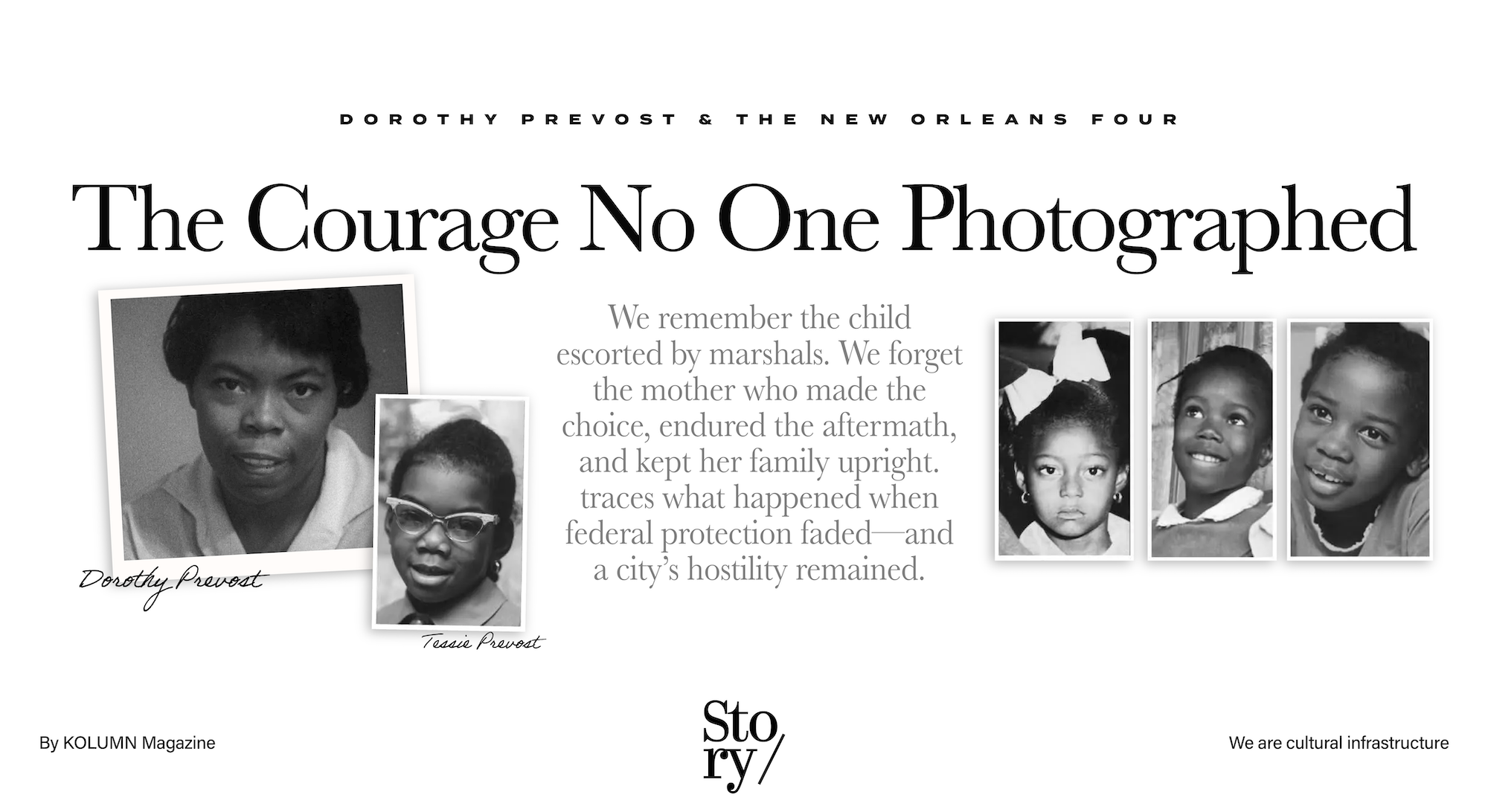
History calls it desegregation. Dorothy Prevost lived it as a mother’s work—done in public, paid for in private, and remembered, finally, as a form of leadership.
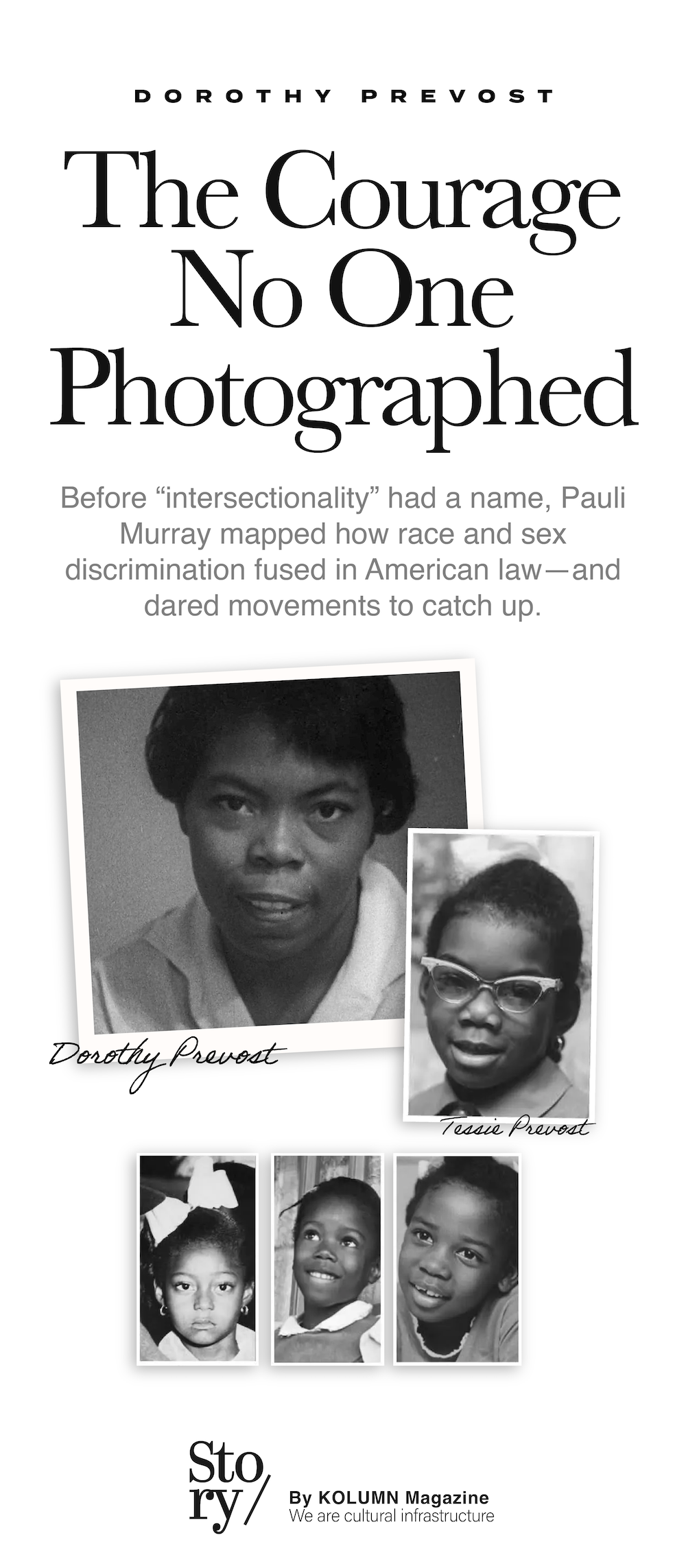
History calls it desegregation. Dorothy Prevost lived it as a mother’s work—done in public, paid for in private, and remembered, finally, as a form of leadership.
By KOLUMN Magazine
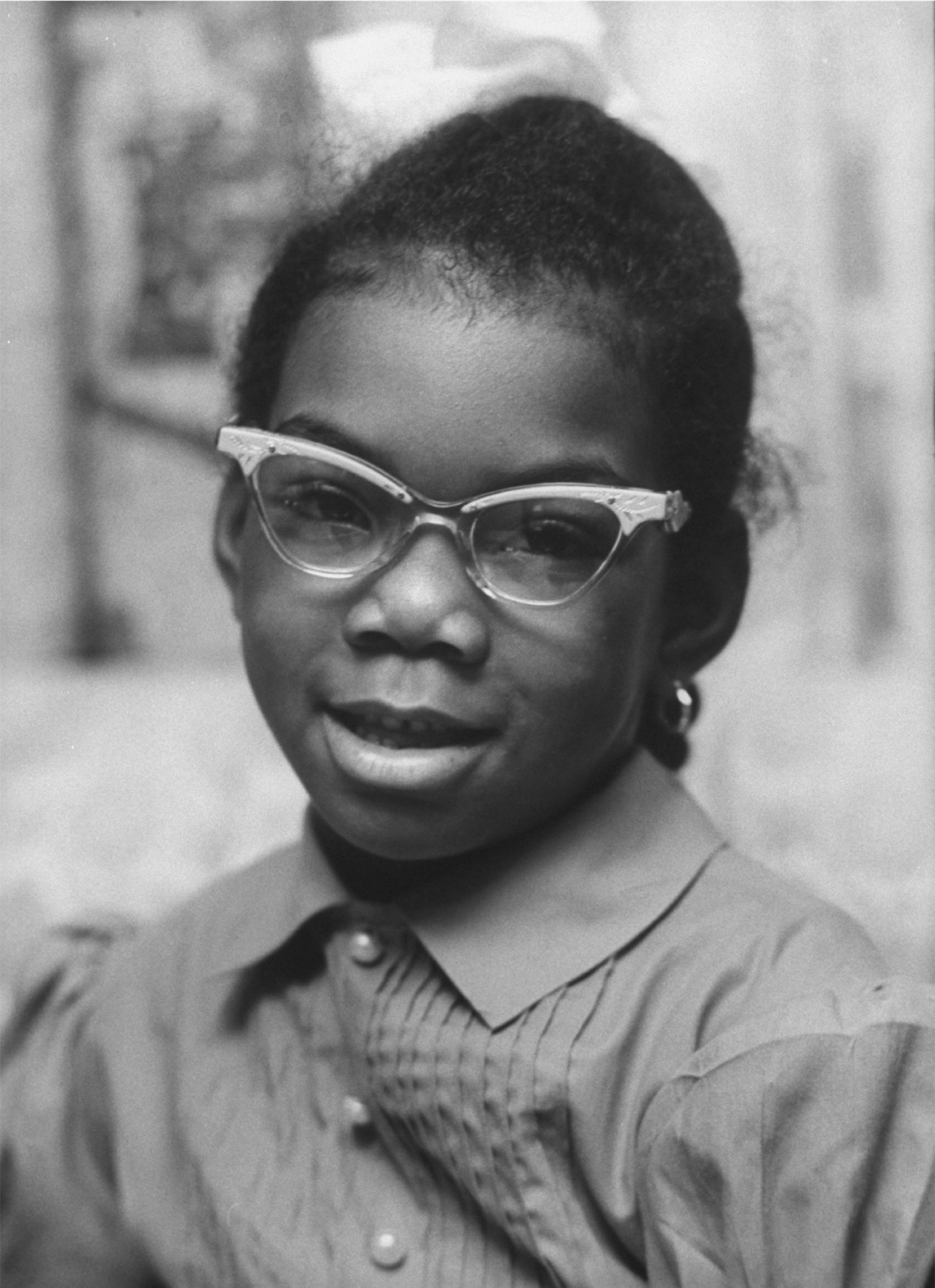
Dorothy Prevost did not set out to become a character in America’s most rehearsed morality tale—the innocent child, the angry mob, the federal marshals, the first day of school that looks, in retrospect, like destiny. She was a New Orleans mother trying to raise a family in a city that loved its pageantry and guarded its power, a city where race could determine which sidewalk felt safe, which doors opened easily, which institutions could be trusted, and which rules were enforced with a sneer. And yet the shape of her life cannot be told without the date that turned her into something larger than herself: November 14, 1960, when New Orleans finally began to desegregate its public elementary schools under federal court order—and when her daughter, Tessie Prevost, became one of four Black first-graders forced into the role of pioneers.
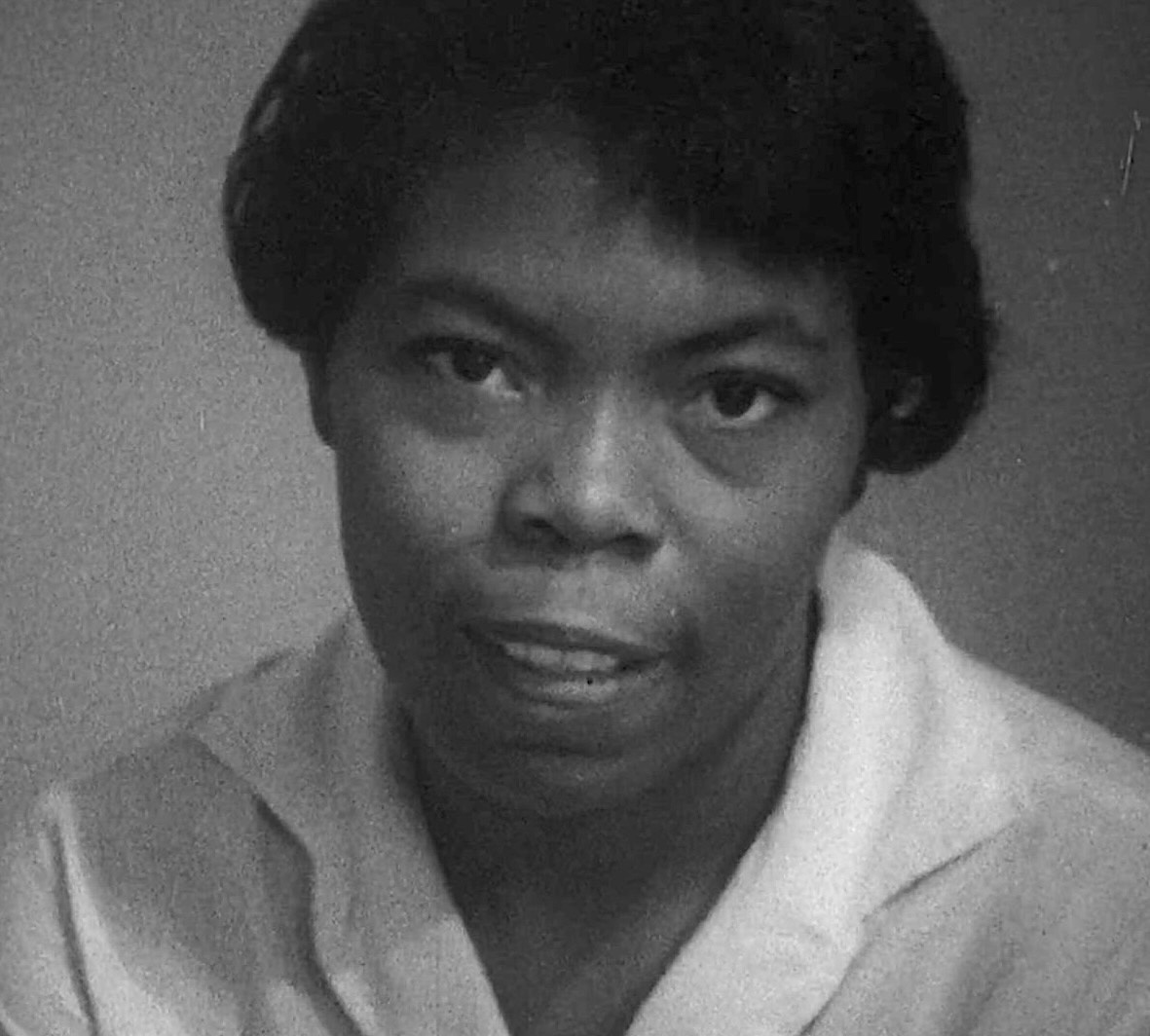
Prevost’s legacy, however, is not only tethered to that single morning. It is bound up in the long, grinding aftermath: the fear and logistics of daily survival, the emotional calculations that parents performed in real time, and the slow recognition—decades later—that the desegregation of schools was not simply an institutional reform but a domestic and psychological siege. In the standard retelling, the spotlight falls on children because the image is unbearable: adults screaming at six-year-olds. But in the shadows of those photographs stood parents, making the kinds of decisions that change a country while wrecking the nerves. Dorothy Prevost was one of those parents. When she died at 94, local reporting noted what the national memory often overlooks: she was the mother of Tessie Prevost-Williams, and she was described as the last living parent of one of the four girls who desegregated New Orleans public schools.
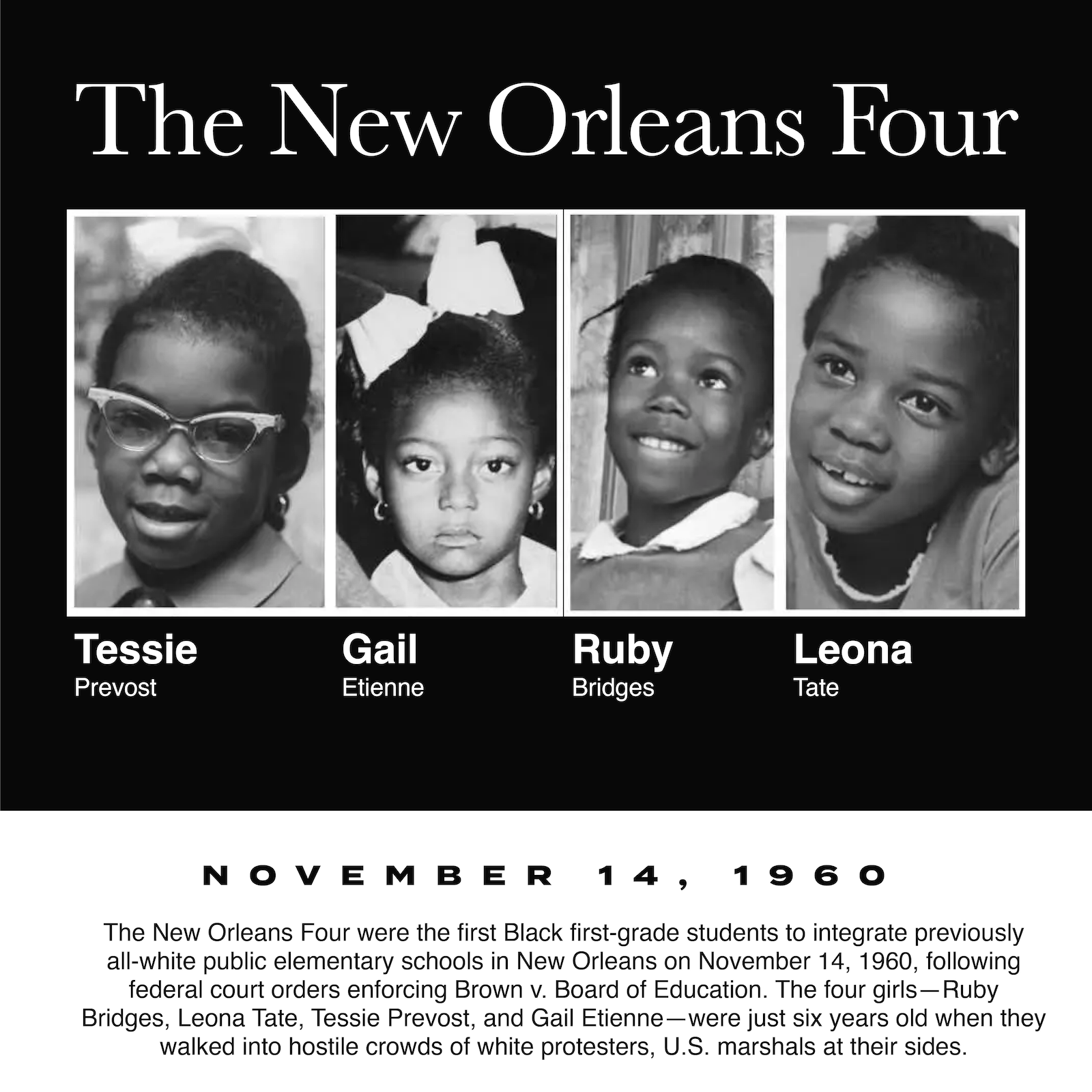
To write about Dorothy Prevost responsibly is to resist the temptation of hagiography while still acknowledging moral gravity. She was not a saint floating above history; she was a woman inside it—subject to its constraints, shaped by its terrors, capable of fatigue, anger, tenderness, and contradiction. What endures is not only the famous act of sending a child into a hostile environment, but also the quieter record: the stubbornness required to keep choosing school, day after day, when the city’s message was clear. And it requires telling the New Orleans story on its own terms, not merely as an extension of Brown v. Board or a footnote to Ruby Bridges. On November 14, the city was forced to confront not one symbol but four living children: Ruby Bridges at William Frantz Elementary School; and at McDonogh No. 19, three girls—Leona Tate, Gail Etienne, and Tessie Prevost—sometimes called the “McDonogh Three,” sometimes folded into the broader name that history would eventually grant them: the New Orleans Four.
The hard truth is that New Orleans did not desegregate because it was ready. It desegregated because a federal judge ordered it to. The institutions of the state and the city responded not with compliance but with delay, sabotage, and theatrical resistance. The families who stepped forward did so in a climate that promised retaliation. Dorothy Prevost’s story is, in part, the story of what it meant to be a Black parent in that moment: to understand the magnitude of a choice while still having to make it on a Tuesday morning, with a child’s hair to comb and shoes to tie.
Before the first day: A decade of legal pressure and political obstruction
By the time Tessie Prevost and the other girls approached their first day in a previously white-only school, the fight had already been underway for years in courtrooms, legislative chambers, and parish offices. The desegregation of New Orleans public schools was not a sudden moral awakening in 1960; it was the delayed consequence of litigation that began earlier, aimed at dismantling a system that operated with the smug assurance of permanence.
One of the central legal engines behind New Orleans school desegregation was the case commonly known as Bush v. Orleans Parish School Board, filed by Black parents and pursued by civil rights attorneys, including A. P. Tureaud of the NAACP in Louisiana. Federal judicial history summaries describe the litigation as a challenge to the assignment of children to racially separate schools under the Equal Protection Clause, and they trace a long sequence of court rulings that steadily boxed the Orleans Parish School Board into compliance.
Judge J. Skelly Wright, a U.S. District Court judge in New Orleans, became a pivotal figure—praised by civil rights advocates, reviled by segregationists, and pressured from all directions. The record shows that in February 1956, a three-judge federal court ruled Louisiana’s segregation mandates unconstitutional, and on the same day Wright ordered the Orleans Parish School Board to move “with all deliberate speed” toward desegregation. Years passed. Deadlines were imposed and extended. In July 1959, Wright set a deadline for a desegregation plan; by May 1960, after the board claimed state restrictions prevented compliance, Wright put in place his own plan requiring desegregation to begin with first grade.
What followed was the familiar choreography of massive resistance dressed in local costume. State officials and segregationist politicians sought legal mechanisms to block or seize authority over schools. The school board maneuvered for delay while also signaling that it was trapped between federal orders and state threats. In the fall of 1960, the timeline tightened. According to the federal judicial account, implementation was delayed from early September until November 14 at the school board’s request, and in the days immediately before that date, Judge Wright issued restraining orders aimed at preventing state interference with the operation of the public schools.
These details matter because they show that desegregation in New Orleans was not merely controversial—it was treated as an invasion. The state legislature passed segregation laws in an attempt to avert the November 14 desegregation, and subsequent reporting in Southern School News noted that the U.S. Supreme Court later affirmed lower court decisions that knocked down a mass of Louisiana segregation legislation tied to the New Orleans fight.
For families like the Prevosts, this legal war created a chilling practical reality: the state’s highest powers were signaling to white citizens that resistance was legitimate, even patriotic. Every delay, every legislative stunt, every public speech about “sovereignty” and “interposition” functioned as a dog whistle and a drumbeat. In that climate, the question of whether to apply for a transfer to a white school was not a matter of preference; it was a decision made under threat.
Selecting the children: “Integration” as a burden placed on six-year-olds
The girls who integrated New Orleans schools were not chosen because they sought fame or because their parents wanted a headline. They were chosen through a process shaped by the legal structure of desegregation and the realities of geography, class, and race. A federal narrative of the crisis emphasizes that desegregation began at two elementary schools, and that the students—first graders—were escorted by federal marshals. At McDonogh No. 19, Leona Tate, Tessie Prevost, and Gail Etienne entered. At William Frantz, Ruby Bridges entered.
The fact that these were first graders was not incidental. It was policy and psychology. Beginning with the youngest children reduced the number of students affected and allowed officials to frame the change as gradual. It also made the moral optics more explosive: screaming at teenagers can be rationalized as “politics”; screaming at first graders reveals something uglier.
The schools themselves were not the wealthy, insulated campuses many had expected. Contemporary summaries of the desegregation crisis note a strategic reality: rather than choosing an “uptown” school whose parents might have the resources to route around desegregation, the first targets were in poorer sections, including the Lower Ninth Ward. That detail complicated the city’s narrative. It is easier to claim “principle” when defending privilege; it becomes harder when the battleground is a neighborhood already marked as disposable.
Dorothy Prevost lived and raised her family in a New Orleans shaped by environmental vulnerability and racialized infrastructure—conditions that would later be magnified by storms and displacement. A biographical profile of Dorothy Mackey Prevost describes her as a New Orleans native and a survivor of Hurricane Betsy, and notes that she married Charles Prevost in 1953 and had daughters including Tessie. Even without every domestic detail, the outline is enough to understand the broader truth: Dorothy’s life was already situated at the intersection of vulnerability and endurance long before the school crisis asked her to gamble with her child’s safety.
That is the background against which the decision to let Tessie become a first grader at McDonogh 19 should be understood. It was not a symbolic act. It was a mother trying to move her child through a system designed to limit her.
November 14, 1960: The city gathers, the marshals arrive, the children enter
If you want to understand why Dorothy Prevost’s story matters, you return to the morning New Orleans tried to turn a school day into a warning. Federal marshal escorts were not an abstract concept; they were the difference between a child reaching a classroom and being swallowed by a crowd. Reporting and historical accounts agree on the broad outline: as the girls arrived, they faced jeering protesters, racial slurs, threats, and the kind of adult rage that makes a child’s body tense before her mind can even name fear.
Ruby Bridges’ walk into William Frantz has been immortalized and reproduced until it can feel almost staged, as if history always comes with good lighting. The Guardian’s profile of Bridges underscores the core facts: she was six years old, escorted past hateful protesters, and taught alone for a year—an isolation that turned “school” into a daily confrontation with emptiness. The Atlantic, reflecting on the psychological toll of desegregation, has pointed back to the famous image of marshals escorting Bridges and noted recollections from one of the marshals about her composure—an adult memory that often doubles as a national fantasy: the brave child who does not break. (The Atlantic)
But at McDonogh 19, the drama was different and, in some ways, more revealing. The school received three girls, not one, and the crowd’s energy translated quickly into a boycott that hollowed out the building. A profile from the Tate, Etienne, and Prevost Center’s related materials describes the scene plainly: as the day progressed, white parents removed their children from McDonogh 19 until the Black girls were effectively alone in the building.
That kind of emptiness is its own form of violence. The segregationists’ message was not only “you are not welcome,” but “we will abandon public life rather than share it.” For a six-year-old, the absence of classmates is confusing; for a mother, it is a forecast. Dorothy Prevost could not pretend this was a normal first-grade year. The city had made it clear that even if her daughter was permitted to enter the building, she would not be permitted to belong.
The story of that day also includes civic chaos. Contemporary summaries of the crisis describe a riot breaking out days later outside an Orleans Parish School Board meeting as tensions escalated. The conflict spilled beyond the schoolyard into the machinery of governance, a sign that the fight was never really about children’s education alone. It was about who controlled the city and what kind of future would be tolerated.
What the photographs omit: The mothers’ math
It is tempting to treat mothers like Dorothy Prevost as supporting characters—an unnamed figure who gives a child breakfast and then exits the frame. But desegregation required a kind of maternal logistics that deserves its own vocabulary. The mothers had to weigh education against immediate safety, dignity against backlash, hope against harm. They had to anticipate not one day of hostility but months, maybe years. They had to decide whether they could absorb threats aimed at their child and still keep their household functioning.
In that sense, Dorothy Prevost was not simply “the mother of.” She was a decision-maker under siege. Local reporting on her death emphasized the nature of that decision: she “made the courageous decision to send her daughter into a hostile environment,” a line that risks cliché until you remember what “hostile” meant in New Orleans in 1960—an environment where crowds formed, threats circulated, and the state itself flirted with open defiance of federal court orders.
That decision also came with a strange and unfair inversion: segregationists often accused Black parents of “using” their children, as if asking for a constitutional right was exploitation. The more honest view is that the system used Black children as test cases, forcing them to bear the consequences of adult politics. The parents were left to manage the fallout.
Dorothy Prevost’s role becomes even clearer when you consider what the federal courts were effectively mandating. The litigation history shows that courts ordered plans, timetables, and compliance. But no judge could order a community to behave humanely. Desegregation decrees could open the door; they could not stop a neighbor from spitting, a stranger from screaming, or an employer from retaliating. The legal victory created a new arena of vulnerability for the people who were supposed to benefit from it.
The years after: When protection thinned and cruelty shifted forms
The first day of school tends to dominate public memory because it is cinematic. Yet for many families, the true ordeal was not confined to November 1960. It extended into the years that followed, when the national press moved on and local hostility adapted.
A Wall Street Journal obituary-style account of Tessie Prevost-Williams’ life described what happened after the early phase at McDonogh: later transfers brought more brutal treatment, with fewer protections. The account notes that when the girls moved to another school for third grade, they no longer had marshals, and Prevost endured physical aggression and sustained trauma; the story frames her endurance as something reinforced by family insistence that she continue.
This arc—initial federal spotlight and later diminished protection—is crucial for understanding Dorothy Prevost’s mothering as a long campaign rather than a single act. It is one thing to send a child on day one when marshals are present and cameras are near. It is another to keep sending her when the spectacle fades and the hostility becomes routine. Parents had to decide, over and over, whether the principle remained worth the pain.
Those years also shaped the internal narratives the children carried. The public sometimes assumes that child pioneers understand the historic nature of their actions in real time. But many did not; they were too young, and their parents often shielded them from the full political context as a form of protection. Accounts of Ruby Bridges frequently include her later recollections—how she did not fully understand what was happening, how innocence functioned as armor. The same dynamic appears in retellings of the McDonogh Three: the children did not walk into history; they walked into first grade.
For Dorothy Prevost, that shielding would have been part of her job. If you cannot prevent harm, you try to prevent comprehension of harm from becoming its own wound. The mother’s work is often invisible because it operates internally: deciding what to explain, what to withhold, how to calm a child who senses danger without being able to name it. In the desegregation crisis, that invisible work was constant.
New Orleans as a case study in “massive resistance” with local flair
New Orleans’ desegregation crisis sits within the broader southern strategy of “massive resistance,” but it had its own particular rhythm: a mix of legislative maneuvering, courthouse battles, and street-level intimidation. The federal judicial history of Bush v. Orleans outlines how Louisiana officials argued that federal orders were illegitimate, leaning on “interposition” theory and claims of state sovereignty, and how courts rejected those arguments. The point of such arguments was not only legal victory; it was time. Delay was a political weapon. Every month without desegregation was another month in which segregation felt normal.
The Supreme Court’s later action, as reported in Southern School News, is revealing precisely because it frames the New Orleans crisis as a confrontation not only with a school board but with a state legislature that had passed “a mass of” segregation laws in an attempt to prevent desegregation. That language captures the scale of effort required to protect segregation—effort that stands in grim contrast to the supposed “tradition” or “custom” defense often invoked by segregationists. Traditions do not usually require that much lawmaking to survive; they survive because people want them. Segregation required constant reinforcement because it was, at its core, an injustice that had to be defended against law and conscience.
This is where Dorothy Prevost’s story becomes something more than family biography. She lived through a moment when the state mobilized its institutions against the basic premise that her child deserved equal access to a public school. Her courage is not only personal; it is an indictment of what she was forced to be courageous against.
The shadow of Ruby Bridges—and the long fight for the “other three” to be remembered
One of the subtler injustices of the New Orleans story is the way memory has been distributed. Ruby Bridges became an icon—helped by photographs, by Norman Rockwell’s painting, by national narratives that prefer singular heroes. The other three girls at McDonogh 19 were often treated as a footnote, even though they integrated schools on the same day. A Washington Post item from the 1990s—published as a corrective—explicitly pushed back against the idea that Bridges was the “first” Black child to integrate New Orleans schools, insisting she was one of four children who entered at the same hour.
This is not about diminishing Bridges. It is about refusing the myth that history happens through one body alone. The New Orleans Four mattered as a collective, and their parents’ decisions mattered as a collective.
In recent years, there has been renewed attention to the “McDonogh Three,” including reporting about efforts to preserve and interpret their legacy. The Guardian, in late 2025, described how the women’s contributions had long been overlooked compared to Bridges’ fame, and it highlighted Leona Tate’s work to purchase and transform the McDonogh 19 site into a center that tells their story and serves the community. That kind of preservation is not merely commemorative; it is corrective. It is a demand that the archive include everyone who paid the price.
For Dorothy Prevost, this corrective memory matters because it is also a correction of how motherhood gets archived. When a child becomes an icon, the parent becomes a silhouette. But it was Dorothy—and the other mothers—who agreed to let their children become targets for a public good the city refused to provide voluntarily.
Recognition, at last: Parades, markers, and the belated language of gratitude
America has a habit of apologizing late. Recognition often arrives when the danger has passed and the beneficiaries can express gratitude without sharing risk. Yet even late recognition is not meaningless; it can provide something like justice to those who were treated as disposable.
In November 2024, the Associated Press reported on New Orleans commemorating the 64th anniversary of school desegregation with a celebratory parade, explicitly naming Tessie Prevost Williams, Leona Tate, Gail Etienne, and Ruby Bridges, and framing them as “little soldier girls”—language that both honors their bravery and underscores the grotesque reality that children were pressed into a battlefield. The AP piece also noted a sobering present-tense fact about the city’s schools: New Orleans public schools today are overwhelmingly students of color, and debates over segregation and equity remain unresolved.
Markers have also been installed and trails created to bring the story into public geography. The AP has reported that William Frantz Elementary—historic for Ruby Bridges’ integration—was designated as a stop on the Louisiana Civil Rights Trail, reflecting an institutional commitment to preserving the memory on-site. Sites tied to McDonogh 19 have similarly been recognized in civil rights tourism and education materials, emphasizing that desegregation in New Orleans was a two-school story, not a single-building myth.
For Dorothy Prevost, recognition came not only through public commemorations but also through the fact that, at the end of her life, she was openly described as a civil rights matriarch—language that implies lineage, stewardship, and lived authority. Local reporting noted that she had been honored with a resolution for her commitment to social justice at the state capital in the year before her death.
These gestures do not erase the cost. But they signal that the city and the state have had to accept—however reluctantly—that the people they once treated as intruders were, in fact, architects of a more legitimate public life.
Dorothy Prevost as an archive: What her life held that textbooks can’t
The phrase “last living parent” carries a quiet terror: it suggests that history is not only something we study but something we can lose. When Dorothy Prevost died, she took with her an irreplaceable repository of intimate details: the phone calls, the warnings, the conversations behind closed doors, the daily mood in a house that knew it was being watched. Reporting about her death framed her not only as a mother but as the final surviving parent from that specific circle—a reminder that movements are made of families, and families can vanish from the archive if we fail to record them.
Even what we do know suggests a life that spanned multiple forms of survival. Sources describing her background frame her as a lifelong New Orleanian shaped by storms as well as segregation—someone who endured Hurricane Betsy and raised a family in neighborhoods that would later become symbols of both cultural endurance and structural neglect. This matters because it expands the civil rights narrative beyond courtroom victories and into the real landscape of Black life in Louisiana: environmental vulnerability, housing inequity, and the constant demand to rebuild.
Dorothy Prevost’s life also illustrates something else: how civil rights history can be both public and private at once. The public story is the day of integration. The private story is the decades of being “that family,” carrying the knowledge that your child’s name is in the city’s mouth, that strangers feel entitled to your fear, that your bravery has become a civic object. Living as an archive is exhausting. It means you are asked to narrate pain for other people’s learning.
And yet, for families like the Prevosts, silence also carried a cost. Silence allowed the myth that New Orleans desegregation was primarily a Ruby Bridges story. Silence allowed the myth that the city complied peacefully once forced. Silence allowed the comfortable forgetting of the mothers.
The newer wave of commemoration—parades, centers, news features—suggests that the silence has been thinning. It is not accidental that the renewed attention has included explicit naming of the women and the institutions created in their honor. Naming is a form of repair.
The city’s enduring question: What did desegregation change—and what did it fail to change?
A longform profile of Dorothy Prevost should not end with a neat moral bow. The truth is more complicated: desegregation changed the legal structure of public education, but it did not automatically produce equality, safety, or belonging. It did not end white flight. It did not erase funding disparities. It did not prevent resegregation through housing patterns, school boundaries, or later policy shifts. The AP’s reporting on the 2024 commemoration points directly to this: even with decades of legal change, segregation and inequality persist in different forms, and New Orleans schools remain shaped by race and class.
That reality should not be used to diminish what Dorothy Prevost and the other parents did. It should sharpen the question of what society owes them. If a child’s courage can be turned into a national symbol, then the nation should also be willing to confront the systems that required that courage in the first place—and the systems that continue to reproduce unequal outcomes after the cameras are gone.
The story of Ruby Bridges’ year of isolation, taught alone by the one teacher willing to teach her, is frequently told as evidence of individual bravery. It should also be told as evidence of institutional failure: a public school system so committed to exclusion that it preferred an empty classroom to integration. McDonogh 19’s hollowed-out building tells the same story in a different register.
Dorothy Prevost lived with that failure not as an abstraction but as a lived reality affecting her daughter’s daily life. Her motherhood was forced to absorb the gap between what the Constitution promised and what the city delivered.
What a mother’s courage looks like, up close
The civil rights movement has an iconography: marches, speeches, police lines, court rulings. Motherhood is harder to photograph. It happens in repetition. It happens in the way a woman keeps her voice level so a child doesn’t panic, in the way she prepares a lunch while knowing the lunch might not be eaten, in the way she walks a child to a door and then stands back because the child must be the one to enter.
Dorothy Prevost’s courage was not a single leap; it was a sustained stance. It was making the choice and then living inside it. It was enduring the city’s anger and refusing to accept that her child’s rights were negotiable. And it was doing so in a political environment where leaders signaled that resistance was honorable and where courts had to issue restraining orders against state interference to keep schools functioning.
When her daughter Tessie died at 69, coverage emphasized her identity as one of the New Orleans Four and noted the long arc from that first-grade morning to a later life shaped by work, community, and survival through the storms that have defined modern New Orleans. Dorothy Prevost lived long enough to see her daughter become more widely recognized, and long enough to see the city begin to ritualize gratitude. She also lived long enough to become, in local memory, a matriarch whose role was finally spoken aloud.
Her death closes a particular chapter: the era when a parent could still say, from lived experience, what it felt like to hand a child to the federal government’s protection because the local community could not be trusted to behave as neighbors. That kind of testimony is invaluable precisely because it is not theoretical. It is domestic history—history that explains how civil rights were won not only in court but at breakfast tables and front steps.
Dorothy Prevost’s legacy, then, is not simply that she raised a daughter who helped desegregate a school. It is that she demonstrates what civil rights actually required of ordinary people: not just belief, but nerve; not just hope, but planning; not just moral clarity, but the willingness to withstand a community’s contempt without surrendering a child’s future.
And perhaps that is the final, uncomfortable truth her life insists upon. We like to celebrate child heroes because their innocence flatters our conscience: if children can be brave, surely adults can be decent. But the story of New Orleans in 1960 is that many adults were not decent—and that a smaller number of adults, including mothers like Dorothy Prevost, were brave enough to force decency into the public record anyway.
History calls it desegregation. Dorothy Prevost lived it as a mother’s work—done in public, paid for in private, and remembered, finally, as a form of leadership.
More great stories
Afro Sheen, Wall Street, and the Architecture of Black Possibility
July 6, 2026
No Comments
The Fire Inside the Fourth
July 5, 2026
No Comments