



The rage that follows the beating becomes part of the movement’s internal struggle.
The rage that follows the beating becomes part of the movement’s internal struggle.
By KOLUMN Magazine
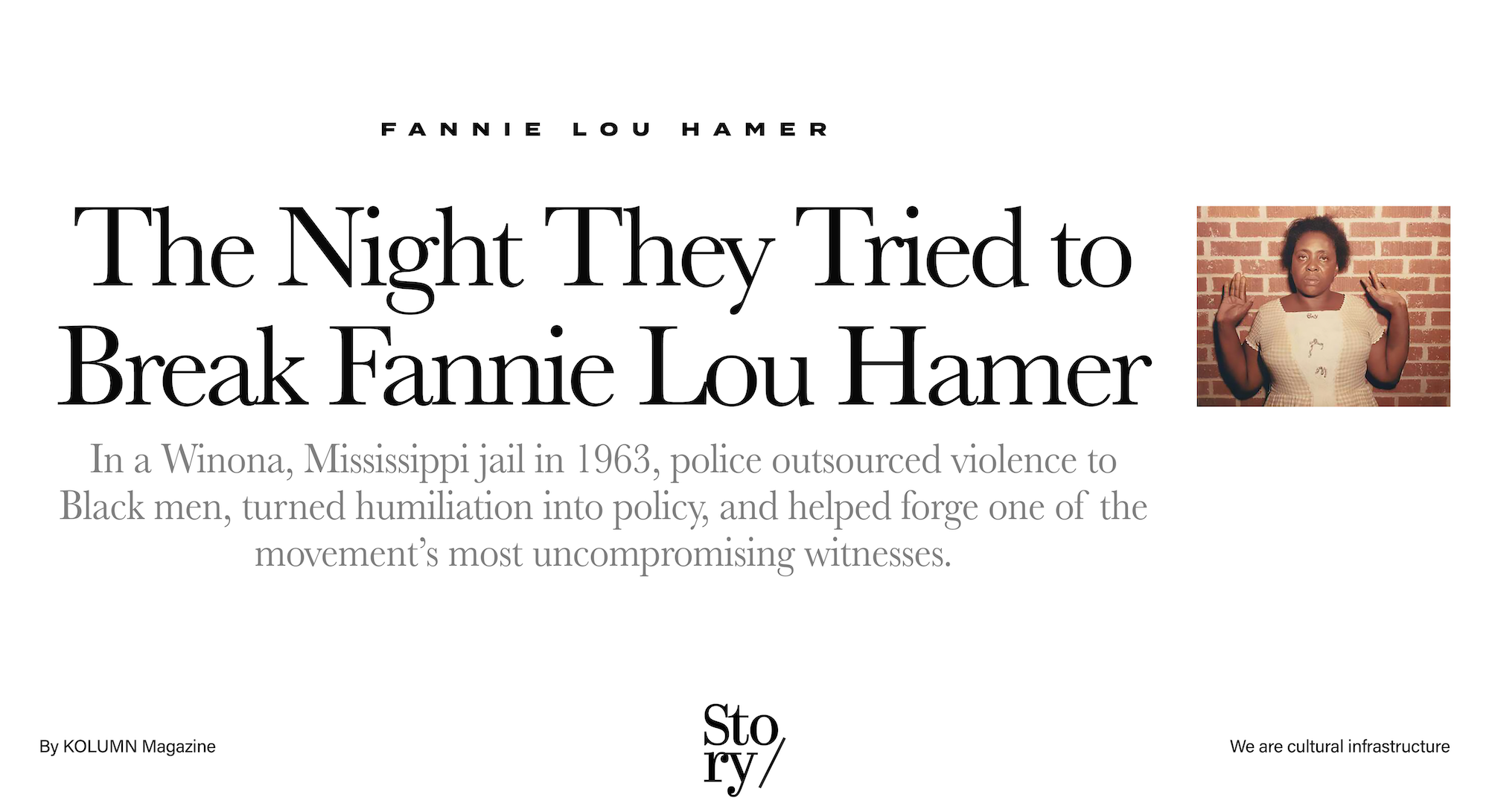
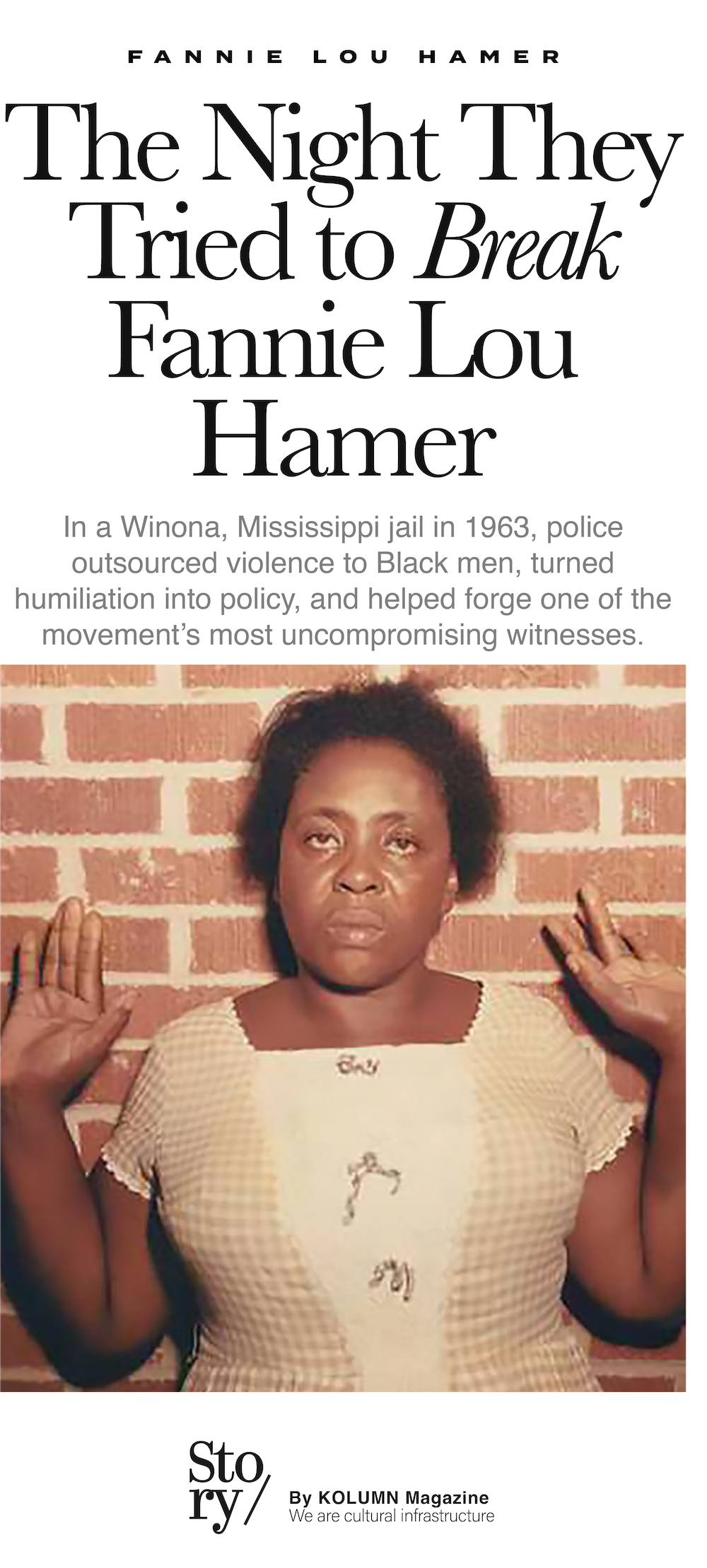
In the American civil rights story, some episodes are remembered as turning points because they were witnessed by the nation in real time: a child facing down a jeering crowd; a march confronted by troopers; a church reduced to rubble. But many of the movement’s most consequential acts of violence occurred in places designed to be unseen—where officials could control not only bodies, but narratives. In June 1963, a county jail in Winona, Mississippi became one of those places. There, Fannie Lou Hamer—then a relatively new field organizer in the voting-rights struggle—was arrested, brutalized, and forced to endure a form of torture that blended racial domination with the mechanics of local policing. Years later, when Americans heard her ask, “Is this America?” they were hearing a question forged in the dark, under orders, behind a locked door.
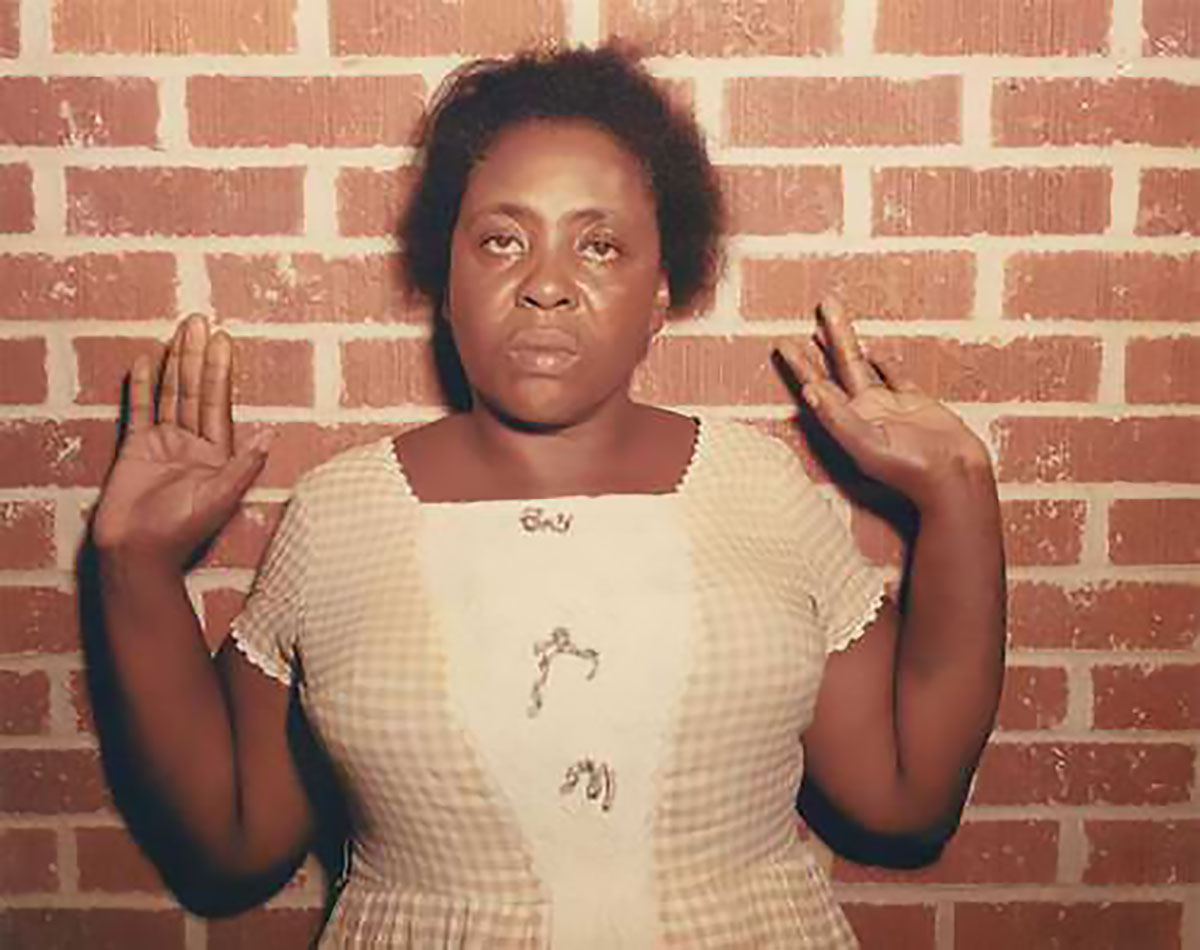
To write about the Winona beating as a discrete event is to risk misunderstanding it. What happened to Hamer was not simply a spontaneous outburst by a few “bad” men. It was the predictable product of a Jim Crow enforcement ecosystem: segregated travel, white-owned public accommodations, local police authority, county jails, and a political culture that treated Black voting as insurrection. Winona was a node in that ecosystem, not an exception. And Hamer was targeted not because she was famous—she was not yet the national figure she would become—but because she represented a particular kind of threat: a Black woman in Mississippi who had decided that political rights belonged to her and to her neighbors, and who was willing to organize for those rights in public.
The evidence base for Winona is unusually rich for an event designed to be obscured. There is Hamer’s own recorded recollection, preserved in archival-style transcripts; there are accounts assembled by the SNCC Digital Gateway; there are later institutional narratives from PBS’s American Experience and the Equal Justice Initiative’s calendar; and there are modern efforts in Mississippi to mark the site and formally acknowledge what occurred. Taken together, these sources do more than recount a beating. They reveal the logic of intimidation—how the state used arrest as a pretext, how humiliation was staged, how violence was delegated, and how survivors carried the injuries into the rest of their lives and into their public testimony.
The road to Winona: Voting rights work as a trigger for policing
By June 1963, Hamer had been in the movement for less than a year, but her transformation—from a sharecropper in Sunflower County to a voting-rights organizer—was already visible to the white power structure. In Mississippi, where discriminatory tests, economic coercion, and the threat of violence suppressed Black registration, organizing for the vote challenged not just a local election but the social order itself. As historian Keisha N. Blain has written in a later reflection on the Winona incident, the context was a state where only a small fraction of Black residents were registered because the machinery of suppression was both administrative and violent.
Hamer and other activists had been attending a voter education workshop out of state—sources commonly describe it as a week-long training meant to teach people how to navigate literacy tests and then teach others. In the American Experience framing and related accounts, these workshops were part of a strategy: build local capacity, create networks, and return home better equipped to confront the barriers county registrars and sheriffs used to keep Black citizens from voting.
On the return trip, the group traveled by bus, and the trip itself became a flashpoint. In the Jim Crow South, segregated travel was both customary and enforced, even when federal rulings had begun to outlaw certain segregated facilities in interstate travel. The SNCC Digital Gateway notes that despite Supreme Court rulings and federal actions that effectively integrated aspects of interstate travel, local law enforcement continued to police “whites only” spaces. That gap between federal principle and local practice mattered. It gave local officials room to treat civil rights travelers as violators, no matter what the law said, and it gave them a familiar script: “disorderly conduct,” “inciting,” “trespass,” “resisting,” the elastic charges that could justify detention and, inside the jailhouse, anything that followed.
When the bus reached Winona, accounts converge on a sequence that feels routine precisely because it was designed to be. Some members of the group attempted to eat at a local café and were refused service. Police arrived. Arrests followed. Hamer initially remained on the bus, but when she saw officers taking her colleagues, she got off—an act she later described as a moment when fear and reason gave way to urgency. In Blain’s account, she would later admit she “abandoned all reason” when she saw her friends being arrested. SNCC’s history emphasizes that she left the bus to defend the others despite warnings, and that she was then physically assaulted—kicked, shoved, handcuffed—and arrested.
The detail here is not incidental. Jim Crow power often relied on the transformation of ordinary actions into punishable offenses. A rest stop, a meal, a seat on a bus—these were the arenas where rights were tested because they were the arenas where white authority was most accustomed to being obeyed. For an organizer, those arenas were also where the movement demonstrated to local people that segregation was neither natural nor invincible. For police, this made even small acts intolerable: each act threatened to teach a lesson the state did not want taught.
The jail as theater: Intimidation made systematic
The Winona jail “nightmare,” as SNCC’s archive calls it, began almost immediately after booking. The county sheriff, according to June Johnson’s recollection, made the stakes explicit: you come to Winona from Greenwood, you will get “the hell whipped out of you.” The point was not only to punish; it was to send a message back along the organizing routes that connected small Mississippi towns. Greenwood was close enough to matter, and the movement’s network was visible enough that a sheriff could assume the story would travel. Terror, to be effective, had to be communicable.
Accounts describe activists being placed in different cells and then assaulted in sequence. The SNCC narrative is blunt: first, fifteen-year-old June Johnson was beaten with a studded leather strap until her dress was soaked with blood; then Annell Ponder was beaten with blackjacks, a belt, fists, and open palms. The violence was punitive, but also pedagogical. In Ponder’s recollection, officers sought submission—wanted her to say “yes, sir”—a reminder that the jail was a place where social hierarchy could be reasserted through ritualized degradation.
Then, according to multiple sources, Hamer was taken—or carried—into a cell with Black incarcerated men and ordered beaten. This feature of the assault is among the most morally revealing details of Winona, and among the most disturbing. Police did not merely beat Hamer themselves. They compelled Black men to do it, using the threat of punishment to conscript them into the violence. This method served several functions at once: it insulated white officers from direct responsibility; it inflicted additional psychological trauma by forcing victims to be harmed by people who were also oppressed; and it created a narrative fog—if the beating came from “inmates,” officials could imply it was not state violence but jailhouse chaos. In the Atlantic’s later recollection of the episode, this conscription is rendered with horrifying intimacy: the officers made one man lash her until he could not continue, then forced another to take his place.
Hamer herself would later call what happened in Winona “the most horrifying experience” of her life, language SNCC preserves and other sources echo. In that phrase is both testimony and analysis. A beating is, tragically, a known tool in the civil rights era. But Hamer’s word “horrifying” suggests a layering beyond bodily pain: the forced exposure, the coercion of other Black people, the sense that humiliation was part of the design. In the Atlantic account—presented through a participant’s remembered voice—Hamer later identified the lifting of her skirt as “the worst part.” Whether one relies on SNCC’s summary, Blain’s contextual essay, or personal recollection transcripts, the pattern is consistent: the violence sought to make her feel not only injured, but invaded.
In an archival interview transcript preserved at CRMvet, Hamer recounts details that are easy to overlook but hard to forget: the begging for cold water, the brief kindness of the jailer’s wife and daughter who brought ice when the men were out, and Hamer’s own decision to “talk so nice and act so dumb” that she could learn names and details without the men realizing she was collecting evidence. It is one of the most important counterpoints to the image of victims as passive. Even in the aftermath of torture, she is thinking like an organizer and a witness, trying to build a record in a place designed to erase records.
That same transcript contains another key feature of the Winona story: the fog of information. Hamer describes hearing screams in the night and later learning that Lawrence Guyot was there too—another organizer who, in some accounts, attempted to intervene or bail others out and was then arrested himself. The jail worked not just by inflicting pain, but by isolating people, preventing them from knowing who else was detained, what charges existed, who outside was aware, or whether release was possible. Even the order of assaults mattered: by beating some people first, officers could use their screams to terrorize others still waiting.
Injuries that became
part of the biography
The physical consequences of the Winona beating followed Hamer for the rest of her life. Blain’s Washington Post essay notes kidney damage, a blood clot in her eye, and injuries that worsened a childhood limp—an embodied ledger of state violence carried into every later speech, every later march, every later moment she stood at a podium and demanded to be treated as a “first-class citizen.” The injuries are not simply medical details; they are part of the movement’s material history. When Hamer spoke, she did so with pain that had been engineered as a deterrent.
To understand why those injuries mattered politically, it helps to remember what the civil rights struggle demanded of bodies. Organizing in Mississippi meant constant travel, mass meetings, canvassing, and the willingness to appear again and again in public spaces where law enforcement had already shown what it would do. A limp worsened by violence was not just a personal hardship; it was a constant reminder, to her and to those around her, of the cost of civic participation. Yet Hamer continued. This is one reason her later testimony became so searing: it was not abstract indignation. It was experiential truth.
In later years, writers and historians would use Winona as a hinge. The episode appears in biographies, institutional histories, and in the way the movement’s own veterans tell the story of Mississippi. In a 2025 piece by Mississippi Today marking the date, the beating is described as involving multiple activists and again emphasizes the tactic of bringing in Black inmates to torture Hamer, alongside her own description of the violence as “the most horrifying experience” she had endured. The continuity between contemporary journalism and archival accounts underscores that the core facts have held: arrest at a bus stop, refusal of service, police involvement, detention, forced beating, long-term injury.
There is also a more difficult dimension: the question of sexual violence. Some recent scholarship and biographical work argues that Hamer was sexually assaulted in Winona, beyond the forced exposure described in several accounts. An Oxford Academic chapter on Winona in Kate Clifford Larson’s Walk with Me states directly that Hamer was raped, framing it as part of a broader pattern of sexualized sadism used to degrade victims. Larson has also written publicly about the ethical challenge of narrating Hamer’s trauma—balancing what Hamer said in public with private records uncovered later and the need to respect what victims often choose not to disclose. This claim is significant and should be handled with care: it is advanced in a specific scholarly-biographical context and is not always present in earlier mainstream summaries. But its presence in contemporary scholarship also fits the broader historical record of how sexual violence functioned as a tool of racial terror in the Jim Crow South.
A responsible journalistic approach, then, is to name what is well-attested across many sources—the forced beating orchestrated by police, the coercion of incarcerated men, the physical injuries that endured—and to report the scholarly claim about rape explicitly as a claim made in recent biographical research, without overstating what any single public account proves. Hamer’s own emphasis, in some retellings, on the humiliation of her skirt being lifted already signals that sexual degradation was part of the assault’s design, whether or not every element was spoken publicly at the time.
From a jail cell to the national stage
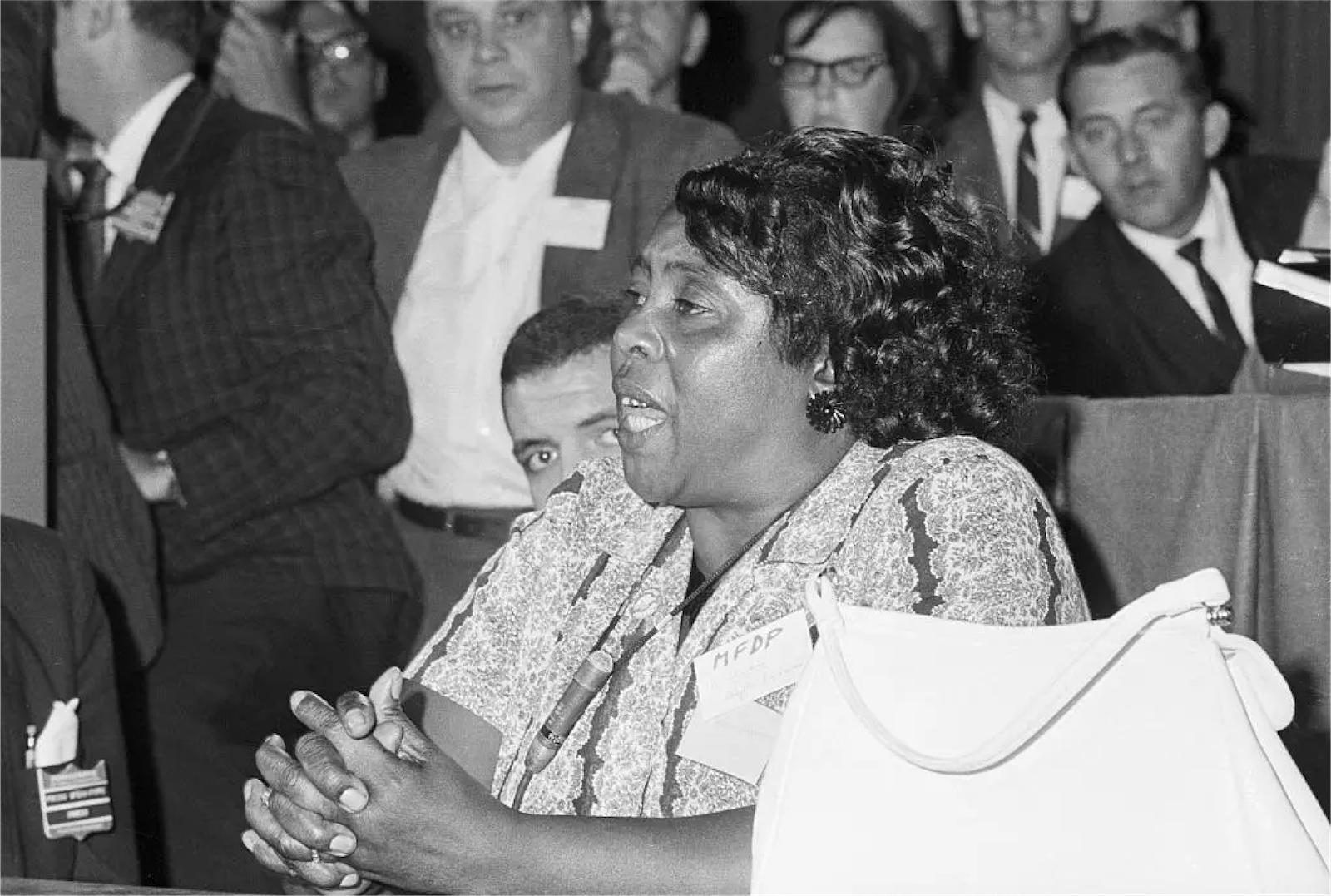
Winona did not end with the beating; it echoed into the movement’s strategy and into Hamer’s public identity. One of the reasons her later 1964 testimony before the Democratic National Convention’s Credentials Committee electrified audiences was that it fused personal suffering with systemic indictment. In PBS’s American Experience framing, Hamer spoke from memory about her eviction from the plantation where she had worked and about the brutal beating in the Winona jail. She concluded with a line that became one of the era’s moral challenges: “If the Freedom Democratic Party is not seated now, I question America.” And then, more pointedly, she asked whether this could be “the land of the free and the home of the brave” if people had to live with constant threats simply for wanting to live “as decent human beings.” (PBS)
The politics around that testimony illuminate how dangerous truth-telling was considered. American Experience recounts how President Lyndon Johnson, worried about alienating Southern Democrats, called an impromptu press conference in an effort to interrupt network coverage of Hamer’s testimony—an extraordinary measure that effectively acknowledged her power. The effort did not work; her testimony aired later, often in evening broadcasts, and reached an even larger audience. The state violence that had been engineered to silence her thus became part of what amplified her.
In other words, Winona was not only a site of harm. It was also, unwillingly, a site of political formation. Hamer’s voice—often described as booming, church-trained, unignorable—carried the authority of someone who had survived what she described. When she spoke of America’s ideals, she did so not as rhetoric but as a direct confrontation: here is what your system does to a citizen who tries to vote.
Why Winona matters now: Memory, markers, and unfinished accountability
For decades, Winona was known in movement circles and in scholarship, but the town itself did not formally acknowledge the incident in the ways American communities have begun to acknowledge other civil rights-era violence. In 2022, that began to change. Blain’s essay describes the city declaring June 9 “Fannie Lou Hamer Day” and unveiling a Mississippi State Historical Marker recognizing the violence inflicted on Hamer and other activists. The essay names local organizer Vickie Roberts-Ratliff, historian Davis W. Houck, and others affiliated with Land Literacy and Legacy as key forces behind these steps. A separate site associated with Fannie Lou Hamer’s America describes the marker unveiling and notes attendance by Hamer’s daughter Jacqueline Hamer Flakes and by Euvester Simpson, who had shared a cell with Hamer at age 17.
It is tempting to treat a marker as closure. It is not. A marker is a statement about what a community is willing to admit publicly, which is different from what it is willing to repair. But admission still matters, particularly in an era when public officials in many places contest how racism should be taught or remembered. Blain frames Winona’s belated acknowledgment as “symbolic yet significant,” a first step that validates dignity and can inspire further reckoning. The marker, in this reading, is not a monument to completed justice but a sign that silence is no longer the only official posture.
This is where the Winona story becomes not only a civil rights history but a journalism story: how communities decide what counts as history, who gets believed, and when official acknowledgment arrives—often long after the victims have borne the costs. Hamer herself lived only until 1977. She spent the years after Winona turning trauma into testimony and testimony into organizing—co-founding the Mississippi Freedom Democratic Party, challenging political legitimacy, advocating for economic justice. But she did so with injuries and with the knowledge that the people who harmed her were protected not only by law but by community norms that treated anti-Black violence as order-keeping.
Modern retellings of Winona also intersect with contemporary language around police brutality and racial justice. The Guardian, in a 2020 piece presenting an excerpt from a graphic history of voting rights, explicitly situates Hamer’s experience alongside present-day protests against police brutality, treating her story as part of a lineage of resistance to state violence. The frame is contemporary, but the underlying historical point is accurate: Winona demonstrates that voting rights work and police violence were deeply entangled in Mississippi. If the vote was power, policing was used to keep that power out of Black hands.
The ethical problem of telling torture stories
There is always a risk in writing about torture and racial violence: the risk of sensationalism, the risk of reducing a person to the worst thing done to them, the risk of re-inflicting harm through description. The Winona story demands detail because the details are what reveal intent. But it also demands restraint because Hamer’s life cannot be collapsed into a beating, even one that permanently altered her body.
One way to navigate this is to stay disciplined about purpose. The purpose of recounting Winona is not to rehearse gore; it is to show how a local state apparatus worked, how it used humiliation as policy, and how a survivor transformed private suffering into public challenge. Hamer’s own practice supports that approach. In speech after speech, she used the facts of her experience to indict the system, not to solicit pity. She was explicit that she wanted citizenship and structural change. Even a Washington Post book review excerpt from the early 1990s preserves the tone: the beating changed her, but it did not end her; she emerged determined to register people, to change the state’s government, to become what she called a “first-class citizen.”
Another ethical point is accuracy about what we know. The core sequence—arrest at Winona, detention, forced beating, long-term injury—is corroborated across multiple reputable sources, including movement archives and major public-history institutions. The more contested or newly surfaced claims—especially around rape—should be attributed precisely to the scholarship making them, without laundering them into “everyone knows” territory. That is not hedging; it is journalistic honesty, and it respects the difference between public testimony, archival discovery, and later interpretive work.
What Winona reveals about power
The most unsettling lesson of Winona is not simply that police beat an organizer. It is that the beating appears to have been staged as an instrument of governance. Consider the components: a trivial precipitating incident, a rapid escalation into arrest, separation into cells, sequential assaults, coerced participation by incarcerated Black men, and an aftermath in which the victim carried permanent injuries. This is not the pattern of a bar fight. It is the pattern of a system communicating a warning.
Winona also reveals something about how white supremacy managed optics. Forcing Black inmates to beat Hamer did more than protect white officers from direct blame. It also weaponized the social vulnerabilities created by the carceral system itself. In a society where Black people were over-policed and under-protected, incarceration became a tool not only for removing people from public life but for turning them into instruments of violence against others. The state could then claim distance from the harm it orchestrated.
And yet, Winona also reveals the limits of terror. The assault did not stop Hamer. It did not stop the movement. In The Atlantic narrative of Mississippi organizing, the rage that follows the beating becomes part of the movement’s internal struggle: how to keep people alive, how to resist the pull toward vengeance, how to continue organizing after the state demonstrates it will violate every moral boundary. In that struggle, Hamer’s survival mattered. It meant the state’s warning could be reinterpreted: instead of “this is what happens if you try,” it could become “this is what the state does when you try—and why you must keep trying.”
More great stories

Afro Sheen, Wall Street, and the Architecture of Black Possibility
July 6, 2026
No Comments
The Fire Inside the Fourth
July 5, 2026
No Comments