

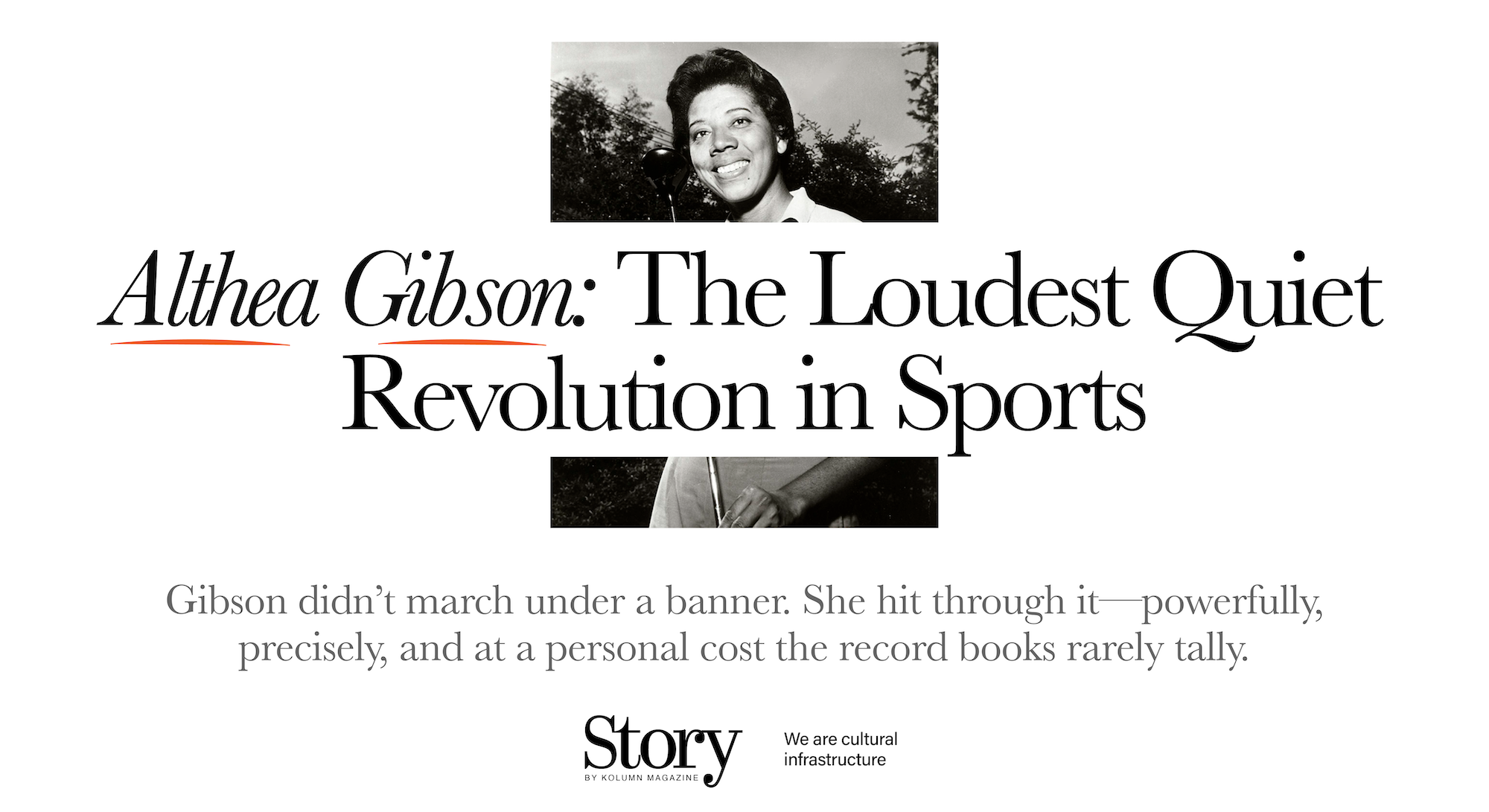
Her life is a study in what America demands from pioneers: be extraordinary, be grateful, be quiet, be palatable. And then, after you’ve changed the world, accept that the world may not change enough to keep you safe.
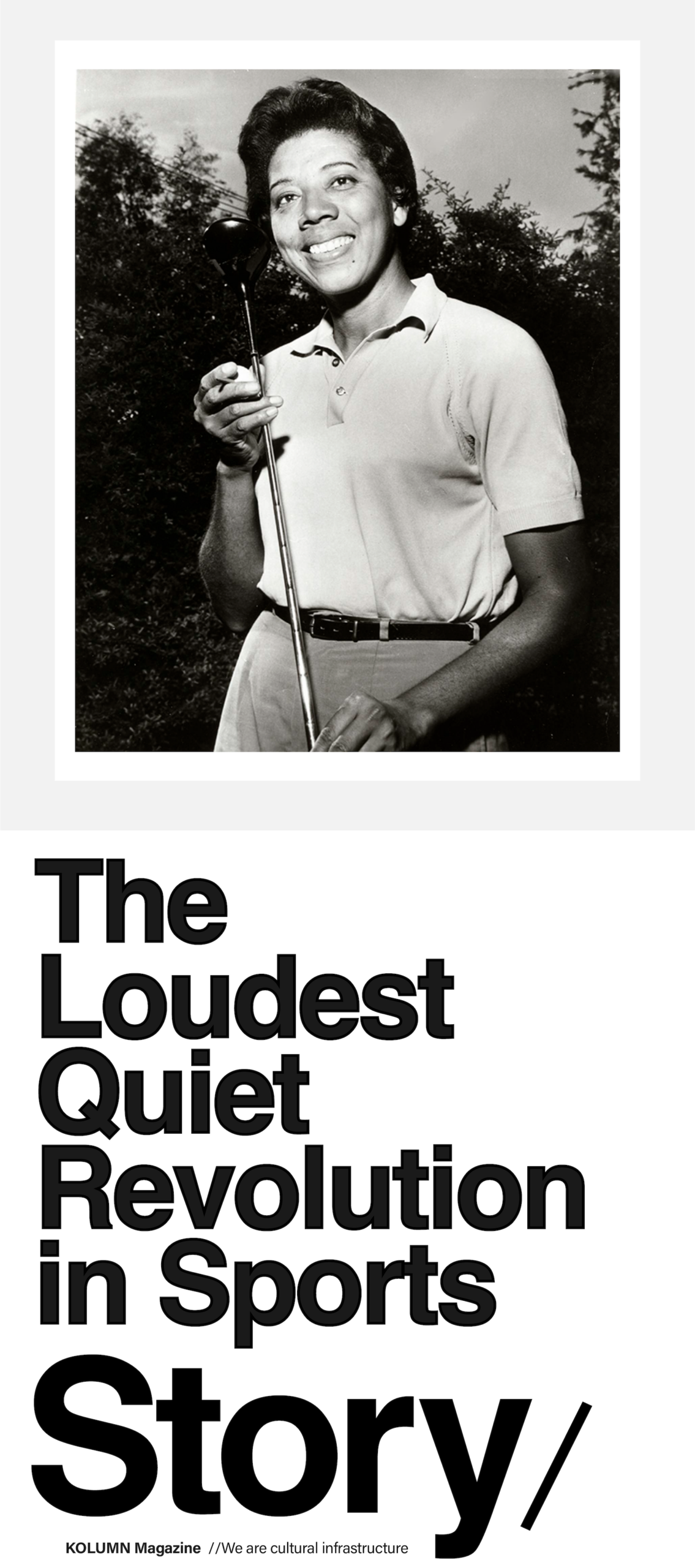
Her life is a study in what America demands from pioneers: be extraordinary, be grateful, be quiet, be palatable. And then, after you’ve changed the world, accept that the world may not change enough to keep you safe.
By KOLUMN Magazine
The measure of a first
On a summer afternoon in London in 1957, the stage looked like it always had: clipped grass, white dresses, controlled applause, and a culture of decorum that insisted it was simply “sport.” But when Althea Gibson walked into the final at The Championships, Wimbledon, the theater of tradition was also a theater of race—whether the All England Club admitted it or not. Tennis in the mid-century Atlantic world liked to imagine itself as a meritocracy, and yet it had been curated, protected, and policed as a private garden. Gibson’s presence didn’t merely introduce a contender. It introduced a contradiction: if the sport was as fair as it claimed, why had it taken 80 years for a Black champion to arrive?
She won anyway.
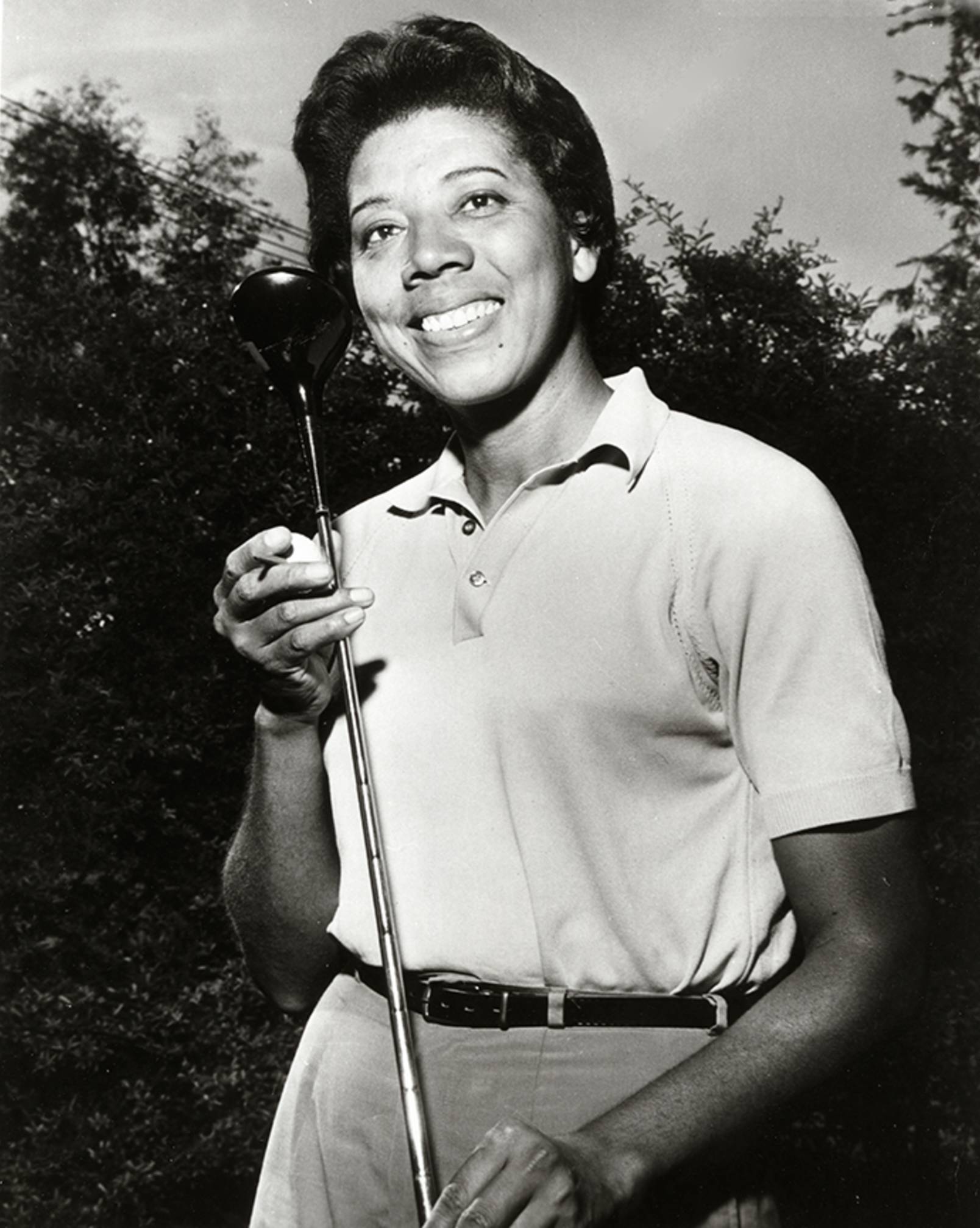
That victory—followed by another Wimbledon singles title, and back-to-back championships at U.S. National Championships—is the headline version of her life: first Black champion here, first Black champion there, a gauntlet of “firsts” that read like a key to a locked house. But the longer story, the one that survives beyond anniversaries and ceremonial tributes, is more complicated. Gibson’s achievement was athletic, certainly—she possessed the kind of power and reach that could redraw a match in a handful of points. Yet it was also sociological. She proved that the barrier was never about capability. It was about access, money, networks, and a particular kind of American comfort that required Black excellence to arrive only on invitation, and only under strict emotional terms.
Even her admirers sometimes cast her as a symbol before they treated her as a person: a “Jackie Robinson of tennis,” a shorthand that flattened the specific contours of her experience. If Robinson’s battle was fought in the daily grind of a team sport, Gibson’s was carried in the isolating geometry of a singles court, where every error looked like proof and every triumph was reinterpreted as exception. Decades later, writers would still return to the same essential paradox: Gibson cracked the ceiling, but the building remained intact.
Her life is a study in what America demands from pioneers: be extraordinary, be grateful, be quiet, be palatable. And then, after you’ve changed the world, accept that the world may not change enough to keep you safe.
From Silver, South Carolina, to Harlem’s asphalt courts
Gibson was born in 1927 in rural South Carolina and raised, in large part, in Harlem—an arc that mirrors the Great Migration itself, the movement of Black families chasing opportunity northward while carrying the realities of segregation in their luggage. The Harlem she entered was crowded, improvisational, loud with street life and possibility. It was also a place where play could become training without anyone calling it that.
Accounts of her early relationship to tennis often begin not with a proper racket but with a street version of the game—paddle or stick-ball-adjacent, a condensed sport adapted to limited space and money. The point is not nostalgia. It’s origin economics: Gibson’s athletic imagination formed in a world that did not assume she would ever stand on manicured grass with a royal trophy in her hands. She learned competition the way many city kids do—fast, public, a little feral, with pride on the line.
Her physical gifts were unmistakable early on. At 5’11”, she had reach and leverage that could turn a serve into a weapon. But talent, especially for a Black girl in the 1940s, was not a passport. The gatekeepers of elite tennis—the clubs, the associations, the invitation lists—were not scouting Harlem. They were reproducing themselves.
Gibson’s first real circuit, and first real community in the sport, was the American Tennis Association, which had been founded in 1916 because Black players were excluded from the mainstream structures of American tennis. The ATA tournaments were not mere consolation prizes; they were parallel institutions, an alternative infrastructure built to hold Black excellence when the primary system refused it. Gibson won there, repeatedly, developing the match toughness and travel habits that would later help her survive hostile crowds and cold shoulders.

What’s often missed is how much psychological education the ATA provided. In a segregated sport, a Black champion wasn’t just trying to win points. She was trying to remain intact—focused enough to perform, but guarded enough not to be broken by the daily humiliations surrounding the performance.
The mentors who saw what the sport refused to see
No barrier-breaker crosses alone. Gibson’s path into the broader tennis world ran through a small network of mentors and patrons who understood, sometimes better than she did at the time, that the issue was never her game. It was the locked doors.
Among the crucial figures was Dr. Robert Walter Johnson, a Black physician and coach whose home and program became a kind of incubator for Black tennis excellence in the era of segregation. He trained and supported players who would otherwise have been stranded outside the mainstream pipeline; his role in shaping Black champions is difficult to overstate, even when histories reduce him to a footnote.
Mentorship, in Gibson’s case, also meant managing not just technique but presentation. Tennis, particularly then, was as much a social performance as an athletic one. For Black players, “how you carried yourself” could be weaponized—used to justify exclusion or to punish noncompliance. Gibson’s power on court came naturally; the etiquette demanded off court did not. Writers and obituarists noted the ways she was expected to be “polite” and “unassertive,” as if the sport required her temperament to be reassuring in order to tolerate her excellence.
That expectation created a trap. A Black woman who expressed anger risked being labeled threatening; one who masked it risked being labeled cold or ungrateful. Either way, she was rarely allowed the full range of normal competitive emotion. Gibson learned, sometimes through painful trial, that in her case the match extended beyond the baseline.
Integration by invitation: Forest Hills, then the world
The breakthrough that placed Gibson in the national spotlight arrived in 1950 when she became the first Black player permitted to compete at the U.S. national championships at Forest Hills—an event that would later be known as the U.S. Open, but was then still deeply tied to the club world and its social exclusions.
The story of “permission” matters. Gibson didn’t simply enter because she was the best. She entered because the system finally decided it could no longer justify keeping her out—after advocacy from within tennis and after her dominance made the exclusion look increasingly ridiculous. One widely cited example is the public push by former champion Alice Marble, who argued that if Gibson was good enough to win within the segregated Black circuit, she was good enough to compete on the country’s biggest stages.
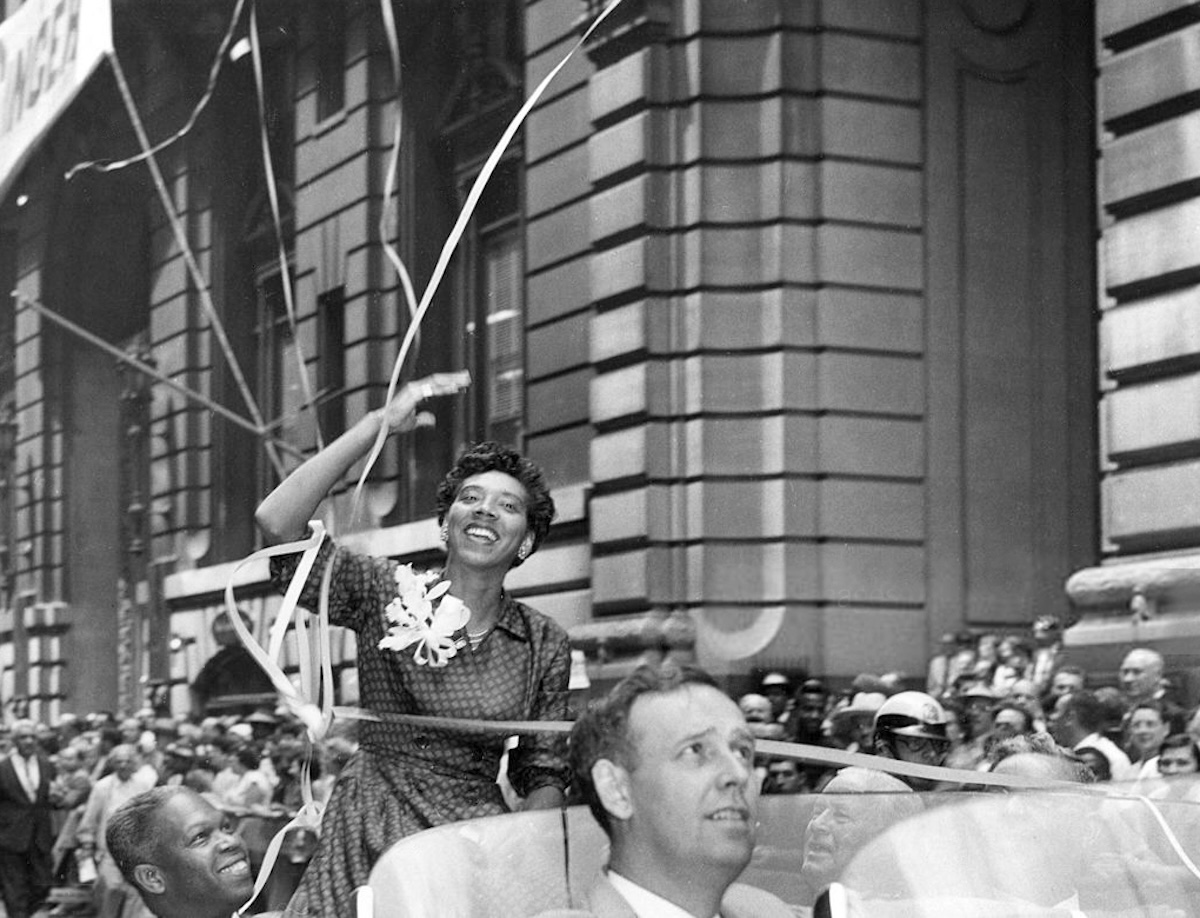
From there, the sequence of milestones reads like a rapid assault on tennis’s most protected symbols. She played at Wimbledon in 1951, another first. She won the French Championships in 1956, becoming the first Black athlete—male or female—to win a Grand Slam singles title. She then took Wimbledon and the U.S. nationals in 1957, and repeated both in 1958.
But it’s worth pausing on the fact that each of these “firsts” required her to step into rooms where many people did not want her, then behave in ways that reassured them, then win under pressure that was not shared equally by her opponents. That is not simply competitive stress. It is the stress of representation—the sensation that your performance will be used as evidence for or against an entire group, and that the crowd is evaluating your right to be present.
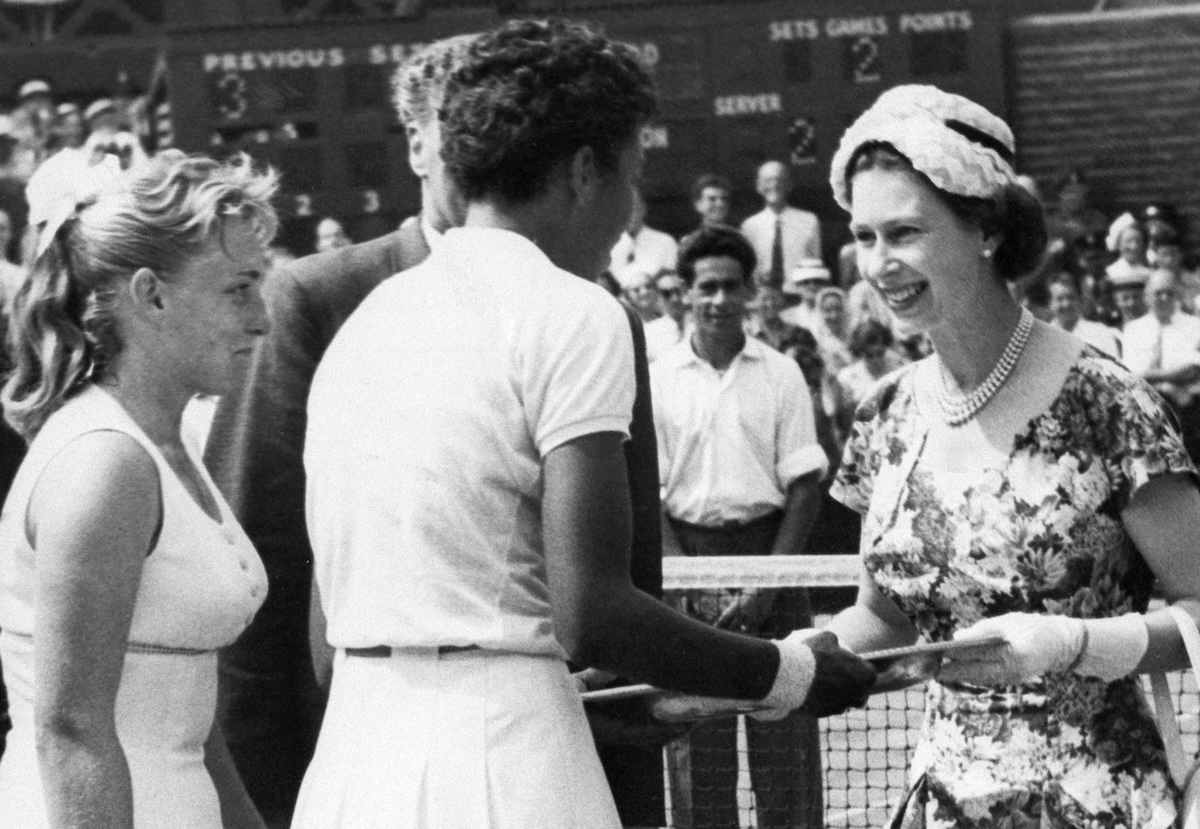
In 1957, when she won Wimbledon and received the trophy from Queen Elizabeth II, the moment became instantly symbolic, a collision of empire, tradition, and a Black woman’s athletic authority. Accounts would later quote Gibson reflecting on the distance between that handshake and the segregated bus seating she’d known in America. Even if the exact phrasing shifts in retellings, the meaning remains stable: she had traveled further than the sport had intended to allow.
Dominance, not novelty
Too often, pioneers are remembered as anomalies—great “for their time,” important “because they were first.” Gibson’s record refuses that softening. She wasn’t a ceremonial integrator squeaking into quarterfinals; she was a champion who, at her peak, could overwhelm fields.
Across her Grand Slam career, she won 11 major titles—five singles, five doubles, one mixed doubles—an accumulation that places her among the sport’s elite of any era. She was ranked world number one, and she earned Associated Press Female Athlete of the Year honors in 1957 and 1958.
Her game, described by contemporaries as powerful and athletic, challenged the era’s expectations of “proper” women’s tennis. In the 1950s, women’s sports were often framed through the language of grace and restraint; Gibson played with force. She served big, attacked points, used her reach. The same traits that would later be celebrated as modern athleticism could, in her time, be criticized as unfeminine—another example of how she arrived before the cultural vocabulary had caught up with what she represented.
And yet, in the mainstream imagination, she was still treated as an exception who proved the rule rather than an athlete who demanded the rule be rewritten. That’s why some of the strongest recent writing about her insists that Gibson’s legend “deserves to be one of our biggest”—a corrective to the way American sports memory can shrink Black pioneers into a single commemorative sentence.
The loneliness of a representative
Gibson came up in an era when Black public figures were often drafted into respectability politics as a condition of access. The assignment was familiar: be excellent, but don’t embarrass the institution; be grateful, but don’t be demanding; accept hostility without reflecting it back.
This helps explain one of the enduring tensions in her story: Gibson did not always want to be a symbol. She wanted to play. She wanted to win. She wanted, as many competitors do, to be judged by the narrow math of points and titles. But the culture around her refused that narrow math. It insisted on metaphor.
Some accounts note that she was compared to Jackie Robinson, but also that she resisted the idea that her primary purpose was to serve as an “ambassador.” That resistance has sometimes been misread as aloofness. It may be more accurate to see it as self-preservation. When you are made into a symbol, people feel entitled to your emotions, your politics, your gratitude. Refusing that entitlement is, in its own way, a form of autonomy.
And yet the symbolic pressure never let up. When she won, it was history. When she lost, it was evidence. When she expressed frustration, it could be interpreted as attitude. Even her body could be policed by rumor and scrutiny—an old pattern in women’s sport, intensified for Black women. That kind of surveillance is not incidental; it is one of the informal tools by which institutions protect themselves.
The economics of excellence: Trophies without security
A modern athlete who wins Wimbledon becomes a global brand. In Gibson’s era, the commercial ecosystem was far smaller, and for Black women it was smaller still. Amateur rules restricted direct earnings, and even when she turned professional, the endorsement and appearance opportunities that flowed to white players did not reliably flow to her.
Gibson herself wrote, memorably, about the way barriers could reappear behind you—how she could beat players on court and still watch them receive invitations and financial opportunities denied to her. The insight is brutal because it dismantles the comforting myth that winning settles the argument. Winning can open a door. It does not guarantee the hallway is safe, or that there will be a room prepared for you on the other side.
Later Atlantic writing about Gibson has emphasized this unfinished dimension of her legacy—how her breakthrough did not automatically create a sustained pipeline for Black tennis players, and how exclusion can mutate rather than disappear. Even when the sport became formally open, it remained informally expensive, clubbed, and networked in ways that preserved old hierarchies.
This is one reason recent biographers and reviewers have returned to Gibson with fresh urgency, documenting not only the victories but the structural forces that shaped her post-championship life. A pioneer can be celebrated while still being denied the material stability that celebration implies.
Life after tennis: Reinvention in a country that prefers a single story
By the early 1960s, Gibson’s tennis dominance had receded, and the question of “what next” arrived with particular sharpness. America loves a champion’s prime because it is easy to package. It is less attentive to the complicated middle years: the period when an athlete is still famous but no longer centered, still recognized but not protected.
Gibson wrote a memoir, I Always Wanted to Be Somebody, in 1960, a title that reads now like both ambition and indictment—an acknowledgment of the hunger that drove her and the social forces that kept trying to make her small. She also did what many athletes of her time did to make money: exhibitions, appearances, work that leveraged fame into income. One account notes that she toured with the Harlem Globetrotters, playing exhibition tennis matches before games—a reminder that even a Wimbledon champion sometimes had to hustle in a way the sport’s myths do not mention.
The point is not to romanticize struggle. It is to be honest about the market value America assigns to different kinds of champions—and about how quickly institutional attention moves on once the pioneer has served her historical purpose.
The second barrier: Golf and the LPGA
If tennis was the first locked house, golf was the second—and in some ways the more economically significant. In 1964, Gibson became the first Black woman to join the LPGA Tour.
Here, again, the headline is easy: first Black member. The lived reality was harsher. Golf’s culture was (and remains) deeply intertwined with country clubs, sponsorships, and corporate hospitality—systems that, in mid-century America, were not built for Black women. The LPGA itself has documented Gibson as “almost forgotten” in the sense that her dual-sport barrier-breaking has often been reduced to her tennis achievements alone.
In golf, she faced familiar obstacles: difficulty accessing practice facilities and tournaments, difficulty attracting sponsors, the grind of travel and entry into spaces where she was not welcomed. And yet she persisted, in part because golf offered something tennis increasingly could not: a potential professional livelihood in a sport where the amateur-era restrictions of tennis had limited how champions could earn.
Word In Black coverage of golf history places Gibson among the lineage of Black women golfers and champions, a connective tissue that matters because it frames her not as a solitary miracle but as part of a longer continuum of Black athletic striving in exclusionary sports.
Public memory: Statues, quarters, and the politics of belated honor
A telling sign of Gibson’s place in American memory is the timing of her honors. Many arrived late—after the culture had already benefited from what she made possible.
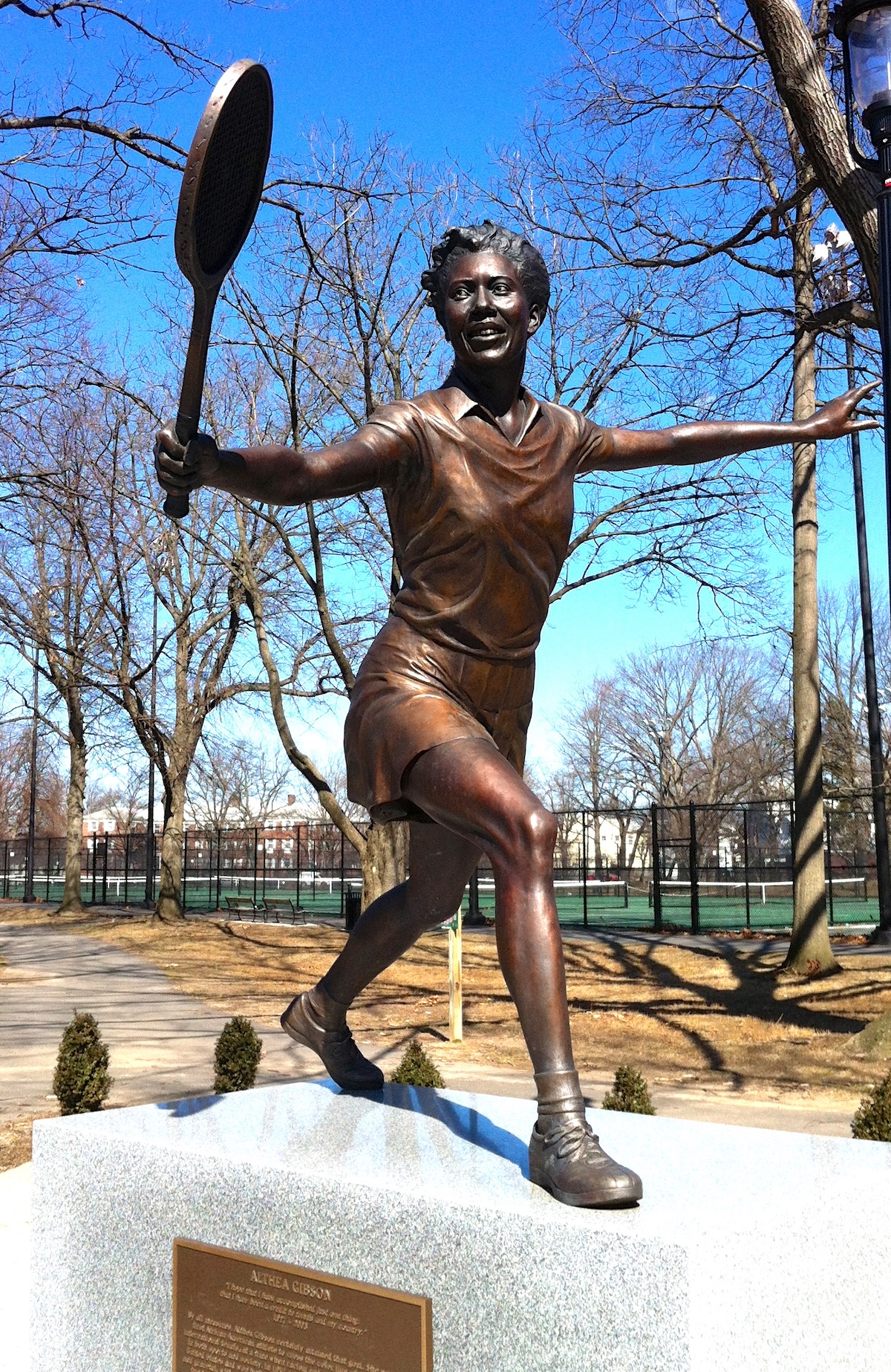
In 2019, a statue honoring her was unveiled at Arthur Ashe Stadium, a moment widely framed as long-overdue recognition. In 2025, the USTA and the U.S. Open mounted a broad celebration around the 75th anniversary of her breaking the color barrier at the U.S. nationals, folding her image into tournament branding and events. That same year, the Smithsonian highlighted her selection for the American Women Quarters program, underscoring the way her story is now being integrated into national iconography.
Belated honor is not meaningless—statues and coins can educate, can restore, can re-rank a life in the public imagination. But belated honor also raises a harder question: why did the recognition take so long? And what does it say about a society that can applaud a pioneer at the moment of triumph while failing to build a durable support system around her afterward?
The Washington Post, reviewing recent biographies, argues that Gibson’s legend is under-scaled in our sports culture—that we have not made enough room for her in the pantheon, perhaps because her era predates television saturation, perhaps because her personality did not conform to a convenient narrative, perhaps because America has a habit of remembering Black pioneers only when it needs to tell a story about progress.
KOLUMN Magazine, in reflecting on the meaning of “the first open” and what tennis calls openness, places Gibson as a necessary precedent—a figure who arrived before the sport learned how to tell the truth about its own exclusions. (KOLUMN Magazine) The piece is less about nostalgia than about infrastructure: what we choose to build after a barrier is broken, and what we pretend is solved once a door is cracked.
The inner life behind the milestones
There is a temptation, when writing about trailblazers, to focus on accomplishments until the subject becomes invulnerable. Gibson’s life resists that treatment. She was tough—she could not have survived otherwise—but toughness is not the same as ease, and dominance is not the same as belonging.
Obituaries and profiles often mention a certain reserve, a guardedness. It’s possible to read that as personality. It’s also possible to read it as strategy. When you are scrutinized for how you sit, speak, celebrate, and grieve, you learn to keep parts of yourself out of reach. You develop a public face that can endure strangers’ entitlement.
And yet glimpses of her humor and exuberance appear in more recent writing, pushing back against the frozen, purely symbolic Gibson. That matters because the pioneer narrative can become a kind of prison: an endless loop of firsts and barriers that leaves no room for the ordinary complexity of being human.
To write about Gibson ethically is to hold both truths. She did reshape tennis history. She also lived inside a country that did not reliably reward the people who reshape it—especially when those people are Black women.
Death, and what followed
Gibson died in 2003. The obituaries emphasized her athletic breakthroughs and the segregation she overcame, but even in death the framing often suggested an ending that was too neat: barrier broken, story complete.
In reality, her legacy has continued to evolve in the public sphere precisely because the questions she raised remain unresolved. Who gets access to “elite” sports? Who is welcomed, and who is merely tolerated? How does a pioneer sustain a livelihood when institutions celebrate the symbolism of her presence more than the material conditions of her life?
The renewed attention—statues, tournament tributes, national programs—suggests that tennis and America are still catching up to what she did.
What Gibson made possible—and what she didn’t get to see
Modern tennis is filled with images that would have seemed impossible in 1950: Black women headlining prime-time matches, shaping style and culture, commanding endorsements, speaking openly about racism in the sport and expecting to be heard. Gibson did not create that world alone, but she is one of its essential architects.
The danger is to treat her as merely the preface to later greatness. Gibson is not valuable because she came before other stars. She is valuable because she was great—full stop—and because she proved that the old exclusions were never about sport. They were about power.
When the U.S. Open devoted major attention to her legacy in 2025, the celebration implicitly acknowledged a truth that would have mattered to her in real time: you cannot build a credible story of American tennis without her at the center. The same can be said of American sport more broadly. She belongs not on the margins of history, invoked only during Black History Month or milestone anniversaries, but in the permanent architecture of the canon.
Gibson’s life, viewed whole, reads like a set of overlapping American arguments. About segregation and the polite fictions that sustained it. About class and the way “amateur” often meant “privileged.” About gender and the narrow definitions of femininity imposed on women athletes. About fame and the difference between applause and care. About what it costs to be first, especially when you are expected to be first without complaint.
She once stood on grass at Wimbledon and accepted a trophy from a queen. She also spent years fighting for ordinary dignity in a country that preferred her as a symbol rather than a complicated person. That is not a contradiction unique to her. It is a pattern. Her achievement is that she broke through it anyway—and left the door open behind her, even when the institutions tried, again and again, to swing it shut.