

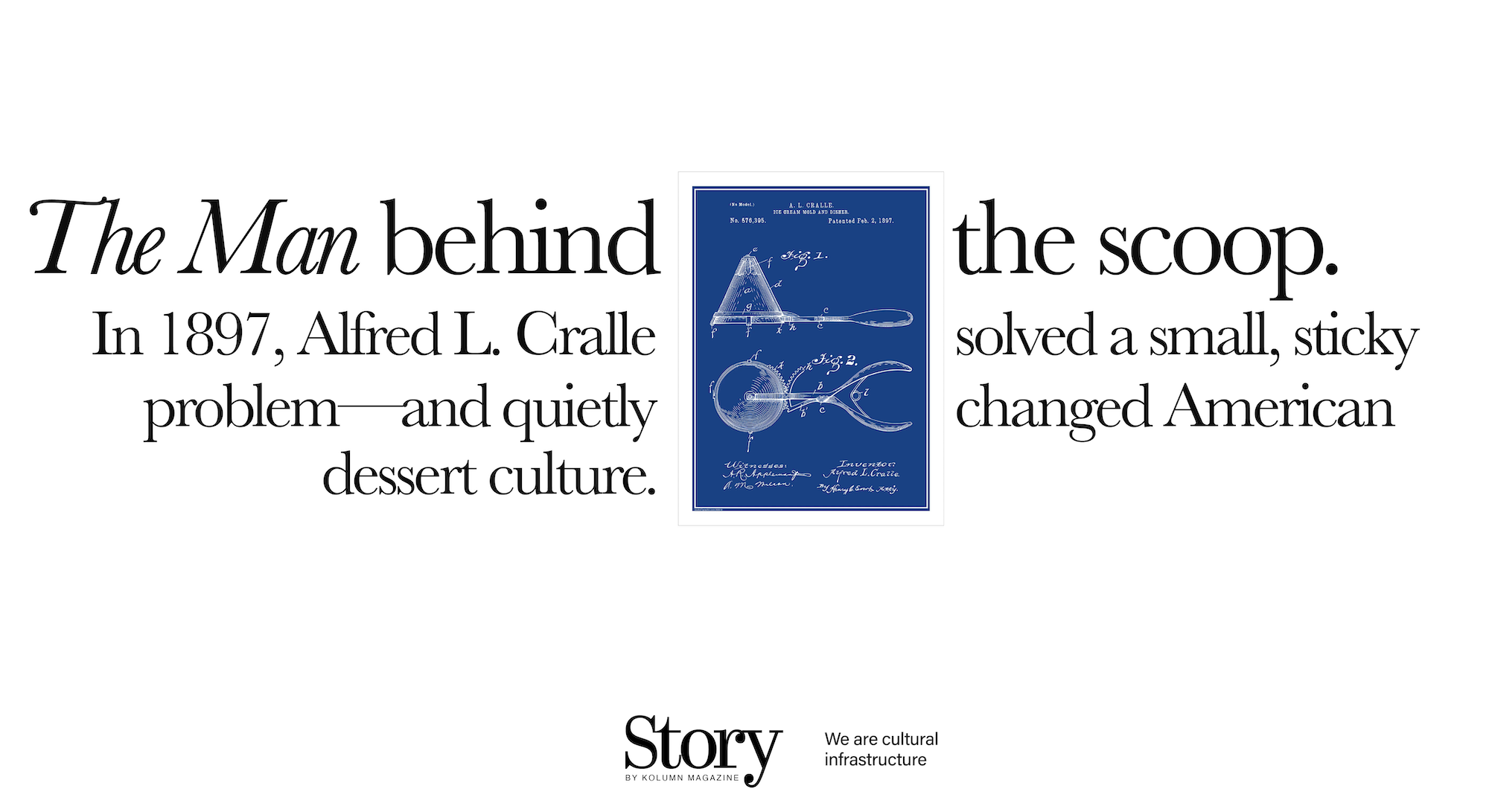
In the architecture of everyday life, there are inventions so common they become invisible.
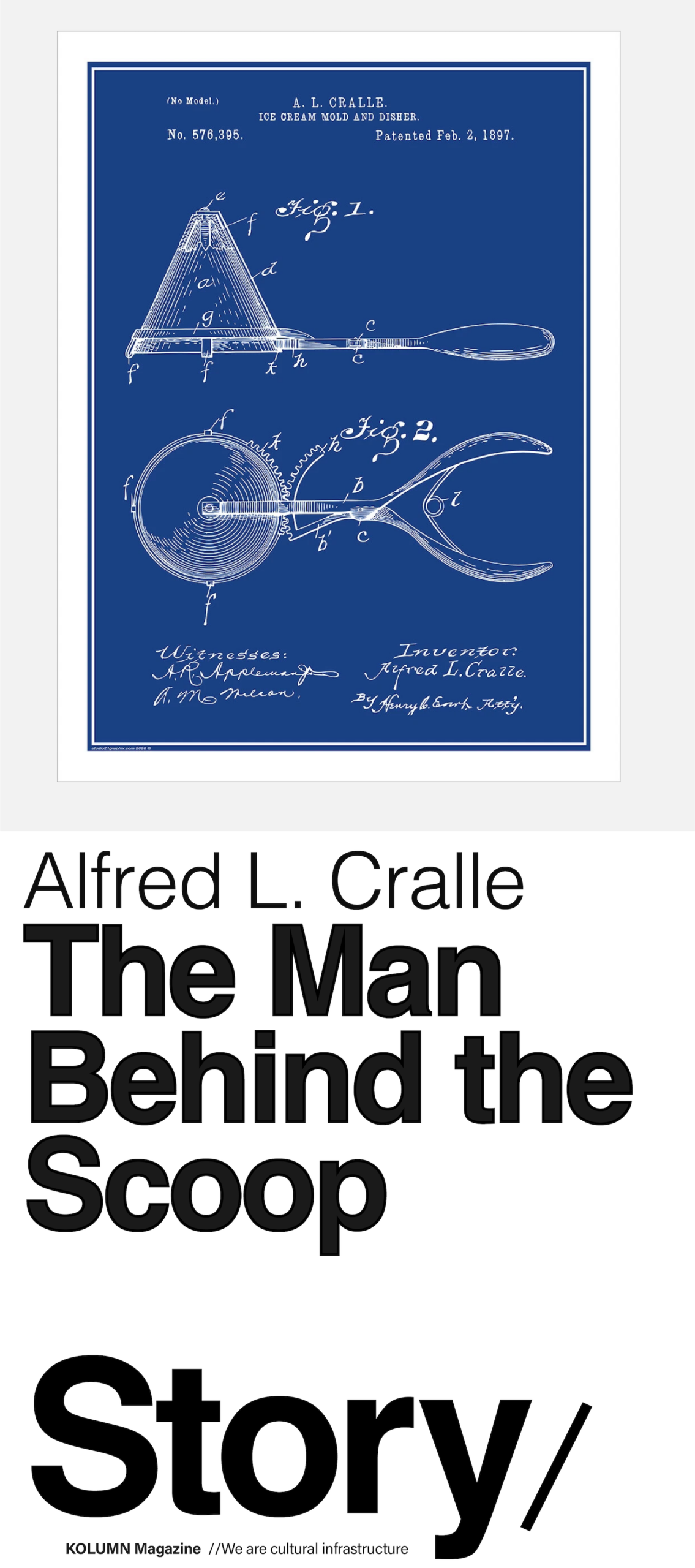
In the architecture of everyday life, there are inventions so common they become invisible.
By KOLUMN Magazine
We notice common inventions only when they’re missing—when the drawer is empty, when the kitchen is improvised, when the ritual can’t quite begin. The ice cream scoop is one of those objects: a small levered instrument that turns a stubborn block of frozen sweetness into something neat, portioned, and shareable. It belongs to summer evenings and diner counters, to birthday parties and cafeteria lines, to the muscle memory of home cooks. It is, in other words, a piece of American infrastructure—culinary, commercial, emotional.
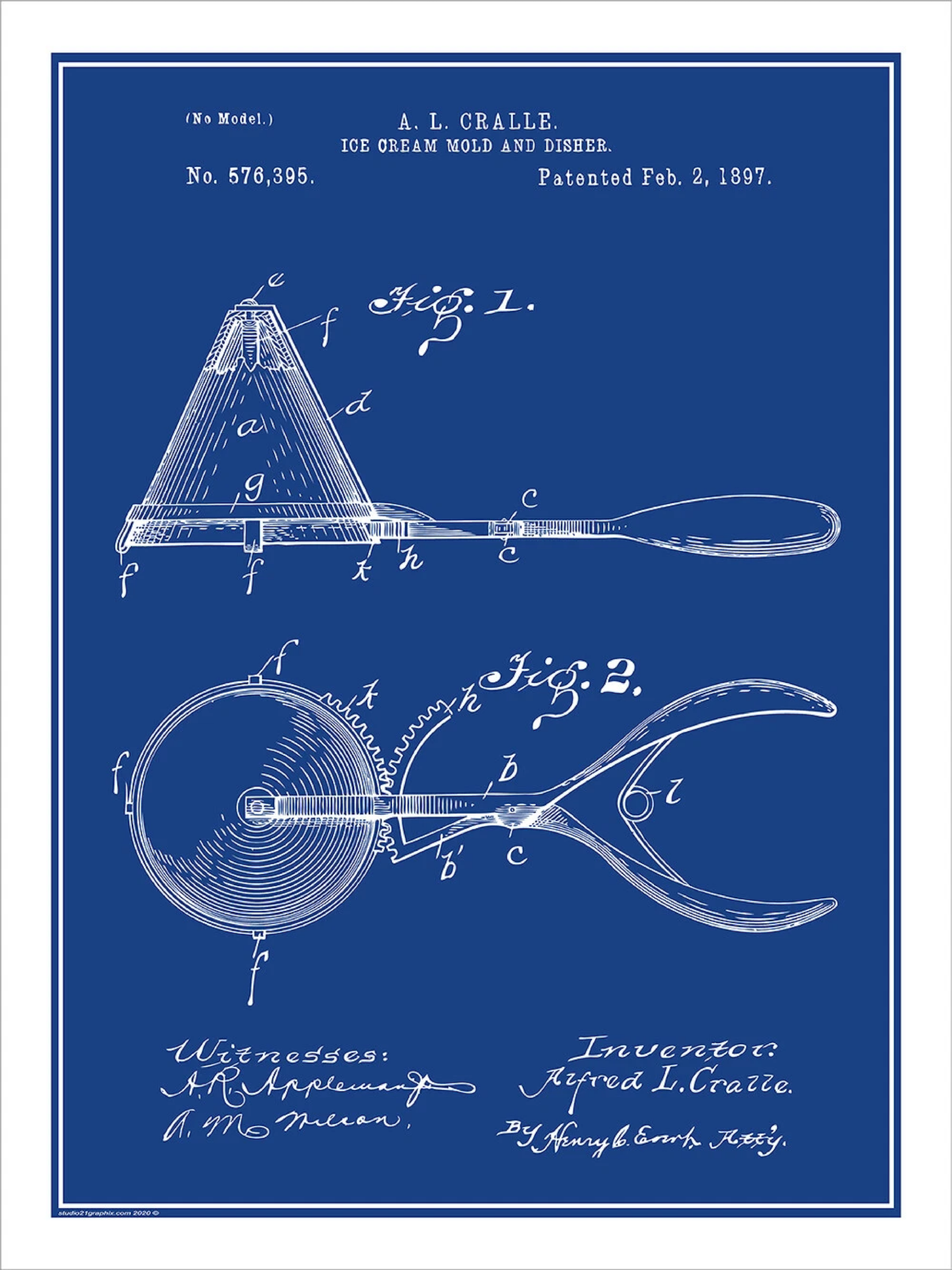
And like much infrastructure, its origin story is usually compressed into a trivia fact, if it is told at all. But the life behind the scoop—behind the patent drawing and the dated paperwork—is larger than the dessert aisle. Alfred L. Cralle’s 1897 patent for an “ice-cream mold and disher” sits at the intersection of Reconstruction’s unfinished promises, the rise of the modern city, the booming late-19th-century leisure economy, and the recurring American pattern in which Black ingenuity fuels daily life while credit, capital, and commemoration lag far behind.
To write about Cralle as an entrepreneur is to resist the temptation to treat invention as a lightning strike—a lone genius moment. His story is more instructive, and more human. It is about skilled labor and observation, about mechanics learned early and refined under constraint, about seeing what a workplace demands and answering with design. It is also about the limits placed on Black ambition in the Gilded Age: the narrow lanes of employment, the precarious pathways to education, and the uneven ability to profit from ideas even after securing legal protection for them.
A childhood in the long shadow of emancipation
Cralle was born in 1866, just after the Civil War, in Kenbridge in Lunenburg County—a geography and a date that matter. The country was remaking itself on paper: constitutional amendments, federal enforcement, new definitions of citizenship. On the ground, Black families in Virginia and across the South navigated a harsher arithmetic: freedom newly legal, opportunity still rationed.

Several accounts describe Cralle as having worked with his father in carpentry and developing an early interest in mechanics. In the late 19th century, that combination—woodworking skill and mechanical curiosity—was a kind of informal engineering education. You learned how materials behaved. You learned tolerances and fit. You learned that the smallest hinge or latch could save time, prevent mess, reduce strain. That sensibility would later appear in Cralle’s patent language and in the very premise of his invention: not novelty for novelty’s sake, but a practical improvement aimed at speed, cleanliness, and ease of use.
There is another formative detail that recurs in biographical sketches: he traveled to Washington, D.C. for schooling at Wayland Seminary, an institution associated with the National Theological Institute and created to educate newly freed African Americans in the years after the war. The seminary’s roots are tied to the American Baptist Home Mission Society and its postwar efforts to build educational capacity for Black communities—an effort that expanded beyond ministry training into broader academic programs.
Even without romanticizing the experience, the mere fact of attendance matters. Postwar Black education was often precarious—dependent on Northern philanthropy, religious organizations, and political winds that shifted as Reconstruction receded. Schools opened and merged; campuses moved; names changed. (Wayland Seminary would later merge with a sister institution in Richmond in the process that formed Virginia Union University, reflecting how fluid Black higher education could be in that era.) For a young man who would later become known for mechanical problem-solving, exposure to an environment where literacy, organization, and civic aspiration were normalized may have been as consequential as any specific course.
The city as workshop: Labor, limitation, and opportunity
By the time Cralle arrives in Pittsburgh, the United States is deep into industrial expansion. The city’s identity—steel, smoke, rail, rivers—often dominates its history. But another Pittsburgh was emerging too: the world of hotels, drugstores, and soda fountains that served an urban public increasingly drawn to commercial leisure.
Multiple sources place Cralle working as a porter in a drugstore and at a hotel, often identified as the St. Charles Hotel and a business known as Markell Brothers Drug Store. Porter work was demanding and, for many Black men in northern cities, one of the more available forms of steady employment—public-facing, physically taxing, and rarely rewarded with the kind of authority that matched skill or intelligence. Yet it offered something crucial for an observant mind: proximity to the friction points of service work.
The “problem” Cralle is said to have noticed sounds almost too modest for history: ice cream stuck to the spoons and ladles used to serve it, and the act of transferring it neatly into a dish or cone could require two hands and multiple tools. But modest problems are often the ones that invite the most elegant engineering, because they happen at scale. In the late 1800s, ice cream was not merely a home treat; it was a commercial commodity increasingly sold in public venues. At a soda fountain or hotel service counter, inefficiency becomes cost. Mess becomes reputational risk. Slow service becomes lost sales. If ice cream sticks and smears, if hands get soiled, if portions vary wildly, the business bleeds in pennies until the pennies become real money.
Cralle’s entrepreneurship begins right there—not in a venture-capital sense, but in the older tradition of enterprise: identifying a repeatable need and designing a repeatable solution. He was not simply imagining a better utensil; he was imagining a better workflow.
The patent: Engineering for one hand, engineered for speed
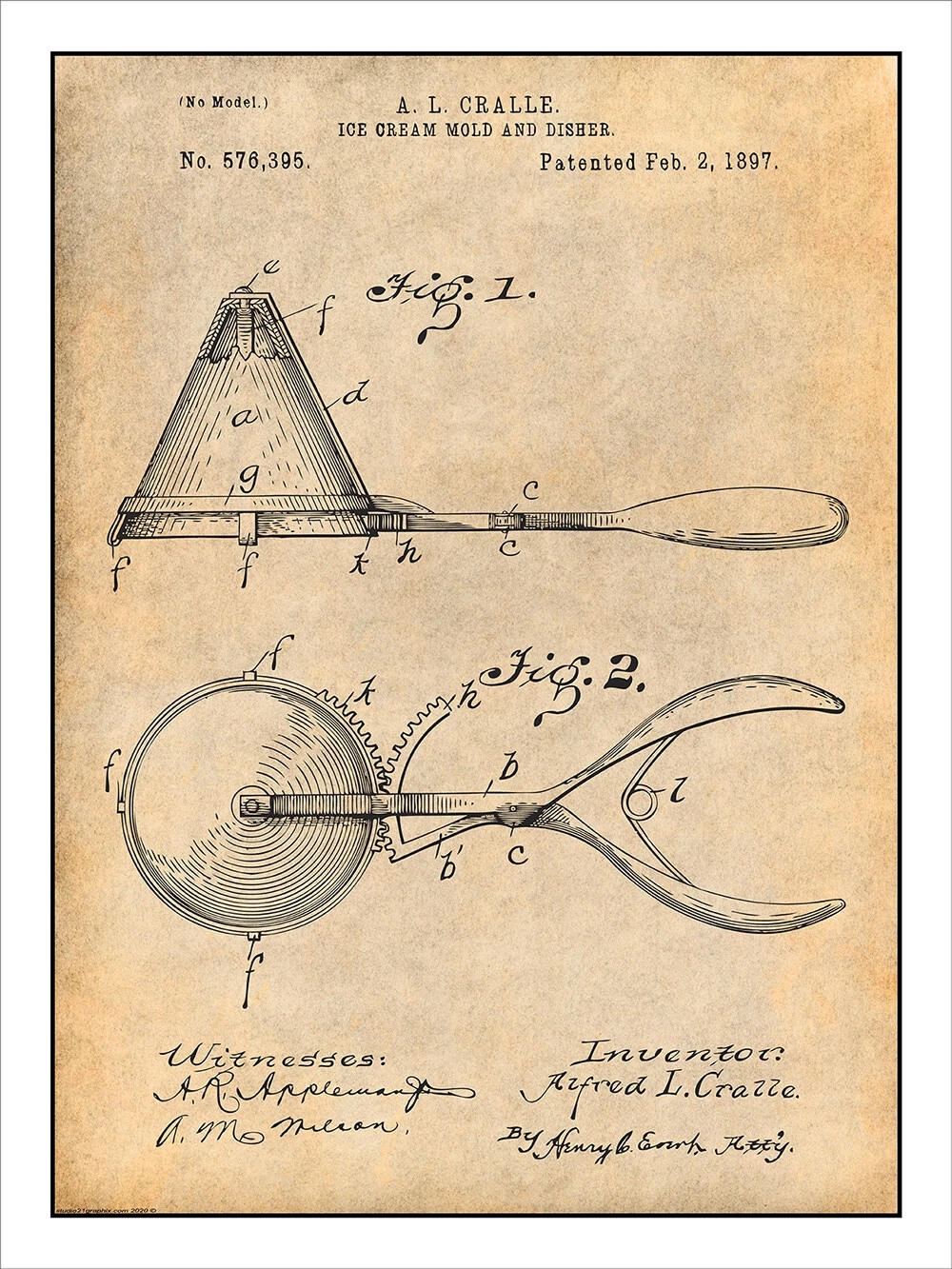
On June 10, 1896, Cralle filed a patent application. On February 2, 1897, the U.S. government granted him Patent No. 576,395 for an “Ice-cream mold and disher.” The phrase is revealing: “mold” as in shaping a consistent form, “disher” as in serving, portioning, and dispensing. This was not only about extraction; it was about presentation—making ice cream look like a product, not a struggle.
The patent’s core insight is mechanical: make a device that can be operated with one hand, while incorporating a scraping mechanism that releases the food cleanly rather than clinging to the metal. In other words, Cralle designed not just a scoop, but a system: a shaped cup and an internal moving element that separates the serving from the tool. It is the ancestor of the spring-loaded or levered scoops many people use today, the kind that ejects a rounded portion with a squeeze of the handle.
What reads, in patent language, as “conveniently operated with one hand” is, in real life, a profound user-centered decision. A one-handed tool frees the other hand for the cone, the dish, the tray, the customer’s change, the balancing act of service. It reduces fatigue. It standardizes output. It likely improves sanitation—important in an era increasingly attentive to public health and cleanliness in commercial food settings, even if the language of modern regulation had not fully formed.
At least one popular historical account notes that contemporary reporting praised the tool’s speed and its ability to avoid soiling hands—claims that, whether exaggerated or not, underline the values the invention addressed: efficiency and cleanliness. It is easy to laugh at the idea of “40 to 50 dishes of ice cream in a minute,” but hyperbole itself is instructive. People weren’t marveling at the romance of ice cream; they were marveling at throughput. The scoop didn’t just serve dessert—it served business.
The era’s paradox: Patents, progress, and the uneven distribution of reward
To be a Black patent holder in the late 19th century carried both symbolic weight and practical frustration. The end of slavery removed one set of legal barriers, but it did not create a level marketplace. Access to capital, manufacturing networks, distribution channels, legal support, and the social legitimacy required to be treated as an “inventor” were all unevenly distributed.
Cralle’s patent is sometimes framed as part of a broader surge of Black innovation after the Civil War—an increase enabled by emancipation and by the fact that Black inventors could, at least in principle, claim intellectual property. Yet the same sources that celebrate the patent also emphasize how frequently inventors like Cralle did not fully capture the economic value of their work. That’s not a moral failing; it is a structural reality. A patent grants the right to exclude others, but enforcing that right requires resources. Manufacturing a product at scale requires partnerships. Turning an invention into a durable business requires infrastructure—financial, legal, social.
Some accounts suggest Cralle did not profit much from the invention as its fame and subsequent iterations spread. Whether that claim can be quantified is difficult, but the pattern is well documented across American industrial history: the distance between inventing and monetizing can be vast, and it is often widened by race, class, and network access. Cralle’s case is therefore less an isolated tragedy than a representative one—an example of how invention can change the country while leaving the inventor comparatively exposed.
Business life beyond the scoop: The entrepreneur as organizer
Cralle is often remembered as “the inventor of the ice cream scoop,” but several sources also describe him as a businessman and a promoter in Pittsburgh. One of the more intriguing details is his association with an organization called the Afro-American Financial, Accumulating, Merchandise and Business Association, where he reportedly served in a managerial capacity.
Even the name of that association reads like a manifesto: finance, accumulation, merchandise, business. It suggests Black Pittsburghers building their own economic scaffolding—pooling resources, organizing commerce, asserting that Black enterprise could be collective as well as individual. If Cralle worked in such a setting, it complicates the image of him as a lone tinkerer. It positions him as someone engaged with the larger question of Black economic self-determination at the turn of the century.
This matters because invention is only one form of entrepreneurship. Another is institution-building: helping create vehicles through which a community can save, invest, trade, and own. If the scoop is Cralle’s most visible artifact, this kind of organizational work—if documented more fully—may represent the deeper ambition: not just to solve a service problem, but to move through the city with agency, to be more than the job category assigned to him.
Why the scoop mattered: Standardization, aesthetics, and the commercialization of pleasure
It’s tempting to treat the ice cream scoop as a novelty, but its significance sits in how it helped standardize a product that was becoming central to American commercial leisure. The late 19th century saw rapid growth in public-facing food service: drugstores with soda fountains, hotels with dining rooms, department stores with refreshment counters. In those venues, ice cream was both a treat and a social performance—something to be served neatly, quickly, and consistently.
Cralle’s device is, in a quiet way, a technology of standardization. A ladle can produce anything from a smear to a mound. A dedicated disher produces something that looks like a unit—repeatable, photographable (if the era had Instagram), saleable. That repeatability turns into pricing logic: a scoop becomes a measure, a portion, a predictable cost of goods. It also turns into customer expectation: a “scoop” becomes a visual promise. The tool helps create the very idea of what ice cream service should look like.
The built-in scraper mechanism carries another kind of significance: it reduces waste and mess. Ice cream that sticks to the utensil is lost product; it also slows the server down. In a high-volume environment, those micro-frictions aggregate. What Cralle built was an efficiency engine dressed up as a dessert utensil.
Recognition and the politics of memory
In 2025, Smithsonian Magazine revisited Cralle’s story, describing his patented “ice cream mold and disher” as a precursor to modern scoops and highlighting the design’s one-handed operation and anti-sticking scraper. This kind of attention is welcome, but it also underscores how recognition often arrives late, in periodic bursts—around anniversaries, heritage months, or viral social posts—rather than as a stable part of mainstream historical memory.
The gap between use and recognition is the core irony of Cralle’s legacy. Millions of people rely on the design logic he patented without knowing his name. That is not accidental. It is a reflection of how American consumer culture absorbs inventions while often discarding the social context that produced them—especially when the inventor sits outside the mythic archetype of who “innovates.”
Even basic biographical facts—like the year and circumstances of his death—can vary across sources, reflecting how thin the archival record can be for Black figures whose lives weren’t continuously documented by powerful institutions. That variation is not merely a footnote; it is evidence of a broader problem: the preservation of Black historical memory has often relied on community effort, local journalism, church archives, and later scholarly reconstruction. When those mechanisms are underfunded or ignored, the story becomes fragmentary, and a person is reduced to a single invention.
The invention as a lens on work
Cralle’s scoop is also a lens on the dignity of service work—an arena where Black labor has long been concentrated and long undervalued. The tool is not designed for a laboratory; it is designed for the counter, for the repetitive strain of hospitality, for the pace of a busy room. It takes seriously the intelligence embedded in frontline observation: the worker who notices the inefficiency, the mess, the awkward two-handed choreography, and imagines a better way.
In modern terms, this is product design rooted in empathy. In historical terms, it is a reminder that innovation often comes from people closest to the problem, not farthest from it. Cralle’s background in carpentry and mechanics, his experience in service environments, and his choice to formalize a solution through the patent system all point to a specific kind of entrepreneurial behavior: practical, attentive, systems-minded.
What we should learn from Cralle now
There are at least three lessons in Cralle’s story that remain contemporary.
The first is that “small” inventions can have outsized cultural impact. The scoop didn’t create ice cream, but it helped define how ice cream is served and sold. It shaped consumer expectation and business practice. It is a reminder that innovation is often incremental and infrastructural.
The second is that intellectual property is not the same as economic power. A patent can certify originality, but it cannot guarantee access to markets or protection against appropriation without resources. Cralle’s experience—patent secured, name not widely carried forward—mirrors a broader pattern in which Black innovators’ contributions become public goods while rewards remain private elsewhere.
The third lesson is about historical storytelling itself. When we tell Cralle’s story as a quirky fact—“a Black man invented the ice cream scoop”—we flatten the conditions that made the invention necessary and the barriers that shaped what came after. A fuller account places him in the real worlds he inhabited: post-emancipation Virginia, the educational experiments of Reconstruction-era institutions, the labor constraints of northern cities, and the Black-led economic organizing that tried to build alternatives within segregation’s long reach.
A legacy you can hold in your hand
The most enduring legacies are sometimes the ones you can hold without thinking. Cralle’s patent survives in the public record, and the mechanics of his design survive in the squeeze of a handle, the clean release of a rounded portion, the way one hand can do the job that once demanded two.
What would it mean to remember him more fully—not just as an inventor, but as a figure in the long history of Black enterprise? It would mean seeing the scoop as a chapter in a broader American narrative: innovation born from constraint, skill built in trades, education pursued where it could be found, entrepreneurship practiced in both invention and organization, and recognition arriving unevenly, often long after the public has adopted the product.
If the ice cream scoop is a tool of pleasure, the story behind it is a tool of perspective. It asks us to look again at the objects that populate our lives—at what they solved, who solved it, and what the solver had to overcome to be heard in the first place. That is the real measure of Alfred L. Cralle’s significance: not only that he made dessert easier, but that he left behind a design that proves how much history can be embedded in the most ordinary things.