

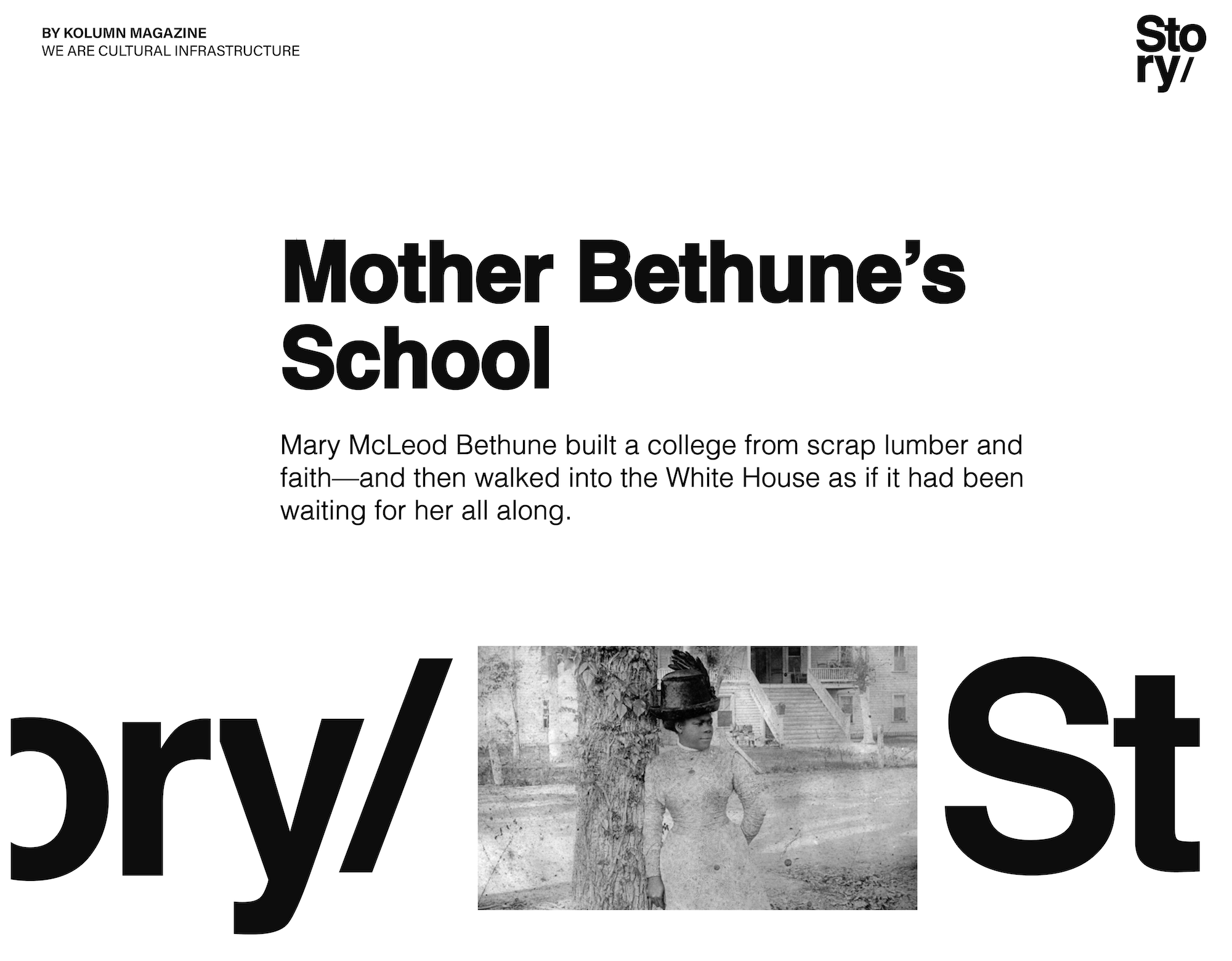
The child of emancipation, the student of inequality
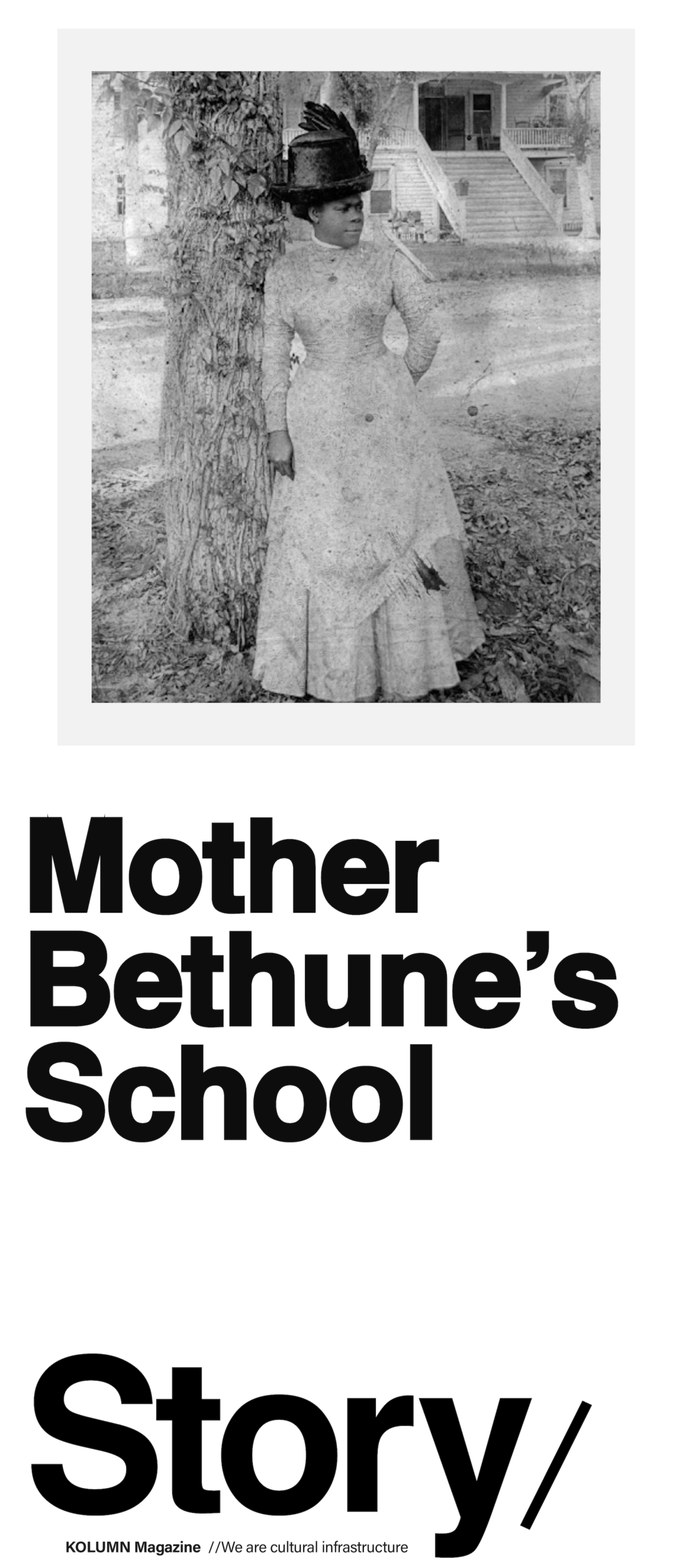
The child of emancipation, the student of inequality
By KOLUMN Magazine
In the American story, certain virtues get praised as if they are personality traits—grit, perseverance, resilience—when they are more accurately survival skills learned under pressure. Mary McLeod Bethune did not invent any of those virtues, but she did something rarer: she converted them into durable institutions. She turned the private labor of endurance into public infrastructure—into classrooms and dormitories, scholarship funds and job programs, women’s coalitions and federal appointments—then held those structures up long enough for other people to walk through.
To write about Bethune is to write about the sheer scale of her ambition, and about what that ambition required. She grew up in the aftermath of slavery, in the South that was busy reinventing racial domination as law and custom, and she decided—early, insistently—that the antidote was schooling. Not as a sentimental good, not as an ornament for a fortunate few, but as a lever for citizenship. Her insistence came with a practical question attached: Where, exactly, would Black children and Black women get access to the kind of education that made the future negotiable?
The United States likes its heroes uncomplicated. Bethune was not. She was a master of what might be called strategic respectability—an ability to speak in the polished, moral language white patrons expected while advancing a Black agenda they often feared. She could coax resources from skeptical donors, charm hostile officials, and manage the contradictions of being both inside and outside power. She could also be, by many accounts, relentless: a leader with an organizer’s memory and a builder’s impatience, someone for whom “no” sounded less like a verdict than like the beginning of a longer conversation.
In May 1955, after her death, Eleanor Roosevelt wrote in her column that she had been “distressed” to read the news of “a really great American woman.” The phrasing is almost formal, but its subtext is intimate: Roosevelt had watched Bethune operate up close, in the overlapping worlds of philanthropy, politics, and wartime mobilization. The tribute is also revealing for another reason. By 1955, Bethune had become the kind of figure the mainstream press could recognize as “interracial goodwill”—a phrase that, depending on the reader, might signal admiration or a narrowing of her radical intent. Bethune did believe in interracial democracy. But she also believed, more stubbornly, in Black autonomy, Black leadership, and Black claims on the state.
The argument of her life is not merely that education matters. It is that education is power only when it is paired with organization—when it is sheltered, financed, and defended against the forces that would prefer ignorance. Bethune understood that her work was not simply to teach students. It was to build a system that could keep teaching them after she was gone.
The child of emancipation, the student of inequality
Mary Jane McLeod was born on July 10, 1875, near Mayesville, South Carolina, to parents who had been enslaved. Her family’s circumstances carried the paradox of emancipation: legal freedom paired with economic vulnerability, and with a social order eager to police the meaning of Black aspiration. She was one of many children, raised in a world where the remnants of slavery lingered not only in memory but in labor arrangements, schooling, property ownership, and the daily choreography of deference expected of Black people.
What distinguishes Bethune’s origin story is not that it was uniquely harsh—many Black families in the Reconstruction and post-Reconstruction South endured similar pressures—but that she recognized early how those pressures reproduced themselves. Education, she came to see, was both the gate and the key. Without it, Black children were confined to the narrow range of work their parents had been forced into; with it, they could contest the boundaries of citizenship.
There is a well-known anecdote—recounted in various forms across biographies—about her encountering a white child’s book and being told she could not read it, a moment that distilled for her the intimacy of racial control: knowledge withheld, curiosity disciplined, possibility fenced off. Whether or not every detail of that scene survives intact, the underlying reality does. The South of Bethune’s childhood did not simply segregate facilities; it rationed imagination. The achievement of her life is that she refused the rationing.
Her path into formal schooling was not guaranteed. Black education in the late 19th century, especially in rural areas, was uneven and often underfunded. Bethune’s eventual training brought her into contact with institutions that framed education as mission—an instrument of moral and social change. But she did not absorb “mission” as pure benevolence. She absorbed it as method: as the discipline of building something lasting from almost nothing, and as the art of persuading communities and patrons to invest in people who had been systematically disinvested in.
The making of an educator—and an institution builder
Bethune’s public reputation often begins with the institution that would bear her name: Bethune-Cookman University. The usual version of that story compresses the difficulty into a kind of inspirational shorthand: a Black woman starts a school with $1.50, faith, and a dream. The truth is more instructive and more complicated, because it reveals the mechanics of institution-building in a hostile environment.
The school Bethune founded in Daytona Beach began in 1904 as the Daytona Educational and Industrial Training School for Negro Girls, later evolving through mergers and expansions into a college. The founding required not only pedagogical skill but real estate savvy, political risk management, and relentless fundraising. It required her to convince Black families—many of whom were balancing precarious budgets and skeptical of promises—that education was worth immediate sacrifice. It required her to navigate white hostility in a Florida that could be both economically opportunistic and racially punitive. It required her to cultivate donors, including white philanthropists who might support Black schooling so long as it did not threaten the racial order too directly.
A The Guardian education column from 2000 mentions Bethune as the founder of what became Bethune-Cookman College, situating her within the longer history of Black higher education while underscoring the significance of 1904 as a moment of institutional creation. That brief reference is not a full biography, but it points to an essential fact: the early 20th century was a period when Black educators were, in effect, building parallel civic structures—schools that functioned as community anchors, leadership incubators, and political staging grounds.
Bethune’s genius lay partly in her ability to read the room. She could speak the language of “industrial education” popular among many white donors—education framed as practical training and moral discipline—while also insisting, in practice, on a broader vision of intellectual development and leadership. She understood that donors often wanted Black education to produce compliant labor. She wanted Black education to produce citizens. Her school’s curriculum and discipline were shaped by the constraints of the era, but her intent was expansive.
The fundraising itself was not merely a side task; it was an education in power. Bethune learned which arguments moved money, which relationships could be leveraged, and which alliances came with strings. She learned that dignity could be marketed to people who did not necessarily believe in equality, and that a school could survive only if its leader could translate moral urgency into budgets.
In this sense, her school was a prototype for her later political life. The same skills—coalition-building, persuasive storytelling, strategic compromise without surrender—would later allow her to move in Washington with a builder’s confidence.
Women’s clubs, suffrage, and the politics of respectability
To understand Bethune’s rise, it helps to understand the ecosystem of Black women’s organizing in the early 20th century. Black women’s clubs were not merely social organizations; they were civic engines. They created scholarship funds, supported anti-lynching campaigns, built settlement-style services, and insisted—often in the face of both racism and sexism—that Black women’s leadership mattered.
Bethune moved within and helped lead this world, eventually founding National Council of Negro Women in 1935, an umbrella organization meant to coordinate and amplify the work of Black women’s groups. The National Park Service describes Bethune’s Washington townhouse—now the Mary McLeod Bethune Council House National Historic Site—as the first headquarters of the NCNW and as a place where strategies and programs were developed to advance the interests of African American women.
This detail matters because it reframes her life away from lone-hero mythology. Bethune did not simply “inspire” people; she organized them. She built networks that could pressure institutions, mobilize resources, and generate public legitimacy for Black women’s demands.
Her engagement with suffrage and voter access also illustrates her practical politics. In the years around women’s suffrage, Black women faced a double bind: excluded from white suffrage organizations and targeted by Southern voter suppression even after constitutional amendments expanded formal rights. Bethune’s work—helping Black people navigate literacy tests, poll taxes, and intimidation—was part of a broader tradition of Black women acting as the often-uncredited infrastructure of democracy.
Respectability politics is a contested term now, sometimes used as critique and sometimes as historical shorthand. Bethune practiced something more nuanced: a conscious performance designed to disarm white fears while building Black capacity. Her public image—composed, elegant, morally authoritative—was both self-expression and tactic. It opened doors, but it also imposed burdens: she had to embody excellence not merely as personal virtue but as political argument.
Entering the federal state: The New Deal and the art of access
Bethune’s move into national politics did not happen by accident; it was the culmination of her local and organizational work. During the Great Depression, as the federal government expanded its role in economic and social life, the question was not simply whether Black Americans would benefit from New Deal programs, but whether they would be excluded through discriminatory implementation. Bethune understood that the federal state was becoming a site of struggle—and she insisted on being present where decisions were made.
She became closely associated with Franklin D. Roosevelt’s administration and served in a significant role within the National Youth Administration, where she led the Division of Negro Affairs. The U.S. National Archives and Records Administration highlights her appointment as director of that division and notes the significance of her federal role for programs aimed at Black girls and women.
In practice, her work involved pushing resources toward Black youth—funding educational opportunities, job training, and employment in a period when Black unemployment and poverty were acute and when discrimination could quietly drain programs of their promise. The point was not symbolic inclusion. The point was material access: money, training, pathways into careers.
Her proximity to power also made her part of what came to be known as the “Black Cabinet,” an informal circle of Black advisers and officials advocating for Black interests within the administration. A TIME profile describes her influence in 1934 and frames her as among the most politically powerful Black women of her era, emphasizing her New Deal role and her leadership within that advisory ecosystem.
But influence in Washington is rarely pure. Bethune’s position existed within a Democratic Party that relied on Southern segregationists and within a federal government that was willing to tolerate racial inequality to maintain political coalitions. The New Deal helped many Americans and reshaped the social contract, but it also permitted discriminatory practices in key programs and left civil rights legislation largely untouched in that era. Bethune operated inside this contradiction. Her strategy was to extract as much benefit as possible for Black youth, while building a case for a more inclusive democracy.
This is where some of the tensions around her legacy emerge. Critics—then and later—could read her access as accommodationist, as too tied to elite approval. Supporters saw it as the only realistic way to secure resources and representation in a moment when outright confrontation could be met with swift political backlash. The record suggests Bethune was neither naïve nor submissive. She was calculating. She knew the limits of the moment, and she pushed against them anyway.
The friendship as strategy: Eleanor Roosevelt and the politics of influence
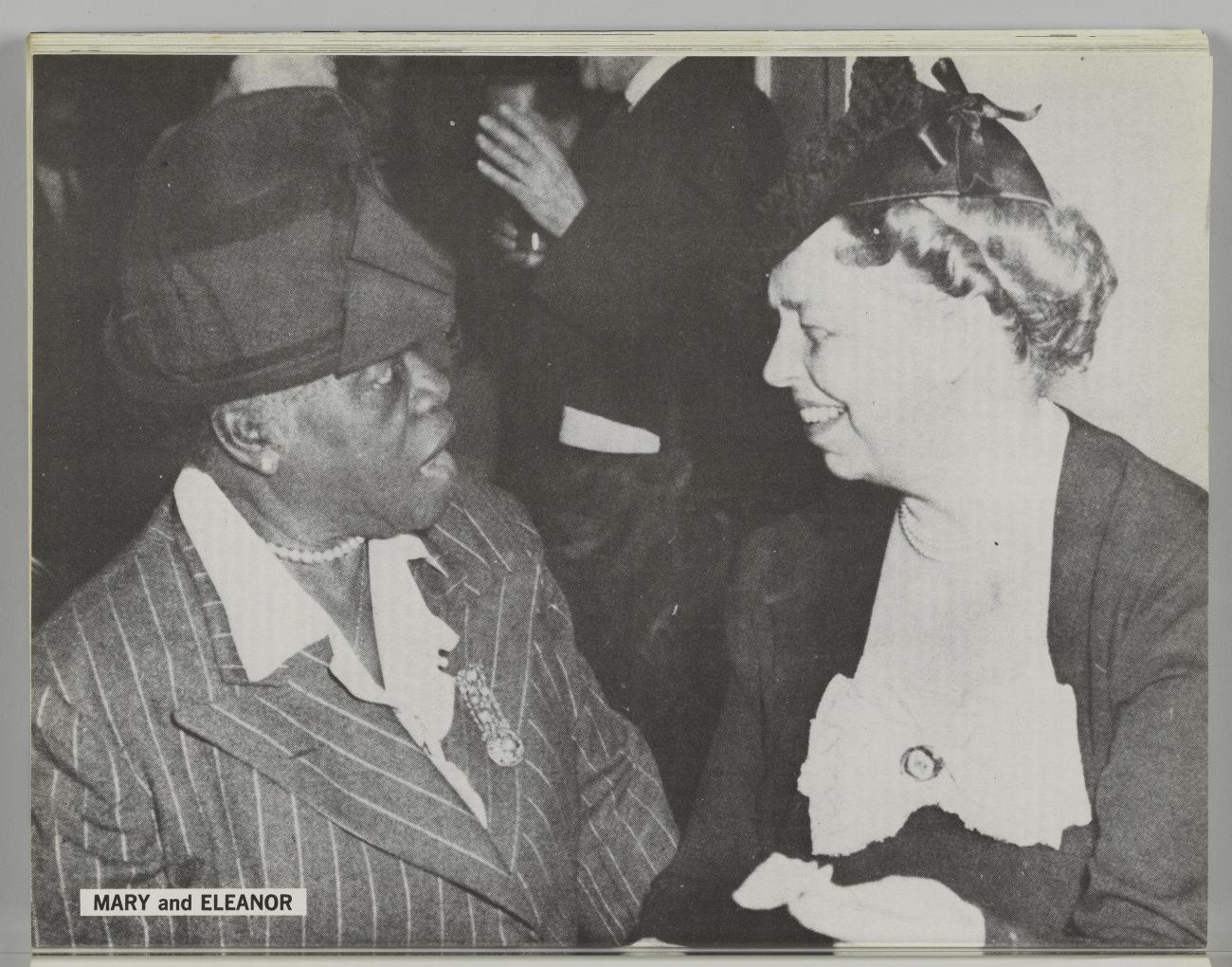
Bethune’s relationship with Eleanor Roosevelt was not merely personal; it was strategic, a bridge between Black women’s organizing and the White House’s moral imagination. Roosevelt was one of the more publicly progressive figures within the administration on issues of race—though she, too, navigated political constraints. Bethune knew how to use such relationships without surrendering her agenda.
When Roosevelt wrote after Bethune’s death, she framed Bethune as an “American woman” of exceptional stature. That framing matters because it gestures toward one of Bethune’s lifelong campaigns: to make Black women legible as full American actors, not merely as beneficiaries of benevolence. Yet the language of “interracial goodwill” that circulated around Bethune in mainstream tributes could also soften the sharper edge of her work. Bethune was not simply building harmony. She was building leverage.
One of Bethune’s talents was to understand that power has multiple channels. There is formal power—titles, budgets, agencies. There is social power—relationships, reputations, access. And there is moral power—the ability to frame an issue so persuasively that opposing it becomes publicly costly. Bethune used all three. Her friendship with Roosevelt amplified her moral and social power, which in turn supported her ability to influence policy.
It is tempting, in hindsight, to treat such relationships as evidence that progress is made by proximity to enlightened elites. Bethune’s life argues something else: that proximity matters only when it is tethered to organized constituencies. She was not a lone voice whispering into power. She was the conduit for networks of Black women and Black institutions that demanded the federal government take them seriously.
War, citizenship, and the global horizon
World War II and its aftermath widened Bethune’s political horizon. The war intensified debates about democracy: how could the United States claim to fight for freedom abroad while tolerating segregation and racial violence at home? Black Americans seized on this contradiction, pressing for a “Double V”—victory against fascism overseas and victory against racism domestically. Bethune, already positioned within national networks, pushed for the inclusion and fair treatment of Black people in wartime mobilization, including Black women in the armed forces. The National Park Service notes her continued advocacy during the war years and her advisory role during the Truman era as well.
After the war, Bethune’s work touched the international stage. Multiple sources describe her presence at the 1945 conference in San Francisco that drafted the charter of the United Nations, where she attended as a consultant connected to civil rights leadership, representing the NAACP in that context. The National Park Service describes her as the only African American woman present at that meeting. The National WWII Museum similarly describes her participation and emphasizes her focus on rights for people in colonized countries, as well as her disappointment that the conference did not yield the breadth of freedom and self-determination she sought.
This global frame matters. Bethune is sometimes remembered as a domestic figure—an educator, a clubwoman, a New Deal official. But the logic of her politics always contained an international dimension: she understood that racism in the United States was part of a broader global hierarchy, and that democracy could not remain provincial if it wished to be credible.
Her disappointment at the limits of international agreements also feels familiar now. Many reformers encounter the gap between aspirational language and enforceable commitments. Bethune, who had spent her life translating aspiration into concrete institutions, was sensitive to that gap. She knew the difference between a declaration and a mechanism, between a promise and a budget line.
The builder’s last document: “My Last Will and Testament”
Bethune had a gift for leaving behind writing that could travel beyond her era. One of the most cited texts associated with her legacy is her “Last Will and Testament,” a moral document that reads as both farewell and instruction. Bethune-Cookman University preserves a version of that text, framing it as her parting philosophy and emphasizing her acceptance of death alongside her insistence on unfinished struggle. An archival reprint associated with AUC Woodruff Library notes that the text was reprinted from the August 1955 issue of Ebony magazine, underscoring its circulation as a communal document rather than merely a private reflection.
What is striking about the “Last Will” is how clearly it reveals Bethune’s theory of change. She does not leave money. She leaves values—love, hope, the challenge of developing confidence, a thirst for education, respect for the uses of power. In modern language, it is a legacy memo: a leader explaining what the next generation must safeguard if it wants to win.
It is also, implicitly, an indictment of the conditions that made such a testament necessary. Bethune’s “will” assumes that Black people will continue to face structural obstacles—economic, educational, political—and that the response must be collective discipline rather than despair. She frames uplift not as individual escape but as communal responsibility.
This is an important corrective to the way Bethune is sometimes commemorated. Public memory often flattens her into inspiration, a figure carved in marble who symbolizes possibility. The “Last Will” insists on something tougher: responsibility.
The Council House and the institutionalization of Black women’s memory
Today, Bethune’s presence in Washington is not only symbolic. The Mary McLeod Bethune Council House National Historic Site operates as a material reminder that Black women’s organizing has addresses—specific rooms where decisions were made, strategies debated, letters drafted, alliances forged. The National Park Service emphasizes that the Council House was the first headquarters of the NCNW and Bethune’s last home, a base for advancing African American women’s interests.
Even the details of the building’s acquisition—purchased in 1943—help clarify Bethune’s method: she believed in owning space, in creating headquarters, in turning movements into institutions. That kind of thinking is not romantic. It is logistical. It is the recognition that a people without institutions is a people forced to borrow stability from others.
The Council House also underscores another dimension of Bethune’s impact: the preservation of Black women’s history as an active political project. Archives and museums are sometimes treated as passive repositories. In Black political life, they often function as evidence—proof of leadership, proof of contribution, proof of legitimacy. Bethune’s insistence on visibility—on documenting Black women’s work—was itself a form of power.
Commemoration in marble: What it means to replace a Confederate
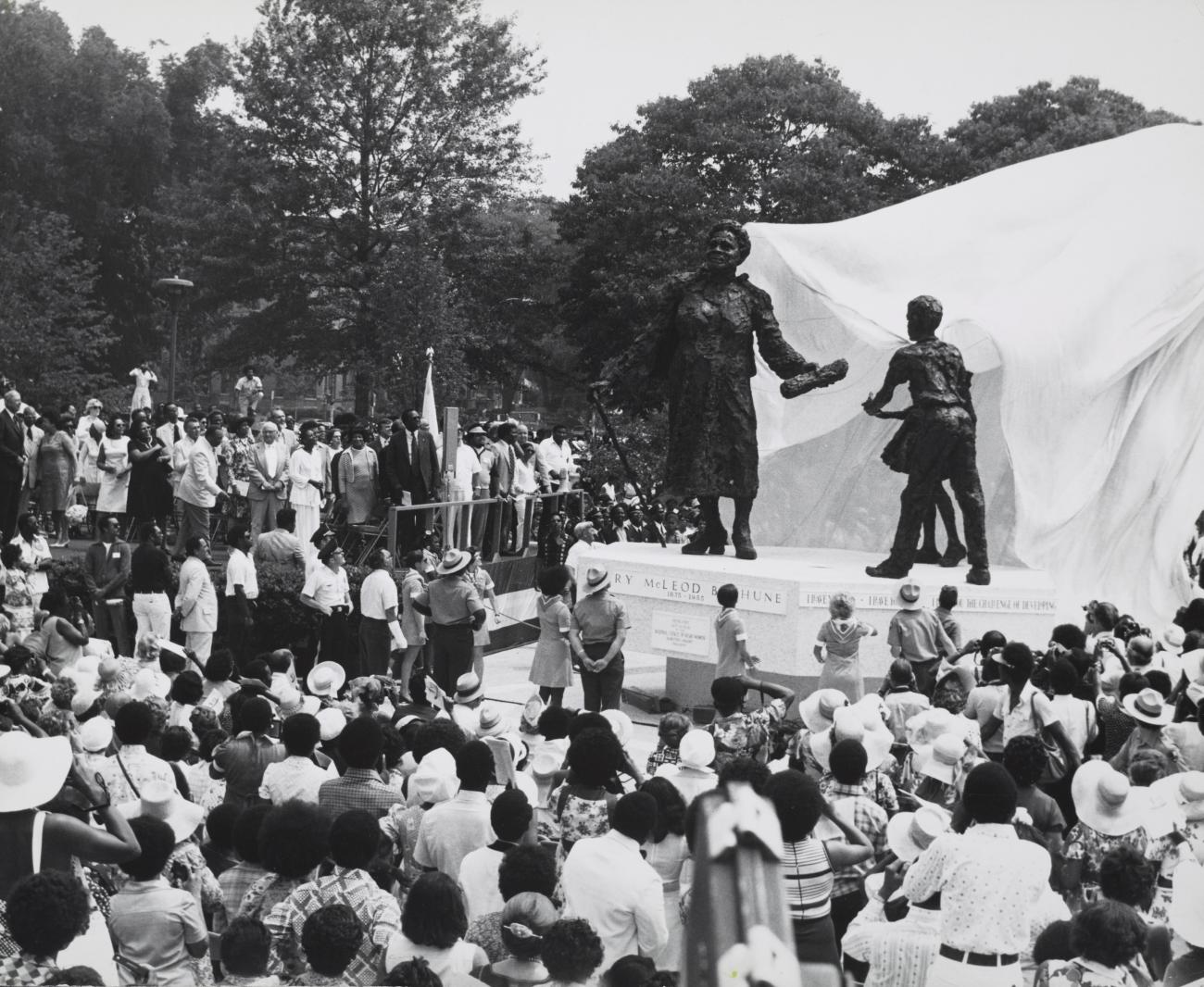
In recent years, Bethune’s legacy has been reintroduced to many Americans through monuments. In July 2022, a statue of Bethune was installed to represent Florida in the National Statuary Hall, replacing a Confederate general. The University of Florida’s news service notes that her statue replaced that of Edmund Kirby Smith, removed in 2021, and contextualizes the selection within broader debates over public memory.
Media coverage across outlets has emphasized what the replacement signifies: a public rewriting of who is honored as representative of a state and, by extension, of the nation. An Ebony article from 2021 describes the statue as set to replace a Confederate figure and highlights the historic nature of Bethune’s inclusion.
What does it mean to replace a Confederate with a Black woman educator? It means, first, that the old story is no longer stable. The Confederacy’s memorialization was never only about history; it was about power, about legitimizing a racial order. Replacing such a symbol with Bethune is not simply “diversity.” It is an argument about what kind of leadership deserves public honor: rebellion in defense of slavery, or institution-building in defense of citizenship.
But monuments also risk turning a life into a slogan. Bethune’s real work was less static and more transactional: persuading people to give money, to change policy, to open doors, to fund Black youth. The monument can remind, but it cannot teach the method unless we insist on telling the full story—the compromises, the conflicts, the sharp elbows behind the serene pose.
The hard parts: Patronage, compromise, and criticism
A thorough account of Bethune has to include the pressures that shaped her choices. She raised funds from white patrons in a segregated South. She operated within a federal government that often preferred symbolic gestures to structural change. She led organizations that had to balance internal ideological differences: between those who favored more confrontational protest and those who favored incremental gains through institutional partnerships.
In the contemporary vocabulary, one might call this “navigating systems.” But that phrase can sound bloodless. In Bethune’s era, navigating systems often meant surviving them—avoiding retaliation, protecting students, ensuring a school’s doors did not close because a donor was offended or a local official decided to tighten the screws.
It also meant making choices that could be criticized. Some activists might have wanted Bethune to use her White House access to publicly condemn segregation more directly; others recognized that her value lay in securing tangible resources that could outlast speeches. These tensions are not evidence of failure; they are evidence of political reality.
Bethune’s strategic respectability, for example, could be read as reinforcing elite norms. Yet it also served as a shield and a key—shielding her institutions from easy attack and unlocking rooms where decisions were made. It is difficult to condemn such strategy without acknowledging what was at stake: the education of Black girls who otherwise might never have had access to formal schooling, the funding of Black youth programs in a federal system prone to neglect, the creation of a national women’s council capable of shaping policy debates.
Even within the “uplift” framework, Bethune’s intent was not to produce docility. Her “Last Will” reads like a call to develop backbone. She believed in discipline, yes, but discipline as preparation for freedom, not submission to hierarchy.
The legacy: A blueprint more than a biography
Bethune’s story is often told as an ascent: from rural poverty to national prominence. But that narrative can miss the deeper lesson. Her life is less a ladder climbed than a blueprint drawn. She modeled how to build power without waiting for permission.
First, she demonstrated that education is not only a personal achievement but an institutional project. Founding a school, sustaining it, expanding it into a college—this is policy work in the most concrete sense. It alters the distribution of opportunity. It changes who can become a teacher, a nurse, a leader, a voter.
Second, she demonstrated that Black women’s organizing is not auxiliary to Black freedom struggles; it is central infrastructure. The NCNW was not a symbolic club. It was a coordinating body that made Black women legible as a political constituency and as policy actors.
Third, she demonstrated that access to the state is a battleground. Her work within the National Youth Administration shows what it looks like to contest bureaucracy from the inside: to push funds toward communities that would otherwise be excluded, to create pathways where none existed.
Finally, she demonstrated that memory is part of politics. The Council House, the documents, the speeches, the “Last Will,” the monuments—these are not merely tributes. They are tools for future arguments about who belongs, who leads, and what democracy owes its people.
Bethune died in Daytona Beach on May 18, 1955, but her life reads less like a closed chapter than like an instruction manual still in use. She expected the struggle to continue; she wrote as if the future generation would need both comfort and command. And she left behind what she had always been building: proof that one person’s resolve, when converted into institutions, can become a collective inheritance.