

By KOLUMN Magazine
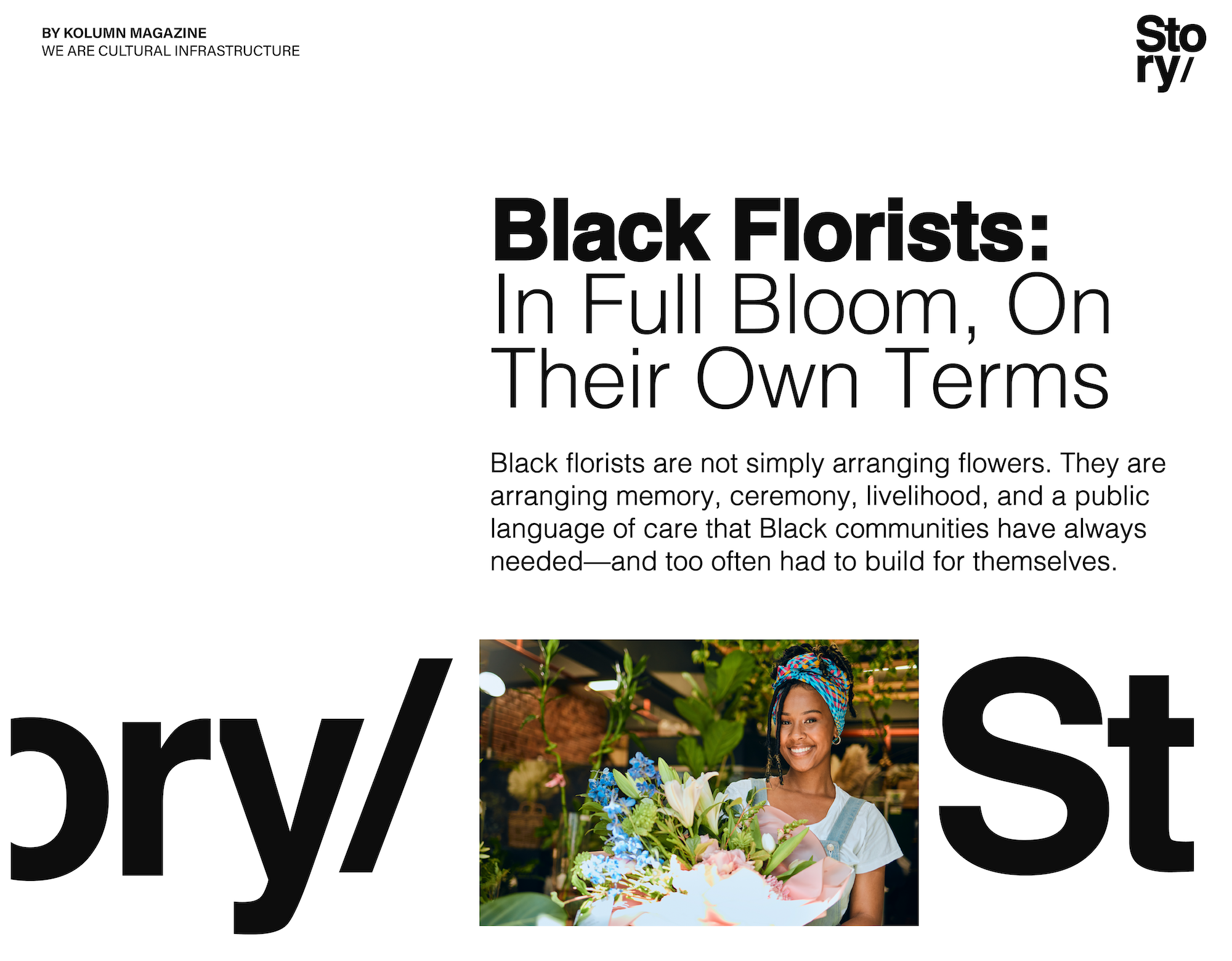
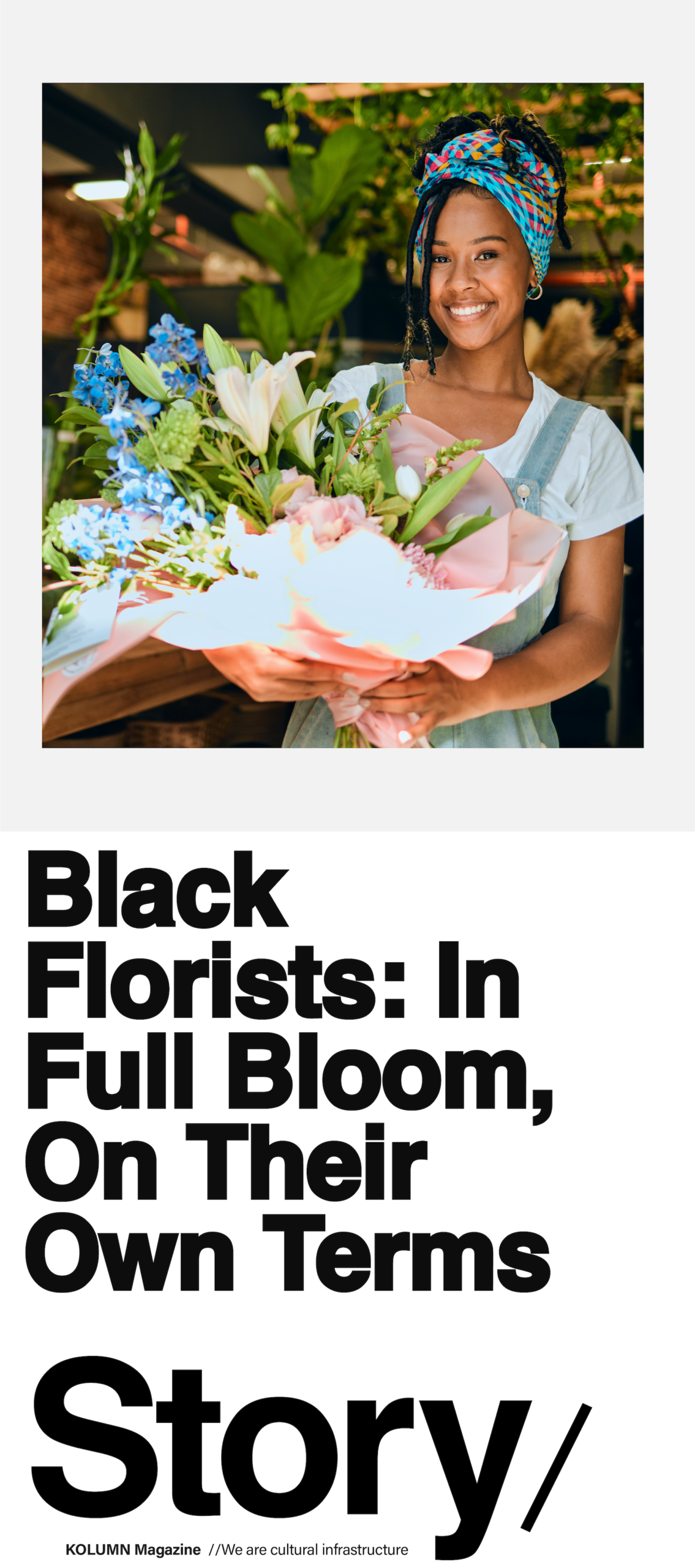
In America, flowers are supposed to be simple. A bouquet, a centerpiece, a corsage pinned to a lapel, a handful of roses wrapped in cellophane—objects purchased quickly, delivered quickly, and discarded quickly. But in Black America, flowers have rarely been only decorative. They have been language when language fails, structure when institutions fail, and dignity when dignity is withheld. They have been, for generations, a way to say what could not safely be spoken out loud: I love you; I’m sorry; I am proud of you; I honor you; I will remember you; we will carry you.
The florist, in this tradition, is not merely a vendor. The florist is a witness. A translator. A small-business owner operating in the intimate geography of a community’s milestones. The florist learns who is getting married and who is getting buried. Who is returning home and who is leaving town. Who is being promoted, who is sick, whose mother has passed, whose son has made the honor roll, whose auntie wants “something bright, but not too loud.” The florist’s work is tactile and immediate, yet it sits inside a longer story: the story of how Black people have created parallel systems of care and ceremony in a country that often denied them both.
That story runs through the pews of Black churches and the hallways of Black funeral homes; through banquet rooms where sororities and fraternities mark anniversaries and initiations; through graduation stages, baby showers, repasts, quinceañeras, and family reunions; through storefronts and pop-ups where beauty is not an indulgence but a form of self-determination. It also runs through entrepreneurship itself—through the reality that, for many Black Americans, building a business has never been simply about profit. It has been about survivability, autonomy, and the right to set the terms of one’s labor.
In recent years, a growing ecosystem of Black-owned floral studios has made that legacy more visible. Some are rooted in long-standing, neighborhood-based retail models; others are studio-driven, event-oriented businesses shaped by design culture, social media, and new consumer expectations. The point is not that Black florists have suddenly arrived. The point is that more people are finally learning to look.
One helpful map of that visibility appears in a Shoppe Black resource. The site’s curated guide, organized by state, emphasizes exactly what many Black florists have long known: there is no single “Black floral style,” no monolithic aesthetic, no one geography of influence. The list spans major metros and smaller cities, luxury studios and community staples, wedding-focused designers and shops whose expertise includes the most difficult work of all—funeral and memorial arrangements. It is, in other words, a portrait of range.
To understand the significance of Black-owned florists, you have to understand the cultural load that flowers carry, and the economic realities behind the beauty. The United States is a massive flower consumer, and the bouquet’s journey is often global. Reporting on the cut-flower pipeline has shown how much of the industry depends on imports, cold-chain logistics, and the labor of workers—frequently women—who grow and harvest flowers under intense seasonal pressures. When a florist in Chicago, Los Angeles, Miami, Atlanta, or Albany designs an arrangement that looks effortless, it is built atop a supply chain that is anything but. That backdrop matters because Black florists are navigating not only artistry and local competition, but also the structural vulnerabilities of a market shaped by international production, pricing swings, and holiday-driven demand cycles.
Still, the significance of Black-owned florists cannot be measured only by macroeconomics. Their most important work happens close to the ground, in communities where flowers are part of how people stay tethered to one another. A Brooklyn Botanic Garden essay on the history of Black flower vendors and florists in New York City, particularly Harlem, underscores this point: flowers have long been connected to Black women’s entrepreneurship and financial independence, and to neighborhood commerce that carried cultural meaning beyond the transaction. That history offers a frame for the present moment. Today’s Black-owned floral businesses are not simply participating in a market; they are extending a lineage—sometimes knowingly, sometimes intuitively—of beauty as livelihood and beauty as social fabric.
This article profiles five Black-owned floral businesses featured in Shoppe Black’s list—Mallory with the Flowers, De La Fleur Miami, Designs By TTOC Floral and Decor, Taysha Florist, and Planks and Pistils—while situating their work inside the larger cultural and economic context that makes Black floristry uniquely resonant.
Flowers as infrastructure: Joy, grief, and the Black public sphere
There is a particular American habit of treating flowers as seasonal, sentimental, and faintly frivolous. That habit collapses quickly when you follow flowers into Black life. In many Black communities, flowers do not simply decorate events; they help constitute the event itself. They are part of the ritual technology that makes a gathering legible—makes it feel like a celebration, a farewell, a testimony, a transition. They “hold” the room.
Consider the homegoing service, a tradition that often asks an impossible question: how do you make loss bearable without minimizing it? In that space, flowers do what they have always done in human societies—they externalize emotion. They make grief visible and therefore shareable. They offer the living a way to show up when they do not know what to say. They fill the air with fragrance and color as if to insist that life, even at its ending, retains beauty.
The florist is central to that insistence. The work is logistical—delivery times, sizes, structures, transport, placement—but it is also interpretive. What colors were her favorite? Did he like things simple or dramatic? Does the family want something traditional, or something that signals personality, humor, style? The florist becomes, in effect, a collaborator in memory-making.
The cultural weight of flowers also appears in less solemn contexts. In Black Greek-letter organizations, floral symbolism can be a language of allegiance and lineage. In churches, flowers mark holidays and anniversaries; they honor elders; they dignify the pulpit; they underline the seriousness of a moment. In weddings, especially for couples who want ceremony that reflects cultural specificity rather than generic luxury, florists help stage a world where Black love is not a footnote but the main event.
This is why the rise of directories and curated lists of Black wedding vendors—and Black florists within those ecosystems—has mattered. It is not only about representation. It is about cultural fluency. When couples seek vendors who understand their communities, their family dynamics, their aesthetics, and their histories, they are also seeking an environment where they do not have to translate themselves. Contemporary wedding coverage has increasingly acknowledged this, noting the breadth of Black-owned wedding professionals and the value of choosing vendors who can deliver both technical excellence and cultural understanding.
Floristry, then, is not merely a service category. It is a portal into how communities organize meaning. And Black-owned florists occupy a particular position in that portal: they are entrepreneurs making a living, artists shaping a visual language, and community actors whose work often functions as a quiet form of care.
The next sections offer five case studies—five distinct businesses, in five different locales, each with its own design sensibility and community relationship. Together, they show the range that Shoppe Black’s guide hints at: a national network of Black floral entrepreneurship that is both deeply local and increasingly interconnected.
Mallory with the Flowers: Building “quality time around flowers” in Los Angeles
Mallory with the Flowers introduces itself not simply as a florist, but as “an experiential floral studio and flower shop” in Los Angeles—language that signals something about what modern floristry can be when it is designed as community space rather than purely retail. The site describes a mission centered on “creating community, conversations, and quality time around flowers,” and it names ownership plainly: “proudly, black + filipina owned.”
Those phrases matter. They frame the business as a place where the product is not only the bouquet; it is also the experience of being in relationship—with beauty, with one another, with the act of making. In a city where aesthetics are often commodified, where “wellness” is frequently marketed more than practiced, a floral studio that foregrounds quality time is making a claim: that flowers can slow you down, and that slowing down can be a social good.
Mallory Browne’s rise has also been documented in mainstream lifestyle coverage. A Los Angeles Times profile described her as self-taught, someone who learned by watching YouTube and experimenting with grocery-store blooms before building a portfolio and an audience under the name “Mallory With the Flowers.” The arc is by now familiar in the modern creator economy—skill acquisition in public, community-building via social platforms, the conversion of audience trust into business viability. But the significance, especially in a Black-owned context, is that it demonstrates a pathway into an industry that can feel gatekept by tradition, apprenticeship networks, and capital.
What Mallory with the Flowers seems to offer is not just arrangements, but permission: permission to learn, to try, to cultivate taste without waiting for institutional validation. That permission has cultural resonance because so many Black creatives have had to build outside the mainstream, not as a romantic choice but as an economic necessity. The studio’s framing—community, conversation, quality time—reads like an answer to a world that monetizes attention and isolates people. Flowers become an excuse to gather, a reason to make something with your hands, a form of respite that is not privatized but shared.
The business’s flower shop component emphasizes seasonal freshness and intention, offering weekly bouquets and custom arrangements for delivery or pickup in Los Angeles. That operational detail—weekly rhythms, local deliveries—also matters culturally. Floristry is often discussed as event-driven, oriented toward weddings and major holidays. But the weekly bouquet is about everyday life: the small rituals of care that keep households feeling like homes. For Black communities that have had to fight for the right to leisure and softness, the normalization of “just because” flowers is not trivial. It is a quiet redefinition of who gets to live surrounded by beauty.
Mallory with the Flowers is also explicitly part of a broader Black-owned floral landscape recognized by Shoppe Black’s state-by-state guide, which lists the business among California-based Black-owned floral companies. In that context, Mallory’s studio is not an isolated success story. It is part of a pattern: Black-owned floristry that is contemporary, design-forward, and community-minded, operating at the intersection of craft and cultural care.
De La Fleur Miami: “Love + light” through event floristry in a global gateway city
Miami is a city of spectacle and intimacy, of nightlife and ritual, of Caribbean and Latin American diasporas layered atop one another. It is also, not incidentally, a global gateway for flowers. Reporting on the U.S. cut-flower economy has repeatedly pointed to South Florida—particularly Miami’s airport infrastructure—as a central artery through which imported stems move into the American market. To be a florist in Miami is to live close to that artery, to create beauty in a city where beauty is expected, and to compete in an environment saturated with event culture.
De La Fleur Designs situates itself squarely in that world. The studio describes itself as “Miami-based” and specializing in “weddings, events, and elevated flower delivery.” (The founder’s voice on the site is personal, almost conversational: a note about events as “a delightful labour of love,” and an invitation to design “a unique experience” for a wedding or special event “for the love of flowers.” That tone communicates a particular positioning. This is not mass-market floristry; it is bespoke, relationship-driven design work that treats the event as narrative.
On social platforms, the brand voice is even more explicit, framing its work as “Love + Light through the art of floristry,” a phrase that aligns floral design with emotional atmosphere rather than mere decoration. In Miami—where many events are about signaling, where venues and visuals carry social meaning—this emphasis on love and light suggests a deliberate counterpoint to aesthetic excess. It reads as a claim that beauty should not only impress but also nourish.
The significance of a Black-owned floral studio in Miami also sits within a larger story about the wedding and events industries: industries that are often aspirational, often expensive, and often shaped by networks of privilege. When Black clients seek vendors who can deliver luxury without erasing cultural specificity, they are often looking for professionals who understand both the aesthetic demands of the market and the lived realities of the community. That is why curated lists of Black-owned wedding professionals have proliferated, and why such lists emphasize that they are starting points rather than exhaustive inventories of talent.
De La Fleur Miami is explicitly included in Shoppe Black’s guide under Florida, listed as a Miami-based Black-owned floral business. That placement matters because Miami’s Black population is not monolithic; it includes African Americans, Afro-Caribbean communities, Black immigrants, and multigenerational residents whose cultural aesthetics vary widely. A Black-owned studio operating in that environment is not simply serving “a market segment.” It is navigating a complex cultural terrain where flowers can carry different meanings—where particular colors, arrangements, and styles resonate differently depending on community context.
At its best, event floristry is a kind of scene-setting that tells people what a gathering is supposed to feel like. De La Fleur Miami’s language—love, light, labor of love, unique experience—suggests a studio attentive to that emotional architecture. In a city shaped by movement—of people, of goods, of cultures, of flowers—such attentiveness becomes its own kind of rootedness.
Designs By TTOC Floral and Decor: Atlanta’s delivery rhythms, subscriptions, and a Black business city’s floral heartbeat
Atlanta is often described as a Black business capital, a city where Black entrepreneurship has been both celebrated and contested, thriving within a broader Southern economy marked by inequality and opportunity in equal measure. In that environment, a florist is not just a creative professional; a florist can be part of how businesses and families perform care publicly—how they mark openings, anniversaries, corporate milestones, and losses.
Designs By TTOC Floral operates with the operational confidence of an established retail-and-service business. The company’s website emphasizes same-day delivery throughout Metro Atlanta, positioning speed and reliability as part of its value proposition. But it also signals a broader service footprint: weddings, corporate work, occasions, and subscriptions. That combination—urgent delivery and long-term subscription—suggests a business designed to meet both the spontaneous and the planned dimensions of life.
The subscription model is especially revealing. The site describes monthly flower deliveries “tailored to your preferences,” positioning flowers as a sustained presence rather than a one-off gesture. Subscriptions, in the current consumer economy, are often associated with convenience and brand loyalty. In the context of floristry, they also signal something else: a claim that beauty should be habitual. For Black customers who have historically been offered survival and not softness, the normalization of regular flowers—at home, in a business lobby, in a studio space—can function as an everyday assertion of worth.
Designs By TTOC also provides concrete operational transparency: address, hours, contact information, and a customer care posture. That might sound mundane, but it is one of the quiet ways neighborhood businesses build trust. A florist’s work is often tied to high-stakes moments. If flowers do not arrive on time for a funeral, a wedding, a graduation, or a corporate event, the damage is not merely aesthetic; it is emotional. A business that foregrounds logistics is also foregrounding responsibility.
The Shoppe Black guide lists Designs By TTOC Floral and Decor under Georgia as an Atlanta-based Black-owned floral business. That inclusion places the company within a larger ecosystem of Black floral entrepreneurship in the city, but it also invites a broader point: in a place like Atlanta, Black-owned businesses are part of the city’s identity, yet they still compete in markets shaped by capital access, commercial real estate pressures, and shifting consumer habits. Floristry adds another layer of complexity because the inventory is perishable and the demand is seasonal.
And then there is the cultural side. Atlanta’s event culture is vast—weddings, conferences, entertainment industry gatherings, church events, civic celebrations. A florist serving that environment has to be fluent in multiple aesthetics at once: the understated and the dramatic, the traditional and the contemporary, the intimate and the large-scale. The best florists function like translators, moving between a client’s story and a visual result.
Designs By TTOC, by structuring itself around delivery, subscriptions, weddings, and corporate work, reads like a business designed to be present across the whole arc of community life. That presence is part of what makes Black-owned florists significant: they are not simply vendors at isolated moments. They are recurring partners in how a community marks time.
Taysha Florist: Albany’s “Florist of the People,” the economics of resilience, and the second generation
There is a particular kind of Black-owned business that becomes more than a storefront. It becomes a landmark—a place people reference with affection, a place where customers do not just buy products but reaffirm a relationship. Taysha Florist, based in Albany, New York, declares itself “FLORIST OF THE PEOPLE,” and it roots its identity in longevity: established in 1986, nearly 40 years of operation, and now moving into a second generation of ownership.
The shop’s origin story is not polished corporate mythology; it is local legend. The website describes founder Mark Carter as someone whose vision was “bringing joy to everyone he comes in contact with,” and it recounts how he began with very little capital and a hand-sewn clown suit, becoming known around Albany as the “Flowerman,” selling single red roses at events across the Capital Region. The details are specific, vivid, almost cinematic. They evoke a kind of entrepreneurship that is performative, relational, and improvised—built not on venture funding or family wealth but on hustle, personality, and an understanding of how to meet people where they are.
But the story is also explicitly civic. The site frames Taysha Florist as a community staple not only because it sells flowers, but because it has functioned as “a mentor for youth,” “an outlet for young men to get positive reinforcement,” and “an opportunity to make a legitimate living for local residents.” That language places the shop in the tradition of Black-owned neighborhood businesses that have historically served as informal institutions—spaces where economic activity and community responsibility blur.
This is where floristry’s significance sharpens. Flowers are tied to life events, but in many Black neighborhoods, the institutions that support those events—funeral homes, churches, small businesses—also provide a kind of social stability. They are the places where people find resources, hear news, exchange recommendations, and feel seen. A florist that positions itself as resilient and community-oriented is not simply marketing; it is describing an actual role.
Taysha’s work spans the full emotional range of floristry. The site foregrounds memorial arrangements alongside other categories like vase and bowl arrangements, reminding visitors that grief is a major part of the business, and that “celebrating life in FULL BLOOM” includes the work of honoring death. That honesty distinguishes long-standing neighborhood florists from purely event-focused studios. The neighborhood florist becomes fluent in the vocabulary of loss.
The second-generation element is equally important. The site notes that Mark Carter’s daughter and business partner, Shanelle, is helping lead Taysha into a “new era.” In Black America, where wealth transfer has been systematically constrained, the transfer of a viable business across generations is itself a form of resistance. It is a tangible inheritance, a structure that can employ family members, anchor a neighborhood, and keep money circulating locally.
Shoppe Black lists Taysha Florist under New York as an Albany-based Black-owned floral business. But the deeper point is that Taysha represents a specific genre of Black floristry: the florist as public figure, the shop as community institution, the bouquet as both commodity and social gesture. In an era when small businesses are routinely threatened by economic shocks and changing consumer behavior, the continued presence of a “Florist of the People” is not nostalgia. It is infrastructure.
Planks and Pistils: Chicago, Black storytelling, and flowers as art practice
Planks and Pistils describes itself with unusual clarity: it is a “Chicago based floral studio using art to highlight black stories and inspire human flourishing.” In that single sentence, the business rejects the idea that floristry is merely ornamental. It positions flowers as narrative medium and as a tool for cultural affirmation.
In Chicago, a city shaped by neighborhood identities and long histories of segregation and creative resilience, that positioning makes sense. The city has deep art ecosystems alongside persistent inequality. A floral studio that foregrounds Black stories is, implicitly, choosing to locate itself inside that tension: to insist that beauty and narrative belong in the same frame, and that “Black stories” deserve not just to be told but to be staged, displayed, and celebrated.
Media and brand collaborations underscore that Planks and Pistils has also operated in spaces where floristry intersects with broader cultural production. A video hosted on YouTube describes the studio as using floral and wood design to highlight Black stories and inspire human flourishing, reinforcing the brand’s public framing of its work as art practice rather than conventional retail. Another example—shared through a brand partner’s channel—identifies the studio as Chicago-based and names founder John Caleb Pendleton, suggesting how floral work can cross into coffee culture, lifestyle branding, and collaborative events.
This is part of a larger shift in contemporary floristry. The industry has increasingly recognized floral design as a form of creative entrepreneurship and, in some circles, as a wellness-adjacent practice—a way for people to process grief, transition, and change through making. Architectural Digest, in a feature on Black floral designers, referenced Teresa J. Speight’s book Black Flora and noted that many floral entrepreneurs came to flowers through loss, upheaval, or trauma, using the work as a vehicle for healing and empowerment. Planks and Pistils’ language—human flourishing—sits comfortably within that framework while maintaining a specifically Black narrative intention.
The studio is also included in Shoppe Black’s list under Illinois as a Chicago-based Black-owned floral business. That matters not only for visibility but because it signals that Black floristry is not confined to one regional aesthetic. Chicago’s floral sensibilities, shaped by Midwest seasonality and the city’s design culture, differ from Miami’s tropical palette or Los Angeles’ lifestyle aesthetics. Yet the throughline remains: Black-owned florists are building businesses that mirror their communities rather than conform to generic expectations.
Planks and Pistils, in particular, clarifies something important about the significance of Black-owned florists today. The work is not only about meeting the needs of traditional life events. It is also about expanding what flowers can mean in public. When a floral studio says it uses art to highlight Black stories, it is claiming space in the cultural conversation. It is saying that flowers belong not only at private celebrations but also in the visual language of Black public life—on shelves, in storefronts, at pop-ups, in collaborations, in installations that treat Blackness not as a theme to be appropriated but as a source to be honored.
What Black-owned florists protect—and what they make possible
Taken together, these five businesses show that Black-owned floristry is not one thing. Mallory with the Flowers leans into experiential community-building in Los Angeles, centering quality time and the act of gathering around beauty. De La Fleur Miami frames event floristry as love and light, crafting bespoke experiences in a city defined by movement and spectacle. Designs By TTOC emphasizes operational reliability—same-day delivery, subscriptions, weddings, corporate work—inside Atlanta’s high-velocity business and event culture. Taysha Florist tells a story of resilience and civic anchoring, a nearly four-decade neighborhood institution now entering a new generation. Planks and Pistils asserts flowers as narrative art practice in Chicago, using floristry to highlight Black stories and encourage human flourishing.
Yet beneath the differences, the significance converges around three realities: cultural fluency, community infrastructure, and economic self-determination.
Cultural fluency means more than knowing a client’s favorite color. It means understanding how Black communities use ritual. It means recognizing why certain moments—homegoings, repasts, church anniversaries, milestone birthdays—carry particular emotional and social weight. It means appreciating that, for many Black families, the aesthetics of celebration and mourning are deeply intentional, shaped by faith traditions, migration histories, and the desire to honor people properly in a world that often refuses to do so.
Community infrastructure is the quieter function. Black-owned florists operate as nodes in the neighborhood network of care. The Brooklyn Botanic Garden’s account of Black flower vendors and florists in New York reminds us that flower selling has long been connected to Black entrepreneurship and financial independence, particularly for Black women. That history parallels what we still see: floral businesses as community-facing institutions that make life events possible, that employ local residents, that generate trust across decades. Taysha Florist’s self-description as a community staple and a mentor-oriented business makes that infrastructure explicit.
Economic self-determination is the final reality, and it is where the romance of flowers meets the hard edge of business. Floristry is labor-intensive, inventory-sensitive, and dependent on supply chains that can be disrupted by everything from weather to global shipping to holiday surges. Reporting on the broader flower economy underscores how international and logistical the business can be, particularly around Valentine’s Day and other peak seasons. For Black-owned florists, those structural pressures intersect with the broader obstacles Black entrepreneurs face: capital access, commercial lease dynamics, and unequal networks of patronage.
And still, Black florists persist. Not as a niche, not as a trend, but as part of a long continuum of Black Americans building businesses that do more than sell. They hold memory. They stage dignity. They keep a community’s calendar intact.
The Shoppe Black list is useful precisely because it captures this continuum in a practical form—names, states, cities, websites—turning an abstract commitment to “support Black-owned” into actionable knowledge. But the deeper significance of the list is what it implies: there are enough Black-owned floral businesses, across enough geographies, with enough range, that a national guide can exist and still be incomplete. That is not just a consumer resource. It is evidence.
Evidence that Black artistry continues to reinvent itself inside old constraints. Evidence that Black entrepreneurship is not only about scaling but about sustaining. Evidence that, in a country where so much of Black life has been forced to operate in the margins, beauty has still found a way to take up space—on a table, at an altar, beside a casket, in a storefront window, in a hand offered with care.
If you want to understand what Black-owned florists mean to Black America, do not start with the bouquet. Start with the moment the bouquet enters the room. Watch how people straighten up. Watch how grief softens, how celebration sharpens, how someone says, quietly, “These are beautiful,” and means something larger than aesthetics. In that sentence is the whole point: beauty is not extra. For Black communities, beauty has often been survival by another name—and Black-owned florists are among the people still doing the work of keeping it alive.