

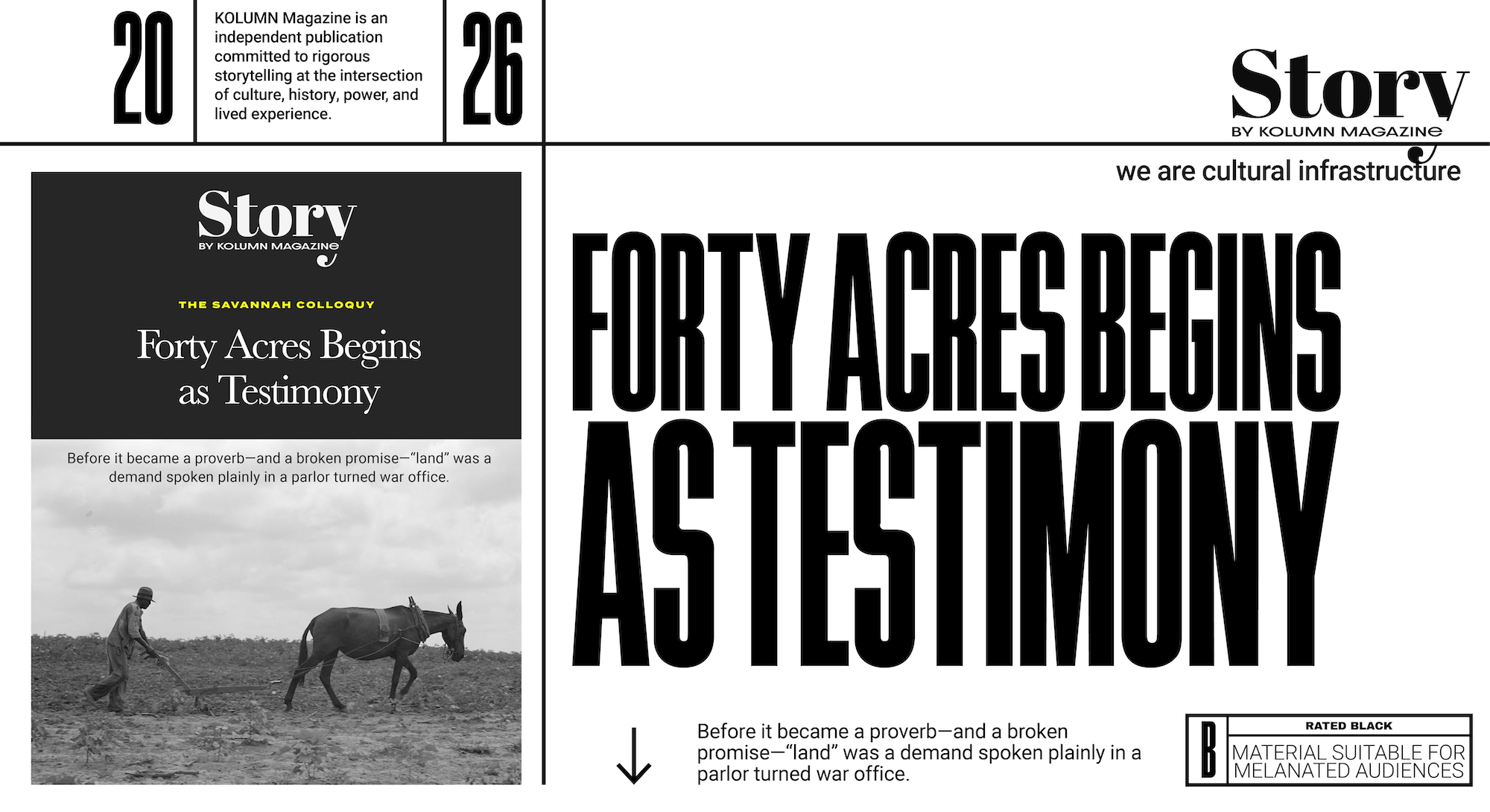
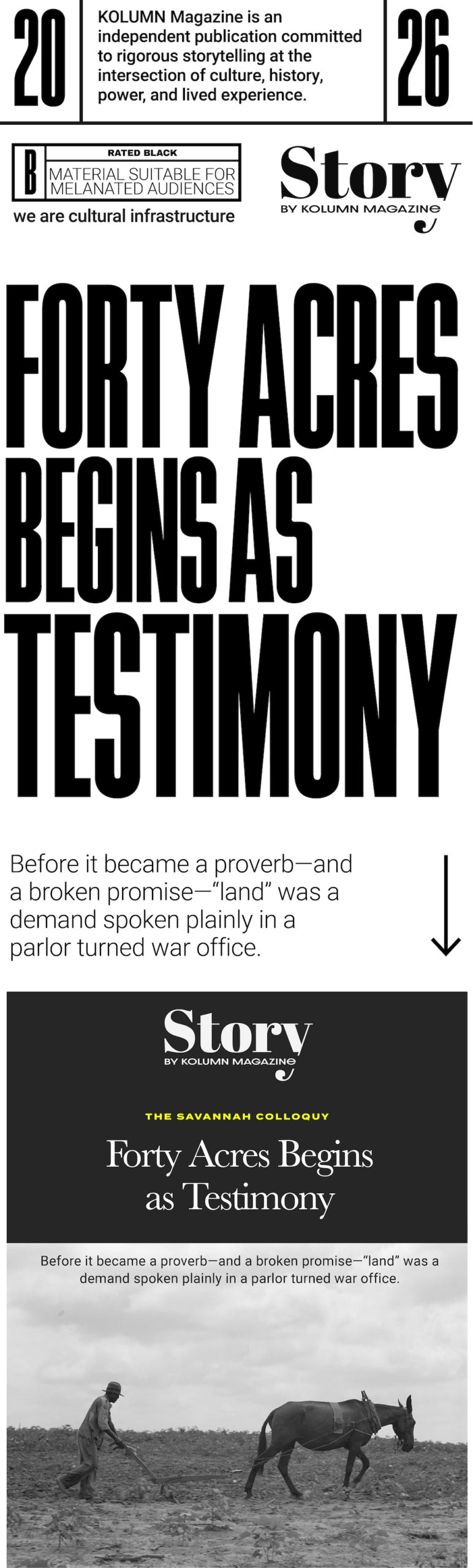
By KOLUMN Magazine
By the second week of January 1865, Savannah was no longer simply a coastal city of squares and spires. It was a hinge in the war—captured, occupied, and suddenly crowded with people the conflict had unshackled but not yet secured. Union blue had arrived with Sherman’s army; freedom had arrived with the army’s movement; and uncertainty arrived with both.
Sherman’s March to the Sea ended in Savannah in late December 1864. In his famous telegram, he offered Lincoln the city as a “Christmas gift”—a military victory packaged as political theater, complete with captured guns and cotton. The March, however, had also produced what commanders tended to call a “contraband problem” and what Black Southerners experienced as something closer to a mass migration: families leaving plantations, trailing the columns, pressing into Union lines, and asking the most basic question a new freedom always asks first—where can we live, and how will we live?
Four months earlier, the country had re-elected Lincoln and, in so doing, reaffirmed a Union war aim that had widened from reunion to abolition. Yet the legal architecture of emancipation remained incomplete. Lincoln’s Emancipation Proclamation was a war measure—powerful, transformative, but tethered to military circumstances and vulnerable to postwar legal challenge. That was one reason abolitionists and Republicans had pushed for a constitutional amendment: a permanent end to slavery that no court, no peace settlement, and no future Congress could easily unwind.
Here is where chronology matters—and where popular memory can compress what was, in real time, a staggered political struggle. The Thirteenth Amendment did not “precede” the Savannah meeting in the sense of having already been fully passed and ratified. In January 1865, it was the central unfinished business of abolition politics: the Senate had approved an abolition amendment in April 1864, but the House had not yet mustered the votes to send it to the states. The House would finally pass it on January 31, 1865—nineteen days after the Savannah Colloquy—before Lincoln signed the joint resolution the next day. Ratification would come in December.
So if the amendment was not yet the law of the land on Jan. 12, why treat it as part of the lead-up? Because in early 1865 the Thirteenth Amendment functioned as a looming threshold: a near-certain transformation of American law that still required political muscle to cross. The amendment fight signaled something to enslaved and newly freed people as surely as it signaled something to Confederate leaders: the federal government was moving from wartime emancipation to constitutional abolition. The legal end of slavery was coming into view, and the question behind it—what freedom would materially consist of—could no longer be postponed.
That is the atmosphere in which Edwin M. Stanton, Lincoln’s Secretary of War, arrived in Savannah to meet Sherman. Stanton’s trip is often described in official terms—inspection, logistics, cotton, command relationships—but it also reflected a deeper anxiety in Washington: the Union could win the war and still lose the peace if emancipation turned into disorder, destitution, and easily reversible improvisation.
The choice Stanton and Sherman made on January 12 was to ask Black Savannah—specifically its religious leadership—to speak for itself.
The result is one of the most revealing primary documents of the Civil War era: a set of meeting minutes first published in the New York Daily Tribune in February 1865 and preserved by the Freedmen and Southern Society Project. The minutes are sometimes summarized into one phrase—“forty acres and a mule”—but the document is not a slogan. It is a deposition of political thought under extraordinary pressure: a concise philosophy of slavery, a theory of freedom, a diagnosis of Southern prejudice, and a practical demand for land as the foundation of independence.
Four days later, Sherman issued Special Field Orders No. 15, setting aside a vast stretch of coastal land for settlement by formerly enslaved people—an order that helped generate the “forty acres” legend and, later, the sense of betrayal when the policy collapsed.
But to understand what happened—and what was lost—you have to begin where the men in that room began: with definitions.

The Savannah Colloquy as a turning point: Freedom defined as ownership
The meeting is sometimes described as a “consultation,” sometimes as an “interview,” and increasingly as a colloquy—a word that implies something more reciprocal than a standard interrogation. Yet the power dynamic was unmistakable. Stanton and Sherman represented the war state: the federal government at its most muscular, armed with occupation authority and backed by the momentum of battlefield success. The twenty Black leaders represented what the government claimed to be fighting for: emancipation as a moral victory, yes, but also emancipation as a social transformation that required structure, resources, and security.
The ministers and church officers who attended were not selected at random. The minutes list their ages, congregational roles, and, crucially, their prewar legal status—enslaved, freeborn, or freed by purchase or will. In miniature, the roster demonstrates the complexity of Black life under slavery: a community that had built institutions even inside bondage, and that had navigated a patchwork of limited freedom, purchased emancipation, and church-based leadership.
Garrison Frazier, a 67-year-old Baptist minister, was chosen as spokesperson. His answers are disciplined, rhetorically careful, and politically lucid. They do not read like the myth of the “grateful freedman.” They read like a man who understood that the end of slavery was not the same thing as the beginning of equality—and that the federal government’s next decisions would determine whether emancipation became independence or dependency.
The key moment comes early, in response to a question about self-support. Frazier answers with an economic thesis:
“The way we can best take care of ourselves is to have land… and we can soon maintain ourselves and have something to spare.”
In one sentence, he links freedom to political economy. Land is not described as charity or reward; it is described as the means by which a people can “reap the fruit” of their labor. And by describing who would work that land—“women and children and old men”—he implicitly sketches the wartime reality: young men enlist, families survive by reorganizing labor, and autonomy requires a resource base.
The document also states, with unusual frankness for its time, that white prejudice is not a misunderstanding but a structural barrier. Asked whether Black people would rather live “scattered among the whites” or “in colonies by yourselves,” Frazier says he would prefer Black settlement because “there is a prejudice against us in the South that will take years to get over.”
This is not separatism as ideology. It is separation as risk management—an attempt to build freedom where it can be defended.
When people cite the Savannah meeting as the origin point of “forty acres and a mule,” they often jump immediately to Sherman’s order, or further still to Andrew Johnson’s reversal and the long afterlife of that broken promise in reparations debates. Those links are real. But the minutes are valuable for another reason: they show Black leadership articulating a coherent vision of post-emancipation life before Reconstruction hardened into policy battles, before the Freedmen’s Bureau expanded and contracted, and before the violent counterrevolution of white supremacy learned how to exploit federal retreat.
In other words, the document is not merely a precursor to a policy. It is a record of Black political intelligence insisting that freedom must be made materially real.
The constitutional horizon: The Thirteenth Amendment and the fear of reversible freedom
The push for the Thirteenth Amendment emerged from a recognition that the Emancipation Proclamation, while epochal, was not enough. It freed enslaved people in areas “in rebellion” as a war measure; it did not reach enslaved people in border states loyal to the Union; and it raised the question every war measure raises: what happens when the war ends?
The Senate’s passage of an abolition amendment in April 1864 was a major step, but the House initially failed to pass it. Lincoln, after winning reelection in November 1864, increasingly treated the amendment as indispensable: a way to lock emancipation into constitutional permanence.
In that light, January 1865 looks like a month of converging deadlines:
The war is nearing its conclusion, but Confederate resistance is not yet broken.
Union armies occupy Southern ground, creating immediate questions of governance.
Enslaved people are emancipating themselves in motion—fleeing, following, laboring, joining lines.
The federal government is about to decide whether abolition will be constitutional fact or merely wartime outcome.
The National Archives summarizes the core arc: Congress passed the Thirteenth Amendment on January 31, 1865, and it was ratified on December 6, 1865. But the Savannah meeting sits inside the narrow gap between moral certainty and legal finality. That gap is where power often tries to manage freedom—by postponing material commitments until after the crisis has passed.
Frazier’s answers read like an attempt to prevent that postponement. He describes slavery as forced labor taken by “irresistible power,” and freedom as the ability to “reap the fruit of our own labor.” The words matter because they redefine emancipation away from mere legal status and toward a practical standard: can you control your work, your body, and the product of your labor?
A constitutional amendment can end slavery. It cannot, by itself, deliver that standard.
That is the policy problem the Savannah Colloquy exposes in real time.
After the questions: Sherman’s order and the birth of a national proverb
On January 16, 1865—four days after the meeting—Sherman issued Special Field Orders No. 15. The order reserved a broad swath of coastal land, including the Sea Islands and a strip of mainland, for the settlement of formerly enslaved people. The Georgia Encyclopedia describes the directive’s scope and its link to the phrase “forty acres and a mule,” while also stressing that Sherman’s motivations included “military expediency”—the urgent need to manage a refugee crisis trailing the army and destabilizing operations. PBS’s historical explainer makes an important correction often lost to folklore: the “40 acres” appears in the order’s settlement logic, but the “mule” is not directly promised in the text, even if the army later lent or redistributed animals in some contexts.
The immediate significance of the order was concrete. It suggested, however temporarily, that the federal government might do more than end slavery—that it might redistribute the South’s most important asset, land, to the people whose labor had built its wealth.
The long-term significance is more tragic. The order became part of a story about reversal—how quickly wartime experiments could be withdrawn once the political center shifted. Over time, it became shorthand for the broader failure to provide economic foundations for Black freedom, a failure that modern reparations advocates often cite as precedent and proof.
But again: Sherman’s order is the aftershock. The Savannah Colloquy is the earthquake. It is where Black leaders told the United States—directly, calmly, and on the record—what emancipation would require.
What follows is the full text of the “Minutes of an Interview Between the Colored Ministers and Church Officers at Savannah With the Secretary of War and Major-Gen. Sherman,” as preserved by the Freedmen and Southern Society Project (originally published as a newspaper account in February 1865).
Full text (primary source): “Minutes of an Interview…” (Savannah, Jan. 12, 1865)
[New York, N.Y. February 13, 1865] Minutes Of An Interview Between The Colored Ministers And Church Officers At Savannah With The Secretary Of War And Major-Gen. Sherman. Headquarters Of Maj.-Gen. Sherman, City Of Savannah, Ga., Jan., 12, 1865–8 P.M.
On the evening of Thursday, the 12th day of January, 1865, the following persons of African descent met by appointment to hold an interview with Edwin M. Stanton, Secretary of War, and Major-Gen. Sherman, to have a conference upon matters relating to the freedmen of the State of Georgia, to-wit:
One: William J. Campbell, aged 51 years, born in Savannah, slave until 1849, and then liberated by will of his mistress, Mrs. May Maxwell. For ten years pastor of the 1st Baptist Church of Savannah, numbering about 1,800 members. Average congregation, 1,900. The church property belonging to the congregation. Trustees white. Worth $18,000.
Two: John Cox, aged fifty-eight years, born in Savannah; slave until 1849, when he bought his freedom for $1,100. Pastor of the 2d African Baptist Church. In the ministry fifteen years. Congregation 1,222 persons. Church property worth $10,000, belonging to the congregation.
Three: Ulysses L. Houston, aged forty-one years, born in Grahamsville, S.C.; slave until the Union army entered Savannah. Owned by Moses Henderson, Savannah, and pastor of Third African Baptist Church. Congregation numbering 400. Church property worth $5,000; belongs to congregation. In the ministry about eight years.
Four: William Bentley, aged 72 years, born in Savannah, slave until 25 years of age, when his master, John Waters, emancipated him by will. Pastor of Andrew’s Chapel, Methodist Episcopal Church–only one of that denomination in Savannah; congregation numbering 360 members; church property worth about $20,000, and is owned by the congregation; been in the ministry about twenty years; a member of Georgia Conference.
Five: Charles Bradwell, aged 40 years, born in Liberty County, Ga.; slave until 1851; emancipated by will of his master, J. L. Bradwell. Local preacher in charge of the Methodist Episcopal congregation (Andrew’s Chapel) in the absence of the minister; in the ministry 10 years.
Six: William Gaines, aged 41 years; born in Wills Co., Ga. Slave until the Union forces freed me. Owned by Robert Toombs, formerly United States Senator, and his brother, Gabriel Toombs, local preacher of the M.E. Church (Andrew’s Chapel.) In the ministry 16 years.
Seven: James Hill, aged 52 years; born in Bryan Co., Ga. Slave up to the time the Union army came in. Owned by H. F. Willings, of Savannah. In the ministry 16 years.
Eight: Glasgon Taylor, aged 72 years, born in Wilkes County, Ga. Slave until the Union army came; owned by A. P. Wetter. Is a local preacher of the M.E. Church (Andrew’s Chapel.) In the ministry 35 years.
Nine: Garrison Frazier, aged 67 years, born in Granville County, N.C. Slave until eight years ago, when he bought himself and wife, paying $1,000 in gold and silver. Is an ordained minister in the Baptist Church, but, his health failing, has now charge of no congregation. Has been in the ministry 35 years.
Ten: James Mills, aged 56 years, born in Savannah; free-born, and is a licensed preacher of the first Baptist Church. Has been eight years in the ministry.
Eleven: Abraham Burke, aged 48 years, born in Bryan County, Ga. Slave until 20 years ago, when he bought himself for $800. Has been in the ministry about 10 years.
Twelve: Arthur Wardell, aged 44 years, born in Liberty County, Ga. Slave until freed by the Union army. Owned by A. A. Solomons, Savannah, and is a licensed minister in the Baptist Church. Has been in the ministry 6 years.
Thirteen: Alexander Harris, aged 47 years, born in Savannah; free born. Licensed minister of Third African Baptist Church. Licensed about one month ago.
Fourteen: Andrew Neal, aged 61 years, born in Savannah, slave until the Union army liberated him. Owned by Mr. Wm. Gibbons, and has been deacon in the Third Baptist Church for 10 years.
Fifteen: Jas. Porter, aged 39 years, born in Charleston, South Carolina; free-born, his mother having purchased her freedom. Is lay-reader and president of the board of wardens and vestry of St. Stephen’s Protestant Episcopal Colored Church in Savannah. Has been in communion 9 years. The congregation numbers about 200 persons. The church property is worth about $10,000, and is owned by the congregation.
Sixteen: Adolphus Delmotte, aged 28 years, born in Savannah; free born. Is a licensed minister of the Missionary Baptist Church of Milledgeville. Congregation numbering about 300 or 400 persons. Has been in the ministry about two years.
Seventeen: Jacob Godfrey, aged 57 years, born in Marion, S.C. Slave until the Union army freed me; owned by James E. Godfrey–Methodist preacher now in the Rebel army. Is a class-leader and steward of Andrew’s Chapel since 1836.
Eighteen: John Johnson, aged 51 years, born in Bryan County, Georgia. Slave up to the time the Union army came here; owned by W. W. Lincoln of Savannah. Is class-leader and treasurer of Andrew’s Chapel for sixteen years.
Nineteen: Robt. N. Taylor, aged 51 years, born in Wilkes Co., Ga. Slave to the time the Union army came. Was owned by Augustus P. Welter, Savannah, and is class-leader in Andrew’s Chapel for nine years.
Twenty: Jas. Lynch, aged 26 years, born in Baltimore, Md.; free-born. Is presiding elder of the M.E. Church and missionary to the department of the South. Has been seven years in the ministry and two years in the South.
Garrison Frazier being chosen by the persons present to express their common sentiments upon the matters of inquiry, makes answers to inquiries as follows:
First: State what your understanding is in regard to the acts of Congress and President Lincoln’s [Emancipation] proclamation, touching the condition of the colored people in the Rebel States.
**Answer–**So far as I understand President Lincoln’s proclamation to the Rebellious States, it is, that if they would lay down their arms and submit to the laws of the United States before the first of January, 1863, all should be well; but if they did not, then all the slaves in the Rebel States should be free henceforth and forever. That is what I understood.
**Second–**State what you understand by Slavery and the freedom that was to be given by the President’s proclamation.
**Answer–**Slavery is, receiving by irresistible power the work of another man, and not by his consent. The freedom, as I understand it, promised by the proclamation, is taking us from under the yoke of bondage, and placing us where we could reap the fruit of our own labor, take care of ourselves and assist the Government in maintaining our freedom.
Third: State in what manner you think you can take care of yourselves, and how can you best assist the Government in maintaining your freedom.
Answer: The way we can best take care of ourselves is to have land, and turn it and till it by our own labor–that is, by the labor of the women and children and old men; and we can soon maintain ourselves and have something to spare. And to assist the Government, the young men should enlist in the service of the Government, and serve in such manner as they may be wanted. (The Rebels told us that they piled them up and made batteries of them, and sold them to Cuba; but we don’t believe that.) We want to be placed on land until we are able to buy it and make it our own.
Fourth: State in what manner you would rather live–whether scattered among the whites or in colonies by yourselves.
Answer: I would prefer to live by ourselves, for there is a prejudice against us in the South that will take years to get over; but I do not know that I can answer for my brethren. [Mr. Lynch says he thinks they should not be separated, but live together. All the other persons present, being questioned one by one, answer that they agree with Brother Frazier.]
Fifth: Do you think that there is intelligence enough among the slaves of the South to maintain themselves under the Government of the United States and the equal protection of its laws, and maintain good and peaceable relations among yourselves and with your neighbors?
**Answer–**I think there is sufficient intelligence among us to do so.
**Sixth–**State what is the feeling of the black population of the South toward the Government of the United States; what is the understanding in respect to the present war–its causes and object, and their disposition to aid either side. State fully your views.
**Answer–**I think you will find there are thousands that are willing to make any sacrifice to assist the Government of the United States, while there are also many that are not willing to take up arms. I do not suppose there are a dozen men that are opposed to the Government. I understand, as to the war, that the South is the aggressor. President Lincoln was elected President by a majority of the United States, which guaranteed him the right of holding the office and exercising that right over the whole United States. The South, without knowing what he would do, rebelled. The war was commenced by the Rebels before he came into office. The object of the war was not at first to give the slaves their freedom, but the sole object of the war was at first to bring the rebellious States back into the Union and their loyalty to the laws of the United States. Afterward, knowing the value set on the slaves by the Rebels, the President thought that his proclamation would stimulate them to lay down their arms, reduce them to obedience, and help to bring back the Rebel States; and their not doing so has now made the freedom of the slaves a part of the war. It is my opinion that there is not a man in this city that could be started to help the Rebels one inch, for that would be suicide. There were two black men left with the Rebels because they had taken an active part for the Rebels, and thought something might befall them if they stayed behind; but there is not another man. If the prayers that have gone up for the Union army could be read out, you would not get through them these two weeks.
Seventh: State whether the sentiments you now express are those only of the colored people in the city; or do they extend to the colored population through the country? and what are your means of knowing the sentiments of those living in the country?
Answer: I think the sentiments are the same among the colored people of the State. My opinion is formed by personal communication in the course of my ministry, and also from the thousands that followed the Union army, leaving their homes and undergoing suffering. I did not think there would be so many; the number surpassed my expectation.
Eighth: If the Rebel leaders were to arm the slaves, what would be its effect?
Answer: I think they would fight as long as they were before the bayonet, and just as soon as soon as they could get away, they would desert, in my opinion.
Ninth: What, in your opinion, is the feeling of the colored people about enlisting and serving as soldiers of the United States? and what kind of military service do they prefer?
Answer: A large number have gone as soldiers to Port Royal [S.C.] to be drilled and put in the service; and I think there are thousands of the young men that would enlist. There is something about them that perhaps is wrong. They have suffered so long from the Rebels that they want to shoulder the musket. Others want to go into the Quartermaster’s or Commissary’s service.
Tenth: Do you understand the mode of enlistments of colored persons in the Rebel States by State agents under the Act of Congress?^{2} If yea, state what your understanding is.
Answer: My understanding is, that colored persons enlisted by State agents are enlisted as substitutes, and give credit to the States, and do not swell the army, because every black man enlisted by a State agent leaves a white man at home; and, also, that larger bounties are given or promised by State agents than are given by the States. The great object should be to push through this Rebellion the shortest way, and there seems to be something wanting in the enlistment by State agents, for it don’t strengthen the army, but takes one away for every colored man enlisted.
Eleventh: State what, in your opinion, is the best way to enlist colored men for soldiers.
Answer: I think, sir, that all compulsory operations should be put a stop to. The ministers would talk to them, and the young men would enlist. It is my opinion that it would be far better for the State agents to stay at home, and the enlistments to be made for the United States under the direction of Gen. Sherman.
In the absence of Gen. Sherman, the following question was asked:
Twelfth: State what is the feeling of the colored people in regard to Gen. Sherman; and how far do they regard his sentiments and actions as friendly to their rights and interests, or otherwise?
Answer: We looked upon Gen. Sherman prior to his arrival as a man in the Providence of God specially set apart to accomplish this work, and we unanimously feel inexpressible gratitude to him, looking upon him as a man that should be honored for the faithful performance of his duty. Some of us called upon him immediately upon his arrival, and it is probable he would not meet the Secretary with more courtesy than he met us. His conduct and deportment toward us characterized him as a friend and a gentleman. We have confidence in Gen. Sherman, and think that what concerns us could not be under better hands. This is our opinion now from the short acquaintance and interest we have had. (Mr. Lynch states that with his limited acquaintance with Gen. Sherman, he is unwilling to express an opinion. All others present declare their agreement with Mr. Frazier about Gen. Sherman.)
Some conversation upon general subjects relating to Gen. Sherman’s march then ensued, of which no note was taken.
Reading the minutes as a blueprint—and a warning
If you read the Savannah Colloquy quickly, you might come away with one headline: land. Read it slowly and you see something broader: a theory of citizenship drafted by people who understood that emancipation could be undermined through labor coercion, political exclusion, and racial violence even after slavery’s formal end.
Three themes in the minutes are especially consequential.
1) Slavery is defined as theft, not “status”
Frazier’s definition—labor taken by “irresistible power” without consent—frames slavery as economic extraction enforced by violence. This matters because it implies that freedom is not achieved merely when chains are removed; it is achieved when extraction stops. The definition anticipates later debates about convict leasing and coerced labor under the “punishment” exception clause in the eventual Thirteenth Amendment. (The amendment abolished slavery and involuntary servitude “except as a punishment for crime,” a clause that would become historically significant in the postwar South.)
2) Freedom is framed as self-sustaining political economy
Frazier does not ask the government to provide lifelong support. He asks it to create conditions under which Black families can sustain themselves: land, protection, and time to purchase ownership. The phrasing—“until we are able to buy it and make it our own”—is also telling. It assumes markets, contracts, and property rights, but it refuses the idea that freedom must be rented from former enslavers through dependency.
This is where the meeting becomes a direct antecedent to Special Field Orders No. 15. Georgia’s encyclopedia notes that the meeting helped precipitate the order and that the order became an enduring symbol in reparations discourse—even though it was later revoked and did not yield lasting material benefit.
3) Prejudice is treated as durable infrastructure
Asked how they would rather live, the ministers do not claim that freedom will dissolve racism. They explicitly say the opposite: prejudice will last “years,” and therefore Black communities must have room to build strength together.
That diagnosis is not pessimism. It is strategy.
And it clarifies why the “forty acres” idea remains potent: it represents a moment when the federal government seemed, however briefly, to acknowledge that racial equality could not be achieved solely through declarations. It would require resources.
The policy afterlife: From Sherman’s order to a national argument over reparations
Special Field Orders No. 15 is often described as the first large-scale federal experiment in land redistribution for freedpeople. Its text and implementation history are complex, and historians continue to debate whether it should be interpreted primarily as humanitarian policy, military necessity, or the seed of a reparations logic.
But several points are well supported in the record:
The order followed immediately after the Savannah meeting and addressed a refugee and labor crisis in the wake of Sherman’s campaign.
The “forty acres” element is rooted in the order’s settlement scheme; the “mule” is more folklore than formal promise, though the army’s material support contributed to the phrase’s credibility.
The order’s symbolic power outlived its practical benefits, becoming a touchstone in later debates about federal obligation and Black dispossession.
In modern journalism and scholarship, the Colloquy and the order are frequently cited in discussions of reparations precisely because they capture a moment when government actors appeared to recognize a principle that would later be denied: that emancipation without assets can become freedom without leverage. A Washington Post history report on reparations debates references Sherman’s order as an early governmental act sometimes described by historians as a first move toward reparative policy, even as its promise collapsed. The Guardian, in a broader treatment of reparations logic, situates these historical precedents inside a continuing argument about what repair requires—money, land, institutional change, and community consent.
What is striking, returning to the minutes, is how little of this is abstracted. The ministers did not speak in the language of later theory. They spoke in the language of survival.
They said: define slavery, define freedom, and then give us land so we can live.
What the Savannah Colloquy ultimately reveals
The Savannah Colloquy is not just a meeting “about” freedpeople. It is freedpeople—through their chosen leaders—stating terms to the United States at the moment the nation was deciding whether abolition would be a legal endpoint or the beginning of a new political economy.
It also clarifies a central irony of American emancipation: the federal government could mobilize immense force to end slavery as a war aim, but it hesitated—then retreated—when the same freedpeople asked for the resources that would make freedom resilient.
In the minutes, Frazier offers a sentence that functions as both proposal and prophecy: prejudice will take years to get over. He was right. The question the meeting leaves behind is whether the United States ever fully confronted what his realism implied: that ending slavery was not the same as building a democracy capable of protecting the formerly enslaved.
The Thirteenth Amendment would pass later that month and, by year’s end, become the Constitution’s declaration that slavery had no legal future here. The Savannah ministers were asking about something harder: whether Black freedom would have an economic foundation strong enough to survive the country’s political moods.
The record shows they already understood the stakes. Their government was still deciding whether it did.