
By KOLUMN Magazine
The Wicked moment—and the memory it unlocks
Every few generations, America re-enters Oz as if returning to a childhood neighborhood that keeps changing zoning laws. New storefronts appear. The old corner shop is gone. Someone’s childhood tree has been replaced with a luxury development, but the street names remain. You can still find your way by the familiar landmarks: the road, the storm, the city that gleams, the promise that you can go home again.
The most recent return—Wicked, now a two-film event—has done what big entertainment is supposed to do: turn a shared story into a shared season. It reignited the appetite for musical spectacle, for origin stories, for behind-the-curtain politics, and for the comforting paradox Oz always provides: it is fantasy that insists it is also a civic lesson. The “good” and “wicked” are not natural facts; they are categories administered by power, stage-managed in public, policed with costumes and slogans. In Wicked, Oz becomes a place where propaganda is choreography and reputation is a special effect—a premise that has only become more legible to modern audiences as public life itself has turned theatrical.
But Oz has always been an adaptation machine, and America is rarely satisfied with one telling at a time. Which is why Wicked’s triumph has sent people back—not only to the 1939 film, or to Gregory Maguire’s revisionist novel and the Broadway juggernaut it inspired, but to the earlier reinventions that tried to relocate Oz inside other American truths. The Guardian, in a recent meditation on the enduring appeal of The Wizard of Oz and its many afterlives, places Wicked on a lineage that includes The Wiz—a reminder that Oz has been remade, repeatedly, as a way of remaking America’s self-image.
That reminder matters because The Wiz occupies a peculiar position in the nation’s cultural archive: a work that is simultaneously canon and counter-canon. It is widely known, often loved, frequently referenced—and yet still treated, in many mainstream accounts, as a curiosity, an extravagant detour, a well-intentioned misfire.
In Black America, the story is usually more complicated, and more intimate. The Wiz is Thanksgiving television. It is “Ease on Down the Road” sung in living rooms by people who can’t remember where they first learned it. It is a particular kind of Black imaginative permission: the claim that fantasy is not the sole property of white innocence, that spectacle can belong to Black performers without requiring caricature, and that an all-Black cast can do more than “represent”—it can re-author the nation’s myths.
And yet, the film version of The Wiz—Sidney Lumet’s 1978 adaptation of the 1970s Broadway phenomenon—arrived with a burden that was both aesthetic and political: it was asked to be a hit, a statement, a corrective, a celebration, and a proof of concept for an industry that has historically demanded Black artists “prove” their market value in genres that whiteness already dominates. When the film underperformed, it wasn’t simply reviewed as a movie. It was audited as an argument.
Nearly five decades later, with Wicked demonstrating once again that audiences will show up for Oz when the machinery is right, The Wiz deserves to be revisited as more than a footnote. It deserves to be understood as a Black cultural landmark that collided with Hollywood’s anxieties—and as a film whose cast carried into Oz the full weight of their own careers, ambitions, and negotiations with power.



Before the movie: A Black Broadway revolution that changed the terms
To understand what the 1978 film was trying to do—and why it remains such a charged artifact—you have to start not with a camera but with a stage.
The Wiz began as a theatrical intervention. Premiering in the mid-1970s, it was an all-Black musical reimagining of L. Frank Baum’s story that didn’t simply swap faces; it re-centered sensibility. The language, the humor, the rhythms, the references—everything signaled that this Oz belonged to Black America’s expressive traditions. It was also, crucially, a mainstream Broadway event, winning major awards and marking a moment of institutional recognition for a Black-cast musical on the biggest commercial stage.
Its afterlife has only strengthened its case as cultural heritage: the original Broadway cast recording was selected for preservation in the Library of Congress’s National Recording Registry—one of the nation’s formal ways of declaring that a work is not merely popular, but historically and aesthetically significant.
So by the time Hollywood came calling, the story already had stakes. This was not a modest cult property being given a chance. This was a proven phenomenon being asked to translate itself into a different industrial language: bigger budgets, wider distribution, a more punitive review economy, and a financing system that insisted star power was the most reliable form of insurance.
From the start, that insurance logic shaped the film.
The movie’s central gamble: Star power as financing, adulthood as reinterpretation
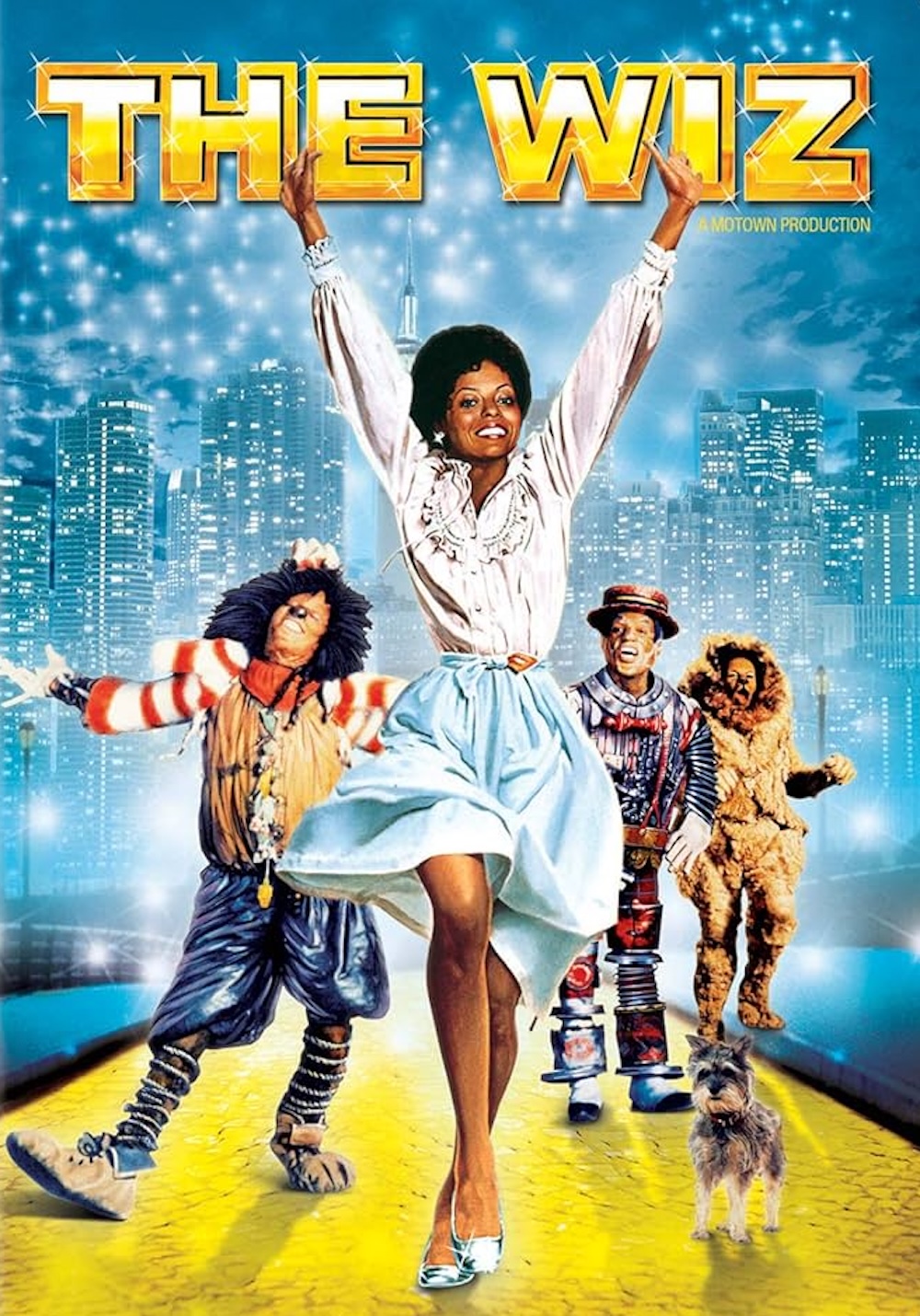
The film The Wiz was produced by Universal Pictures and Motown Productions, filmed largely in New York City, and released in 1978. The creative team alone carried a kind of institutional drama: Sidney Lumet, a director celebrated for serious urban films, was now asked to steer a fantasy musical; Quincy Jones was tasked with supervising and expanding a beloved score for the screen.
But the most consequential decision wasn’t behind the camera. It was the face of Dorothy.
On Broadway, Dorothy had been originated by Stephanie Mills—youthful, electric, and vocally definitive for many fans of the stage production. Motown founder Berry Gordy, by several accounts, initially wanted that continuity. But Diana Ross—already a superstar—wanted the role in the film. And she pursued it with the kind of leverage only a star can deploy: she effectively made her casting the condition for the film’s financial momentum, a negotiation described even by chroniclers as a decisive act of will.
This is where The Wiz becomes a parable not only about art but about Hollywood’s deal-making. Ross did not simply audition for Dorothy; she functioned as a financing instrument. The logic was blunt: the film would be more fundable, more marketable, and more “bankable” with Ross at the center. In exchange, the story shifted: Dorothy became an adult—often described as a Harlem schoolteacher—rather than a child.
That change has been argued over ever since. To some critics, it strained the tale’s innocence. To many Black viewers, it did something else: it made Dorothy legible as a Black woman in the city—an adult carrying responsibilities, anxieties, and self-doubt that were not childish but socially produced. It turned Oz into a site of grown-up self-recognition.
And it set the tone for the film’s other casting choices: a blend of Broadway continuity and celebrity magnetism, assembled into a constellation that—on paper—looked unstoppable.
Dorothy: Diana Ross.
Scarecrow: Michael Jackson.
Tin Man: Nipsey Russell.
Cowardly Lion: Ted Ross.
Glinda: Lena Horne.
The Wizard: Richard Pryor.
The Wicked Witch of the West—reimagined as Evillene—was played by Mabel King, who, like Ted Ross, carried stage lineage into the film.
If you want to understand The Wiz as a Black Hollywood moment, you can read that cast list as a map of Black entertainment’s 1970s power structure: Motown royalty, comedy royalty, jazz-and-nightclub royalty, Broadway veterans, and a pop prodigy at the pivot point of American celebrity.
And yet, power structures do not automatically produce harmony. Each of these performers arrived at the role through their own negotiations—artistic, personal, and political—about what Oz should be, what it could do for them, and what it might cost.
Dorothy: Diana Ross and the politics of insisting
Diana Ross’s Dorothy remains the film’s most contested element, which is precisely why it is so revealing.
By 1978, Ross was not merely famous; she was institutionally significant. She had been the face of The Supremes, a central architect of Motown’s crossover, and a solo star who understood, better than most, how narratives of Black femininity were packaged for white-dominant markets. Taking Dorothy was not just a role choice; it was an act of authorship.
In the film’s development history, Ross’s desire to play Dorothy is often described as the hinge that forced the production into being, even against initial objections about age appropriateness. Critics at the time took the age shift as a conceptual problem. But Ross’s insistence can also be read as a sophisticated bet: that Dorothy, when played as an adult Black woman, could carry emotional and thematic weight that a child could not.
In other words, Ross wasn’t trying to recreate Judy Garland. She was trying to create a Dorothy who belonged to another America—one where “home” is not simply a house but a psychic location, a place you fight to feel entitled to.
That intention is embedded in the film’s most famous Dorothy number, “Home,” which—regardless of how one feels about the movie’s overall tone—has survived as a standalone standard. Even in eras when the film is dismissed, “Home” persists, passed from singer to singer as if it were part of an informal Black songbook.
Ross’s performance is also inseparable from the film’s New York setting: this Dorothy is not swept away from a farm; she is swallowed by a city, and Oz feels like the city’s dream logic rearranged. The adult Dorothy becomes a way to talk about adulthood itself: fear as a civic condition, loneliness as an urban weather system, and wonder as something you have to choose rather than inherit.
What Ross accepted, along with the role, was the responsibility of being the film’s symbolic center. If the movie worked, Dorothy would be credited. If it failed, Dorothy would be blamed. That is the tax of insisting.
The Scarecrow: Michael Jackson at the threshold of metamorphosis
If Ross carried the film’s financing logic, Michael Jackson carried its future.
When The Wiz was filmed, Jackson was in an in-between state: no longer simply the child star of the Jackson 5, not yet fully the solo artist who would reorder global pop. The Washington Post later described The Wiz as the first major film window into Jackson at this post-adolescent threshold—already performing a kind of androgynous, elastic persona that would become part of his signature.
Casting Jackson as the Scarecrow was, on the surface, an intuitive move: a gifted dancer and singer playing a character defined by physicality and yearning. But it also functioned as a narrative metaphor: the Scarecrow wants a brain, a legitimacy, a proof that he is more than what others see. Jackson, too, was seeking a redefinition—an adult artistry that could outgrow the categories assigned to him.
Contemporary reception often singled Jackson out as a bright spot even in critiques that found the film unwieldy. This is not incidental. Jackson’s Scarecrow is the character most aligned with the musical’s kinetic joy; he moves like liberation itself. Even viewers who find the film’s visual palette heavy tend to remember Jackson’s lightness—the way he seems to float above the film’s industrial anxieties.
For Jackson, accepting the role can be seen as a strategic expansion: film acting as one more arena in which to prove range. But it is also possible to read it as a moment of containment: he is astonishing, yet trapped inside a film that could not fully organize its own gifts. That tension—brilliance inside constraint—would echo throughout Jackson’s later public life.
The Tin Man: Nipsey Russell and the art of seasoned comedy
Nipsey Russell’s Tin Man carries a different kind of star power: the veteran’s authority.
Russell had long been a fixture in American entertainment—stand-up, television, variety circuits—an artist whose presence could signal warmth, wit, and credibility. As the Tin Man, he is tasked with embodying a character defined by the absence of a heart, which, in musical logic, usually means the actor must generate extra humanity to make the “lack” poignant.
Russell’s Tin Man does something quietly subversive: he plays the role not as a robotic blankness but as a man using humor as armor. That choice aligns with a long Black performance tradition—comedy as a survival technique, a way of transforming social harshness into something you can hold.
In the original 1978 critical landscape, many reviews argued over style, lighting, and the film’s departure from fairy-tale brightness. But within that debate, the Tin Man’s function is almost sociological: he is the character who makes emotional absence speakable without collapsing into sentimentality. He shows how a person might “lack a heart” not because they are unfeeling, but because feeling has been made too costly.
The Cowardly Lion: Ted Ross bringing Broadway’s roar to the screen
Ted Ross, who had played the Lion on Broadway, carried continuity into the film. That matters because The Wiz was not only adapting a story; it was adapting a performance history, a set of choices audiences already loved.
Ross’s Lion is not simply afraid; he is proud, flamboyant, bruised by his own self-disappointment. He is a portrait of masculinity wrestling with its own myth. The “cowardice” becomes less a punchline than an emotional condition: the gap between who you are expected to be and who you feel you are.
In Black community reception, Ross’s Lion has often been remembered with affection because he turns the character into a kind of uncle figure—big personality, big voice, big vulnerability. In a Hollywood ecosystem that too often narrowed Black male roles into menace or buffoonery, the Lion offered something else: a theatrical Black masculinity that was comedic without being dehumanized.
Ross’s acceptance of the film role can be read as loyalty to the property that helped make him, and as a bid to translate Broadway success into screen immortality. It is also, inevitably, a negotiation with scale: what plays as joyous exaggeration on stage can read differently on film, where the camera registers everything as “real.” Ross had to calibrate the Lion so that the character’s outsized performance remained emotionally legible.
Glinda: Lena Horne as glamour, history, and the “event” of presence
If Ross insisted and Jackson shimmered, Lena Horne arrived as history.
Horne’s Glinda is not merely a character; she is an apparition of Black elegance inside a genre that, in mainstream American imagination, had been coded white. Her casting was treated as an event—an acknowledgment that her mere presence carried cultural meaning beyond the scene’s immediate needs.
Horne had lived through Hollywood’s older rules: the era when Black performers were simultaneously desired and segregated, included and edited out, showcased and constrained. By the late 1970s, she was a legend whose career symbolized both triumph and the cost of navigating racist systems.
So what does it mean for such a figure to accept Glinda?
It means Glinda becomes more than “good.” She becomes ancestral—like a glamorous guardian who has seen the industry’s ugliness and refuses to let it define the fantasy. Horne’s performance brings a tonal shift: she makes Oz feel like a place where Black glamour is not a novelty but a governing aesthetic.
Her acceptance can also be read as a reclamation. To appear in The Wiz was to endorse a Black retelling of a national myth, to declare that this story, too, could belong to Black artistry without apology.
The Wicked Witch of the West: Mabel King’s Evillene and the anatomy of menace
In The Wiz, the Wicked Witch of the West is transformed into Evillene—played by Mabel King—an antagonist whose power is industrial, urban, and explicitly exploitative.
King was already a recognizable figure—robust presence, sharp timing, a performer who could command a room. As Evillene, she is asked to embody something more than wickedness: a system. This is one of the film’s most pointed departures from earlier Oz tellings. Evillene is not simply a personal villain; she presides over a world of forced labor and degradation, a nightmare that maps uncomfortably onto real American histories.
This is where The Wiz’s significance in the Black community often becomes most explicit. The film’s Oz is not an abstract fairyland; it is a distorted reflection of urban America, where Black bodies are policed, used, and mocked. Evillene, in this reading, is not just a witch—she is an administrator of dehumanization.
King’s acceptance of the role can be seen as a willingness to play power without softening it. In a genre that often renders villainy as camp, Evillene can feel like something harsher: a face for the machinery that grinds people down.
The Wizard: Richard Pryor and the complicated charm of the man behind the curtain
Richard Pryor’s Wizard is the film’s most conceptually loaded casting decision.
Pryor, by the late 1970s, was not merely popular—he was a cultural force, a comedian whose work exposed American hypocrisy with surgical cruelty and tenderness. Casting him as the Wizard aligns with Oz’s core twist: the great authority is, in fact, a performer, a charismatic hustler, a man whose power is theatrical.
Pryor understood theatrical authority better than most. His comedy dissected the lies America tells itself; his public persona carried both brilliance and volatility. Put him behind Oz’s curtain and you get a potent metaphor: the Wizard as a Black man improvising power inside a system that expects him to be either clown or threat.
Pryor’s acceptance also reflects Hollywood’s appetite for his charisma at the time—an appetite that did not always translate into humane working conditions or coherent vehicles. The Wizard is less a fully developed character than a gravitational cameo, but Pryor’s presence supplies the necessary ambiguity: he is charming enough to seduce, fragile enough to expose the scam.
Hollywood’s reception: The film as a referendum
When The Wiz arrived in 1978, some critics recognized the density of talent involved and felt the sadness of watching it struggle to cohere. TIME’s review captured this ambivalence—acknowledging the “wit and talent and energy” while concluding the production “never had a chance,” in part because the cultural comparison machine would not stop grinding it against The Wizard of Oz (1939), even though The Wiz was not a remake so much as a cousin.
The Washington Post’s contemporary review framed the story as an enduring fable about virtues—scrutiny, intelligence, compassion, valor—while also measuring the film in relation to the Oz tradition it was inevitably judged against.
And Pauline Kael, writing in The New Yorker, treated the film as a high-profile cultural object worthy of major critical attention—part of the proof that this was not a small experiment but a mainstream event being held to mainstream standards.
But what often gets lost in the shorthand (“flop,” “misfire”) is how the film functioned industrially. When big-budget Black-led projects stumble, Hollywood historically treats the stumble as data: evidence that Blackness is the risk, rather than the script, the strategy, the marketing, or the studio’s own fear. The burden of representation becomes the burden of profitability.
This is why The Wiz’s significance in Black America is inseparable from its significance in Hollywood. The film did not simply disappoint some critics; it became part of the industry’s mythology about what Black-led spectacle could and could not do. It was used—implicitly and sometimes explicitly—as a cautionary tale.
And yet the story did not end where the box office ended.
The afterlife
In the decades after 1978, The Wiz achieved what many “successful” films never do: it embedded itself in ritual.
It became a television staple. Its songs became standards. Its images—the subway tunnels, the gleaming city, the stylized decay—became part of a Black visual archive of late-20th-century New York fantasy. It also became a template that later productions would revisit, revise, and honor.
The stage property remained alive through revivals and reinventions, including major modern re-engagements such as The Wiz Live! and renewed Broadway interest in the 2010s and 2020s. The point is not that every revival is perfect; it is that the story keeps returning, because the need it meets—the need for Black-centered wonder—does not go away.
When Quincy Jones was honored at the 2025 Oscars, “Ease on Down the Road” surfaced again in a high-profile tribute—an emblem of how deeply the music has traveled beyond the film’s initial reception.
This is what endurance looks like: the culture keeps the work, even when the marketplace punishes it.
What The Wiz gave Black America—beyond nostalgia
It is easy, especially in an era of constant remakes, to talk about The Wiz as nostalgia. But nostalgia is too small a word for what the film represents in Black American cultural life.
It expanded the genre map.
The Wiz insisted that Black performers could occupy fantasy without translation. Not “Black fantasy as parody,” not “Black fantasy as niche,” but Black fantasy as mainstream mythmaking.
It treated Black urban life as a legitimate site of wonder.
The film’s Oz is built from city textures—industrial spaces, public infrastructure, architectural ruins. Whether one finds that choice aesthetically successful, it is conceptually radical: the city is not merely danger; it is the raw material of dream.
It offered an emotional vocabulary for grown-up longing.
Dorothy’s “Home” is not a child’s wish; it is an adult’s prayer. That shift matters in a community where “home” has often been threatened—by economic precarity, by migration, by policy, by violence.
It assembled a Black star constellation without asking whiteness to validate it.
The cast did not need a white co-star to “anchor” the project. That alone remains a political fact, even now.
A road that keeps opening
If the first life of The Wiz was shaped by resistance—industrial caution, critical impatience, and the weight of being asked to “prove” something larger than itself—its second, third, and fourth lives have been defined by something more durable: recognition.
Recognition that the film did not fail at imagining, but arrived early. Recognition that its ambition was not excess, but confidence. Recognition that Black artists placing themselves at the center of a classic American myth was not a gimmick, but an assertion of belonging.
This is the context in which the success of Wicked feels less like a contrast and more like a continuation. Wicked’s embrace of political allegory, moral revision, and spectacle-driven sincerity confirms what The Wiz already understood: Oz is most alive when it reflects the real world’s inequities and aspirations back to itself. When fantasy tells the truth sideways.
What time has given The Wiz—and what it was denied in 1978—is breathing room. Removed from the immediate pressures of box office scorekeeping, the film can now be seen as a cultural bridge: between Broadway and Hollywood, between Black urban realism and mythic imagination, between the Civil Rights era’s unfinished work and the aesthetic self-determination that followed. Its songs did not vanish; they migrated. Its images did not fade; they lodged themselves in memory. Its casting did not date; it became archival proof of a moment when Black excellence gathered in one place and refused to minimize itself.
Today, The Wiz is less a referendum than a resource. It is studied, revived, sampled, quoted, and re-staged not because it was perfect, but because it was generous. It made room—for Black joy, for Black vulnerability, for Black spectacle on a scale that did not ask permission. It showed that fantasy could hold lived experience without losing wonder, and that home could be something you build internally as much as something you return to.
The yellow brick road, as it turns out, was never a straight line. It curves through decades, through reinterpretations, through moments of doubt and rediscovery. The Wiz did not close that road; it widened it. And every new journey into Oz—whether triumphant, contested, or transformative—walks a little more easily because that path was laid.
Ease on down. The road is still open.