

The Chef
Who Won Oklahoma
City
Andrew Black’s menus don’t just travel. They remember—Jamaica, Europe, Deep Deuce—and now, a restaurant named for his grandmother.
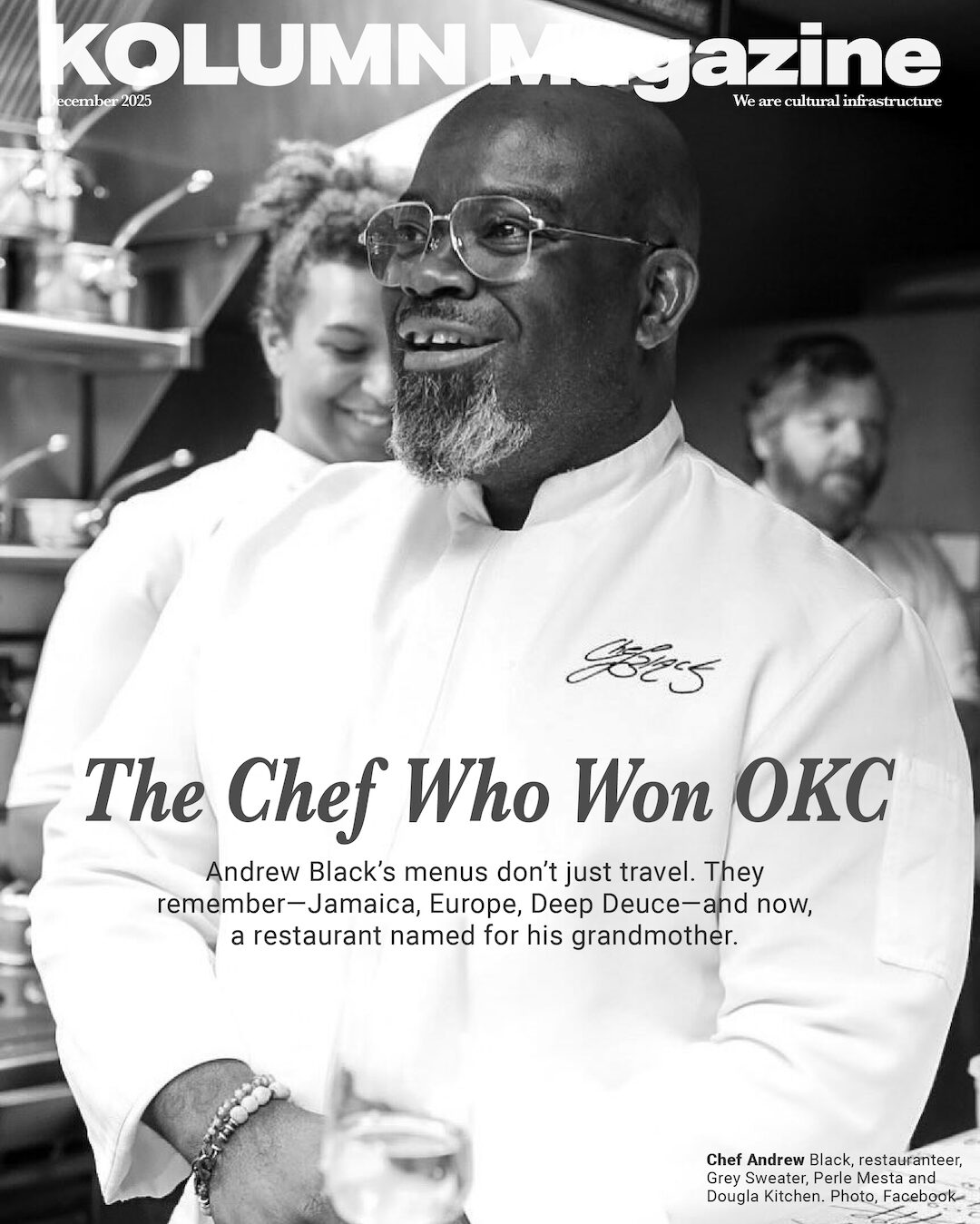
By KOLUMN Magazine
Before Oklahoma City became the place where Chef Andrew Black would collect the country’s most visible culinary validation—Best Chef: Southwest at the James Beard Awards—there was a more elemental education, one that began without stainless steel or formal brigades. Black has spoken of a childhood in Jamaica shaped by Indo-Jamaican traditions, where cooking was not a profession so much as a fact of daily life. His grandmother Elizabeth cooked roti over fire, and as a boy he was sometimes tasked with building outdoor clay ovens for her, learning—without vocabulary for it yet—how heat moves, how dough responds, how patience becomes flavor. It was an apprenticeship rooted in necessity and intimacy, the kind that leaves a physical memory in the hands.
That early grounding would later make sense of a far more formal education. As a young man, Black moved into professional kitchens in the United States, working in resort and hotel environments that prized consistency, scale, and discipline. These were not glamorous rooms, but they were exacting ones: places where repetition teaches muscle memory and where a young cook learns that precision is a form of respect—for ingredients, for colleagues, for guests who may never know your name. In those kitchens, Black absorbed the operational side of hospitality, the invisible systems that allow warmth to feel effortless.

Europe sharpened the blade. Black’s time training abroad—most notably staging at the Ritz in Paris—immersed him in the rigor of classical technique and the unforgiving standards of haute cuisine. In that world, mistakes are not corrected with charm; they are eliminated through repetition and humility. Sauces are judged by texture as much as taste, plating is architecture, and time itself becomes an ingredient. For Black, the experience provided not only technical fluency but contrast: a counterweight to the improvisational cooking of his childhood. Where his grandmother’s kitchen taught intuition, Europe taught structure. The two would eventually fuse.
By the time Black arrived in Oklahoma City in 2007, he carried both worlds. He came to help lead the reopening of the historic Skirvin Hotel, stepping into a role that required managerial clarity as much as culinary vision. It was here, in a city rarely described as a fine-dining destination, that his training converged. The European discipline allowed him to build systems that worked; the Caribbean inheritance gave him a reason to keep them human. What was meant to be a professional stopover became a long-term commitment—to a city, to its dining public, and to the idea that excellence did not have to migrate toward the coasts to be legitimate.
That belief underpins everything that followed. Grey Sweater would later distill his training into a menuless tasting room that relies on trust rather than instruction; Perle Mesta would translate classical hospitality into a modern, all-day room built on possibility; Dougla Kitchen would finally place his earliest culinary language—Indo-Caribbean, communal, ancestral—at the center of the table. Seen together, the arc is not accidental. It moves from clay ovens to European palaces to Midwestern reinvention, from learning how food sustains a family to proving how it can anchor a city.
Andrew Black’s career, then, is not a story of departure and arrival so much as accumulation. Each kitchen added a layer—technique, discipline, scale, empathy—until Oklahoma City became not a compromise but a canvas.





Grey Sweater: The menu-less room where the “ambassadors” guide the night
Website: Grey Sweater
At Grey Sweater, the first thing you learn is that the usual rules are negotiable. The menu—normally the diner’s map, the restaurant’s contract—isn’t really the point here. Andrew Black has been explicit about why: he wants guests to pay attention to the experience, to “dig deep,” to let the meal become something remembered rather than merely documented. In the Andscape profile published after his James Beard win, he frames the restaurant as an “emotional journey,” one designed to leave a memory “up here,” he says, tapping his head.
This is not minimalism for minimalism’s sake. Grey Sweater is built like theater. It is a 48-seat room where the staff are not simply servers but “ambassadors,” a term Black uses to convey responsibility and intention—representing him, the room and themselves. Even the name is an argument: “grey,” he says, has no allegiance, and therefore no obligation to nostalgia. The “sweater” is the opposite impulse: the insistence that, at the end of the night, what matters is how the place made you feel.
The mechanics reinforce the philosophy. Grey Sweater’s tasting menus operate in tiers—seven courses and ten courses, with pricing publicly listed—yet the signature is not the structure but the fluidity. Dishes change month to month; the point is to keep moving, to prevent a “greatest hits” mentality from hardening into complacency. And when Black talks about what encapsulates the approach, he reaches not for luxury but for a turnip—served in coconut and cilantro sauce—precisely because a printed menu description would not do it justice. He wants the guest to trust the room enough to taste first, judge second.
The same contrarian confidence shows up in smaller choices, like Grey Sweater’s water menu—ten countries, a kind of quiet dare in a place outsiders still stereotype as plainspoken. Black tells the story like a punchline that became truth: people said it wouldn’t last, yet guests now order water tastings and discover—often with surprise—that “water is just water” is not actually a fact.
Grey Sweater also sits in Deep Deuce, a historically Black Oklahoma City neighborhood once known as a jazz hub. Black has described how he initially chose the location without fully understanding its history—and how, afterward, a friend texted him a charge that landed like an inheritance: make the neighborhood proud. The restaurant’s ambition, then, is not only personal but geographic: a room in Oklahoma dedicated to the proposition that fine dining can be both experimental and rooted, both worldly and accountable to the ground beneath it.
Grey Sweater is where Black’s career became legible to the nation. But inside the restaurant’s logic, it is also something else: the place where he proved—to himself and to a city still negotiating its own reputation—that the most radical move is to treat warmth as the highest form of technique.
Dougla Kitchen: Replacing Black Walnut with a love letter to Elizabeth
Website: Dougla Kitchen
If Grey Sweater is Andrew Black’s argument for reinvention, Dougla Kitchen is his argument for return.
The restaurant—scheduled to open February 14, 2026—will replace Black Walnut, the concept Black opened in 2019 and plans to close on New Year’s Eve 2025. In interviews about the transition, he has described the decision with the language of completion: when the painting is finished, you sign the bottom and move on. The metaphor matters because it suggests what he thinks a restaurant is: not a machine that prints the same successes nightly, but an artwork with a natural end.
Dougla Kitchen’s beginning is explicitly familial. Black has said the menu is a tribute to his grandmother Elizabeth—“a note” of gratitude for flavors, spices and integrity, and for seeing his dream before he knew what to dream. The Dougla Kitchen site frames the concept as his first turn inward, after years of pushing outward into experiments and cosmopolitan technique: honoring roots, memories, and the woman who guided him toward cooking.
Even the name is a thesis. “Dougla” is a Caribbean term referring to mixed Indian (South Asian) and African ancestry, used especially in Trinidad and across the region; the site foregrounds the word’s history and the way identity can be both descriptive and contested. Black’s own framing is clear: this isn’t fusion as trend, but lineage as cuisine.
In a local interview about the rebrand, he positioned Dougla as the restaurant people have been asking him to cook for years—the food he grew up on, the culture he hasn’t fully centered in his Oklahoma concepts yet. He has also acknowledged the timing: had he opened this first, he suspects, it might not have worked. Not because the food is lesser, but because the audience—and perhaps the city—needed to learn his language before he spoke his most personal dialect.
The details released so far suggest an atmosphere designed to echo community rather than exclusivity. Black has talked about community tables—because when he was growing up, “we’d always eat together”—and a companion “Dougla Lounge,” imagined as a refined nightlife and live-music space. The restaurant’s branding nods to blended cultures: flame for heat and spice, green leaf for freshness, yellow flower for new beginnings and ingredients associated with Caribbean fruit and South Asian spice.
Dougla Kitchen, in other words, is not simply the next restaurant. It is an attempt to reconcile the public Andrew Black—the Beard winner, the chef who made Oklahoma City a headline—with the private origin story: a grandmother, a clay oven, and an inheritance of flavor that has waited, patiently, for the right room.
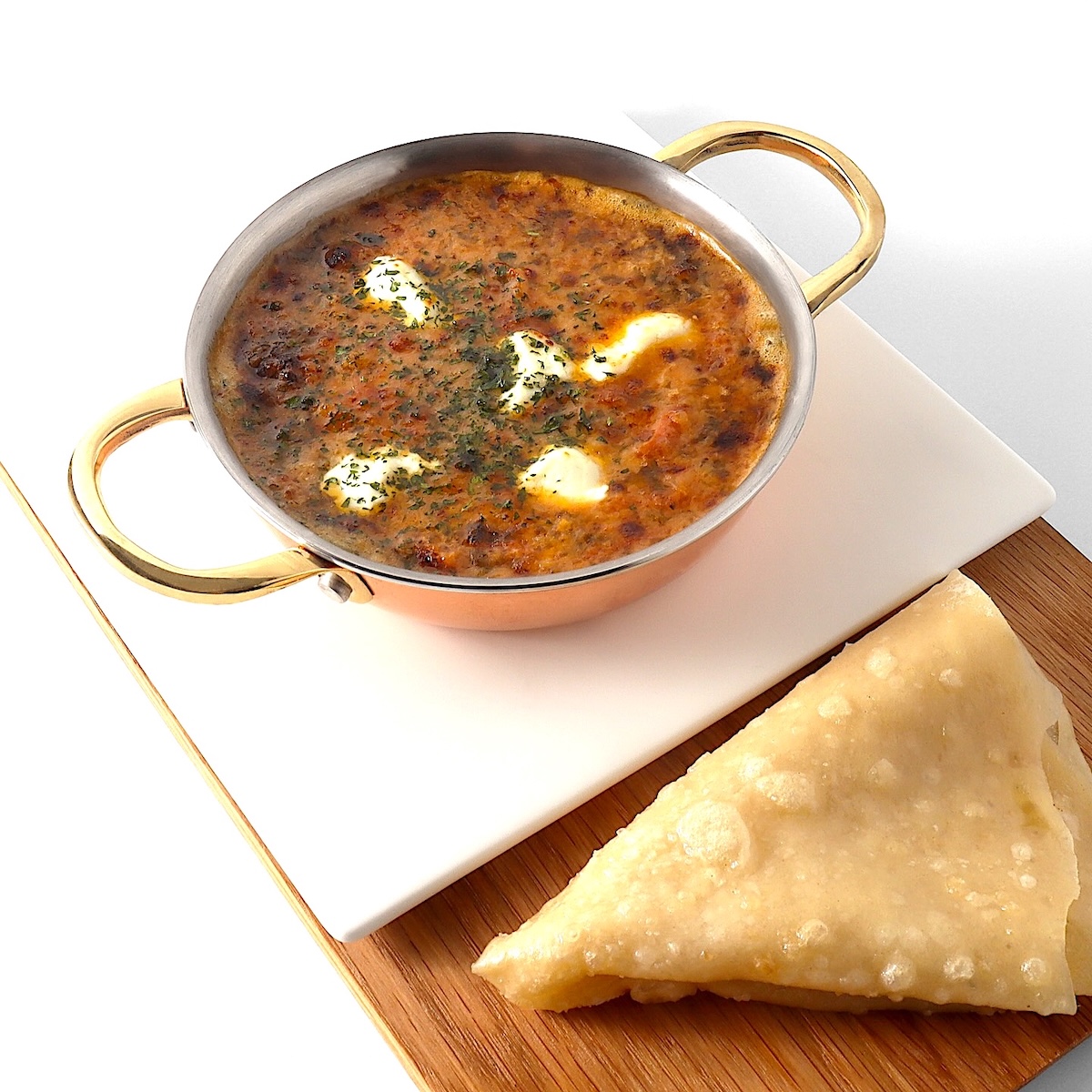

Perle Mesta: The Skirvin’s new signature and Black’s “possibility cuisine”
Website: Perle Mesta
Perle Mesta is Andrew Black’s full-circle move made literal: returning to the Skirvin Hotel, where he arrived in 2007 to help reopen the building and lead its restaurant program, and opening a new concept in the same historic space. If Grey Sweater reads as a manifesto of contemporary dining, Perle Mesta is something slightly different: a restoration project with a chef’s sensibility—reviving glamour without turning it into costume.
The restaurant opened June 24, 2024, on the first floor of the Skirvin, with an all-day structure that includes breakfast, lunch, dinner and brunch. The intention, as described by Visit OKC and other local coverage, is to offer “European luxury and hospitality” at a moment when diners—after pandemic simplification—are newly hungry for the ceremonial pleasures of eating out: tableside attention, dressed-up nights, the feeling that someone built an evening for you rather than merely served you.
Perle Mesta is also where Black has most explicitly named his philosophy. “Possibility cuisine,” in his framing, is an approach that embraces the “endless possibilities” of ingredients, flavors, techniques and cultural influences—an openness to fusion, experimentation, and the kind of technical play that can turn a disliked ingredient into a signature. In the announcement materials, he offers okra as an example: he doesn’t even like it, he says, which is precisely why he treats it as a challenge—brining, drying, seasoning, battering, frying—until it becomes the “chips” in a playful riff on fish-and-chips, paired with candied lamb belly as the “fish.”
The restaurant’s name supplies the narrative scaffolding. Perle Mesta, daughter of the Skirvin’s original owner, was a famed political hostess—“hostess with the mostess”—and the restaurant leans into that legacy with a modernized high tea service and an events-forward sensibility. There is also a cocktail wink: the Black Russian, described as made famous by Perle Mesta, positioned as part of the bar program’s identity.
Design becomes part of the storytelling. Announcement details emphasize a room that blends historical elements—original tile flooring, stained glass—into a palette meant to keep attention on the plate. The premise is transport: chandeliers from Barcelona, sconces reminiscent of Paris streetlights, a feeling of being in London or Paris while still held by the particular warmth of Oklahoma City.
National lifestyle media have treated Perle Mesta as proof of Black’s growing range—an all-day restaurant that still wears the mind of a tasting-menu chef. Southern Living, for example, framed the opening as another “full-circle moment,” noting Black’s 2007 arrival at the Skirvin and describing the cooking as a blend of his Indo-Jamaican upbringing and global travels.
Perle Mesta, ultimately, reads like an answer to a question diners have been asking since 2020: what is “special occasion” dining now? Black’s answer is not merely higher prices or rarer ingredients. It is atmosphere, memory, and the disciplined belief that hospitality—when practiced at its highest level—can still feel like theater without ever becoming fake.
Coda: After the accolades, the work
The temptation, after a James Beard medal and a trio of restaurants that now define a city’s dining conversation, is to frame the future in terms of scale: more rooms, more markets, more headlines. Andrew Black resists that framing. His public comments, taken together, suggest a quieter ambition—depth rather than sprawl, intention rather than velocity. The next phase of his career appears less concerned with proving possibility than with stewarding it.
Dougla Kitchen signals that shift most clearly. By centering his grandmother Elizabeth and naming the restaurant after a word that carries both cultural pride and historical complexity, Black is making an editorial decision about what matters now: authorship. After years of speaking fluently in multiple culinary dialects—European technique, American fine dining, modern hospitality—he is choosing to foreground the language he inherited first. That move is not nostalgic; it is corrective. It suggests a chef interested in legacy as something actively shaped, not merely left behind.
There is also a broader civic posture emerging. With Grey Sweater established as a national destination and Perle Mesta embedded in one of Oklahoma City’s most symbolic buildings, Black has positioned himself less as an insurgent talent and more as a custodian of standards. His emphasis on training—on “ambassadors,” on systems that teach hospitality as a discipline—points toward mentorship as a central concern. The future may hold fewer surprises for diners and more opportunities for cooks: kitchens designed not just to execute his vision, but to produce others capable of carrying it forward.
If expansion comes, it is likely to be conceptual rather than geographic. Black has spoken often about memory, about how meals lodge themselves in the mind. That preoccupation hints at projects beyond the plate: education, cultural programming, perhaps even writing—ways of articulating a philosophy that younger chefs, particularly those from diasporic backgrounds, can recognize themselves in. In that sense, his work aligns less with empire-building than with curriculum design.
Oklahoma City remains the constant. Black’s career has quietly refuted the idea that serious culinary work must orbit a handful of coastal cities. The future he seems to be building is one in which place is not a limitation but a responsibility. To stay, to invest, to refine rather than extract—that may be his most consequential statement.
At a moment when American dining is renegotiating its values—labor, sustainability, meaning—Andrew Black appears less interested in chasing what comes next than in asking a harder question: what is worth carrying forward? The answer, if his trajectory holds, will look familiar. It will be warm. It will be rigorous. And it will remember where it came from.