

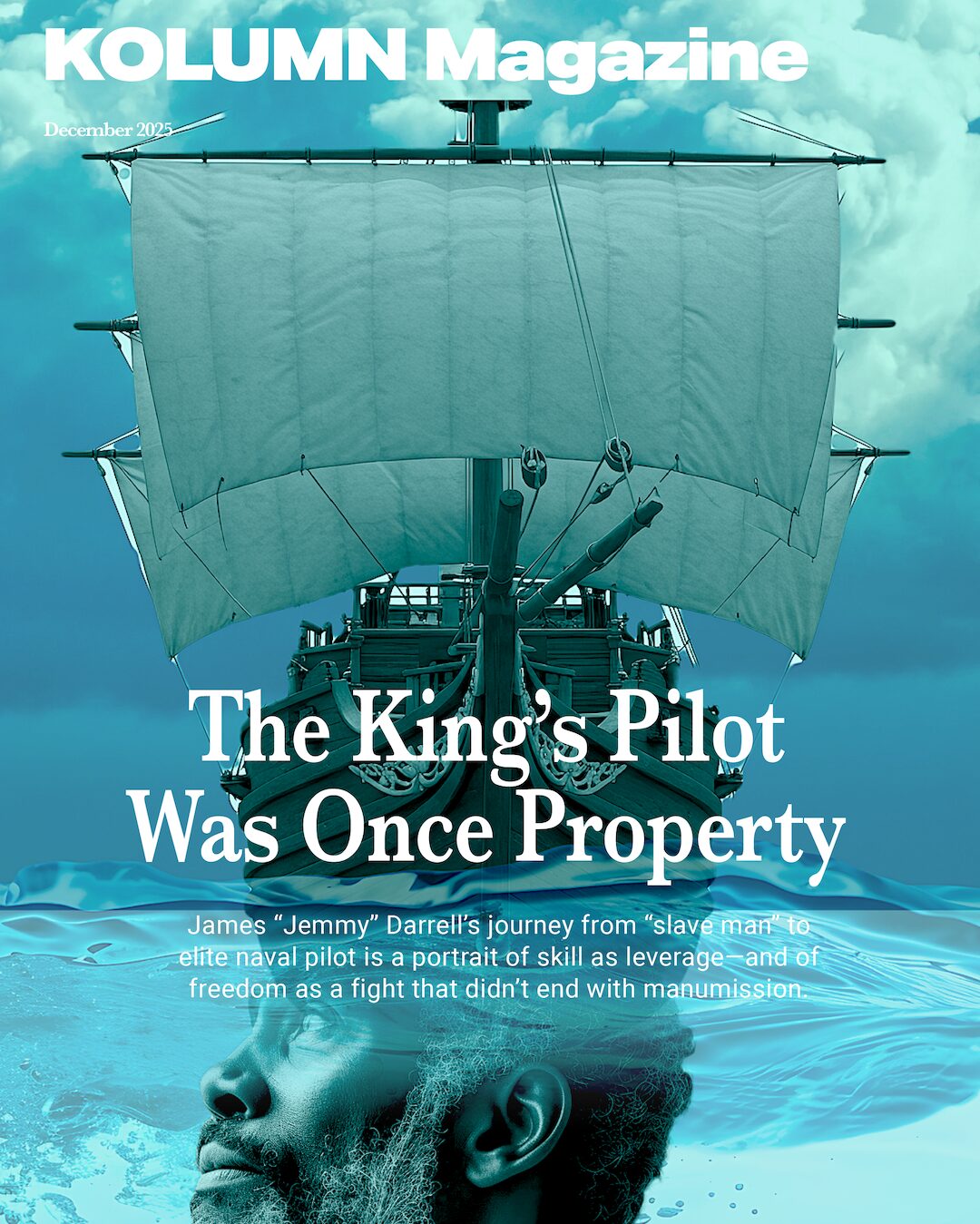
By KOLUMN Magazine
On a bright Bermuda morning in the 1790s, the water near St. George’s could deceive an untrained eye. It still can. The blues arrive in layers—turquoise thinning to cobalt, light bending around coral heads that sit just beneath the surface, beautiful and lethal at once. Bermuda’s sea has always been a paradox like that: an invitation that doubles as a test. For centuries, it has kept its own record, a ledger written not in ink but in wreckage, survival, and skill.
It is into that ledger that James “Jemmy” Darrell entered—first as property, later as proof.
For KOLUMN Magazine, this story is not only archival; it is ancestral. The publisher of this magazine traces their family lineage directly to James Jemmy Darrell, a fact that carries both pride and responsibility. Pride, because Darrell’s life stands as a testament to Black mastery in a world structured to deny it. Responsibility, because telling his story demands more than celebration. It requires accuracy, context, and a refusal to sand down the violence that shaped the conditions of his brilliance.
Darrell was born enslaved in Bermuda in 1749, owned by Captain Francis Darrell of St. George’s, and valued in ledgers the way ships and cargo were—by price, not by personhood. By middle age, however, he had become something the British Empire could not ignore: a pilot capable of steering Royal Navy warships through one of the most treacherous reef systems in the Atlantic. In 1795, when a 74-gun vessel approached Bermuda’s coral defenses, it was Darrell—still enslaved—who guided it safely to anchorage. The ship survived. The empire benefited. And the contradiction at the heart of Bermuda’s slave society became impossible to dismiss.
The admiral on board, George Murray, was impressed enough to recommend Darrell’s freedom. The governor complied. In 1796, Darrell was manumitted. Within months, he was appointed a King’s Pilot—an elite, crown-sanctioned role entrusted with navigating the empire’s most valuable ships through waters that could swallow them whole.
This is the version of the story that often circulates: skill rewarded, freedom granted, a rare triumph within a brutal system. But that telling is incomplete. Because Darrell’s life did not resolve neatly once he was free. He bought property in St. George’s. He challenged discriminatory laws. He petitioned colonial authorities when policies threatened the livelihoods of Black pilots. He lived, in other words, as a man who understood that freedom—once achieved—had to be defended, argued for, and made durable.
For KOLUMN, tracing lineage back to Darrell is not an exercise in nostalgia. It is an editorial commitment. His life sits at the intersection of enslavement and expertise, empire and resistance, ancestry and accountability. To tell his story is to interrogate how Black knowledge built Atlantic power, how slavery coexisted with reliance on Black mastery, and how freedom—then as now—was never simply bestowed. It was navigated.
The sea gave Darrell leverage. The law tried to contain him. History, unevenly, remembers him. What follows is an attempt to do so fully.
Early life, in a colony that measured people like cargo
The archival record of James “Jemmy” Darrell’s childhood is thin—an absence that is itself part of the violence of enslavement. Slavery made biographies out of transactions: valuations, inventories, wills, deeds, and court petitions. Interior life, family life, and the private texture of childhood were rarely preserved unless they served someone else’s interest.
What we can say with confidence begins with the bare spine of the timeline. Darrell was born in 1749. He was enslaved for most of his life and belonged to Captain Francis Darrell of St. George’s. In the language of the period, he appears as “Slave Man Jemmy,” described as valuable—worth 100 pounds sterling, according to one historical account.
That number matters not because it captures his worth—no number could—but because it reveals how Bermuda’s slave society understood him: as a unit of value. A price tag is a kind of biography in an economy where Black life is commodified.
St. George’s in the mid-18th century was a maritime town with an outward-facing economy. Bermuda’s geography shaped its labor system. The island’s limited arable land and its dependence on the sea meant enslaved Bermudians were often used in skilled maritime work—on boats, in shipbuilding, in pilotage and fishing—occupations that required judgment and local knowledge. This dynamic created a particular Bermudian paradox: the colony relied on enslaved people not only for brute labor but also for specialized expertise, while still insisting they were legally chattel.
For a boy born into that system, “early life” was not a protected stage. Childhood was training—sometimes informal, sometimes enforced—for whatever work the enslaver or the market required. In Bermuda, that could mean time in salt ponds or in households; it could also mean early exposure to boats and the sea, where skill could become both a survival strategy and a bargaining chip. You can imagine the sensory education: the feel of rope burn, the language of wind shifts, the way reefs “announce” themselves through water color and wave behavior. This is not romanticism; it is the practical curriculum of maritime survival in a place where a small mistake could kill everyone aboard.
Bermudian pilotage, in particular, was a world of inherited knowledge and high stakes. The reef line around Bermuda is among the most extensive in the Atlantic; safe channels were not obvious to outsiders, and charts—when they existed—could not substitute for lived experience. The British hydrographic survey work in the late 18th century, associated with Lieutenant Thomas Hurd, depended on local assistance, including enslaved Bermudians with deep knowledge of inlets and channels. Several accounts place Darrell among those who assisted Hurd.
Whether Darrell’s learning was formal or improvised, it culminated in a profession that sat at the edge of slavery’s logic. A pilot is, by necessity, authoritative. When you are responsible for bringing a ship through lethal water, the ship’s captain must listen to you. This is why scholars of Atlantic maritime slavery have noted how pilotage could create a peculiar form of leverage: pilots—enslaved or free—often had to be treated, in practice, more like officers than like property, because everyone’s life depended on their expertise.
That leverage did not abolish slavery. But it could, in rare moments, pry open a door.



“Steadfastness” and the politics of being undeniable
The story of Resolution is often told as a single dramatic act: Darrell guiding a warship into anchorage with such competence that an admiral intervened on his behalf. But embedded in that moment are at least three different power negotiations.
First, there is the negotiation between local knowledge and imperial machinery. The Royal Navy’s global power depended on particular places where it had to admit it was not self-sufficient. Bermuda’s reefs were one of those places. A warship could carry cannons and command, but it could not carry intimacy with the water.
Second, there is the negotiation between enslaved expertise and the system that claimed to own that expertise. Darrell’s skills did not belong to the admiral or to the governor; they belonged to Darrell. Yet the legal fiction of slavery insisted otherwise.
Third—and most telling—is the negotiation between recognition and risk. For a Black man to be publicly praised for mastery in a slave society was to create a problem for that society: if he could be trusted with the empire’s ships, why could he not be trusted with his own life?
In Bermuda’s retellings, the admiration is explicit. Accounts describe Murray as “so impressed” that he recommended Darrell’s freedom; the governor granted it; Darrell’s manumission followed on March 1, 1796. And soon after, Darrell was appointed a King’s Pilot—an elite role guiding Royal Navy ships through the reefs.
The speed of that transition—enslaved pilot in 1795, free man and King’s Pilot in 1796—can tempt a reader into thinking the system was flexible. It wasn’t. What changed was not the system’s morality but its calculus. The Navy needed safe passage. Darrell could deliver it.
Freedom, here, was not charity. It was the price of expertise that could no longer be conveniently ignored.
The house: Property as proof, and as provocation
Not long after manumission, Darrell purchased a house in St. George’s—often described as the first known Black person in Bermuda to buy property. Deed records are cited in local reporting as confirmation that he owned a home at 5 Aunt Peggy’s Lane, in St. George’s, in the late 18th century.
This detail is sometimes offered like a charming coda: freedom, then homeownership, a tidy arc. But in a slave society, a Black man owning property is not just a personal milestone; it is a political fact. Property is how colonial societies measure belonging and stability. It is also a form of documentation: a way to insist, on paper, that you exist as a legal actor.
Darrell’s house sits in memory so strongly that the surrounding area is associated with his name—Pilot Darrell’s Square is referenced in commemorations and public history. The house itself has been marked in historical registries and public heritage discussions, framing it as both a physical remnant and a symbolic threshold: the place where an enslaved man’s skill translated into ownership in a colony that preferred Black dispossession.
According to one public history account, the house he built remains in family hands—an intergenerational continuity that, if true, is itself an argument against slavery’s intent to sever Black lineage and legacy.
And yet, a house is also a target. Homeownership makes a person legible to taxation, regulation, resentment. In Bermuda’s racial order, the advancement of free Black people often triggered new restrictions aimed at controlling them. Darrell’s life after emancipation is notable not simply because he prospered, but because he fought.
Freedom as a legal fight: petitions, restrictions, and the narrowing of Black space
The historical notes that survive about Darrell’s post-enslavement years emphasize his activism as much as his seamanship. As a free man of color, Darrell challenged laws that imposed new restrictions on free Blacks and enslaved people. He also petitioned against proposals that would have reduced the income of King’s Pilots.
Those two actions—civil rights advocacy and economic defense—are connected. In a slave society, economic autonomy is always political. To protect the earnings of pilots was to protect a rare space where Black expertise could command compensation and respect. To challenge restrictive laws was to insist that freedom must be more than conditional permission.
Bermuda in the late 18th and early 19th centuries was part of an Atlantic world where “free” Black status was often treated as a problem to be managed. British imperial policy and colonial legislatures experimented with registration regimes, movement controls, and various legal constraints on free people of color—measures that acknowledged, indirectly, that Black freedom destabilized slavery’s claim to be natural.
Darrell’s petitions show him operating inside the system’s own bureaucratic language, using paperwork as a weapon. This is an underappreciated form of resistance: not the romantic rebellion of cinematic imagination, but the grinding insistence that the law must answer you because it claims authority over you.
It also suggests something else about Darrell’s identity: he understood himself not only as an exceptional individual but as part of a larger Black community whose rights were being negotiated in real time. Commemorative and historical accounts describe him as fighting discrimination and advocating for equal rights for Black people in Bermuda.
If his sea work made him famous, his civic work made him dangerous—to the assumptions of his era.
The work itself: What it meant to be a King’s Pilot
To call Darrell a “pilot” can mislead readers unfamiliar with maritime culture. A pilot is not a sailor in the generic sense. A pilot is a specialist whose authority overrides rank when the ship enters hazardous waters. In many ports, pilots are licensed and regulated; their role is to guide vessels through narrow channels, reefs, shoals, and harbors where local knowledge is essential.
In Bermuda, that expertise was life-or-death. The reefs around the island are not merely obstacles; they are a defensive system, historically protecting Bermuda from invasion while also endangering careless navigation. For the Royal Navy, Bermuda’s reefs were both shield and hazard—useful strategically, but only if the Navy could access safe anchorages reliably.
King’s Pilots, in particular, were elite. Accounts describe them as entrusted with bringing in the admiral’s flagship and other valuable naval vessels. The title itself—“King’s Pilot”—carries the monarchy’s stamp, implying not only skill but status.
And this is where Darrell’s life becomes a prism. Because what does it mean for a monarchy to certify an enslaved Black man as an elite maritime authority? It means the empire could not function in Bermuda without Black mastery. It means the reef line forced an uncomfortable truth: the colony’s most valuable navigators were often the very people the colony tried to keep in subjugation.
It also helps explain why Bermuda’s pilot culture became such a significant site of Black labor history. Even later narratives about the Bermuda pilot gig—the small, fast boats used for pilotage—emphasize that crews were frequently made up of enslaved Black men, recognized as masters of the sea.
Darrell is the most famous name in that tradition, but he is also a representative figure: proof that the Atlantic’s maritime economy was built not only on Black labor but on Black expertise.
The racial math of recognition: rumors, lineage, and the color line
Some researchers have suggested Darrell may have been light-skinned and possibly the son of Captain Francis Darrell, the man who enslaved him—a speculation reported in local writing, reflecting how slavery’s sexual violence and coercion produced tangled genealogies that colonies often refused to acknowledge openly.
This kind of claim must be handled carefully. Without definitive documentation, it remains conjecture. But the fact that the conjecture persists points to a broader truth: slavery created family structures that were both intimate and brutal, and the archive often records them only as rumor, inference, or genetic possibility.
If Darrell was connected biologically to his enslaver, the irony becomes almost unbearable: the colony would have been treating as property a man who may have shared blood with one of its respectable families—while also relying on him to protect British warships from disaster.
Whether or not that specific lineage is true, the larger historical pattern is well documented across slave societies: the color line was never simply about skin; it was about power, inheritance, and who was allowed to claim kinship publicly. Darrell’s life intersects that pattern in the quiet ways histories often do: in what is whispered, in what is omitted, in what is left for descendants to argue about centuries later.
Death, burial, and the afterlife of a reputation
James “Jemmy” Darrell died on April 12, 1815, at about 66 years old. He is buried at St. Peter’s Church in St. George’s, in a section associated with the burial ground for enslaved and free Black people—an arrangement that reflects the segregation that structured even sacred space.
That burial location matters. St. Peter’s is not only a churchyard; it is a historical map of Bermudian racial order. Accounts of the site describe segregation practices in worship and in death, with Black Bermudians directed to separate entrances and separate galleries, and with burial areas divided accordingly.
And yet, Darrell’s grave is also the site of annual remembrance. Memorial services honoring him have been held for years, drawing community members and descendants and keeping his story in public circulation.
In some ways, this is Bermuda’s ongoing negotiation with itself: a society that once treated Darrell as property now treats him as heritage.
The question that lingers is what that shift costs—and what it repairs.
What Darrell’s story reveals about Bermuda, Britain, and the Black Atlantic
It is tempting to treat Darrell as a Bermudian exception: a singular genius who overcame his condition. But that framing can flatten the political truth. Darrell’s success was not only personal; it was structural evidence.
1) Black expertise was foundational, not incidental
Bermuda’s maritime economy depended on skilled Black labor, including enslaved sailors and pilots. Scholarship on maritime Bermuda emphasizes the scale of enslaved seafaring and its centrality to the island’s commercial life. Darrell’s pilotage for the Royal Navy is the most famous illustration, but not an isolated anomaly.
2) The empire rewarded utility, not justice
Darrell’s freedom came through an imperial recommendation following a naval feat—an act of recognition tied to British strategic needs. The moral lesson is not that the empire was benevolent; it is that the empire could be forced, occasionally, into pragmatic concessions when its interests aligned with a Black man’s undeniable skill.
3) Manumission was not emancipation
Darrell was freed in 1796; slavery in Bermuda—and across the British Empire—did not end until later, with empire-wide emancipation taking effect in 1834 (with apprenticeship regimes and other afterlives of coercion). His activism against restrictive laws underscores that legal freedom could still be constricted by policy.
4) Property is political memory
Darrell’s homeownership—documented through deeds and celebrated in public history—represents an early Black claim to permanence in Bermuda. In a slave society, permanence was precisely what Black people were denied. A house becomes a counter-archive: a physical insistence that someone was here, built something, and intended to remain.
5) Commemoration is a second battlefield
The annual services and heritage references keep Darrell’s name alive, but they also raise questions about what is remembered and what is softened. If a society remembers Darrell only as a symbol of “resilience,” it risks turning structural violence into backdrop. If it remembers him as a civic actor—someone who fought discriminatory law—it has to confront a less comfortable legacy: that Bermuda’s racial order had to be contested from within, repeatedly, by people who were never supposed to have standing.
A KOLUMN-style coda: The reef as metaphor, the pilot as proof
KOLUMN readers understand that somethings that archive often don’t hold that Black history is frequently a story of expertise that someone tried to steal, and of dignity that someone tried to regulate.
Darrell’s life reads like that. The sea did not free him because the sea is benevolent. The sea freed him because it exposed the colony’s dependency. It made a lie visible: that Black people were interchangeable labor. A reef does not care about the ideology of slavery; it cares about whether you know how to pass.
Darrell knew.
He knew enough to bring a warship to safety and make an admiral ask a governor for something the governor did not freely offer. He knew enough to convert that freedom into a profession the monarchy had to certify. He knew enough to buy a house in a place that measured humanity by deeds and denied deeds to Black hands. And he knew enough—this might be the most important part—to keep fighting once he had what many people would have considered “success.”
That fighting is why his story is not only inspirational. It is instructive.
Because the hard truth of Jemmy Darrell’s Bermuda is that freedom, once granted, can still be narrowed—like a channel through reefs—by the people who control the charts. What Darrell did, again and again, was insist on steering anyway.
Source note and reporting transparency
This article draws primarily on Bermudian public history and journalism documenting Darrell’s life, including Bermuda Biographies, Emancipation Bermuda, St. Peter’s Church reporting, and local press coverage in The Royal Gazette and Bernews, as well as contextual maritime history resources.
Acknowledgement
KOLUMN Magazine acknowledges that the publisher of this publication is a direct descendant of James “Jemmy” Darrell of Bermuda.
This lineage informs the care with which this story has been researched, written, and presented. While the familial connection brings personal significance, it also imposes a heightened responsibility to accuracy, rigor, and historical integrity. This article has been developed in keeping with KOLUMN Magazine’s editorial standards, drawing on documented archival sources, public history records, and scholarly context to ensure that Darrell’s life is examined not as myth or inheritance, but as history.
The purpose of this acknowledgement is transparency. It recognizes ancestry without claiming authority over the historical record and affirms that Darrell’s legacy belongs not only to one family, but to Bermuda, to the Black Atlantic world, and to the broader history of enslavement, resistance, and expertise that shaped the modern era.