

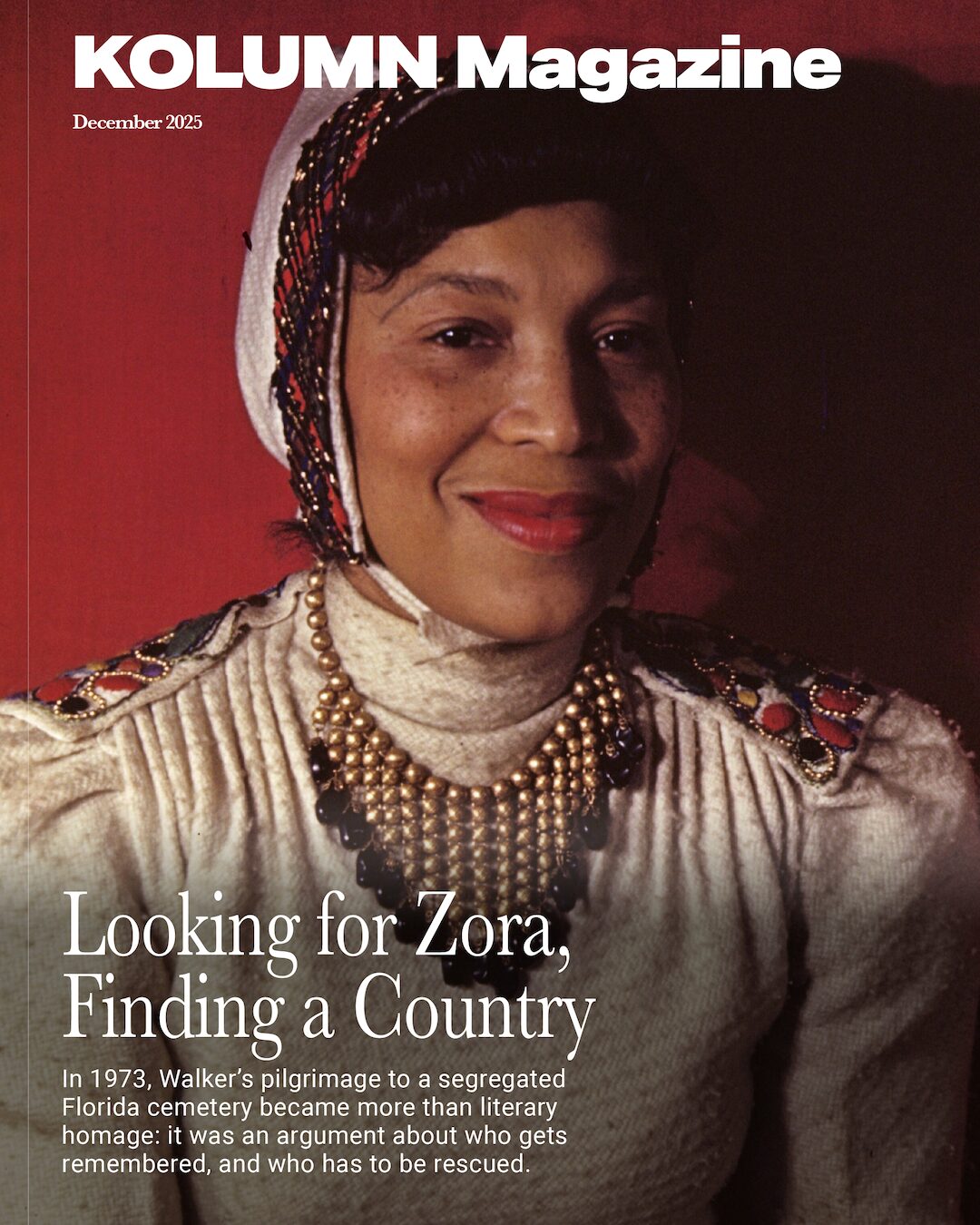
By KOLUMN Magazine
The American literary canon likes its rediscoveries clean.
A lost manuscript in a climate-controlled archive. A dramatic auction. A professor’s lucky find. The romance of scholarship, with its gloves and lamps and elegant footnotes, suggests that a writer vanishes the way a book slips behind a shelf—quietly, almost politely—until a careful hand retrieves it.
But Zora Neale Hurston did not disappear politely. She was pushed, ignored, edited down to an anecdote, then left to the slow violence of indifference—the kind that does not announce itself as cruelty because it can always claim it was simply busy. When Hurston died in 1960, she was buried in Fort Pierce, Florida, in a cemetery that was segregated, under conditions that were as much about a nation’s habits as one woman’s poverty: her grave went unmarked.
The recovery of Hurston’s legacy is now so widely accepted—so fundamental to how American literature is taught and sold—that it can feel inevitable. Their Eyes Were Watching God is a staple; Hurston’s name is invoked as shorthand for Black Southern voice, for folklore as method, for vernacular as art, for a kind of narrative intelligence that refuses to beg permission. Yet inevitability is the story we tell after the work has been done, when we can afford to forget how contingent it was—how easily it could have gone another way.
The work was not clean.
The work involved a young Black woman writer—Alice Walker—traveling into the humid, overgrown backyards of American memory and deciding that a grave is a form of argument. In 1973, Walker went to Fort Pierce looking for Hurston’s burial site; she found an unmarked grave area and had a marker placed there. Two years later, she published an essay in Ms.—“In Search of Zora Neale Hurston”—that helped ignite what is now routinely called the Hurston “revival,” a word that can sound quaint until you remember what revival actually implies: a patient declared dead, shocked back into public life.
There is a temptation—especially in anniversary essays and classroom lore—to cast Walker as sainted rescuer, Hurston as grateful ancestor, and the story as a simple morality play in which literature corrects its own mistakes. But the more honest version is less tidy and more instructive. It is about power: who gets to decide what counts as evidence, what counts as genius, what counts as a life worth commemorating. It is about institutions: publishing houses that let books go out of print; universities that build fields of study and, in doing so, resurrect the names those fields require. It is about place: Florida’s Black towns and burial grounds, Southern soil as archive. And it is about a peculiar kind of friendship—one that cannot involve dinners, phone calls, or shared rooms because it moves across time.
Walker and Hurston never met. Hurston died when Walker was in her teens. Their “friendship,” as it is often described in cultural shorthand, is literary: a kinship built out of reading, recognition, argument, and a fierce sense of inheritance. That distinction matters, because it clarifies what Walker was actually doing when she went looking for Hurston. She was not seeking a mentor in the living world; she was seeking proof that a lineage existed at all—and that Black women’s art could be traced, named, protected.
In KOLUMN’s editorial grammar—where the question is never only what happened but what it cost—the headstone is not just a headstone. It is a portal into the American habit of forgetting, and into the insurgent labor required to make memory hold.
A writer who would not behave
Hurston’s life—by now narrated in biographies, letters, anthologies, documentaries—has been distilled into a series of images: the anthropologist with her notebook and pistol; the Harlem Renaissance luminary among salons and quarrels; the collector of folktales who insisted that Black speech was not “broken” English but an art form with its own music. Yet the version of Hurston that matters most for this story is simpler and harsher: the woman who died in economic precarity, in a welfare home, and was buried without a marker.
To call that an indignity is accurate but incomplete. The indignity was not just that she lacked money. The indignity was that the culture in which she lived could not, or would not, keep her in view once she ceased to be fashionable.
Hurston’s career peaked in a world that liked its Black art packaged for white consumption: the Harlem Renaissance marketplace, the patronage networks, the editorial gatekeeping that alternately exoticized and policed Black expression. Hurston, famously, did not behave. She wrote the South as a place of violence and beauty without offering the expected posture of tragedy. She refused to flatten her characters into sociological types. She used dialect not as spectacle but as evidence of intelligence. And she could be politically uncooperative—too idiosyncratic to fit cleanly into the liberal narratives later generations wanted to build around Black struggle.
When a writer does not behave, disappearance becomes easy to justify. The canon tells itself: she was minor, she was difficult, she was of her time. The marketplace tells itself: she doesn’t sell. The academy tells itself: we have other priorities.
Meanwhile, the world moves on. Books go out of print. A name becomes a footnote. The footnote becomes a rumor. The rumor becomes nothing.
In Fort Pierce, the nothing had a geography: an unmarked grave in the Garden of Heavenly Rest.

The pilgrimage logic of Black women’s reading
Walker’s story begins the way many Black women’s intellectual awakenings begin: not with institutional permission, but with a private moment of recognition—an encounter with a voice that feels like it has been waiting for you.
The record of Walker’s early relationship to Hurston is scattered across essays, interviews, and the later scholarship that traces how Hurston’s afterlife was assembled. The consistent theme is that Walker experienced Hurston not as an “influence” in the polite sense, but as a kind of revelation: proof that a Black Southern woman could write with audacity and remain herself on the page. The Guardian, recounting this lineage in the context of Hurston’s posthumously published work, describes Walker as a young admirer inspired by Hurston’s writing who tracked down the grave in 1973.
This is what literary friendship looks like when you come from a tradition that has been repeatedly interrupted. It is not just admiration; it is survival strategy. It is the reading that says: if she existed, I can exist. If she wrote this sentence, I am not alone.
By the early 1970s, this hunger for lineage met a cultural opening. Black Studies programs were expanding. Feminism—especially in its white mainstream forms—was being contested by Black women insisting that gender could not be separated from race, class, region, and history. In that environment, Hurston’s work was not merely “rediscovered.” It was needed: as evidence that Black women’s intellectual traditions were not new, not derivative, not dependent on the permission structures of white publishing or white academia.
Still, need alone does not resurrect a writer. Someone has to do the literal work.
Someone has to go into the weeds.
Fort Pierce, 1973: memory as a physical landscape
One of the most haunting details in every retelling of Walker’s search is how material it was. Not metaphorical weeds. Not “weeds” as a cute symbol for neglect. Actual overgrowth, the kind that makes a cemetery feel less like a place of rest than a place the world has decided to stop tending.
Multiple accounts note that Hurston’s burial was in a segregated cemetery and that her grave was unmarked until Walker’s intervention. The Smithsonian’s National Museum of African American History and Culture summarizes the essential fact pattern succinctly: Walker, alongside scholar Charlotte D. Hunt, discovered the unmarked grave in 1973 and had it marked; in 1975, Walker published the Ms. essay that fueled renewed interest.
The presence of Hunt in this history is important and is sometimes softened in popular retellings. Hunt was not merely a companion; she was a Hurston scholar, and contemporaneous accounts emphasize her archival devotion—what one remembrance calls an unusually extensive collection of information on Hurston for that moment in time. The revival story, then, is not only about a novelist’s intuition; it is also about scholarship and the slow accumulation of evidence, much of it accomplished by Black women operating without the institutional megaphones their work warranted.
Walker’s on-the-ground method—how, exactly, she identified “the grave”—is also part of why this story remains complicated. Even reputable summaries describe the site as an approximation: an unmarked grave “in the general area” where Hurston had been buried, identified and marked by Walker and Hunt. There is no comforting DNA test here, no forensic certainty, only the best available reconstruction in a landscape shaped to defeat reconstruction.
That, too, is the point. Black death in America has often been administered with bureaucratic thinness: incomplete records, segregated burial grounds, the quiet indignity of “pauper” systems. The archive is not missing by accident. The archive is missing because the culture did not consider the missing worth repairing.
Walker’s act was, therefore, both devotional and confrontational: a refusal to let the lack of perfect evidence become an excuse for doing nothing.
“A Genius of the South”: the epitaph as argument
Walker chose a line—“A Genius of the South”—and placed it in stone above Hurston’s name. The headstone’s phrasing has been widely noted as a borrowed tribute, attributed in several summaries to Jean Toomer’s work, and it remains the most quoted part of the marker.
It is hard to overstate the rhetorical force of that phrase, especially in 1973.
“A genius” is not the language America has historically offered Black women. The word “genius” has been distributed like a restricted substance—bestowed by institutions, guarded by critics, inflated around certain men, withheld from those whose brilliance threatened the story the nation preferred to tell about itself. When Walker inscribed Hurston as “genius,” she was not merely praising her. She was staking a claim in the terrain of cultural authority.
And when she specified “of the South,” she was making the claim more radical still. The South in American literary mythology is often cast as a place that produces trauma and steals possibility. Hurston’s work insisted the South also produced artistry, language, play, intellectual complexity—a Black Southern world that was not merely a site of suffering but a site of culture-making.
The marker also made a second, less visible argument: that the ground itself mattered. That you could not fully restore Hurston to the canon while leaving her body in a place treated as disposable.
In an era when literary revival might have meant a reissue contract or a conference panel, Walker began with a grave.
The campaign: money, logistics, and a public story
The headstone did not rise through institutional grantmaking. Walker used her own money, according to accounts of the trip and its aftermath, to place the marker. This fact is often recited as a charming anecdote—proof of Walker’s sincerity—but it is also a window into how cultural repair frequently functions in America: privately, unevenly, dependent on the passion and resources of individuals rather than a system designed to honor its artists.
The civic record from Fort Pierce also recognizes Walker’s role, noting that Hurston was laid to rest in an unmarked grave and that Walker, in the early 1970s, located and identified the grave site she determined to be Hurston’s—an act the city frames as the beginning of Hurston’s “second rise” into public recognition.
Notice the language: determined to be Zora’s. The phrasing holds both the devotion and the uncertainty. It is a municipal acknowledgment of what Walker did—and of what the archive could not fully guarantee.
The next step was narrative. In 1975, Walker published “In Search of Zora Neale Hurston” in Ms. magazine; scholarly summaries, museum timelines, and literary histories consistently cite this essay as catalytic.
This is where the story becomes most modern: Walker understood that commemoration requires media. A headstone is a physical intervention; an essay is a distribution system. Together, they formed a campaign—part pilgrimage, part investigative report, part love letter, part indictment.
The essay did what Walker’s generation of Black women writers often had to do: it created the context the mainstream failed to supply. It explained why Hurston mattered, why she had been dismissed, and why the dismissal should be treated as a scandal rather than a natural outcome.
In other words, Walker didn’t merely locate Hurston. She argued her into visibility.
The revival machine: publishing, academia, and the hunger for an ancestor
Once Walker’s essay circulated, the cultural ecosystem that had been missing in 1960 began to assemble. Publishers began to see commercial opportunity in reissues and anthologies. Universities built syllabi that required Hurston as foundational text. Scholars wrote books that transformed her from an eccentric footnote into a central figure of twentieth-century American letters.
A Washington Post review, looking back on this period, describes Walker’s early-1970s mission to revitalize Hurston’s work at a moment when Hurston’s books were out of print and had fallen out of favor—even in Hurston’s hometown. The piece frames the headstone as both symbolic and practical: a literal marker that parallels the broader project of making Hurston legible again to the culture that had allowed her to vanish.
The Guardian, in coverage related to Hurston’s posthumous publications, likewise points to Walker’s grave-finding as pivotal—an intervention that precedes, and in many ways makes possible, the later waves of renewed attention.
And the scholarly record has formalized what readers already sensed. A Michigan Law Review essay about Hurston and the legal-cultural dimensions of her legacy cites Walker’s Ms. essay as a spark that helped lead to the canonization of Their Eyes Were Watching God.
The revival, then, was not one thing. It was an alignment of forces—grassroots devotion, feminist publishing platforms, academic infrastructure, reprint economics—triggered by a pilgrimage that gave the story a compelling origin point.
But origins, too, can mislead. To tell the story as though Hurston was “saved” by Walker alone is to repeat a familiar American habit: turning collective repair into an individual hero narrative. Hunt’s scholarship mattered. Black Studies mattered. Librarians and teachers mattered. Readers—especially Black women readers—mattered.
Walker’s singular contribution was that she made the repair impossible to ignore.
The discomforts: the wrong birth year, the ethics of certainty, the burden of icon-making
Every memorial is a selection: what to include, what to omit, what to claim as fact.
Hurston’s headstone contains a famous error: the dates. Hurston was born in 1891, but the marker lists 1901—a misstatement tied to Hurston’s own complicated public handling of her age, and to the difficulty of pinning down biographical facts in a culture that did not preserve Black women’s records with care.
Some retellings treat the wrong date as a minor footnote. In truth, it is a revealing detail. The headstone is both corrective and imperfect—an attempt to stabilize memory that also demonstrates how unstable the underlying archive was. It is what happens when you are forced to build certainty with partial materials.
There is also the question—rarely foregrounded in celebratory versions—of how Walker and Hunt navigated the cemetery bureaucracy and local knowledge networks. Later recollections sometimes mention the theatrical necessity of persuasion: in a segregated landscape, a young Black woman asking about a Black woman writer nobody had thought to honor might not receive immediate assistance. The exact tactics vary across accounts, and responsible journalism should not overstate what is not consistently documented. What can be said, with confidence, is that Walker relied on local leads, institutional fragments, and human memory—precisely the kinds of sources that become decisive when official records fail you.
These discomforts do not diminish Walker’s act. They clarify its stakes. The headstone is not simply an artifact of reverence; it is an artifact of structural neglect.
And structural neglect produces a particular moral pressure: it forces the living to do restoration work under conditions where the restoration cannot be perfect.
What Walker was really marking
If you strip away the literary mythology, what remains is something blunt: Walker saw a national embarrassment and treated it as urgent.
Hurston’s unmarked grave was not only about Hurston. It was about the world that could not imagine a Black woman writer deserved stone.
Walker’s decision to mark it, therefore, functioned on at least three levels:
Personal lineage. Walker’s own artistic identity—Black, Southern, woman, writer—found precedent in Hurston’s work. The marker is gratitude expressed in the most durable medium a young writer could afford.
Cultural critique. The marker is a rebuke to institutions that allowed Hurston’s books to go out of print and her memory to fade.
Public instruction. The marker is a teaching tool. It tells future visitors: this life mattered. This name belongs in your mouth.
The phrase “A Genius of the South” does not only describe Hurston; it describes a claim Walker was making about the region, about Black culture, about vernacular intelligence, about the kind of artistry that grows in places the nation calls “backward.”
And once the claim is made in stone, it becomes harder to undo.
The afterlife: offerings, festivals, and the evolving public Zora
A marker changes behavior. People visit. People leave things.
In contemporary accounts of Hurston’s gravesite, the plot appears less as a static memorial than as a living altar: visitors leave offerings that echo Hurston’s work and Walker’s intervention, turning the grave into a participatory site of remembrance. This is not merely tourism. It is community memory-making, the kind that emerges when official commemoration arrives late and readers decide to build their own rituals.
Municipal and cultural institutions in Florida have also institutionalized Hurston’s presence through heritage trails and festivals, incorporating the grave and related sites into civic storytelling—an inversion of the earlier neglect.
This evolution raises a quiet question: what does it mean when a writer becomes a “site”?
Hurston’s work was always about sites—porches, jook joints, fields, roads, kitchens—places where Black life was not merely endured but shaped into language. The irony is that Hurston herself became, posthumously, a site to be visited, mapped, narrated.
Walker’s headstone is the hinge between those two realities: the writer who documented living Black places, and the culture that required her to become a place in death in order to be remembered properly.
A friendship across time, and the ethics of speaking for the dead
To call Walker and Hurston “friends” risks sentimentality. Friendship implies reciprocity, conversation, mutual negotiation. Hurston could not consent to Walker’s framing of her. She could not edit the revival story. She could not clarify the parts of her politics and personality that modern readers find inconvenient.
This is one reason contemporary scholarship insists on Hurston’s complexity: her political stances do not always align with the narratives later generations wanted from her, and any revival that treats her as a flawless emblem risks replacing one kind of disappearance with another—erasing the inconvenient parts by turning her into a usable icon.
Walker’s own writing, especially her willingness to present Hurston as “complicated and tremendous” rather than sanitized, has often been cited as part of the revival’s power: it did not require Hurston to be perfect to be worthy.
Still, the ethics remain. When you resurrect a writer, you also claim a form of authority over her story.
Walker’s headstone is, in this sense, both intimate and public: an intimate gesture placed into public space, where it becomes a kind of official statement. Visitors who never read Hurston will still read that epitaph. Students who encounter the grave through a lesson plan will inherit Walker’s framing before they develop their own.
That is what makes the episode so important for a media culture like ours—one that constantly “discovers” Black women’s brilliance as if it were new. Walker’s intervention reminds us that discovery is often the wrong word. It is not that the genius was hidden. It is that the culture refused to look.
Why this story matters now
There are at least three contemporary reasons the Walker-Hurston headstone story continues to resonate.
First: it models repair as practice, not feeling.
In an era when public discourse often treats recognition as a social-media post or a commemorative month, Walker’s act insists that honoring a writer can require money, travel, discomfort, confrontation, and time.
Second: it exposes how fragile the canon really is.
If a writer as singular as Hurston could be out of print and nearly forgotten, then “greatness” is not self-sustaining. It needs stewards. It needs infrastructure. It needs people willing to argue with institutions that claim neutrality while reproducing neglect.
Third: it reframes friendship as inheritance.
For Black women writers, “friendship” with predecessors often has to be built out of absence: the missing mentors, the erased archives, the dead who cannot answer back. Walker’s relationship to Hurston is a case study in what it means to love a foremother publicly—enough to insist on a stone.
And perhaps a fourth reason, quietly, in the background: the headstone story helps explain why KOLUMN’s editorial mission matters. We are living in a moment when cultural institutions are again contested—when curricula, libraries, archives, and museums are sites of political struggle. Word In Black’s reporting on book bans and contested literary heritage underscores how quickly the public story of Black writing can be threatened, rerouted, or erased when power decides certain narratives are “dangerous.”
Walker’s intervention offers a template: when the system withdraws recognition, build your own, and make it durable.
The headstone as a beginning, not a conclusion
It is tempting to end this story at the grave, where the narrative feels symbolically complete: the forgotten writer receives her marker; the living writer fulfills her duty; the dead are honored; the canon adjusts.
But the headstone was not an ending. It was a beginning.
It began the public argument that Hurston belonged not as a niche figure or a regional curiosity, but as central American literature. It began a renewed wave of publishing that continues to yield new Hurston material—posthumous collections, recovered essays, fresh editions—proof that disappearance was never about scarcity of work but scarcity of attention. It began a model of how cultural lineage can be claimed by those who were never meant to inherit it.
And it began a set of questions we still have not finished answering:
Who pays for memory?
Who gets a stone?
Who is allowed to be called genius?
Walker answered, in 1973, with the bluntest instrument she could afford: engraved certainty.
ZORA NEALE HURSTON. A GENIUS OF THE SOUTH.
Not a question. A declaration.
A stone in the weeds, insisting that the weeds were never the truth.