

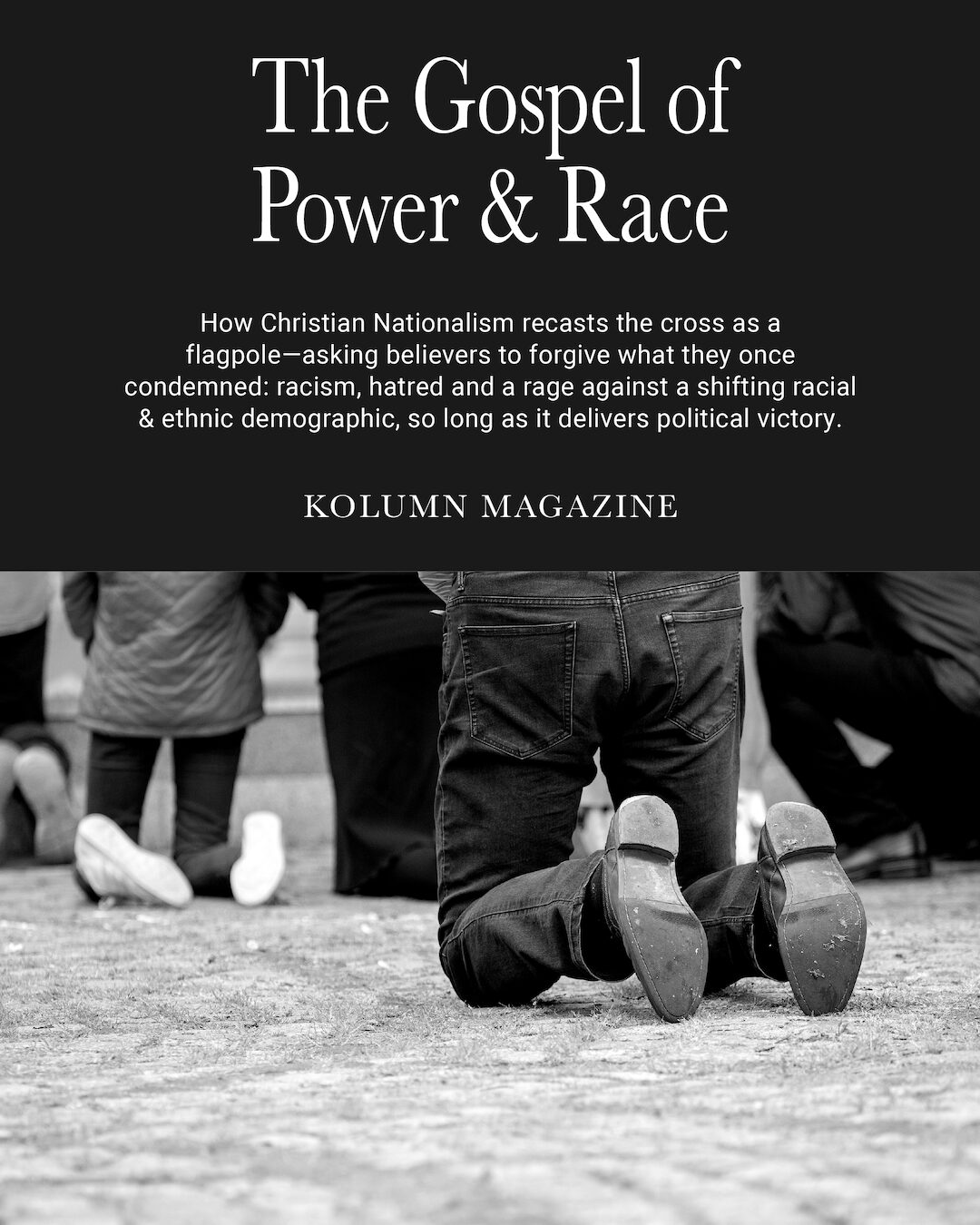
The Gospel of Power & Race
How Christian Nationalism recasts the cross as a flagpole—asking believers to forgive what they once condemned, racism, hatred and a rage against a shifting ethnic demographic, so long as it delivers political victory.
By KOLUMN Magazine
On a Sunday morning that could have been anywhere—an exurban strip of asphalt, a sanctuary dressed in stage lighting, a lobby that looks like a boutique hotel—there is a familiar choreography. Volunteers in matching shirts guide cars into neat rows. A worship band warms the room with minor-key urgency, the drums tuned to the pulse of anticipation. The sermon is billed as “biblical,” but it is also unmistakably contemporary, full of the nouns and enemies of the present tense.
The message, as it often is now, is not merely that God loves America. It is that America belongs to God in a way other countries do not; that the nation has a special covenant; that the people inside it—some people—are custodians of that covenant; and that the state must be wielded, if necessary, to restore what has been lost.
A pastor speaks of “taking our country back.” A politician’s name is invoked like a liturgical refrain. The crowd laughs at an insult aimed at immigrants, or “wokeness,” or “globalists.” The laughter is not incidental. It is an adhesive. It binds the room to an emotional certainty: we are right, we are under siege, and we are owed victory.
Outside this sanctuary, Christians are still doing what Christians have always done—feeding people, burying the dead, visiting prisons, teaching children, praying for enemies, building schools, confessing sin, practicing the slow arithmetic of mercy. But inside the political arena—and increasingly inside the religious institutions that orbit it—another form of Christianity has taken on the confidence of a governing philosophy. It calls itself faith, but it behaves like a movement. It speaks in scripture, but thinks in leverage.
Sociologists Andrew Whitehead and Samuel Perry have offered one of the most widely used definitions of Christian nationalism: a cultural framework that blurs the distinction between Christian identity and American identity, treating them as properly fused and insisting the union must be protected and preserved. Public Religion Research Institute (PRRI), which has tracked the phenomenon for years, finds that stronger adherence correlates with a readiness to sacralize political outcomes (“ordained by God”) and a higher tolerance for political violence under the banner of saving the country.
That last finding can sound abstract—data-point as warning label—until you translate it back into a room with people in it, into the emotional temperature of a rally, into the way sacred language can make desperation feel like destiny.
The divergence this article examines is not between Christianity and politics. Christians have always been political in the simple sense of living in a polis, a society, and being called—by their own scriptures—to care about justice, truth, and the treatment of the vulnerable. The divergence is between traditional Christianity, which centers repentance, humility, and love of neighbor, and Christian nationalism, which increasingly centers power: who has it, who must get it back, and who must be defeated to secure it.
In that divergence, moral character becomes negotiable; hypocrisy becomes rational; and racial and ethnic hierarchy—sometimes explicit, often coded—becomes easier to baptize.
A Promise Made in Moral Language
To understand what is happening now, it helps to remember what was once said out loud.
In the late 20th century, the modern Religious Right rose in the language of alarm and rectitude. There were jeremiads about divorce, sexual permissiveness, secularism, and the collapse of “family values.” There was a political identity shaped not only by theology but by a posture: we are the guardians of a moral order, and the country is decaying because it has stopped listening to us.
The “Silent Majority,” popularized in the Nixon era, was a political mythos that cast ordinary, churchgoing Americans as besieged by elites and cultural radicals. It wasn’t only about religion, but it fused easily with religious self-understanding—especially among white conservatives—because it offered a flattering narrative: you are the true America, even if you are not in charge.
That story matured into something with institutions: TV ministries, voter guides, church-based mobilization, and a moral vocabulary that could turn elections into referendums on virtue.
The movement’s most persuasive weapon was its claim to standards. “Character matters” was not merely an argument; it was a litmus test. It offered conservative Christians a sense that their politics were not raw tribalism but principled witness.
Then, slowly, that language began to change.
Not because sin disappeared—Christianity assumes sin is permanent—but because power became a more urgent sacrament than integrity. As one Guardian columnist put it in the Trump era, the religious right’s embrace of a champion who broke their own behavioral taboos revealed “hypocrisy” that felt like “heresy,” a shift from devout belief to political combat.
There were always Christians who insisted that voting is not sainthood selection—that one can choose policies without canonizing politicians. That argument is not new, and in itself it is not unreasonable.
What is new is how frequently the movement’s defenders stopped saying, “We don’t approve of his behavior, but…” and started implying the behavior did not matter at all—or, more provocatively, that the outrage itself was persecution: an attack on “Christian America.”
This is where Christian nationalism becomes distinct from ordinary political compromise. It does not merely tolerate an imperfect ally; it reclassifies the ally’s imperfections as strategic assets, and recasts moral objections as disloyalty.



The Theology of the Exception
The most revealing word in today’s Christian nationalist politics is not “sin.” It is “grace.”
Grace is among Christianity’s central concepts: unearned favor, mercy offered without merit. In traditional theology, grace is meant to humble the recipient, to soften pride, to widen compassion.
But in a political movement, grace can be weaponized. It becomes selective—lavished on “our” leader, withheld from “their” people. It becomes a kind of permission slip: for cruelty, for dishonesty, for the abandonment of standards once used as cudgels.
You can see this selective grace in the way prominent Christian leaders defended Donald Trump’s personal conduct during his first rise. The Guardian reported, for example, on Jerry Falwell Jr.’s insistence that Trump was a “good, moral person,” paired with a general appeal to Christian forgiveness and human imperfection. The structure of that defense mattered more than its details: it asked audiences to treat criticism as moralism, and to treat excusing as Christian charity.
But grace in traditional Christianity is not meant to erase accountability; it is meant to make accountability possible. Repentance is not optional. Truth-telling is not a luxury. The admonitions against hypocrisy are among the most pointed in the New Testament, where Jesus reserves some of his harshest language not for outsiders but for religious leaders who perform righteousness while neglecting justice and mercy.
Christian nationalism, by contrast, often operates on a different moral logic: the ends justify the exemption. A leader who delivers the courts, the policies, the symbolic restoration—who “fights”—is treated as uniquely entitled to indulgence.
This is why the movement’s internal contradictions are so visible to outsiders. It is also why those contradictions are so survivable to insiders. Hypocrisy is not experienced as hypocrisy when it is felt as necessity.
A political theology of the exception is not new in history. What makes it modern is its media ecosystem and its speed: the instant conversion of scandal into persecution narrative, the immediate reframing of criticism as spiritual warfare, the rapid pivot from “values” to “victory.”
“Silent Majority” Amnesia
One of the most consequential shifts in American religious politics is the movement’s relationship to the very behaviors it once said were disqualifying.
In the era of the “moral majority” posture (the phrase itself became an institution), there was a pronounced interest in sexual ethics, marital fidelity, public decency, and the idea that leaders should model a kind of uprightness. Even when leaders failed, the failures were treated as scandals, not as proof that standards were silly.
Today, a movement that once made a public show of being scandalized now often performs a shrug. The shrug is not apathy; it is a strategy.
It is also a test of group belonging. If you still care about the old standards, you may be told you are naïve, or insufficiently committed, or “helping the enemy.” If you raise the same objections once raised against Democrats, you may be accused of misunderstanding the stakes.
This is where the “Silent Majority” inheritance becomes a kind of moral amnesia. The movement retains the language of righteousness but not its consistent application. Its outrage has become partisan rather than principled.
Many writers have tried to diagnose this without reducing it to mere cynicism. Some argue it is a form of negative partisanship: the dread of what the other side represents is so strong that any instrument that blocks it becomes justifiable. Others point to a masculinist political culture that prizes dominance and aggression, a style of leadership that feels “strong” even when it is unvirtuous—an analysis explored in reporting and scholarship about modern evangelical politics.
These explanations help, but they do not fully capture the religious dimension. A movement that claims to speak for Jesus is not merely choosing a politician. It is choosing what kind of Christian witness it will offer the public.
And the witness, increasingly, is this: moral character is optional, so long as the leader is ours.
The Racial and Ethnic Subtext Becomes Text
Christian nationalism’s most enduring American feature is not its piety. It is its proximity to racial hierarchy.
This is not a claim about every Christian conservative, or even every person who believes the United States has a providential role. It is a claim about the ideology’s center of gravity—what it tends to protect, whom it tends to fear, and how it tends to define “real” Americans.
Academic work has documented the overlap between Christian nationalist identity and attitudes toward racial inequality, immigration, and out-groups, especially among white Americans who conflate national and religious identity. PRRI’s state-by-state reporting also emphasizes that Christian nationalism is linked, in measurable ways, to conspiratorial thinking and a greater openness to political violence, a posture that often travels alongside narratives of invasion and replacement.
But beyond data, there is the bluntness of public speech.
When President Trump referred to Haiti and African nations as “shithole countries,” the remark was widely reported and condemned as racist because it targeted predominantly Black places while suggesting preference for immigrants from countries perceived as white. When he told four congresswomen of color to “go back” to “broken and crime infested” countries, the attack drew condemnation for injecting race into political criticism, ignoring that the women were American citizens—three U.S.-born.
These are not marginal statements. They were presidential. And they were not disqualifying to a significant portion of the Christian electorate that once claimed to be guardians of decency.
There is a temptation—especially among people who do not share the movement’s theology—to treat this as simple hypocrisy: they do not care about racism because they never did. But that can become its own kind of flattening. Some in the movement insist they oppose racism while supporting immigration restriction or “law and order.” Others argue the media distorts them. Still others concede the rhetoric is ugly but defend it as “truth-telling.”
The result, however, is a politics in which racialized language becomes compatible with Christian identity in public life. That compatibility is the story.
It is reinforced by a broader ecosystem in which Republican candidates and influencers have promoted “replacement” rhetoric—framing immigration as an “invasion” and suggesting demographic change is a plot—language that multiple observers link to racist conspiracy theory. Christian nationalism does not invent these narratives, but it sanctifies them. It makes them feel like a defense of “God’s order,” not merely a defense of status.
In Black media and Black religious commentary, the connection is often made with fewer euphemisms. Word In Black has published reporting and commentary describing Christian nationalism as intertwined with white supremacy and as a political force shaping Trump-era—and post–Trump-era—life, including inside churches. The Root, in its own blunt register, has warned Black audiences about the dangers of white Christian nationalism, including its tendency to reinterpret slavery and downplay racism, and to treat “America is a Christian nation” as a gateway claim rather than a harmless slogan.
The difference between these perspectives is not merely tone. It is proximity. For many Black Christians, Christian nationalism is not an academic concept. It is a lived threat—one that shows up in voter suppression arguments, in policing rhetoric, in attacks on multicultural democracy, and in the casual way some white Christians treat Black pain as political inconvenience.
The Black Church as Counter-Witness
One of the most clarifying frames for the divergence is to place Christian nationalism alongside the Black Christian tradition—not as a monolith, but as a counter-witness shaped by history.
Black churches emerged in America not because Black Christians wished to separate, but because white Christianity often rejected, excluded, and dehumanized them—a point articulated in recent reporting about Black church responses to Christian nationalism. That historical memory changes what “Christian nation” language sounds like. It changes what it means to hear people call themselves persecuted while they hold cultural and political power.
Word In Black has highlighted voices like Bishop Michael Curry, who has described Christian nationalism as a “heresy,” insisting that the church’s mandate is grounded in Jesus’s teachings rather than national idolatry. Rev. William Barber II, a prominent pastor and anti-poverty organizer, has repeatedly warned against using religion to “sanctify wrong,” emphasizing that a faith that blesses injustice without confronting it becomes a counterfeit.
These critiques are not primarily partisan. They are theological. They argue that when Christianity becomes a tool for domination—when it trades the cross for a sword—it betrays itself.
They also expose something Christian nationalism tends to downplay: the gospel’s economic claims.
Traditional Christianity, at least in its scriptural sources, is saturated with economic concern: debts forgiven, the poor lifted, the rich warned, the worker treated fairly, the stranger welcomed. Yet contemporary American religious politics, especially in white evangelical spaces, has often focused more on sexual morality and cultural grievance than on poverty or exploitation. That imbalance is frequently noted by critics within the faith, including Black clergy who argue that Christian nationalism prefers symbolic battles to material justice.
This is not incidental. If a movement’s moral imagination shrinks, it becomes easier to excuse cruelty, because cruelty is redefined as necessary defense.
The Sermon of “Threat”
Consider the ordinary believer who grew up in a church where marriage was sacred, honesty was required, racism was a sin, and compassion was central. Consider that believer watching leaders they trusted offer absolution to conduct they once condemned—excusing it as “imperfect vessels,” insisting critics are persecutors, demanding loyalty as proof of faith.
Or consider the Black Christian professional who walks into a predominantly white church seeking community and finds, beneath the polished worship set, a politics that treats demographic change as menace and civil rights language as suspect. The Root has framed this as a safety issue as much as a theological one—warning that proximity to white Christian nationalist ideology can be spiritually and socially dangerous for Black congregants.
Then consider the immigrant believer—Catholic, evangelical, Pentecostal—who hears Christian politicians speak of migrants as criminals, invaders, demographic poison. Even when those politicians claim Christian identity, the message delivered is not “welcome.” It is “you are a threat.”
This is how the divergence becomes human: the sanctuary starts to feel like a border checkpoint.
How Power Rewrites Virtue
Christian nationalism’s central temptation is the same temptation Christianity has warned about for two millennia: to gain the world and lose the soul.
Power is not inherently corrupting, but it is revealing. It clarifies what a movement will sacrifice. And Christian nationalism, in its most visible forms, has shown a willingness to sacrifice the moral character it professes to protect.
When PRRI reports that Christian nationalist adherents are significantly more likely than skeptics or rejecters to agree that “true American patriots may have to resort to violence to save the country,” it is not describing a minor mood swing. It is describing a theological distortion: the sanctification of force as faithfulness.
When political leaders deploy racialized insults—about African nations, about immigrants, about elected officials of color—and remain embraced by Christian voters who once claimed moral high ground, it is not merely hypocrisy. It is the remapping of virtue itself: cruelty becomes candor; domination becomes strength; exclusion becomes order.
And when a movement repeatedly demands that the public extend grace to its champions while offering little grace to those it labels enemies, it is not practicing Christianity’s mercy. It is practicing political immunity.
This is why the divergence matters even for Christians who share conservative policy goals but reject Christian nationalism. The movement does not simply ask for votes. It asks for moral surrender: the quiet agreement that standards are only for outsiders.
The Argument Christian Nationalism Makes—And the One It Hides
To be fair, Christian nationalists often present themselves as defenders of religious freedom and cultural continuity. They argue that secular elites have pushed faith out of public life, that traditional values are mocked, that Christian institutions are threatened. Some of these grievances have grounding: Americans have become more religiously diverse; churches have less cultural authority; courts and legislatures do shape what religious people can do in public institutions.
But Christian nationalism tends to hide—or euphemize—its more radical claim: not merely that Christians should be free to live as Christians, but that the state should privilege Christianity, enforce a particular moral order, and treat dissent as illegitimate.
That is why it “blurs distinctions” between Christian and American identity. It is also why it can appeal to people who are not deeply religious. As the New Yorker has reported, many who score high on Christian nationalism measures are not necessarily devout in practice; Christianity functions as cultural inheritance and boundary marker, not primarily as discipleship.
In other words: Christian nationalism can be less about Christ than about “us.”
Where This Leaves Traditional Christianity
Traditional Christianity—across denominations and centuries—has no single political program. It contains arguments about statecraft, war, economics, and rights. But it does have durable moral instincts: humility, truthfulness, sexual integrity, care for the poor, hospitality to strangers, and the insistence that hypocrisy is a spiritual danger.
Christian nationalism diverges not because it engages politics, but because it increasingly treats politics as the arena that justifies abandoning those instincts. It reverses the order of loves: nation first, then neighbor; victory first, then virtue; tribe first, then truth.
The cost is not only public credibility. It is theological deformation. If you spend long enough calling cruelty “righteousness,” eventually righteousness will feel like cruelty.
And yet—because Christianity is a faith built around confession and repentance—there remains an alternative to the divergence: an honest reckoning. A refusal to excuse what you would condemn in others. A willingness to separate the kingdom of God from the kingdoms of this world. A recovery of the most subversive Christian idea of all: that no political leader is messiah, and no nation is God.
The future of American Christianity may depend on whether enough believers decide that power is not worth the price of the faith’s soul.