

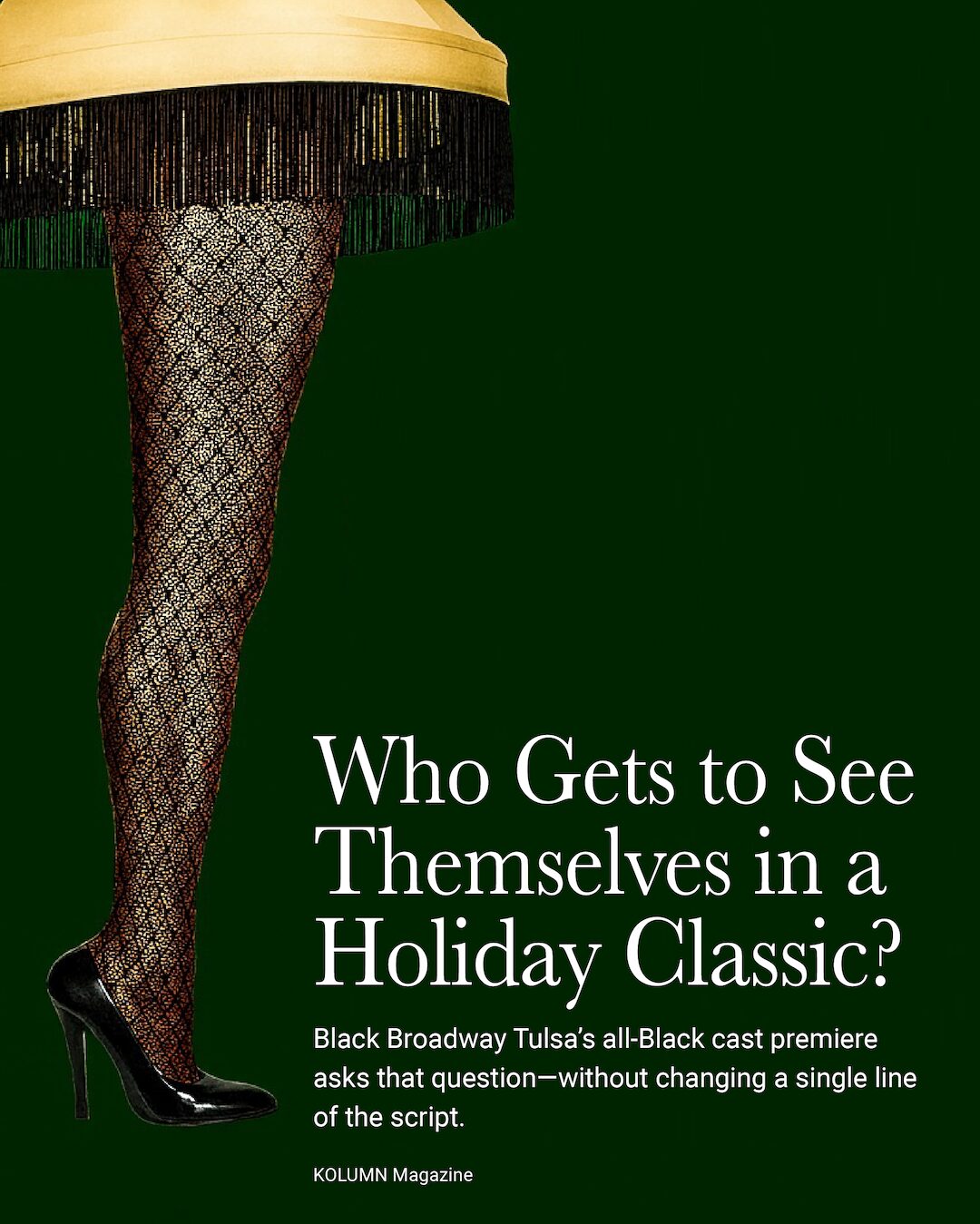
Who Gets to See Themselves in a Holiday Classic?
Black Broadway Tulsa’s all-Black cast premiere asks that question—without changing a single line of the script.
By KOLUMN Magazine
On paper, it looks like a modest run: three performances over one weekend in December, inside a school auditorium on West Edison Street. A familiar title. A family-friendly promise. A ticket link. But the closer you get to the doors of the Maya Angelou Auditorium in North Tulsa, the more the production’s scale—its real scale—comes into focus.
Black Broadway Tulsa is debuting what it and local coverage describe as a historic first: an all-Black cast production of A Christmas Story: The Play—the same holiday property so many Americans can recite by reflex, now performed entirely by Black youth and adult artists, in a city better known nationally for the story of Black Wall Street and the violence that razed it.
Director David Harris, according to reporting, frames the work as both reverent and revisionary: “We are honoring a classic story while introducing audiences to a fresh and powerful lens.” Obum Ukabam—the founder of Black Broadway Tulsa and a visible force in the city’s theater ecosystem—puts it more bluntly in the same report: “This is not about changing the story… It is about expanding who gets to tell it.”
In other words: the script remains. The casting changes. And the meaning, in Tulsa, shifts under your feet.
A small stage carrying a large argument
The official details are precise, almost spare: performances on December 19 at 7 p.m., December 20 at 7 p.m., and December 21 at 4 p.m., at the Maya Angelou Auditorium, 3101 W. Edison St. Ticketing copy emphasizes what the production insists it is doing: “the timeless holiday favorite presented with a full Black cast,” keeping “the classic script, characters, and charm.”
And yet, the production is also described as a partnership with Central Performing Arts Middle and High School and Solid Foundation Preparatory Academy—an intentional pipeline for training, technical theater exposure, and paid performance opportunities for young people and community members who have often had to improvise access to the arts.
That word—pipeline—matters. Tulsa has long had theater. It has had celebrated stages downtown, and strong community companies, and touring houses. But pipelines are about who gets to move through the system without begging at every gate. Pipelines are the opposite of exception stories.
Black Broadway Tulsa’s public-facing mission, as described in arts coverage, goes beyond the applause line: workforce development across “every facet of theater,” from acting to design and stagecraft, with a stated intention to prepare participants for professional opportunities in regional venues and beyond.
So the weekend is not merely a weekend. It is a proof-of-concept.

Why Tulsa makes the message louder
If this production were opening in a conventional theater district—if it were the kind of casting news that becomes a seasonal lifestyle item—its significance might settle into a familiar American groove: representation as refresh, diversity as marketing, novelty as a press hook. But Tulsa does not let holiday theater float free of history.
Here, performance is never just performance. It is also memory work.
A century ago, Greenwood—the thriving Black district later mythologized as “Black Wall Street”—had its own cultural infrastructure, including the Williams family’s Dreamland Theatre. Historical accounts describe Dreamland not simply as a place to watch films or catch a show, but as a community anchor: live entertainment, silent films, theatrical revues, and a venue that could seat hundreds.
During the 1921 Tulsa Race Massacre, Dreamland was destroyed. The Tulsa City-County Library’s historical summary of the Williams family notes the theater was reduced to “bricks and ashes,” part of a broader obliteration of Greenwood’s built environment and economic life. The National Endowment for the Humanities, recounting the massacre’s opening movements, places Dreamland in the story as a gathering point where a teenager—Bill Williams—witnessed urgent community organizing on the day violence erupted.
And Greenwood’s losses did not end in 1921. Later 20th-century “urban renewal” and highway construction cut through the neighborhood again, with reporting describing how an interstate project devastated what remained of the district’s commercial footprint—another erasure layered atop the first.
This is the Tulsa backdrop against which a school auditorium hosting a holiday play begins to read differently. In a city where a Black theater once symbolized Black prosperity—and then Black vulnerability—an all-Black cast holiday production becomes, inevitably, a commentary on who gets to occupy the center of the stage without explanation.
The new venue and the old question: who is the audience?
Black Broadway Tulsa’s choice of venue is not incidental. The Maya Angelou Auditorium is tied to Central Performing Arts High School, and arts coverage explicitly points to North Tulsa accessibility as part of the project’s logic—“delivering accessible, high-quality theater” outside the gravitational pull of traditional cultural corridors.
That matters because Tulsa’s arts map has long reflected Tulsa’s racial geography. To build a theatrical home in North Tulsa is to argue—quietly, persistently—that the city’s cultural “center” can be elsewhere, and that Black audiences need not be treated as a visiting constituency in their own town.
Ukabam’s quote—“expanding who gets to tell it”—is also, implicitly, about expanding who gets to be presumed as the default audience for American nostalgia.
In the ticketing description, the production is framed as “the same story you grew up with,” anchored in community opportunity. That line carries two messages at once: one to audiences who have always felt at home inside these holiday canons, and another to audiences who have been asked—sometimes politely, sometimes not—to see themselves as guests inside someone else’s tradition.
Dreamland as precedent, not just tragedy
When Dreamland Theatre is invoked in Tulsa’s public memory, it is often framed as an emblem of loss—a cultural casualty of the 1921 Race Massacre, flattened alongside homes, churches, and businesses. But to understand Dreamland only as tragedy is to miss its more durable significance. Before it was destroyed, Dreamland functioned as precedent: proof that Black Tulsa did not wait for permission to build a cultural life that was ambitious, cosmopolitan, and connected to the wider currents of Black performance in America.
Owned and operated by the Williams family, Dreamland was not a marginal venue. It was a legitimate stop on the Black theatrical and vaudeville circuits of the early 20th century, hosting films, live music, comedy, and touring acts at a moment when segregation barred Black performers from most white-owned theaters. In Greenwood, Dreamland stood alongside institutions like the Apollo Theater in Harlem and Chicago’s Regal Theatre—not identical in scale, but equal in purpose. It was a place where Black audiences saw themselves reflected onstage, and where Black entertainers could perform without the humiliations of Jim Crow backstage arrangements.
After Dreamland’s destruction, that tradition did not vanish; it migrated.
Over the next hundred years, Tulsa became a recurring waypoint for some of the most consequential Black entertainers of the 20th century, even as venues shifted and the city’s racial geography hardened. Jazz greats including Duke Ellington, Count Basie, and Louis Armstrong played Tulsa during the swing era, performing in segregated rooms but drawing multiracial crowds nonetheless. Ellington’s orchestra, in particular, was known for touring through Oklahoma repeatedly, bringing a sophisticated, orchestral Black modernism to cities often mischaracterized as cultural hinterlands.
By mid-century, the city had become a stop for gospel powerhouses as well. Mahalia Jackson, whose voice fused sacred music with the emotional authority of the civil rights movement, performed in Tulsa churches and auditoriums, her concerts functioning as both spiritual gatherings and civic events. Gospel groups like the Soul Stirrers—at times featuring a young Sam Cooke—passed through Oklahoma regularly, carrying with them a distinctly Black performance tradition rooted in call-and-response, testimony, and collective witness.
As popular music shifted, Tulsa adapted. Ray Charles, whose blend of gospel, blues, and country would redefine American music, performed in Tulsa venues during the 1950s and 1960s, often navigating the indignities of segregated accommodations even as his records topped national charts. Aretha Franklin followed, her appearances marked by the paradox of her era: a Black woman revered onstage, constrained off it.
The late 20th century brought a different kind of visibility. Tina Turner, in her post–Ike Turner resurgence, performed in Tulsa as part of national tours that treated the city not as an outpost but as a necessary stop between coasts. James Brown, whose shows blurred the line between concert and sermon, brought his electrifying performances to Oklahoma audiences, affirming Tulsa’s place within the Black touring circuit even as mainstream narratives continued to overlook it.
Comedy, too, found fertile ground. Richard Pryor, whose Tulsa connection runs deeper than a tour stop—he spent part of his youth in nearby Peoria and had familial ties to Oklahoma—performed in the region, his work resonating with Black audiences who recognized both the humor and the harm embedded in his stories. Later generations saw figures like Chris Rock and Dave Chappelle perform in Tulsa, often drawing crowds that reflected the city’s complicated racial makeup: integrated audiences laughing at jokes forged in Black experience.
By the time Broadway tours and large-scale productions became more common in Tulsa’s downtown performing arts centers, Black performers were no longer novelties—but neither were they centered. They arrived as part of national productions, not local institutions. The infrastructure that Dreamland once represented—a Black-owned, Black-oriented cultural anchor—remained absent.
This is where Black Broadway Tulsa’s work becomes legible as lineage rather than innovation alone. The company is not merely staging a holiday play; it is reasserting the idea that Tulsa can once again be a place where Black performance is generated, not just received. Where Black artists do not pass through but build.
Dreamland’s true legacy, then, is not only what was lost in 1921. It is the enduring expectation it set—that Black audiences deserve excellence close to home, that Black performers deserve stages where they are central rather than supplemental, and that Tulsa’s cultural story does not begin or end with destruction.
An all-Black cast holiday production in North Tulsa may seem modest against that history. But precedent often reenters quietly. Sometimes it returns not with a marquee on Greenwood Avenue, but with a curtain rising in a school auditorium, carrying forward a promise that was never meant to die.
The point of “not changing the story”
Holiday theater often survives by being reassuring. The same beats. The same laughs. The same sentimental turns. A Christmas Story—in any casting configuration—is a nostalgia machine.
So why insist, so loudly, that the story itself is unchanged?
Because in America, “unchanged” has often been code for “unchallenged.” And Black Broadway Tulsa’s wager seems to be that you can keep the script intact while still challenging the cultural ownership of the script.
“This story belongs to everyone,” one promotional quotation circulating in coverage says, before describing what becomes possible when “talent is supported, trained, and given room to shine.” Harris echoes that logic with a craft-oriented pride in the work’s “joyful, heartfelt” family appeal.
But Tulsa is a city where “belongs to everyone” is never a neutral sentence. Not when the most famous chapter in its Black history is about a neighborhood that was made to belong to no one but history.
A local company with national implications
There is a particular kind of cultural story America likes to tell about Black theater: the New York story, the Broadway story, the touring-house story. Tulsa complicates that template.
Coverage describes this production as a “world-first debut happening not on Broadway or in a major coastal city, but in Tulsa.” Even if one brackets the “first-ever” framing to what can be verified publicly, the larger point stands: important cultural experiments do not always originate from the usual zip codes.
And Black Broadway Tulsa has been building toward this moment. In 2024, arts reporting positioned the company’s debut season as a statement of intent—productions meant to showcase local Black talent, create fair compensation, and train participants across disciplines, with ambitions that extend as far as taking students to experience Broadway itself.
That matters for a simple reason: theater ecosystems are built by repetition—by seasons, not stunts. The holiday show is visible because holiday shows are visible. But the infrastructure under it is what determines whether this becomes tradition.
The premiere as a civic scene
On opening weekend, the audience will likely include the kinds of people Tulsa theater always depends on: parents and grandparents, educators, churchgoers, arts patrons, the curious, the skeptical, the proud. The civic mix is the point. A school auditorium is not a velvet-rope venue. It is a room designed for community gathering, period.
And in a city still negotiating how to commemorate Greenwood without commodifying it, a Black-led company staging a mainstream holiday property offers a different kind of remembrance—less about trauma retelling, more about presence. Not the burning building, but the lit stage.
Dreamland, after all, was once a place where Black Tulsans went to enjoy themselves. That is easy to forget in a public narrative that freezes Greenwood in the moment of its destruction.
Black Broadway Tulsa’s holiday premiere, in that sense, is not only a statement about representation. It is also a statement about Black joy as civic practice—the right to treat leisure as normal, not exceptional.
What to watch for next
The success of a single weekend is easy to measure in ticket scans. The success of a pipeline takes longer—and shows up in where the cast and crew are working two, five, ten years from now.
If Black Broadway Tulsa’s model holds, Tulsa could see a cohort of artists and technicians who did not have to leave home to be taken seriously. A cadre of young people for whom theater is not a hobby you age out of, but a craft with wages, mentors, and progression.
And if the city is serious about honoring Greenwood beyond plaques and anniversaries, then supporting living Black cultural institutions—companies that create jobs, train youth, and produce art in North Tulsa—will matter as much as any commemorative architecture ever will.
For this weekend, though, the pitch is simpler: come in from the cold, take your seat, and watch what happens when a story America has always treated as familiar becomes newly, unmistakably, shared.
Performances
Friday, December 19 at 7 p.m., Saturday, December 20 at 7 p.m., and Sunday, December 21 at 4 p.m. at the Maya Angelou Auditorium, 3101 W. Edison St.