

Before Kindred,
There Was
the Pattern
Inside the early life and working-class grind that shaped Octavia Butler’s first universe of telepaths, parasites and power.
By KOLUMN Magazine
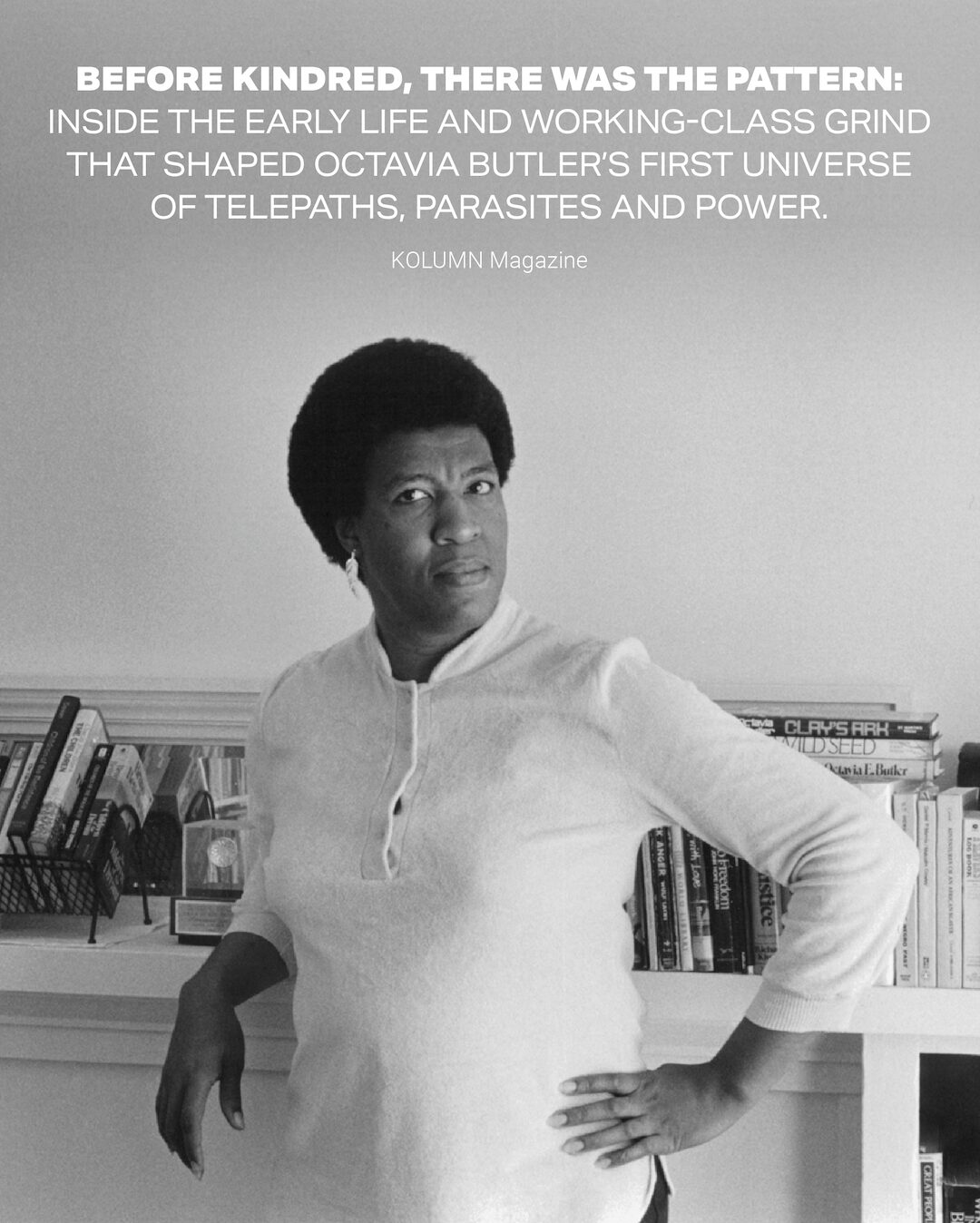
On weekday afternoons in 1950s Pasadena, when the sun was still burnishing the San Gabriel Mountains, a tall, painfully shy girl would slip into the cool hush of the Central Library and disappear. She moved through the stacks with the wary self-consciousness of someone who has already learned that it is safer not to be seen. Books were easier company than children; shelves more predictable than school hallways.
Octavia Estelle Butler—only child of a maid and a shoeshine man—found in those stacks her first portal out of a world that seemed determined to make her feel small. She read fairy tales and horse stories, then pulp science-fiction magazines with lurid covers: Amazing Stories, Galaxy, The Magazine of Fantasy & Science Fiction.
By the time she was 12, she was not just reading other people’s worlds. She was sketching the blueprints of her own.
That was the year she watched a low-budget British film called “Devil Girl from Mars,” a stiff, cardboard vision of alien invasion. Butler later recalled deciding, right there in front of the television, that she could write a better story. She turned the TV off and started typing.
The pages she began then—in a “big pink notebook” and on a clacking Remington typewriter her mother scraped together money to buy—would grow, over the next decade, into the skeleton of the Patternist series. Before she had a name for it, before she had a publisher, Octavia Butler was already imagining a secret history of humanity: telepaths, parasites, hierarchies of power, and people whose bodies and minds were never fully their own.
The Pattern, in other words, started as a girl trying to write herself out of the corner the world had put her in.


Pasadena, Behind the Back Door
Octavia Butler was born in Pasadena, California, on June 22, 1947. Her father, Laurice, he died when she was very young. Her mother, Octavia Margaret Guy, cleaned other people’s houses and raised her daughter with the help of Octavia’s grandmother in a strict Baptist household.
The Pasadena of Butler’s childhood marketed itself as a sunny, postwar idyll. For Black residents, it was also a place shaped by housing covenants and de facto segregation. Butler accompanied her mother to work, entering white families’ homes through the back door, watching as her mother was treated as an invisible presence in someone else’s domestic drama.
Those days left imprints that would later surface—mutated, transposed—on the page. In the Patternist books, whole classes of people are bred to be useful to the powerful, passed from household to household, valued for their labor and bodies more than their personhood. It is not a direct allegory of Black domestic work in the 1950s, but the echo is hard to ignore.
Physically, Butler stood out. She was tall, broad-shouldered, and, by her own account, chronically self-conscious about her appearance. She struggled with dyslexia and was introverted enough that she described spending much of her youth “staring at the ground.”
Classmates teased her; adults mistook her for someone older. School was a place of small humiliations. Books became the refuge that made endurance possible. In the Pasadena Central Library, Butler could disappear into distant planets or futures where, if people were cruel or hierarchies brutal, at least she could imagine changing the rules.
The tension between the vulnerability of her real life and the absolute authority of an author at her desk would become one of the quiet engines of her fiction. She might be powerless in the cafeteria. On the page, she would decide who lived, who died, and who controlled whom.
The Making of a Working-Class Visionary
The idea that she might become a writer for a living was greeted at home not with encouragement but with fear. In one oft-retold episode, a well-meaning aunt told young Octavia that “Negroes can’t make a living writing.” The remark, Butler later said, didn’t crush the dream—but it clarified the odds.
If she was going to write, she would also have to work.
After high school, Butler cycled through a series of low-wage jobs: telemarketer, warehouse worker, dishwasher, potato chip inspector. She enrolled at Pasadena City College, then took classes at California State University, Los Angeles, as the Black Power movement surged through Southern California. In the streets and on campus, she saw how ideologies of liberation collided with entrenched power—another pattern she would later weave into fiction.
She developed a punishing routine: wake around 2 or 3 a.m., write for several hours, then head to whichever job was paying the rent that month. Rejection slips piled up; the work remained stubbornly invisible. Even after selling two early short stories to anthologies in the early 1970s, she still faced five years of steady rejection before seeing her name on the spine of a novel.
But each pre-dawn shift at the typewriter, each walk to a bus stop in the dark, was a vote of confidence in the worlds she was building—none more ambitious than the one that began to coalesce as the Patternist series.
A Secret History of Humanity
If you trace the Patternist books in the order Octavia Butler published them, the series seems almost deceptively linear. Patternmaster, her first novel, appeared in 1976, followed by Mind of My Mind (1977), Survivor (1978), Wild Seed (1980), and Clay’s Ark (1984). But the publication sequence disguises the deeper architecture Butler had envisioned—an audacious, centuries-spanning reimagining of human evolution that stretches from an early modern African village to a far-off future in which telepaths reign over the remnants of civilization.
If read chronologically within Butler’s universe, Wild Seed comes first. Its story—an immortal, body-hopping patriarch (Doro) and a shapeshifting, self-possessed healer (Anyanwu) locked in a centuries-long battle over the ethics of power—has long been considered one of the most original origin myths in speculative fiction. Critics have repeatedly singled out Wild Seed as Butler at her most elegant and psychologically incisive. The Washington Post, in an early appraisal, called the novel “a devastatingly imagined fable of control and resistance,” praising Butler’s “mastery of character-driven mythmaking” and her ability to build a speculative framework with “the weight and complexity of real history.”
Mind of My Mind, set largely in 20th-century Los Angeles, deepens the saga by chronicling the rise of Mary, the first Patternmaster—an unwilling prodigy whose ability to bind other telepaths into a single psychic web creates a new social order. The New York Times later described the novel as “a breakthrough in the genre… an exploration of power that feels both intimate and planetary,” noting Butler’s “rare talent for grounding the fantastical in the emotional logic of everyday life.”
Patternmaster, the novel readers encountered first, is in fact the end of the story: a brutal, caste-bound future in which telepaths rule over “mutes” (ordinary humans) and battle the infected Clayarks for dominion. While some reviewers in the 1970s approached the book as conventional science fiction, others recognized a new force in the field. In a retrospective review, the Los Angeles Times called Patternmaster “lean, unflinching, and strangely majestic,” praising the way it “plants the seeds of a cosmology that Butler would spend a decade refining into one of the most philosophically daring sagas in American fiction.”
The Patternist books were not bestsellers in their time, but they earned a small and intensely loyal readership that recognized the ambition behind them. In later years—after Butler’s MacArthur award, after Kindred entered school curricula—critics began reassessing the Patternist novels as foundational to her oeuvre. The Guardian, in a 21st-century reevaluation, wrote that “the Patternist series reveals Butler as an architect of narrative systems: hierarchies, networks, contagions of power. She was asking questions few other writers in the genre had considered—and fewer still dared to center in Black experience.”
The series’ ethical concerns have especially resonated with contemporary scholars of Black feminist thought. Word In Black called Wild Seed “a masterclass in depicting the survival strategies of Black women across centuries,” lauding Butler’s portrayal of Anyanwu as “one of the most textured and triumphant figures in Afrofuturist literature.”
Even Clay’s Ark, long treated as the Patternist outlier because of its viral infection plotline, has experienced critical revival. The Root noted that its examination of bodily autonomy and mutation reads today as “eerily prescient… a novel that interrogates the meaning of humanity from the inside out.”
Taken together, the Patternist books form what one Guardian reviewer described as “a secret history of humanity—one written not by victors but by survivors, shapeshifters, renegades, and people who refuse the destinies imposed on them.”
Beyond their narrative scope, critics now situate the series as an early blueprint for Butler’s lifelong interrogation of power: how it forms, how it corrupts, and how it might be wielded without replicating the violences of the past. In this sense, the Patternist novels do not simply precede Kindred, Dawn, or the Parable books chronologically—they lay the conceptual groundwork for everything that followed.
They were, as one Ebony Magazine profile put it, “the first long breath of a writer who would change the shape of the future—not just in fiction, but in the American imagination.”
Power, Control, and Who Counts as Human
In interviews, Butler resisted tidy labels, preferring “speculative fiction” to “science fiction,” and bristling at the idea that her books were didactic allegories. But the Patternist series is unmistakably a laboratory for thinking about power—who wields it, who benefits, and who gets crushed.
At the center of that lab stands Doro, introduced fully in Wild Seed but implicit in the Patternist universe from the start. Ancient, parasitic, able to abandon one body for another at will, Doro has spent millennia breeding humans with telepathic abilities. His goal is a race of powerful sensitives whose minds he can both cultivate and control.
Doro is, on one level, a fantasy villain: a near-immortal patriarch who treats people like livestock. Yet critics have pointed out that he also carries echoes of slave traders, colonizers, and eugenicists, reimagined through a science-fiction lens.
Against him Butler sets Anyanwu and, later, Mary—Black women whose powers and moral visions challenge Doro’s assumption that control is its own justification. Anyanwu, an African healer whose shapeshifting and longevity make her Doro’s only true peer, refuses to see the people he breeds as expendable material. Mary, a young Black telepath in Mind of My Mind, forms the first Pattern, linking a community of sensitives into a network that is at once intimate and coercive.
Readers and scholars have noted how these relationships mirror and complicate histories of slavery and patriarchy. The Pattern, after all, gives Patternists extraordinary mental communion, but it also allows a single Patternmaster to override others’ wills—an arrangement that looks, from below, a lot like enslavement.
Power, in Butler’s early fiction, is never simple. It is both the thing you need to survive and the thing that threatens to twist you into someone you do not want to be.
That ambivalence feels rooted in Butler’s own trajectory: the shy Pasadena girl who dreamed of mastery—over language, over plots, over her own time—yet understood intimately what it meant to live in someone else’s hierarchy. Her early life, as Susana M. Morris’s recent biography Positive Obsession emphasizes, was marked by chronic self-doubt, financial precarity, and a persistent fear that she might never quite become the writer she imagined.
The Patternist novels can be read as the fictional form of that negotiation: a writer exploring what it means to claim power without simply reproducing the violence she has endured.
The Discipline of a “Positive Obsession”
If the Patternist series is structured around questions of control, Butler’s life in those years was structured around discipline. She called writing her “positive obsession.”
The phrase is not hyperbole. She kept detailed notebooks where she wrote out affirmations in longhand—commitments to herself that bordered on spellwork: declarations that she would be a bestselling writer, that she would win awards, that she would support herself through her work. Decades later, when Parable of the Sower finally hit the New York Times bestseller list and her novels began to be adapted for television and opera, those affirmations circulated online as evidence of an almost prophetic will.
But in the 1970s, there was no guarantee any of it would come true. There was just the alarm clock, the typewriter, the rejection slips.
Patternmaster, drafted and redrafted in the margins of those working-class days, finally sold to Doubleday and was published in 1976. The novel is leaner and more conventional than Butler’s later work, with an adventure-story spine about a young telepath, Teray, fighting rival Patternists as he claws his way toward power. But even in this first effort, critics have noted, the seeds of her major concerns are already visible: the stratified society of Patternists, “mutes” (non-telepaths), and Clayarks; the uneasy question of who gets counted as fully human; the suggestion that liberation for one group might mean subjugation for another.
Mind of My Mind, published the following year, is a bolder and more assured book. Set in contemporary Los Angeles, it imagines telepathy emerging not in some distant galactic empire but in a landscape of cheap apartments, blighted neighborhoods, and makeshift families—terrain much closer to Butler’s own experience.
If Patternmaster asks what happens when a brutally unequal system is already in place, Mind of My Mind asks how such a system is born—and whether the people who build it can avoid becoming what they hate.
While she wrote, Butler was still assembling a living from odd jobs. She attended the Clarion Science Fiction Writers’ Workshop in 1970, where Harlan Ellison encouraged her to persevere, and sold early short stories to anthologies that gave her just enough validation to keep going. For several years, as the Patternist manuscripts accumulated, she would rise before dawn, write until the sun came up, then head to work inspecting chips or packing boxes.
The Patternist series, in other words, was not just a creative project; it was a long gamble against exhaustion.
A Breakout, Then a Backward Glance
By the late 1970s, Butler had done something that once seemed impossible in her aunt’s living room: she had become a professional science-fiction writer, one of the very few Black women in a field dominated by white men.
Survivor, the third published Patternist novel, sent a group of human colonists—many of them religious fundamentalists—to another planet, where they encounter alien species and grapple with cross-cultural survival. Butler later grew so dissatisfied with the book that she refused to let it be reprinted, calling it, in essence, a compromise she no longer wanted in circulation.
Her willingness to disown one of her own novels is striking. It reflects not only a perfectionist streak but also an ethical clarity about her body of work: if the Patternist saga was going to serve as her speculative history of power, she was unwilling to let a volume stand that, in her view, mishandled its responsibilities.
After Survivor, she pivoted briefly away from the series to write Kindred (1979), the time-travel novel in which a contemporary Black woman is pulled back to a Maryland plantation to save, and confront, her white slave-owning ancestor. It would become her most widely read work and, in many readers’ minds, the one that most directly braided speculative premises with the historical traumas of slavery.
But Butler returned to the Patternist universe in Wild Seed (1980) and Clay’s Ark (1984), deepening the origin story of Doro’s breeding project and the alien infection that would eventually create the Clayarks.
Wild Seed, especially, has become a touchstone for writers, scholars, and artists—including musicians such as Janelle Monáe—who cite Anyanwu’s shapeshifting resilience and the novel’s interrogation of domination as a formative influence.
In those years, Butler was not yet a cultural icon. She was a working writer scraping by in Los Angeles, building, book by book, a cosmology in which Black women’s interior lives and choices sat at the center of the story—and in which the fight over whose mind belongs to whom was always, in some way, about race, gender, and class.
Patterns from Pasadena to the Future
From the vantage point of 2025, when wildfires in California, rising authoritarian currents, and widening inequality make Butler’s Parable novels feel less like prophecy than reportage, it is easy to read backward and anoint her as a seer who “predicted” our present. Writers and critics in outlets from The Root to Word In Black have invoked her as the “mother of Afrofuturism” whose work offers both warnings and blueprints for survival.
But the Patternist series reminds us that Butler’s earliest sustained experiment in world-building was less about specific forecasts than about structural questions: How do hierarchies take shape? How does a person live ethically inside a system that rewards domination? What happens when liberation for some requires submission from others?
It is difficult not to see the roots of those questions in a childhood spent watching her mother enter white homes by the back door, or in the experience of moving through a world that often treated a tall, dark-skinned, working-class Black girl as if she were out of place.
The Patternist books are, among other things, a set of thought experiments in refusing the roles that history would hand you. Anyanwu refuses to be just Doro’s breeding stock; Mary refuses to be just his obedient daughter; Teray refuses to accept the hierarchy he inherits without question. Butler, the writer behind them, refused to accept that the roles offered to her—domestic worker’s daughter, low-wage employee, a fan in the back row of a science-fiction convention—were the only ones available.
That refusal did not make her life easy. As Morris’s biography shows, the years surrounding the Patternist series were marked by bouts of depression, writer’s block, and a constant struggle to reconcile the grand scope of her ideas with the grind of daily life. Yet it is precisely this tension—the gap between the young woman staring at the ground in Pasadena and the sweeping histories of power she inscribed on the page—that gives the Patternist novels their uneasy, enduring power.
In a 2003 oral history for Seattle’s Museum of Pop Culture, Butler reflected on discovering science fiction as a child and deciding to stay with it because it allowed her to rethink the world’s assumptions. The Patternist series is where she began that rethinking in earnest: a project launched by a teenage girl who turned off a bad science-fiction movie and decided she could do better.
Before the MacArthur “genius” grant, before the posthumous Google Doodles and television adaptations, there was a girl in a library, mapping a universe in which no pattern of power was ever natural or inevitable.
The Pattern began there.