

Hope Is On
The Table
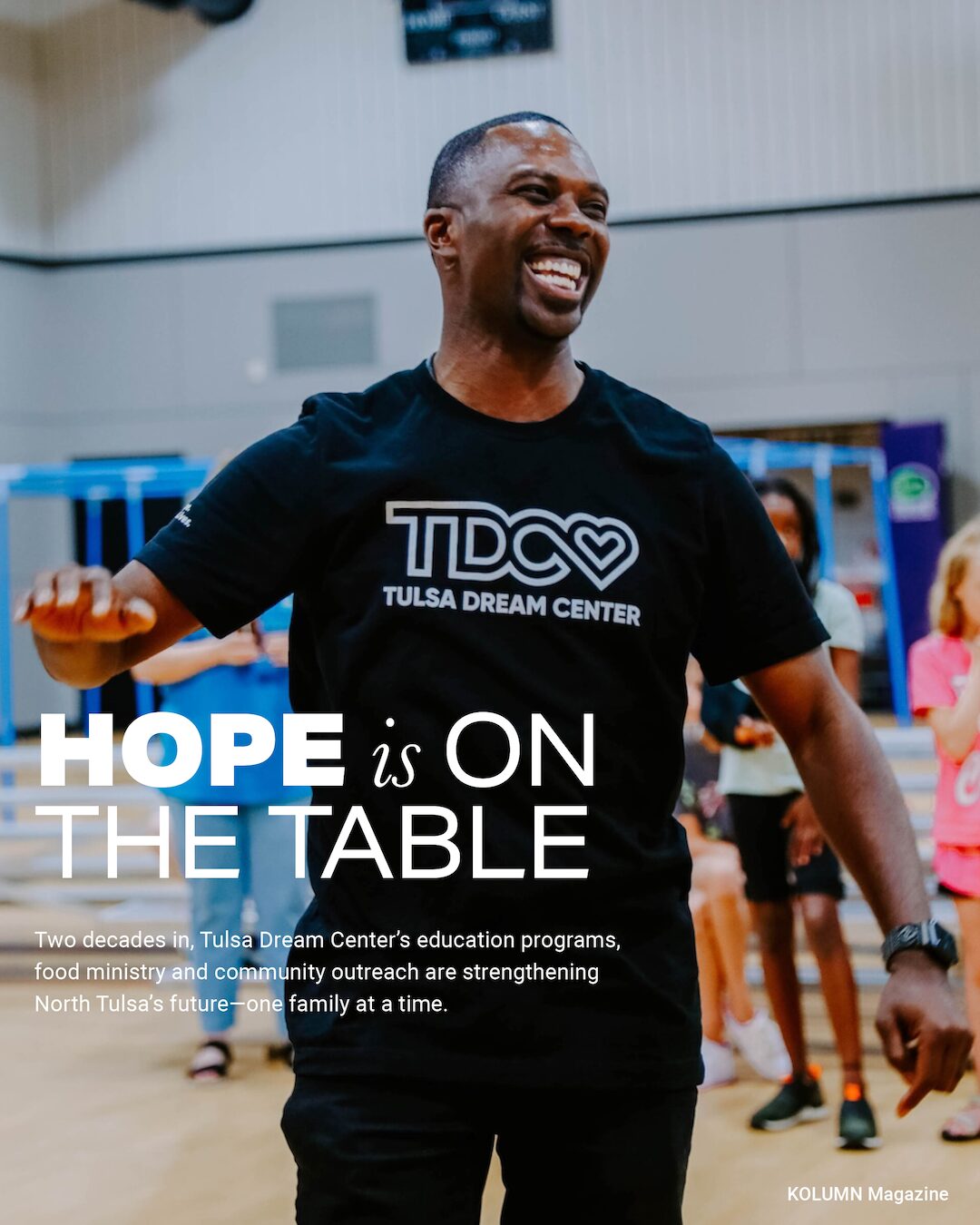
Two decades in, Tulsa Dream Center’s education programs, food ministry and community outreach are strengthening North Tulsa’s future—one family at a time.
By KOLUMN Magazine
On any given Tuesday at the Tulsa Dream Center, the parking lot on West 46th Street North fills long before the doors open.
Minivans idle in a slow-moving line. Grandmothers in church T-shirts lean on their shopping carts, toddlers tugging at their sleeves. Teenagers in basketball shorts drift between the sidewalk and the gym, where the echo of a bouncing ball competes with the buzz of after-school tutoring just down the hall.
Through the glass doors, the building opens into a corridor of small, urgent miracles: a line for free groceries and hot meals; a lobby bulletin board covered with flyers for GED classes and youth sports; a STEM lab lit by the glow of computer screens and worksheets about fractions. Near the entrance, a man in a black T-shirt that reads “TDC❤️ – Tulsa Dream Center” moves from group to group, calling people by name.
This is Pastor Tim Newton’s parish—not in the traditional sense of a Sunday sanctuary, but in the weekday cadence of a community center that has quietly become one of North Tulsa’s most dependable institutions.
“As long as these doors are open, we’re going to put hope on the table,” Newton has said in public remarks about the center’s work. It’s an organizing principle as much as a promise.



A North Tulsa story, written after 1921
The Tulsa Dream Center opened in 2001 with a very explicit purpose: to address the socioeconomic injustices that grew out of the 1921 Tulsa Race Massacre and the decades of disinvestment that followed in North Tulsa. The nonprofit, founded by Victory Church but operating as an independent 501(c)(3), now serves more than 5,000 unduplicated clients a year through programs that reach across education, food security, health care and youth development.
Most of the people who walk through its doors live below the poverty line. Roughly two-thirds are racial minorities—African American, Native American, Hispanic or multiracial—reflecting the demographic reality of the neighborhoods around it. The staff and leadership are intentionally built to mirror that community: about 80 percent of the center’s top leaders and two-thirds of its part-time staff are people of color.
From the beginning, the Dream Center’s organizing idea was deceptively simple: everything free, everything under one roof. Whether it’s a clinic visit, groceries, clothing, tutoring, summer camp or youth sports, the entire menu of services is offered at no cost, designed to chip away at both immediate crises and the deeper structural inequalities that define life in North Tulsa.
Newton, who spent more than a decade as Director of Programs before becoming Executive Director, has been at the center of that experiment in comprehensive neighborhood care. For many families, he is the Dream Center—“a familiar face” who has served in leadership for over 12 years and now oversees the daily work of teams responsible for education, programs, facilities and grants.
In local profiles and community events, he is frequently introduced as “a true champion for North Tulsa,” a man whose personal charisma masks the complexity of what he’s trying to pull off: in a part of the city where life expectancy is roughly 10 years shorter than on the other side of Interstate 244, the Dream Center is trying to build a different future, one tutoring session, one bag of groceries, one youth league at a time.
The classroom after school
If food distribution is what first draws many families to the Dream Center, the marquee program—the one staff members talk about with a particular mix of data and pride—is education.
The education wing is designed not as an afterthought but as a kind of second school day. The center runs programs from early childhood all the way through GED preparation for adults, but the heart of the operation is the LIFE program—Literacy Is For Everyone—for students in grades 1 through 5.
More than 200 children are enrolled, with a waitlist of over 50. Every child receives one-on-one tutoring, guided by I-Ready diagnostic software that pinpoints where, exactly, a student has fallen behind. The goal is not just homework help; it’s bringing at-risk students up to grade level in reading and math and keeping them there.
In the late afternoon, the tutoring rooms hum with a kind of focused chaos. A first grader reads aloud to a volunteer, stumbling through consonant blends. A fourth grader works through a math problem on a small whiteboard, erasing and rewriting until the numbers line up. In a corner, a staff member pulls a small group into the STEM lab, where a lesson on fractions becomes an exercise in measuring ingredients for a simple recipe.
For many of these students, the Dream Center is not just an academic boost but a nutritional lifeline. Every child in the program receives a hot, well-balanced meal—often the only hot meal of their day.
The educational theory behind the program is familiar to anyone who has followed the national conversation about learning loss and achievement gaps: intensive, individualized instruction; evidence-based teaching strategies; consistent exposure to grade-level content. But what gives the Dream Center’s model its particular texture is the way academics are braided into the rhythms of community: tutoring is followed by sports, which in turn are used as a lever to keep young people tethered to school and to the building itself.
The center’s eight-week summer camp extends that routine into the hottest months, mixing academic reinforcement with field trips, enrichment and youth sports leagues. There’s a STEM lab, funded in part by corporate and philanthropic partners, and partnerships with institutions like Langston University’s Cooperative Extension program, which now brings additional STEM opportunities—from robotics demonstrations to hands-on science activities—into the Dream Center’s classrooms.
In a recent university write-up about that partnership, photos show Newton and staff posing in front of a colorful Dream Center mural with Langston faculty and students—an image of a pipeline they are actively trying to build between North Tulsa’s elementary schoolers and Oklahoma’s historically Black land-grant university.
The long-term academic outcomes are still unfolding in real time; there is no instant metric for what it means to have a consistent adult who expects you to show up for tutoring every Tuesday and Thursday for five years straight. But the internal logic of the program is clear: if children can read at grade level, if they are fed, if they can imagine an academic future that doesn’t feel abstract or unreachable, then the rest of the Dream Center’s work—food distribution, health care, neighborhood outreach—has something solid to stand on.
“Hope is on the table”: Ending hunger, building health
The Dream Center’s education programs sit literally and figuratively next to the food ministry.
North Tulsa has long been identified as a food desert—an urban area where low-income residents live more than a mile from a full-service grocery store. Without a car, that mile expands: to find fresh fruits and vegetables, many families must navigate multiple bus transfers or rely on corner stores that stock mostly processed food. The consequences show up in rates of obesity, diabetes and heart disease.
On the Dream Center’s food services page, the language is blunt: the organization’s focus is on eliminating hunger in North Tulsa. Every Tuesday and Thursday, groceries are distributed in the late morning, with hot meals served before noon. To receive groceries, families check in at the front desk; many stay to eat, talk with staff and connect with other services.
“Hope is on the table, and so is a hot meal,” the center wrote in a social media post promoting the program—less slogan than simple description of what happens in the fellowship hall.
The operation itself is a blend of old-fashioned church pantry and logistical choreography. Volunteers unload pallets of produce and shelf-stable goods supplied by partners like the Community Food Bank of Eastern Oklahoma; staff members organize distribution so that families can choose from an array of options rather than receive a one-size-fits-all box. On some days, the line includes elderly residents who remember the heyday and destruction of Greenwood; on others, it’s mostly young parents juggling babies and grocery bags.
In 2025, the Dream Center’s food work took a step into a different model of access when it became home to The Grocery Box, a full-service “micro” grocery store built into a customized shipping container on site. The Grocery Box, which began as a mobile store, now serves roughly 10,000 residents in the surrounding area, offering affordable produce and staple goods in a neighborhood where there had been no such store.
Within five months of opening its north Tulsa location, the Grocery Box had logged more than $95,000 in sales and served over 9,000 customers—early evidence that when fresh food is available within walking distance, people will buy it.
Standing outside the gleaming container, Newton has described the project as part of a larger push toward health equity. In one local TV interview, he noted that life expectancy is a decade shorter in this part of town than south of the freeway and argued that closing that gap will require more than emergency food boxes—it will take sustained access to better food, better health care and better information.
The Dream Center’s on-site health partners, including a free clinic operated in collaboration with local medical providers, are an attempt to knit those threads together: a place where a resident might pick up groceries, get a blood pressure check, and sign their child up for tutoring in a single visit.
Community outreach as ecosystem
If there is one phrase that appears again and again in descriptions of the Tulsa Dream Center, it is “meeting needs, building relationships, and empowering individuals and families to thrive.” That mantra is not just nonprofit boilerplate; it’s the scaffolding around which Newton and his staff have built an ecosystem of outreach.
On holidays, the Dream Center morphs into something that looks like a cross between a block party and a social-service fair. “Friendsgiving” events, promoted heavily on social media, bring together volunteers, donors and neighborhood residents for shared meals and activities. Christmas programs transform the gym into a gifting warehouse, with toys and coats for children and grocery vouchers for parents.
On ordinary weekdays, outreach is more granular. Youth sports leagues—basketball, flag football, cheer—provide structure in after-school hours when, as Newton has pointed out, teens are most likely to get into trouble. A new program launched in recent years explicitly aimed to curb youth gun violence by giving young people more positive options: community service projects packing food, structured time in the gym, and leadership mentoring.
That emphasis on “keeping kids busy,” as Newton told one local reporter, is less about distraction than about building alternative pathways in a city where violence can feel like the default script.
There are the quiet forms of outreach that rarely make the news: staff who call parents when a student hasn’t shown up for tutoring in weeks; volunteers who drop by a family’s home with an extra box of food when a car breaks down; the Executive Director who still spends much of his time in hallways and parking lots, greeting people not as “clients” but as neighbors.
For Newton, whose own biography is woven into the institution’s history—years of program leadership before stepping into the top role—the work is personal. In staff profiles and community spotlights, he is photographed laughing with children in the gym, speaking with a microphone in hand, standing with his wife Nichole outside Greenwood Rising, the history center commemorating Black Wall Street. These images hint at the dual nature of his job: part CEO, part pastor, wholly embedded in the story of North Tulsa’s resilience.
Quiet metrics of success
Unlike splashy philanthropic initiatives that rise and fall with national attention, the Tulsa Dream Center’s success is measured in steady, incremental gains.
There are numbers the organization can point to: the 5,000-plus unduplicated clients served annually; the full enrollment and waitlist for the LIFE literacy program; the hundreds of hot meals served each week; the thousands of customers who have bought groceries at The Grocery Box since it opened on site.
There are also honors that confer a more official kind of recognition. HUD has designated the Dream Center an EnVision Center—one of a select group of “centers of excellence” recognized for their work in economic empowerment, educational advancement, health and wellness, and character development.
But some of the more meaningful metrics don’t fit in a fact sheet. They are embedded in stories that repeat in slightly different form: a child who moves from far below grade level to reading confidently aloud; a parent who comes for groceries and ends up in a GED class; a teenager who shows up for free pizza and leaves with a job lead and a mentor.
For a national audience accustomed to stories about urban decline and institutional failure, it can be tempting to slot the Dream Center into the category of “feel-good exception,” the passionate nonprofit that succeeds against the odds. Newton resists that framing. In his telling, the center is less an exception than a prototype: evidence of what becomes possible when long-term, locally anchored investments in education, food access and community life are made in places where the odds have been stacked against families for generations.
A living experiment in “whole neighborhood” care
Two decades after its founding, the Tulsa Dream Center is no longer an experiment in the speculative sense. It is a fixture: one of the city’s largest providers of after-school tutoring, health care for the uninsured and equitable opportunities for underserved residents.
Yet Newton and his team talk about their work as if it is still in progress, still subject to revision. Partnerships evolve; programs expand or contract; a one-time holiday event becomes an annual tradition; a mobile grocery becomes a permanent fixture.
“We can’t fix everything,” Newton has said, in a line that surfaces in different versions across interviews and speeches. “But we can show up, every single day, right here.”
In North Tulsa, where the legacy of 1921 is written into land deeds, family histories and the health statistics of entire zip codes, the decision to “show up” has taken on its own quiet radicalism. Success, in that context, looks less like a ribbon-cutting than like the familiar sight of a line of cars on a Tuesday morning, snaking toward a low concrete building that promises, without flourish, to give hope and change lives.
It is, in many ways, a modest claim. It is also, for thousands of Tulsans, the most reliable one they hear all week.