




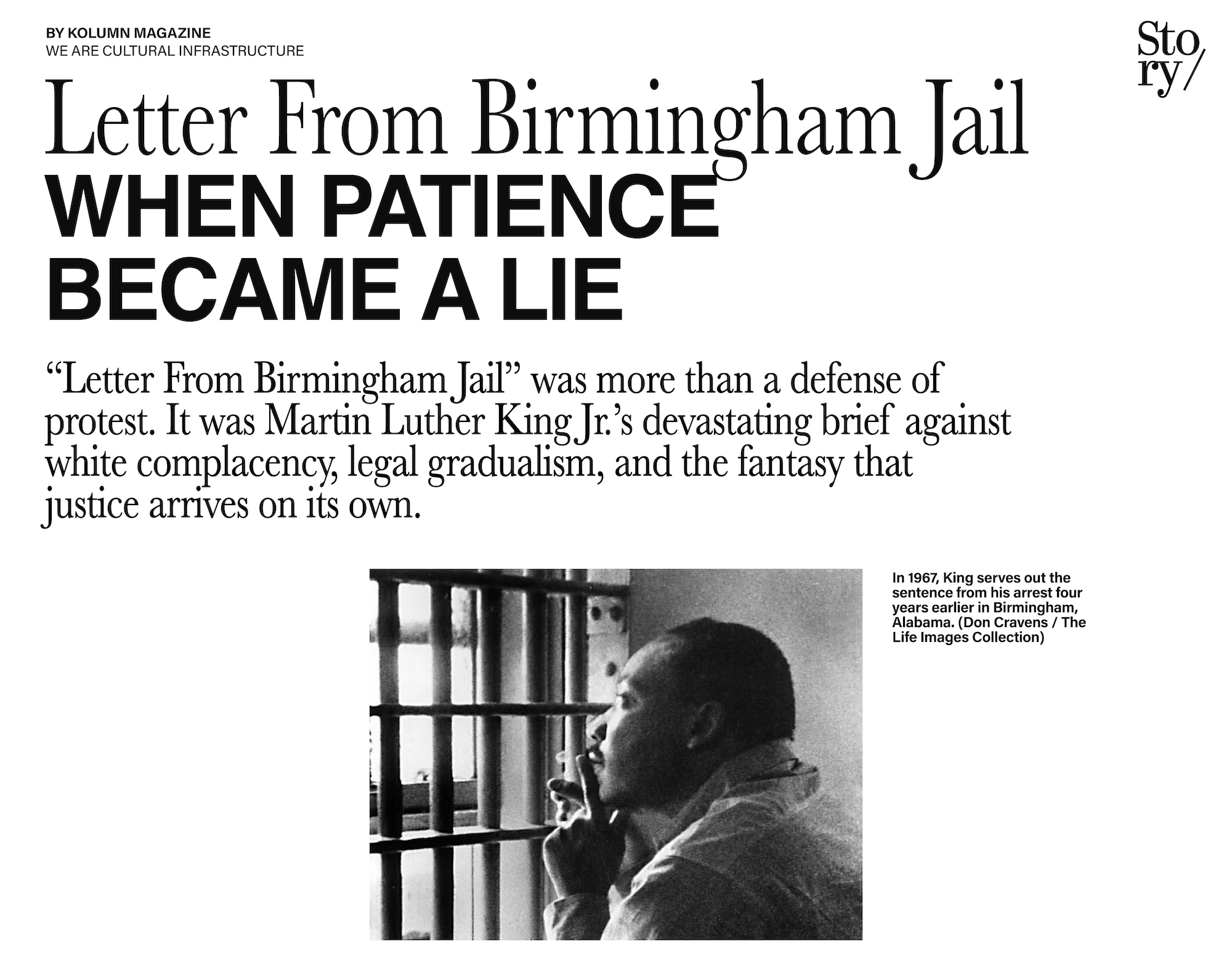
The letter’s real target was not only the violent segregationist, but the respectable moderate who treated Black suffering as regrettable, and Black protest as the real disruption.
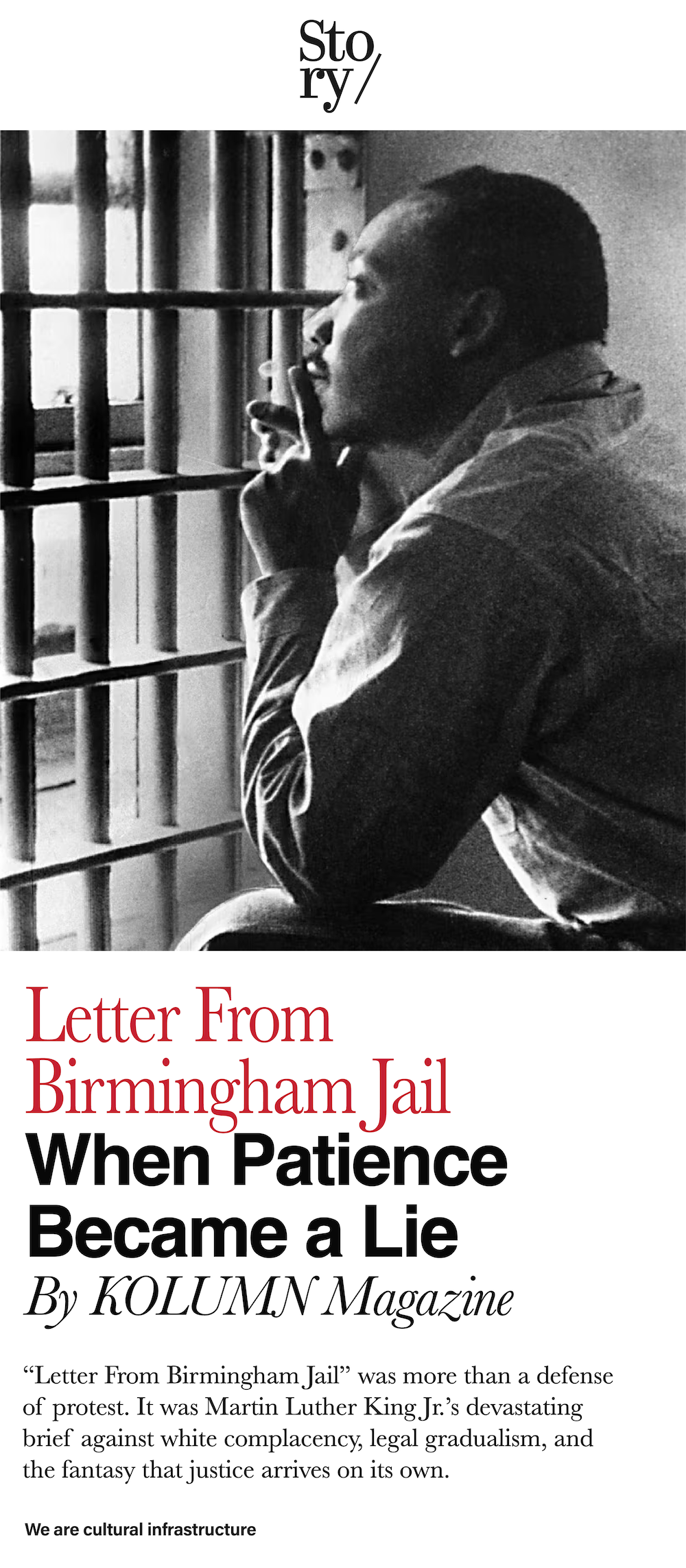
The letter’s real target was not only the violent segregationist, but the respectable moderate who treated Black suffering as regrettable, and Black protest as the real disruption.
By KOLUMN Magazine
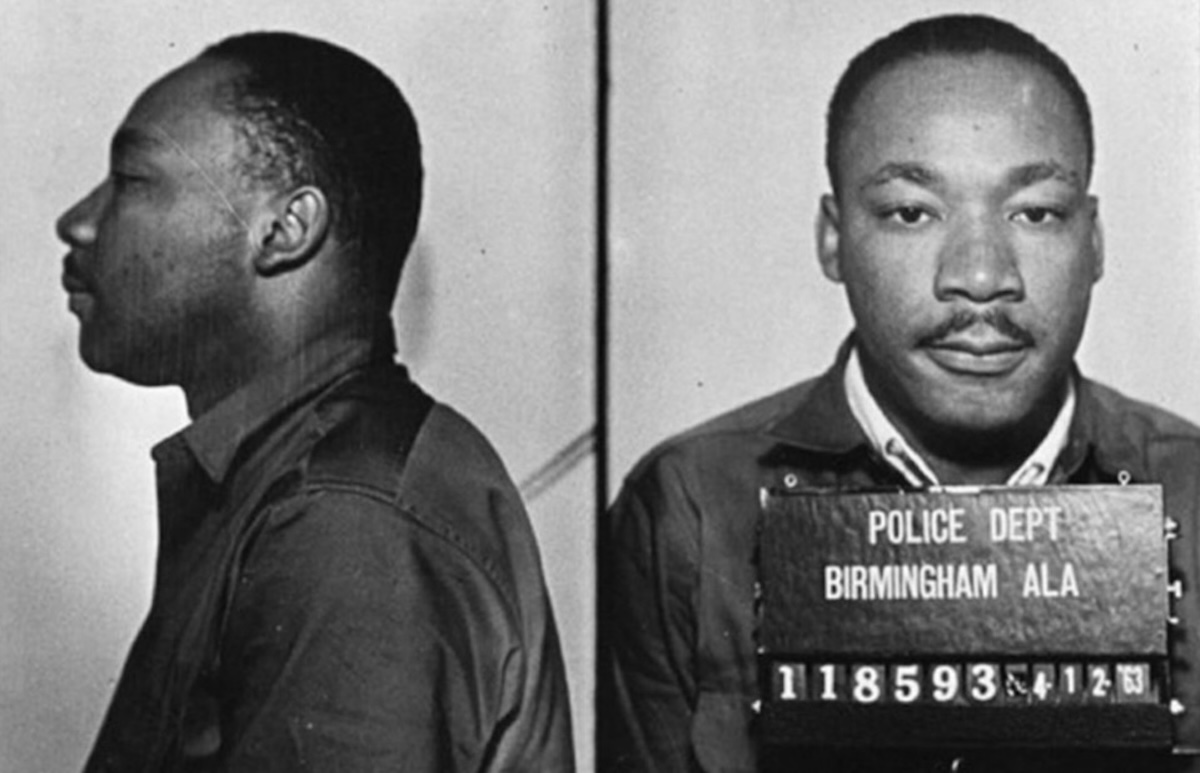
By the time Martin Luther King Jr. began writing what became known as “Letter From Birmingham Jail,” Birmingham, Alabama, had already been made into a kind of American shorthand: a city where segregation was not merely custom or code, but atmosphere. It was industrial and punitive, modern in its commerce and medieval in its racial order. The Birmingham Campaign launched in April 1963 by the Southern Christian Leadership Conference and the Alabama Christian Movement for Human Rights was designed to force that order into crisis through nonviolent direct action, mass arrests, boycotts, and strategic economic disruption during Easter season, one of downtown merchants’ most important retail periods. King was arrested on Good Friday, April 12, after defying an anti-protest injunction. During that confinement, responding to a public statement by eight white Alabama clergymen who had denounced the demonstrations as “unwise and untimely,” he drafted the letter that would become one of the definitive texts of the civil rights movement.
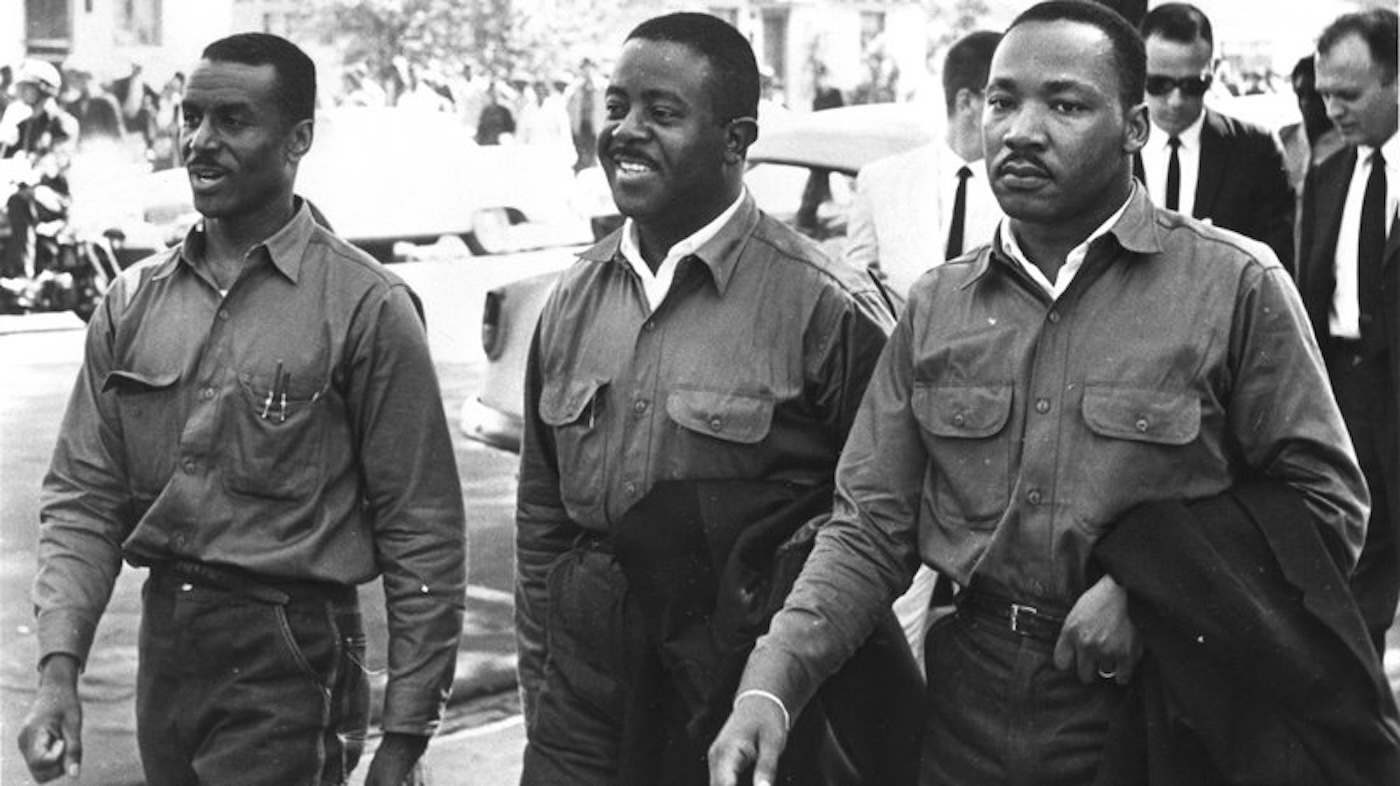
This was not a letter written from the margins of history. It was written from the center of a campaign built to make the nation look at what it had spent decades refusing to see. Birmingham had been selected precisely because its racial regime was both unusually brutal and unusually legible. King later described it as perhaps the most thoroughly segregated city in the country, a place where fear and violence worked in tandem with civic decorum and commercial self-interest. The city’s white power structure could present itself as orderly while Black residents lived under the routine threat of bombings, intimidation, exclusion, and legally enforced humiliation. The campaign’s objective was not symbolic witness alone. It was to make segregation expensive.
That strategic point matters because Americans often remember “Letter From Birmingham Jail” as if it arrived fully detached from organizing — a timeless text floating above the movement rather than arising from it. But the letter was inseparable from infrastructure: local planning, movement discipline, clergy networks, attorneys, secretaries, printers, and a political theory of pressure. KOLUMN Magazine’s recent profile of Fred Shuttlesworth makes this point with welcome sharpness, arguing against the simplified memory that King simply “came” to Birmingham. The local movement, Shuttlesworth’s work above all, created the conditions under which SCLC’s national profile could be fused with Birmingham’s combustible local reality. The letter belongs to that convergence.
Birmingham was not a backdrop. It was the argument.
To understand the letter’s force, it helps to begin with the city that made it possible. Birmingham in 1963 was not just segregated in the usual Southern sense of separate schools, lunch counters, parks, and transit customs. It was a city whose economy, legal system, and enforcement apparatus were calibrated to keep Black life politically weak and socially subordinate. The campaign there was designed as “Project C,” for confrontation — not confrontation as violence, but confrontation as organized pressure. That distinction is crucial. In the movement’s grammar, confrontation meant creating a crisis severe enough that negotiation could no longer be deferred by appeals to propriety.
King’s critics in Birmingham understood exactly what was happening, which is why their language was so revealing. In “A Call for Unity,” the eight clergymen did not defend segregation in crude terms. Their tone was measured, clerical, respectable. They acknowledged that grievances existed. They insisted, however, that the demonstrations were badly timed, too extreme, and improperly led by “outsiders.” They urged that disputes be handled in the courts and through negotiation, not in the streets. This was moderation as management. It did not deny injustice; it attempted to contain the means of opposing it.
King recognized the genre instantly. The letter he wrote in reply is powerful not only because it confronts open racism, but because it anatomizes a more evasive adversary: the person who claims to favor justice in principle while objecting to the methods, tempo, visibility, or inconvenience of actually pursuing it. That is one reason the document still feels contemporary. It is not mainly an answer to snarling segregationists. It is an answer to proceduralists, gradualists, institutional guardians, and all those who mistake civility for morality.
The letter opens with a concession that is also a trap. King says he does not ordinarily answer criticism, because if he tried to respond to every misconception about his work, he would have little time for anything else. But he makes an exception because the clergymen appear to be men of good will. That gesture has often been read as courtesy. It is also tactical framing. King grants their sincerity so that he can expose the moral inadequacy of sincerity without courage. From there, he begins dismantling each charge: outsider, untimely, lawbreaking, extremism, impatience.
The “outsider” charge and the geography of moral obligation
The most famous early rebuke in the letter is also among the most enduring: the insistence that King was no outsider in Birmingham because injustice there implicated everyone. He explained that he had organizational ties to the city through SCLC’s affiliate and, more fundamentally, that “injustice anywhere is a threat to justice everywhere.” That line survives because it compresses an entire philosophy of democratic interdependence into a sentence. Segregation depended on local enforcement, but its logic exceeded local borders. King’s answer rejected the fiction that one could quarantine racial injustice within municipal boundaries and then accuse those who crossed them of trespassing.
This argument was political as much as moral. Southern segregationists and their respectable allies often used locality as a shield. Local customs, local pace, local authorities, local temperament — these were the terms through which national scrutiny was treated as meddling. King understood that if justice could be indefinitely deferred in the name of local process, then federal ideals were ornamental. His reply therefore turned geography inside out: the true outsider was not the activist who came in response to suffering, but the observer who imagined himself untouched by it.
There is a reason this section of the letter continues to be cited well beyond civil rights commemorations. It offers a durable rebuttal to the politics of selective distance. It insists that democratic community is not sentimental but structural. The nation is interconnected not because people feel affection for one another, but because institutions, laws, and harms are braided together. King’s point was not abstract cosmopolitanism. It was an indictment of provincial moral bookkeeping.
Why direct action had to create crisis
Much of the letter is devoted to explaining why the Birmingham campaign could not simply wait for negotiation to emerge on its own. King lays out what he calls the basic steps of nonviolent action: collection of facts, negotiation, self-purification, and direct action. That sequence matters because it answers the claim that protest is reckless. King’s account is not improvisational or romantic. It is procedural, disciplined, and strategic. Negotiation had been attempted; promises had been broken. Direct action was designed to create the kind of tension that a community refusing negotiation could no longer ignore.
That tension, in King’s formulation, was not violence. It was a dramatization of a crisis that already existed but had been rendered invisible to those with the luxury not to feel it. This is one of the letter’s deepest insights. Public disorder is often described by power as the thing that breaks peace. King argued the reverse: direct action reveals the false peace that already rests on unacknowledged coercion. In that sense, Birmingham was not made unstable by the movement. The movement exposed the instability segregation required.
The line between that idea and later movement strategy is unmistakable. From lunch-counter sit-ins to Selma’s bridge, from anti-apartheid campus actions to contemporary protests against police violence, the logic remains recognizable: produce a crisis public enough that the comfortable can no longer narrate injustice as distant, isolated, or premature. King’s letter is one of the clearest theoretical statements of that logic in American political writing.
“Wait” as a technology of power
If the letter has a central emotional current, it is King’s demolition of the word “wait.” He writes that “wait” has almost always meant “never” for Black Americans. This is the point where the document ceases to be merely a defense of tactics and becomes a work of moral compression. King moves from organizational explanation into lived experience, cataloging the daily degradations of segregation: explaining to a child why she cannot go to a public amusement park; seeing signs reading “white” and “colored”; enduring the humiliation of second-class status; fighting the internal corrosion of “nobodiness.” This section is not ornamental pathos. It is evidence. It translates delay into the psychology of domination.
What King understood, and what many of his critics did not or would not understand, was that gradualism presents itself as prudence while functioning as cruelty. Time is never neutral in a system of injustice. Delay benefits the status quo because the status quo is already collecting returns. When the powerful counsel patience, they are rarely offering to bear the interim costs. They are assigning them. King’s fury at the language of timeliness was therefore not rhetorical excess. It was analytic precision.
This is part of why the letter still refuses domestication. Public memory often sands King down into a patron saint of consensus, but “Letter From Birmingham Jail” is a sustained argument against consensus as a moral hiding place. The famous respectability of the prose can obscure how radical its substance remains. King is not asking his readers to admire endurance. He is telling them that their preference for order has become an accomplice to violence.
The white moderate and the architecture of disappointment
No part of the letter has had a more persistent second life than King’s statement that he had become gravely disappointed with the white moderate, who was more devoted to “order” than to justice. The line gets quoted constantly, sometimes so often that it risks becoming slogan rather than argument. But in the letter it arrives with a very specific diagnosis. The moderate is not merely timid. He is someone who prefers a negative peace — the absence of visible tension — to a positive peace based on justice. He acknowledges the goal but rejects the methods required to reach it. He sets the timetable for another man’s freedom.
King’s disappointment here is theological, political, and personal all at once. He had expected more from religious leaders and liberal whites because they possessed the vocabulary to understand the movement’s claims. Their failure was not ignorance alone. It was a refusal of implication. This is why the critique cuts so deep. Open segregationists offered no illusion. White moderates offered empathy without solidarity, principle without risk, praise for goals paired with hostility to pressure. King judged that posture more bewildering, and in some ways more damaging, because it slowed the transition from sympathy to action.
The afterlife of that passage in American discourse says something sobering about the country. It survives because each generation produces fresh versions of the same figure: the official who condemns the injustice but deplores the protest, the columnist who admires the cause but objects to the disruption, the institution that issues principles while disciplining dissent. The letter endures because it names a recurring pattern in democratic failure.
Law, morality, and the duty to disobey
Perhaps the letter’s most formally elegant section is King’s distinction between just and unjust laws. Drawing on Augustine and Aquinas, he argues that a just law squares with moral law and uplifts human personality, while an unjust law degrades personality and is out of harmony with moral law. Segregation, in this framework, is not merely inefficient or unpleasant. It is morally distorted because it gives the segregator a false sense of superiority and the segregated a false sense of inferiority.
This argument does several things at once. It reassures readers inclined toward legal reasoning that civil disobedience is not anarchy. It places King squarely in a long tradition of natural-law thought. And it clarifies that legality cannot be the final measure of justice in a society whose institutions are themselves structured by domination. This was especially potent in Birmingham, where the injunction against protest sought to transform a demand for constitutional rights into a violation of local order. King’s point was simple but devastating: obeying every law in such a context would amount to assisting injustice.
Importantly, King does not celebrate lawlessness. He insists that one who breaks an unjust law must do so openly, lovingly, and with a willingness to accept penalty. That willingness, he argues, expresses the highest respect for law because it appeals to a legal order beyond the immediate statute. Civil disobedience, in his telling, is not contempt for democracy but an attempt to redeem it. This is one reason constitutional scholars and historians continue to return to the letter as a model of civic argument rather than merely movement rhetoric.
The National Constitution Center’s discussion of the letter underscores another revealing point: in contrast to the later “I Have a Dream” speech, the Birmingham letter leans less on the Constitution and Declaration than readers may assume. It is saturated instead with biblical, philosophical, and historical references, as though King understood that American founding language alone could not puncture the moral evasions of his clerical critics. He met them in the terrain they claimed to inhabit — Christian ethics, moral tradition, and the obligations of conscience.
From diplomat to prophet
One of the letter’s most remarkable features is its tonal architecture. It begins with patient rebuttal and gradually hardens into something closer to prophetic indictment. Jonathan Rieder, the Barnard scholar whose work on the letter was featured by PBS, has emphasized the text as both argument and gospel-inflected moral witness. That duality is essential. King is writing as strategist, pastor, public intellectual, defendant, and movement leader at once. The letter does not choose between those roles. It fuses them.
By the middle of the letter, King is no longer merely clarifying movement tactics. He is chastising the moral imagination of white America. The Constitution Center’s analysis notes the moment where he largely stops justifying the movement to whites and begins addressing their failures more directly. That shift is not a loss of restraint. It is the revelation of what the first half has been building toward: a conclusion that explanation alone will not rescue a society determined to confuse comfort with righteousness.
That prophetic movement helps explain the letter’s singular literary power. Its sentences carry argument, but they also carry wound, irony, and cadence. King’s education in theology and philosophy mattered, of course. So did the Black sermonic tradition. So did the movement’s daily intimacy with danger. What emerges in the prose is neither academic treatise nor sermon proper, but something rarer: a public document in which moral thought is inseparable from organized struggle.
The manuscript itself: scraps, margins, assembly
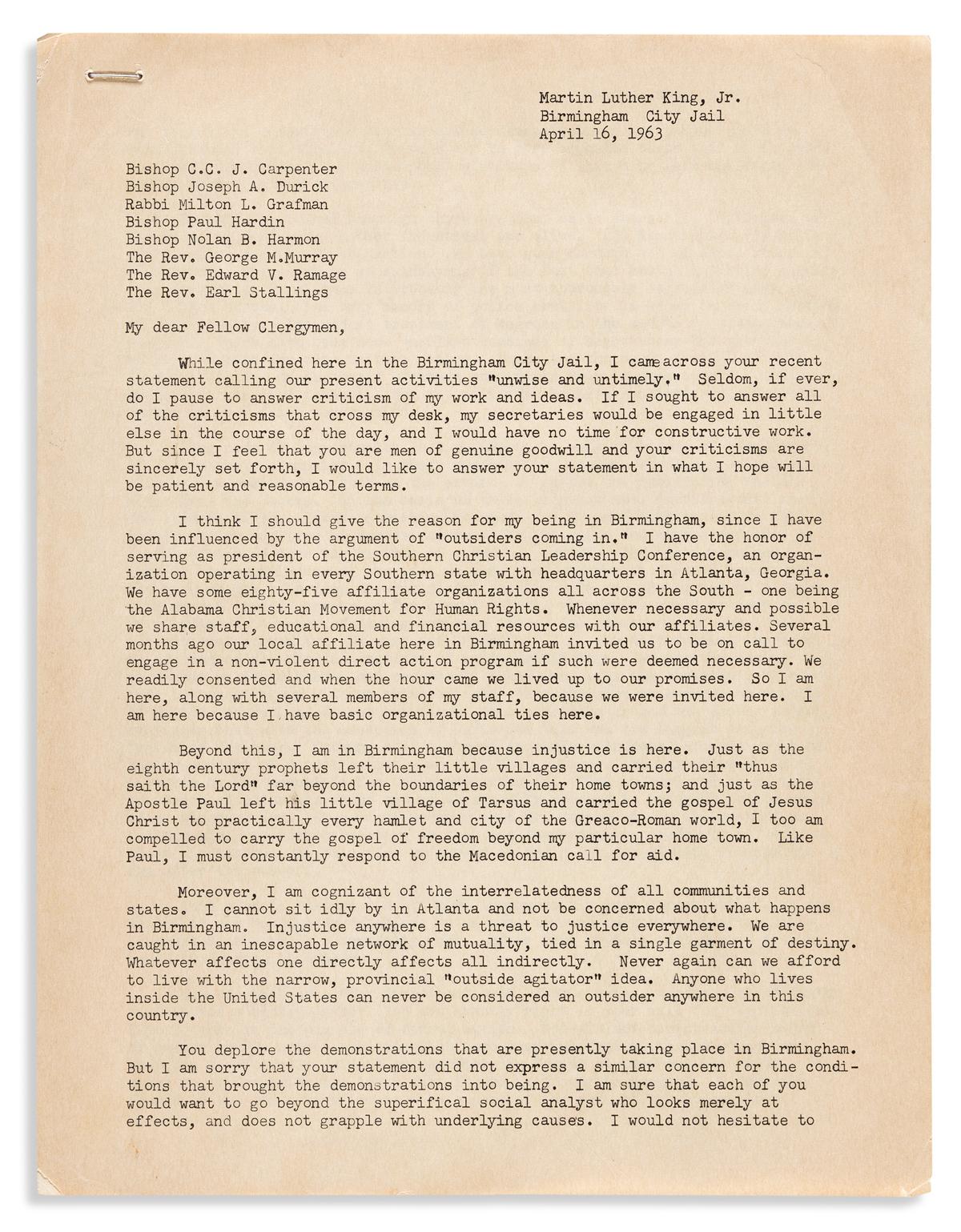
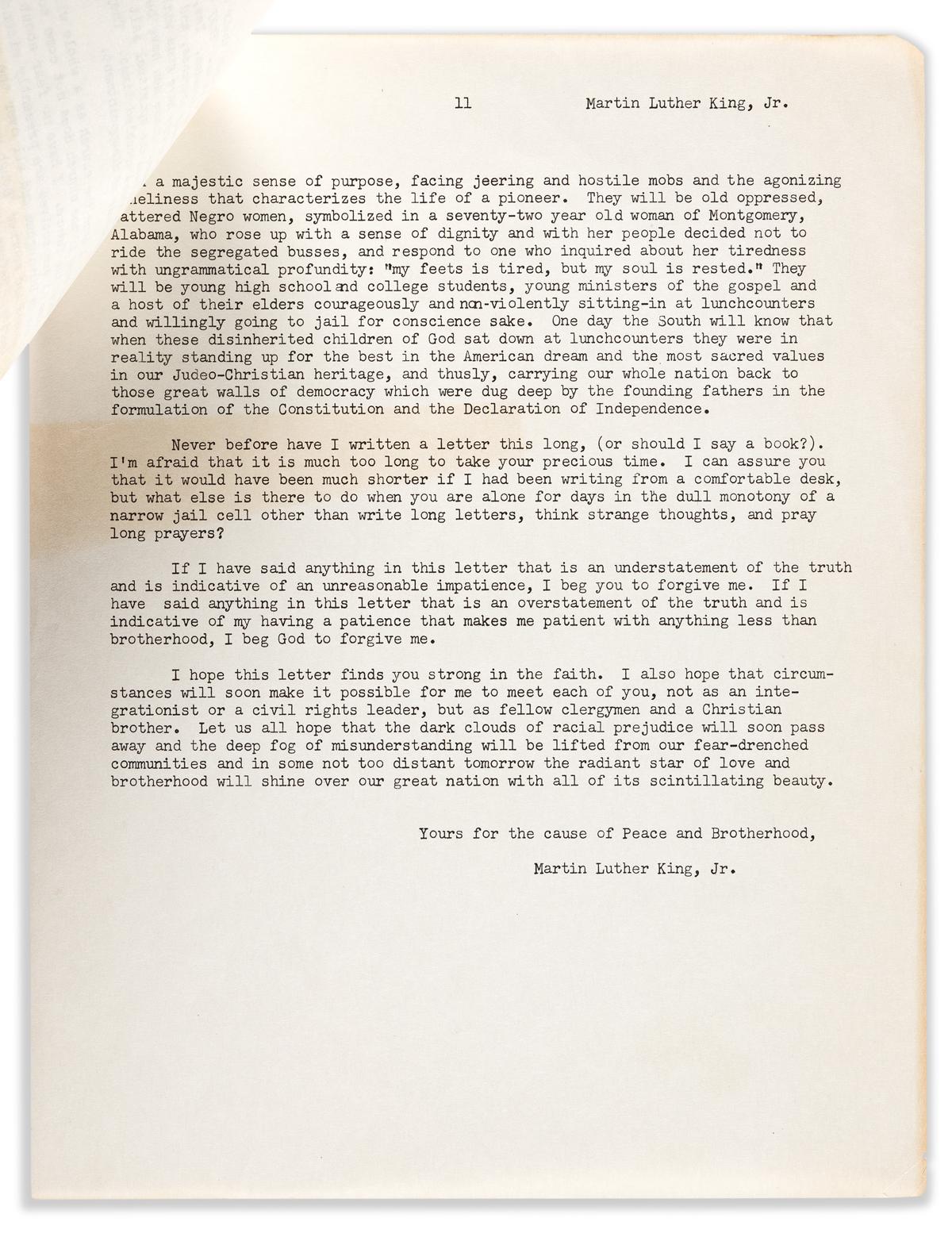
Even the physical making of the letter has entered movement lore because it mirrors the conditions of its argument. King began writing on the margins of a newspaper containing the clergymen’s statement. He continued on scraps of paper and eventually on a legal pad his attorneys were allowed to leave. Clarence B. Jones, one of King’s lawyers and later a key witness to the letter’s making, described carrying pages and scraps out of the jail for assembly and typing. The Washington Post’s interview with Jones and the historian Taylor Branch captures both the improvisation of the process and the fact that the document’s significance was not immediately obvious to everyone involved. It became canonical through circulation and circumstance, not instant consecration.
That contingency matters. Great texts are often retrospectively treated as inevitable monuments. “Letter From Birmingham Jail” was, in real time, a prison document assembled through movement labor. Secretaries typed it. Organizers distributed it. Editors reprinted it. The Progressive later republished the piece under the headline “Tears of Love,” while The Atlantic printed it in August 1963 under the title “The Negro Is Your Brother.” In other words, the text’s afterlife depended not only on King’s brilliance but on the movement’s communications machinery and the changing national mood as Birmingham’s images of repression spread.
This is an important corrective for magazine culture as well as movement history. We like masterpieces with solitary origins. The Birmingham letter had one author, yes, but it also had a supply chain: jail conditions, lawyers, typists, sympathetic channels, periodicals, and a rapidly expanding public appetite for explanation as the crisis intensified. Its form of production was collective even where its voice was singular.
The letter and the images that followed
The letter is sometimes taught in isolation, but the country encountered it amid a media storm. After King’s arrest and release, the Birmingham campaign escalated dramatically. Mass arrests, especially of young demonstrators, and the televised spectacle of police dogs and fire hoses brought national and international attention to the city. As Taylor Branch notes in the Washington Post interview, once those images circulated, the nation turned to the letter to understand what was driving the protests. The text became not just a reply to clergy but an interpretive frame for the movement’s confrontation with American conscience.
That sequence is significant. The letter did not replace visual evidence of segregationist brutality; it explained why nonviolent activists would knowingly provoke such a response. It told the country that the tension visible on television was not the movement’s creation alone. It was the exposure of a violent order that had long operated without national scrutiny. Read that way, “Letter From Birmingham Jail” is not a standalone classic. It is part of a choreography of persuasion — protest, repression, circulation, interpretation, escalation.
This also helps explain why Birmingham proved so consequential for federal politics. The campaign’s crisis atmosphere helped move the Kennedy administration toward more decisive civil rights action, culminating in the administration’s June 1963 civil rights address and the legislative momentum that eventually became the Civil Rights Act of 1964. The letter did not pass that law, of course. But it articulated the movement’s moral logic at precisely the moment the nation was being forced to confront the costs of inaction.
Why this text still feels uncomfortably current
The temptation with canonical documents is to embalm them. We praise them so thoroughly that we no longer hear them. “Letter From Birmingham Jail” resists that treatment because its primary antagonists have not disappeared. The rhetoric of untimeliness has not disappeared. Appeals to procedure over justice have not disappeared. The desire for quiet over transformation has not disappeared. King’s letter remains live because it describes a political reflex that modern democracies reproduce with startling consistency: support the principle, discredit the pressure.
There is also the matter of popular misremembering. King is regularly reduced in public culture to a dreamer of interracial harmony, detached from disruption, mass action, and coercive moral pressure. The real King of Birmingham is harder to package. He was arguing for crisis as a democratic instrument. He was defending lawbreaking under unjust conditions. He was rebuking white clergy, white moderates, and liberal gradualists in language that still stings. The Guardian’s contemporary reflection on King’s legacy makes a related point: the King most Americans celebrate is often less demanding than the King who actually wrote and organized.
That is one reason the letter remains indispensable in classrooms, churches, law schools, and activist circles. It does not merely inspire. It clarifies. It names how domination narrates itself as order. It explains why protest can be ethical even when it is disruptive. It refuses the notion that moral urgency is uncivil. And it demonstrates that eloquence, in the hands of an organizer, can be a tool of escalation rather than softening.
The KOLUMN lineage around Birmingham and movement memory
For KOLUMN, the letter also belongs to an editorial lineage already visible in recent work on movement figures and civic struggle. The magazine’s Fred Shuttlesworth feature insists, correctly, that Birmingham cannot be narrated as a stage onto which King simply descended. Local architecture mattered. Its Charles Sherrod piece reminds readers that the movement was never only a pageant of major speeches but a long discipline of staying, organizing, risking, and building. Its Samuel Wilbert Tucker and Roy Wilkins profiles widen the frame further, showing how legal leverage, institutional pressure, and strategic persistence often mattered as much as televised flashpoints. Seen in that context, “Letter From Birmingham Jail” sits exactly where KOLUMN’s best historical work has been pointing: at the intersection of moral language and operational force.
That framing is useful because it prevents the letter from becoming a relic of pure rhetoric. King’s genius was not separate from organization. The text is great because the campaign was real, because local activists had made Birmingham unavoidable, because movement lawyering and movement logistics kept the struggle alive, because the audience being addressed was not abstract humanity but a concrete class of respectable obstructionists. KOLUMN’s recent civil rights coverage has repeatedly argued that the movement’s understructure matters. The Birmingham letter is one of the clearest places where that understructure becomes visible in prose.
The American canon, properly understood
Clarence Jones, in reflecting on the document decades later, called it a “Magna Carta” for freedom and justice. Taylor Branch, in the same conversation, pushed the analogy carefully, noting that the letter was not inventing democratic ideals so much as exposing the contradiction between America’s professed ideals and its actual practices. Between those two descriptions lies the letter’s peculiar place in the American canon. It is neither founding document nor simple protest memo. It is a document of national confrontation — a text that says, in effect, you already claim the moral language I need. My task is to make you answer for your refusal to live by it.
That may be why the letter has outlived countless speeches that were louder in their own moment. It is radically portable. One need not share all of King’s theology to understand its moral structure. One need not live under Jim Crow to recognize the politics of being told to wait. One need not be a historian to grasp the force of its distinction between order and justice. The document travels because the habits it diagnoses keep recurring.
And yet its portability should not bleach out its Black specificity. The letter is not generic civic wisdom. It emerges from Black Southern struggle, from a jail in a segregationist city, from a movement that understood respectability as both weapon and trap, from a tradition of Christian witness shaped by terror and endurance. Its universality is earned through specificity, not achieved by escaping it.
The real significance of the letter
The true significance of “Letter From Birmingham Jail” is larger than any one quotation, even the immortal ones. It is significant because it gave the civil rights movement a public philosophy of direct action at a moment when the nation demanded explanation but resisted implication. It is significant because it exposed moderation as a political position rather than a neutral virtue. It is significant because it argued that law without justice is idolatry. It is significant because it fused strategic clarity with moral seriousness in a prose style that remains devastatingly readable. And it is significant because it keeps embarrassing the American preference for celebrating justice after the fact while condemning the means that make justice possible in the present.
More than sixty years later, the letter still issues the same challenge it issued from that cell: do not tell the oppressed to wait for a season more convenient to the oppressor. Do not sanctify order that depends on degradation. Do not confuse criticism of tactics with innocence about injustice. And above all, do not imagine that admiration for King counts for much if one recoils from the pressure politics he spent his life refining. The letter survives because it does not ask to be remembered. It asks to be obeyed.
More great stories
Afro Sheen, Wall Street, and the Architecture of Black Possibility
July 6, 2026
No Comments
The Fire Inside the Fourth
July 5, 2026
No Comments