




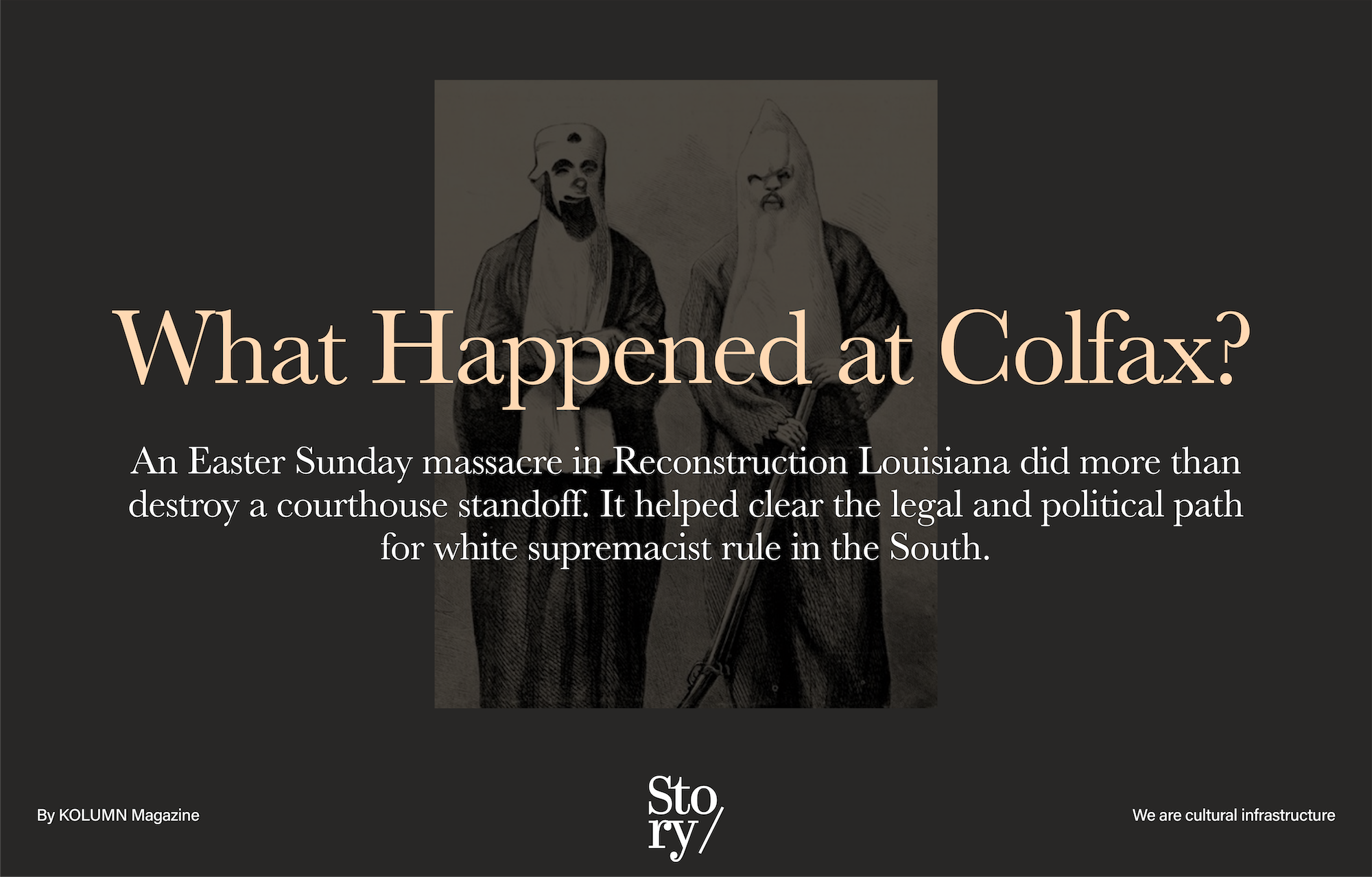
Colfax was not just a massacre. It was a rehearsal for how white supremacy would reassert itself—through violence first, and doctrine second.
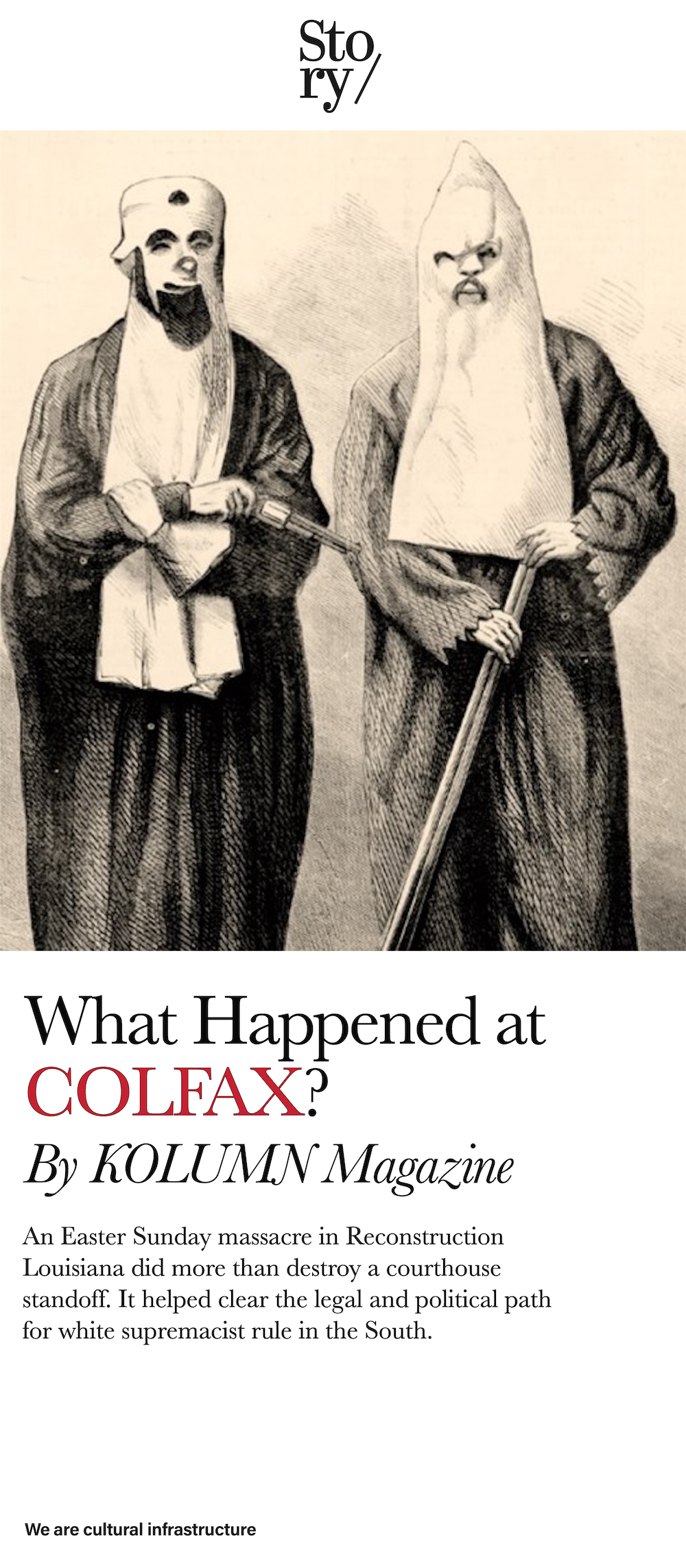
Colfax was not just a massacre. It was a rehearsal for how white supremacy would reassert itself—through violence first, and doctrine second.
By KOLUMN Magazine
There are some events in American history that feel buried on purpose. The Colfax Massacre is one of them. It does not sit in public memory the way Tulsa does, or Birmingham, or Selma. It should. On Easter Sunday in 1873, in Colfax, Louisiana, more than 100 Black men were killed by armed white supremacists, with estimates ranging from at least 60 to as many as 150. Nearly all of the victims were African American. Historians and public institutions now widely recognize it as the deadliest single episode of racial and political violence of the Reconstruction era, and one of the most devastating acts of domestic terror in the post-Civil War United States.
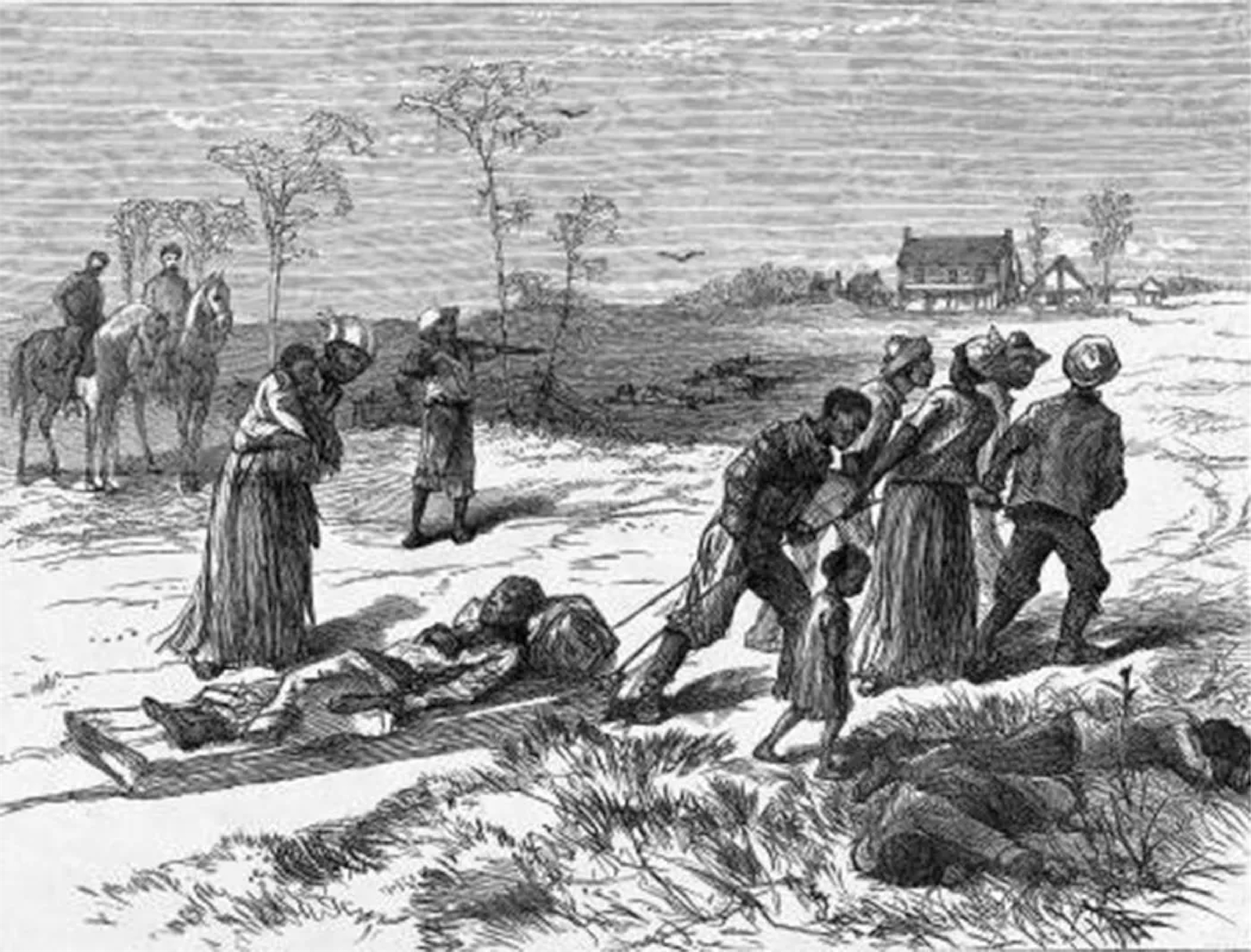
That alone would make Colfax historically significant. But Colfax is not only a story about slaughter. It is also a story about how racial violence works in America: first through bullets, then through court decisions, then through civic mythology, and finally through memory itself. The massacre grew out of a dispute over an election. It targeted Black political organization. It ended with executions after surrender. And when federal prosecutors tried to punish some of the perpetrators, the Supreme Court, in United States v. Cruikshank, narrowed the federal government’s ability to protect Black citizens from private racial terror. That decision became one of the key legal blows against Reconstruction.
To understand Colfax, you have to drop the comforting idea that Reconstruction was merely a messy, idealistic transition after the Civil War. Reconstruction was a fight over who counted as a citizen, who could wield power, and whether multiracial democracy would actually be allowed to function. Louisiana was one of the fiercest battlegrounds in that fight. The elections of 1872 produced disputed outcomes and effectively rival governments. In Grant Parish, both Republicans and Fusionists—an alliance of conservative Democrats and anti-Radical Republicans—claimed legitimacy. The local courthouse at Colfax became the physical symbol of that dispute because whoever held it could claim local governing authority.
What happened next is the sort of thing that later generations often flatten into euphemism. That flattening matters. For decades, white residents and official markers called Colfax a “riot,” as if it were simply chaos, a clash, an unfortunate but mutual breakdown of order. That language was never neutral. The National Park Service, historians like LeeAnna Keith, and later advocates working to correct the historical record have made clear that “riot” obscured the central fact: this was a massacre of Black citizens and voters by white supremacists trying to overturn legitimate political power. The fight over what to call Colfax was, in its own way, a continuation of the original violence.
A courthouse, an election, and a state on edge
Louisiana in the early 1870s was a place where political conflict and paramilitary violence overlapped so thoroughly that separating the two is almost impossible. The November 1872 election pitted Republican governor William Pitt Kellogg against John McEnery, while local offices across the state were contested just as fiercely. Both sides accused the other of fraud. Both sides certified their own winners. Both sides believed they were defending lawful government. In Grant Parish, Republicans claimed the offices of sheriff and judge for Dan Shaw and R. C. Register, while Fusionists backed Christopher Columbus Nash and Alphonse Cazabat. The courthouse in Colfax became the center of the crisis because control of the building meant control of the parish.
The Black men who gathered around and inside the courthouse were not some random mob stumbling into violence. Many were politically mobilized freedmen; some were former militia members or veterans. They were there because they understood, with painful clarity, that white opponents of Reconstruction were willing to use force to nullify Black voting power. The Root’s framing is blunt and useful here: Black people in Colfax knew white racists would kill them to keep them from voting and governing, so they occupied the courthouse to protect the outcome they believed lawful. That is not lawlessness. That is defensive politics under siege.
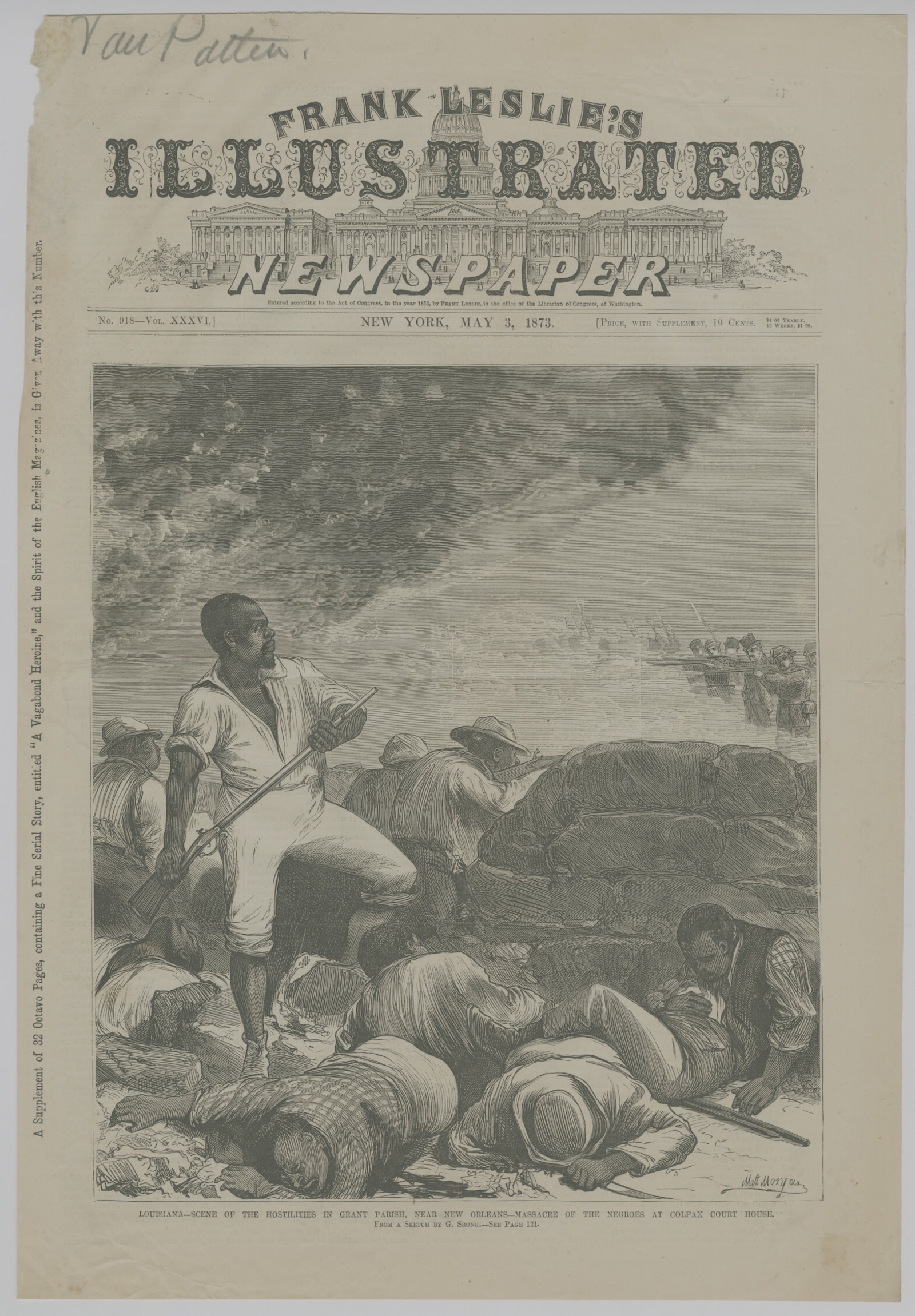
White men from Grant Parish and surrounding parishes began organizing in response. According to 64 Parishes, they came from miles away, assembling a paramilitary force that ultimately numbered at least 150 and likely more. The National Archives notes that many were former Confederate soldiers and Ku Klux Klan members or affiliates, armed with rifles and even a small cannon. Those details matter because they strip away the myth of spontaneous local unrest. Colfax was an organized assault, one that reflected broader white supremacist mobilization throughout Reconstruction Louisiana.
This was the pattern across the South. Black citizenship expanded on paper through the Reconstruction Amendments, and Black political participation surged in practice. White reaction followed almost immediately, often under the banners of “home rule,” “redemption,” or restoring order. The language was tidy. The methods were not. As the Guardian noted in connecting Colfax to other episodes of white election violence, mobs unwilling to accept multiracial democracy had already found a working formula in the nineteenth century: when votes could not secure white control, terror might.
Easter Sunday, 1873
After weeks of tension, the confrontation broke open on Easter Sunday, April 13, 1873. Hundreds of Black people, including women and children as well as armed defenders, had gathered near the courthouse. White attackers announced their intention to assault the site and allowed noncombatants time to leave. What followed was not a fair fight. White forces, mounted and better armed, used a cannon, forced defenders back into the courthouse, and set the building on fire.
Some of the men inside the courthouse tried to negotiate surrender. That did not save them. According to 64 Parishes, after the building was set ablaze and defenders began to flee or emerge, white attackers opened fire on Black men near the courthouse door and then pursued others as they scattered. A large number were taken prisoner. Later that evening, amid debate among the white attackers over what to do with their captives, a faction led by the sons of James Hadnot executed Black prisoners, many with shots to the head, in view of family members. The story of Colfax is horrific not only because so many died, but because so many died after resistance had effectively ended.
This is one of the most important distinctions in the historical record. Colfax was not simply a deadly battle over a building. It included massacre after surrender. That fact is one reason historians and later legal scholars have treated the event as a paradigm of racial terror rather than merely political unrest. The Atlantic, in a memorable account from 2003, emphasized that about fifty African Americans were slaughtered after laying down their arms. Other sources vary in the exact count, but they align on the larger point: many of the dead were not killed in open exchange of fire. They were hunted, detained, or executed. (The Atlantic)
State officials later helped bury fifty-nine bodies, but the total death toll almost certainly exceeded that number. The National Park Service says over 100 African Americans were murdered. The National Archives notes that the number of Black dead was unknown but may have been 150 or more. LeeAnna Keith’s 64 Parishes essay gives a range of at least 60 to perhaps 150. This uncertainty is not incidental; it reflects the chaos, destruction, and deliberate devaluation of Black life that followed the massacre. Bodies were burned, hidden, or otherwise lost to the record, which is one reason the exact number remains contested even as the scale of the crime is not.
The old mythology of Colfax worked hard to blur that fact. White memory in Louisiana often treated the event as a heroic defense against “carpetbag misrule,” a phrase later carved into public interpretation. But the central issue at Colfax was Black political power. White supremacists were not defending democracy from chaos. They were attacking a multiracial order that threatened their control of local government. The massacre was a means to a political end, and the end was clear enough: Black citizens were to understand that ballots would not protect them if white men decided otherwise.
Why Colfax mattered so much to white supremacists
One reason Colfax mattered, and still matters, is that it condensed the anxieties of Reconstruction into a single scene. The courthouse was not just a building. It was a visible sign that formerly enslaved people and their white Republican allies could actually hold office, direct public institutions, and govern. In a region where Black voters often outnumbered white voters, white supremacists recognized the arithmetic problem quickly. If elections were fair, they could lose power. The response, in Louisiana and elsewhere, was not merely rhetorical backlash. It was organized terror.
That is why the massacre cannot be separated from the broader counterrevolution known as Redemption. Across the South, white paramilitary groups did not just express resentment; they developed a working program for overturning Reconstruction governments. Colfax in 1873 was followed by the Coushatta Massacre in 1874, the Battle of Liberty Place in New Orleans that same year, and related waves of white violence elsewhere. Washington Post reporting on Reconstruction’s legacy has described Colfax as part of the broader explosive fallout from the era’s transformational amendments and Black political gains. The massacre belongs to that larger campaign to make Black citizenship legally thin and physically dangerous.
It is also worth pausing on language like “race war,” a phrase that appeared in contemporary coverage. The Washington Post has noted that The New York Times ran the headline “THE WAR OF RACES” in the aftermath, tying Colfax to the longer and bloodier genealogy of white supremacist ideology in America. That rhetoric did not merely describe events. It helped normalize the idea that Black political participation itself represented existential threat. Once that premise takes hold, atrocity becomes easier to justify.
There is a temptation, especially in mainstream civic storytelling, to describe white supremacy as a set of attitudes. Colfax reminds us that it also functioned as infrastructure. It had personnel, weaponry, political coordination, local legitimacy, and eventually legal shelter. The men who attacked the courthouse did not imagine themselves as criminals in the modern sense. Many thought of themselves as restorers of order. That self-understanding is part of what made Reconstruction-era terror so effective. Violence in defense of hierarchy was routinely cast as public service.
The law steps in, then steps back
If the story ended with the massacre itself, Colfax would still deserve far wider attention than it gets. But the legal aftermath is what turned a local atrocity into a national turning point. Federal officials did investigate. State officials assisted in burial and inquiry. U.S. Attorney James Beckwith prepared indictments under the Enforcement Acts of 1870 and 1871, which Congress had enacted to combat Klan violence and conspiracies to deprive citizens of civil rights. Hundreds of witnesses testified. A few men were convicted. For a moment, it looked possible that the federal government might actually punish anti-Black terror in the South.
Then came United States v. Cruikshank. The case emerged from the Colfax prosecutions, first styled as United States v. Columbus Nash before later bearing the name of a defendant who remained at large. The Federal Judicial Center explains the case plainly: it arose from the massacre, in which armed whites killed more than a hundred African American men following a political dispute, and it involved convictions under the 1870 Enforcement Act. But the Supreme Court reversed those convictions, holding that the indictments were insufficient and sharply limiting the federal government’s reach.
The Library of Congress copy of the Court’s opinion shows exactly how devastating the reasoning was. The Court said the rights of assembly and bearing arms were not protected against private interference by the federal government in the way prosecutors claimed; those protections, the justices said, primarily constrained Congress, not individual citizens or states in this context. The opinion further held that the Fourteenth Amendment added no rights as between one citizen and another, but only operated against state action. In practice, that meant that if white mobs terrorized Black citizens and states refused to act, the federal government had sharply limited power to intervene unless prosecutors could fit the case within a narrow constitutional box.
That sounds technical. Its effects were not. As 64 Parishes notes, after the Court invalidated key sections of the Enforcement Acts, responsibility for prosecuting racial and political crimes effectively shifted back to the states. In the former Confederacy, that was close to a death sentence for federal civil-rights enforcement. Southern courts and officials were increasingly committed to white supremacy or at minimum unwilling to challenge it. The massacre’s perpetrators largely escaped real punishment, and the broader message was unmistakable: the national state would not reliably protect Black citizens from organized private terror.
Charles Lane, writing in the Washington Post years later, described Colfax as a quieter but enormously consequential correction to the historical record, especially as the nation reexamined Tulsa and other massacres. He has also argued elsewhere that the Court’s reversal in Cruikshank “defanged” civil-rights protections. That is not rhetorical excess. It is a historically grounded description of what happened when the promise of Reconstruction collided with judicial hostility and northern fatigue. The legal system did not simply fail to avenge Colfax. It helped institutionalize the conditions under which more Colfaxes could happen.
From massacre to monument
Public memory often tells you as much about a country as the event itself. In Colfax, memory was weaponized. In 1950, Louisiana erected a state historical marker titled “Colfax Riot.” It declared that on the site “three white men and 150 Negroes were slain” and that the event “marked the end of carpetbag misrule in the South.” That was not a clumsy mistake. It was an ideological statement installed by the state, one that effectively honored the violent overthrow of Reconstruction and treated Black political participation as illegitimate disorder.
There was also an older monument in the town cemetery commemorating men who died “fighting for white supremacy.” The Atlantic’s Richard Rubin called it the frankest monument he had ever seen, and the description is hard to top. If many American monuments to white rule rely on euphemism, Colfax sometimes dispensed with the euphemism altogether. Still, the “riot” marker may have been more insidious because it claimed neutrality. It folded a massacre into administrative language and taught passersby to see Black death as regrettable but civilizationally useful.
The effort to remove or correct that marker took years. According to the Journal of the Civil War Era, Black convict-journalists at The Angolite challenged the sign’s white supremacist framing as early as 1989. Later activists, historians, students, and local officials continued the push. The journal’s account is revealing because it shows how memory work often happens: not through one grand national reckoning, but through stubborn local organizing, institutional maneuvering, and pressure on public officials. In 2021, the marker was finally removed.
That removal was significant in its own right. It marked a state-level willingness, however belated, to stop endorsing a false narrative. Yet removal alone was not enough. In 2023, on the 150th anniversary of the massacre, a new memorial was unveiled in Colfax honoring Black victims and retelling the history more truthfully. Local coverage noted that the memorial emerged from collaboration that included descendants on different sides of the event and organizers determined to ensure that the dead were named and remembered with dignity rather than erased beneath white civic myth.
This matters because public history is not decoration. It is instruction. A town square, a courthouse lawn, a cemetery obelisk, a school plaque: these are all places where a nation tells ordinary people what happened and whom it values. For decades, Colfax taught the wrong lesson. It suggested that Black political power had been a mistake corrected by white force. The recent memorialization efforts do not undo the violence, but they do begin to undo the lie.
Why Colfax still feels so current
It is tempting to confine Colfax to Reconstruction, to imagine it as one of those grisly old episodes that belong to a vanished America. That would be a mistake. Part of what makes Colfax so unsettling is how modern its political logic remains. The Guardian framed nineteenth-century white mob violence as part of a recurring American method for overturning or intimidating multiracial democracy. The specifics change, but the pattern is recognizable: when one faction cannot accept the legitimacy of a democratic outcome that empowers Black citizens or other disfavored groups, violence or intimidation is recast as patriotic necessity.
That does not mean every later episode is identical to Colfax. History is not copy-paste. But historians and journalists who revisit Reconstruction keep circling back to the same lesson: white political violence was not peripheral to American democracy. It was often constitutive of how power was recovered, guarded, and rationalized. Colfax helps explain not only the end of Reconstruction but the durability of the structures that followed—disenfranchisement, Jim Crow jurisprudence, racial impunity, and a public culture in which anti-Black violence could be recoded as restoration.
The massacre also exposes a chronic weakness in the American civic imagination: the desire to separate law from violence when, in fact, the two often collaborate. The men who killed at Colfax were not the Supreme Court. The justices did not light the courthouse on fire. But when the Court narrowed federal enforcement power, it helped create a political order in which similar acts would be harder to punish and easier to repeat. In that sense, Colfax sits at the intersection of armed terror and constitutional retreat. It is one of the clearest cases in which racial domination moved from the street into doctrine without ever losing its original purpose.
There is also something revealing about the event’s long obscurity. The massacres that make it into schoolbooks are often those that can be framed as moral tragedy without threatening the broader national story. Colfax is harder to package that way because it forces a direct look at how democracy was narrowed after the Civil War, and how national institutions helped that narrowing along. It is not just a local horror. It is an American systems story. And systems stories are usually where public memory gets nervous.
The real significance of Colfax
So what, finally, is the significance of the Colfax Massacre?
First, it shows that Reconstruction was not undone primarily by abstract “sectional reconciliation” or vague loss of northern will, though both mattered. It was also undone by deliberate, spectacular violence against Black officeholding, Black voting, and Black self-defense. Colfax was one of the clearest expressions of that violence. White supremacists did not merely protest Reconstruction. They attacked it with military force.
Second, Colfax reveals how the state can fail twice: once by not preventing terror, and again by failing to punish it. The federal government did prosecute, briefly and imperfectly. But Cruikshank sharply limited that effort, leaving Black citizens in the South increasingly dependent on state governments that often would not protect them. That legal retreat had consequences far beyond Louisiana. It weakened one of the main tools available to enforce the new constitutional order created after emancipation.
Third, Colfax is a case study in the politics of naming. “Riot” and “massacre” are not interchangeable. One implies mutual disorder; the other identifies asymmetrical killing. One obscures agency; the other clarifies it. For more than a century, official language in Louisiana leaned toward the first term because that language protected the moral standing of white rule. The recent correction is not semantic fussiness. It is historical accountability.
Fourth, the event underscores the central role of Black political courage during Reconstruction. The men at Colfax were not passive victims waiting for history to happen to them. They were participants in government, defenders of a lawful political order as they understood it, and citizens trying to secure the rights promised by the postwar Constitution. Their defeat was not evidence that Reconstruction had been naïve. It was evidence that democracy, when it seriously threatens entrenched hierarchy, may be met with ferocious violence.
And finally, Colfax matters because it is one of those events that forces the country to answer a hard question: what kind of democracy survives when one side learns that violence works? The Guardian quoted historian Wayne O’Bryant saying that when a political strategy succeeds, people keep using it. That is a brutal way to put it, but history gives it weight. Colfax succeeded for its perpetrators in the most important sense. It helped terrorize Black political participation, embolden white paramilitary organization, and demonstrate the fragility of federal protection. In the years that followed, that lesson spread.
The dead at Colfax were not simply casualties of an ugly local dispute. They were citizens caught in one of the country’s most consequential counterattacks against freedom. For decades, the nation let the event sit under a false name and an even falser moral frame. The work now is not merely to remember Colfax, but to understand it properly. It was a massacre. It was political. It was foundational. And its aftershocks, legal and cultural, extended far beyond a courthouse in rural Louisiana.
More great stories
What Ernest Crichlow Saw
April 13, 2026
No Comments
The Woman Whose Name Changed the Law
April 13, 2026
No Comments