





From every mountainside, let freedom ring.
From every mountainside, let freedom ring.
By KOLUMN Magazine
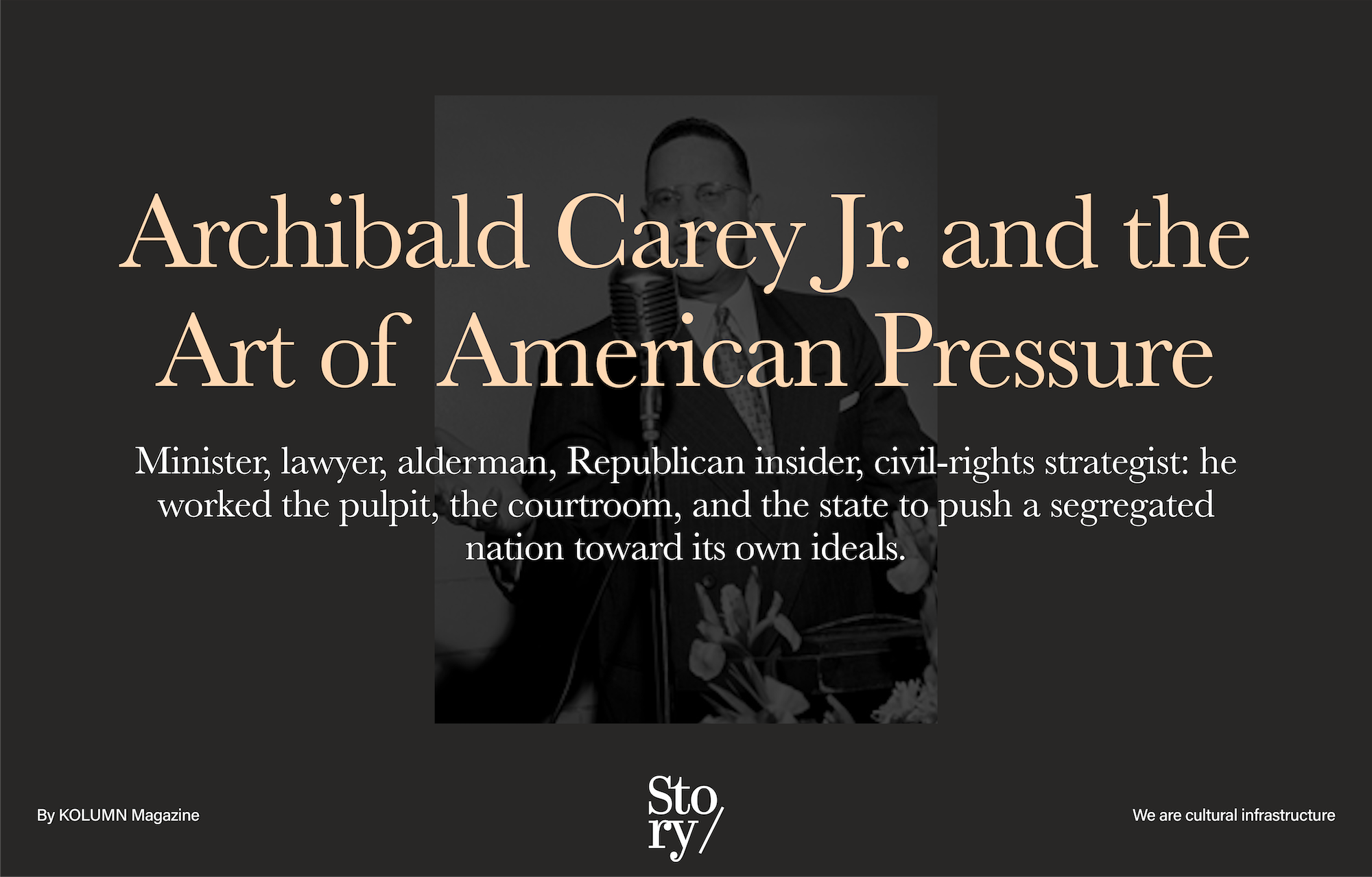
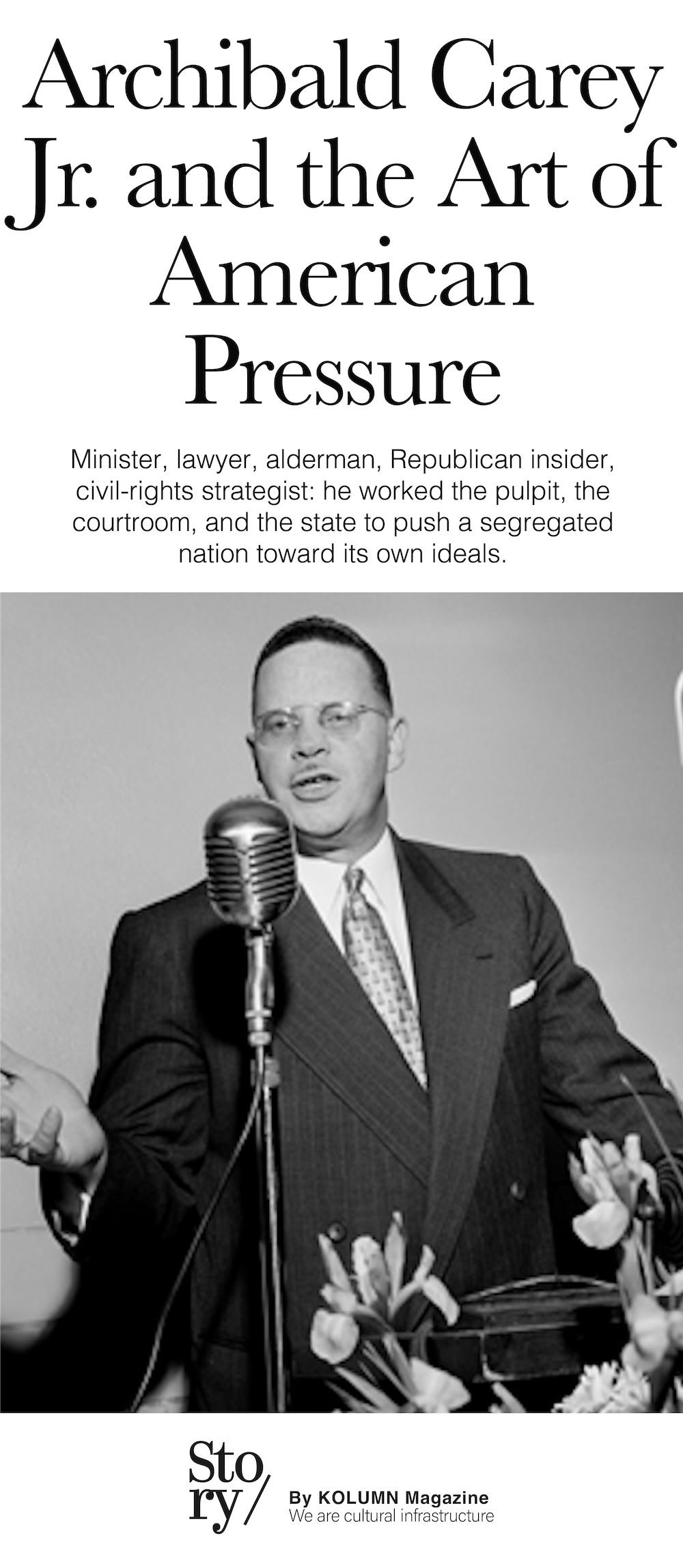
Archibald Carey Jr. should be more famous than he is. That is the bluntest way to begin, and probably the fairest. He was a minister with a first-rate gift for public speech, a lawyer trained to work power where it actually lived, a Chicago alderman, a national Republican figure during the Eisenhower era, a United Nations delegate, a civil-rights advocate with close ties to Martin Luther King Jr., and later a judge. He belonged to that generation of Black leaders who had to be multilingual in the deepest American sense: fluent in church, fluent in law, fluent in the choreography of party politics, and fluent in the moral language of citizenship.
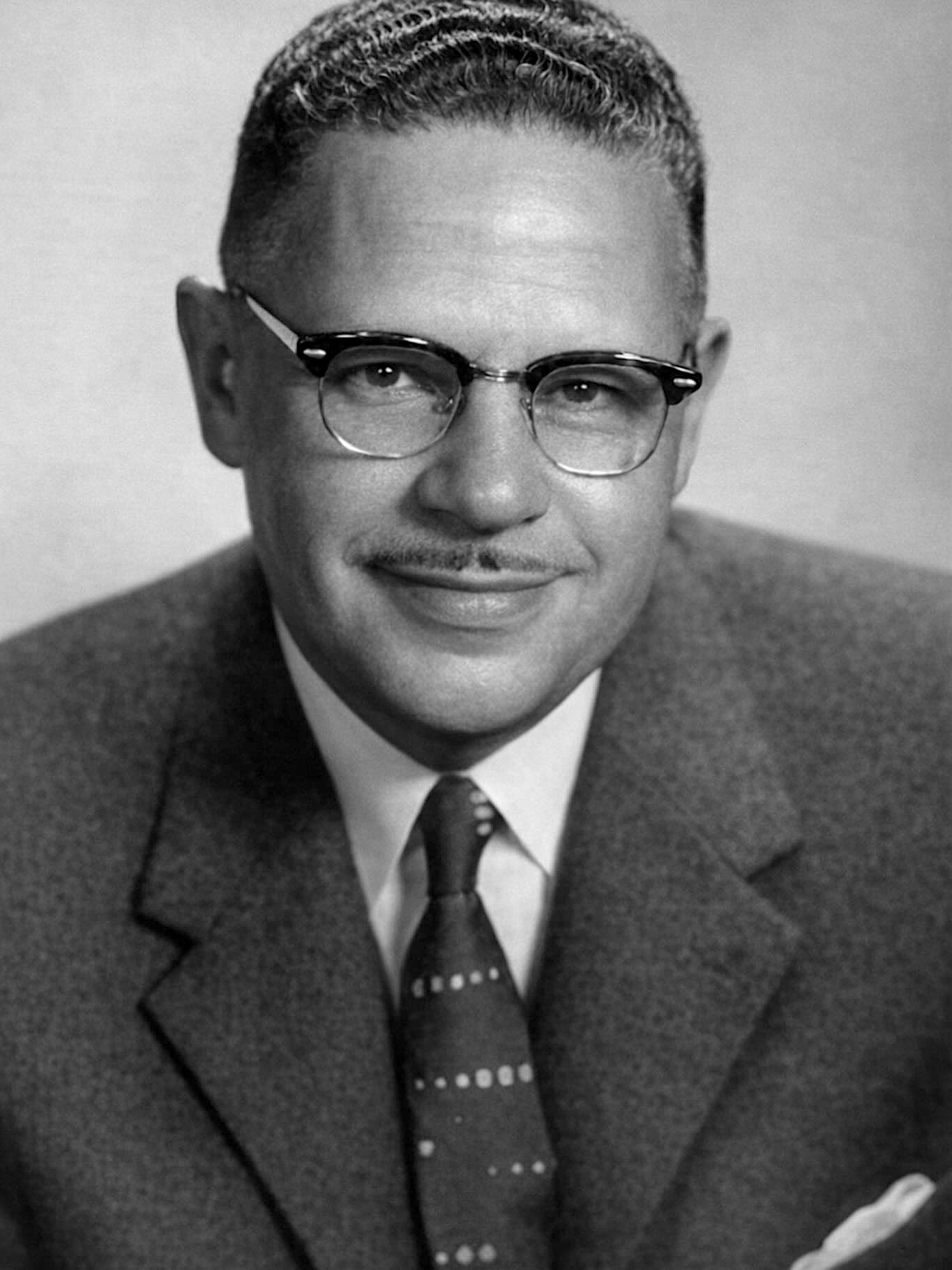
Yet Carey’s name rarely appears in the first rank of civil-rights memory. Part of that is because he does not fit neatly into the simplified narratives Americans like to tell about the Black freedom struggle. He was not only a street-level protest figure, though he aided protest movements. He was not only a churchman, though his ministry shaped everything he did. He was not only a Republican, though he spent much of his public life trying to force that party to honor the antislavery and Reconstruction legacy it so often invoked and so often betrayed. He was not only a Chicago insider, though Chicago was his base and his proving ground. Carey’s life resists caricature because it happened at the messy intersection of ideals and institutions.
That complexity is exactly why he matters now. Carey understood something that still feels contemporary: moral witness is rarely enough on its own. It has to be paired with organization, money, leverage, legal tools, and persistent pressure. In the middle decades of the twentieth century, he worked all of those angles. He did so as a Black minister shaped by a politically active family, as a public official navigating Chicago’s hard-edged machine environment, and as a national figure using whatever doorway the American system left open.
That line is now inseparable from King in the public imagination. But Archibald Carey Jr. used a version of that climactic appeal in 1952, at the Republican National Convention in Chicago, more than a decade before the March on Washington. The point is not to flatten history into a plagiarism debate. It is to recognize that Carey was already articulating, in public and at scale, a Black democratic rhetoric that connected patriotism, prophecy, and unfinished freedom. He was helping write the language of the era before the era fully knew itself.
He was born into a tradition that saw ministry and politics as related work
Carey was born in Chicago on February 29, 1908, into a family where religion and politics were not separate departments of life. His father, Archibald J. Carey Sr., was a major African Methodist Episcopal leader and an important Black political actor in Chicago. The elder Carey had built influence in both the church and the city’s Republican orbit, and Quinn Chapel AME—where the father had once pastored and the son would later serve—was itself a historic Black institution with long civic significance in Chicago. That inheritance mattered. Carey Jr. did not invent the idea that a Black minister might also be a political strategist. He absorbed it early.
He attended Wendell Phillips High School, earned a bachelor’s degree from the Lewis Institute in 1928, then continued theological study at Northwestern University’s Garrett Biblical Institute before completing a law degree at Chicago-Kent in 1935. The educational sequence says a lot about him. It was not an accidental assortment of credentials. Theology, public speaking, civic argument, and law were mutually reinforcing disciplines for someone like Carey. To preach convincingly in Black Chicago required intellectual range. To survive in politics required legal fluency. To be effective in both required presence.
He began preaching young and became known early for oratorical skill. Reference works on his life note that he won a national oratorical contest while still quite young, and later accounts consistently describe him as an exceptional speaker. That reputation was not ornamental. In midcentury Black public life, eloquence was infrastructure. A powerful speech could raise money, recruit support, shame institutions, reframe a crisis, and keep a movement’s morale intact. Carey knew that, and he treated rhetoric not as performance alone but as a usable instrument.
The Black church gave him a base, but he never treated the pulpit as a retreat from public life
Carey served first at Woodlawn AME Church beginning in 1930, then moved in 1949 to Quinn Chapel AME, Chicago’s second-oldest Protestant church and one of the city’s most historically resonant Black institutions. At Quinn Chapel, he inherited not just a congregation but a civic platform. The church’s archive underscores its long political and social role in Chicago’s Black history, and Stanford’s King Institute notes that Carey remained there until 1967. This was not quiet pastoral work in the privatized sense. It was ministry positioned inside the bloodstream of Black urban politics.
Carey’s theology was not abstractly “social” in the way that phrase can sometimes become fuzzy. It was grounded in the AME tradition’s long insistence that Black Christianity must address the conditions under which Black people actually live. Scholarship on the Carey family describes this as a kind of public theology: the conviction that preaching, organizing, citizenship, and institutional struggle belong together. That helps explain why Carey could move from the sanctuary to city hall to national political meetings without seeming, to himself at least, to be changing missions. The arena shifted; the obligation did not.
“The Black freedom struggle needed more than protest. It needed institutions, access, and a man who could speak in all three languages.”
That is one way to understand Carey’s importance. He was not an outsider to power in the purest romantic sense. He was often trying to get near it, influence it, embarrass it, or bargain with it. For some later observers, that can make him look too close to establishment politics. But for Carey, proximity was not surrender. It was opportunity, provided he could keep his moral center and his Black constituency in view.
Chicago made him practical
It is impossible to understand Carey without understanding Chicago. Midcentury Chicago was a laboratory of Black political incorporation and Black political frustration at the same time. It offered channels to office and patronage, especially through machine alliances, while preserving deep racial inequalities in housing, employment, education, and policing. Black officeholders could gain visibility and even influence while still operating within a tightly managed system. Carey learned to navigate that terrain as an ally of William L. Dawson, one of the dominant Black political figures on the South Side.
Carey entered city politics in earnest and won election as alderman from Chicago’s Third Ward in 1947, serving until 1955. In office, he became associated with the so-called Carey Ordinance, a fair-housing effort aimed at preventing racial discrimination in public housing assignments. Even the surviving secondary references to the ordinance make clear what was at stake: postwar Chicago was hardening residential segregation, and housing policy was one of the main battlefields. Carey was trying to use municipal law to interrupt the routine reproduction of racial exclusion.
This is one reason he deserves to be remembered not merely as a gifted speaker but as a legal-political actor. Carey understood that racism was not only personal prejudice or public insult. It was administrative. It lived inside assignment systems, committee structures, hiring rules, party calculations, and government discretion. You do not fight that kind of racism with inspiration alone. You fight it with ordinances, appointments, investigative committees, and sustained public pressure. Carey spent much of his life doing exactly that.
His 1952 Republican convention speech still tells us what he thought America ought to be
Carey’s national breakthrough came at the 1952 Republican National Convention in Chicago. There, he delivered what became known as the “Let Freedom Ring” speech, an address calling the Republican Party and the nation more broadly to honor the democratic promises they celebrated so casually. WBEZ later recovered audio of the speech from the Eisenhower Presidential Library, allowing modern listeners to hear Carey’s cadence and force for themselves. What stands out is not only the phrase later echoed in King’s 1963 address, but the whole architecture of Carey’s argument: America’s greatness would be measured by whether it extended full citizenship to Black people and other excluded groups.
This was a strategically chosen stage. The Republican Party still claimed Lincoln as its moral ancestor, and Black Republicans had long tried to leverage that heritage. Carey was pressing the party on its own advertised values. He was also doing something more subtle: refusing the notion that Black civil-rights claims were sectional complaints or special pleading. In his formulation, racial equality was a test of national legitimacy. If the party wanted to speak the language of freedom, it had to prove it under pressure.
The speech was widely praised at the time, according to WBEZ’s reporting, and Carey’s stature rose accordingly. He received national attention, was discussed by admirers as a possible vice-presidential prospect, and went on to serve in Eisenhower-era roles. That trajectory matters because it shows he was not simply a local celebrity whose words happened to resonate. He had become, for a moment, one of the most visible Black Republicans in America—precisely because he could combine loyalty, eloquence, and pressure in the same performance.
“He was asking America to be answerable to its own mythology.”
That may be the best way to read Carey’s convention address. He was not naïve about the country. He knew the violence of its color line. But like many Black freedom advocates of his generation, he understood the tactical usefulness of patriotic indictment. The nation’s founding songs, civic scripture, and self-congratulatory rituals could be turned back against it. Carey did that with skill and nerve.
The connection to Martin Luther King Jr. was real, practical, and politically significant
Carey’s relationship with Martin Luther King Jr. was not some retroactive attempt to attach a lesser-known figure to a larger icon. The documentary record shows real contact, real respect, and real cooperation. Stanford’s King papers include correspondence between Carey and King during the Montgomery bus boycott. In February 1956, shortly after King’s arrest, Carey wrote to express admiration for the boycott and asked what northern allies could do to help, while also showing strategic sophistication about how outside money might be used without giving segregationists an opening to claim the movement was being directed from the North.
King’s reply makes the relationship even more concrete. Stanford notes that the movement’s most pressing need was financial support and that Carey, working with the Chicago NAACP, helped organize an April prayer meeting at the Chicago Coliseum featuring Ralph Abernathy and Roy Wilkins, which raised $2,500 for the Montgomery Improvement Association. For a movement under siege, that was not symbolic help. It was material support. Carey was acting as a northern conduit for southern struggle, linking Black Chicago’s institutions to the most consequential mass protest in the country.
That role of “background benefactor,” to use language associated with Dennis Dickerson’s scholarship, is one of the most revealing aspects of Carey’s life. Movements survive because visible leaders have invisible or semi-visible infrastructure around them: fundraisers, network-builders, local hosts, introducers, political intermediaries. Carey was one of those figures for King and for the broader freedom struggle. He could bring together clergy, party contacts, fraternal networks, and civic organizations. He could translate urgency across regions. That is movement labor too, even if history books tend to privilege the microphone over the wiring.
Carey also visited Montgomery and participated in events connected to King’s orbit. Stanford records place him at a citizenship rally in Montgomery in 1955 and describe him as a figure who maintained a close relationship with King. WBEZ reports that King often visited Quinn Chapel to see Carey. Taken together, the picture is clear: Carey was part of the northern religious-political network that helped sustain the southern movement and amplify its claims.
He was not just a civil-rights preacher; he was also an operator inside federal power
After the 1952 convention and Eisenhower’s victory, Carey moved into federal appointments. He served as an alternate U.S. delegate to the United Nations from 1953 to 1956 and then chaired the President’s Committee on Government Employment Policy after 1957, becoming the first Black person to lead that body according to the NIU thesis and other biographical accounts. This committee, established to combat racial and religious discrimination in federal employment, was not glamorous work. It was administrative civil rights. That distinction matters because the machinery of equality often looks boring until you realize how much daily life it governs.
The most tangible evidence of Carey’s impact there comes from Eisenhower himself. In a January 1961 letter, the president praised the committee’s work and noted that of 1,053 discrimination cases on which the committee had rendered opinion, corrective actions had been taken in 96 percent. Presidents flatter appointees all the time, but those numbers indicate that the committee was not purely ceremonial. Under Carey, it processed cases and produced outcomes. He was forcing part of the federal state to answer civil-rights claims in operational terms.
This part of Carey’s career deserves more attention in civil-rights storytelling because it complicates the tendency to imagine the 1950s only as a prelude to the protest explosions of the 1960s. The Black freedom struggle was also unfolding inside commissions, personnel systems, executive orders, and complaint procedures. Carey understood that discrimination had to be attacked in those places too. He was not choosing bureaucracy over movement; he was extending movement aims into bureaucracy.
His Republicanism was principled, but it was not permanent
Carey spent much of his life within Republican politics, and that can surprise people who approach Black political history through the late twentieth-century party map. But Black Republicanism, especially among leaders formed in the shadow of Lincoln and Reconstruction memory, was once a coherent tradition even as the party drifted and Black voters increasingly moved elsewhere. Carey appears to have believed, for a long time, that the Republican Party could still be contested from within and pushed toward a more serious civil-rights stance.
“Carey believed in leverage, but he also believed there was a line.”
Eventually he concluded otherwise. The NIU thesis notes that after a lifetime of Republican affiliation, Carey left the party in protest over Barry Goldwater’s position on civil rights and campaigned for the Democratic ticket in 1964. WBEZ similarly notes that Goldwater’s nomination helped push Carey toward the Democrats. The shift is telling. It was not just partisan opportunism at the tail end of a career. It reflected the larger national realignment around civil rights. Carey had tried to keep faith with a party tradition; when the living party moved too far from the moral claim it liked to inherit, he walked.
That decision also reveals something about his political ethics. Carey was certainly pragmatic, but pragmatism was not his only compass. He was willing to work within imperfect institutions, but he was not infinitely patient with betrayal. At some point, the distance between rhetoric and policy became too large to ignore. Black political actors of Carey’s generation often had to decide not only how to gain access, but when access had become a trap. His party switch suggests he recognized that moment.
Even outside the biggest national spotlights, he kept building Black institutional power
One of the quieter but important details in Carey’s biography is that he also served in the world of Black finance and institution-building. The NIU thesis describes his early role in founding Illinois Federal Savings and Loan Association and notes that he later became its president. Other biographical summaries describe him as a bank president as well as minister, lawyer, and politician. This matters because Black freedom has always depended on institutions capable of sustaining community life, not just on speeches aimed at the nation.
Carey also participated in civic and fraternal networks that mattered deeply in Black public life, including Alpha Phi Alpha and NAACP work. Stanford’s records and biographical entries tie him to Alpha Phi Alpha events in Montgomery; scholarship and reference sources note his service with the Chicago NAACP. These affiliations were not resume filler. They were part of the organizational lattice that made Black leadership possible across city, region, and nation. Carey belonged to a generation for whom every formal network could become a freedom network if used well enough.
He was also active beyond Chicago in visible civil-rights forums. Sources note that he was a featured speaker at the Regional Council of Negro Leadership’s large annual meeting in Mound Bayou, Mississippi, a major gathering in the early 1950s that drew thousands and included figures such as Medgar Evers and T. R. M. Howard’s network. That appearance signals Carey’s place in a broader Black political geography. He was not just a Chicago man. He was part of a larger national conversation among Black leaders about citizenship, public accommodations, economic pressure, and political rights.
His judgeship was the final act of a career built on argument, law, and public trust
In 1966 Carey was elected or appointed into service on the Circuit Court of Cook County and remained on the bench until the late 1970s, with a brief continuation because of caseload needs. By then he had already lived several public lives. The judgeship did not erase the others; it consolidated them. A preacher trained in moral language, a lawyer trained in procedure, an alderman trained in negotiation, and a civil-rights advocate trained in structural argument became a judge in one of the country’s most important urban jurisdictions.
There is something fitting about that endpoint. Carey had spent decades trying to make American institutions behave as if Black people were full citizens. To sit on the bench was, in a sense, to inhabit one of those institutions from inside and to embody a change that earlier generations had been denied. It did not mean the system was redeemed. But it did mean the line from protest to representation to authority had become visible in one career.
Even in later years, he retained stature as a major Black Chicago figure. When he died in 1981, it marked the passing of someone who had touched nearly every important midcentury Black institutional sphere: church, city politics, federal administration, movement support, finance, law, and the judiciary. Yet his memory never quite hardened into the kind of mainstream canonization given to other figures. That is partly because his achievements were spread across arenas, and American memory often prefers heroes whose stories can be told in one register only.
Why he faded from popular memory
There are practical reasons Carey slipped from national view. He did not found a singular mass organization identified permanently with his name. He did not leave behind one universally taught text. He worked both inside and outside official structures, which means later interpreters could miss him from either direction. To some radicals, he may have seemed too establishment. To establishment histories, he may have seemed too Black, too church-rooted, too movement-adjacent to fit neatly into conventional political biography. That in-between quality often causes a public figure to be underremembered.
There is also the simple fact of overshadowing. King became one of the most studied figures in modern history, and once “Let Freedom Ring” was fused to the March on Washington in the national memory, Carey’s earlier use of the phrase became a specialist’s insight rather than common knowledge. But the goal is not to diminish King in order to elevate Carey. It is to restore the ecosystem of Black political thought and speech that made the classical civil-rights era possible. Great speeches do not emerge from empty air. They come out of communities of language, argument, sermonizing, and strategy. Carey belonged to that community at a very high level.
Why he matters now
Archibald Carey Jr. matters because he offers a more complete picture of how change actually happens. He reminds us that the civil-rights movement was not solely a morality play of heroic marchers against villainous sheriffs, though it certainly included that. It was also a dense web of pastors, lawyers, local officials, donors, policy advocates, national intermediaries, fraternal men, churchwomen, researchers, and bureaucratic tacticians. Carey moved through many of those roles himself.
He matters because he was a Black leader who did not confuse access with victory. He kept testing institutions, sometimes from within, sometimes from without. He understood symbolism, but he also understood case files. He could stir a hall, but he could also help move money, persuade officials, and push committees to act. That combination is not glamorous in every moment, but it is often what turns rhetoric into history.
He matters because his life forces a broader understanding of Black political tradition. The Black church, at its best, was never merely devotional space; it was a school of citizenship and a relay station for action. Black Republicanism, before its collapse as a major Black political home, was not always conservatism in the later sense; for figures like Carey, it could be a contested site from which to demand civil rights. Black urban politics was never pure; it was negotiated terrain. Carey lived all of those truths at once.
And he matters because he knew America’s most durable contradiction: the country loves freedom as a word and resists it as a practice. Carey spent his life trying to narrow that distance. Sometimes he did it in a robe. Sometimes from a pulpit. Sometimes in a party hall. Sometimes through committee work that would never make schoolchildren’s timelines. But he kept at it. He kept demanding that citizenship mean what the nation said it meant.
“He belongs not at the margins of the story, but in its architecture.”
That may be the clearest final judgment. Archibald Carey Jr. was not a minor supporting character wandering through the civil-rights era. He was one of the people who helped build its language, fund its campaigns, challenge its institutions, and translate its moral claims into governmental action. If he is less remembered than he deserves, that says as much about the narrowness of public memory as it does about the scale of his accomplishment. The work now is not just to praise him. It is to put him back where he belongs: in the main frame of twentieth-century Black political history.
More great stories
What Happened at Colfax
April 13, 2026
No Comments
The Woman Whose Name Changed the Law
April 13, 2026
No Comments