




Robert F. Williams forces a harder truth into civil rights history: the movement was not only about persuading America to be better. It was also about surviving America as it was.
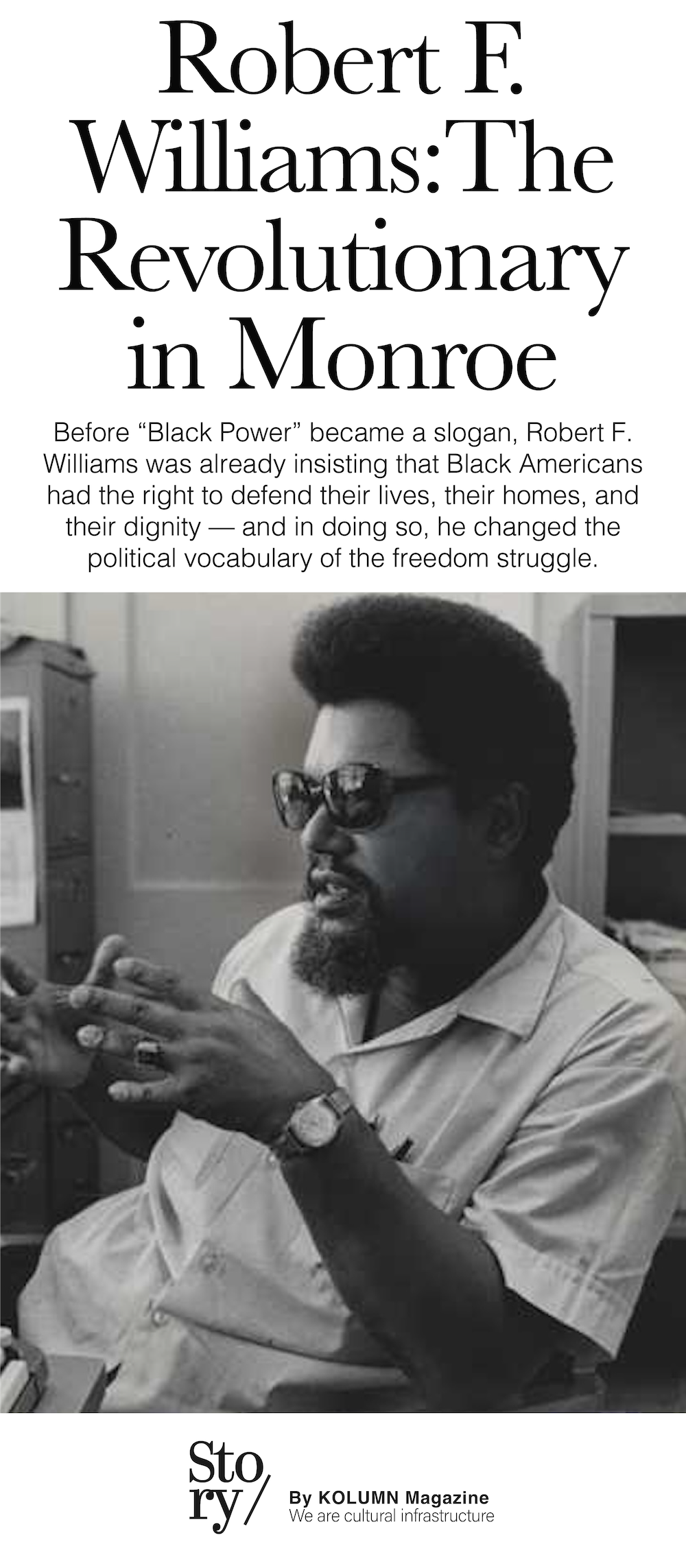
Robert F. Williams forces a harder truth into civil rights history: the movement was not only about persuading America to be better. It was also about surviving America as it was.
By KOLUMN Magazine
There are certain people in American history who remain oddly underdescribed not because they were minor, but because they were too disruptive to fit the version of the story the country prefers. Robert F. Williams is one of those people. He was born in Monroe, North Carolina, in 1925, served in the U.S. military, returned home to organize through the NAACP, fought local segregation, defended Black communities against Ku Klux Klan violence, helped turn the “Kissing Case” into an international embarrassment for Jim Crow America, went into exile in Cuba and then China, and left behind a political legacy that reached deep into the Black Power era. He died in 1996, but the arguments he raised about self-defense, state violence, citizenship, and freedom have not gone away.
If Williams is less canonized than Martin Luther King Jr., Rosa Parks, or even Malcolm X, that has less to do with his importance than with his inconvenience. He forces a more exacting reading of the civil rights movement. He complicates the old classroom split between “good” nonviolence and “bad” militancy. He reminds us that many Black Southerners did not experience nonviolence as a total philosophy so much as one tactic among others, used under the shadow of people who kept rifles in the house because the law either would not protect them or actively colluded with those who meant them harm. Historians and archival institutions now treat Williams as a central figure in understanding the roots of Black Power precisely because he makes the freedom struggle look more like what it was: local, improvisational, strategic, international, and perpetually at risk.
That is the essential thing to grasp about Robert F. Williams. He was not some fringe outlier standing outside the movement, shouting from the perimeter. He was inside it, organized through one of its most respectable institutions, and then became one of the people who revealed its fault lines. His life reads like an argument with the sanitized American memory of the 1950s and 1960s. He makes it harder to pretend that racial progress was won only through moral suasion and televised suffering. He points instead to a blunter truth: in many places, Black survival depended on the willingness to resist terror by whatever lawful and necessary means remained available.
A boy shaped by Reconstruction’s afterlives
Williams was born into a Black family with its own deep memory of struggle. Accounts of his life consistently note that the stories passed down through his family mattered: slavery was not ancient history, Reconstruction was not abstract, and the threat of white violence was not theoretical. That inheritance helps explain why Williams later rejected the idea that Black Southerners should meekly entrust their safety to sheriffs, judges, and mayors who were often aligned with the very people terrorizing them. In his world, racial domination was not merely a matter of separate facilities or voting restrictions. It was enforced by humiliation, economic retaliation, beatings, sexual violence, and the constant possibility of mob attack.
As a young man, he left Monroe for Detroit, where he worked in the auto industry and encountered labor politics before serving in both the Army and the Marine Corps. That sequence mattered. The city exposed him to industrial Black life and political struggle beyond the strict terms of southern segregation; military service exposed him to discipline, weapons, and the contradictions of fighting for democracy abroad while returning to second-class citizenship at home. The SNCC Digital Gateway notes that Black veterans like Williams came home from World War II and the early postwar period more willing to challenge Jim Crow and more comfortable with the practical knowledge of self-defense. Williams later said one of the Army’s clearest lessons was teaching Black men how to use arms.
That biography helps explain why Williams never approached southern politics as a patient petitioner. He understood Monroe not as a place waiting for enlightenment, but as a local regime held together by force and custom. When he returned, he did not come back seeking symbolic inclusion. He came back ready to organize. That distinction is crucial. Williams’s politics were not driven by rhetorical fury alone; they were grounded in institution-building, membership, campaigns, and a hard-headed reading of power.
Monroe: where the theory met the night riders
By the early 1950s, Williams had become president of the Monroe chapter of the NAACP. That fact still surprises people who imagine him as somehow beyond or outside liberal civil rights institutions. In reality, he rose through one of the movement’s most established organizations and used it to pursue local desegregation and community defense. Under his leadership, the Monroe branch pushed to integrate the public library and later the public swimming facilities, insisting that public resources funded by taxpayers should not remain racially segregated.
Monroe was not simply “a segregated town,” the kind of phrase that can sound dry and administrative from a distance. It was a place where segregation lived through violence, intimidation, and official indulgence of white supremacy. Contemporary accounts and later historical summaries describe a local Klan presence so large that it became part of the town’s political atmosphere. Demonstrations against segregation were met not just with heckling but with armed hostility. Williams and the people around him understood, very quickly, that appeals to law meant little if law enforcement had no intention of restraining white attackers.
This is where Williams’s signature position took shape. He did not advocate random violence. He argued for armed Black self-defense against racist assault. The distinction mattered enormously to him, even if critics often blurred it. In Monroe, that position became concrete in the form of a rifle club, chartered through the National Rifle Association, and in the formation of what became known as the Black Armed Guard. This was not performative bravado. It was a practical response to the reality that Black homes, Black organizers, and Black civic institutions were being threatened by white terror groups.
One of the most famous episodes came in 1957, when Klan violence threatened the home of Dr. Albert Perry, the vice president of the local NAACP. Williams and armed Black men fortified the area, and when the Klan arrived shooting, they returned fire and drove the attackers off. The historical importance of that episode goes beyond its drama. It demonstrated that the Klan’s power depended partly on expectation — the expectation that Black people would remain unarmed, exposed, and terrified. Monroe briefly broke that expectation. Williams understood that as a psychological as well as political shift. Terror works best when it goes unanswered.
This is the point where Williams usually gets flattened into a stock character: the “militant” foil to King. But that framing misses both men. Williams did not emerge because nonviolence had failed in some abstract debate. He emerged because in places like Monroe, Black families faced immediate danger. The question was not what sounded loftier in theory. The question was what people were supposed to do when cars full of Klansmen rolled into their neighborhood at night. Williams answered that question in plain language: defend the community.
The “Kissing Case” and the exposure of American absurdity
If the armed defense battles in Monroe made Williams locally famous, the “Kissing Case” made him internationally known. In 1958, two young Black boys in Monroe — James Hanover Thompson and David Simpson — were accused after a white girl kissed them on the cheek. The machinery of Jim Crow responded with grotesque force. The boys were arrested, held without proper access to their parents, beaten, and sentenced by a juvenile judge to reform school. The case was barbaric even by the standards of its time, and it exposed the sexual paranoia, racial sadism, and legal indecency that structured southern white rule.
“Williams understood something the United States preferred to forget in the Cold War: a sheriff in North Carolina could become an international problem.”
Williams seized on the case not simply as a legal injustice but as a political opportunity to embarrass the United States before the world. That was one of his recurring gifts: he understood that the Cold War made American racism a global liability. Through organizing, publicity, outside allies, and international pressure, he helped turn a local atrocity into international news. The result was not justice in any complete sense, but it was pressure. North Carolina officials, confronted with mounting scrutiny, eventually released the boys and granted pardons. No official apology could repair what had been done, but the case demonstrated that Jim Crow could be shamed, not only in federal court but in the court of world opinion.
The “Kissing Case” also helps explain why Williams cannot be reduced to the gun in the photograph. He was a media strategist, a transnational political thinker, and a local organizer who knew how to scale outrage outward. He saw that racial terror in a small North Carolina town did not have to remain provincial. It could be made legible to Africa, Asia, Europe, and the wider anticolonial world. That instinct would later define his years in exile, but Monroe gave him the first proof of concept.
The breach with the NAACP — and with America’s preferred script
In 1959, Williams’s national profile rose further after remarks he made following the acquittal of a white man accused of assaulting a Black woman. Williams argued, in essence, that if the law refused to protect Black people, then Black people had the right to protect themselves. That argument ignited a firestorm. The NAACP suspended him, worried about both the substance of his position and the public damage it could do to the organization’s carefully managed national posture. Williams insisted he was being misrepresented: he was not calling for offensive violence or lynching, he said, but for self-defense under conditions where the state had failed.
This conflict has often been retold as a moral split between respectable civil rights leadership and reckless militancy. That reading is too clean. The real dispute was also strategic, generational, and institutional. National organizations had to consider donors, allies, litigation campaigns, federal relationships, and public image. Local people in places like Monroe had to consider whether they would still be alive by morning. Williams represented a grassroots impatience with the idea that Black suffering must remain photogenic and disciplined to deserve protection. The NAACP, in turn, feared that Williams’s language would hand segregationists a propaganda weapon. Both sides were responding to real pressures. But history has been kinder to the organization than to the local militants whose circumstances made such arguments unavoidable.
It is tempting to frame Williams as the man who predicted Black Power before Black Power. There is truth in that, and Britannica explicitly places him as a precursor to the later Black Power and Black nationalist movements. But the label can also oversimplify him. He was not merely an early militant voice waiting for the late 1960s to catch up. He was a particular kind of southern organizer whose politics grew from the collision between democratic aspiration and racial impunity. His worldview was forged not first in ideology, but in the daily experience of knowing that white violence could arrive faster than any constitutional remedy.
Freedom Riders, kidnapping charges, and exile
In 1961, the freedom struggle intensified again in Monroe amid the broader Freedom Rides. Williams supported the Freedom Riders, and his home became entangled in the local crisis when a white couple briefly took shelter there during unrest. North Carolina authorities responded by charging Williams with kidnapping, a charge widely understood by his defenders and later historians as politically motivated. Facing arrest and possible violent retribution, Williams fled the United States with his family, first making his way through Canada and Mexico to Cuba.
That transition marked a dramatic shift in scale. Williams had been a southern activist; now he became an exile, a broadcaster, and a symbol in global Cold War politics. In Cuba, he continued publishing The Crusader and launched “Radio Free Dixie,” a program aimed at Black listeners in the United States. PBS and Stanford’s King Institute both note that his Cuban years made him a transnational figure who fused the Black freedom struggle with anti-imperial and anti-colonial movements abroad. He was no longer simply contesting Monroe’s white power structure. He was speaking into a geopolitical moment in which racial oppression in the United States could be read as part of a larger global system.
Williams’s 1962 book Negroes with Guns cemented that reputation. The title alone guaranteed controversy, but the work’s influence ran deeper than provocation. It gave language to a tradition of Black self-defense that polite national memory had often pushed aside. Historians have repeatedly described the book as important to later Black Power thinkers, including figures in the orbit of the Black Panther Party. The book did not invent armed resistance; it named and organized an existing current within Black political life.
Williams’s years in Cuba also complicate any effort to place him neatly within domestic civil rights categories. He was not only a critic of U.S. racism. He became a critic of U.S. empire, a participant in left international networks, and a figure whose politics were shaped by the Cold War’s radical circuits. That made him even harder to absorb into conventional American civic memory. A patriot reformer can be celebrated. An exile who broadcasts from Havana and allies himself with revolutionary governments is much more difficult for mainstream remembrance to domesticate.
China, anti-colonialism, and the global Black imagination
Williams later moved to China at the invitation of Mao Zedong, staying there for several years before returning to the United States in 1969. His time there mattered not just because it extended his exile, but because it further widened the frame through which he understood Black struggle. At the Wilson Center, historian Ruodi Duan describes Williams’s China years as part of a contested but significant political relationship between Black liberation movements and Chinese revolutionary internationalism. Williams was treated as an important political figure, and he used that platform to argue that Black freedom in the United States belonged to a global contest over race, empire, and human liberation.
There is a risk, in retrospect, of reading those years only through Cold War irony or ideological mismatch. Better to read them as evidence of Williams’s seriousness about internationalism. He recognized earlier than many liberals that the Black freedom movement was being watched abroad and that its moral and political alliances need not be confined within U.S. borders. This was not merely symbolism. It was strategy. If American democracy depended on international prestige, then Black organizers could exploit that dependence. If anti-colonial movements across the world recognized in Black America a related struggle, then solidarity could become politically useful as well as emotionally powerful.
Williams was not alone in this, of course. Malcolm X, SNCC organizers, and later Black radicals all developed international frameworks. But Williams belongs near the front end of that trajectory. He serves as one of the key bridges between the southern freedom struggle of the 1950s and the explicitly global Black radicalism of the late 1960s. That is one reason scholars keep returning to him. His life helps collapse the artificial wall between “civil rights” and “Black Power,” between southern organizing and international revolution, between local survival and world-historical critique.
“Robert F. Williams did not see Monroe as provincial. He saw it as one front in a worldwide contest over who counted as human, who held power, and who had the right to fight back.”
The man behind the iconography
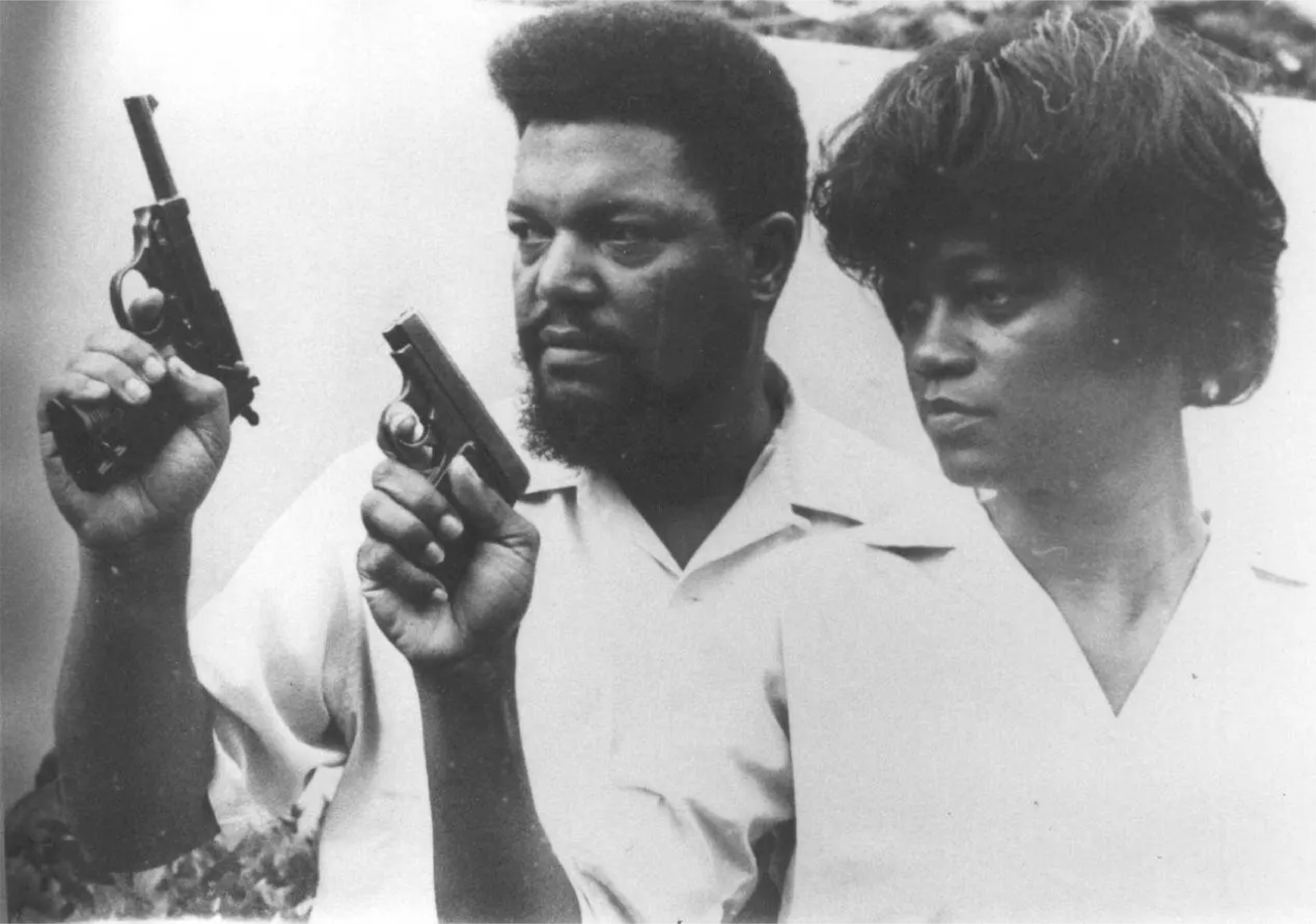
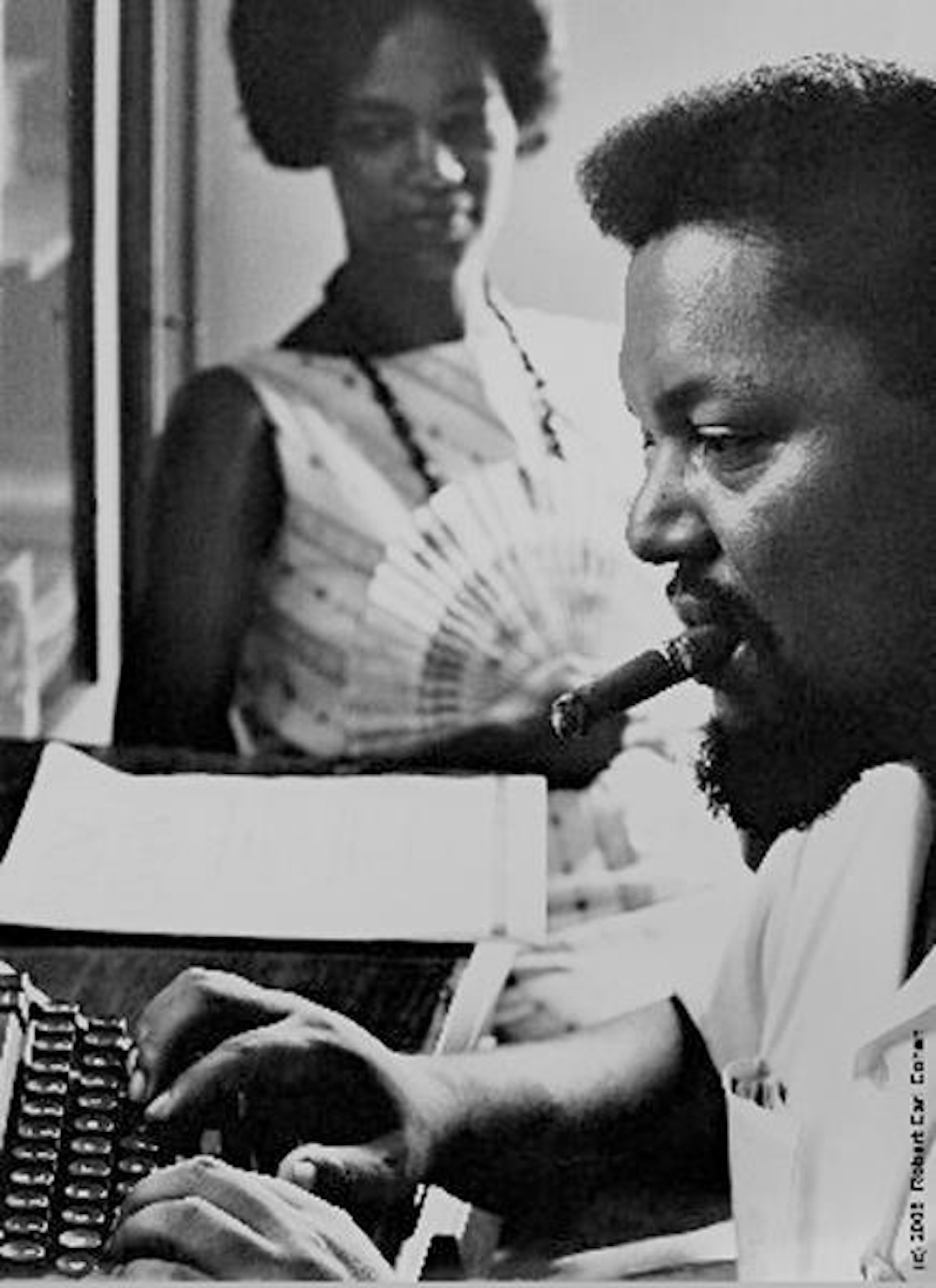
Still, Williams’s afterlife is often trapped in iconography. The famous images — Williams with a firearm, Williams alongside Mabel Williams, Williams in exile — are powerful, but they can encourage a thin reading of a thick political life. The gun matters because he meant it to matter. He wanted the image to interrupt Black subordination and white expectation. But he was also a theorist of dignity, a disciplined organizer, and a husband whose political life was inseparable from that of Mabel Williams, herself a formidable activist and chronicler of their shared struggle. Oral histories with Mabel Williams and archival materials from Freedom Archives make clear that the story is not properly his alone. It is a story of political partnership, shared risk, exile, and a common refusal of subservience.
Mabel Williams matters here for another reason too: she helps humanize what can otherwise become an overly mythic account. The Williamses paid for their politics in ordinary ways as well as historic ones — jobs lost, danger endured, family life dislocated, years lived abroad, legal uncertainty waiting at home. Robert F. Williams was not merely an emblem of militancy. He was a man whose commitments imposed steep costs on the people closest to him. That does not diminish him. It clarifies the scale of what commitment meant.
The phrase that best captures Williams may be neither “militant” nor “nationalist,” though both appear in descriptions of him. It may be “unassimilable.” He simply would not accept the emotional posture white supremacy demanded. He would not perform deference as a survival ritual. He would not concede that legality and legitimacy were the same thing. And he would not pretend that citizenship without protection was meaningful citizenship. That refusal gave his politics their edge, but it also helps explain why official America long preferred a civil rights memory with less friction in it.
Return, legal reckoning, and unfinished recognition
Williams returned to the United States in 1969. The criminal charges against him lingered until North Carolina finally dropped them in 1976. Sources from Stanford and contemporaneous congressional material confirm that his reentry was a serious political event, not just a personal homecoming. By then, the country he returned to had changed. Black Power was no longer marginal language. Urban uprisings, antiwar politics, decolonization abroad, and a transformed Black public sphere had made many of Williams’s once-scandalous premises more legible, even where they remained contested.
Yet wider recognition still lagged. In the popular hierarchy of civil rights memory, Williams remained awkwardly placed. Too radical for some liberal tellings, too NAACP for simplistic revolutionary myth, too southern to be folded only into urban Black Power, and too international to be contained by domestic narratives, he sat in the cracks. Historians, documentary filmmakers, and archivists have done a great deal to restore him in recent decades. PBS’s Negroes with Guns, Timothy Tyson’s scholarship, Stanford’s King Institute, NCpedia, and other resources have all helped recenter him. But his name is still not nearly as present in public memory as his influence warrants.
Williams died in 1996 of Hodgkin’s disease at age 71. Stanford and other biographical sources note that the charges against him had long since been dropped and that his historical significance had begun to receive more scholarly attention by the end of his life. But the larger verdict on his place in American history has been rendered mostly after his death, as researchers and activists have tried to reconstruct a fuller map of the movement he helped shape.
Why Robert F. Williams matters now
Robert F. Williams matters now because the questions he posed remain painfully current. What is a community supposed to do when the state is indifferent to racialized violence? What is the moral status of self-defense for people systematically denied protection? How should movements balance discipline, optics, legality, and survival? When does international pressure become necessary to expose domestic injustice? These are not antique questions. They recur whenever the law presents itself as neutral while operating through unequal force. Williams did not solve them once and for all. But he named them without euphemism.
He also matters because he corrects a sentimental distortion in American civic culture. The standard story often asks Black activists to be heroic in a very specific way: peaceful, photogenic, spiritually elevated, and ultimately reassuring to the nation that injured them. Williams refused that assignment. He demanded a politics grounded not in white comfort but in Black dignity. That stance made him controversial then and harder to memorialize later. But it also made him one of the clearest voices on a central democratic principle: rights that cannot be defended are fragile rights indeed.
None of this requires turning Williams into a flawless figure. That would only repeat the flattening he already suffered in reverse. His politics were sharp-edged. Some of his alliances remain debatable. Some of his rhetoric was intentionally incendiary. His years in Cuba and China raise difficult questions about the uses and limits of Cold War solidarity. And yet to acknowledge those complications is not to diminish his importance. It is to take him seriously. He should not be remembered as a slogan, a poster, or a gun photograph detached from context. He should be remembered as a strategist, organizer, theorist, and insurgent democrat who forced the movement — and the country — to confront realities it preferred to evade.
There is, finally, something deeply American about Williams, even if America spent years trying to cast him as alien to itself. He drew on a tradition older than the republic’s self-image likes to admit: the tradition of oppressed people claiming the full meaning of freedom rather than the decorative version offered to them. He insisted that Black people were not supplicants asking for a moral favor. They were citizens, workers, veterans, parents, children, and human beings entitled to safety and power. That is a radical position only in a country that routinely denied it.
And that may be the clearest way to understand his significance. Robert F. Williams did not stand outside the American freedom struggle. He stood inside it and exposed its stakes. He showed that the battle against segregation was also a battle over who had the right to defend a home, interpret a constitution, summon the world’s attention, and define what freedom was for. Before the phrase “Black Power” became widely legible, Williams had already begun articulating its premises in Monroe. Before the movement’s international turn became obvious, he had already made Black freedom a global conversation. Before public memory softened the era into civics, he had already demonstrated that democracy, when denied, can make radicals out of ordinary people trying to live.
If Robert F. Williams still feels contemporary, that is because he belongs to the part of history that never fully settled. The distance between law and justice, between citizenship and protection, between memory and truth — those are still with us. Williams remains valuable not because he offers comfort, but because he offers clarity. He makes it harder to lie about what Black freedom required, and still requires, in the United States. That alone secures his place among the most consequential activists of the 20th century.
More great stories
Afro Sheen, Wall Street, and the Architecture of Black Possibility
July 6, 2026
No Comments
The Fire Inside the Fourth
July 5, 2026
No Comments