





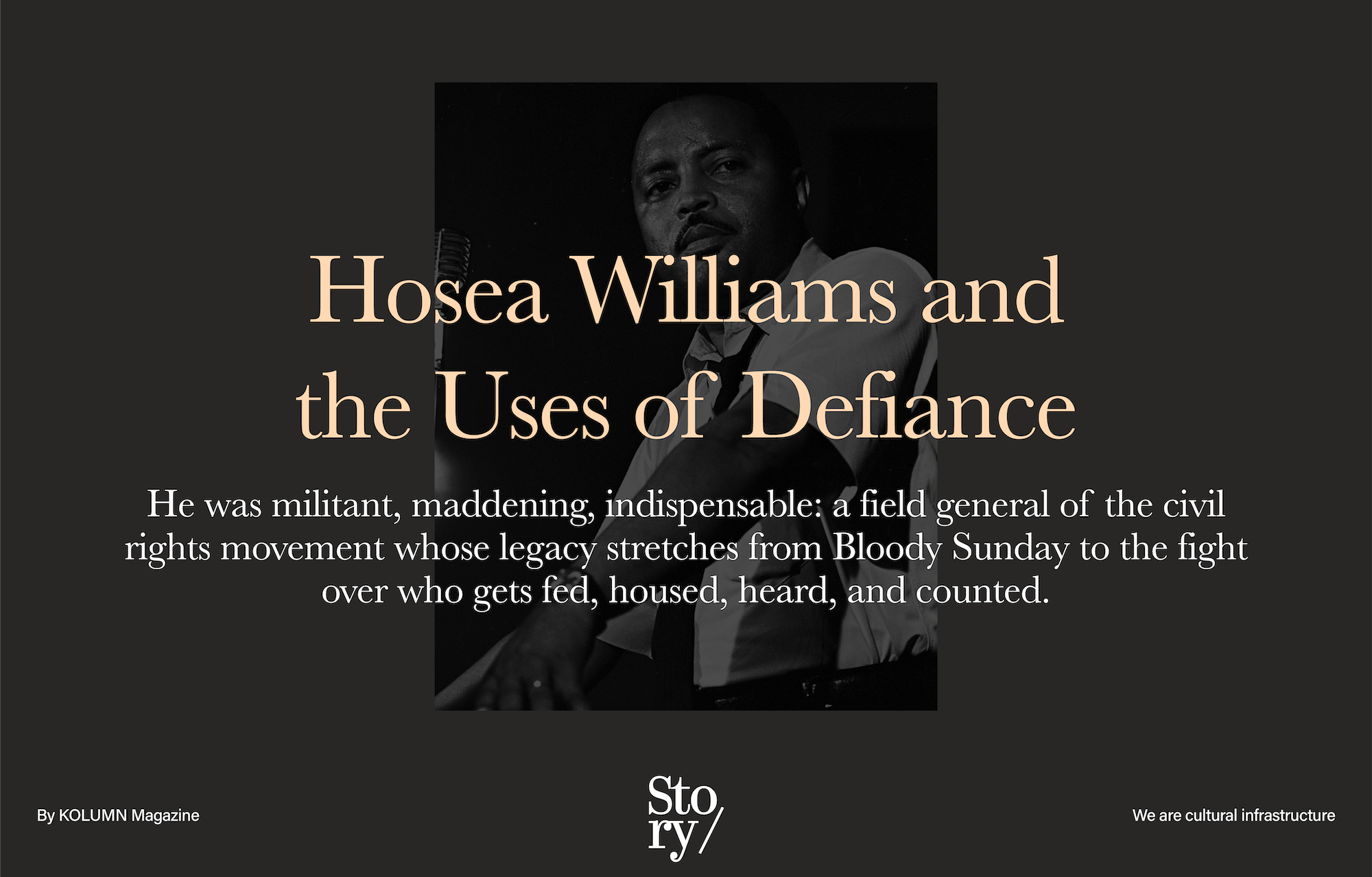
Movements need eloquence, but they also need pressure. Hosea Williams specialized in pressure.
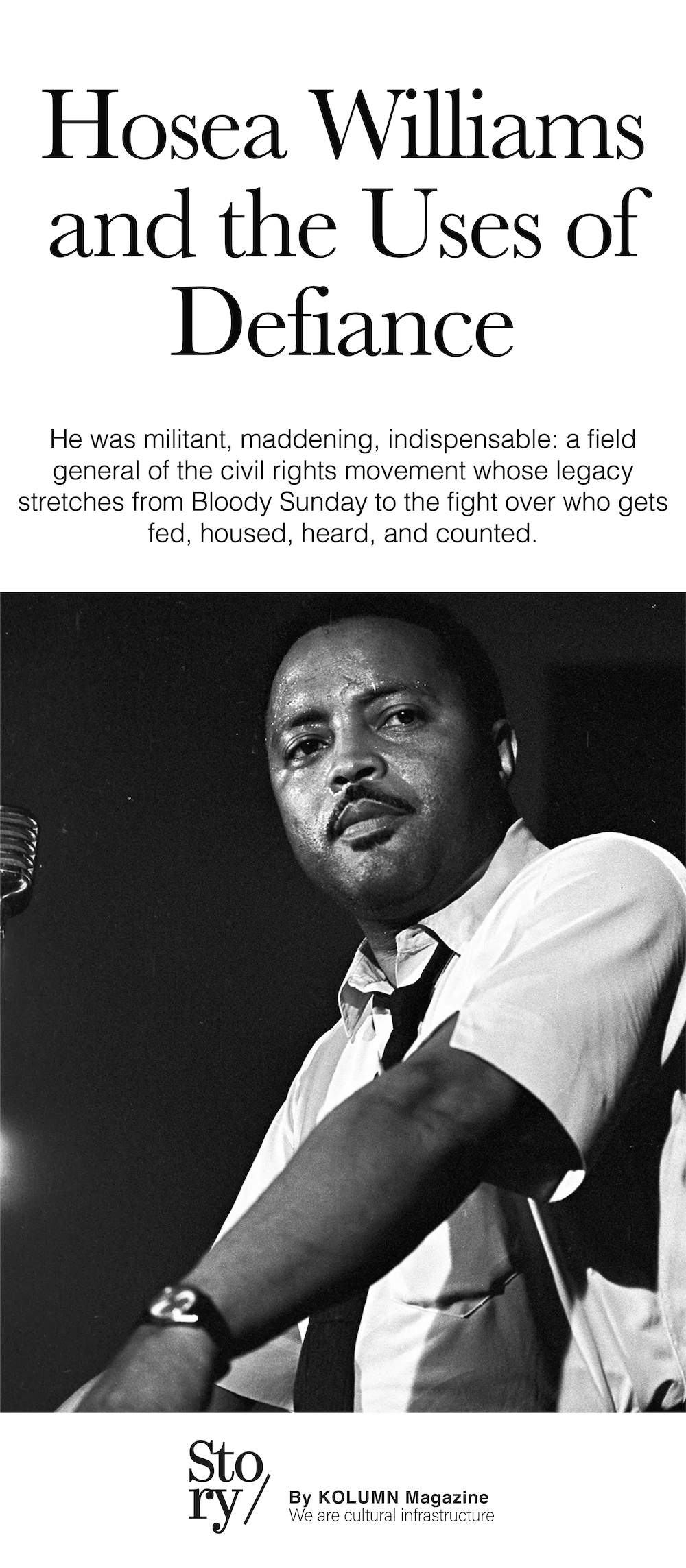
Movements need eloquence, but they also need pressure. Hosea Williams specialized in pressure.
By KOLUMN Magazine
There are some figures in the civil rights movement whose public memory has been streamlined into something neat, noble, and almost too polished to be fully human. Hosea Williams does not fit that template. He was too loud for it, too restless, too confrontational, too suspicious of respectability, and too willing to make trouble in places that preferred ceremony to change. If Martin Luther King Jr. often represented the movement’s moral lyricism, Williams embodied something closer to its hard edge: impatience, provocation, field discipline, and escalation. He was an organizer who understood that democracy, especially in the South, rarely yielded to good arguments alone. It had to be pressured, embarrassed, cornered, and forced to reveal what it really was.
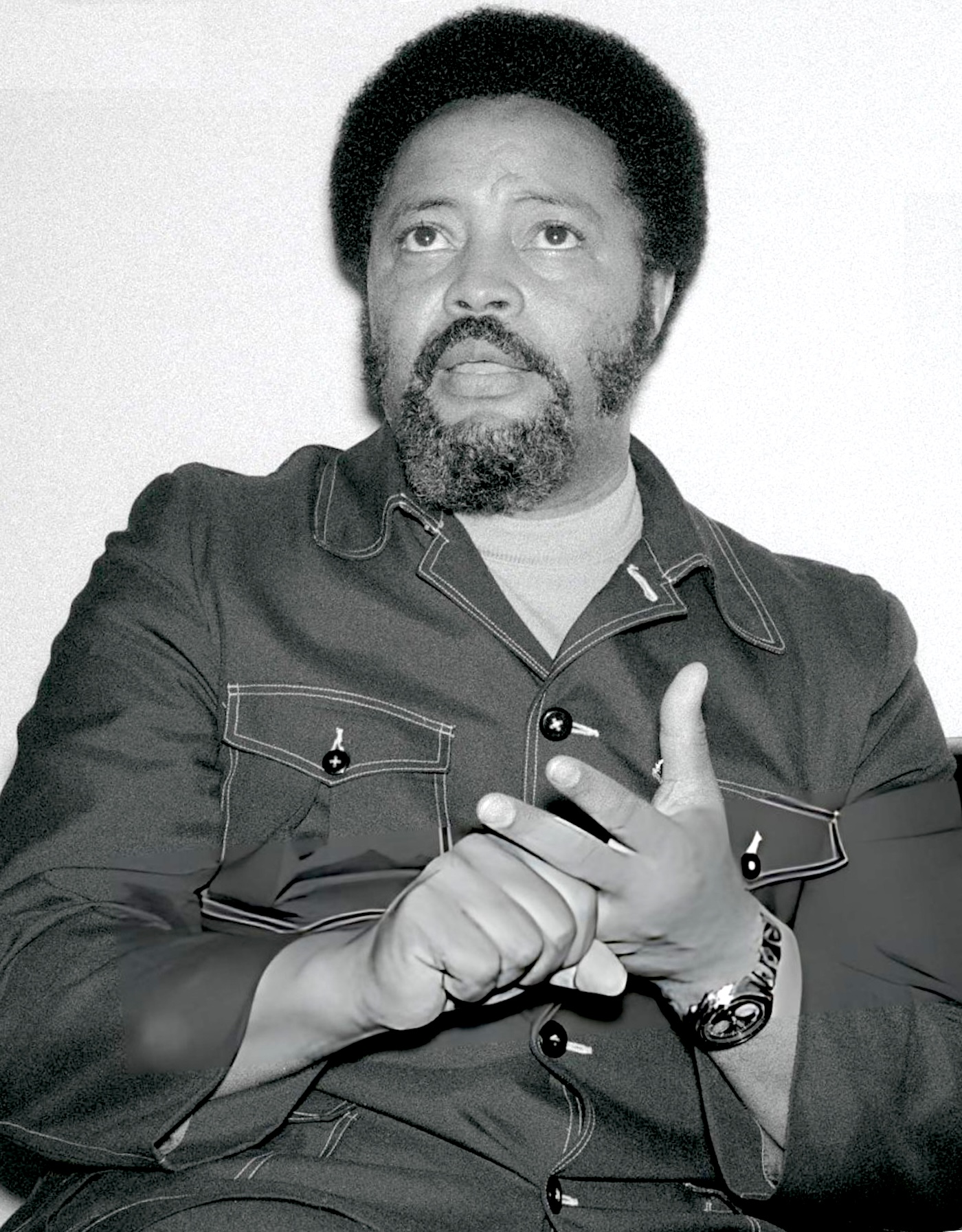
That helps explain why Williams matters so much and why he remains, compared with some of his contemporaries, under-remembered. He was a principal leader of the civil rights movement, a top aide to King, a veteran of the Savannah struggle, a co-leader of Bloody Sunday in Selma, a senior Southern Christian Leadership Conference operative, a later elected official in Georgia, and the founder of a long-running anti-poverty effort in Atlanta. He was arrested more than 125 times. He was also a political maverick whose career included internal conflicts, party switching, failed campaigns, and a style that admirers called fearless and detractors called combustible. All of that is part of the story. To understand Hosea Williams honestly is to understand that movements do not run on saints alone. They also run on people who are willing to be difficult in public, over and over again.
A Childhood Marked by Loss, Violence, and Survival
Williams was born on January 5, 1926, in Attapulgus, Georgia. His beginnings were shaped by instability and deprivation. His mother, a blind teenager, died soon after his birth, and he was raised largely by his grandparents. His early life was not a prelude to prominence so much as a long apprenticeship in endurance. By his teens, he had already left home, worked odd jobs, and learned how precarious Black life in the Deep South could be when race, poverty, and vulnerability converged. Several accounts of his life note that he nearly lost his life as a teenager in racial violence and that the memory of mob terror stayed with him.
World War II became one turning point. Williams enlisted in the Army and rose to staff sergeant in an all-Black unit. He was severely wounded by shrapnel and spent more than a year recovering in a British hospital. Like many Black veterans, he returned from war having risked his life for a country that still expected his submission at home. But Williams also returned with a sharpened sense of self-possession. He completed high school after the war, used the G.I. Bill to continue his education, earned a bachelor’s degree in chemistry from Morris Brown College, and later completed a master’s degree at Atlanta University. The biography is striking not because it conforms to a bootstrap myth, but because it shows how much force of will Williams needed simply to claim the credentials that white America often took for granted.
His training as a chemist is more than a colorful side note. Williams worked for the U.S. Department of Agriculture in Savannah from 1952 to 1963, and sources from Emory’s Southern Changes described him as the first African American chemist south of Washington, D.C., in that role. That detail matters because it complicates the caricature sometimes attached to him later as merely a loud street fighter. Williams was educated, technically trained, and professionally accomplished. He knew how institutions worked from the inside. He also knew that none of that insulated a Black professional from segregation’s humiliations. The chemist and the agitator were not contradictory identities. In Hosea Williams, they were cause and effect.
Savannah: Where the Chemist Became an Organizer
Savannah was where Williams became a movement figure in earnest. After arriving there for his federal job, he joined the NAACP and threw himself into grassroots organizing. He became known for giving anti-segregation speeches in a public park during his lunch break, an image that feels almost too perfect: the scientist using his midday pause not for rest, but for agitation. By 1960 he was president of the Southeastern Georgia Crusade for Voters, an SCLC affiliate, and by the next year he was speaking at the organization’s annual meeting about the power of the ballot. The work was not abstract. Williams treated voting rights and desegregation as lived matters of power, access, and humiliation.
Savannah also revealed a recurring theme in Williams’s life: he was often too blunt, too unconventional, or too socially inconvenient for the gatekeepers of established organizations. Stanford’s King Institute notes that when Williams sought advancement within the NAACP, Roy Wilkins told him he could go no further because of his family background. Williams took the grievance to King. The episode is revealing not because it indicts one organization wholesale, but because it shows how class, legitimacy, and respectability politics operated even inside the freedom struggle. Williams did not come wrapped in elite acceptability. He came with brilliance, courage, and volatility. King recognized the value of that combination sooner than some others did.
The Savannah campaigns helped establish Williams as what you might call a movement tactician of disruption. He pushed marches, protests, arrests, and organized pressure on the white business structure. Georgia Encyclopedia notes his talent for mobilization and militancy; Stanford’s profile underscores how quickly he became known for grassroots work. In practical terms, Williams was part of the generation of local and regional leaders who turned civil rights from courtroom principle into street-level confrontation. Without that layer of organizers, King’s national stature would have had far less force. The movement’s major victories were built from many local struggles, and Savannah was one of the proving grounds where Williams showed he could move people, not just inspire them.
King’s “Wild Man”
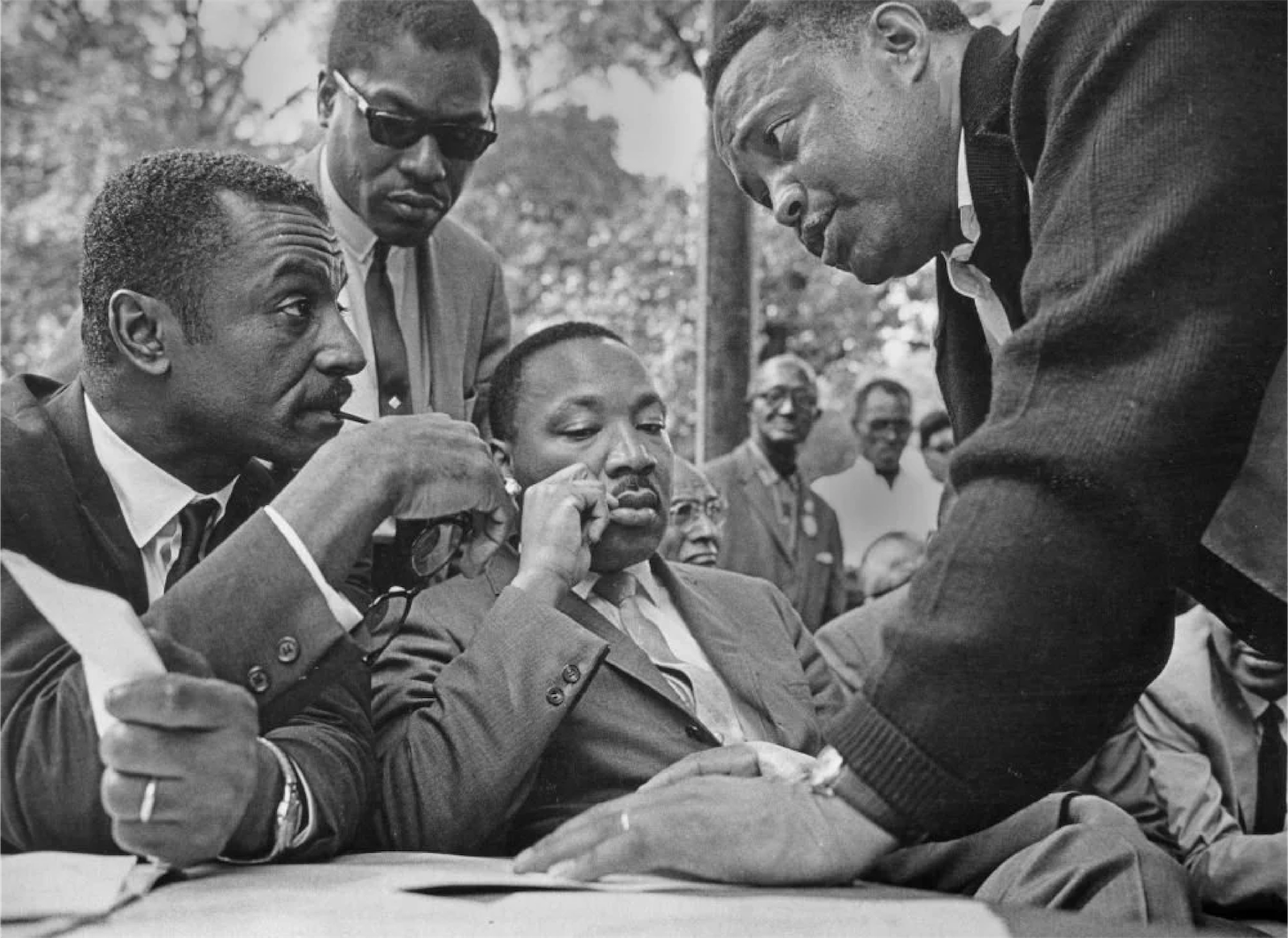
Williams’s relationship with King is central to his historical significance. The King Institute records that Williams described himself as the “thug” of SCLC, while King affectionately referred to him as “my wild man, my Castro.” Those labels were not throwaway jokes. They captured Williams’s functional role inside the movement. He was not the polished national spokesman. He was the field operator, the enforcer, the organizer with what biographer Rolundus Rice, as summarized by the University of South Carolina Press, called an “arsenal of agitation.” King needed people around him who could convert moral strategy into kinetic action. Williams was one of the most important of those people.
In 1964, after activism in Savannah and work in St. Augustine, Williams formally joined SCLC staff as director of voter registration. King personally raised money for his salary, writing that Williams’s talents needed a “broader horizon” than Savannah alone. That endorsement matters. King was not merely tolerating Williams’s rough edges; he was investing in them because he understood their utility. Williams taught nonviolence to volunteers, led marches, and took arrests alongside his family. He was not a contradiction to disciplined protest. He was one of the people who operationalized it. The public often mistakes militancy for an absence of discipline, but in Williams’s case, militancy was often the discipline: the willingness to keep pushing when others wanted pause.
By 1965, Williams was positioned for one of the defining moments not only of his life, but of modern American democracy.
Selma and the Meaning of Bloody Sunday
On March 7, 1965, Hosea Williams and John Lewis jointly led the first attempt to march from Selma to Montgomery in support of Black voting rights. The plan followed the killing of Jimmie Lee Jackson and the larger campaign against Alabama’s regime of disenfranchisement. The National Park Service records that roughly 300 protesters gathered at Brown Chapel A.M.E. Church, swelling to around 600 by the time they crossed the Edmund Pettus Bridge. Waiting on the other side were Alabama state troopers and mounted vigilantes. Williams tried to speak; the officers refused meaningful dialogue and ordered dispersal. Then came tear gas, clubs, mounted attacks, and chaos. Hundreds were injured.
“Democracy did not arrive in Selma because power grew kind. It arrived because people like Hosea Williams made cruelty impossible to ignore.”
The story of Bloody Sunday is often told with John Lewis, rightly, at its center. But Williams was not incidental to that moment. He was shoulder to shoulder with Lewis, representing SCLC at the front line of one of the most consequential confrontations in the history of the movement. The King Institute notes that after months of groundwork in Selma, Williams and Lewis jointly led the march. The National Park Service credits him among the lead figures. Word In Black’s sixtieth-anniversary coverage, drawing on Lewis’s recollections, revisits the harrowing seconds at the bridge’s crest, when the marchers looked down and saw a wall of state power prepared to beat them back. Williams was there not as background, but as command.
And this is where Hosea Williams’s significance expands beyond individual biography into democratic consequence. Bloody Sunday helped transform national opinion. Television images of nonviolent marchers being brutalized forced the country to confront the actual cost of Southern disfranchisement. The National Park Service explicitly connects the attack to the surge in support for voting rights that culminated in the Voting Rights Act of 1965. Georgia Encyclopedia similarly ties the violence and ensuing television coverage to Lyndon Johnson’s push for the legislation. Williams did not author that law, but he helped create the conditions in which the federal government could no longer evade the issue. That is historic significance of the highest order.
Beyond Selma: The Less Remembered Labor of Organizing
If Selma is the most famous image attached to Williams, it can also obscure the breadth of his work. The months and years around Selma were not a single heroic burst, but part of a larger architecture of organizing. After Bloody Sunday, Williams was placed in charge of SCLC’s Summer Community Organization and Political Education Project, or SCOPE. Stanford notes that he oversaw a budget of roughly half a million dollars and several thousand volunteers. By 1966 he had become southern project director, touring campaigns, rallying supporters, and continuing the difficult, unglamorous labor that sustains a mass movement after cameras leave.
This phase of Williams’s career deserves more attention than it usually gets. American memory loves a symbolic bridge and often neglects the infrastructure around it. SCOPE was not just symbolism. It was voter registration, training, recruitment, local engagement, and movement maintenance. Williams helped turn the SCLC from a cluster of high-profile interventions into a regional operational force. He was, in effect, one of the organization’s field executives. Georgia Encyclopedia lists the sequence of his senior roles within SCLC, including special projects director, national program director, regional vice president, and national executive director. Those titles can sound bureaucratic, but behind them was the practical question every movement faces: who gets people organized, coordinated, and moving? Williams was often that person.
He was also with King in Memphis in April 1968, near the end of King’s life. Multiple sources note that Williams remained a close associate and was present when King was assassinated. That fact carries obvious emotional weight, but it also underscores how close Williams was to the strategic center of the movement. He was not a peripheral activist occasionally adjacent to history. He was in the room, on the road, and at the scene when some of the movement’s most consequential decisions and traumas unfolded.
The Hard Part of the Legacy: Conflict, Ambition, and Political Messiness
A serious account of Hosea Williams cannot flatten him into a flawless hero. He was too politically erratic and institutionally contentious for that. Georgia Encyclopedia and Britannica both note that after King’s death Williams moved more aggressively into electoral politics. He ran unsuccessfully for a Georgia House seat, switched parties for a time, lost statewide races, returned to the Democrats, won election to the Georgia legislature, later served on the Atlanta City Council, and eventually became a county commissioner. Britannica notes that he was ousted from SCLC in 1979 during a power struggle. Georgia Encyclopedia says Joseph Lowery accused him of not devoting full attention to the executive director role.
For some observers, this messiness made Williams look undisciplined, even self-dramatizing. But it may be more useful to see it as an extension of the same traits that made him effective in movement work. Williams was not temperamentally built for deference. He did not naturally settle into ceremonial elder status. He agitated institutions from the outside and, when he entered them, often agitated them from within. That could be energizing or exhausting, depending on where one stood. The Washington Post obituary captured that enduring combative spirit, noting that he never lost the edge that had pulled him from a government chemist’s job into the center of civil rights struggle.
This part of the legacy matters because it reminds us that movement leadership and institutional leadership are not always the same skill set. Williams excelled at confrontation, urgency, and mobilization. Electoral politics often rewards coalition maintenance, strategic compromise, and procedural patience. He could do some of that, but it was never his most natural register. Even so, his years in public office should not be treated as a coda of decline. They were part of his broader effort to convert movement legitimacy into governing leverage, however imperfectly. Georgia Encyclopedia records his service in the state senate, city council, and county government; that is not the résumé of a man who vanished after the 1960s. It is the résumé of someone who kept testing where power lived and how to access it.
Forsyth County and the Return of Public Confrontation
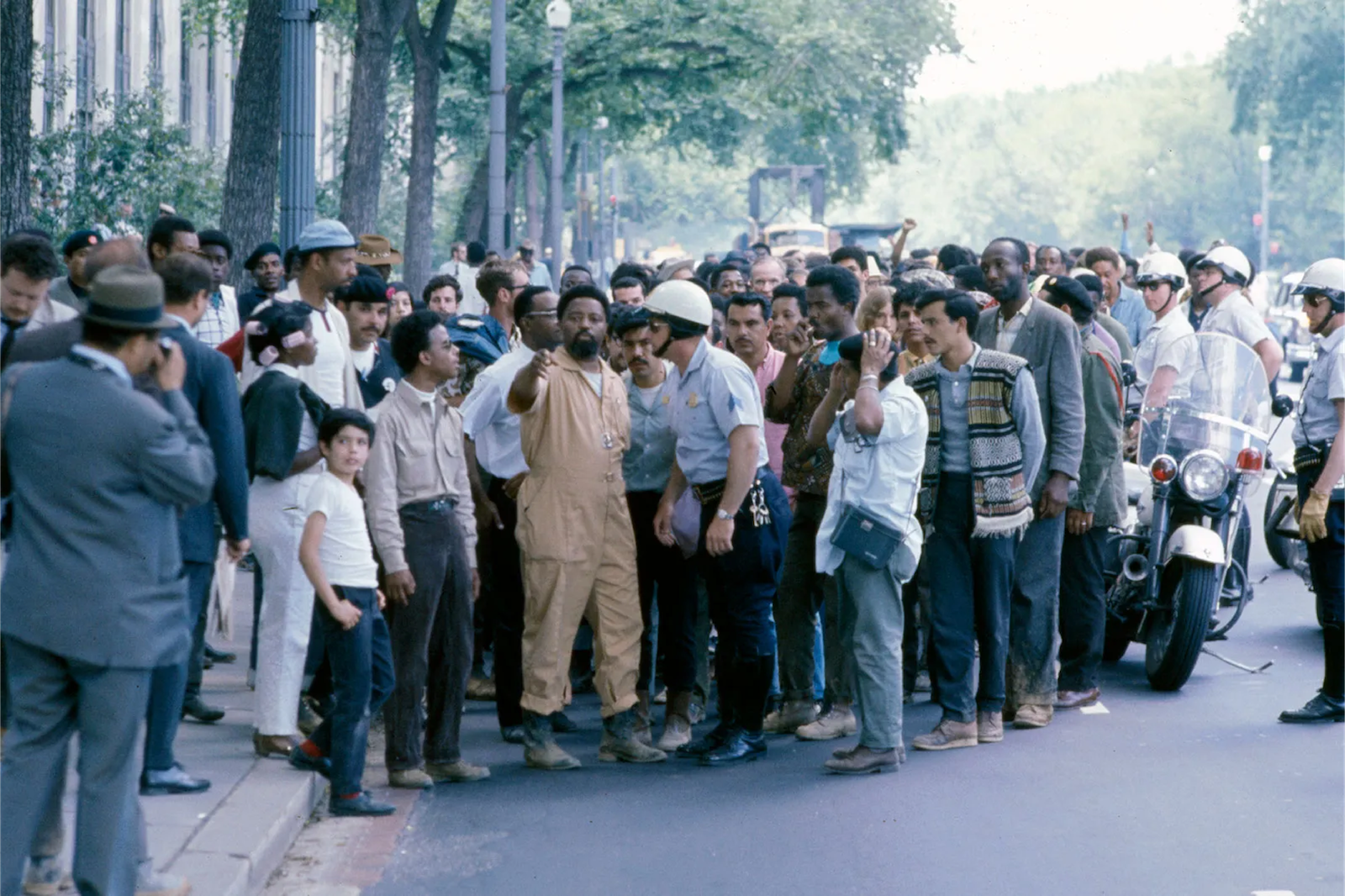
If anyone thought Williams had mellowed into pure memorial respectability by the 1980s, Forsyth County put an end to that notion. In 1987 he led marches into a majority-white county with an ugly history of racial exclusion and intimidation. The first march, according to Georgia Encyclopedia, drew roughly 75 supporters and was met by 400 to 500 Klansmen and sympathizers who broke through police lines throwing rocks and bottles. Emory’s Southern Changes remembered that Williams himself was struck in the head with a brick. The following weekend, after national outrage, he led a vastly larger march of about 20,000 people, joined by figures including Coretta Scott King, Andrew Young, and Jesse Jackson and protected by a massive security presence.
Forsyth is crucial to understanding Williams because it shows that he did not treat civil rights as a closed chapter after the canonical victories of the 1960s. He was still willing to identify a place where white supremacy remained structurally visible and bring confrontation directly to it. In that sense, Forsyth was a late-career echo of Savannah and Selma: find the site where the racial order still believes itself untouchable, then challenge it in public. Georgia Encyclopedia says Williams presented the county with demands including fair employment, restitution for property lost when Black residents were expelled in 1912, and a biracial council. This was not merely symbolic marching. It was an attempt to force public reckoning with theft, exclusion, and power.
Atlanta media and later retrospectives have treated those marches as a turning point in exposing Forsyth County’s racist history to a national audience. The Atlanta Journal-Constitution notes that the protests became the state’s largest civil rights demonstration since the 1960s and pushed long-suppressed realities into public view. Williams understood something that remains true now: racism often survives through local quiet. It thrives when national culture has moved on and local structures have not. He had a gift for disrupting that quiet.
Poverty, Hunger, and the Work He Refused to Romanticize
One of the most revealing aspects of Williams’s life is that he did not confine civil rights to legal equality or commemorative nostalgia. In 1971 he founded Hosea Feed the Hungry and Homeless in Atlanta, a program that continued through the rest of his life and survives under the leadership of his daughter Elisabeth Omilami. Britannica states plainly that the organization provided food, medical help, and clothing to people in need. Georgia Encyclopedia says it served thousands. The organization’s own historical materials place its founding in 1971 and describe it as a response to sustained human need, not seasonal charity branding.
“Hosea Williams understood that civil rights without material survival is an incomplete victory.”
This work matters because it situates Williams in a political tradition that did not separate racial justice from economic justice. The same man who walked into Selma and Forsyth also turned toward hunger, homelessness, clothing, and direct service. That was not a retreat from politics. It was a blunt statement about what politics had failed to solve. The Guardian’s account of the 1969 anti-poverty protest around the Apollo 11 launch, where Ralph Abernathy was flanked by Hosea Williams while denouncing the nation’s priorities, helps place him within the broader Poor People’s Campaign logic: a country capable of technological grandeur but unwilling to feed its poor was morally disordered. Williams appears, again, on the side of forcing that contradiction into public view.
There is something almost defiantly unsentimental about this part of Williams’s legacy. He did not just talk about “the poor” as a rhetorical constituency. He built an institution around feeding them. The AJC later traced the origin of those efforts to modest Thanksgiving meals that grew into one of Atlanta’s best-known social-service traditions. That continuity matters. A lot of movement veterans become symbols. Williams also remained, quite concretely, a provider.
Why He Is Not Remembered as Widely as He Should Be
Part of Hosea Williams’s relative under-recognition comes down to style. American public memory has always been selective about which movement figures it feels comfortable celebrating. It prefers the rhetorically elevated, the visually iconic, the legible moderate, the figure whose contradictions can be cropped out without too much effort. Williams resists that cropping. He was militant but committed to nonviolent protest. He was loyal to King but also his own force. He pursued office but never fit neatly inside officialdom. He cared about symbolism but seemed most alive in confrontation. He could be, by many accounts, exasperating. That makes him historically interesting and canonically inconvenient.
It also does not help that the grand narrative of the civil rights movement has often condensed itself around a handful of names and moments. In that compressed version, King is the orator, Lewis the conscience, Parks the spark, and Selma the climax. But movements are not novels with a tidy cast list. They are ecosystems. Williams was one of the ecosystem’s essential organisms: the organizer who could rally, recruit, escalate, and make institutions uncomfortable. University of South Carolina Press, summarizing Rolundus Rice’s biography, argues that Williams’s activism was central to the success of the larger movement. That corrective seems right. He was not supplemental to history. He was part of its engine.
The Significance of Hosea Williams Now
Hosea Williams’s life lands differently in a period when voting rights are again contested, public protest is again pathologized, and poverty is still too often treated as unfortunate scenery rather than political emergency. Word In Black’s recent Selma anniversary coverage made that continuity explicit, connecting the march Williams led in 1965 to present-day fights over voter suppression and equal ballot access. The point is not to force a simplistic one-to-one comparison between then and now. It is to recognize that the issues Williams fought over—voting access, racial intimidation, public accountability, and economic abandonment—never really disappeared. They changed form, language, venue, and legal architecture, but not core substance.
His legacy also speaks to a tactical question that still divides movements: what role should agitation play? Williams’s answer, judged across his life, was unmistakable. Agitation is not a breakdown of democratic process; often it is what exposes that the process has already broken down for somebody else. Savannah, Selma, Forsyth, anti-poverty protests, anti-hunger work—these were not disconnected episodes. They formed a political philosophy, even if Williams did not package it in academic language. The philosophy was simple: where power grows comfortable with injustice, comfort must be interrupted.
That does not mean every tactic Williams used should be romanticized, or that all his political instincts were correct. They were not. His career includes friction, reversals, and failed bets. But measured historically, the scale tilts decisively toward significance. He helped shape one of the pivotal voting rights confrontations in American history. He helped build SCLC’s field capacity. He stayed active after King’s death rather than converting memory into myth. He brought national attention to racist exclusion in 1980s Georgia. He built a long-lived anti-hunger institution in Atlanta. And he did so with a style that made it hard for the country to pretend the struggle for justice could be managed politely.
When Williams died in 2000 at age 74, the Washington Post called him a top lieutenant to King; John Lewis, quoted by his biographer’s publisher, said he should be regarded as one of the founding fathers of the new America. That language is not hyperbole. It is a reminder that democratic transformation is made not only by those who articulate the dream, but by those who insist, in the street and under pressure, that the country account for its evasions. Hosea Williams was one of those people. He was not easy. He was not tidy. He was, in the ways that count most historically, indispensable.
More great stories
Roy Wilkins and the Politics of Staying Power
April 7, 2026
No Comments
The Threads That Bind Sonya Clark
April 7, 2026
No Comments