





What makes West famous is not simply that he talks about race, but that he insists race could not be severed from class, grief, spirit, history, and the damage of being told your life is disposable.
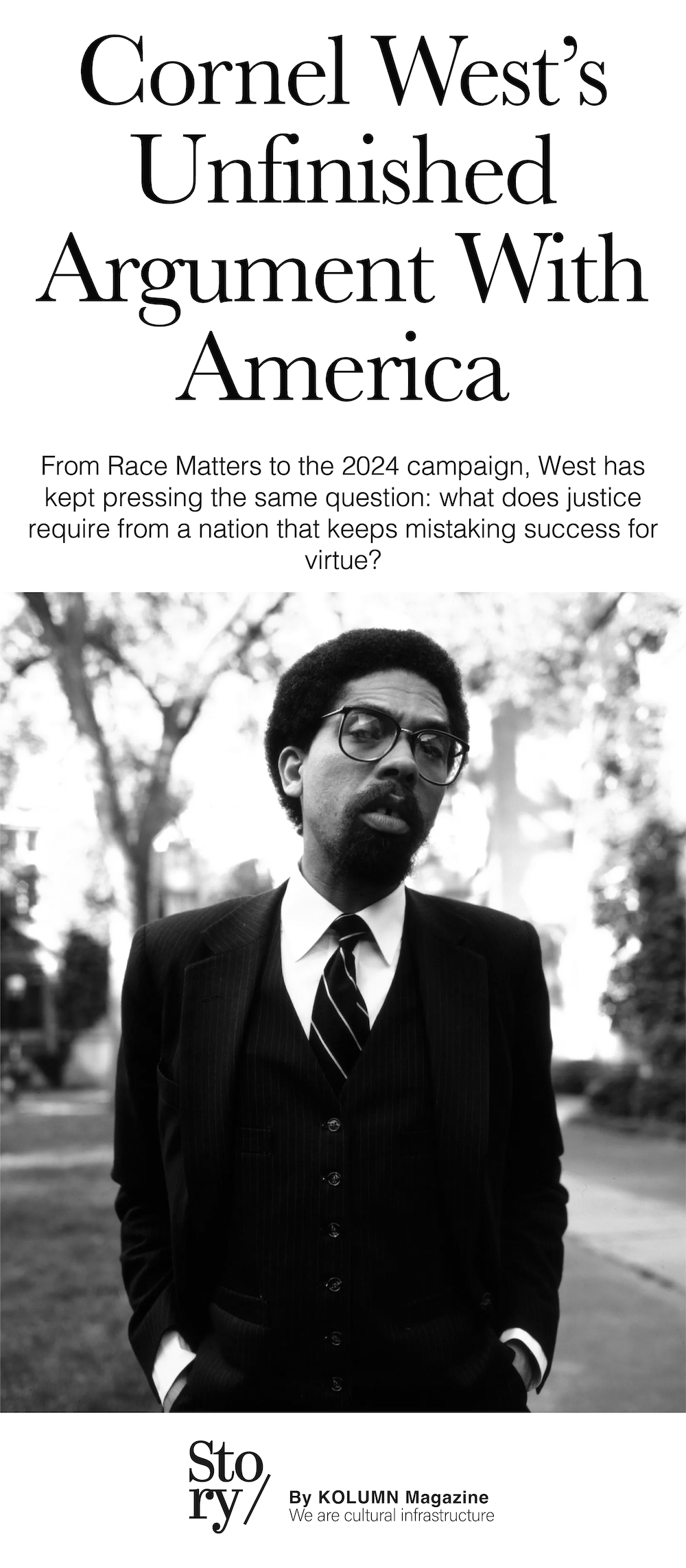
What makes West famous is not simply that he talks about race, but that he insists race could not be severed from class, grief, spirit, history, and the damage of being told your life is disposable.
By KOLUMN Magazine
Cornel West has spent so long in public that he can seem less like a single person than a recurring American argument. He is a philosopher and theologian, but also a street-corner moralist, a campus celebrity, a jazz-inflected lecturer, a television presence, a protest veteran, and, more recently, a presidential candidate. He is one of the rare scholars whose name traveled far beyond seminar rooms, largely because he refused to act as though the seminar room were the final destination of thought. For West, ideas were never supposed to remain polished and still. They were supposed to enter the mess of democratic life: churches, picket lines, talk shows, bookshelves, commencement stages, jail cells, and ballot fights. That ambition made him famous. It also made him polarizing.
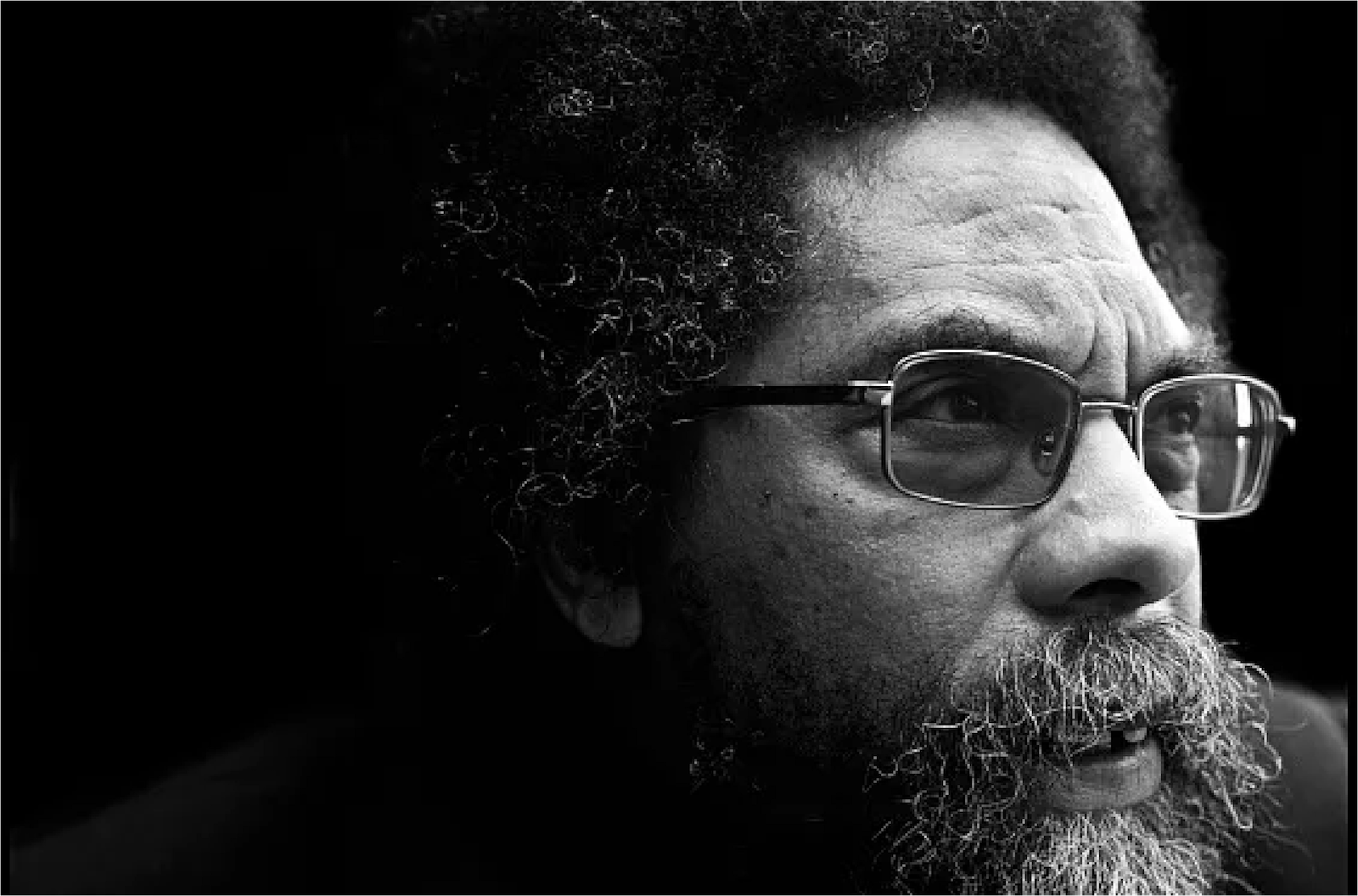
West’s significance lies partly in that refusal to separate intellect from agitation. At his best, he has functioned as a translator between traditions that do not always speak to one another comfortably: Black church prophecy and European philosophy, democratic socialism and Christian witness, academia and the street, canonical texts and hip-hop cadence. At his most frustrating to critics, he has seemed to embody the liabilities of public intellectual life in America: performance overpowering precision, moral thunder shading into self-mythology, political witness slipping into provocation for its own sake. The reason he still matters is that both assessments contain some truth. West has been too important, too visible, and too contradictory to fit cleanly inside either sainthood or dismissal.
The making of Brother West
Cornel Ronald West was born in Tulsa, Oklahoma, on June 2, 1953, and grew up largely in Sacramento, California, in a working-class Black community shaped by church life, public service, and the afterlives of segregation. His father worked as a civilian administrator for the Air Force or Defense Department, depending on the account; his mother was an educator who became a principal. West has repeatedly described the importance of the Black Baptist tradition in his upbringing, not just as a theology but as a moral formation: a way of hearing sorrow, endurance, style, witness, and collective survival all at once. That background matters because nearly everything identifiable in the adult West was already incubating there—the sermonic rhythm, the stress on love and justice, the attraction to moral grandeur, and the insistence that suffering must be interpreted rather than merely endured.
As a teenager, West was already testing the line between scholarship and protest. Accounts of his youth describe participation in civil-rights demonstrations and student organizing for Black studies coursework while he was still in high school. He graduated from Harvard in three years, magna cum laude, after studying Near Eastern languages and civilization, then went on to Princeton for graduate work in philosophy. By the time he entered academic life, West had already formed the broad outlines of what would become his signature approach: he would not choose between the Black freedom struggle and the Western canon, between the prophets and the philosophers, between Frederick Douglass and Chekhov, between church mothers and Marx. He meant to read all of them against the emergency of American life.
That intellectual synthesis would eventually take the name “prophetic pragmatism,” a term associated with West’s attempt to combine American pragmatist philosophy, especially figures such as John Dewey, with Black prophetic Christianity, left politics, and a tragic sense of history. The key point was not system-building in a narrow academic sense. It was moral orientation. West’s thought has long revolved around the claim that democratic life decays when market values, racial hierarchy, and spiritual emptiness combine to hollow out human beings. His language for that crisis has varied over the decades, but the underlying argument has remained strikingly stable: a nation obsessed with profit, empire, and image will produce forms of civic and personal despair that policy alone cannot cure.
The scholar who became a public figure
West held teaching posts at Union Theological Seminary, Yale, Princeton, Harvard, and then Union again, building a career across elite institutions while remaining suspicious of their moral vanity. Official biographies today identify him as the holder of the Dietrich Bonhoeffer Chair at Union Theological Seminary and note his earlier roles at Harvard and Princeton, where he also became professor emeritus. That itinerary matters because West’s authority has always rested on a productive tension: he is unmistakably an institutional insider with the résumé to prove it, but he has made a public identity out of speaking as though he were forever on the verge of being ejected from polite company. He has wanted the classroom and the microphone, the archive and the rally.
By the early 1990s, West had become something rare in American letters: a scholar whose work had genuine crossover power. Race Matters, published in 1993, made him a national figure. Britannica still describes it as his influential breakthrough book, one that lamented the “spiritual impoverishment” of the Black underclass and examined what he saw as a crisis in Black leadership. The book’s force lay in its refusal to reduce racism to either bad feelings or bad laws. West argued instead that modern Black life was being ravaged by structural inequalities and by a corrosive nihilism—a term he used not to pathologize Black people, but to name the psychic consequences of domination, abandonment, and the daily assault on dignity.
That argument landed because it arrived at a moment of acute post-riot, post-Reagan racial anxiety, when mainstream American discourse was both fixated on race and deeply allergic to talking honestly about power. West wrote in a register that felt academically grounded but morally exposed. He could move from policy to blues music, from philosophy to personal grief, from Malcolm X to market culture, without pretending those categories lived in separate houses. A New Yorker profile from 1994 treated him as a singular cultural figure: a serious philosopher with a genuine popular following and a growing chorus of critics in academia. That double reception has followed him ever since.
Why Race Matters still matters
To understand West’s staying power, it helps to revisit what Race Matters actually did. Its most durable claim was that Black suffering in the United States could not be captured by technocratic language alone. West believed liberal policy discourse often understood inequality in managerial terms while failing to confront the emotional and existential injuries produced by white supremacy. At the same time, he was skeptical of conservative narratives that framed Black hardship as a failure of values divorced from history. He wanted to place moral life back inside politics without turning morality into blame. The book’s continuing relevance comes from that balancing act. It treated racism as structural, but it also treated humiliation, hopelessness, and lovelessness as political facts rather than private defects.
That emphasis on the spiritual and existential sometimes drew suspicion from readers who preferred cleaner ideological categories. West was never a straightforward secular left critic, nor simply a church intellectual. He was after a broader diagnostic language, one capable of talking about prisons, policing, labor exploitation, patriarchy, and cultural emptiness in the same breath. His admirers saw that as moral range. His detractors sometimes saw it as vagueness, or as rhetorical sweep substituting for grounded analysis. Yet even those who questioned West’s precision often conceded his influence. The New Yorker’s assessment in the mid-1990s that Race Matters might set a new measure for cultural criticism captured the scale of its arrival. More than three decades later, the book remains one of the clearest entry points into the public vocabulary of post-civil-rights Black critique.
West’s later books, including Democracy Matters, extended the same core warning into a broader indictment of empire, market triumphalism, and civic decay. He repeatedly returned to the claim that democratic institutions become brittle when elites mistake procedural management for moral leadership. This helps explain why he has remained compelling to readers who may not agree with him point for point: he writes as someone convinced that the deepest crises of the republic are ultimately crises of character, courage, and solidarity. In a political culture addicted to strategy and branding, that kind of language still has purchase.
The performance, the criticism, the celebrity problem
West’s rise also revived an old question about Black intellectual life in America: what happens when a scholar becomes famous enough to be judged not only by peers, but by the rules of celebrity culture? In West’s case, the answer was years of argument about whether his public vocation enriched his scholarship or diluted it. Some defenders called him a democratic necessity—a thinker willing to take difficult ideas beyond the academy and to speak with ordinary people in a language that carried rhythm, memory, and urgency. Critics countered that he too often confused presence with depth, style with argument, or ubiquity with rigor. That dispute did not begin with social media. It was present in profiles and debates going back decades.
West has never merely occupied institutions. He has staged arguments inside them, against them, and through them.
The Lawrence Summers controversy at Harvard in the early 2000s turned that argument into national spectacle. Reporting at the time described Summers rebuking West over alleged grade inflation, missed classes, and what Summers viewed as insufficiently serious scholarship, while West and his defenders saw the criticism as an attack on a major Black public intellectual whose very publicness had always been part of his value. West left Harvard for Princeton in 2002. The episode mattered because it revealed the discomfort elite institutions can feel with a figure they have eagerly marketed but cannot fully domesticate. West was not just a professor under review; he was also a symbol around whom broader anxieties about race, celebrity, and academic legitimacy could gather.
The tension resurfaced in 2021, when West again broke with Harvard after a dispute over tenure and faculty standing. Coverage of his resignation highlighted his accusation that the university was suffering from “spiritual rot” and market-driven decay. However one evaluates the merits of that fight, it fit a longstanding West pattern: he uses institutional conflict not only to defend himself, but to dramatize a larger moral diagnosis. Sometimes that makes him sound prophetic. Sometimes it makes him sound incapable of distinguishing personal grievance from systemic critique. Either way, West has always understood that the public battle itself can become part of the argument.
West the activist, not just the professor
Reducing West to a campus celebrity misses a major part of the record. His public life has been bound up with actual movement politics, even if not always in tidy organizational forms. He has been active in labor struggles, prison and antiwar causes, Black freedom campaigns, and public protests against white supremacy. In 2017, after the Unite the Right rally in Charlottesville, West was among the clergy and counterprotesters on the ground and later gave a stark account of the danger posed by the far right, while also arguing that anti-fascist militants had saved lives. The episode reinforced his long-running insistence that fascism, racism, and militarism are not abstractions to be debated at a safe distance. They are live forces.
West’s activism has also been distinctly ecumenical in its alliances and unnerving in its unpredictability. He has collaborated across ideological and institutional lines that many public figures would avoid. He can appear with clergy, socialists, abolitionists, students, old-school civil-rights veterans, and conservative intellectuals with whom he sharply disagrees. Recent events featuring West and Princeton’s Robert P. George, for example, have framed their relationship as a model of civic friendship amid polarization. That pairing does not erase their disagreements; it underscores West’s belief that public struggle requires confrontation without complete social severance. In an era when every argument is incentivized to become a final excommunication, that habit is part of his relevance.
Still, West’s activism often courts contradiction. His fierce critique of American empire and NATO expansion, his defense of controversial dissidents, and his sweeping moral denunciations have made some allies uneasy. He has never been especially interested in laundering his views through establishment respectability. That can make him bracingly independent or maddeningly absolutist, depending on the issue and the observer. But it is consistent. West’s politics are not rooted in party discipline. They are rooted in witness, which is one reason he has spent so much time in and around campaigns while seeming temperamentally unsuited to the compromises campaigns demand.
The Obama break and the question of Black loyalty
One of the most revealing episodes in West’s public life was his break with Barack Obama. West had supported Obama early, but by 2011 his criticism had become public, personal, and incendiary enough to trigger a wider debate among Black writers and commentators. Washington Post coverage at the time described the intensity of the backlash and the broader argument inside Black America over whether West’s critique represented principled disappointment, personal resentment, or a failure to understand the pressures on the first Black president. For West, Obama had capitulated to Wall Street, militarism, and political caution. For many of West’s critics, he had allowed ideological purism and bruised ego to overwhelm historical judgment.
That fight mattered because it exposed two competing traditions within Black political thought. One tradition emphasizes symbolic breakthrough, coalition management, and incremental gains under hostile conditions. The other demands prophetic clarity even when it carries political costs. West planted himself firmly in the second camp, often with language so harsh that it eclipsed whatever legitimate structural critique he was trying to make. Yet the episode also clarified why West can be hard to assimilate into mainstream liberal consensus. He is not built to play the loyal insider. He is built to accuse. Whether that accusation proves illuminating or excessive has varied from case to case, but the instinct itself has been central to his role.
West would later channel his political energy into support for Bernie Sanders, whose redistributive agenda and anti-oligarch language fit more naturally with West’s democratic socialist commitments. His endorsement framed Sanders as a “long-distance runner” for justice, language that also revealed what West most admires in political life: endurance, moral consistency, and willingness to confront concentrated power directly. That preference helps explain much of his admiration map, from older movement figures to contemporary organizers. He has little patience for sleek centrism. He is drawn instead to what he sees as moral stamina.
Why he ran for president
By the time West launched his 2024 presidential bid, it was easy to see the campaign as either inevitable or absurd. In one sense, it followed naturally from decades of telling the country that both major parties were captive to money, militarism, and moral cowardice. In another, it exposed the gap between prophetic critique and electoral mechanics. Reuters reported his initial announcement through the People’s Party in June 2023, and the campaign soon lurched through party switches—from the People’s Party to a Green flirtation, then to an independent run, then to the Justice for All Party. The Guardian and other outlets documented the instability, along with West’s insistence that he was running for “truth and justice” rather than for conventional viability.
The campaign illuminated both West’s appeal and his limits. To supporters alienated by the bipartisan consensus on war, inequality, Gaza, and corporate power, he offered an unsoftened moral vocabulary and a refusal to pretend the existing political order was salvageable through minor adjustments. To critics, including some on the Black left, the run looked quixotic at best and reckless at worst. Word In Black argued in 2023 that the stakes were too high for a vanity-like third-party exercise, especially in a political environment where spoiler fears were not hypothetical. That criticism stung precisely because it came from within a Black public sphere that has often taken West seriously.
As the race unfolded, the mechanics got uglier. Associated Press reporting showed West winning ballot access in some states and losing in others, including Pennsylvania, while separate AP reporting documented the involvement of Republican-linked operatives in parts of his ballot drive. Washington Post coverage from 2024 described West, then focused heavily on Gaza and his critique of opponents and former allies, as a candidate with long odds who was not backing down. The upshot was clarifying: West could still command attention, but attention was not the same thing as durable organization. The campaign was a useful case study in how moral charisma can struggle when confronted by the fine print of state law, party infrastructure, and electoral suspicion.
The religious core
To read West only as a man of the left is to miss how thoroughly his politics are saturated with religious language and formation. He is not merely a professor who sometimes quotes scripture. He is a Black Christian intellectual shaped by the sermonic tradition, by the witness of the church, and by an understanding of love as a public ethic rather than a private sentiment. Even his harshest political critiques are usually grounded in moral and spiritual vocabulary: decay, integrity, courage, compassion, witness, sacrifice. He does not talk like a consultant or a policy wonk because he does not believe technocratic fluency can answer the country’s deepest forms of abandonment.
For West, justice is never just a platform plank. It is a test of whether a society has mistaken success for soul.
This religious core is also why West has remained compelling to audiences beyond the secular left. He can speak in the idiom of democratic socialism, but he also speaks in the language of sin, redemption, and the dignity of the least protected. He is as likely to invoke jazz, Chekhov, and Curtis Mayfield as he is Marx or Dewey, because he sees them all as resources for teaching people how to stay human in dehumanizing systems. That fusion is not decorative. It is his intellectual method. The Westian sentence is built to carry philosophy through the bloodstream of culture.
The real measure of his legacy
So what, finally, is Cornel West’s significance? Not that he has always been right. He has not. Not that he has built the most disciplined body of scholarship of his generation, though his major works unquestionably shaped public debate. And not that he has translated his moral authority into institutional power, because often he has done the opposite, burning bridges or turning disputes into public theater. His importance is that he helped preserve a tradition of Black democratic criticism that refuses to flatter American innocence. He has spent a lifetime insisting that racism is not a glitch in the system but one of the ways the system has historically organized value, vulnerability, and belonging.
He also helped keep alive a thicker idea of the public intellectual at a moment when that role often shrank into punditry. West has always aimed for something larger than “commentary.” He wants interpretation with stakes, criticism with conscience, language with memory. That aspiration can veer into grandiosity, but it has also made him unusually legible to generations of readers, students, and listeners who felt that conventional political speech could not describe the texture of the crisis around them. In West’s best work, one hears not just diagnosis but accompaniment—the sense that thought should walk with suffering people rather than merely explain them.
And then there is the plain fact of endurance. West is still in circulation because the conditions he named decades ago—racialized abandonment, elite complacency, market worship, democratic hollowness—never went away. They mutated, scaled, digitized, and found new vocabularies, but they did not disappear. That does not make every West argument correct. It does make him hard to dismiss as a relic. He remains one of the few American public figures whose entire body of work is organized around a single, hard question: how do people keep faith with justice in a civilization built to reward forgetting?
In that sense, Cornel West’s life is not best read as a stable arc from scholar to activist to candidate. It is better understood as a prolonged improvisation on one moral theme. He has been trying, in one register after another, to warn the country that a democracy without truthfulness, tenderness, and courage will become excellent at producing winners and failures, but terrible at recognizing human beings. That is the burden of his work, and also the source of its durability. America keeps changing costumes. West keeps asking whether the costume hides a spiritual vacancy underneath.
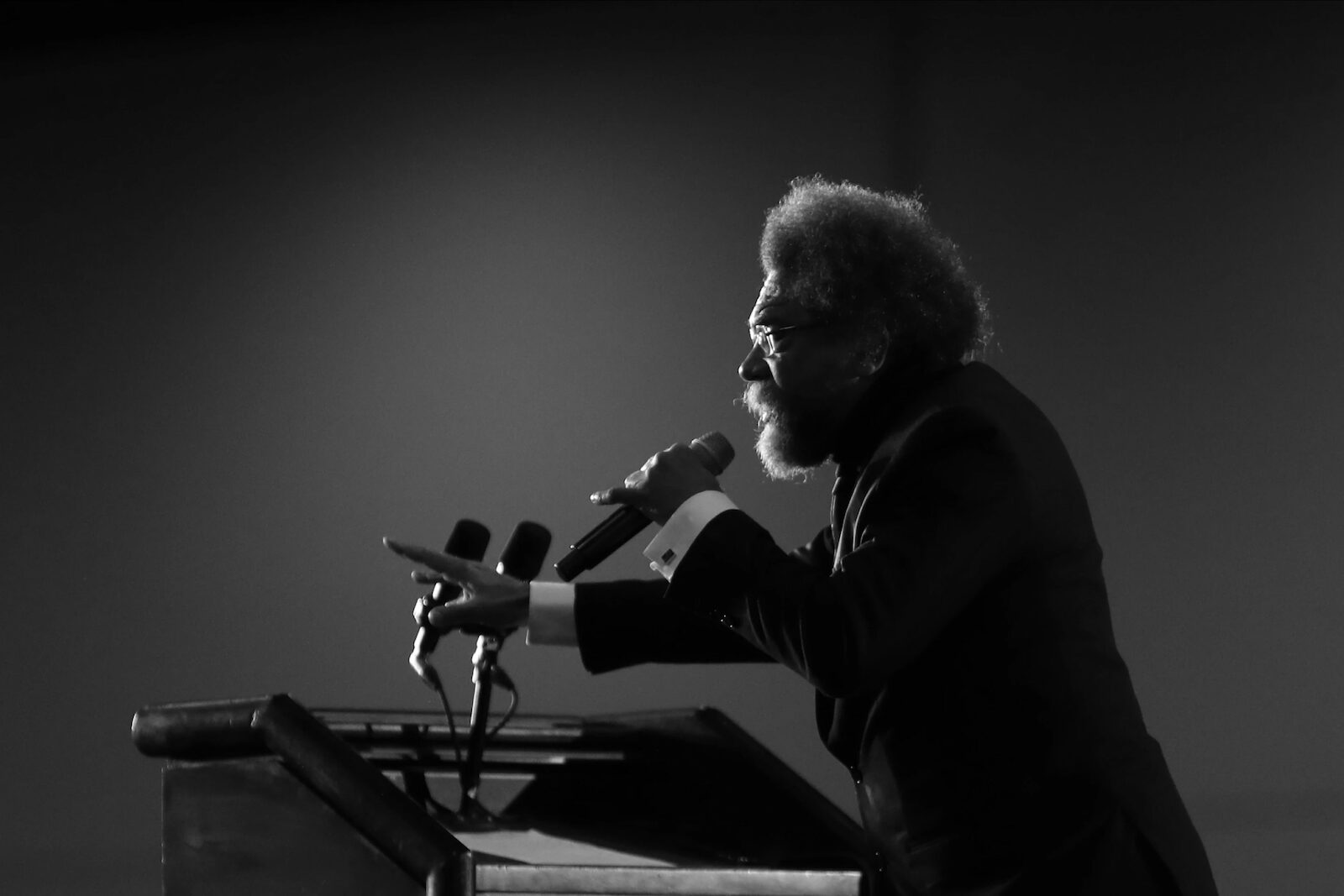
For admirers, that makes him a necessary witness. For critics, it makes him a man too entranced by the sound of moral emergency. Both camps, though, are responding to the same fact: Cornel West has spent decades making it impossible to talk seriously about race, democracy, and conscience in America without eventually running into his voice. Even when the country resists him, rolls its eyes at him, or decides he has overreached again, it still recognizes the outline. The hair, the baritone, the blues references, the prophetic warning, the insistence on love. Few intellectuals become instantly legible symbols. Fewer still remain substantively unavoidable after decades of public argument. West, for all the disorder and controversy, has done exactly that.
More great stories
Roy Wilkins and the Politics of Staying Power
April 7, 2026
No Comments
The Threads That Bind Sonya Clark
April 7, 2026
No Comments