



The revolt of 1712 was not a footnote to New York history. It was a revelation of what New York was.
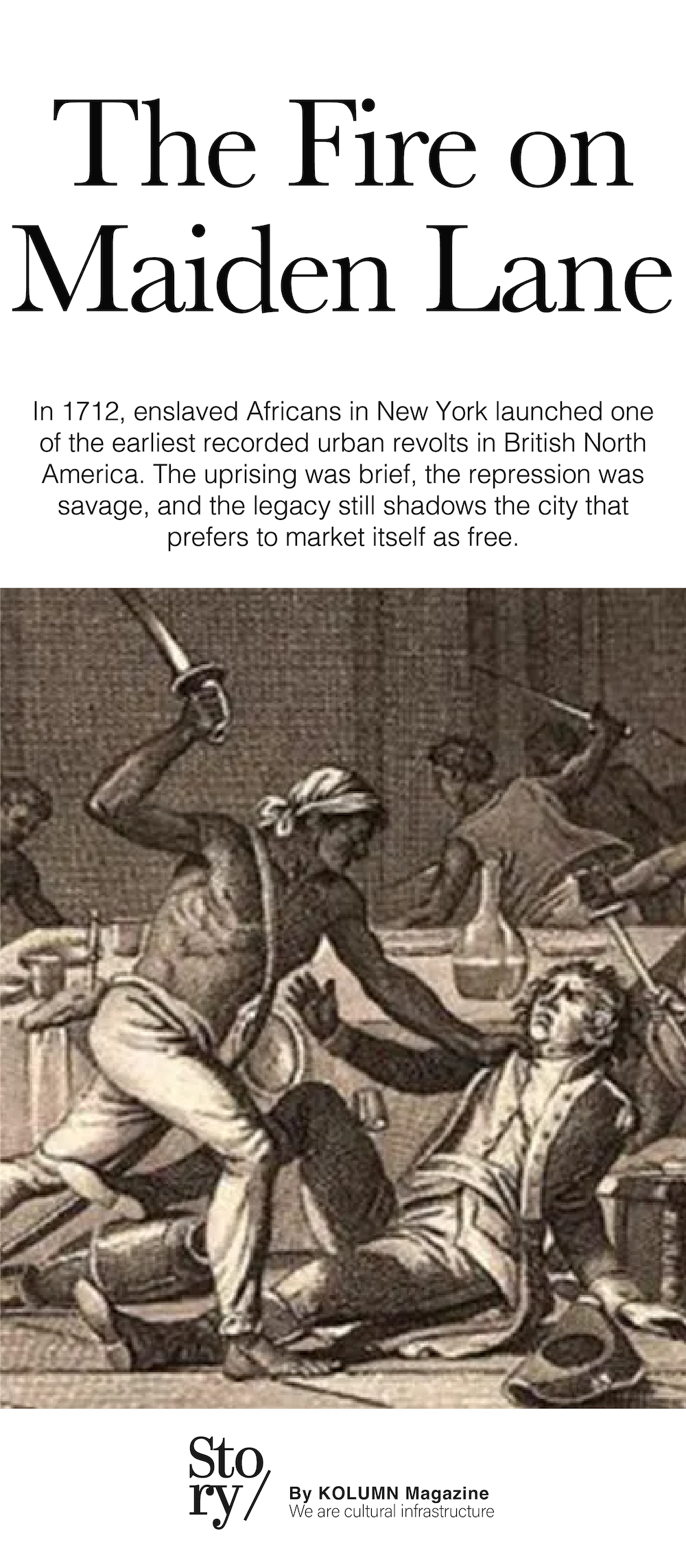
The revolt of 1712 was not a footnote to New York history. It was a revelation of what New York was.
By KOLUMN Magazine
There is a certain mythology New York loves to tell about itself. It is the city of reinvention, the city of immigrants, the city of hustle, the city that absorbs the world and somehow becomes more itself in the process. It sells a familiar story: restless, modern, pluralistic, free. But some of the oldest truths about New York do not fit comfortably inside that polished civic script. One of them is this: early New York was a slave city. Another is this: enslaved people in that city resisted. And on the night of April 6, 1712, that resistance exploded into one of the earliest recorded uprisings of enslaved Africans in British North America.
The New York Slave Revolt of 1712 does not occupy the same space in the public imagination as the Stono Rebellion or Nat Turner’s revolt. It is not as frequently taught, not as widely dramatized, and not nearly as woven into the standard national narrative. Yet that relative obscurity says more about how American history has been taught than it does about the event’s importance. The rebellion laid bare the realities of Northern slavery, shattered any illusion that New York’s prosperity was somehow separate from bondage, and triggered a fierce legal crackdown that tightened the machinery of racial control in the colony.
This is, in part, a story about an uprising. It is also a story about a city built on coerced labor, a governing class terrified by Black resistance, and a national memory that long treated slavery as a Southern drama with a Northern audience. If the revolt of 1712 still feels startling, that may be because so many Americans were taught to imagine colonial New York as commercial and cosmopolitan, but not as a place where slavery saturated civic life. The records, the archaeology, and the scholarship all say otherwise. By the early 18th century, New York City had a population of roughly 6,000 to 8,000 people, and about 1,000 of them were enslaved. In other words, slavery was not peripheral. It was central.
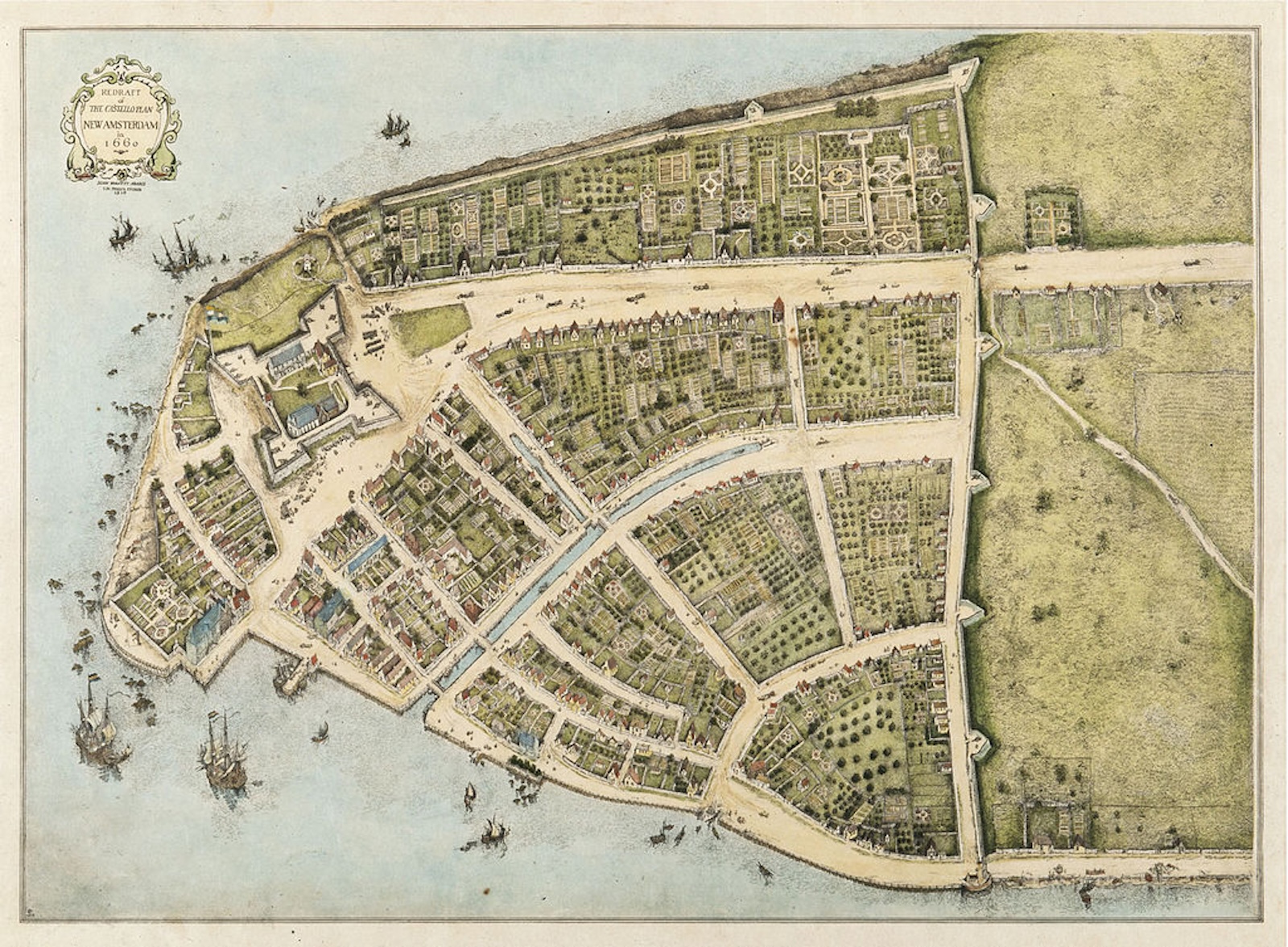
To understand the revolt, you have to begin with the city itself — not the New York of steel and glass, but the compact colonial settlement at the southern tip of Manhattan, where enslaved Africans and Indigenous people were bought, sold, rented, policed, and punished in plain view. A city-run slave market was established on Wall Street in 1711, just a year before the rebellion. That fact alone should rearrange the mental map of lower Manhattan. The financial district was not merely adjacent to slavery; it developed through it. Enslaved labor helped build roads, fortifications, and public works. The economy drew profit from slave trading, slave hiring, and the taxation of human beings.
A Northern Slave City
One of the most enduring distortions in American public memory is the idea that slavery belonged chiefly, or somehow naturally, to the South. That distortion has been stubborn partly because it flatters the North. It allows cities like New York to imagine themselves as eventual liberators without fully confronting how deeply they were enriched by slavery before abolition, and in many ways after. But the history is not coy about this. Africans arrived in New Amsterdam in the 17th century, and under both Dutch and later English rule, slavery became a defining feature of labor, property, and racial hierarchy in the colony. By the 1740s, as The Atlantic noted in its examination of Black Gotham, enslaved people made up about 21 percent of the city’s population.
Urban slavery in New York looked different from plantation slavery in the Chesapeake or the Carolinas, but “different” should not be confused with “milder.” Enslaved New Yorkers worked as domestic servants, dock workers, builders, artisans, cart drivers, and laborers. They lived in a densely packed city, often in proximity to one another, to free Black people, to poor whites, to merchants, and to the institutions of colonial government. That density mattered. It created surveillance, but it also created contact. News traveled. Grievances were shared. Plans could be made. Historians have long noted that one reason the 1712 revolt became possible was because enslaved people in New York, unlike many on dispersed plantations, were regularly in one another’s company.
The law, meanwhile, was moving in the opposite direction of any meaningful freedom. Under Dutch rule, some Africans in New Netherland had carved out limited rights, including in certain cases landholding and family formation. Under English rule after 1664, those rights steadily eroded. By the early 1700s, colonial lawmakers had constructed a more rigid regime of racial control through slave codes and local ordinances. Enslaved people could be required to carry passes, restricted in movement, discouraged from marrying, limited in gatherings, and segregated in religious spaces. Fear of Black congregation was not incidental to the system. It was one of the system’s organizing principles.
And fear, of course, was mutual. White colonists feared revolt. Enslaved Africans lived under the daily threat of sale, separation, corporal punishment, deprivation, and death. To call the 1712 uprising “violent” is factually correct, but incomplete. Slavery itself was an architecture of violence, legal and intimate at once. The revolt did not introduce violence into New York. It answered violence with violence. That distinction matters, especially in public discussions that instinctively frame slave rebellions through the language of disorder while treating slavery as background scenery.
The Night of the Revolt
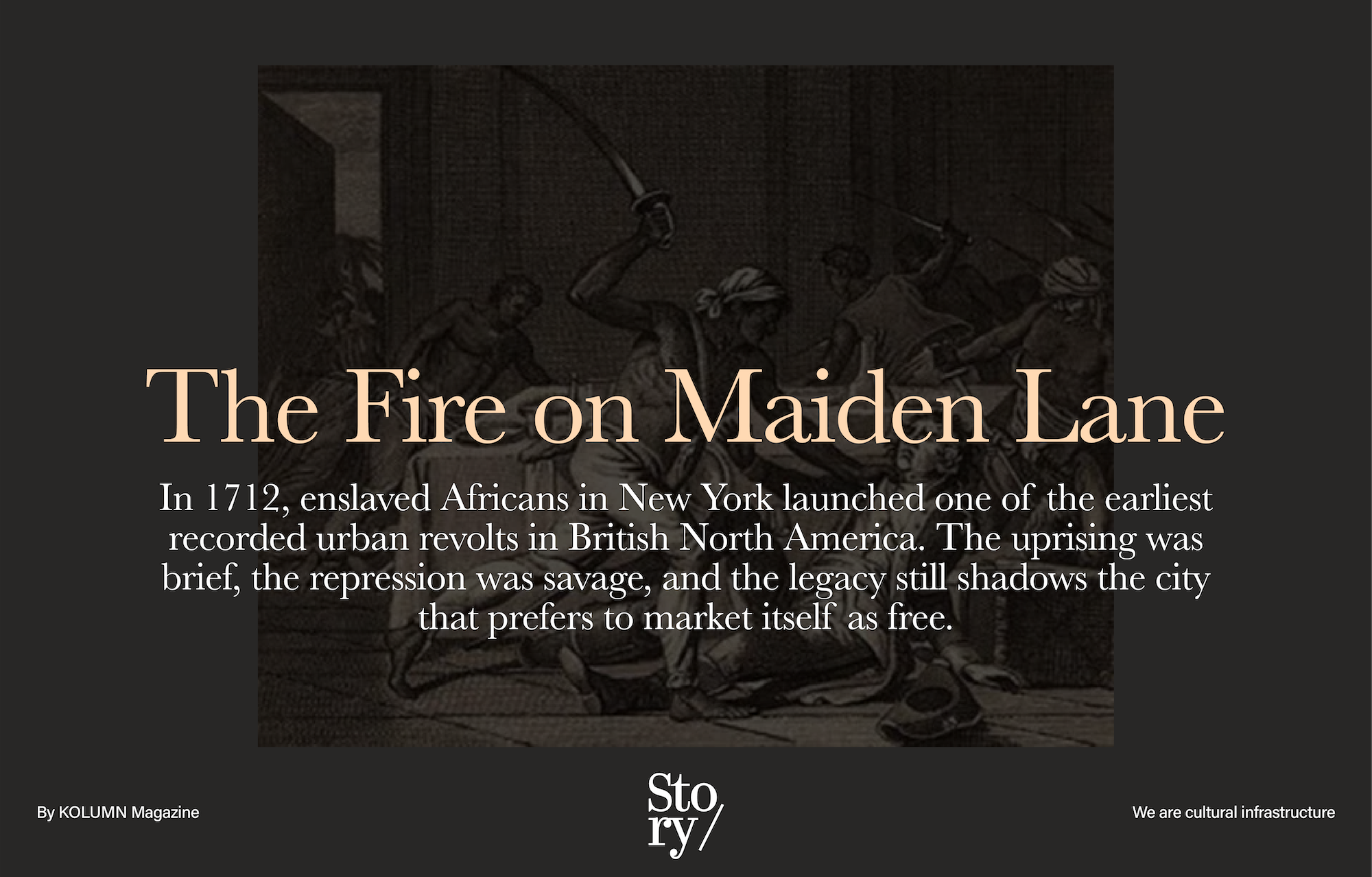
The broad outline of what happened on April 6, 1712, is well established, though some details vary across accounts. A group of more than 20 enslaved Africans — Britannica gives the figure as 23, while some other accounts cite higher estimates — gathered near Maiden Lane, then on the northern edge of the town. They set fire to a building or outbuilding, using the blaze as bait. As white residents rushed out to respond, the rebels, armed with guns, hatchets, swords, knives, and axes, attacked. At least nine white colonists were killed and several more wounded.
That tactical detail matters. The uprising was not random mayhem. It was planned. Fire, in a crowded wooden colonial city, was one of the surest ways to summon people into a confined zone of panic. The rebels used the city’s own vulnerabilities against it. The site itself — Maiden Lane near Broadway — is now embedded in lower Manhattan’s dense commercial geography, a place where modern commuters and tourists move through layers of memory they often do not see. Columbia’s mapping project on the site notes that the revolt began in an orchard along Maiden Lane, a space where enslaved Africans and two Native Americans are believed to have met to plan the rebellion.
“The rebellion was brief, but it destroyed the fantasy that the enslaved accepted their condition.”
Contemporary colonial accounts, including Governor Robert Hunter’s report, frame the event from the perspective of alarmed authority, but even through that lens one can detect the rebels’ resolve. Hunter described one enslaved man setting the fire and then rejoining the others, who marched armed toward the blaze. When townspeople approached, the rebels opened fire. The moment was short, but it was unmistakably insurgent: a collective strike against the racial order of the city.
Who, exactly, were the participants? The archive is thinner on their identities than it is on their punishment, which is itself telling. Colonial records often preserved Black people most meticulously when cataloging property, prosecution, or death. Some historians and reference works note that many of the rebels were likely African-born and possibly Akan or Coromantee, groups associated in English colonial records with military experience and organized resistance. Britannica notes that African-born enslaved people used African-based religious beliefs to encourage revolt and called for war on Christians. Whether one leans heavily on that interpretation or treats it more cautiously, the larger point stands: these were not abstract victims. They were people with political consciousness, communal ties, and enough strategic coordination to mount an armed attack in the center of a slave city.
For white New Yorkers, the psychological shock seems to have been profound. Part of that was numerical: a town of only several thousand people could feel the upheaval intimately. Part of it was spatial: this was not some distant plantation frontier but the city itself, near its homes and streets and public institutions. And part of it was ideological: enslaved people had not only resisted, but done so in a coordinated way that suggested planning, communication, and intention. That was exactly what slaveholding regimes feared most.
Retribution as Public Policy
The colonial response was swift and brutal. Militia forces and soldiers hunted down suspected participants. Reports say around 70 Black people were arrested, though not all were tried. Twenty-seven were ultimately brought to trial, and 21 were convicted and sentenced to death. Some accounts report that six people died by suicide after capture or before trial. What followed was not mere punishment. It was theater. Colonial authorities staged executions as a warning to the living.
The methods of execution were exceptionally savage. Britannica states that some were burned alive, one was crushed on a wheel, one was left hanging in chains until he starved, and a pregnant woman was executed after giving birth. The Guardian, in its broader account of the history of racial terror in America, cites the 1712 punishment in New York as an early example of spectacular, exemplary violence used to terrorize Black people. This is one of the grim continuities that link colonial slavery to later racial regimes: violence was not only punitive, it was communicative. It was designed to send a message.
That message was for enslaved people, but it was also for whites. Public punishment reassured slaveholders and lawmakers that the state was willing to defend the system with maximum ferocity. And because revolts expose the fragility of domination, slave regimes often answer rebellion by becoming even more totalizing. That is exactly what happened in New York after 1712. Lawmakers passed stricter codes limiting movement, assembly, firearm possession, and manumission. A 1712 law required owners seeking to free an enslaved person to post a £200 bond or security, a steep sum designed to discourage emancipation. The law also widened the latitude for punishment and narrowed the already precarious possibilities for Black autonomy.
This aftermath is one of the most important things to understand about the revolt. The uprising did not end slavery in New York. It intensified it. The colony’s answer to resistance was not reflection but repression. Enslaved people were more tightly watched, more severely regulated, and more firmly embedded in a legal order built on racial suspicion. Free Black people were also targeted by these measures, because slave societies rarely police only the enslaved. They police Blackness itself.
Yet to focus only on the retaliation would be to accept the colonists’ frame. The revolt also revealed something the authorities could not fully erase: slavery required relentless enforcement because the enslaved never simply consented to it. Resistance took many forms — slowdowns, flight, sabotage, kinship, mutual aid, cultural retention, theft, refusal — and armed rebellion was one of the most dangerous and visible of them. The revolt of 1712 announced, in the middle of Manhattan, that the city’s enslaved population understood bondage as a condition to be fought, not accommodated.
Why the Revolt Matters So Much
It would be easy, though wrong, to treat the 1712 uprising as significant merely because it came early. Yes, it was among the first major slave rebellions in British North America. But chronology is not the whole case for its importance. Its deeper significance lies in what it reveals about the North, about cities, and about the history of Black resistance in places often misremembered as marginal to slavery.
First, the revolt demolishes the comforting geography of American innocence. The popular map of slavery often casts the South as the engine and the North as the conscience. But colonial New York was deeply invested in slavery, and later New York remained deeply entangled in the broader Atlantic slave economy. The city’s merchants, insurers, shipbuilders, financiers, and political institutions all benefited, directly or indirectly, from systems built on African bondage. The 1711 slave market on Wall Street is not a historical curiosity. It is evidence that the city’s public life and commercial life were intertwined with the sale of human beings.
Second, the revolt complicates the plantation-centered narrative of American slavery. Much of the national iconography of slavery is rural: fields, overseers, large plantations, plantation houses. Those images are historically real, but incomplete. New York’s enslaved people lived in a dense urban world. They worked in households and workshops, on docks and roads, amid taverns, markets, churches, and government buildings. Their revolt shows that urban slavery was not incidental to the colonial order and that cities, too, were sites of organized Black insurgency.
Third, the event belongs in the lineage of Black political struggle. Too often, discussions of resistance begin with abolitionist petitioning or 19th-century reform movements, as though enslaved Africans first entered political history when they appealed to liberal conscience in legible written form. But rebellion is politics. Collective action against enslavement is politics. Armed refusal is politics. The people who rose in 1712 were not waiting for history to recognize them as actors; they acted.
There is also a historiographical reason the revolt matters. For generations, American education sanded down the edges of Northern slavery, and public culture often preferred stories of gradual progress to stories of coercion and revolt. That has changed in part because of scholarship, public history projects, archaeology, and the work of Black historians, archivists, artists, and local memory keepers. The African Burial Ground in lower Manhattan has been especially important in forcing a reckoning. The site, rediscovered during federal construction in the early 1990s, contains the remains of hundreds of Africans and African Americans and stands as the oldest and largest known excavated African burial ground in North America. It is material proof that African life — and death — are foundational to New York.
The City Above the Burial Ground
The rediscovery and memorialization of the African Burial Ground changed how many people understand New York’s colonial past. It is difficult to continue telling a clean story about the city once you have absorbed the fact that beneath lower Manhattan, beneath federal offices and traffic and routine bureaucratic life, lay the remains of a vast community whose labor built the place and whose humanity the city tried to bury twice — once in death, and again in memory.
That site is not the same as the 1712 rebellion, but the two histories speak to each other. Both force the same correction. Black New Yorkers were never marginal to the making of the city. They were central. Their labor shaped it. Their communities endured within it. Their suffering financed it. Their resistance unsettled it. The revolt, the burial ground, the Wall Street market, the later panic around the 1741 conspiracy — together these are not isolated curiosities. They are the architecture of colonial New York.
“Lower Manhattan is not just the geography of finance. It is also the geography of bondage, punishment, and refusal.”
The Atlantic’s reporting on Black Gotham captured the contemporary challenge well by placing readers on the actual streets where these histories unfolded: Wall Street, South Street, Federal Hall, the site of the 1712 uprising. That kind of mapping matters because New York’s physical density makes forgetting easy. Buildings disappear. Markets vanish. Burial grounds are covered. Financial districts rebrand themselves. But place still carries an argument. Lower Manhattan is not only a landscape of capital; it is also a landscape of enslavement and revolt.
And still, the city’s official memory has often been selective. New York is better now than it was decades ago at acknowledging slavery’s presence, but acknowledgment is not the same as integration. Many people can spend years in the city without ever learning that a municipal slave market once stood near Wall Street, that one in five New Yorkers in the mid-18th century was enslaved, or that enslaved Africans launched an uprising there in 1712. Historical literacy remains uneven, and public commemoration remains incomplete.
What the Archive Can and Cannot Tell Us
Writing about a revolt like this also means confronting archival imbalance. The people who left the most records were governors, judges, legislators, merchants, and chroniclers aligned with power. They recorded the rebellion because it threatened them. They counted arrests, described executions, and codified punishments. But they rarely preserved the rebels’ interior worlds in full. We know more about how colonial officials feared them than about how they named themselves. That is a familiar problem in the history of slavery: the archive is rich in domination and comparatively thin in subjectivity.
Still, even hostile archives yield clues. Planning implies trust. Coordinated arson implies strategy. Group action implies communication networks, however informal. The willingness to attack armed whites in a fortified colony implies either desperation, courage, or some combination of the two. The records of punishment imply how seriously the colonists took the threat. You do not burn, break, hang, and legislate with that intensity unless you understand that the revolt pierced something essential.
Modern scholarship has tried to fill these gaps not by romanticizing the revolt, but by situating it in the broader Atlantic world. New York was tied to Caribbean slavery, to Atlantic trade, to African diasporic cultures, to imperial warfare, and to shifting regimes of labor. Enslaved Africans brought memories, cosmologies, military knowledge, and social formations from the societies from which they had been violently taken. Colonial authorities recognized this, often in distorted and racialized terms, when they singled out certain African-born groups as especially “dangerous.” Even the panic in official writings tells us that the enslaved were seen not as inert labor units but as people capable of coordination, memory, and force.
There is also the matter of scale. Because the revolt involved a few dozen people rather than hundreds, some retellings shrink it. That would be a mistake. Scale has to be read relative to context. In a town of 6,000 to 8,000 residents, in a society built on surveillance and coercion, a coordinated armed uprising by 23 or more enslaved people was not small. It was seismic. It was large enough to kill multiple colonists, terrify the city, and reshape the legal order.
The Legacy We Inherited
So what, exactly, is the legacy of the New York Slave Revolt of 1712?
One legacy is legal. The revolt accelerated the tightening of slave codes in New York, showing how rebellion often produces a state response that expands surveillance, punishment, and racial control. The post-1712 laws restricted assembly, weapons, and movement while making manumission more difficult. That is one of slavery’s recurring patterns: each act of Black self-assertion is met with institutional reinforcement of white power.
Another legacy is historical. The revolt stands as direct evidence that enslaved Africans in colonial New York resisted not only through endurance but through organized force. That matters for how we narrate American freedom struggles. Black resistance did not begin in courtrooms, legislatures, or newspaper columns. It began wherever enslaved people decided that bondage was intolerable and acted accordingly. The revolt belongs in the same moral archive as marronage, sabotage, mutiny, petition, and abolitionism. It is part of a continuum, not an exception.
Its legacy is also mnemonic. The event challenges New York — and the nation — to remember itself more honestly. Modern New York often likes to present diversity as a brand attribute, a symbol of urban sophistication. But diversity without historical truth is just aesthetic management. The 1712 revolt insists that we face the fact that Black presence in the city was never merely decorative or demographic. It was coerced, exploited, creative, communal, and resistant. It shaped the city under duress.
And then there is the emotional legacy, which may be the hardest to quantify. Slave revolts unsettle people because they collapse sentimental readings of history. They do not allow us to talk about slavery only through suffering, which can sometimes be consumed passively. Revolt introduces agency, rage, tactical thought, risk, and moral confrontation. It asks readers to grapple not only with what was done to enslaved people, but with what enslaved people did in response. That shift can be clarifying. It can also be uncomfortable, especially in a national culture that still often prefers narratives of patience to narratives of resistance.
Telling the Story Without Sanitizing It
Any responsible account of the 1712 revolt must resist two temptations. The first is sanitization. The violence of slavery must not be softened, and neither should the violence of the repression that followed. People were burned alive. A woman was executed after childbirth. The law was sharpened to preserve bondage. These are not decorative details; they are the substance of the system.
The second temptation is flattening. The revolt should not be transformed into a simplistic parable of heroism stripped of complexity. We do not know every participant’s biography. We do not know every motive, every debate, every fear or hesitation. We do know that the people involved acted under a regime of enslavement so coercive that rebellion itself becomes legible as a profoundly human response. The point is not to force the event into myth, but to restore it to history with its urgency intact.
In that sense, the New York Slave Revolt of 1712 is not only an episode to be commemorated in April or inserted into a textbook sidebar. It is a lens. Through it, you can see New York differently. You can see Wall Street differently. You can see the African Burial Ground differently. You can see the long American habit of regional self-exoneration differently. And you can see resistance not as a dramatic exception to slavery, but as one of slavery’s constant companions.
The city today is very good at motion. It is less good at stillness, and worse at excavation. But some histories require both. To stand on Maiden Lane, or near the African Burial Ground, or near the old site of the Wall Street market, is to recognize that New York’s celebrated energy was built, in part, by people who were denied freedom and who fought back anyway. The revolt of 1712 did not topple slavery. It did something else just as enduring: it exposed the city’s foundations and left a record of refusal that still burns through the official story.
If New York wants to keep telling the truth about itself — not the brochure truth, but the harder one — then the revolt belongs near the center of the narrative. Not because it is convenient, and not because it flatters anybody, but because it names a reality the city can no longer afford to hide. Before New York became the city of ambition, it was a city of captivity. Before it was a symbol of American freedom, it was a place where human beings were sold by municipal policy. And before it learned to celebrate resilience in the abstract, enslaved Africans on Maiden Lane had already shown what resistance looked like when the odds were murderous and the world refused to recognize your humanity.
That is the significance of the New York Slave Revolt of 1712. It was an uprising, yes. But it was also a revelation. It revealed the violence of Northern slavery, the fragility of colonial control, and the permanence of Black resistance in the American story. New York has lived above that revelation for more than three centuries. The least it can do now is remember it in full.
More great stories
Samuel Wilbert Tucker and the Quiet Architecture of Freedom
April 6, 2026
No Comments
Bryan Stevenson and the Long Work of Repair
April 6, 2026
No Comments