


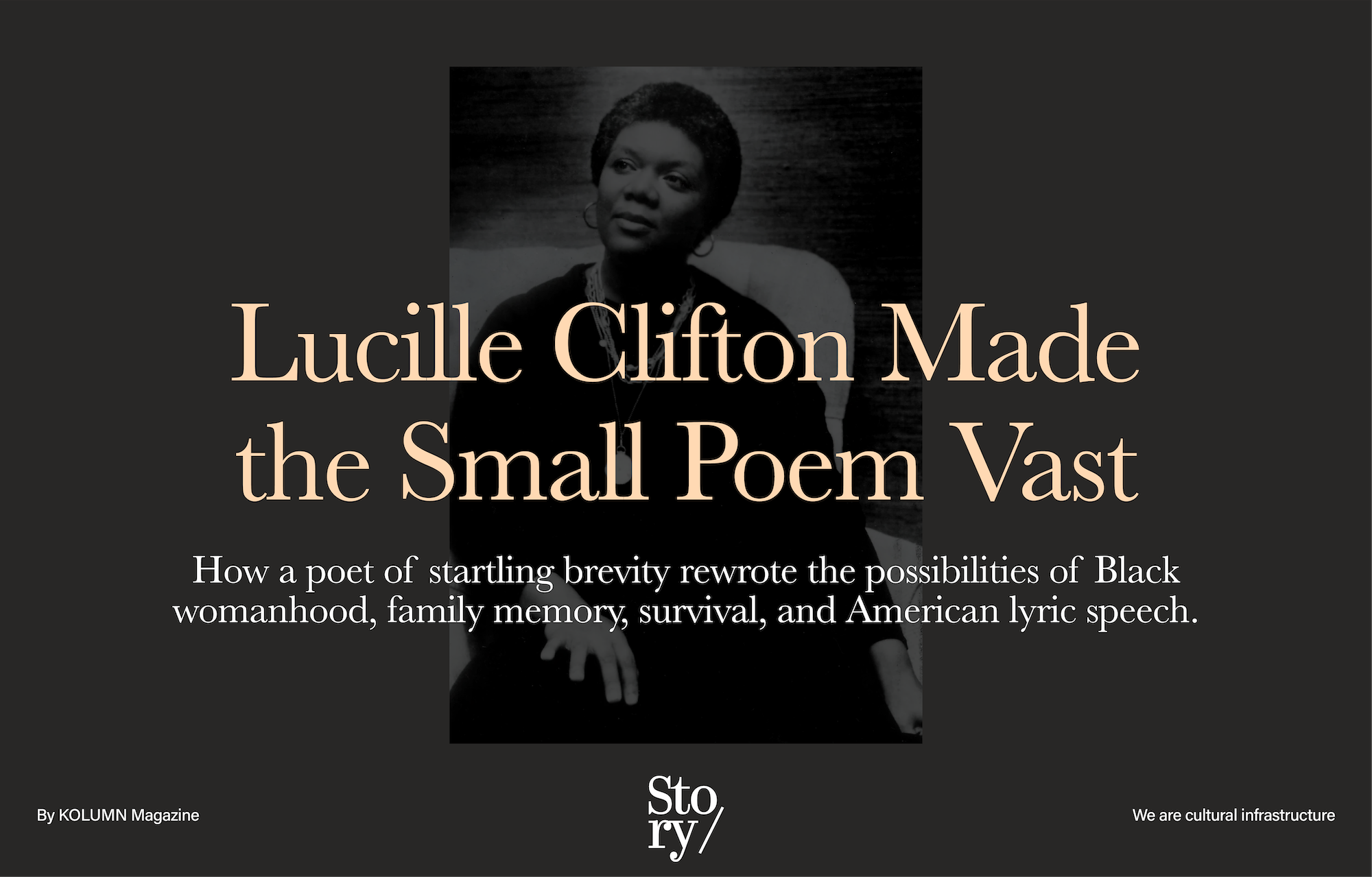
Lucille Clifton’s gift was not merely brevity. It was compression with consequence.
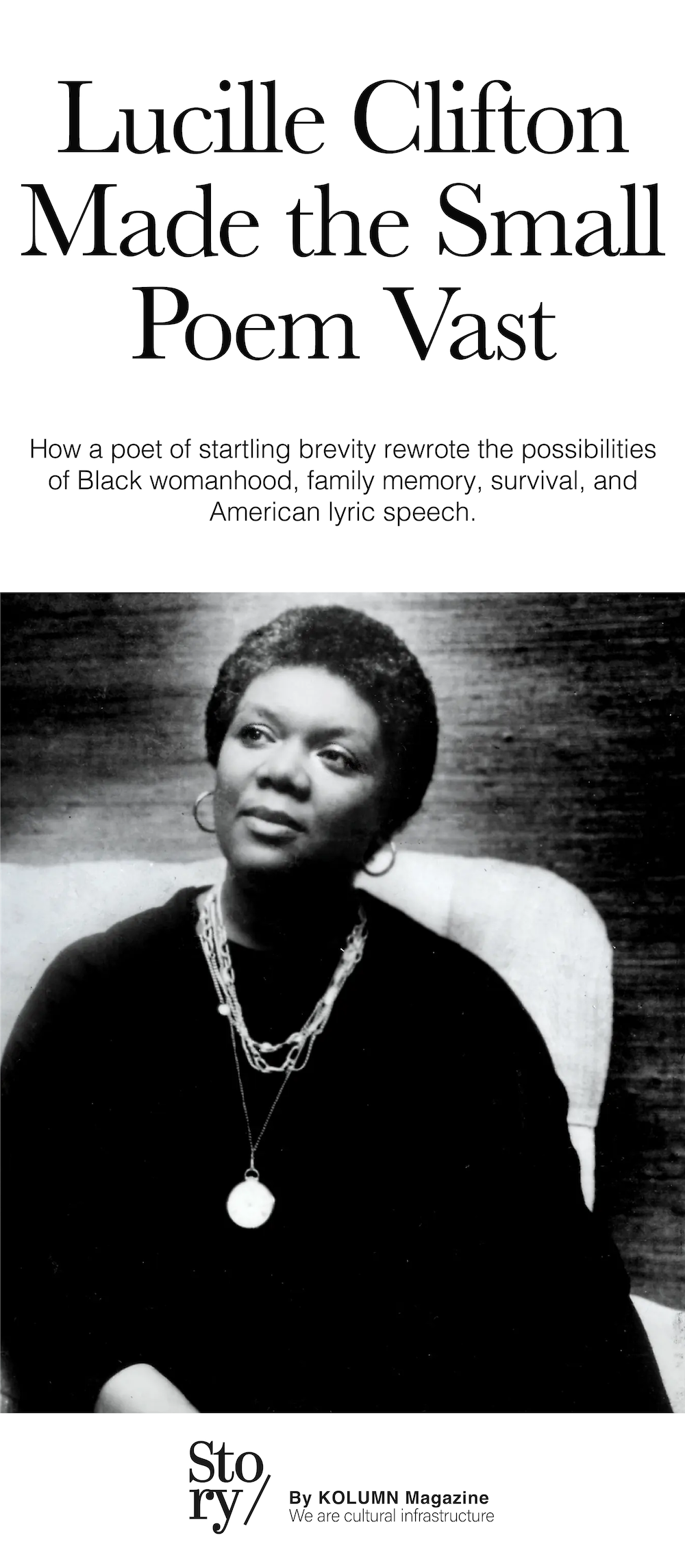
Lucille Clifton’s gift was not merely brevity. It was compression with consequence.
By KOLUMN Magazine
There are writers whose reputations rest on bigness: the maximalist novel, the grand theory, the public performance of genius. Then there was Lucille Clifton, who built one of the most durable bodies of work in American literature by moving in the opposite direction. Her poems were often brief. Their diction was plain. Their lines came stripped of ornament, usually without capitals, often without punctuation that would tell a reader exactly how to behave. Yet the apparent simplicity was a kind of trapdoor. Step onto one Clifton poem and you could find yourself falling through generations of Black history, the afterlife of enslavement, the private facts of a woman’s body, the metaphysics of survival, the comedy of family life, and the daily labor of continuing to live when the world has made that labor hard. Critics and institutions gradually caught up to what readers already knew: Clifton had made an art of compression so powerful that it altered the scale of American poetry itself.
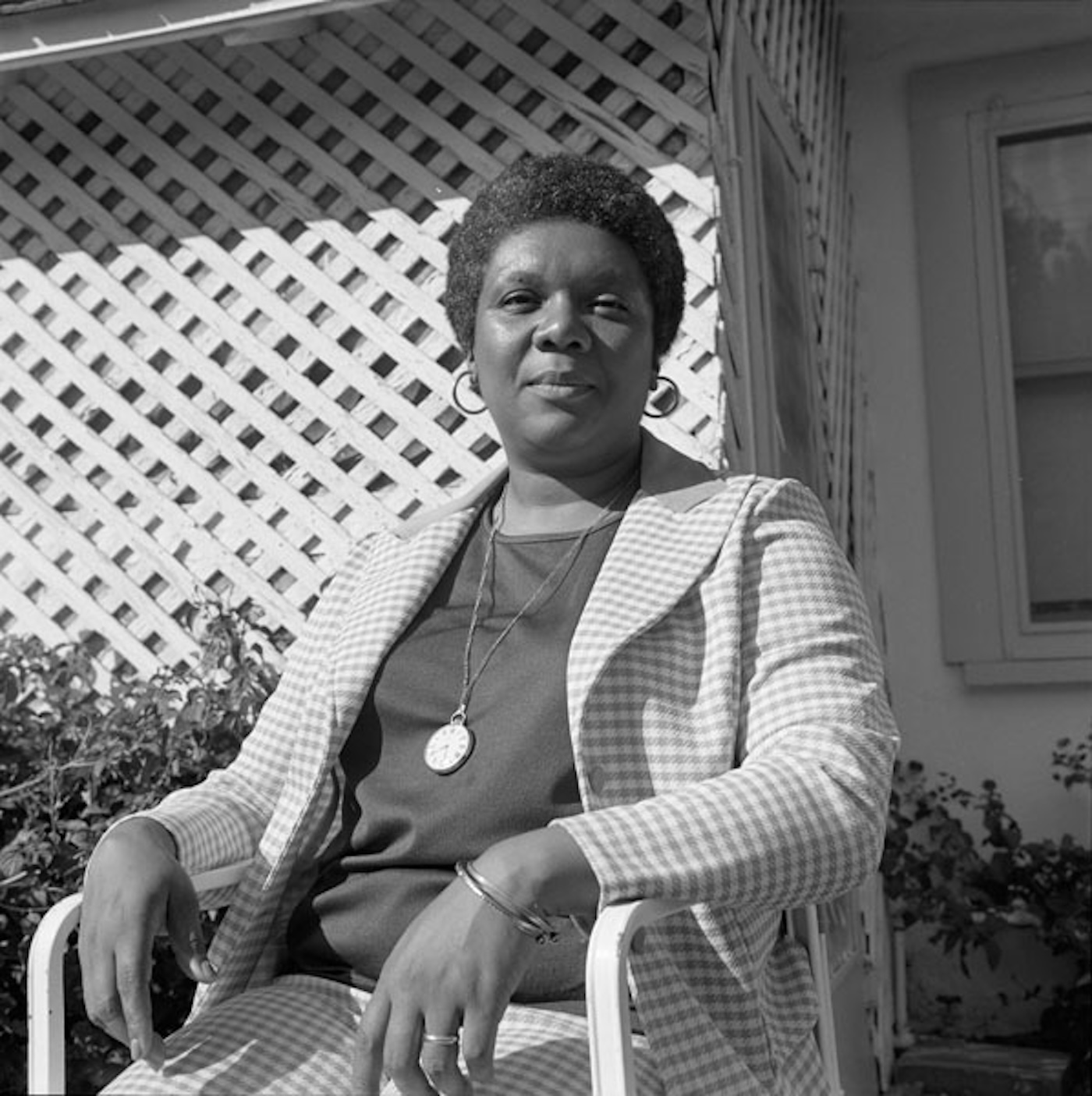
A Poet of Compression and Consequence
To write about Clifton is to write about range without losing sight of intimacy. She was born Thelma Lucille Sayles in Depew, New York, in 1936, and grew up in Buffalo. She attended Howard University before continuing at SUNY Fredonia. Her early life mattered not just because it supplied biographical detail, but because it formed the pressure system in which her work developed: a Black northern childhood, a family dense with story, the presence of migration and memory, and a household in which ancestry was not abstraction but living instruction. She would later trace family roots back to Dahomey, and that inherited sense of Black continuity became one of the enduring sources of her imagination. Even when Clifton wrote about the immediate and domestic, she rarely wrote as though any self existed alone. The poem, in her hands, was a room haunted in the best way—full of mothers, daughters, dead kin, future kin, and the difficult unfinished project called America.
One of the foundational stories in Clifton lore is also one of the most telling. Langston Hughes encountered her work through the novelist Ishmael Reed and helped bring it into broader view by including her poems in The Poetry of the Negro. The anecdote matters because it places Clifton in a lineage without reducing her to it. Hughes recognized something in her poems that American letters had not yet fully learned to value: directness without thinness, vernacular without diminishment, Black interiority without translation for a white gaze. Clifton did not arrive as a decorative addition to a tradition. She arrived as a writer who understood, very early, that the supposedly “small” lives of Black women contained the material for major literature. Her first collection, Good Times, appeared in 1969 and was named one of the year’s best books by The New York Times, an early signal that her voice was not marginal in any artistic sense, even if the culture was slow to center it.
The Power of Plain Speech
That distinction matters because Clifton has sometimes been praised in ways that almost miss the point. She is called accessible, and she is. She is called simple, and that is where the trouble starts. The plainspoken quality of her poems can make them look easier than they are. But Clifton’s work is not simple in the sense of intellectually or emotionally reduced. It is distilled. Her short lines and stripped-down syntax force an encounter with what cannot be evaded: blood, memory, fear, menstruation, miscarriage, children, slavery, desire, God, cancer, joy. As the Poetry Foundation notes, her signature style was brief, sharp, and unshowy, while still carrying mystery and resonance. The Guardian, in a much later reading of “here yet be dragons,” recognized that same moral density, describing the poem’s power to hold racism, misogyny, and militarism inside an apparently small verbal space. Clifton’s poems do not sprawl because they do not need to. They move like instruments built for exact pressure.
Clifton’s early books established many of the traits that would become central to her career: a refusal of literary fussiness, a devotion to Black speech rhythms, and a willingness to treat everyday life as worthy of lyric seriousness. But the everyday in Clifton is never merely anecdotal. In poem after poem, she took what dominant literature had either sentimentalized or ignored—Black motherhood, kitchen labor, neighborhood life, female embodiment, inherited struggle—and rendered it with an authority that did not ask to be let in. This was part of what made her so significant to the Black Arts era and beyond. She was not only writing amid movements for Black liberation and feminist transformation; she was helping expand the formal possibilities available to those movements. Her poems could be intimate without being private in the narrow sense. They could be political without becoming slogans. They could be funny, sensual, wounded, and spiritually inquisitive in the same breath.
Survival as a Poetic Grammar
A lot of Clifton’s seriousness about language seems to have come from her seriousness about survival. That does not mean every poem is grim. Far from it. Clifton could be sly, flirtatious, even mischievous on the page. But survival is the deep grammar of the work. The body survives. The family survives. Black people survive. Women survive the stories told about them. Sometimes the survival is triumphant; sometimes it is ragged, exhausted, furious. What Clifton refused was the false choice between dignity and candor. She wrote about abortion. She wrote about the aftershocks of sexual violence. She wrote about the indignities of illness. She wrote about breast cancer and dialysis. She wrote about the body as vulnerable matter and as a site of revelation. Few poets of her generation treated embodiment with such clarity. Fewer still did so with as little self-dramatization. Even when Clifton’s poems are devastating, they do not beg to be admired for their pain. They insist, instead, on being heard.
That insistence became more visible as her career advanced and institutions were forced to acknowledge what the poems had been doing all along. Clifton served as Maryland’s poet laureate from 1979 to 1985, becoming the first Black person and second woman to hold the post, according to Maryland state sources. She taught at a range of institutions, including Coppin State College, the University of California, Santa Cruz, Columbia University, and St. Mary’s College of Maryland, where she became Distinguished Professor of Humanities. Teaching mattered to her legacy not because it made her respectable, but because it extended the reach of her attention. Clifton belonged to that valuable class of writers who can make literature feel at once ancient and immediate. Students did not encounter her as a relic. They encountered a mind still actively wrestling with what it means to be alive in history.
Writing Black Life at Every Age
Her work for children is often mentioned after the poetry, almost as an addendum, but that understates its significance. Clifton wrote numerous children’s books, including the Everett Anderson series, which brought Black children and Black family life into literary visibility with warmth and specificity. In American publishing, that was and remains no small intervention. To write for children without flattening them, and to write Black children into the center of moral and imaginative life, was fully consistent with Clifton’s larger artistic project. She understood that representation is not only about inclusion in a numerical sense. It is about what kinds of feeling, grief, curiosity, and joy a culture allows children to recognize as their own. Her 1984 Coretta Scott King Award for Everett Anderson’s Good-bye reflected that contribution, but the larger point is broader: Clifton did not segregate literary seriousness from literature for the young. She wrote across forms because she understood that Black life required witness at every age.
Family, Labor, and the Shape of a Life
It is impossible to understand Clifton without understanding family as both subject and method. She married Fred James Clifton in 1958, and the two had six children before his death from cancer in 1984. The scale of domestic responsibility in her life is worth pausing over, not because it makes her achievements more inspirational in a generic way, but because it clarifies what her art was up against. American literary mythology has often romanticized the solitary genius, usually male, making work in splendid isolation. Clifton wrote from a life crowded by obligation, by care, by grief, by jobs, by bills, by children, by the unglamorous architecture of daily existence. That did not shrink the work. It sharpened it. You can feel, in many Clifton poems, a deep distrust of wasted motion. The poem knows time is limited. The line knows the stove is still on, the child still calling, the diagnosis still waiting. Her concision was aesthetic, yes. It was also practical, ethical, and existential.
The memoir Generations made explicit what had always been embedded in her poems: that personal history and collective history could not be neatly separated. Clifton’s writing continually returned to ancestors, especially Black women whose strength had been remembered in family speech before it was ever formalized in literary criticism. Her mother’s insistence on Dahomean roots became part myth, part inheritance, part political instruction. In Clifton’s work, lineage is not nostalgia. It is a living claim against erasure. This is one reason her poems retain such force for contemporary readers navigating debates around identity, memory, and belonging. Clifton was doing this work long before institutions developed the proper vocabulary for it. She understood that Black women’s stories had been systematically minimized, and she answered by writing them as cosmic fact. The body of a Black woman, in her poetry, is never just one body. It carries law, labor, pleasure, wound, rumor, myth, and the future.
Ancestry, Myth, and the Living Dead
That cosmic quality helps explain why Clifton can feel simultaneously grounded and uncanny. A kitchen in her work is a kitchen, but it can also be an altar. A family anecdote can become theology. A scar can become a portal. The Poetry Foundation has emphasized the mystical undertow in her poems, and that is exactly right. Clifton’s work is often realist on the level of language and surreal on the level of implication. She can move from the ordinary to the metaphysical without changing her voice. That is rare. Many poets sound different when they turn “serious” or “spiritual”; Clifton often sounds more like herself. Her art suggests that the mystical is not elsewhere. It is braided into the lived material of Black women’s lives, into the inherited intelligence required to keep going, into the knowledge that the dead are not done speaking just because official history stopped listening.
When institutions did honor her, they often did so by acknowledging how singular her achievement was. In 1988, she became the first author to have two books of poetry named finalists for the Pulitzer Prize in the same year: Good Woman: Poems and a Memoir and Next: New Poems. That distinction is not just trivia. It marks a moment when literary authority had to reckon with abundance. Clifton was not a one-book miracle or a niche writer beloved only by insiders. She had built a sustained, formally coherent, emotionally varied body of work that resisted every easy category. Then, in 2000, Blessing the Boats: New and Selected Poems 1988–2000 won the National Book Award for Poetry. The title itself feels like Clifton: benediction fused with motion, grace fused with danger. By then, her status as a major American poet was no longer arguable. The argument had shifted to something more interesting: how had the culture taken so long?
Recognition, Reputation, and Delay
The answer has something to do with the ways American literature has historically undervalued precision when it comes from Black women. Clifton did not perform difficulty in the approved academic mode. She did not write poems that depended on a reader’s admiration for their elaborate apparatus. Instead, she wrote poems that sounded like they had already passed through fire. That quality can be mistaken for ease, especially by critics trained to equate obscurity with depth. But Clifton’s depth is inseparable from her lucidity. She says the thing, and because she says it so cleanly, the reader cannot hide. Her best poems leave nowhere to retreat. That is why her work has lasted in classrooms, in anthologies, in sermons, in conversations among writers, and on social media, where lines from poems like “won’t you celebrate with me” continue to circulate as something more than inspiration. They circulate as compact philosophies of persistence.
Anger, Mercy, and Moral Precision
Clifton’s clarity also made room for anger. Not performative anger. Not fashionable anger. Real anger: anger at racism, misogyny, historical theft, bodily suffering, and the casual cruelties by which societies discipline the vulnerable. But anger is not the endpoint of her work. One of the reasons Clifton remains so widely loved is that she rarely mistakes rage for total knowledge. Even when she is furious, she is still curious about mercy, kinship, possibility, and the weird stubborn pulse of hope. The NEA’s reflection on her life correctly points to endurance and strength as central to her work, yet even those words can sound too polished if they are left alone. Clifton’s endurance is not clean. It sweats. It limps. It bleeds. It argues with God. It asks embarrassing questions. It remembers the dead. It keeps the joke alive at the hospital bedside. That is why the poems feel inhabited rather than merely admirable.
Her illness deepened rather than narrowed her art. Clifton underwent treatment for breast cancer and later dealt with kidney disease requiring dialysis; these experiences entered the poems without sentimentality. Here again, her significance exceeds biography. Clifton helped make space in American poetry for a Black woman’s medically marked body to speak in its own register. She was neither reduced to inspirational survivorship nor trapped inside elegiac suffering. The poems could be bitter, grateful, ironic, prayerful, or all four at once. That tonal complexity matters. Too often, literature about illness is received through ready-made scripts: bravery, tragedy, uplift. Clifton refused the script. She let contradiction stand. She let the body testify in multiple keys.
Sound, Breath, and the Engine of the Line
There is also the matter of sound. Because Clifton’s poems appear visually spare, readers sometimes miss how musically engineered they are. The line breaks do more than shorten the page; they control breath, delay, pressure, and revelation. Her syntax often works by withholding just enough connective tissue to make the reader participate in making sense. This is one reason her poems read so well aloud. The Library of Congress recordings preserve a great deal here. Hearing Clifton read, you notice how the poems refuse overstatement. She doesn’t oversell them because they do not need selling. Her delivery confirms what the page suggests: the authority comes from exact measure, from a trust that language can carry enormous weight without theatrical strain. In a literary culture often tempted by volume, Clifton practiced calibrated force.
The public record of Clifton’s later life also reveals another layer of her importance: she became, for many writers, a writer’s writer without becoming obscure to ordinary readers. That is a difficult balance to strike. The Atlantic, recommending Good Woman in 2023, described her oeuvre as singular and expansive, full of joy, grief, fury, and love. That formulation gets close to the key point. Clifton belongs to that small group of authors who seem to enlarge in relevance with every decade because the culture keeps generating new ways to need them. Readers concerned with reproductive autonomy find her. Readers looking for language about Black motherhood find her. Readers reckoning with cancer, aging, ancestry, migration, girlhood, apocalypse, and survival find her. She is a poet people return to not because she offers easy comfort, but because she can speak to crisis without surrendering beauty.
A Legacy That Keeps Expanding
Her death in February 2010, at age 73, prompted tributes that emphasized both her stature and her modesty. The Washington Post called her one of the most important and most popular poets of her time. The Guardian obituary stressed the directness and humor with which she wrote about the lives and survival skills of Black women, present and past. Those phrases still hold up. They also suggest the interesting split in Clifton’s public image: she could appear quiet, almost understated, while producing work that hit with enormous force. The cultural appetite for loudness can make it difficult to register this kind of authority. Clifton did not need to dominate a room in order to alter the terms of the conversation. She did it on the page, again and again, until the page itself looked different.
What, finally, is Lucille Clifton’s significance? It is tempting to answer by listing awards, posts, and publications. Those matter. But they are not the deepest measure. Her significance lies in what she made available. She made available a poetic language in which Black women’s lives were not supplemental but central. She made available a way of writing about the body that was unsentimental and spiritually alive at once. She made available a lyric intelligence that could hold history and intimacy without diluting either one. She made available forms of courage that did not depend on posing as invulnerable. And she made available, maybe above all, a model of literary seriousness that was not allergic to accessibility. Clifton proved that the plain style, in the hands of a master, can cut deeper than ornament ever could.
Why Clifton Still Feels Urgent
There is a reason younger writers and critics continue to find fresh vocabulary for her. Clifton’s work now sits at the crossroads of several ongoing conversations: Black feminist poetics, archival memory, disability and illness writing, ecopoetics, children’s literature, vernacular aesthetics, and the politics of brevity. Yet she is not reducible to any one framework. In academic terms, her work is generative because it keeps exceeding the method brought to explain it. In ordinary terms, the poems keep giving more than you thought they would. Read one in your twenties, and it might sound like permission. Read it in grief, and it becomes company. Read it after diagnosis, and it becomes witness. Read it in a season of political ugliness, and it becomes a stern little engine of moral attention. This is not accidental. Clifton wrote from an understanding that literature is one of the places where human beings rehearse how to remain human.
She wrote as though every line had to earn its life.
The phrase that may best describe Clifton is one she likely would have complicated: necessary. Necessary to American poetry, certainly. Necessary to the literature of Black womanhood, absolutely. Necessary to anyone who suspects that language can still clarify life rather than decorate it. But necessity, for Clifton, would never be merely institutional. She was not necessary because syllabi say so. She was necessary because she wrote toward the human predicament with unusual steadiness. Her poems know that life is comic and catastrophic, sacred and bodily, inherited and improvised. They know that suffering is real and so is delight. They know that history injures and that memory can answer back. They know that survival is not the same as justice, but they also know survival matters. That knowledge, pared down to line and breath, is what keeps Lucille Clifton current.
The Lasting Alteration
In one sense, Clifton’s achievement is easy to describe. She wrote poems, memoir, and children’s books of unusual beauty and consequence; she won major honors; she taught generations of students; she left a body of work that remains widely read. In another sense, description is the wrong scale. Lucille Clifton changed what many readers believe a poem can do. She showed that a poem could be compact without being slight, political without becoming inert, intimate without becoming confessional in the cheap sense, and spiritual without pretending to float above the body. She showed that Black women’s daily realities could generate not only social testimony but enduring art. And she showed that a writer can be humble in manner while being radical in effect. That is legacy in the strongest sense: not fame alone, but alteration. After Clifton, American poetry had fewer excuses for evasion.
The best way to end with Clifton is to resist ending too neatly. Her work does not encourage tidy closure. It encourages return. Return to the poem. Return to the ancestor. Return to the body, which remembers what ideology tries to forget. Return to the child. Return to the line. Return to the hard fact that so much tries to kill us, individually and collectively, and to the equally hard fact that people keep making language, kinship, music, and beauty anyway. Clifton understood that surviving is not the same as winning. She also understood that survival can be a form of witness, and witness a form of art. That understanding is all through her work. It is in the humor, the fury, the prayer, the tenderness, the stripped-down music. It is why Lucille Clifton remains not just a beloved poet, but an indispensable one.
More great stories

Bryan Stevenson and the Long Work of Repair
April 6, 2026
No Comments
The Fire on Maiden Lane
April 6, 2026
No Comments