





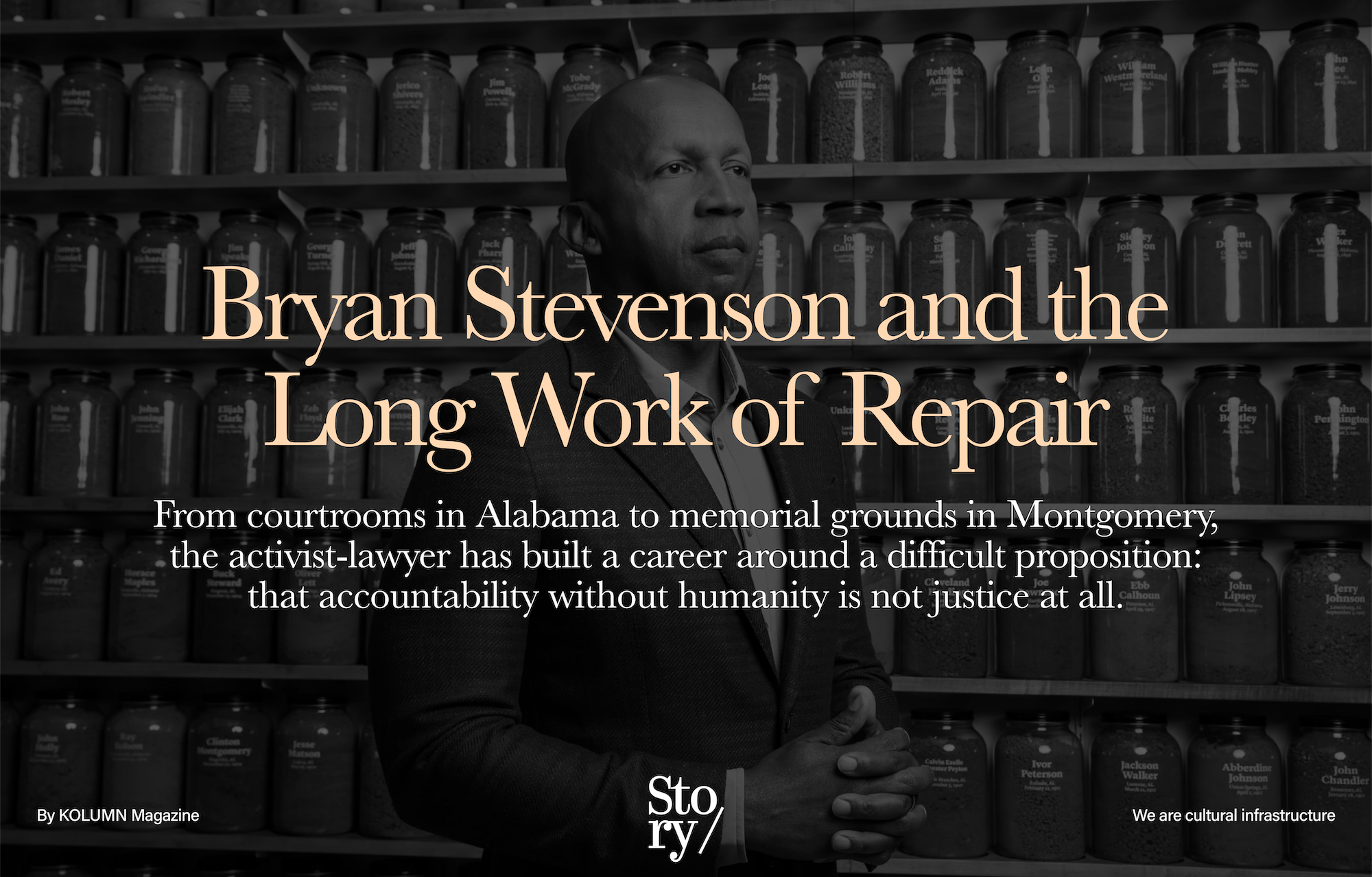
Each of us is more than the worst thing we’ve ever done.
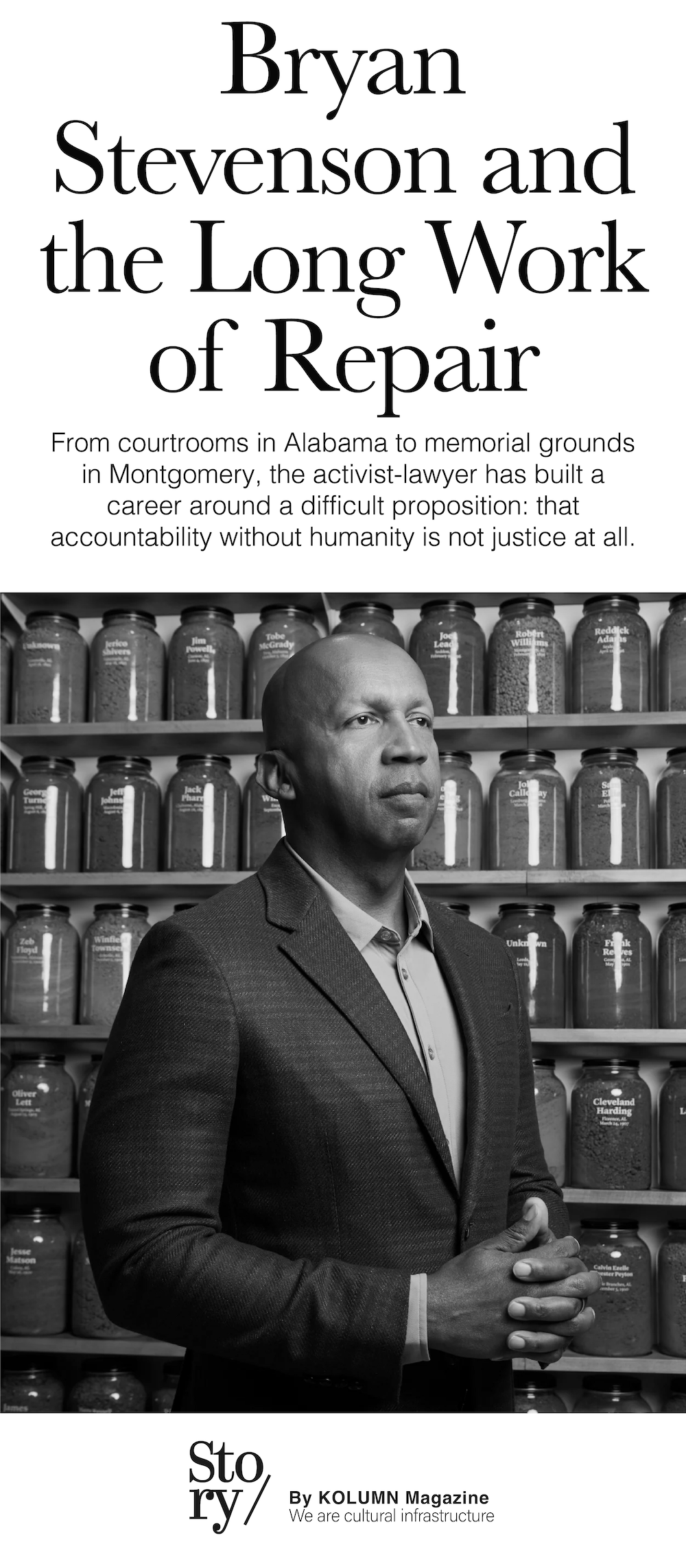
Each of us is more than the worst thing we’ve ever done.
By KOLUMN Magazine
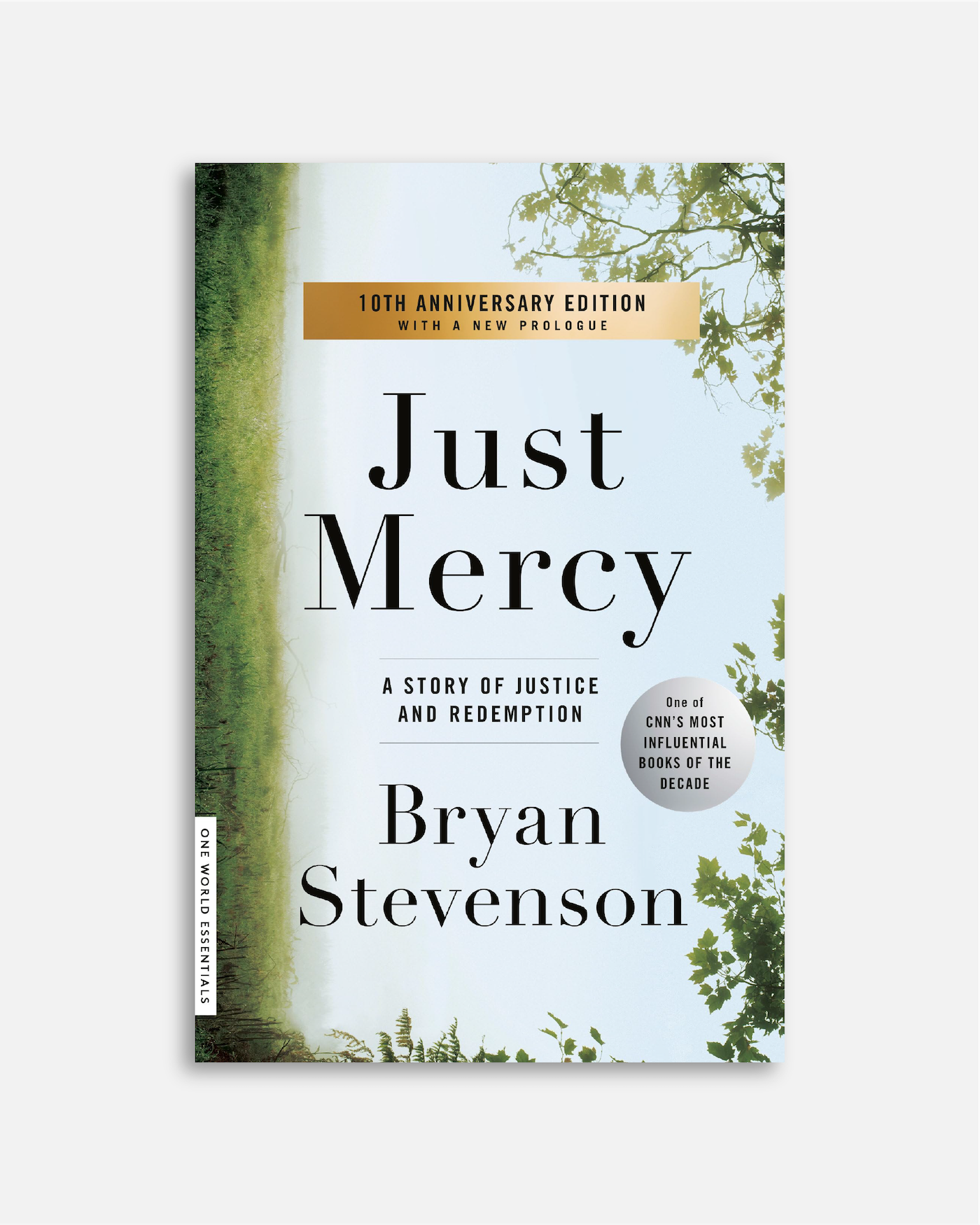
Bryan Stevenson occupies a rare place in American public life. He is, at once, a lawyer, a movement strategist, a public moralist, a memoirist, a teacher, and a builder of institutions. A lot of activists become known for a single campaign. A lot of public-interest lawyers become associated with a single case. Stevenson’s significance is larger than that. Over roughly four decades, he has changed legal doctrine, expanded the national vocabulary around mercy and punishment, helped expose how deeply race and poverty shape the American criminal legal system, and created some of the country’s most important public sites of historical memory. If many Americans first met him through Just Mercy, the bestselling 2014 memoir later adapted into a feature film, that book was really an introduction to a much broader project: forcing the United States to confront not only wrongful convictions and extreme sentences, but also the long afterlife of slavery, lynching, segregation, and mass incarceration.
Stevenson’s public stature can make his origin story sound almost inevitable, but it was not. He was born in 1959 in Milton, Delaware, and educated first at Eastern College, where he earned a bachelor’s degree in philosophy, and then at Harvard, where he completed both a J.D. and a master’s in public policy in 1985. Those credentials placed him within the conventional pipeline of elite American success. Yet his career took shape in the opposite direction: away from prestige for its own sake and toward the people most abandoned by the system. The official biographies that track his path emphasize that he has dedicated his work to “the poor, the incarcerated, and the condemned,” which is not just a résumé line but a precise description of the clientele that much of American politics has preferred not to see clearly, except as abstractions or threats.
Early Encounters With Injustice
That choice did not emerge in a vacuum. In interviews over the years, Stevenson has described being shaped by Black elders whose political imagination was grounded less in performance than in responsibility. One of the most important figures in his telling is Rosa Parks. Stevenson has often recalled meeting Parks and receiving from her not celebrity validation, but something more demanding: moral encouragement to keep going in hard work that few people wanted to do. He has also spoken about how personal encounters with police suspicion, and the larger humiliations of American racism, clarified for him that legal inequality was never merely technical. It was cultural. It was narrative. It was historical. And it was intimate. Even now, one reason Stevenson resonates across legal, civic, and educational spaces is that he almost never speaks about policy as if policy exists apart from lived experience.
He began practicing in the South in the mid-1980s, first as a staff attorney with the Southern Center for Human Rights in Atlanta. By 1989, he was leading what became the Equal Justice Initiative, based in Montgomery, Alabama. That location mattered. Alabama was not some neutral backdrop for a reform career; it was one of the hardest possible places from which to wage this kind of fight. The state’s courts, prosecutors, sentencing practices, and death-penalty machinery made it a crucible for the issues Stevenson cared about most. The Equal Justice Initiative began as a legal organization focused on indigent defense, capital cases, and the constitutional rights of the incarcerated. Under Stevenson’s leadership, it grew into something more expansive: a litigation shop, a research institution, a public-history engine, and a national voice against excessive punishment and racial hierarchy in the administration of law.
Building the Equal Justice Initiative
That line is probably Stevenson’s best-known formulation, and it explains a lot about his influence. It is not a sentimental slogan. It is a theory of justice. In Stevenson’s work, mercy is not the opposite of accountability; it is what makes accountability human rather than barbaric. That distinction has been central to his arguments against the death penalty, life-without-parole sentences for children, and the routine dehumanization of poor defendants and incarcerated people. His point has never been that harm is unreal or that victims do not matter. It is that a society reveals its ethical character not by how fiercely it punishes the easiest targets, but by whether it retains any capacity to recognize human dignity in people who are feared, despised, or politically disposable. The NEH’s citation for Stevenson’s National Humanities Medal captured this aspect of his public role unusually well, describing his work as a “moral call” to redeem the nation’s soul.
The Case That Changed the Conversation
The case most closely associated with Stevenson’s rise is that of Walter McMillian, a Black man wrongfully convicted and sentenced to death in Alabama for the murder of a white woman. Stevenson took McMillian’s case in post-conviction proceedings and uncovered perjured testimony, suppressed exculpatory evidence, and a prosecution riddled with misconduct. McMillian’s conviction was overturned, and he was released from death row in 1993 after six years imprisoned for a crime he did not commit. The facts of the case were so stark that they became emblematic: a Black man railroaded in the Deep South, in a death-penalty system polluted by race, pressure, and procedural indifference. But Stevenson’s handling of McMillian’s case mattered not only because he won. It mattered because he told the story in a way that made the system legible to a broader public. He translated legal failure into moral language without flattening the legal specifics. That ability would become one of his signature powers.
What emerged from cases like McMillian’s was not just an indictment of individual prosecutors or bad actors. Stevenson was building a larger critique of how American punishment works. His argument has been consistent: the harshest penalties in the United States are shaped less by the severity of crime in the abstract than by race, poverty, geography, and the value the system assigns to certain victims over others. In various interviews and public appearances, he has pointed to the racial skew of capital punishment and the vulnerability of poor defendants who cannot purchase effective representation. He has insisted that the system’s errors are not accidental glitches in an otherwise fair machine; they are recurring features of a structure that has long treated some communities as over-policed, under-protected, and readily sacrificed.
Children, Sentencing, and Constitutional Change
That framework helps explain why Stevenson’s litigation on behalf of children became so consequential. Through EJI, he helped lead the constitutional challenge to sentencing practices that treated adolescents as if they were fully formed adults, incapable of change and fit to die in prison. In Miller v. Alabama, the Supreme Court held in 2012 that mandatory life-without-parole sentences for people under 18 convicted of homicide are unconstitutional. The decision built on a broader recognition that children are developmentally different and that sentencing must account for youth, vulnerability, and capacity for rehabilitation. Stevenson’s public statements around that work were not merely doctrinal; they were civilizational. A decent society, he argued, cannot ignore the distinctive characteristics of childhood and still call itself just. In that sense, his juvenile-sentencing advocacy pushed the law toward a more developmentally informed and morally serious view of punishment.
Poverty, Power, and the Architecture of Inequality
That sentence is one reason Stevenson is often too narrowly described as an anti-death-penalty lawyer. He is that, certainly. But his core subject has always been the convergence of poverty and power. In Stevenson’s analysis, poor people enter the criminal legal system already carrying a deficit of credibility, resources, and protection. They are more likely to be overcharged, underdefended, and punished with severity that wealthier defendants can often evade. This is one reason he has repeatedly framed criminal-justice reform as inseparable from anti-poverty work. The point is not only that poverty correlates with incarceration. It is that American law often treats poverty itself as evidence of disposability. Stevenson’s career has therefore moved along multiple tracks at once: direct representation, sentencing reform, prison conditions, race discrimination, and what he describes as major anti-poverty and anti-discrimination efforts.
Storytelling as Strategy
He is also a gifted tactician of public narrative. Before many institutions had fully embraced the language of storytelling as strategy, Stevenson understood that facts alone were not enough. He has urged audiences to get “proximate” to suffering, to challenge the narratives that legitimate inequality, to stay hopeful, and to do uncomfortable things in pursuit of justice. The language is accessible, but the method is sophisticated. Proximity, in Stevenson’s model, is not just empathy. It is epistemology. You do not understand punishment by reading aggregate tables alone; you understand it by sitting with people on death row, by visiting prisons, by hearing from families, by learning how trauma and deprivation shape conduct, and by tracing the historical line from past terror to present policy. The brilliance of Stevenson’s rhetorical style is that he can make this framework sound like common sense while quietly reordering the audience’s moral premises.
That narrative gift reached a mass audience through Just Mercy. Published in 2014, the memoir blended legal storytelling, personal witness, moral argument, and structural critique with unusual fluency. The book’s success was not accidental. Stevenson wrote in a register that made complex constitutional and procedural issues emotionally legible without diluting them into cliché. He showed readers the terror of death-row litigation, the fragility of innocence in a biased system, and the spiritual cost of abandoning whole categories of people. When the film adaptation arrived in 2019, with Michael B. Jordan portraying Stevenson and Jamie Foxx portraying McMillian, the story reached an even broader public. Popularization can flatten radical work, but in Stevenson’s case it mostly amplified it. The memoir and film helped pull terms like mercy, wrongful conviction, extreme sentencing, and racialized punishment into mainstream conversation.
Memory as a Form of Justice
If the first act of Stevenson’s public life was centered on the courtroom, the next act expanded onto physical landscape. In Montgomery, EJI created the Legacy Museum and the National Memorial for Peace and Justice, which opened in 2018, followed by the Freedom Monument Sculpture Park, which opened in 2024. These are not side projects or branding exercises. They are central to Stevenson’s argument that the United States cannot repair what it refuses to remember honestly. The National Memorial for Peace and Justice is the nation’s first memorial dedicated to victims of racial terror lynchings. The site documents thousands of lynchings and connects that era of racial terror to segregation, contemporary violence, and the modern punishment state. The Freedom Monument Sculpture Park broadens the scope further, centering the lives of enslaved people and the vast system that commodified them. Stevenson’s insight here is that legal reform without historical truth-telling remains shallow. A nation that misremembers its past will misdiagnose its present.
The Montgomery sites are among Stevenson’s most important achievements precisely because they do not ask visitors merely to learn information. They ask visitors to situate themselves. The memorial’s design, the naming of counties, the material weight of the hanging steel columns, the riverfront setting of the sculpture park, and the insistence on local reckoning all turn history into encounter. That has helped make the sites critically important not just to tourists or museumgoers, but to educators, artists, clergy, descendants, and local communities trying to tell fuller truths about racial violence. The broader effect has been to move Stevenson from the role of lawyer-advocate into that of civic architect. He has been building not only arguments, but spaces in which Americans are compelled to reckon with what kind of country they have inherited.
Hope as a Discipline
“Hopelessness is the enemy of justice.”
That phrase captures another essential feature of Stevenson’s significance: he is an activist of disciplined hope rather than naïve optimism. He has spent enough time in prisons, courtrooms, and counties marked by racial terror to know better than to confuse progress with inevitability. Hope, in his framework, is a practice of resistance against the deadening logic that says people and systems cannot change. It is one reason his work has appealed to audiences far beyond the bar and the academy. He is not selling easy redemption. He is insisting that despair is politically useful to unjust systems because despair persuades people to accept cruelty as permanent. Stevenson’s moral style, then, is not merely compassionate. It is insurgent. It asks whether a democracy can become more decent if it gives up the habit of imagining whole groups of people as irredeemable.
The Weight of Critique and the Scale of Impact
Even so, a serious assessment of Stevenson has to note that admiration is not the same thing as unanimity. His abolitionist stance on the death penalty remains contested in American politics, especially among officials and commentators who frame capital punishment as necessary retribution or a guarantor of safety. More subtly, the memory work associated with the Legacy Sites has prompted discussion among critics and scholars about how public art and memorialization should represent racial violence without aestheticizing it or turning pain into a consumable experience. Some writers have praised the memorial’s restraint and refusal of spectacle; others have warned more generally that even the best remembrance projects risk becoming cultural experiences that viewers pass through without materially altering their commitments. Those debates do not diminish Stevenson’s achievement. They underline its seriousness. He has moved questions once treated as marginal—Who gets mercy? Who gets remembered? What is the relationship between history and punishment?—into the center of civic argument.
There is also the matter of scale. Stevenson is often described as a singular figure, and in one sense that is true: few public lawyers have combined litigation, institution-building, moral suasion, historical interpretation, and popular communication as effectively as he has. But the language of singularity can obscure something Stevenson himself usually emphasizes, which is that justice work is collective. EJI’s victories have depended on clients, families, investigators, organizers, staff lawyers, historians, artists, community partners, and local descendants willing to revisit painful pasts. The community-remembrance work tied to the lynching memorial, for example, has involved coalitions around the country gathering soil, erecting markers, and restoring names to people long erased from public memory. If Stevenson stands at the center of this story, he also continually points outward. That is part of why he has remained influential: he understands charisma as useful only when it enlarges a public, not when it narrows one around a single hero.
A Legacy Still Unfolding
His honors reflect how wide that influence has become. Stevenson received a MacArthur Fellowship in 1995, long before much of the country knew his name, and later the National Humanities Medal, an acknowledgment that his work has shaped not just law and policy but the nation’s understanding of itself. That second recognition is especially telling. The humanities medal is not a prize for litigating a case well. It is an award for deepening public understanding of the human experience. Stevenson has done that by collapsing the artificial boundary between legal history and national history. He has argued, in effect, that you cannot understand American democracy without understanding whom it has punished, excluded, and disappeared. And he has made that argument not only in books and speeches, but through physical places that millions of people can visit and through legal interventions that changed actual lives.
In the current American climate, that body of work feels even more consequential. Battles over curriculum, public memory, policing, incarceration, and the meaning of race in national life have only intensified. Stevenson’s relevance persists because he never treated those as separate arenas. Long before “narrative change” became institutional shorthand, he understood that historical amnesia licenses contemporary injustice. Long before every foundation and newsroom began talking about storytelling, he knew that stories could either humanize the condemned or disappear them. Long before much of mainstream culture found itself debating structural racism in earnest, he had already spent decades tracing the institutional links between slavery, lynching, segregation, and mass incarceration. His work looks prescient now because he was reading the country at a deeper level than many of its official interpreters were willing to go.
What, finally, is Bryan Stevenson’s significance? It is partly legal. He helped alter the constitutional landscape around juvenile sentencing and helped free people whose convictions exposed the system’s indifference to truth. It is partly literary and rhetorical. He gave millions of readers a language through which to think about mercy, punishment, and human worth. It is partly institutional. He built the Equal Justice Initiative into one of the most formidable justice organizations in the country. And it is partly historical. He has insisted, with uncommon persistence, that America cannot become more just without becoming more honest. That may be his most enduring contribution. Stevenson has spent his career refusing the convenient lie that cruelty belongs only to the past, or only to other places, or only to obviously monstrous people. He keeps returning the nation to a harder proposition: justice begins when we tell the truth about who we have been, who we have harmed, and who we still might become.
More great stories
Samuel Wilbert Tucker and the Quiet Architecture of Freedom
April 6, 2026
No Comments
The Fire on Maiden Lane
April 6, 2026
No Comments