




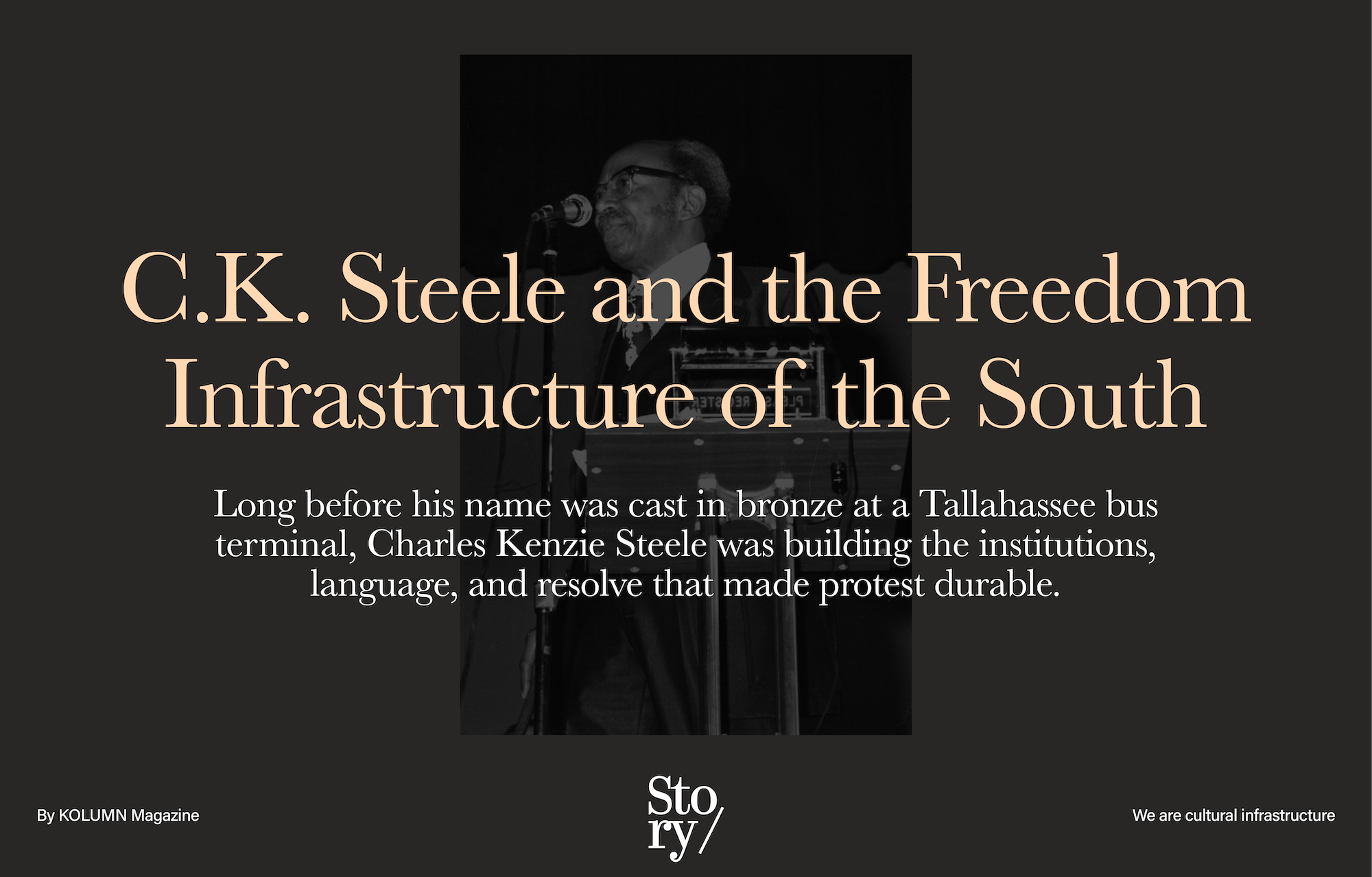
Charles Kenzie Steele helped turn protest into infrastructure—and infrastructure into freedom work.
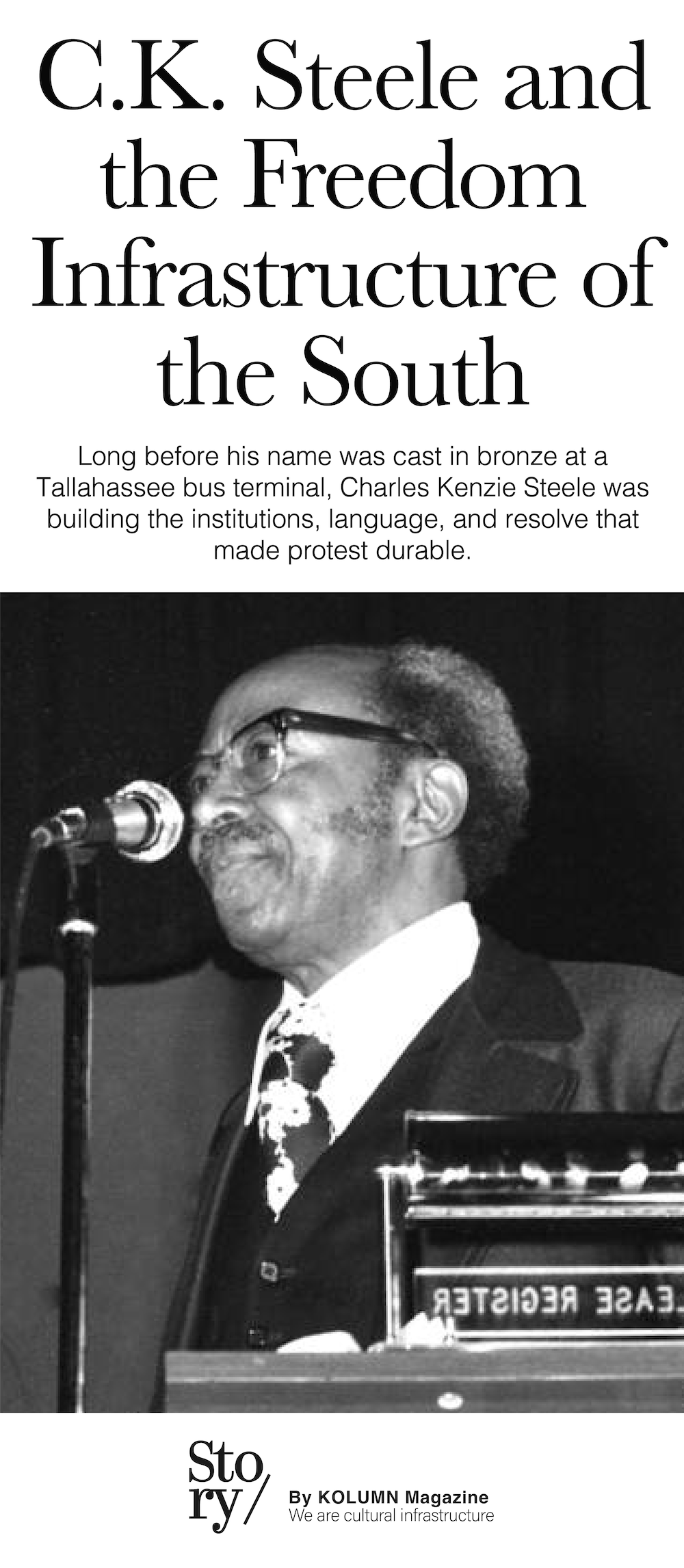
Charles Kenzie Steele helped turn protest into infrastructure—and infrastructure into freedom work.
By KOLUMN Magazine
Charles Kenzie Steele occupies a particular kind of place in American history: central to the story, but too often placed at its margins. He was not as mythologized as Martin Luther King Jr., not as relentlessly memorialized as Rosa Parks, and not as regularly taught in broad national survey courses as some of his contemporaries. Yet when you begin tracing the circuitry of the modern civil rights movement—how local protest became regional strategy, how church leadership became political infrastructure, how a boycott became a template rather than a one-off event—you keep running into Steele. He was there in Tallahassee. He was there in the formation of the Southern Christian Leadership Conference. He was there in the work of translating righteous anger into organized nonviolent pressure.
That matters because the civil rights movement was never only the story of its most famous faces. It was also the story of the people who made movements legible, durable, and governable from the ground up. Steele belonged to that tier of leadership: pastors who were also tacticians, community figures who were also institutional builders, men and women who understood that protest needed both moral force and administrative discipline. In Steele’s case, that meant helping lead the 1956 Tallahassee bus boycott, serving as a key ally and colleague of King, and continuing the work of desegregation and civic pressure in Florida and beyond well after the first burst of national attention had moved on.
His significance, then, is larger than biography. To write about Charles Kenzie Steele is to write about the connective tissue of the Black freedom struggle. He reveals how movements function when they are healthy: they draw on existing institutions, especially churches; they rely on trusted local leadership; they adapt tactics from one city to another; they survive intimidation through discipline; and they keep going after the headlines thin out. Steele’s life is not only the story of one minister-activist. It is a case study in how Black political endurance worked in the middle of the twentieth century.
A West Virginia beginning, a pulpit calling
Steele was born on February 17, 1914, in Bluefield, West Virginia, and was raised in Gary, a coal town whose Black community gave him an early sense of racial solidarity, collective life, and spiritual formation. Multiple biographical accounts note that he felt called to preach at a young age and began preaching in his teens, long before his public role as a civil rights leader took shape. That early religious seriousness is not incidental trivia. In the Black South and border South of Steele’s generation, the ministry was not simply a private vocation. It was often the route into public speech, moral authority, and organizational leadership.
He attended Morehouse College and graduated in 1938, part of a tradition of Black intellectual and ministerial formation that linked education, theology, and racial uplift. Morehouse mattered not just because it produced prominent graduates, but because it nurtured a style of leadership that assumed educated Black clergy had obligations beyond the church walls. Steele’s later life bears that imprint. He was not merely a preacher who happened to protest. He was a preacher formed in an institutional tradition that understood ministry as civic obligation.
After college, Steele served congregations in Georgia and Alabama, including a pastorate in Montgomery before moving to Tallahassee in 1952 to lead Bethel Missionary Baptist Church. That move would prove decisive. Tallahassee in the early 1950s was a city defined by Jim Crow rules, a growing Black middle class, and the presence of Florida A&M University—a combination that made it fertile terrain for organized resistance. At Bethel, Steele inherited more than a congregation. He stepped into a civic platform. His church would become one of the key staging grounds of local protest, mass meetings, and strategic planning.
The pastoral role also gave Steele a style that distinguished him. By every credible account, he was forceful without theatrics, disciplined without being cold, and deeply committed to nonviolence as both an ethical principle and a practical strategy. Stanford’s King Institute notes that he shared King’s vision of social equality through nonviolent means, while Florida’s civil-rights institutions consistently describe him as a central architect of peaceful but firm protest. That combination—moral seriousness and operational clarity—would become the hallmark of his public life.
Tallahassee, 1956
The Tallahassee bus boycott began after the arrest of two Florida A&M students, Wilhemina Jakes and Carrie Patterson, in May 1956. Their refusal to surrender their seats ignited a protest that spread rapidly through the student body and then into the wider Black community. Florida State University’s historical materials and Florida Memory both make clear that this was a movement sparked by students but sustained by broader Black institutions. Steele did not create the initial incident, and that is important. He helped turn a flashpoint into a campaign.
That distinction says a lot about how the civil rights movement actually functioned. Contrary to the simplified versions often taught in popular culture, these movements were rarely born fully formed from one dramatic act. They emerged through a chain reaction: students or everyday citizens defied custom; churches and civic groups provided legitimacy and coordination; local leaders imposed structure; then the movement either deepened or dissolved. In Tallahassee, Steele was among the figures who ensured it deepened. He helped organize the Inter-Civic Council, or ICC, which became the boycott’s managerial engine.
The ICC was not glamorous. It was essential. It coordinated demands, communication, discipline, and transportation alternatives. It was modeled in part on the Montgomery Improvement Association, reflecting the intimate connection between Montgomery and Tallahassee. Stanford’s King Institute and FSU historical materials both note that Tallahassee organizers consciously learned from the Montgomery example, using car pools and mass meetings to sustain the boycott. That is one of Steele’s major historical roles: he was part of the process by which protest tactics became transferable civic technology across the South.
The demands the ICC advanced were telling. On May 30, 1956, Steele and Tallahassee’s Inter-Civic Council met with city officials and called for first-come, first-served seating, more courteous treatment of Black riders, and the hiring of Black bus drivers. Those demands reveal the movement in transition. This was not yet always a maximalist public language of total transformation. It was a tactical approach that addressed immediate humiliations while pushing directly against the architecture of segregation. Steele understood, as many movement leaders did, that campaigns sometimes begin where people can gather the broadest discipline and momentum.
The courage behind the calm
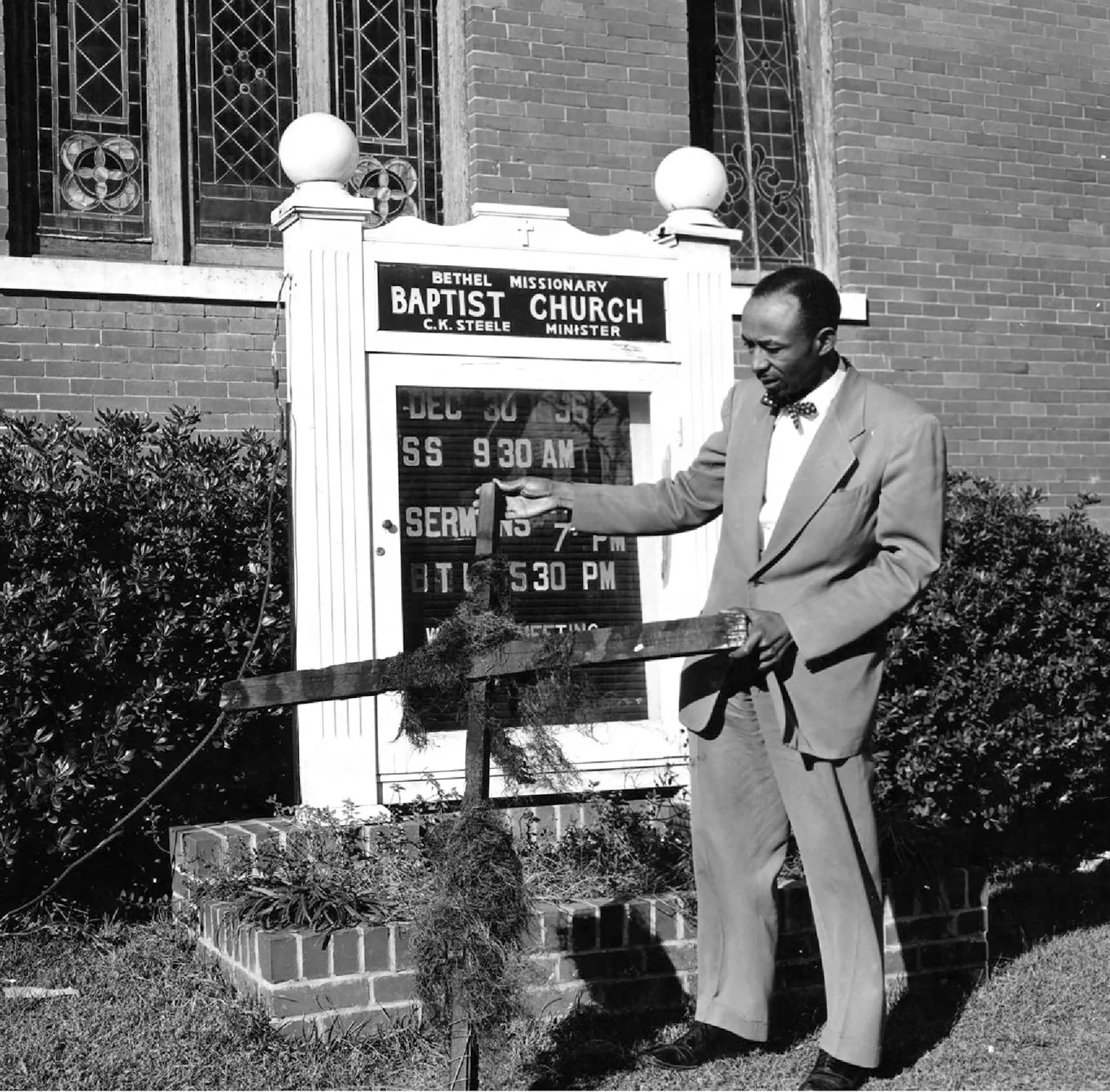
Steele’s leadership was not exercised in abstraction. The boycott brought intimidation, harassment, and violence. Florida Memory records that segregationists smashed windows at Steele’s home and burned crosses repeatedly in efforts to terrify organizers and the Black community at large. One archival image documents Steele at Bethel Baptist Church with a cross burned there in January 1957, likely in retaliation for integrated front-of-the-bus demonstrations. Those details matter because they restore the actual stakes of nonviolence. It was not passive. It was courage under siege.
In Steele’s world, moral clarity was never enough by itself. It had to be organized, defended, and repeated.
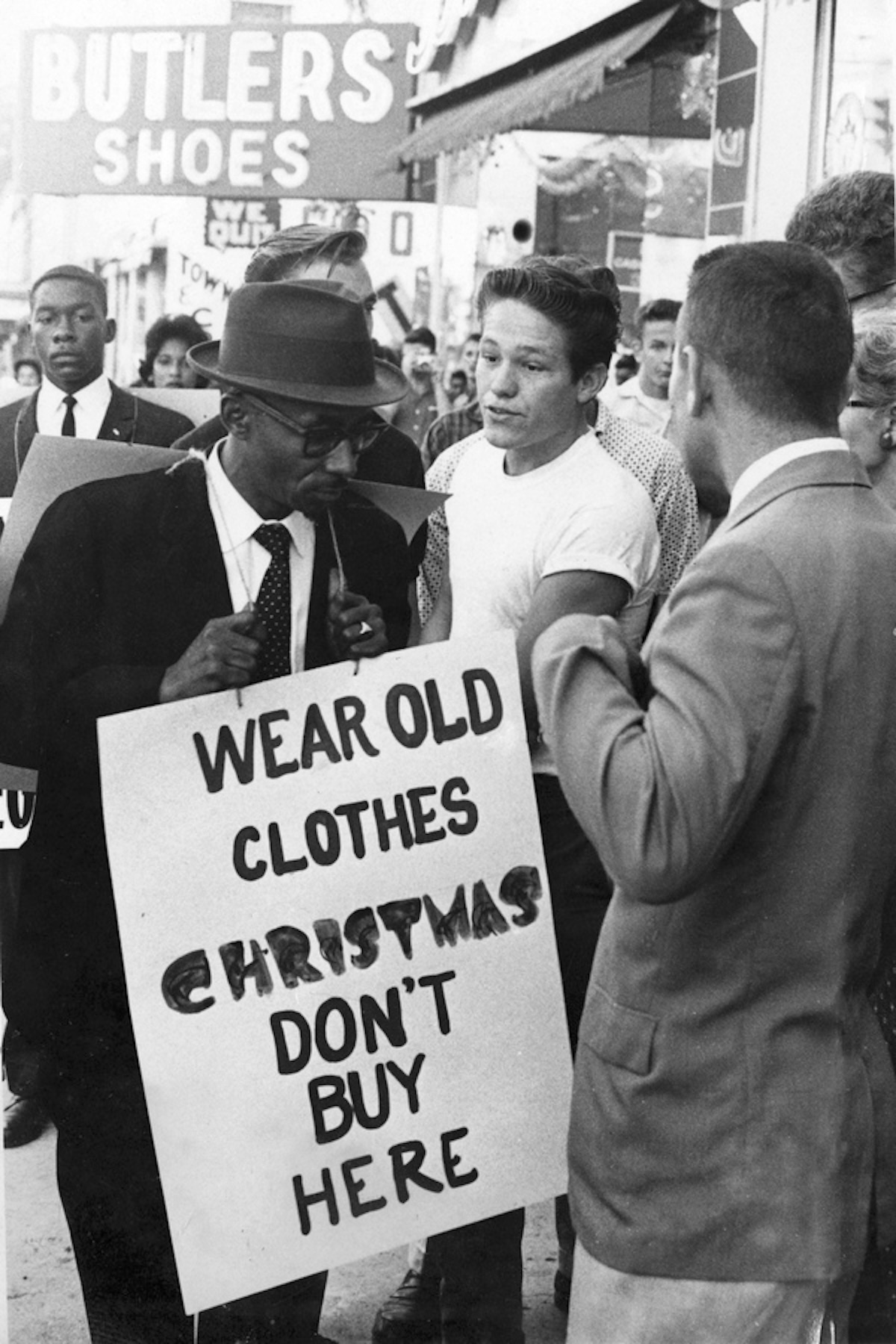
Too often, public memory treats nonviolence as softness or gentility. In Tallahassee, as in Montgomery, it was closer to disciplined defiance. It required people to keep showing up under threat, to take the bus issue seriously as a question of personhood, and to trust organizers enough to remain inside a collective strategy. Steele’s job was to keep that discipline from collapsing into fear or retaliation. That kind of leadership is easy to flatten in retrospect. But in real time it involved soothing the frightened, stiffening the wavering, negotiating with officials, and reminding people that dignity required persistence.
The boycott lasted for months, not days. That longevity tells its own story. Mass protest can be dramatic in its opening phase; the harder question is whether people can maintain it once inconvenience, economic pressure, and racial terror accumulate. Tallahassee’s Black residents did. Car pools helped. Churches helped. Students helped. But leadership helped too. The ICC gave the boycott form, and Steele’s position at the center of that formation made him both a symbol and a coordinator. He was the public face of a movement that depended on countless others, yet public faces matter because they absorb pressure and embody resolve.
When the legal landscape changed after Browder v. Gayle and related developments weakened bus segregation, Tallahassee organizers tested integrated riding. The process was not smooth. Stanford’s materials note that on December 26, 1956, Tallahassee suspended the bus company’s franchise after Steele and others attempted to integrate buses, underscoring how local authorities continued to improvise resistance even as segregation’s constitutional footing eroded. This is another reason Steele matters. He represents the gap between court decisions and lived enforcement—the place where movements either finish the work or watch victories evaporate.
Why Tallahassee is not a footnote
One of the quiet distortions of civil rights history is that Montgomery often stands in for every Southern bus struggle. Montgomery deserves its place, of course. But the Tallahassee boycott, led in major part by Steele, shows that the movement was not a one-city miracle. It was a regional process in which ideas, tactics, and courage traveled. The Tallahassee campaign is sometimes described as less famous than Montgomery, but that should not be confused with being less revealing. In some ways, it better exposes movement mechanics because it shows imitation, adaptation, and persistence without the same degree of national mythmaking.
Tallahassee also complicates the tendency to tell civil rights history as a straight line from iconic event to iconic event. The city’s protest culture involved students, churches, local Black institutions, and later waves of sit-ins and desegregation efforts. Stanford’s materials note that Steele later worked closely with student protesters, including his own sons, during the sit-in years. That continuity matters. He was not merely a boycott leader frozen in 1956. He remained engaged as the movement evolved from transportation protest to broader direct-action campaigns.
There is another reason Tallahassee deserves more attention: it highlights Florida’s place in civil rights history. The state often sits awkwardly in national memory—neither the Deep South archetype nor outside Southern segregation’s logic. Yet Florida generated its own intense struggles, surveillance regimes, and local movements. Steele was one of the people who made that unmistakable. His leadership demonstrates that the architecture of Jim Crow was not geographically narrow, and neither was the Black freedom response.
Steele and King
Steele’s relationship to Martin Luther King Jr. helps explain both his importance and his relative obscurity. He was close enough to King to matter in the formation of major movement structures, but not positioned to dominate the national story. The SCLC’s own origins make that plain. Stanford’s account of the Southern Christian Leadership Conference notes that the founding conference was called in January 1957 by King with fellow ministers C.K. Steele and Fred Shuttlesworth, and that the gathering was motivated by the conviction that there was “no moral choice” but to go deeper into coordinated nonviolent struggle. Steele then served as the organization’s first vice president.
That is not ceremonial trivia. It means Steele was part of the transition from locally rooted bus boycotts to a regional civil-rights coordinating body. SCLC was designed to connect local struggles, draw on the institutional independence of Black churches, and extend nonviolent direct action across the South. Steele fit that mission almost perfectly. He had credibility as a pastor, experience leading a boycott, and practical knowledge of what it took to sustain mass protest in hostile conditions. In organizational terms, he was precisely the kind of leader SCLC needed.
Yet Steele’s relationship to King also reveals how history can be shaped by narrative gravity. King became the defining moral voice of the era, and understandably so. But the very rise of a singular national figure has sometimes obscured the collegial network around him: people like Shuttlesworth, Joseph Lowery, Ella Baker, Septima Clark, Dorothy Cotton, and Steele, each of whom performed forms of leadership that cannot be reduced to supporting cast status. Steele was not simply “with King.” He was one of the leaders who helped make the movement King led structurally possible.
You can see Steele’s standing in other documents of the period as well. His name appears among Southern ministers endorsing the famous 1960 “Heed Their Rising Voices” advertisement associated with support for the student movement and King, a reminder that Steele remained a recognized voice as the movement broadened. He also participated in later campaigns and national organizing spaces, including the Selma to Montgomery movement. The National Park Service identifies him as one of the movement figures connected to Selma, reinforcing that his activism was not confined to one city or one year.
A movement pastor, not a single-issue man
One of the risks of writing about Steele is to let the bus boycott consume the whole portrait. It was his signature chapter, but not his only one. Florida’s Civil Rights Hall of Fame notes that he served as both state and local president of the NAACP and remained active through the 1960s in efforts to eliminate discrimination in public facilities across the South. That ongoing work is less cinematic than the boycott, but in some ways even more revealing. Steele was not just good at ignition. He was good at maintenance.
Maintenance is an underrated political virtue. Movements need people who can continue when victory is partial, when news coverage cools, when legal wins arrive unevenly, and when communities are exhausted. Steele seems to have understood that Black freedom work was as much about continuity as spectacle. He stayed at Bethel Missionary Baptist Church until his death in 1980, folding pastoral care and public activism into one another rather than treating them as separate tracks. That sustained local presence is one reason Tallahassee remembered him so deeply.
He also stood at an interesting intersection of generations. He belonged to the ministerial leadership that helped launch mass nonviolent protest in the mid-1950s, but he also remained relevant as student-led direct action intensified around 1960. Stanford notes that he worked closely with student protesters in Tallahassee, including his sons Henry and Charles. That detail is easy to miss, but it hints at Steele’s flexibility. Some older clergy treated student activism as too disruptive or insufficiently deferential. Steele appears, instead, to have recognized youth activism as an extension of the same moral fight.
The style of his leadership
So what kind of leader was Charles Kenzie Steele? The documentary record suggests someone less interested in personal mythology than in collective efficacy. He was clearly charismatic enough to hold together a congregation and a movement, but his legacy rests as much on structure as on speech. He helped build the Inter-Civic Council. He helped found SCLC. He kept Bethel as a site of civic mobilization. He tied local grievances to broader regional campaigns. Those are the habits of a builder.
Steele’s gift was not simply inspiring people to move. It was helping them keep moving together.
The King Institute’s summary includes a phrase attributed to Steele’s understanding of the movement as “the pain and the promise.” That line is useful because it captures his realism. He was not naïve about the costs of struggle. He had seen harassment, bombast, and racial backlash up close. Yet he also appears to have believed, deeply, that organized nonviolence could create durable democratic change. Not instant salvation. Not easy reconciliation. But change. The phrase feels like a ministry of political honesty: don’t lie about the pain, and don’t surrender the promise.
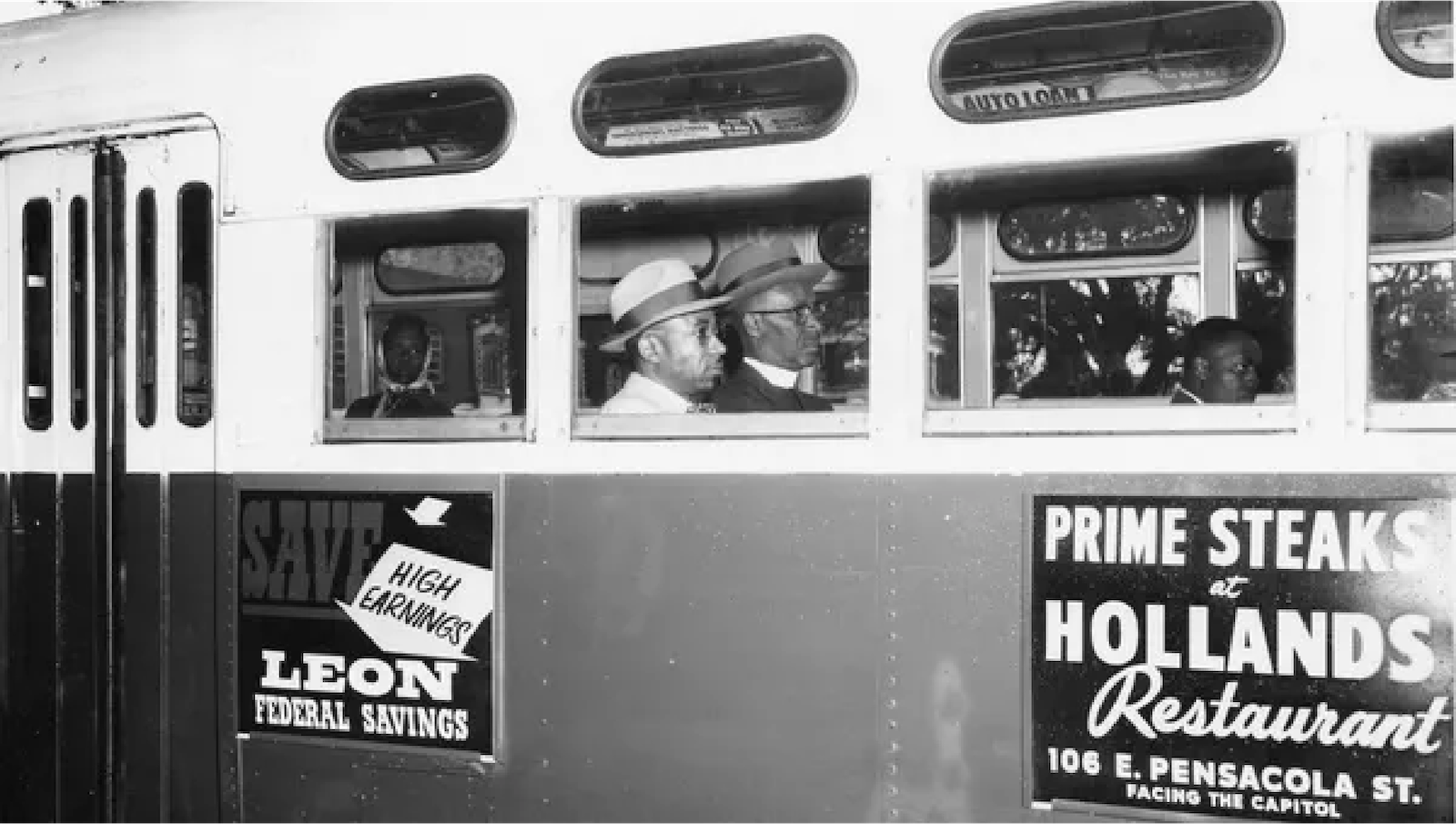
That realism may also explain why Steele has not always lent himself to pop-history simplification. He was not built for the kind of neat symbolic package that museums and textbooks often prefer. He was a pastor and strategist, a local leader and national organizer, a man of deep faith and institutional habit. His story does not climax in one single perfect image, though there are powerful ones: Steele with the charred cross at Bethel, Steele at the front line of Tallahassee transit protest, Steele remembered in bronze at the bus plaza. His legacy is more distributed than iconic. That is precisely why it deserves attention.
Death, memory, and what Tallahassee chose to honor
Steele died on August 19, 1980, after battling cancer. By then he had spent nearly three decades at Bethel and a generation in public struggle. His death closed a life of sustained civic ministry, but it did not close the city’s relationship to him. Tallahassee and the state of Florida continued, over time, to institutionalize his memory in ways that say something about the scale of his local impact.
Florida State University awarded Steele an honorary Doctor of Humane Letters in 1980, a notable recognition from a major public university in the same city where he had spent years pressing for racial justice. Tallahassee later named its bus terminal for him, and his statue became one of the city’s most visible civil-rights memorials. In 2012, he was inducted into the Florida Civil Rights Hall of Fame. These honors do not create greatness, but they help reveal how deeply it was felt by those living in the geography he changed.
There is a certain poetic clarity in the bus terminal memorial. Steele helped confront segregation in public transit; the city ultimately attached his name to a transportation hub. Public memory is often imperfect, but in this case it landed on a fitting symbol. The place where people pass through the city bears the name of a man who helped reshape who could move through public space with dignity.
Why Charles Kenzie Steele still matters
Steele matters now for at least three reasons. First, he reminds us that civil rights history was built by networks, not lone heroes. The movement needed globally resonant figures, yes, but it also needed trusted local leaders capable of holding institutions together. Steele was one of those figures. To recover his story is to recover a more accurate picture of how democratic change happens.
Second, Steele offers a corrective to the thin way nonviolence is sometimes discussed in current culture. In his life, nonviolence was not branding. It was discipline under provocation, community organization under surveillance, and moral commitment under terror. It required carpools, meetings, negotiation, and endurance. In other words, it required systems. Steele understood that ethical language without organized capacity rarely survives contact with power.
Third, his story pushes against a fame-based understanding of significance. History is littered with figures whose names became large enough to eclipse the world that produced them. Steele’s life calls us back to that world: churches doubling as headquarters, students triggering wider unrest, local leaders translating anger into policy demands, state and local authorities improvising obstruction, and communities persisting anyway. If King is one of the great moral voices of the movement, Steele is one of the clearest examples of its moral mechanics.
There is also something timely about Steele’s rootedness. He was not a pundit of justice. He was a practitioner of it. He stayed in one community for decades. He absorbed the cost of leadership there. He did not merely visit the struggle; he pastored inside it. In an age that often confuses visibility with value, that kind of long-haul, place-based leadership feels especially instructive.
And maybe that is the cleanest way to understand his significance. Charles Kenzie Steele was a freedom movement leader who made systems out of courage. He helped build the local infrastructure that turned indignation into coordinated power. He served as a bridge between city-level protest and regional organization. He endured intimidation without surrendering to it. He believed the movement contained both “the pain and the promise,” and his life suggests he took both parts equally seriously. In that sense, Steele was not just adjacent to history. He was one of the people who taught it how to move.
More great stories
Claude Clark Painted a Black World Too Often Left Unseen
April 7, 2026
No Comments
Ta-Nehisi Coates and the American Ledger
April 6, 2026
No Comments