




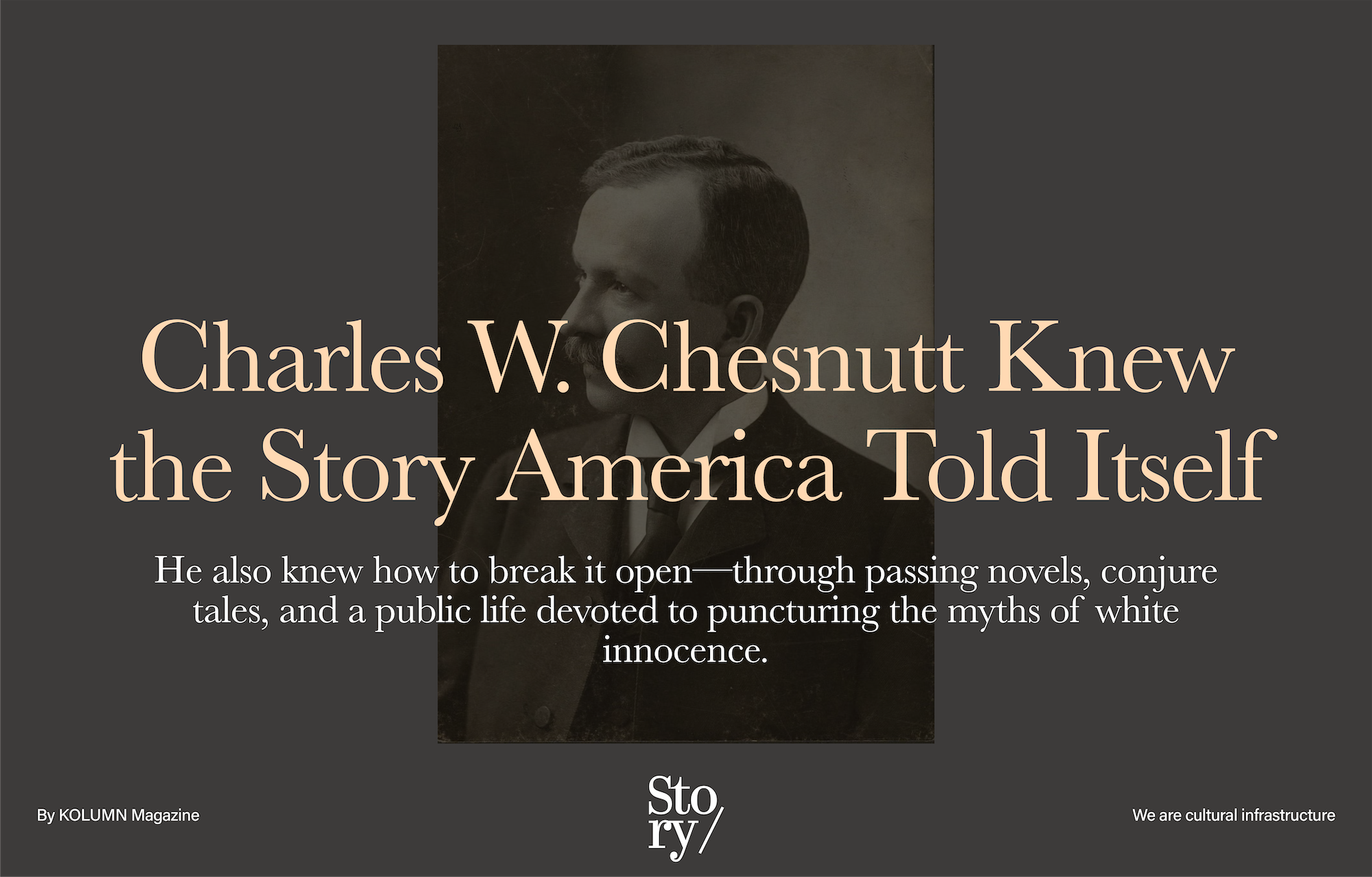
Chesnutt’s genius was not merely to describe racial categories, but to show how flimsy, coercive, and ruinous those categories were in practice.
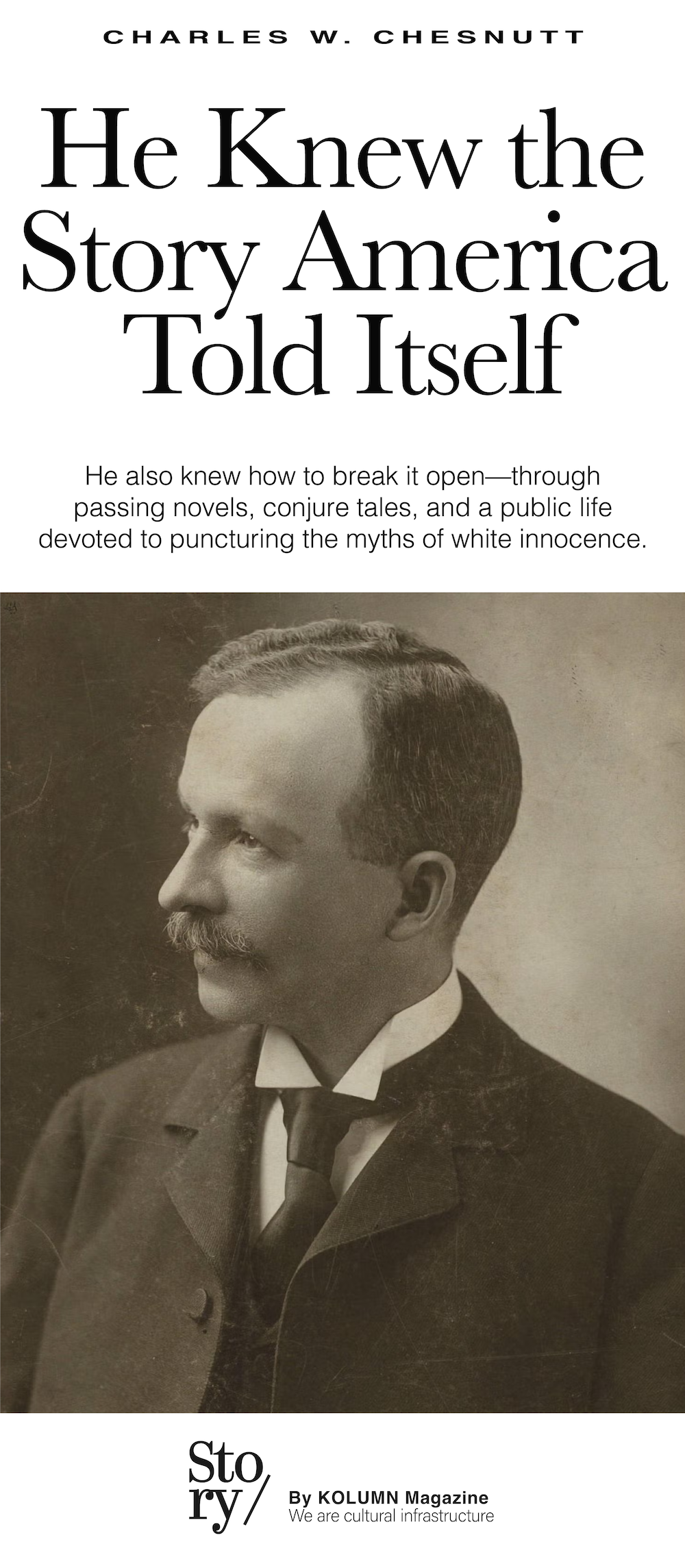
Chesnutt’s genius was not merely to describe racial categories, but to show how flimsy, coercive, and ruinous those categories were in practice.
By KOLUMN Magazine
Charles W. Chesnutt occupies a peculiar place in American letters: admired in his own day, constrained by the racial marketplace of that same era, partially neglected for decades, and then recovered as a writer who had seen the country with greater accuracy than many of his more canonized peers. He was born in Cleveland in 1858 to free Black parents with roots in Fayetteville, North Carolina; he taught in the South, made a career in stenography and law in the North, published nationally in The Atlantic, wrote landmark story collections and novels between the 1880s and early 1900s, and later became an important civic voice on race, disfranchisement, and Black advancement. Even the compressed version of that life makes him sound improbably productive. The fuller version reveals something more interesting: a man who understood, earlier than most, that race in the United States was not merely a prejudice or a custom but an operating system shaping aspiration, intimacy, mobility, safety, and art itself.
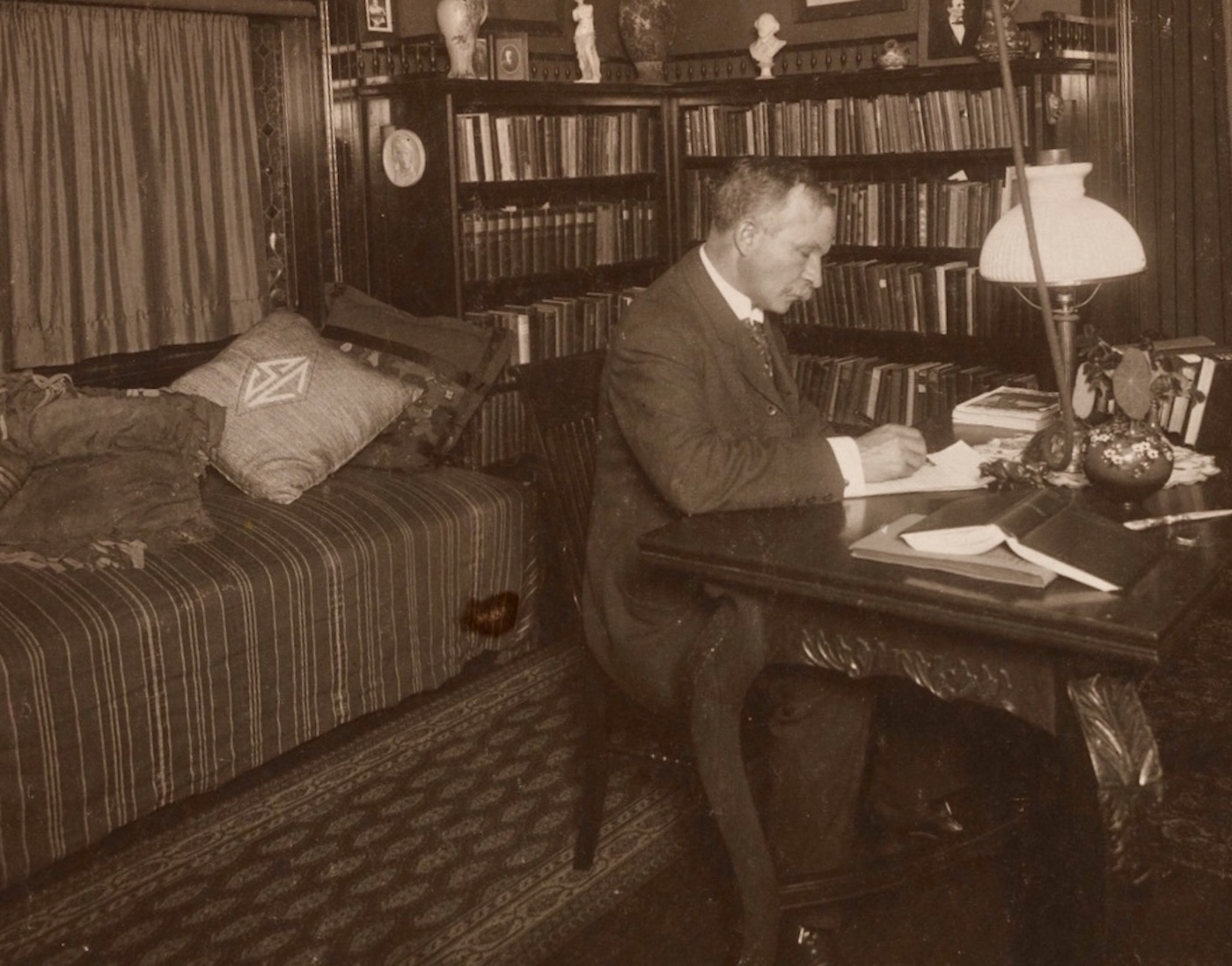
That is part of why Chesnutt matters now. He was not simply “early,” not simply “pioneering,” and not simply “first,” though all of those labels fit in one way or another. He was analytically sharp. He saw that American racism was not only spectacular, not only violent in the obvious ways, but administrative, psychological, and social. He understood that the color line could be enforced by mobs and by manners, by law and by literary taste, by segregated institutions and by the pressure to become legible to white readers. His fiction made those structures visible without flattening his characters into sermons. His essays and speeches made the politics plain when fiction alone was no longer enough. That double achievement—as artist and public thinker—is what gives his work its durability.
A recent wave of scholarship has only sharpened that case. The Charles W. Chesnutt Archive, now one of the most comprehensive records of his life and work, has helped make clear how extensive his writing, correspondence, and civic interventions were. Recent commentary around Tess Chakkalakal’s 2025 biography has also emphasized that Chesnutt should not be read as a marginal precursor but as a central architect of African American literary modernity, a writer whose career illuminates the pressures Black authors faced when the literary marketplace demanded art without too much racial truth.
A life shaped by movement, study, and self-fashioning
Chesnutt’s early biography matters because it helps explain the unusual range of his writing. His parents, Andrew Jackson Chesnutt and Maria Sampson Chesnutt, were free people of color from Fayetteville who left North Carolina for Ohio before the Civil War in search of better prospects. Charles was born in Cleveland on June 20, 1858, but the family returned to Fayetteville after the war. That movement between North and South, freedom and constraint, relative possibility and systematic restriction, would become central to his sensibility. He was never only a “Southern” writer or only a “Northern” one. He belonged to the corridor between those worlds, and his fiction repeatedly stages the instability of those categories.
Charles W. Chesnutt did not merely write about the color line. He understood how it reorganized an entire society—its laws, its manners, its intimacies, and even its definitions of art.
He was, by every serious account, intellectually restless from a young age. NCpedia records that after studying at Fayetteville’s Howard School, he taught in Charlotte as a teenager, returned to Fayetteville to work at the State Colored Normal School, and by age twenty-two had become its principal. His formal education was limited by circumstance, but he compensated through relentless self-education in languages, literature, mathematics, and music. That pattern—working inside institutions while also building himself beyond them—is one of the most revealing features of his life. Chesnutt was not produced by elite literary culture. He forced his way into it.
Later, he taught himself stenography, moved north in 1883, spent time in New York, and then settled in Cleveland, where he built a successful professional life as a court reporter, stenographer, lawyer, and businessman after passing the Ohio bar in 1887. This is not incidental background. It means Chesnutt knew bureaucracy, courtroom language, the mechanics of evidence, and the habits of official speech. He understood how public narratives are made to sound neutral. That legal and clerical discipline can be felt in his prose: the exactness, the measured irony, the refusal to waste motion. Even when he is writing folklore-inflected stories, there is often a countervailing analytical pressure in the sentences, as though he is observing the story and the social machinery around it at the same time.
He also built a relatively stable family life, marrying Susan Perry and raising four children, all of whom became college graduates. Chesnutt once described himself, with a mix of modesty and earned pride, as a man who had achieved “an ample income” by professional standards and who participated in civic institutions like the Chamber of Commerce and the Cleveland Bar Association. That self-description matters because it complicates the flat image of the isolated artist. Chesnutt was bourgeois in some respects, civically embedded, professionally disciplined, and deeply invested in the Black politics of uplift. He was never just a literary bohemian. He was a public citizen who wrote.
Entering the literary world on terms that were never equal
Chesnutt’s ambition was never casual. As early as 1880, NCpedia notes, he was already thinking in his private journal about writing a book that would combat what he called “the unjust spirit of caste” in the United States. That phrase is crucial. It tells you that he grasped race not just as irrational hatred but as a caste logic: a social ordering mechanism sustained by exclusion, status anxiety, and institutional power. Long before modern scholars popularized that vocabulary, Chesnutt was already circling the idea.
His national breakthrough came in The Atlantic. The magazine identifies him as one of the first African American authors to be published nationally, and the Chesnutt Archive notes that “The Goophered Grapevine” appeared there in 1887, launching a relationship that would eventually include seven stories. That publication was no small thing. The Atlantic was not merely a prestigious outlet; it was a gatekeeping institution in the literary culture of the time. To enter it as a Black writer in the late nineteenth century meant crossing a barrier that was aesthetic, commercial, and racial all at once.
Yet Chesnutt’s entry into that world came with conditions. He was, as scholar Michael Nowlin writes, strategic and self-conscious about entering what he called the “literary world.” His rise depended in part on publication with Houghton Mifflin and the critical approval of William Dean Howells, one of the era’s most influential literary arbiters. That approval helped make Chesnutt legible to a mainstream white readership, but it also exposed the trap Black writers faced: acceptance often depended on being admired as an artist while not being dismissed as a propagandist. The line between those categories was not aesthetic so much as racial. A white writer could moralize and still be “literary.” A Black writer who pressed too directly on white violence risked being accused of bitterness.
That tension runs through Chesnutt’s career. The early stories often arrived clothed in forms white readers found familiar or even comfortable—local color, dialect, regionalism, folklore—yet beneath those forms he was already testing the limits of what that audience could bear. Imani Perry’s reflection on Chesnutt’s Atlantic career makes the point well: his work initially benefited from a general appetite for stories of Southern life, but unlike plantation nostalgists and Lost Cause mythmakers, Chesnutt depicted Black culture with political intelligence and care. He used conjure, wit, and voice not to romanticize the plantation but to expose the distortions through which America preferred to remember it.
The conjure tales were never just folklore
This is one of the enduring misunderstandings about Chesnutt: that the conjure stories are warm-up exercises before the “serious” novels. In fact, they are already serious, already sophisticated, already doing formal and political work that many later writers would elaborate in different ways. The Conjure Woman, published in 1899, gathers stories in which Black oral tradition, spiritual practice, and narrative cunning become modes of survival and interpretation. To read them lazily is to see quaint folklore. To read them closely is to see a writer studying power.
“The Goophered Grapevine,” for example, can be read as a local-color story. It can also be read as a critique of extraction, credulity, and white desire for ownership. The frame matters. Chesnutt frequently places white listeners or interlocutors near Black storytellers, allowing the reader to register not only the tale itself but the asymmetry in who is presumed to interpret it correctly. That doubleness is central to his method. He does not merely tell a story; he dramatizes misreading. And in a nation built on the systematic misreading of Black humanity, that is not a minor trick.
Perry’s account is especially helpful here because it underlines how Chesnutt handled Black North Carolinian folkways and spiritual traditions with fidelity while also making his stories politically wry. The conjure material is not ethnographic display for white consumption, at least not on its own terms. It is a form in which enslaved and formerly enslaved Black characters can outmaneuver dominant narratives. Their resource is not brute force but interpretive intelligence. Chesnutt, who knew very well how white audiences consumed Blackness, built stories that could be read one way by a casual reader and another way by someone attentive to the pressure of power.
That layered method helps explain why Chesnutt looks so contemporary. He is interested in masks, double audiences, tactical performance, and the unstable boundary between story and evidence. He is also interested in what happens when trauma survives not as direct testimony alone but as lore, inflection, rumor, and cautionary memory. In that sense, the conjure stories do not sit outside realism. They widen realism by forcing it to reckon with cultural forms that polite American literature often treated as decorative or primitive.
The color line inside Black life
If the conjure stories expose white power obliquely, The Wife of His Youth and Other Stories of the Color Line, also published in 1899, moves more directly into the social and psychic complexities of race. Britannica notes that the collection examines color prejudice between white and Black people and also among Black people. That dual emphasis remains one of Chesnutt’s greatest strengths. He was too serious a writer to pretend that Black life under white supremacy could be rendered without internal distinctions, class aspirations, color hierarchies, and moral compromises.
“The Wife of His Youth” remains among his most anthologized stories for good reason. Perry summarizes its critique of the elite “Blue Veins,” a light-skinned Black social set whose status is tied to complexion and distance from darker Black people. Chesnutt does not caricature them; he anatomizes them. That distinction matters. He understands that colorism and classism within Black communities are not detachable from the larger white supremacist order. They are among its afterlives. The story’s power lies in the way it dramatizes aspiration and embarrassment without surrendering the humanity of any of its players.
Here, too, Chesnutt’s modernity is obvious. He writes race as performance, inheritance, and social choreography. He also writes respectability as something both understandable and dangerous. He knows why people want admission into safer, higher-status worlds. He also knows what gets disavowed in the process. For a writer working at the turn of the twentieth century, that degree of moral and sociological complexity is remarkable. It is one reason later readers increasingly recognized him not as a period curiosity but as a major analyst of American identity.
Passing, peril, and the unstable architecture of whiteness
With The House Behind the Cedars in 1900, Chesnutt turned to the subject that has become central to many later assessments of his fiction: racial passing. The Atlantic’s author page notes that he focused on racial identity in the South before and after the Civil War, and Perry emphasizes that Cedars rejected simplistic notions of race while entering the terrain of the passing novel. Britannica similarly identifies the novel as part of Chesnutt’s larger exploration of color prejudice and psychological tension.
But The House Behind the Cedars is not compelling simply because it is “about passing.” Plenty of works can be reduced to that label and still remain thin. Chesnutt’s deeper accomplishment is that he treats passing not as a gimmick of revelation but as a stress test for the entire racial order. If a person can pass, what exactly is race? If whiteness depends on invisibilized ancestry, what is its stability? If love, law, and inheritance can all be reordered by classification, what does that say about a society claiming moral seriousness? Chesnutt’s fiction does not answer those questions with lecture-hall neatness. It stages them through lives under pressure.
Perry argues that Chesnutt refused the idea that every Black person who passed for white must be rendered as automatically tragic or doomed. That is a subtle but essential point. He was not interested in easy moral punishment. He was interested in how race itself produces the conditions under which passing becomes legible as both temptation and indictment. The tragedy, in his work, is not that boundaries are crossed. The tragedy is that the boundaries exist at all and carry such devastating consequences.
The novel that understood Wilmington before much of America did
If one book best captures Chesnutt’s political courage, it is The Marrow of Tradition, published in 1901. The Chesnutt Archive calls it his devastating fictionalized account of the Wilmington coup and massacre of 1898. A Washington Post review of David Zucchino’s later history of the event goes further by emphasizing that the false public story about Wilmington persisted for decades and that Chesnutt’s novel was among the rare early challenges to that mythology. In other words, Chesnutt was not simply drawing literary inspiration from recent news. He was intervening in the battle over historical truth.
That context is crucial. Wilmington was not just racial unrest in some vague sense. It was organized white supremacist violence, mass murder, political overthrow, and narrative theft. White perpetrators and their allies did not only seize power; they manufactured a story that justified the seizure. Chesnutt understood that violence of this kind is never only physical. It is historiographic. It decides who gets remembered as aggressor, victim, citizen, or threat. To write The Marrow of Tradition so soon after the events was to contest white memory in near-real time.
And it cost him. Michael Nowlin’s chapter on Chesnutt describes his “downfall” after The Marrow of Tradition as the moment when he became marked as a propagandist. That phrase is a map of the literary politics of the era. When Chesnutt wrote stories that white readers could praise for irony, restraint, or “local color,” he was admired. When he wrote a fierce novel engaging a recent atrocity of white supremacy, the old protections of aesthetic neutrality grew thin. His failure, in the eyes of many gatekeepers, was not artistic. It was that he refused to let realism stop short of power.
Some contemporaries admired the book’s force while recoiling from its moral severity. Later summaries of the critical climate note that Howells found it powerful but worried over what he called its bitterness. That response, too, tells us something about the period. The problem for many white readers was not that Chesnutt had exaggerated racial brutality; it was that he had refused to sentimentalize reconciliation. He had written a novel in which white supremacy appears not as misunderstanding but as program. That clarity remains one of the book’s strengths.
Today the novel reads as both historical witness and warning. The Post’s account of Wilmington emphasizes how long public memory remained corrupted. Chesnutt saw early that fiction could become a counterarchive, a place where the official lie might be interrupted. He also saw that literary form itself could help a nation understand the human cost of political myth. That is one reason the novel still feels so alive: it is concerned not just with the event but with the machinery that makes atrocity narratable as order restored.
From fiction to direct civic argument
After The Marrow of Tradition and then The Colonel’s Dream in 1905, Chesnutt published less long fiction, though he continued to write. The shift was not a collapse into silence so much as a redistribution of energy. The Chesnutt Archive and Stanford University Press’s volume on his essays and speeches make clear that he increasingly devoted himself to public argument against racism, disfranchisement, and cultural exclusion. He was not abandoning literature’s concerns. He was meeting a political moment that required more frontal confrontation.
His essay “The Disfranchisement of the Negro” is exemplary. The Chesnutt Archive describes it as a straightforward statement of facts about the suppression of Black voting in the South, adding that he put the case to the American people plainly and “spares neither the North nor the South.” That last point matters. Chesnutt was not interested in comforting regional fictions. He understood that Northern innocence about Southern racism was itself a political convenience. When Black citizenship was under attack, sectional alibis were useless.
This movement from fiction to essay should not be misread as an aesthetic retreat. It was an extension of the same moral intelligence. In the stories and novels, Chesnutt dramatized the lived texture of caste. In the essays, he named the system more directly. The two modes belong together. To separate them too sharply is to miss how comprehensively he understood American public life. He was not simply a storyteller who occasionally commented on politics. He was a political thinker whose fiction and essays worked in tandem.
NAACP, Du Bois, and the politics of racial uplift
By the 1910s, Chesnutt was deeply involved in organized Black civic life. The Chesnutt Archive notes that by 1910 he was helping coordinate the Cleveland meeting for the newly founded NAACP. It also records his membership in Twelve for the Advancement of the Interests of the Negro Race alongside figures such as Booker T. Washington, Kelly Miller, and T. Thomas Fortune. This is not the profile of a writer on the sidelines of Black political life. It is the profile of an intellectual operating inside the major institutional currents of his day.
His relationship to Du Bois and The Crisis further underscores that role. A letter record in the Chesnutt Archive notes that Du Bois, as editor of The Crisis, published four of Chesnutt’s short stories and two essays between 1912 and 1930. That continued publication matters for two reasons. First, it shows that Chesnutt remained a relevant literary presence even as younger writers emerged. Second, it places him in the ecosystem that would help incubate what became the Harlem Renaissance. He was not entirely of that generation, but he was certainly one of the figures who made it possible.
That is why recent commentators have described him, not hyperbolically, as a kind of forgotten father of the Harlem Renaissance. Publishers Weekly’s interview with Tess Chakkalakal uses precisely that framing, and Michael Nowlin’s chapter notes that Harlem Renaissance writers recognized him as “the first Negro novelist,” even as he could only partially identify with their new literary moment. The phrasing is revealing. Chesnutt was honored as precursor, but precursors are often remembered more symbolically than fully read. His current revival is, in part, an effort to correct that.
Why he was recovered, and why that recovery keeps expanding
Chesnutt was not wholly forgotten in the decades after his death in 1932, but his centrality was not secure. The journals, later reprintings, and major scholarly editions helped change that. Duke University Press’s description of The Journals of Charles W. Chesnutt calls them the only known private diary by a nineteenth-century African American author and notes how powerfully they illuminate his daily struggle for education and self-making in the postwar South. That kind of documentary record matters because it gives scholars and readers a richer, less mythic understanding of the man behind the fiction.
The recovery has also been driven by the simple fact that his work anticipated conversations later generations considered urgently modern. Colorism. Passing. The manufacture of white innocence. The relation between violence and public narrative. The cost of respectability. The pressure on Black artists to produce art but not accusation. These are not antiquarian concerns. They are still live wires in American culture. Chesnutt’s fiction keeps returning because the structure he described never disappeared; it adapted.
The Charles W. Chesnutt Archive has become central to that afterlife, and recent grants and editorial work continue to expand the public record of his correspondence and manuscripts. That is not only a boon for specialists. It signals that Chesnutt’s oeuvre is now being treated with the seriousness reserved for writers whose place in the national canon is no longer merely honorary. The infrastructure of preservation is itself a verdict.
The discipline of his prose, the range of his vision
One of the risks in writing about Chesnutt is turning him into a monument before one accounts for his artistry. He was politically brave, yes. He was also technically gifted. His prose often moves with deceptive calm, especially when it is approaching moral catastrophe. He favors irony over flourish, exact social observation over melodrama, and structural pressure over rhetorical excess. Those qualities helped him navigate the late nineteenth-century literary field, but they also gave his fiction a long shelf life. He does not need to shout. The arrangement of the scene does the work.
Howells admired precisely those features in 1900, praising the remarkable quality of Chesnutt’s stories even while filtering that praise through the racial assumptions of his time. The review is interesting now partly because it reveals both genuine admiration and the limitation of the critical culture receiving him. Chesnutt could be celebrated as exceptional, but the terms of that celebration still bore the mark of condescension and surprise. He was always being measured against a white literary norm he had already exceeded in certain ways.
That is another reason he still feels modern: he understood institutions that flatter while confining. He knew what it meant to be praised within a system that had not actually relinquished its hierarchy. That experience shaped the caution, doubleness, and tactical intelligence of his work. It also helps explain the strange mix of ambition and skepticism that scholars continue to find in his career. He wanted entrance into American letters, certainly. He also knew the entryway was guarded by readers who wanted race rendered as theme but not too often as indictment.
A public legacy that outlived the marketplace
By the late 1920s, Chesnutt’s literary prestige was being more formally recognized. The Chesnutt Archive records that the NAACP awarded him the Spingarn Medal in 1928 for his pioneering literary work on behalf of the Afro-American struggle. Another archive item preserves contemporary praise describing him as a “pioneer work[er] as a literary artist” whose career had been long and useful. Recognition came, in other words, not simply because he had published books, but because his books had done civic labor.
That recognition also helped revive sales and place him more firmly in the genealogy of Black literature. The Archive notes that Langston Hughes later placed “The Sheriff’s Children” first in his influential 1967 anthology of Black short fiction. Even before the contemporary revival, Black literary culture had its own ways of remembering who mattered. Chesnutt remained in that lineage because later writers and editors understood what he had made available to them: a body of work that confronted American race-making with unusual candor and formal intelligence.
Why Charles W. Chesnutt still matters
So what, finally, is Charles W. Chesnutt’s significance? It is not exhausted by being one of the first major Black American fiction writers to achieve national publication. It is not exhausted by his treatment of passing, though that alone would be enough to keep him relevant. It is not exhausted by The Marrow of Tradition, though that novel remains one of the earliest and fiercest literary responses to white supremacist coup violence in the United States. His significance lies in the breadth of what he could see.
He saw that race was a fiction with lethal consequences. He saw that democratic language could coexist with caste practice. He saw that literary institutions liked Black talent most when it could be admired without destabilizing white comfort. He saw that respectability could be both strategy and snare. He saw that history could be falsified in real time and that fiction might be one of the few places where moral truth could survive long enough to be recognized later.
And he saw, maybe most importantly, that Black life in America could not be honestly rendered through simplification. His characters are not propaganda puppets. They are ambitious, frightened, compromised, proud, wounded, strategic, loving, and sometimes self-deceiving. That commitment to complexity is one reason modern readers keep finding him fresh. Chesnutt understood that the point of realism was not merely to mirror society but to expose the hidden arrangements by which society called itself natural.
In that sense, Charles W. Chesnutt belongs not at the edge of the American canon as a dutifully acknowledged pioneer, but nearer the center of the national argument. He wrote from the fault line between Reconstruction and Jim Crow, between aspiration and exclusion, between the promise of citizenship and the daily ingenuity required to survive its denial. He wrote before the country had a vocabulary for many of the contradictions he tracked, and often before the culture was willing to hear them. That is usually how prophetic writers sound in their own time: too exact, too insistent, too early. Chesnutt was all three. America is still catching up.
More great stories
Claude Clark Painted a Black World Too Often Left Unseen
April 7, 2026
No Comments
Ta-Nehisi Coates and the American Ledger
April 6, 2026
No Comments