




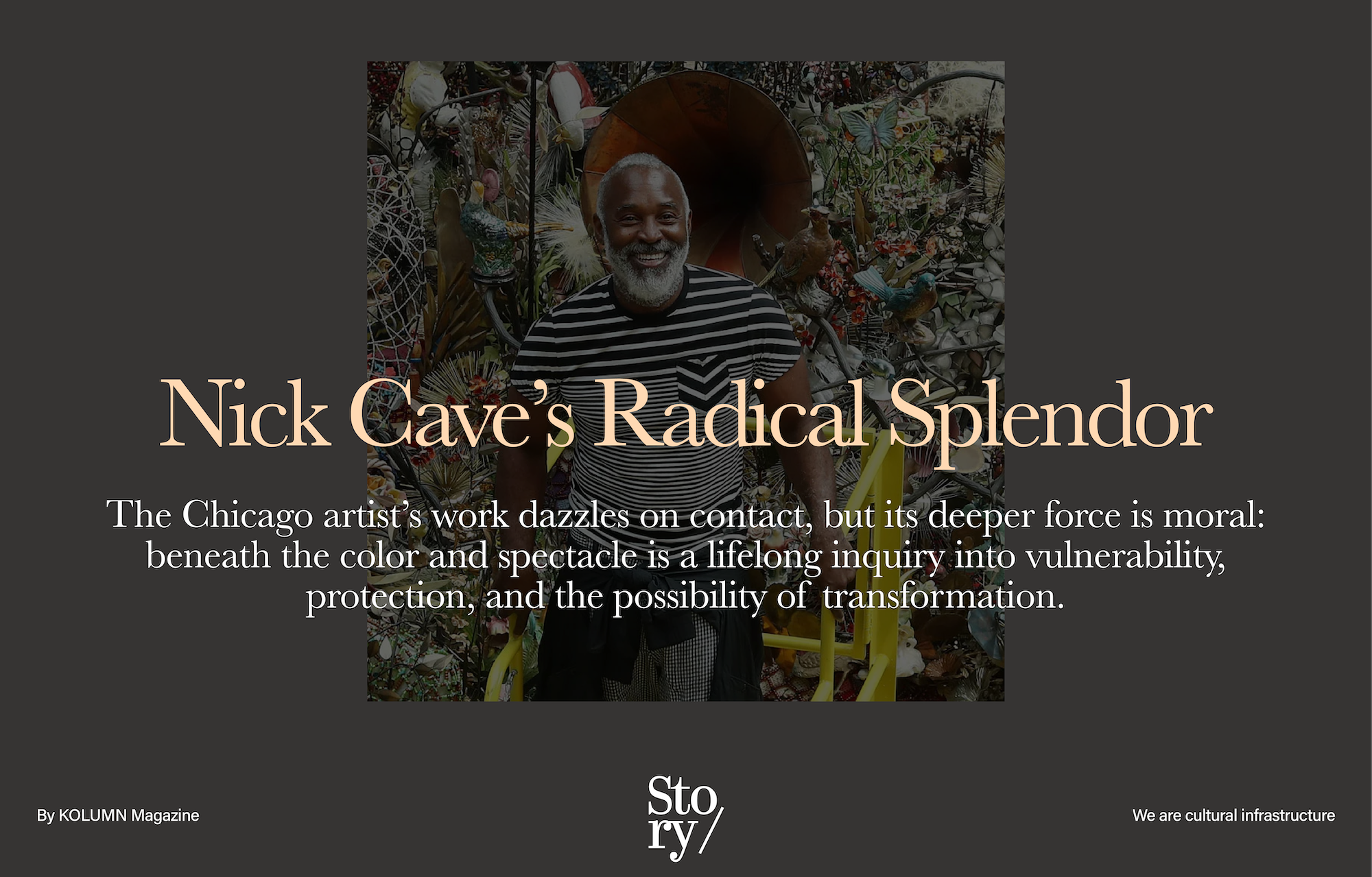
The beauty is never just beauty in Nick Cave’s work. It is strategy, shield, seduction, and argument all at once.
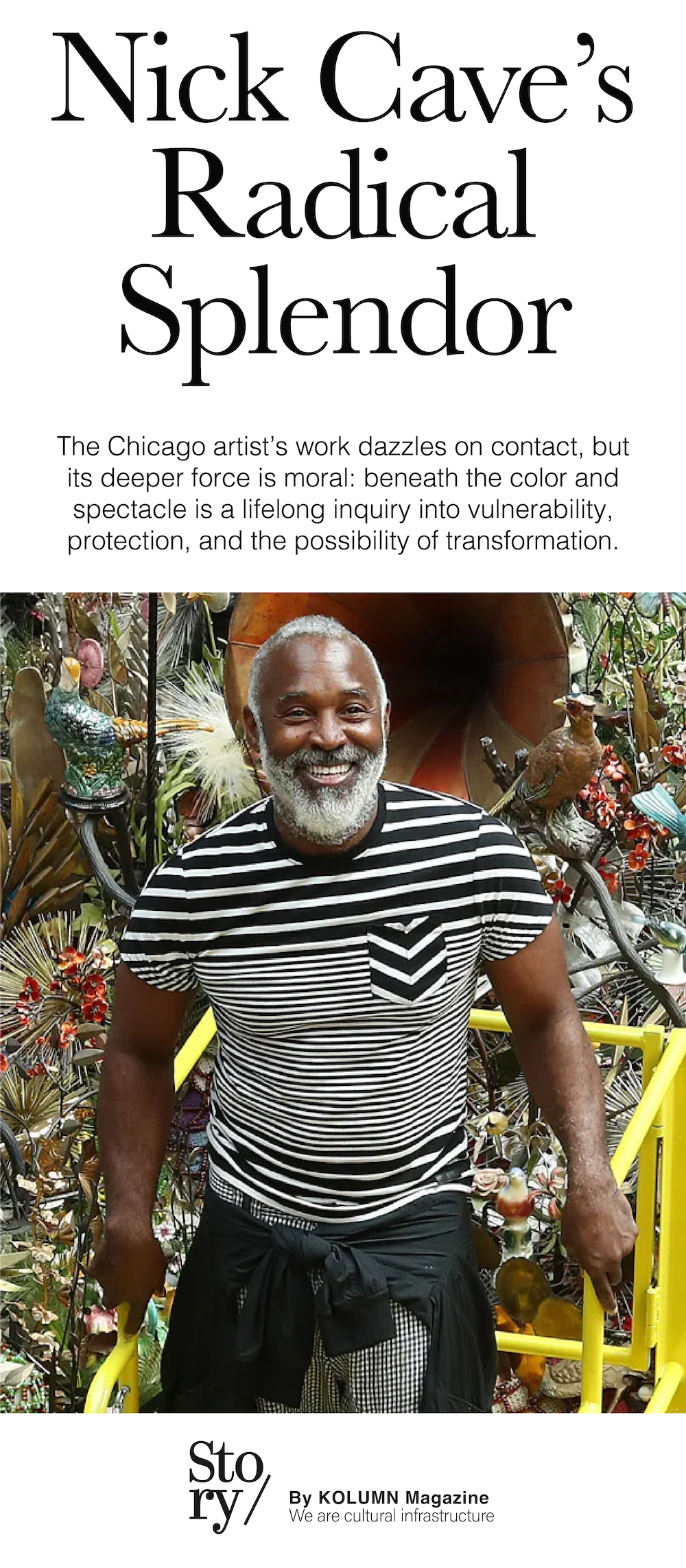
The beauty is never just beauty in Nick Cave’s work. It is strategy, shield, seduction, and argument all at once.
By KOLUMN Magazine
Nick Cave has spent much of his career making objects that seem, at first glance, to arrive from some brighter, freer civilization. They shimmer with sequins, bristle with twigs, bloom with artificial flowers, jangle with buttons and beads, and often stand at human scale like ceremonial visitors from a parallel world. They are funny sometimes, glamorous often, and almost always astonishing. But the closer you get to Cave’s work, the clearer it becomes that the spectacle is not an escape hatch. It is a method. The beauty is there to pull you in; the politics are there to keep you from leaving unchanged. Cave’s art has always understood something essential about America: people will often approach delight faster than they approach discomfort, so he learned to smuggle the discomfort inside the delight.
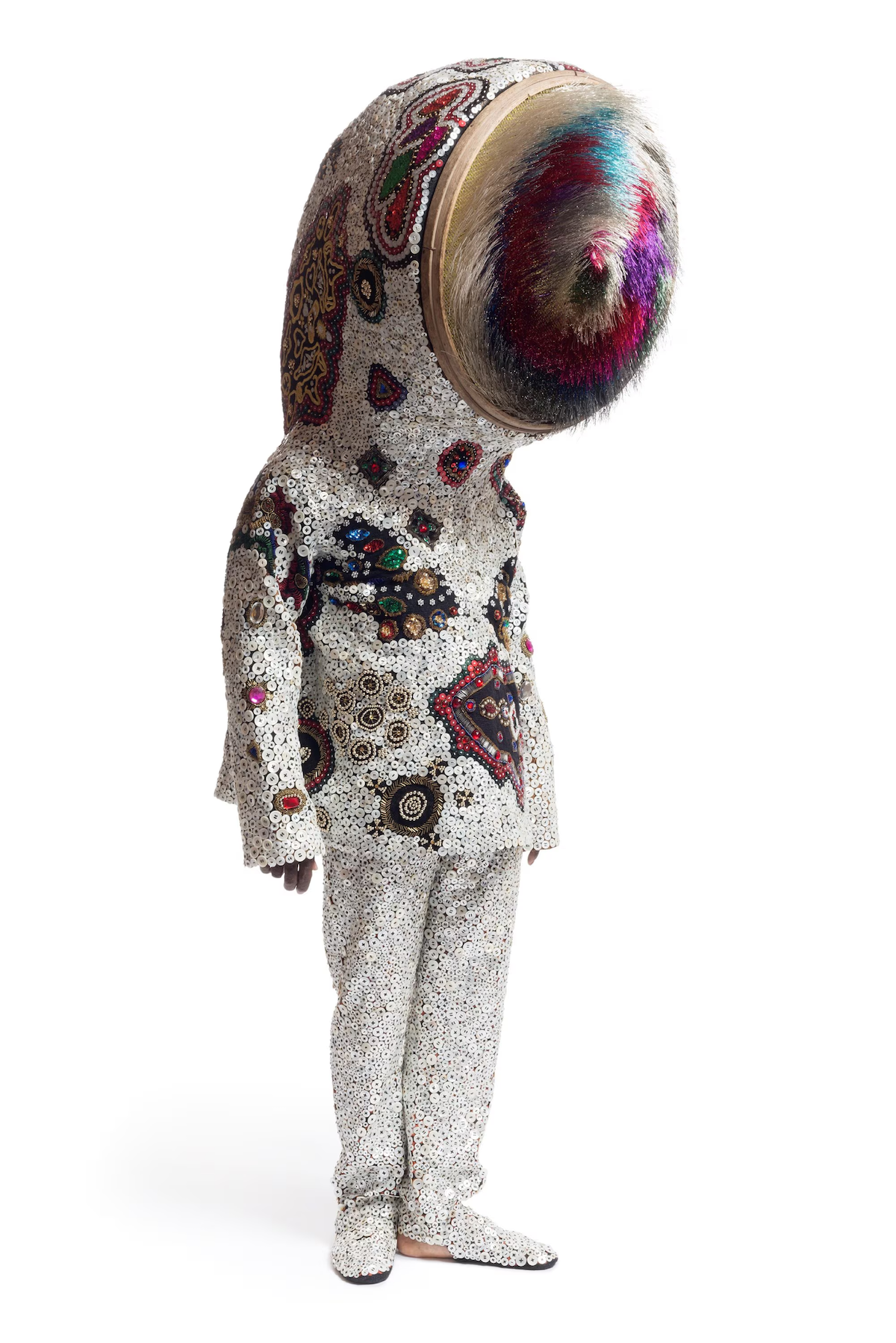
That is one reason Cave matters so much now. For more than three decades, he has built an interdisciplinary practice that moves between sculpture, fashion, dance, installation, video, performance, education, and public art without ever seeming scattered. The work is coherent because the underlying questions are coherent. How do you protect the body in a hostile world? How do you make viewers confront systems of race, class, and gender when they would rather not? What can adornment do that argument cannot? And can art create a temporary social space in which we see each other with less fear and more imagination? These are not small questions. They are civic questions, spiritual questions, American questions. Cave has answered them not with manifestos, but with form.
Now 67 and still expanding his reach, Cave remains one of the rare artists whose influence cuts across the museum, the street, the subway platform, the fashion studio, the classroom, and the public square. In 2025 he received the Smithsonian Visionary Award for innovation and artistry in fiber art. In 2026, the Smithsonian American Art Museum opened Nick Cave: Mammoth, a major new commission and his first solo exhibition in Washington, while the Venice Biennale named him among the invited artists for its 2026 international exhibition. Those markers matter not merely as career trophies, but because they confirm what many critics, curators, students, and viewers have understood for years: Cave is not just a maker of memorable objects. He is one of the defining image-makers of contemporary American life.
A Missouri childhood, a fashion instinct, an artist in formation
Nick Cave was born on February 4, 1959, in Fulton, Missouri, and raised in a large family headed by a mother who encouraged his creative instincts. In interviews, Cave has described growing up as one of seven boys in a closely knit Black family, shaped by a strong sense of mutual care, resourcefulness, and community. He has also spoken about spending time on his grandparents’ farm in Chariton County, where the textures of rural life—animals, crops, labor, found materials, repetition—left a lasting mark on his imagination. Long before the art world knew his name, Cave was learning to read the expressive possibilities of everyday things.
It matters that Cave’s early formation was not strictly “fine art” in the narrow sense. He studied at the Kansas City Art Institute, earning a B.F.A. in 1982, later did graduate study at what was then North Texas State University, and completed an M.F.A. at Cranbrook Academy of Art in 1989. Along the way, he also spent summers studying with Alvin Ailey American Dance Theater, worked in display and fashion, and maintained an enduring relationship to garment, movement, and the staged body. That mixed training helps explain why Cave’s work has always refused easy categories. He is not an artist who occasionally borrows from fashion or performance. He is an artist for whom cloth, choreography, silhouette, and public presence were part of the grammar from the start.
After Cranbrook, Cave moved into teaching and eventually built a long association with the School of the Art Institute of Chicago, where he became a prominent professor and later the Bill and Stephanie Sick Professor of Fashion, Body and Garment. Chicago became not just his base but his laboratory. It is where his studio practice matured, where his educational influence deepened, and where his hybrid language of sculpture, performance, and social address took full shape. Chicago, with all its brilliance and brutality, its cultural innovation and segregated realities, gave Cave a city big enough to hold the contradictions his work wanted to probe.
One of the most revealing details about Cave’s development is that he never abandoned the sensibility of the maker who understands clothes as social technology. Garments are how people enter a room. They are how they are read, misread, desired, dismissed, classified, or feared. Cave understood this deeply, and he understood it as a Black man in America. That made dress, surface, and concealment not merely aesthetic issues, but existential ones. Before the first Soundsuit ever existed, the logic of the Soundsuit was already forming: the body is visible, and because it is visible, it is vulnerable.
The first Soundsuit and the politics of being seen
The origin story of Cave’s signature form has become central to understanding his work because it is so direct, so morally legible, and yet so expansive in its afterlife. Cave has repeatedly said that he made the first Soundsuit in 1992, in the aftermath of the Rodney King beating and the Los Angeles uprising. The original suit was assembled from sticks and twigs. It was protective, improvised, and noisy; when worn, it rustled and crackled with movement. It was, in Cave’s telling, a suit of armor. But it was also more than armor. It was a way of transforming rage and fear into form.
“A Soundsuit does not erase identity so much as expose how violently identity is assigned.”
The brilliance of the Soundsuit lies in how many things it does at once. It conceals the wearer’s race, gender, and class markers; it amplifies motion into sound; it turns performance into sculpture and sculpture into performance; it invites viewers in with extravagance while denying them immediate access to the person inside. That denial is crucial. Cave’s work interrupts the ordinary hierarchy of looking. The viewer cannot easily sort the body according to familiar social codes, which means the work stages, however briefly, a different perceptual order. Cave has described the Soundsuits as creating a space where one is forced to look without judgment. That phrase can sound idealistic until you remember how much of American life depends on snap judgment. Then it sounds radical.
This is where Cave’s art escapes the trap of being merely topical. The Rodney King beating may have been the immediate catalyst, but the work’s underlying subject is broader: the danger attached to Black embodiment under systems of surveillance, policing, and stereotype. The Soundsuit is not a literal solution to that danger, of course. It is a poetic and performative response. Yet poetry can do serious work. Cave takes the wound of racialized looking and turns it into an inquiry about what it means to be seen at all. He is not simply hiding the body. He is exposing the violence of the categories through which the body is usually read.
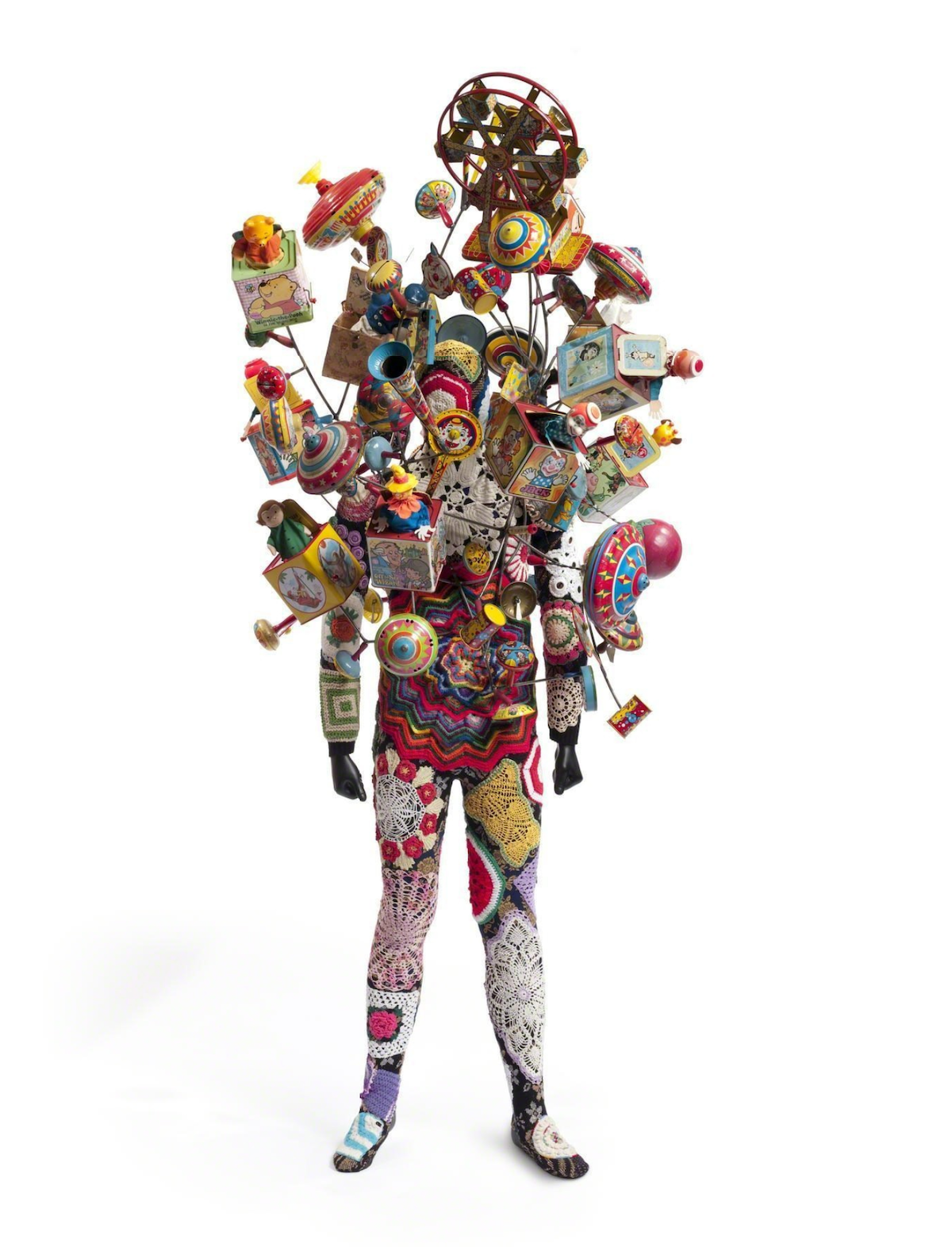
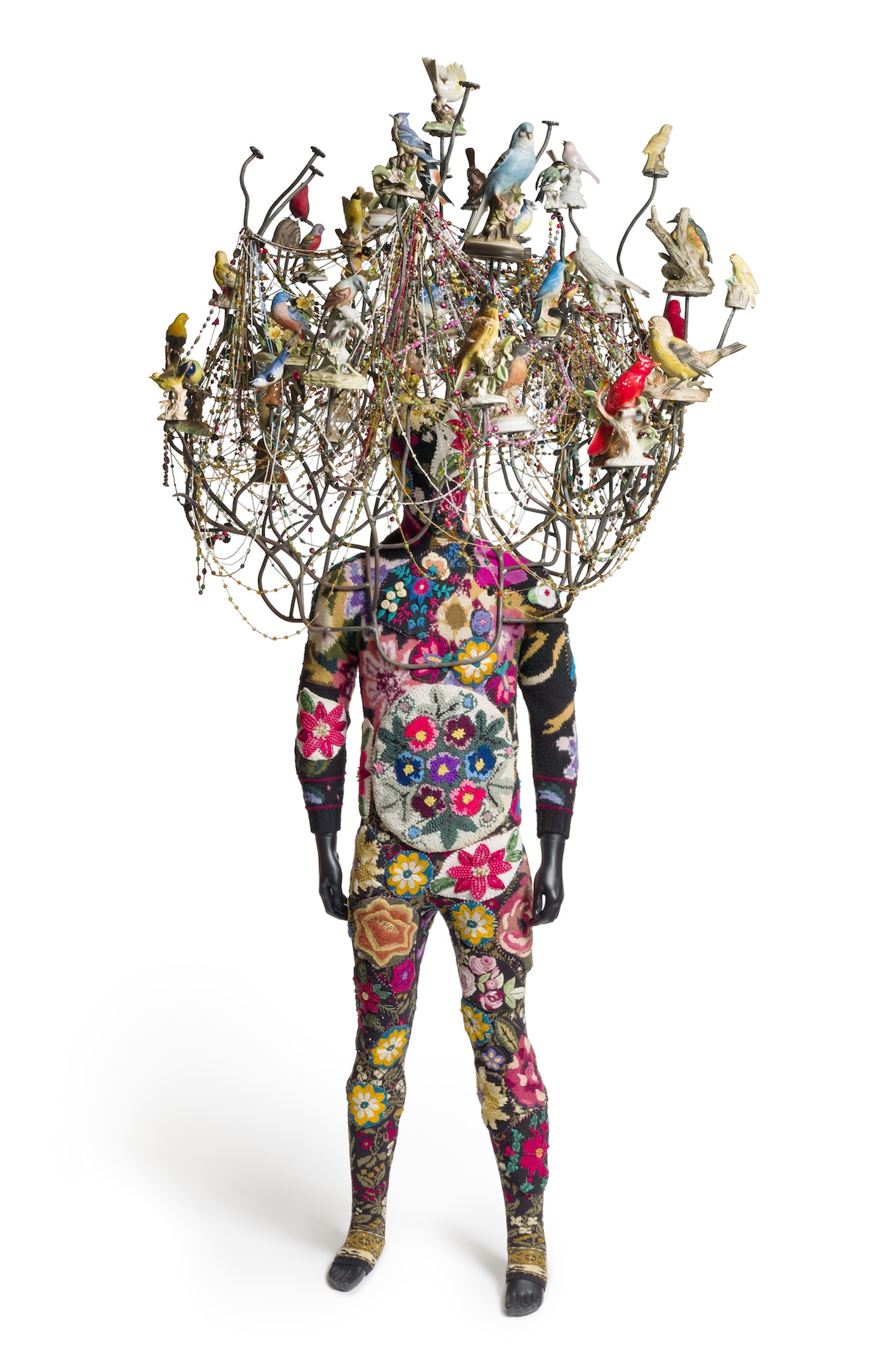
Over time, the Soundsuits evolved from relatively spare constructions into astonishing accumulations of found objects, textiles, embroidery, buttons, toys, sequins, raffia, hair, flowers, metal, and more. Some resemble ritual attire. Others feel like futuristic royalty, carnival emissaries, or mythological beings caught mid-stride. Their relation to African masquerade traditions and Yoruba egungun forms has been noted by museums and critics, but Cave’s achievement is not reducible to influence-mapping. He is making a distinctly contemporary American hybrid, one that places Black cultural memory, craft intelligence, consumer excess, fantasy, and threat in a single vibrating form.
Beauty as confrontation
A less perceptive reading of Cave treats his work as cheerful because it is colorful, or whimsical because it is playful. That has never quite captured the full temperature of the art. Cave’s work is often exuberant, yes, but exuberance is not innocence. The Atlantic put it well years ago when it argued that despite all the hallucinogenic color and sparkle, the work is not lighthearted. The brightness can carry dread. The humor can carry grief. Cave’s elaborate surfaces are frequently composed of discarded or mass-produced things, and his careful assemblage gives them renewed status without stripping them of their prior lives. The result is not kitsch, though kitsch is one ingredient. It is a highly controlled transformation of the ordinary, the thrown-away, and the commercially overproduced into something hovering between critique and devotion.
This tension between attraction and disturbance is part of what makes Cave such a powerful public artist. He understands seduction. He knows viewers come to art with defenses of their own: fatigue, cynicism, ideology, museum anxiety, aesthetic snobbery. So he constructs experiences that bypass those defenses. A viewer may first register the work as dazzling, then uncanny, then troubling, then emotionally exposed. That sequence matters. It allows Cave to widen the audience for difficult questions without diluting the questions themselves.
His work also insists on the seriousness of craft at a moment when craft is too often treated either as quaint or as an undercard to concept. Cave’s labor is visible. The beadwork, stitching, layering, and construction are not incidental to meaning; they are meaning. They speak to patience, discipline, repetition, repair, and touch. In a culture that prizes speed and frictionless surfaces, Cave makes things that insist on time and handwork. That insistence has political weight, especially when placed within histories of Black making, domestic labor, textile traditions, adornment, and forms of beauty long marginalized in elite art discourse.
And then there is sound. Even people who know Cave’s work mostly through photographs can miss how essential sound is to the project. The name “Soundsuit” is literal. These objects announce movement. They crackle, clatter, rustle, swish. That audio dimension turns the body into an event. It also refuses the fantasy of silent passage. The wearer cannot move unnoticed. In a country where the politics of Black visibility are often bound up with the politics of audibility—who gets heard, who is treated as noise, who is told to quiet down—that feels especially resonant. Cave’s art does not merely occupy space. It scores it.
Performance, collaboration, and the social life of the work
To talk about Cave solely as a sculptor is to undersell him. Performance is not a side venture in his practice; it is part of the work’s bloodstream. Because the Soundsuits are wearable, they invite animation. And once animated, they shift from objecthood toward social presence. Cave has long collaborated with dancers, musicians, students, and community participants to activate the works in museums, public sites, and civic environments. Those performances matter not because they “bring the sculptures to life,” as if the sculptures were inert before, but because they reveal Cave’s deeper investment in collective energy. His art is often about what happens when many bodies share a rhythm of looking, listening, and moving together.
“Nick Cave’s real medium may be transformation itself: object into body, body into sound, studio into gathering place, wound into ceremony.”
That collective dimension came into especially sharp focus in large-scale projects such as The Let Go and Until, installations and performances that widened Cave’s field from the individual disguised body to the staged environment of social reckoning. In interviews around Until, Cave spoke directly about gun violence, racism, and the harder question embedded in the installation’s subtitle-like provocation: “Is there racism in heaven?” The point was not to produce a neat answer. It was to force a confrontation between the desire for transcendence and the persistence of earthly injustice. Even Cave’s most sumptuous environments tend to contain a fracture line. The dream is never innocent of the nightmare.
This is also why community-building recurs in descriptions of his work from institutions that have shown it. The Museum of Contemporary Art Chicago, framing its retrospective Forothermore, described Cave as an artist celebrated for blending community building with projects across disciplines. That is not just museum copy. It is a real clue to how his work functions. Cave does not simply produce objects for contemplation; he produces situations for participation and reflection. The viewer is not always a passive receiver. Sometimes the viewer becomes audience, witness, co-mover, or temporary citizen of a Cave-built world.
The social life of the work extends beyond the stage. Cave and designer Bob Faust created Facility in Chicago as a multidisciplinary creative hub that houses Cave Studio, Faust Special Projects, the SoundsuitShop, the Facility Foundation, and a range of pop-up exhibitions, performances, and design experiments. Facility matters because it makes visible something already true of Cave’s career: his practice is infrastructural. He does not only make art; he builds the conditions in which art, design, teaching, performance, and public engagement can cross-pollinate.
Public art and the democratic reach of spectacle
One of the most compelling developments in Cave’s career is the way his language has scaled into public art without losing complexity. Too often, artists entering the public realm simplify themselves into legibility. Cave has largely avoided that trap. His permanent MTA commission in the Times Square–42nd Street and Bryant Park connector, Each One, Every One, Equal All, translates the motion and exuberance of the Soundsuits into mosaic and video within one of the most heavily trafficked transit spaces in New York. The project includes dancing, leaping, brightly colored Soundsuit figures spread across a massive transit environment. In a subway system defined by rush, fatigue, and anonymity, Cave inserted a vocabulary of communal motion and exuberant difference.
Public art at its best can alter routine without demanding piety. Cave understands that. He does not approach the public as though it needs to be scolded into enlightenment. He approaches it as though it might still be surprised. The subway mosaics do not abandon his longstanding concerns with race, embodiment, and visibility; they relocate those concerns into a site where millions of ordinary encounters happen. In that sense, the work is deeply democratic. It refuses the confinement of serious art to elite interiors and insists that color, motion, difficulty, and joy belong in the daily commute too.
This public-facing instinct has helped make Cave unusually legible across audiences. Museum-goers, fashion followers, design enthusiasts, students, dancers, and casual passersby can all find an entry point into the work. That broad reach is not accidental. It comes from Cave’s willingness to operate across disciplines without anxiety about hierarchy. High craft, performance, commerce, and civic address coexist in his practice. That can unsettle purists, but it is also one reason Cave feels so contemporary. He makes art for a world where categories leak.
The retrospective years and the consolidation of a legacy
The 2022 MCA Chicago exhibition Forothermore was an important inflection point because it framed Cave’s production on a career-spanning scale. Institutions and critics had long recognized the power of individual bodies of work, but the retrospective format clarified just how expansive the practice had become: Soundsuits, installations, rescue-dog bronzes, wall works, video, fashion, monumentality, intimacy, social critique, memorial impulse. It also clarified that Cave’s art had matured without becoming static. He was not repeating a signature form for market comfort; he was continually testing what that form could become and what adjacent forms it could produce.
That is an important distinction because the art world often turns successful artists into brands, and brands into repetition. Cave has certainly become recognizable, but recognition has not calcified him. The new work continues to move. Jack Shainman Gallery’s 2025 exhibition Amalgams and Graphts pointed to yet another extension of his visual language, while his 2026 Smithsonian exhibition Mammoth announced a project of even greater scale and autobiographical depth. According to the Smithsonian American Art Museum, Mammoth transforms the galleries into an immersive landscape of crafted mammoth hides and bones, a beaded curtain depicting the Missouri family farm of his childhood, and video projections that animate the extinct animals. The project links prehistoric scale to family memory, land, race, and the force of inherited history.
That turn to the mammoth is fascinating. The mammoth is ancient, immense, extinct, and loaded with associations of buried history. Cave’s use of it suggests an artist digging deeper into origin stories—personal, national, geological, racial—without relinquishing the theatricality that has always been part of his mode. Reviews and previews have emphasized that Mammoth explores land and fraught American history as much as autobiography. In other words, Cave’s recent work is not retreating into personal memory; it is using personal memory as a route into the deeper archive of the country.
Why Cave matters in American art
Nick Cave’s importance is partly formal: few living artists have invented a visual language as distinctive, elastic, and immediately recognizable as the Soundsuit. It is partly historical: he has built that language through sustained engagement with policing, racism, gender performance, Black cultural memory, ritual, spectacle, and public presence. It is partly pedagogical: as a longtime educator, he has influenced generations of artists and designers. And it is partly civic: he has made work that can move between institutions and public life without surrendering seriousness.
But perhaps the clearest way to state Cave’s significance is this: he has found a way to make beauty answerable to violence without allowing violence to define the full horizon of Black art. That is not a minor achievement. Too often, Black artists are asked either to testify to suffering or to provide uplift. Cave refuses that binary. His work can mourn, protest, seduce, dazzle, and laugh in the same breath. It knows America is dangerous. It also knows Black life contains pageantry, invention, wit, softness, glamour, and ecstatic overabundance that cannot be reduced to damage.
There is also something bracingly unfashionable about Cave’s seriousness of purpose. Even when the work is playful, it is not glib. Even when it is accessible, it is not pandering. He believes art can alter perception, and that belief animates the scale of his ambition. In some corners of contemporary culture, that kind of conviction is treated with suspicion, as though earnestness were naïve. Cave has never really played by that rule. He has continued to act like art matters because, in his practice, it plainly does.
And then there is the matter of timing. Cave’s work arrived in the early 1990s with a direct response to state violence against a Black man. It continued through decades in which questions of police brutality, structural racism, public mourning, queer visibility, gender performance, and the politics of the body only became more urgent, not less. That gives his career a chilling continuity. The first Soundsuit was made in one America, but it still speaks fluently in this one.
The future tense of Nick Cave
It can be tempting, when an artist reaches Cave’s level of institutional validation, to write about them in the past tense even while they are still producing major new work. That would be a mistake here. Cave’s practice feels alive in the deepest sense: still evolving, still testing new scale, still expanding the contexts in which art can operate. The 2026 Venice Biennale invitation places him inside one of the world’s most visible international art platforms. Mammoth places him in direct conversation with national history at the Smithsonian. Facility continues his experiment in creating spaces where art and civic imagination meet. None of that reads like a career winding down. It reads like an artist continuing to enlarge the stage.
“In Cave’s world, adornment is never superficial. It is how survival learns to sing.”
What remains most affecting about Cave, though, is not simply his scale or success. It is his insistence on transformation as an ethical act. To transform discarded materials into objects of radiance. To transform a threatened body into ceremonial presence. To transform anger into choreography, grief into rhythm, noise into score, concealment into revelation. Cave’s work does not promise that art can save us from history. It does something harder and more honest. It shows that history can be carried, remade, and answered through form.
That may be why so many viewers leave his work feeling both buoyed and unsettled. The buoyancy comes from the sheer sensory intelligence of the thing: the color, the texture, the audacity, the delight. The unsettled feeling comes from realizing that none of it is casual. Every bead is pulling on a question. Every flourish is guarding a bruise. Every spectacle has a pulse behind it. Cave wants viewers to experience wonder, yes. But he also wants them to understand what wonder is protecting, and what it might allow us to imagine beyond the rigid scripts of the present.
In the end, Nick Cave’s great subject may be freedom—not freedom as slogan, but freedom as a temporary condition of perception. What would it mean to meet a body before prejudice rushes in? What would it mean to move through public space armored not by hardness but by imagination? What would it mean to make room, however briefly, for a fuller human presence than the categories of race, class, gender, and fear typically allow? Cave does not claim to answer those questions conclusively. He stages them. He dresses them. He lets them dance. And in doing so, he has given contemporary American art one of its most original vocabularies for thinking about the peril and possibility of being seen.
More great stories
Amelia Boynton Robinson: A Life Larger Than an Iconic Photograph
April 2, 2026
No Comments
“Black Power”
April 2, 2026
No Comments