



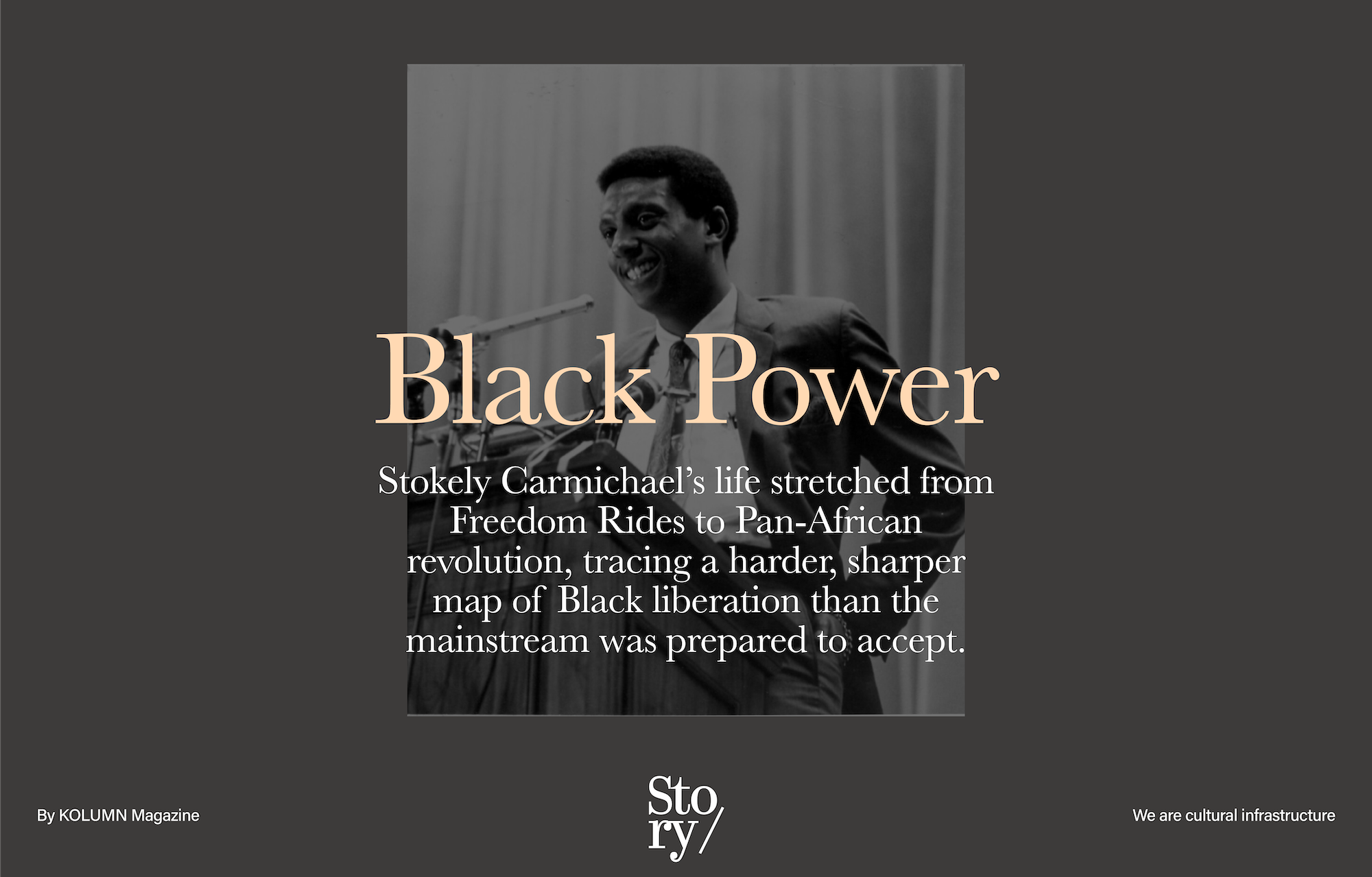
What made Stokely Carmichael dangerous to the American mainstream was not just his militancy. It was his insistence that rights without power were a fragile bargain.
What made Stokely Carmichael dangerous to the American mainstream was not just his militancy. It was his insistence that rights without power were a fragile bargain.
By KOLUMN Magazine
By the time most Americans meet Stokely Carmichael in the historical imagination, he is already mid-sentence. He is on a stage, or at a microphone, or in a grainy photograph with his chin lifted toward the future, saying the two words that would make him famous, controversial, and, in many ways, permanently misunderstood: Black Power. The phrase is often treated as if it arrived fully formed from his mouth in 1966 and then simply detonated across the country. But Carmichael’s life, and his significance, cannot be understood as a rhetorical outburst. He was not merely a slogan-maker. He was an organizer, a strategist, a theorist of power, a world traveler of Black radical politics, and eventually a Pan-Africanist who came to believe the struggle for Black freedom in the United States could not be separated from anti-colonial struggle abroad.
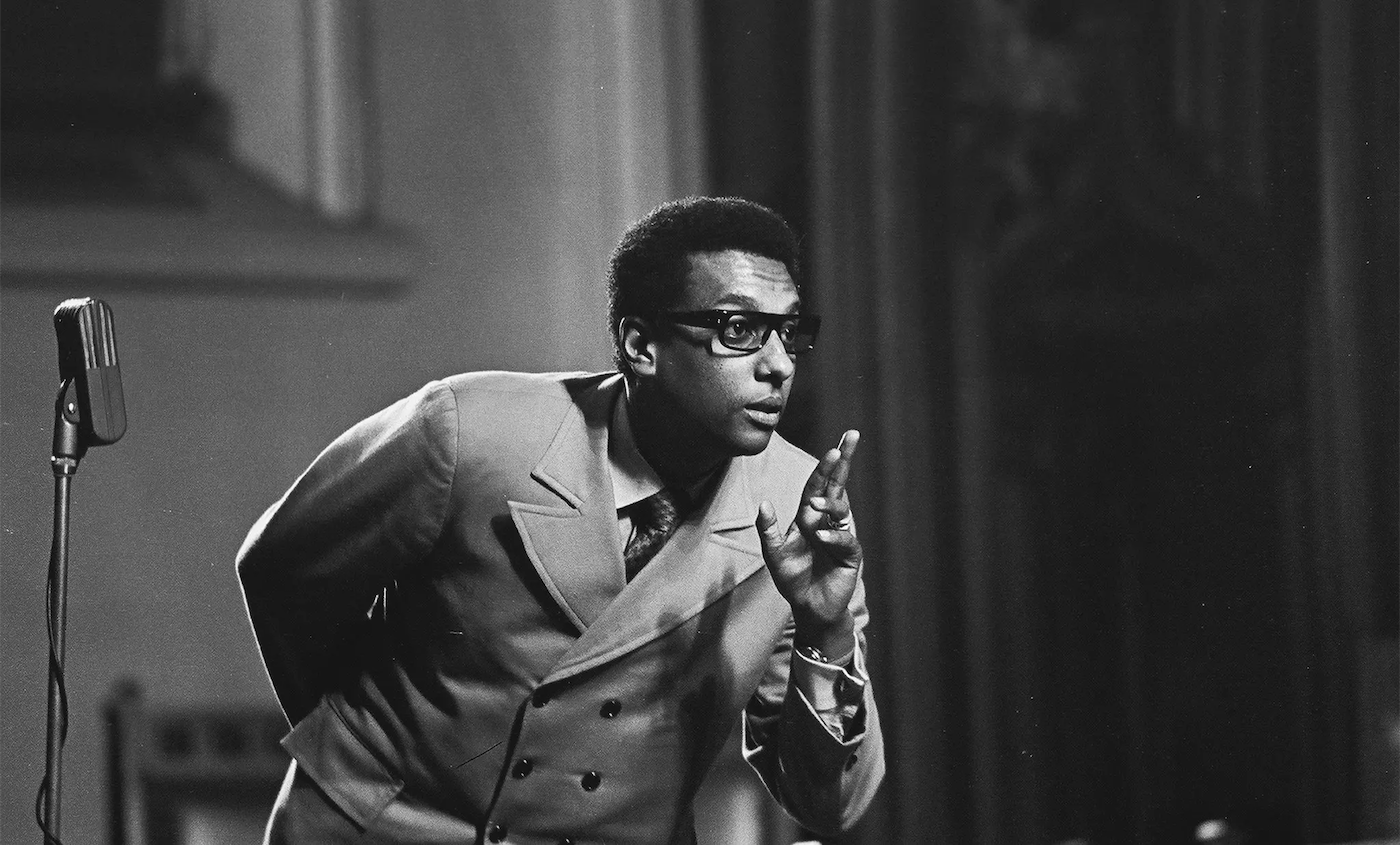
To write about Carmichael honestly is to write about one of the most brilliant and destabilizing figures of the modern Black freedom struggle. He was young enough to embody the impatience of a new generation and sharp enough to expose the limits of liberal consensus. He entered the movement through nonviolent direct action, endured jail and racist terror, helped build voting-rights campaigns in the South, rose to chair the Student Nonviolent Coordinating Committee, and then became one of the most visible faces of a movement that refused to equate desegregation with liberation. Later, after changing his name to Kwame Ture, he devoted much of his life to Pan-African organizing from Guinea. That arc alone should prevent any simplistic treatment of him as either civil-rights apostate or cartoon militant. He was more complicated, and more consequential, than both admirers and detractors often allow.
The temptation with Carmichael is to sort him into a morality play. In one version, he is the fiery radical who pushed the movement off its moral center. In another, he is the truth-teller who stripped away the comforting fictions of interracial liberalism and named what many Black Americans already knew: that legal equality without power leaves a people exposed. Both versions contain fragments of truth. Neither is enough. What matters is not simply that he said “Black Power,” but why that phrase resonated with so many people who had already risked their lives for rights the nation still seemed unwilling to secure.
Before the symbol, there was the organizer
Stokely Standiford Churchill Carmichael was born on June 29, 1941, in Port of Spain, Trinidad, and moved to the United States as a child, eventually growing up in New York. He attended the Bronx High School of Science, a detail that matters not as résumé decoration but because it hints at the intellectual force he would later bring to movement politics. He was not an accidental leader elevated by charisma alone. Even his opponents recognized the precision of his mind. By the time he enrolled at Howard University in 1960, he was entering a Black intellectual and political world that sharpened his instincts and widened his ambitions. Howard was not simply where he studied philosophy; it was where he entered the furnace.
At Howard, Carmichael joined the Nonviolent Action Group and connected with the Student Nonviolent Coordinating Committee, the youth-led formation that would become one of the most important engines of grassroots civil-rights struggle. SNCC was different from the more publicly legible organizations of the era. It prized fieldwork over pageantry, local leadership over personality cults, and sustained organizing over symbolic spectacle. For someone like Carmichael, it offered both discipline and danger. It also offered a way to turn moral outrage into political practice.
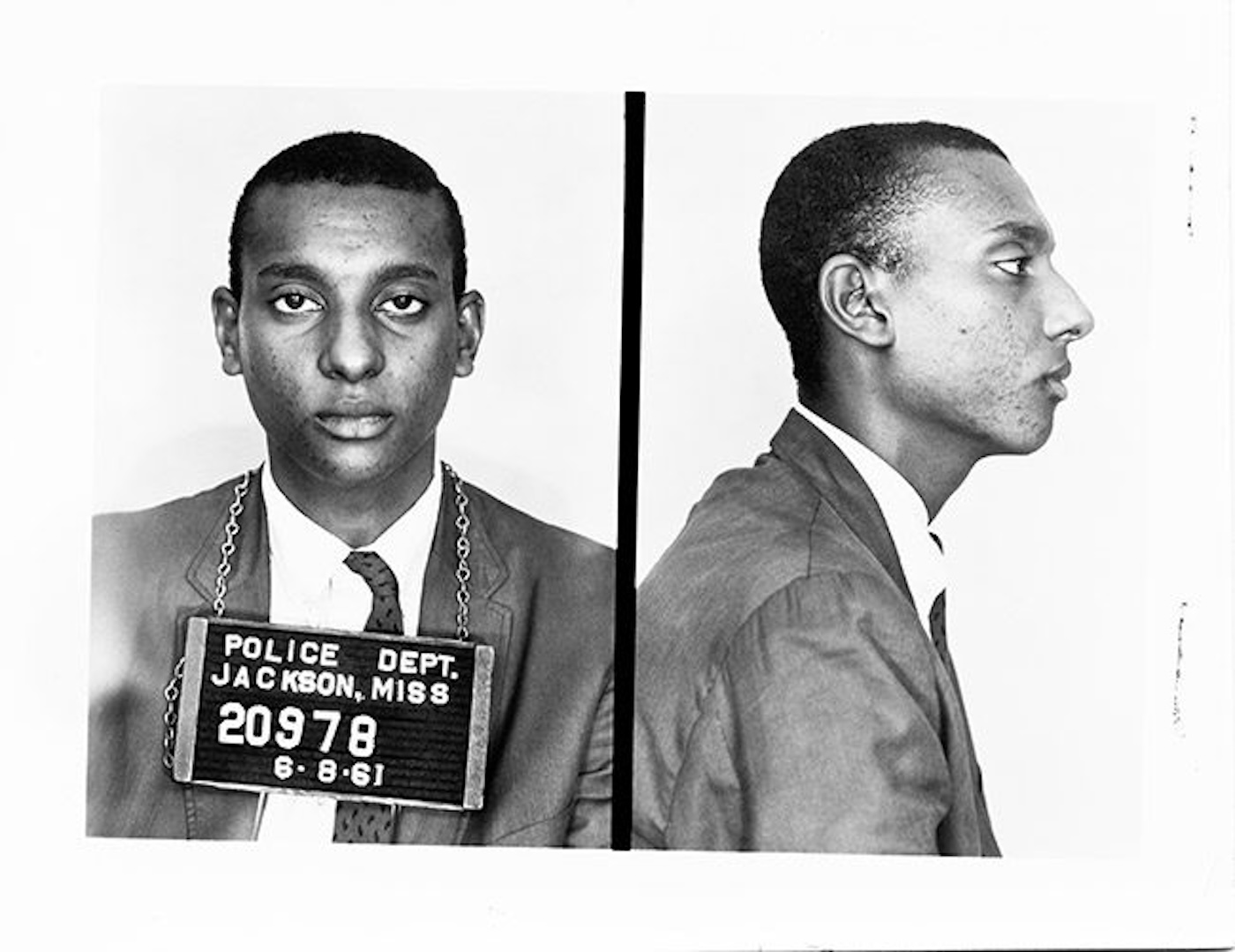
He was only 19 when he joined the 1961 Freedom Rides, the interracial campaign challenging segregated interstate travel. That decision was not a youthful flourish. It was a deliberate entry into a movement that understood jail, beatings, and possibly death as occupational hazards. Carmichael was arrested during the rides and spent weeks in Mississippi’s Parchman Penitentiary, one of the South’s most notorious prisons. That experience is crucial to understanding the man he became. The Stokely Carmichael who later questioned whether white America could be moved by appeals to conscience was not theorizing from a distance. He had already tested the nation’s conscience and found it brutal.
This is one of the central misreadings of Carmichael’s career: the idea that he began in nonviolence and then somehow fell from grace into anger. In reality, his political development was shaped by accumulated evidence. He saw activists beaten. He watched local Black communities absorb terror with little federal protection. He witnessed the country celebrate white martyrdom while too often minimizing Black suffering. In later commentary, Martin Luther King Jr. himself acknowledged that Carmichael’s critique emerged from repeated encounters with unpunished white violence. King disagreed with Carmichael’s conclusions, but he did not dismiss the experience that produced them.
Mississippi taught him what the nation was
Carmichael’s deepest political education did not happen in lecture halls. It happened in Mississippi and Alabama, in the long, dangerous work of voter registration and local organizing. He became part of the movement’s ground game, the under-credited labor of building trust in places where Black people faced economic retaliation, physical assault, and murder for trying to vote. If television made national leaders, counties like Leflore and Lowndes made movement thinkers. Carmichael was one of them.
“Carmichael did not arrive at Black Power because he had lost interest in democracy. He arrived there because he no longer confused access with control.”
SNCC’s organizing philosophy mattered here. Rather than imagine liberation as something delivered by famous men from outside, SNCC worked to cultivate local power. That meant listening to sharecroppers, domestic workers, preachers, young people, and elders who had been resisting for years before camera crews arrived. Carmichael absorbed that ethic. He could be flamboyant in public, but his political grounding came from the patient, unspectacular labor of organizing Black communities to act on their own behalf.
The Mississippi Freedom Democratic Party’s treatment at the 1964 Democratic National Convention sharpened his skepticism toward American party politics. After Black Mississippians and their allies built an alternative delegation to challenge the segregationist regulars, the national party refused to seat them in full. For many SNCC activists, the lesson was devastating. It suggested that even after extraordinary sacrifice, Black political claims could still be managed, delayed, and diluted in the name of national unity. Carmichael was among those who concluded that moral witness alone would not reorder power.
That conclusion helped set the stage for one of his most important, and often underappreciated, achievements: his work in Lowndes County, Alabama. After the passage of the Voting Rights Act in 1965, Carmichael and other organizers worked with local Black residents to build the Lowndes County Freedom Organization, an independent political party in a county where Black people were the majority population but had long been excluded from meaningful political power. The group adopted the black panther as its symbol, a choice that later echoed in Oakland when Huey Newton and Bobby Seale formed the Black Panther Party for Self-Defense. Lowndes was not a detour in Carmichael’s story. It was the proof of concept for his politics.
Lowndes County revealed the substance beneath the rhetoric. Black Power, at least in Carmichael’s most serious formulation, did not simply mean emotional militancy or anti-white symbolism. It meant building institutions, independent political leverage, and a constituency that could act without asking permission. In that sense, his politics were both more radical and more practical than critics often admitted. He was not just calling for pride. He was calling for governance.
The day “Black Power” became a national argument
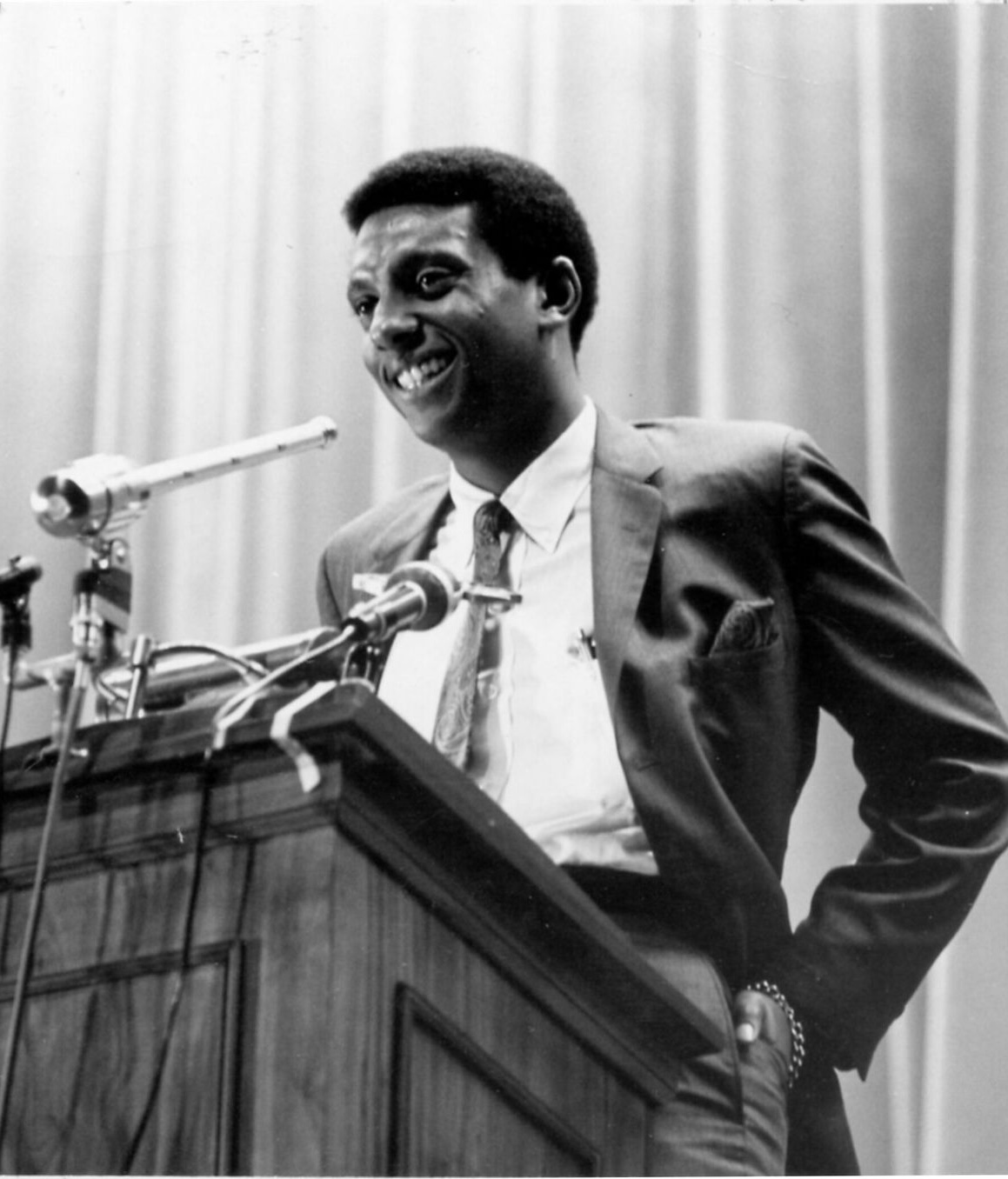
In June 1966, during the March Against Fear in Mississippi, James Meredith was shot after beginning a solitary march meant to challenge racial terror and encourage Black voter registration. Major civil-rights groups, including SNCC, SCLC, and CORE, continued the march. During the campaign, Carmichael was arrested in Greenwood, Mississippi. After his release, he addressed a crowd and declared, “We been saying ‘freedom’ for six years and we ain’t got nothin’. What we gonna start saying now is ‘Black Power.’” The phrase ricocheted across the nation almost instantly.
It is hard to overstate how much anxiety those two words generated. To many white Americans, “Black Power” sounded like a threat, a racial inversion, a repudiation of integration, perhaps even a summons to violence. To some Black moderates, it seemed politically reckless. To others, especially younger activists and urban Black audiences living with persistent poverty, police abuse, and northern segregation, it sounded like overdue honesty. What Carmichael had done was force a semantic crisis inside the freedom struggle. He made the country argue about what Black people were actually asking for.
Carmichael tried repeatedly to explain that Black Power was not a mirror image of white supremacy. In his speeches and later in Black Power, written with Charles V. Hamilton, he argued that the issue was not hatred of white people but the creation of political, economic, and cultural strength in Black communities. He also helped popularize the concept of “institutional racism,” shifting public understanding beyond individual prejudice toward the ways systems distribute harm and opportunity. That conceptual move alone makes his legacy feel contemporary. Long before diversity statements and corporate reckonings, Carmichael was naming racism as structure, not merely sentiment.
Still, the discomfort he produced was real, and not only among white liberals. King worried that the slogan would alienate allies and obscure the moral force of nonviolence. Other critics believed it oversimplified strategy at a moment when the movement needed broad coalition. Those concerns were not frivolous. But the problem with much of the criticism, then and now, is that it focuses on the phrase’s tone more than the conditions that made it persuasive. “Black Power” did not gain traction because Carmichael was theatrical. It gained traction because many Black Americans had already concluded that legal breakthroughs were not translating into security, wealth, or governing power.
This is where Carmichael still feels unnervingly modern. He asked whether representation without transformation amounts to much. He challenged the idea that proximity to white institutions is itself a form of freedom. He insisted that communities needed not just inclusion in systems built by others, but the power to define agendas, allocate resources, and defend their own lives. Whether one agrees with all of his conclusions or not, those questions remain alive in contemporary debates over policing, schools, voting rights, labor, and wealth.
Why he broke with the mainstream
Carmichael’s elevation to chairman of SNCC in 1966 made visible tensions that had been building for years inside the movement. SNCC had emerged from sit-ins and freedom rides with a fierce commitment to nonviolent direct action, interracial organizing, and grassroots democracy. But by the mid-1960s, many of its members had grown exhausted with white terror, federal timidity, and the tendency of national media to flatten Black struggle into morality tales centered on white redemption. Carmichael did not create that impatience. He gave it a sharper language.
As chairman, he pushed SNCC further toward Black self-determination and away from interracial liberalism as an article of faith. That move remains one of the most contested parts of his legacy. Critics say it narrowed the movement’s coalition and hardened public backlash. Supporters argue it clarified a basic political truth: oppressed groups cannot outsource their liberation, and interracial partnership means little when one side still controls the terms. In hindsight, both readings illuminate something real. Carmichael’s shift helped re-center Black agency, but it also intensified fractures inside a coalition already strained by class, region, ideology, and the escalating war in Vietnam.
He also became increasingly outspoken against the Vietnam War and more openly skeptical of American imperialism. That mattered because it widened his frame. Carmichael was not content to see racism as a domestic defect in an otherwise redeemable national project. He increasingly understood Black struggle in relation to colonial violence abroad, and he aligned himself with global liberation movements in Cuba, Vietnam, and across Africa. The result was a politics that many Americans viewed as radical, even unpatriotic. To Carmichael, it was simply coherent.
This is also where the media story around him began to harden. The press, especially mainstream white press, often treated him as the anti-King: combustible where King was measured, separatist where King was universal, inflammatory where King was redemptive. That binary was always too neat. Carmichael admired King’s courage even as he doubted nonviolence as a permanent strategy. King, for his part, recognized the experience behind Carmichael’s militancy even as he rejected its political direction. Their relationship was not reducible to simple opposition. It reflected an internal argument within Black freedom politics about strategy, timing, and the meaning of power.
The Black Panther connection, and the confusion that followed
One of the enduring confusions around Carmichael is his relationship to the Black Panther Party. Because the phrase “Black Power” and the image of militancy became so intertwined, many people collapse his role into the Panthers entirely. The historical record is more precise. Carmichael helped build the Lowndes County Freedom Organization, whose black panther symbol predated the Oakland-based Black Panther Party. He later aligned with the Panthers and served, for a time, as their honorary prime minister, but his relationship with the organization was neither simple nor permanent.
“America often remembers Carmichael as a provocation. History is clearer when it remembers him as a diagnosis.”
That distinction matters because it helps recover Carmichael as an architect of Black independent politics rather than merely a poster figure of armed resistance. The Panthers, of course, became iconic for their patrols, uniforms, and confrontations with police, but they were also engaged in community programs and political education. Carmichael’s connection to them intensified the state’s scrutiny of him and cemented his image as a radical in the public mind. Yet he was already headed toward a broader Pan-African horizon that would eventually pull him beyond the Panthers’ U.S.-centered framework.
He was also a target, and not just rhetorically. The surveillance state regarded him as dangerous. In 2022, declassified documents reported by The Guardian showed that British officials had targeted Carmichael and sought to weaken the Black Power movement through covert disinformation efforts. In the United States, his prominence made him a subject of FBI attention as well. That sustained scrutiny did not create his politics, but it did help shape the environment in which his public image was manufactured: watched, distorted, feared, and often detached from the organizing logic beneath it.
Miriam Makeba, exile, and the global turn
Carmichael married the South African singer and activist Miriam Makeba in 1968, a union that symbolized more than celebrity or romance. It embodied his movement toward a global Black politics rooted in anti-colonial struggle. Makeba herself had become an international voice against apartheid, and together they represented a kind of diasporic convergence: Black freedom in the United States linked to liberation movements in Africa. Their marriage also intensified backlash. Makeba’s career in the United States suffered, and the couple increasingly relocated their political center of gravity abroad.
Eventually Carmichael moved to Guinea, where he took the name Kwame Ture in honor of Ghana’s Kwame Nkrumah and Guinea’s Ahmed Sékou Touré. The name change was not cosmetic. It signaled an ideological commitment to Pan-Africanism as the framework through which he increasingly understood his life’s work. For many Americans, this was the point at which Carmichael seemed to disappear from the national story. In reality, he did not vanish so much as exit the narrative field that the United States is most comfortable recognizing. He was no longer legible as a domestic protest celebrity. He was trying to become something else.
That move has often been treated in one of two ways: either as evidence that he abandoned the American struggle or as proof of visionary internationalism. The truth is messier. His relocation did reduce his direct presence in U.S. movement politics. It also reflected a principled belief that Black liberation in America could not be severed from the political fate of Africa and the wider African diaspora. Whether that belief seems strategically persuasive may depend on one’s own politics. But it was not escapism. It was the culmination of a worldview he had been building for years.
Even in exile, he remained a point of reference. Historians, activists, and cultural critics kept returning to him because the arguments he raised would not disappear. What is the difference between integration and equality? Between access and power? Between reform and self-determination? Those are not archival questions. They recur whenever Black political life is asked to accept symbolic progress as substantive justice.
The burden of being remembered badly
No major figure in the freedom struggle escapes simplification, but Carmichael has suffered a particularly severe form of it. King gets polished into a harmless dreamer. Malcolm X gets condensed into militancy and then redeemed through selective quotation. Carmichael is often reduced even further, to an expression, a posture, a mood. The effect is to sever him from the intellectual and organizational tradition he inhabited. He becomes all heat, no architecture.
That reduction is politically useful. A thinker like Carmichael becomes easier to dismiss if he can be framed as merely angry. But there was a disciplined logic to his arguments. He was insisting that communities subjected to racial domination needed the means to govern themselves, defend themselves, and shape their own economic destiny. He believed interracial democracy, if it was to be real, had to be built on power rather than sentiment. That proposition frightened people then, and it still does.
The term “institutional racism,” which Carmichael helped popularize with Charles Hamilton, is now so normalized in public discourse that it can be easy to miss how disruptive it once was. It redirected attention from individual bad actors to systems, from prejudice to administration, from moral innocence to political design. That is a profound shift in analysis, and it helps explain why his work endures beyond the context of 1960s speechmaking. In an age still arguing over whether racism is structural or merely personal, Carmichael sounds less like a relic than a precursor.
The same can be said of his critique of representation. Carmichael did not deny the significance of Black electoral breakthroughs. He questioned whether they changed the material position of ordinary Black people when institutions remained structurally unequal. Near the end of his life, he was still making versions of that argument. It remains uncomfortable because it asks a harder thing of democracy than symbolism can supply.
What his critics got right, and what they missed
A fair account of Carmichael has to admit that some criticism of him was grounded, not reactionary. His rhetoric could be sharp, theatrical, and occasionally combustible. He sometimes embraced provocation with a showman’s instinct, and he could give adversaries plenty of material with which to caricature him. His later politics also included a more rigid ideological posture that some former allies found limiting. It would be unserious to pretend none of that mattered.
But the sharper question is whether those criticisms have overshadowed what he saw more clearly than many of his contemporaries. Carmichael understood that anti-Black domination was not just a matter of lunch counters and buses, but of political machinery, economic extraction, and armed enforcement. He understood that white approval could become a trap for Black movements. He understood that the North was not morally superior to the South, merely less honest about its racial arrangements. And he understood that decolonization abroad would reshape Black political consciousness at home. Those insights have held up remarkably well.
The tension, then, is not between hero and villain. It is between a figure whose language sometimes exceeded the strategic comfort of the mainstream and a country whose idea of justice was often too small to meet the crisis he described. Carmichael was not always right. But he was often early. That is a different kind of historical importance.
Why Stokely Carmichael still matters now
The afterlife of Carmichael’s ideas is visible almost everywhere, even where his name is not. When organizers talk about community control, structural racism, self-determination, or international solidarity, they are moving on terrain he helped map. When contemporary activists reject the idea that representation alone equals liberation, they are revisiting a debate he forced into the open. When scholars and museums frame Black Power not as a betrayal of civil rights but as one of its logical evolutions, they are correcting a story that long treated Carmichael as an aberration instead of an inheritor and transformer of Black radical tradition.
His relevance is also visible in the recurring state anxiety around Black organizing. The surveillance, distortion, and containment of Black political movements did not end with the 1960s. The newly revealed British effort to target Carmichael is a reminder that governments often understood the threat of his politics better than casual history does. They understood that the real danger was not merely a slogan, but the possibility that Black people might build durable political consciousness beyond the management of liberal institutions.
For younger generations, Carmichael can be tempting as iconography: handsome, sharp, quotable, radical. But his actual legacy is more demanding. He asks whether movements are building power or only visibility. Whether they are winning reforms or changing who governs. Whether they are satisfied with diversity in elite spaces or committed to transforming the conditions under which most people live. Those are not nostalgic questions. They are live wires.
There is, too, something clarifying in the fact that Carmichael’s reputation still makes many people uneasy. History has a habit of domesticating the dead, sanding their roughest edges into classroom civics. Carmichael resists that process. He remains difficult because his central claim remains difficult: a people denied power cannot secure freedom on terms set by others. Whether one calls that Black Power, self-determination, participatory democracy, or communal sovereignty, the friction remains.
The man after the myth
Kwame Ture, as he was known in the final decades of his life, died in Conakry, Guinea, on November 15, 1998, at 57, after battling prostate cancer. Obituaries inevitably returned to the phrase that made him famous, and with good reason. But they also pointed to something more durable: a life spent trying to imagine Black freedom beyond the narrow boundaries that the United States kept offering as compromise. Jesse Jackson said he gave his life to transforming America and Africa. Julian Bond said he should be remembered for spending nearly every moment of his adult life advancing Black liberation. Those are large claims, but not exaggerated ones.
The simplest way to say it may also be the most accurate. Stokely Carmichael mattered because he changed the argument. He changed what could be said in public, what could be demanded, what counted as political realism, and what kinds of Black futures were imaginable. He did not do that alone; no serious history would claim otherwise. He stood in a movement crowded with organizers, thinkers, local leaders, students, preachers, workers, and freedom fighters. But he had a rare ability to crystallize a historical mood and push it toward doctrine.
If America prefers heroes who reassure it, Carmichael was never going to be easy to love. He was too impatient for ceremony, too skeptical of symbolism, too attuned to the gap between rights on paper and power in practice. That is exactly why he remains essential. He did not ask the country to feel better about itself. He asked whether it was prepared to change.
And that, more than half a century after “Black Power” entered the national bloodstream, may be the clearest measure of his significance. Stokely Carmichael is still with us not because the slogan survived, but because the problem he named did.
More great stories
Nick Cave’s Radical Splendor
April 2, 2026
No Comments
Amelia Boynton Robinson: A Life Larger Than an Iconic Photograph
April 2, 2026
No Comments