





If you want, I can also turn this into a publication-ready version with a sharper magazine lede and a more stylized ending.
If you want, I can also turn this into a publication-ready version with a sharper magazine lede and a more stylized ending.
By KOLUMN Magazine
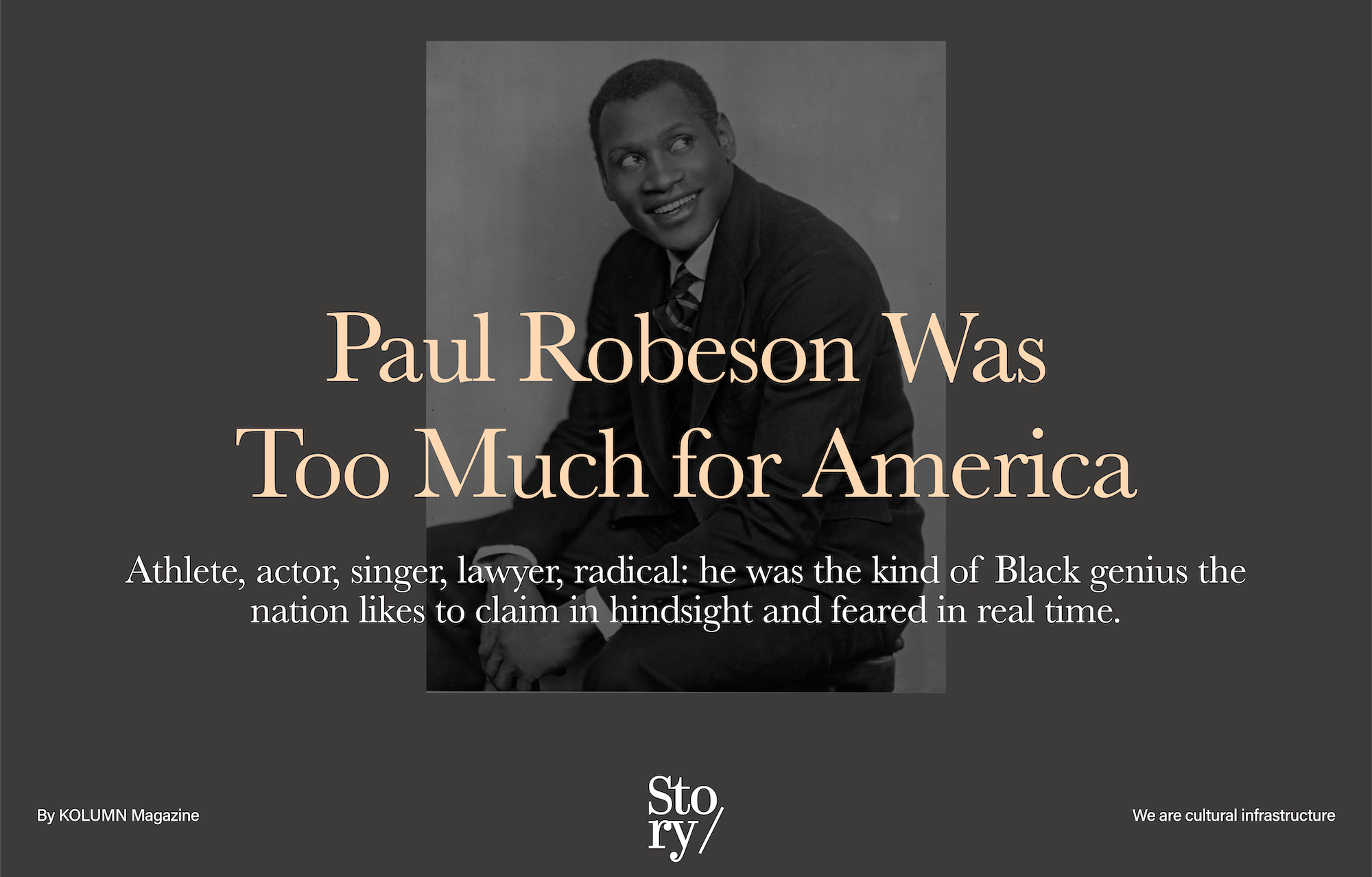
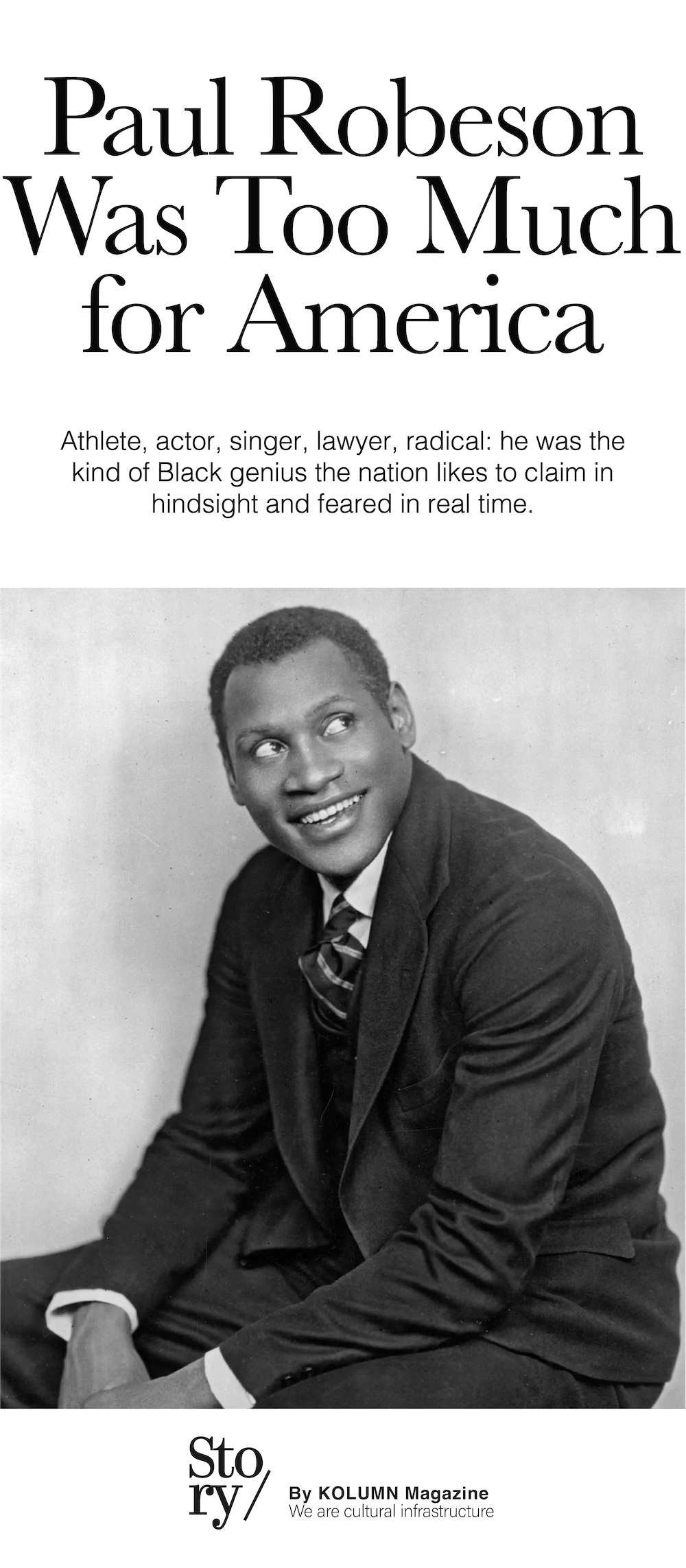
There are public figures whose greatness is easy for a country to celebrate. They break records, collect honors, and fit neatly into a patriotic frame. Then there are figures like Paul Robeson, whose brilliance was so expansive, and whose politics were so uncompromising, that the country spent decades trying to decide whether to exalt him, erase him, or fear him. Robeson was not simply a singer, actor, athlete, lawyer, and activist. He was one of the rare Black Americans whose talent could have secured him a permanently comfortable place in the national pantheon. Instead, he used that fame to indict white supremacy, labor exploitation, colonialism, and state repression in language so direct that the American establishment turned on him with unusual force.
That is what makes Robeson so compelling even now. The basic biographical outline is already astonishing: born in Princeton in 1898 to a father who had escaped slavery, graduating from Rutgers as one of its earliest Black students and a star athlete, earning a Columbia law degree, then becoming an international celebrity on the stage and in concert halls. But the outline alone does not explain why his life still feels urgent. What makes Robeson matter is that he refused the bargain America has often offered its most gifted Black citizens: you may be extraordinary, but only so long as your extraordinariness never turns into a structural critique. Robeson broke that bargain early and decisively.
He understood, perhaps earlier and more completely than many of his contemporaries, that Black freedom in the United States could not be separated from labor rights, anti-fascism, anti-colonial struggle, and the global color line. That worldview made him unusually modern. It also made him unusually dangerous to those invested in narrowing Black politics into something more manageable, more respectable, and less international. Long before the phrase “intersectional” entered mainstream vocabulary, Robeson was living a politics that linked racism, class exploitation, war, and empire into one moral argument
Born into memory, discipline, and expectation
Paul Leroy Robeson was born on April 9, 1898, in Princeton, New Jersey. His father, William Drew Robeson, had escaped enslavement as a teenager and became a minister. His mother, Maria Louisa Bustill Robeson, came from a family with deep roots in Black free communities and abolitionist traditions. That lineage mattered. Robeson did not come to political consciousness out of nowhere; he was shaped from the beginning by a family history in which slavery, resistance, literacy, religion, and Black self-respect were all braided together. His mother died when he was still a child, and the emotional and material hardships that followed did not make his ambitions smaller. They sharpened them.
At Rutgers, Robeson performed the kind of excellence that American institutions like to mythologize in retrospect but were far less comfortable honoring in real time. He was only the third Black student known to attend the university, earned a scholarship, excelled in speech and debate, played four varsity sports, and graduated at the top of his class. He was a football standout and All-American, the kind of campus legend schools later build branding campaigns around. But his achievements unfolded inside an environment where racial hostility was a routine fact, not a footnote. The point is not that Robeson transcended racism through grit. The point is that he carried its violence with him while outperforming the structures designed to diminish him.
After Rutgers, he attended Columbia Law School and earned his law degree in 1923. In another life, that might have been the beginning of a distinguished legal career. Instead, one oft-cited incident became emblematic of the profession’s racial ceiling: a white secretary refused to take dictation from him because he was Black. The insult was clarifying. Robeson did not leave the law because he lacked discipline or direction. He left because American law, like so many elite professions of the period, had already announced the terms of Black participation. Talent, again, would not be enough.
Stardom was not the destination
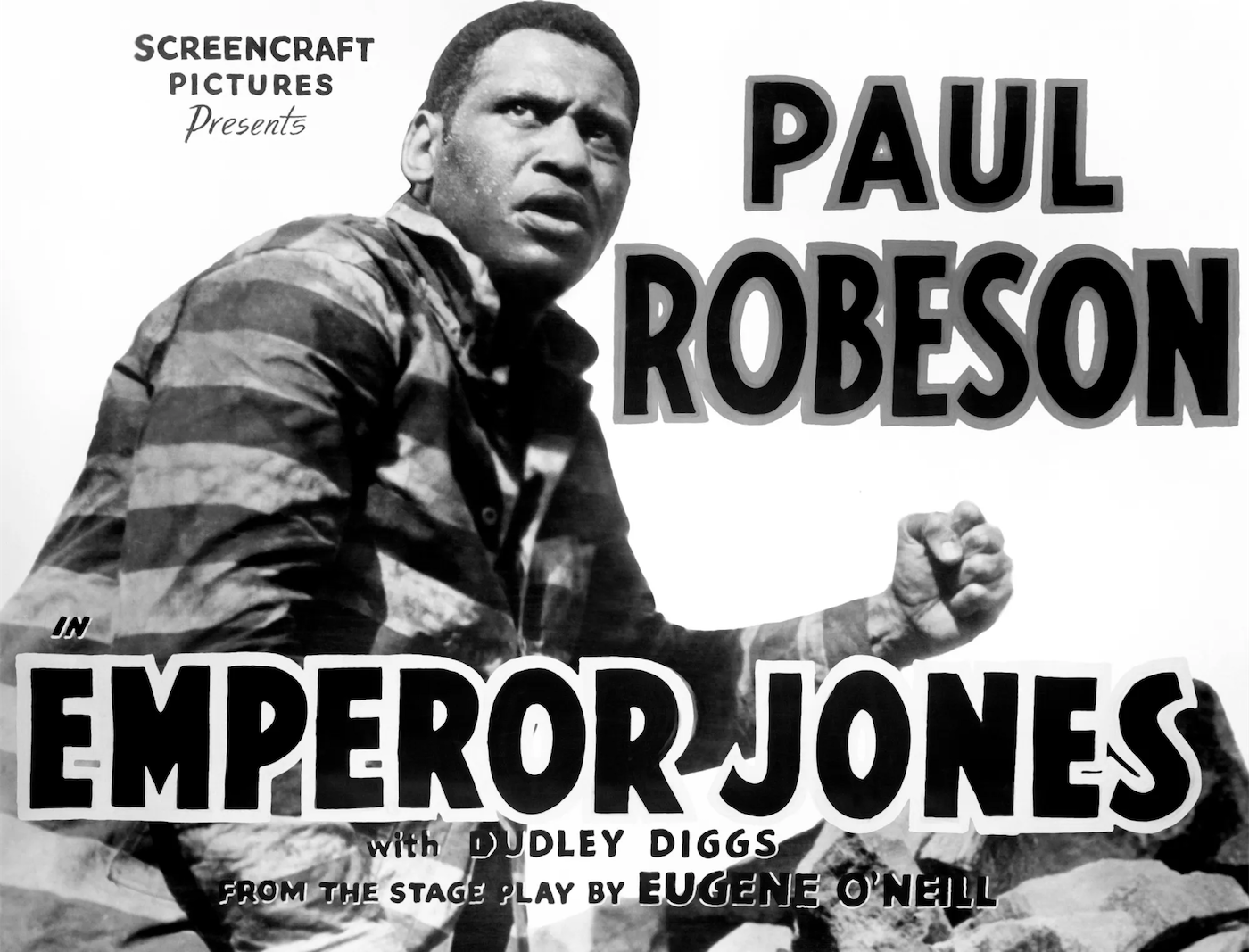
Robeson’s move into theater and music can look, from a distance, like a glamorous pivot. In reality, it was also a practical reorientation toward a field where his gifts could be seen and heard more fully. He made his Broadway and London debuts in the early 1920s, worked with Eugene O’Neill, and became a sensation in The Emperor Jones. His first recitals of spirituals also helped redefine what serious concert music could sound like when filtered through Black cultural inheritance. Robeson did not treat spirituals as quaint ethnographic artifacts. He performed them as a living, dignified, and artistically complex tradition.
His rise in Show Boat made him internationally famous, especially through “Ol’ Man River,” a song that became inseparable from his voice. Yet even here Robeson refused simple stardom. He gradually changed how he sang the song, pushing it away from fatalism and toward resistance. That interpretive shift was not cosmetic. It was a philosophy. He understood that art shapes political feeling, and he would not keep reproducing resignation for audiences when struggle was the more honest register. Britannica notes that in a London performance supporting the Spanish Republic, he altered the ending toward a defiant insistence on continued fighting rather than passive suffering. That evolution tells you almost everything about him. He would not merely embody Black pain; he would revise its script.
“The artist must elect to fight for freedom or slavery. I have made my choice.”
That statement has survived because it captures Robeson’s central refusal: he did not believe art could remain neutral in a world organized by domination. He was not interested in being an ornament of culture. He wanted culture to move history. That conviction put him at odds not just with conservative America but with anyone who wanted artists, especially Black artists, to remain inspirational but politically harmless.
Othello, and the meaning of representation
No discussion of Robeson is complete without Othello. He played the role in London in 1930 opposite Peggy Ashcroft, a mixed-race casting arrangement that would have been almost unthinkable on the U.S. stage at the time. When he returned to the role in the 1943 Broadway production, the result was historic. Folger and the Library of Congress both document that the production became the longest-running Shakespeare production on Broadway at the time, ultimately reaching 296 performances. It was not merely a personal triumph. It was a demonstration of what happened when a Black actor seized a role long filtered through white performance traditions, including blackface.
The 1943 production also mattered because it fused artistic achievement with moral discipline. The cast refused to perform in segregated theaters while touring, a decision preserved in the Library of Congress essay on the production. That meant Robeson’s theatrical work did not sit in a separate box from his politics; it carried them. Even in Shakespeare, he was making an argument about who deserved full presence on the American stage and under what conditions. He was not simply becoming visible. He was contesting the terms of visibility.
And yet Othello also reveals the recurring tension in Robeson’s life. America loved him most when it could describe him as unprecedented. The first Black actor to do this. The breakthrough star who did that. But Robeson was never content to be a symbol of inclusion detached from collective struggle. He insisted that his fame point back toward larger systems: segregation, labor precarity, colonial subjugation, fascism. He kept turning prestige into platform, and platform into pressure. That is when the applause started thinning out.
Wales, London, Moscow, and a wider political horizon
One of the most consequential things about Robeson’s life is that he belonged to a generation of Black intellectuals and artists for whom travel was not only liberating but analytic. He saw the United States more clearly by leaving it. In Britain, especially through his encounters with Welsh miners and working-class communities, Robeson deepened a politics that linked anti-racism to labor solidarity. The Guardian’s account of his political development in the Welsh valleys argues that Britain helped radicalize him, not because it was free of racism, but because it exposed him to class struggle in a more legible form and offered solidarities that widened his frame.
That matters because Robeson is sometimes flattened into a domestic civil-rights precursor. He was that, yes, but he was also something more transnational. He sang folk songs in numerous languages, studied more than twenty languages, and deliberately used global repertoire to emphasize human connection across national and cultural boundaries. The New York Public Library’s collection notes his interest in songs from Welsh, Chinese, Russian, and Jewish traditions, part of his broader insistence on cultural and human unity. This was not a side project. It was his worldview: Black struggle was neither provincial nor exceptional; it was one front in a global contest over human dignity.
The Atlantic, writing about Black expatriate traditions, places Robeson in a longer lineage of African Americans who sought, or were pushed into, other geographies in search of air outside U.S. racism. But the same piece makes an important distinction: Robeson was not fleeing politics. He was pushed outward by them and made more political by the movement. Travel expanded his critique rather than softening it. His affection for places like London and Moscow was never just about personal comfort. It was about what those places revealed, however imperfectly, about America’s own racial hypocrisies.
The activist the establishment could not discipline
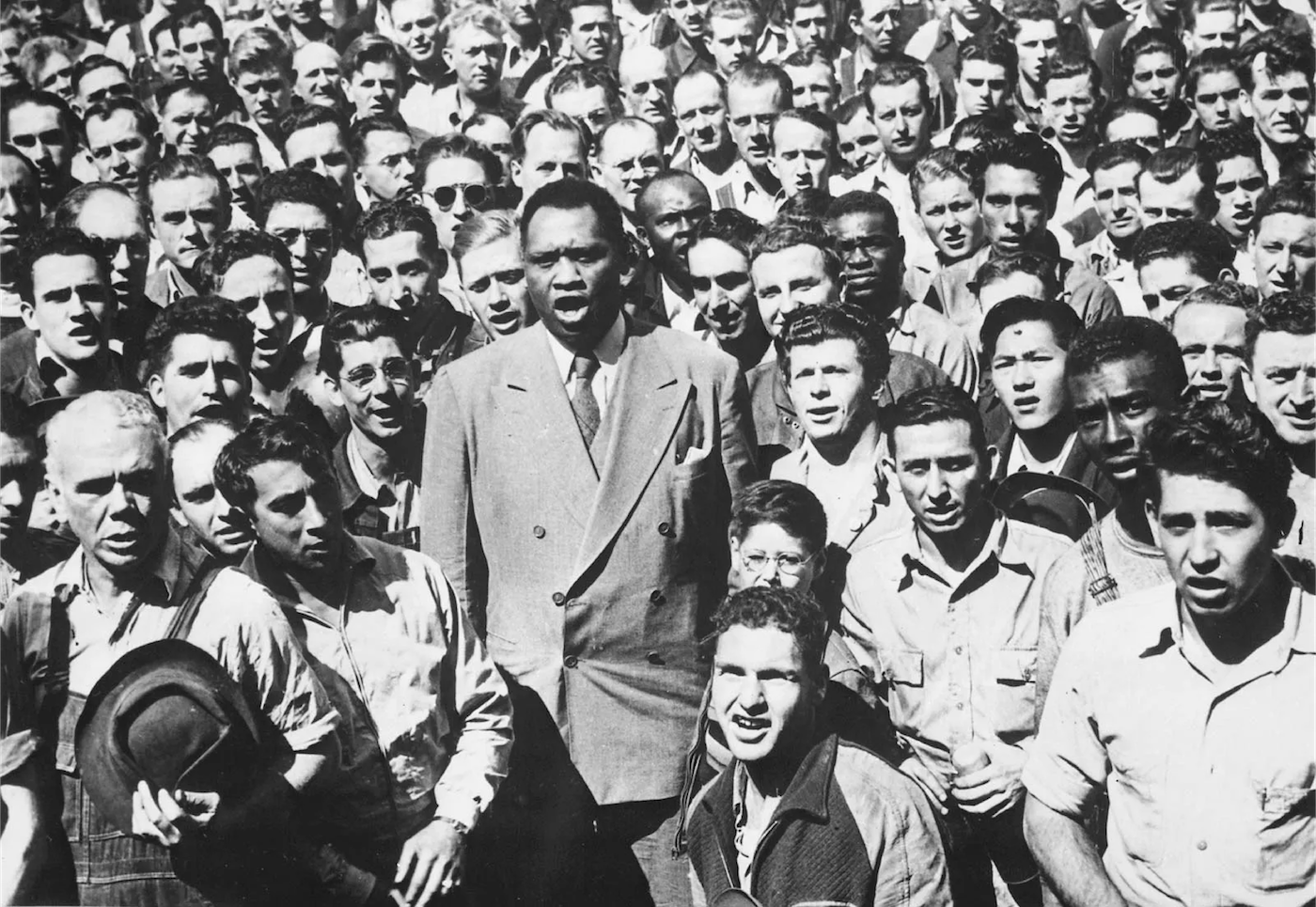
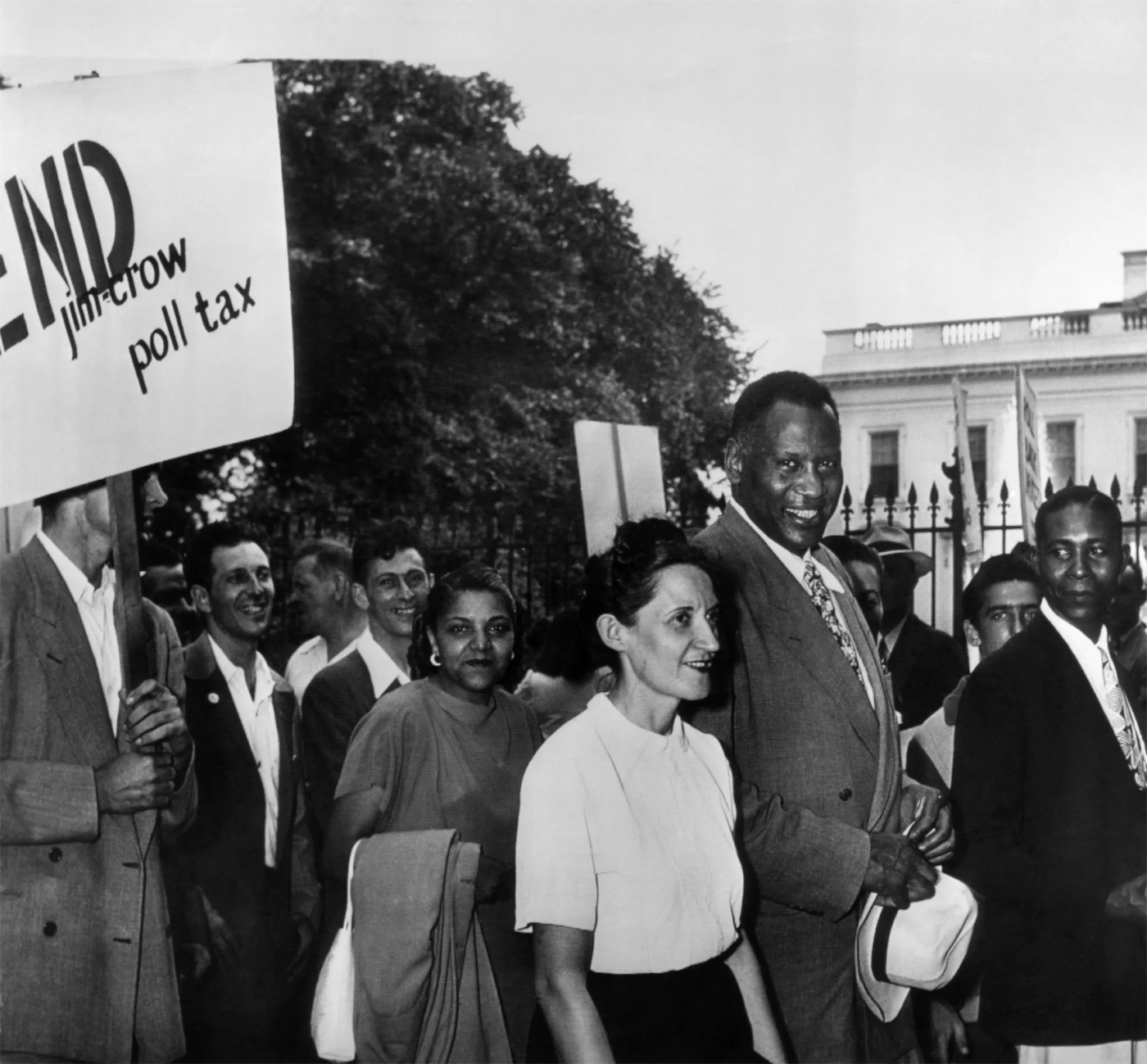
By the 1930s and 1940s, Robeson had become one of the world’s best-known Black public figures. He used that standing in ways that would make him increasingly intolerable to U.S. power. He supported labor organizing, spoke against fascism, advocated for colonial liberation, and criticized American racism not as a regrettable contradiction but as a foundational scandal. During World War II and after, he was also visible in public acts of patriotic solidarity on terms that did not require silence about injustice. The National Archives preserves images of him leading workers in singing “The Star-Spangled Banner,” a reminder that his critics later simplified him into a foreign sympathizer only by ignoring how insistently he claimed America while condemning its betrayals.
Robeson’s willingness to connect Black liberation to labor struggle remains especially important. He did not imagine freedom as a matter of etiquette, representation, or elite access alone. He spoke to workers, not just donors. He engaged trade unions and anti-colonial movements, not just polite liberal audiences. The Washington Post’s account of the Peace Arch concerts and Robeson’s career underscores that his commitment to human rights routinely exceeded questions of art alone. That language is useful, because it clarifies why he was treated differently from entertainers who voiced mild dissent but remained within national consensus. Robeson did not seek mere reformist credibility. He sought structural change.
EBONY, in a later reflection on the political history of Black athletes, identifies Robeson as an early figure in the lineage of outspoken Black sports activism, citing his 1949 condemnation of American racism during the Paris Peace Conference. That framing is crucial. He was not only a forefather of Black artist-activists; he was also a prototype for the athlete who understands celebrity as leverage rather than shelter. In that sense, Robeson’s descendants are not just singers and actors. They are Muhammad Ali, Colin Kaepernick, and every Black public figure who has been told to entertain instead of testify.
Peekskill and the organized fury of Cold War America
The Robeson story becomes especially stark in 1949. That year, a concert associated with him in Peekskill, New York, became the site of violent racist and anti-communist attacks. The events have come down as the Peekskill riots, and they matter because they show the degree to which opposition to Robeson had moved beyond editorials and into mob action. Records preserved by archives and later reporting document smashed property, attacked concertgoers, and an atmosphere of open menace. The violence was political theater of its own: a public warning about what could happen to a Black man who combined global fame with radical speech.
The Guardian’s recent reassessment of Robeson places Peekskill at the center of his public downfall, linking the riots with Jackie Robinson’s 1949 congressional testimony against him and the broader convergence of federal scrutiny and public hostility. That convergence matters. Robeson was not undone by a single speech or a single controversy. He was targeted through an ecosystem of punishment: hostile press, official surveillance, institutional abandonment, and white mob violence. Respectable America did not need to choose between bureaucratic repression and street-level intimidation. In Robeson’s case, it got both.
The passport case, and the machinery of erasure
If there is one episode that most plainly captures the state’s effort to break Robeson, it is the passport fight. In 1950, the State Department revoked his passport. The New York Public Library’s materials on the case make plain both the timing and the stakes: he had extensive international invitations and engagements, and officials told him, in effect, that his movement and livelihood could be conditioned on his silence. The passport was not just a travel document. It was the government’s choke point on his audience, income, and political reach.
The fact sheet preserved by the NYPL is remarkable reading because it strips the episode of later euphemism. It notes that Robeson’s passport was canceled on August 4, 1950; that he lost scheduled appearances in Europe and elsewhere; and that he was told he could regain the document if he agreed to refrain from making speeches abroad. This was censorship by administrative means. It punished him for his views while allowing the state to pretend it was merely exercising discretion. The case announced, in unmistakable form, that citizenship rights could become contingent when a Black dissenter became influential enough.
The revocation lasted until 1958. NYPL and the National Archives both note the eight-year period in which Robeson was denied the passport, while the Guardian links the eventual reversal to the Supreme Court-era recognition that denying travel on the basis of political belief could not stand. By then, the damage had already been done. Robeson lost engagements, income, momentum, and much of his mainstream standing. Erasure, after all, does not always look like imprisonment. Sometimes it looks like forced immobility, institutional suffocation, and the slow draining of public memory.
Freedom, Black radical media, and the next generation
Robeson did not simply endure repression. He built alternatives. In 1950 he helped launch Freedom in Harlem, a newspaper that challenged racism, imperialism, colonialism, and political repression while advocating civil rights, labor rights, and peace. NYU’s archive and the NYPL collection both underscore its significance. It gave Robeson a platform for his own bylined column, “Here Is My Story,” and it created an institutional home for a Black left public sphere during the Cold War.
This part of the story is often underemphasized, but it should not be. Freedom was not merely a defensive response to censorship. It was a generative political project. It connected domestic racism to global struggles, covered labor issues often neglected elsewhere, and helped cultivate younger intellectuals. Among them was Lorraine Hansberry. Word In Black notes that Hansberry worked for Freedom as a young journalist and that, when Robeson’s passport was seized, he selected her to represent him at an international peace conference. That is a profound detail. It suggests Robeson was not just a singular figure but a node in a Black radical lineage, transmitting both analysis and institutional responsibility to those coming after him.
It also complicates the common habit of isolating Black luminaries into separate museum cases. Robeson’s story touches Hansberry, labor history, Pan-Africanism, anti-colonial media, and the cultural left. He did not occupy a neat box labeled “entertainer” or “civil-rights figure.” He moved through networks. That networked quality is part of why he was perceived as so threatening. State repression tends to intensify when a public figure is not merely famous but connective. Robeson connected people, movements, and vocabularies the state preferred to keep apart.
HUAC and the famous refusal
Robeson’s 1956 appearance before the House Committee on Un-American Activities remains one of the defining scenes of Cold War political theater. His testimony has lived on because he did not arrive frightened into deference. He arrived prepared to expose the committee’s moral absurdity. In one of the most famous lines from the hearing, he answered the suggestion that he should leave America if he admired the Soviet Union by invoking his father’s enslavement and the labor of Black people who built the country. The power of the line lies in its refusal of exile. Robeson was not conceding America to its reactionaries. He was contesting ownership.
“Because my father was a slave, and my people died to build this country, and I am going to stay here.”
The sentence still lands because it is both patriotic and accusatory. It refuses the cold-war demand that dissenters prove belonging by shrinking themselves. Robeson’s response was, essentially: my claim is older than yours. My people’s blood is already in the ground. That moral clarity is why the hearing endures in historical memory more vividly than many of the committee’s other spectacles. HUAC wanted confession or humiliation. Robeson gave them indictment.
The cost of being right too early
It would be dishonest to tell the Robeson story as a simple arc from greatness to vindication. The middle and later years of his life were hard. The passport fight, blacklisting, surveillance, public vilification, financial pressure, and political isolation took a deep toll. The National Archives notes that after his travel ban ended in 1958 he returned to performing abroad, but his health deteriorated and he eventually withdrew from public life. He died in Philadelphia in 1976. Even then, as the Guardian’s 2026 reassessment argues, the silence around him had not truly lifted.
One uncomfortable truth about Robeson is that many people who should have defended him more strongly did not. Some feared guilt by association. Some believed his politics were too radical. Some were simply trying to survive an atmosphere in which anti-communism became a disciplinary weapon across Black institutions as well as white ones. That context matters. So does accountability. Robeson’s treatment is a reminder that the state’s attack on dissent often succeeds not only through force but through strategic abandonment.
Why Paul Robeson still unsettles the present
Robeson’s relevance in 2026 is not nostalgic. It is diagnostic. He helps explain a recurring American pattern: the country celebrates Black genius when it can be framed as symbolic progress, then punishes Black genius when it becomes materially oppositional. He also helps clarify why certain historical figures remain harder to absorb into consensus memory than others. Robeson cannot be easily repackaged as a generic hero of perseverance because his politics were precise. He condemned empire. He aligned with labor. He defended peace in ways that challenged militarized nationalism. He made many people ask not merely whether America was failing its ideals, but whether some of its ideals had always been structured to fail people like him.
He also offers a corrective to the sanitizing of Black history. Robeson was not important because he was first at something, though he was first at many things. He was important because he insisted that success without solidarity was morally empty. In an era when institutions often prefer diversity without redistribution, symbolism without labor analysis, and memory without militancy, Robeson remains productively inconvenient. He demands that we ask what art is for, what citizenship means, and who gets punished for naming the structure instead of just narrating the wound.
Maybe that is why each generation seems to rediscover him and then stop short of fully reinstating him. He is too large to ignore, but too exacting to neutralize. A football star, a valedictorian, a Columbia-trained lawyer, a world-famous bass-baritone, a Shakespearean lead, a labor ally, a Black internationalist, a man the U.S. government tried to contain by force of bureaucracy and fear. Paul Robeson still poses the same question he posed in his own lifetime: what kind of country punishes one of its greatest artists for insisting that freedom should actually mean freedom?
And perhaps the deepest answer is this: Robeson matters because he would not let America love him in fragments. He would not be just the singer, just the actor, just the athlete, just the patriot, just the Black exception. He insisted on being whole. America has often struggled with whole Black people. That struggle is one reason his legacy remains unfinished. The other reason is more hopeful. Each time he is recovered seriously, not as a token but as a thinker and fighter, he still enlarges the political imagination. He still sounds like tomorrow.
More great stories
Elizabeth Catlett Never Separated Art From Freedom
April 1, 2026
No Comments
Frederick D. Reese and the Grammar of Freedom
April 1, 2026
No Comments