




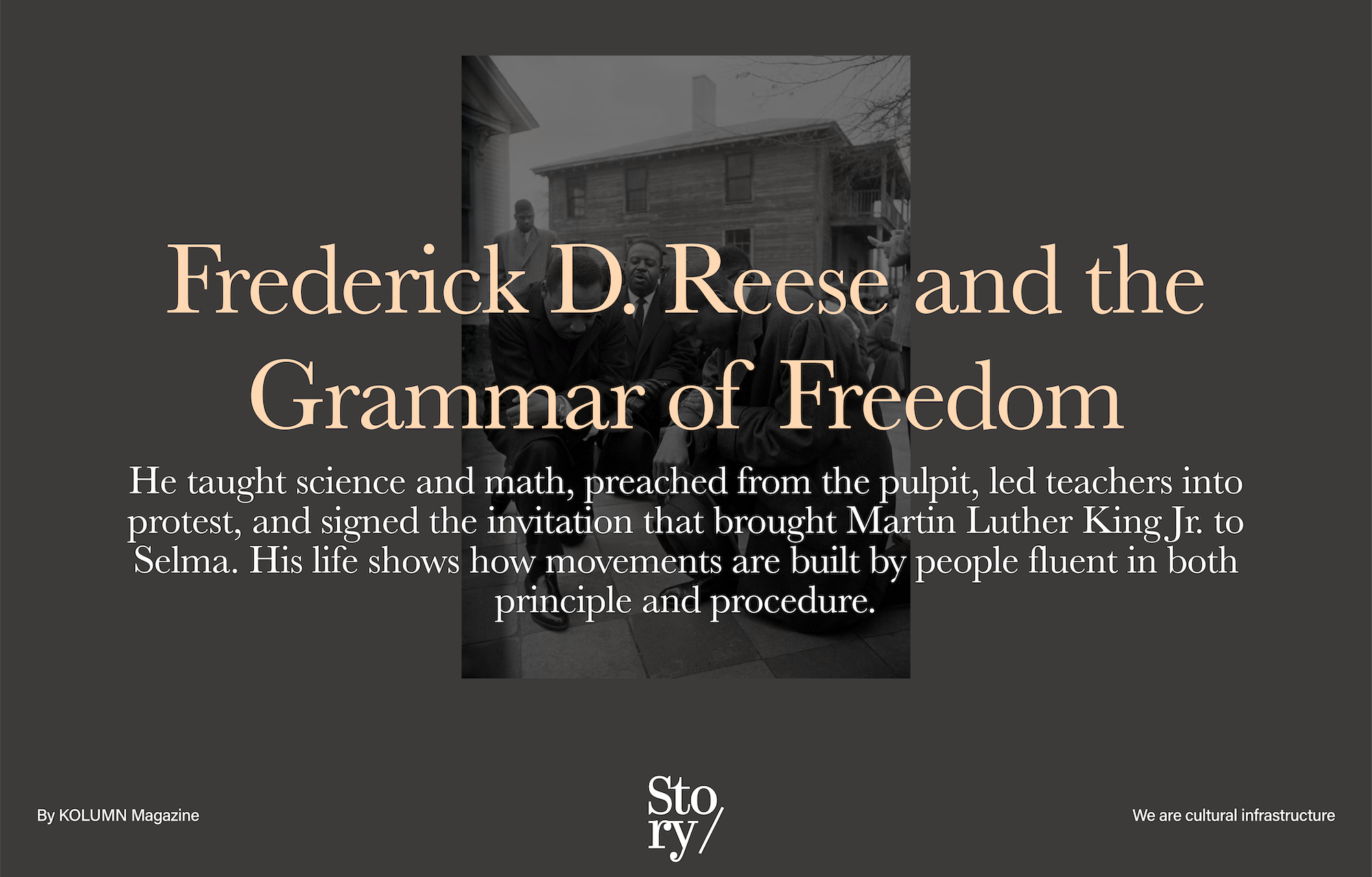
Frederick D. Reese understood that democracy was not only a moral promise. It was an organizational problem waiting to be solved.
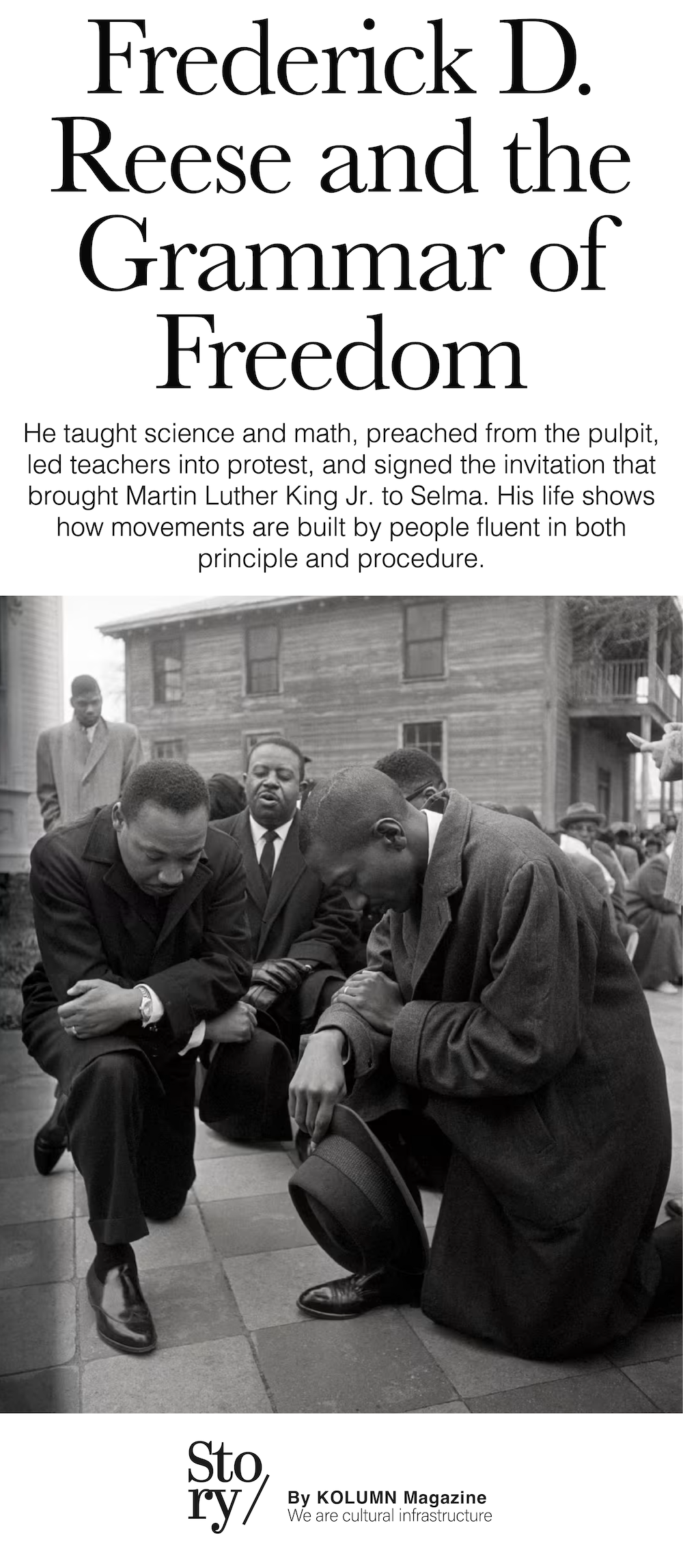
Frederick D. Reese understood that democracy was not only a moral promise. It was an organizational problem waiting to be solved.
By KOLUMN Magazine
The public memory of the civil-rights movement often flattens history into a few immortal scenes: a bridge, a billy club, a speech, a martyr, a march. Frederick D. Reese complicates that memory in the best possible way. He reminds us that before a movement becomes a national symbol, it is usually a local institution. Before the cameras arrive, somebody has to know who can be trusted, which church doors will open, which professionals can be persuaded to risk their livelihoods, and how to translate outrage into disciplined action. Reese was one of those somebodies. In Selma, Alabama, he was not a supporting character to history. He was one of the people who made history structurally possible.
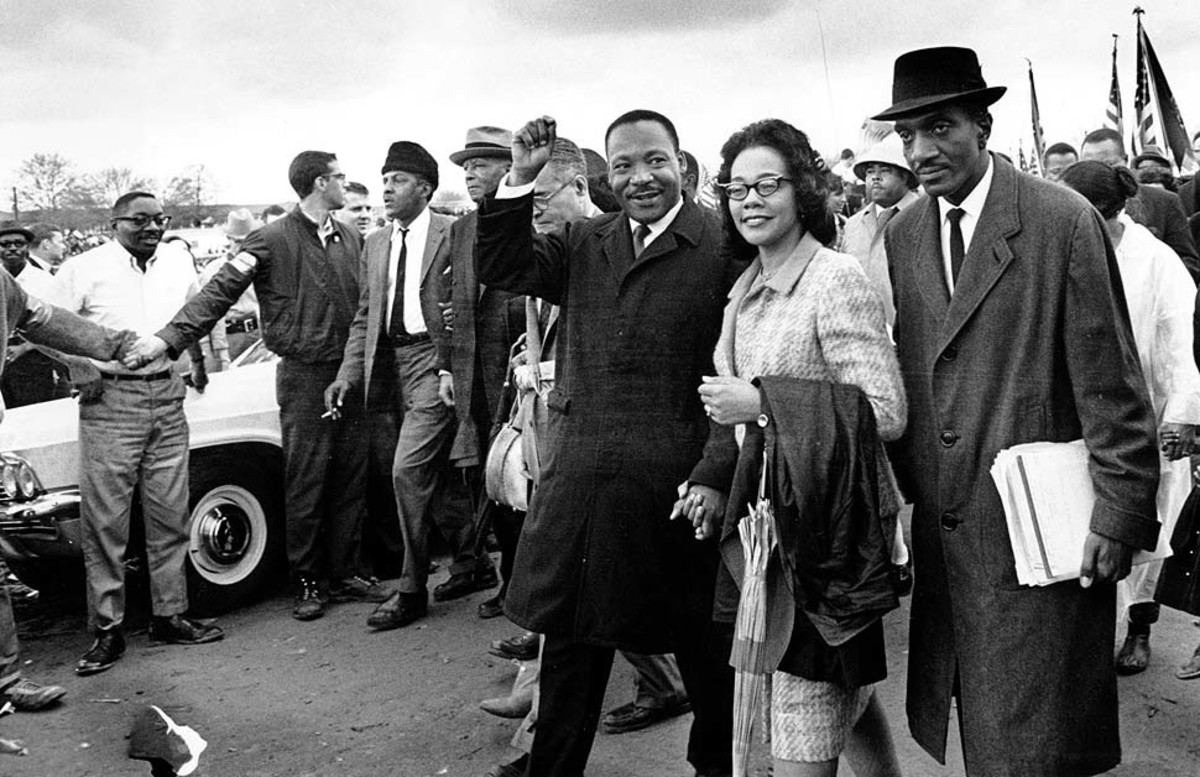
That matters because Selma has long been narrated through the arrival of national figures, especially Martin Luther King Jr. But Reese’s own testimony points in another direction. Selma, he said, was chosen because of the “commitment” of local people who were already alarmed by the near-total exclusion of Black citizens from the franchise. In Dallas County, where more than 15,000 Black residents were eligible to register, only about 130 were on the rolls in 1960, according to the Encyclopedia of Alabama’s summary of federal findings; Reese recalled the same basic catastrophe in oral history, describing a county in which only a tiny fraction of eligible Black residents had been allowed to vote. That local emergency, not celebrity politics, is where his significance begins.
Reese’s life also offers a more disciplined definition of leadership than the one American culture typically rewards. He was a teacher, a minister, a union-style advocate for Black educators, a president of the Dallas County Voters League, a member of Selma’s “Courageous Eight,” and later a public official in the city he never really stopped serving. The overlapping nature of those roles is central to understanding him. He was effective not because he occupied a single charismatic lane, but because he could move among constituencies that often remain siloed: the church, the classroom, the civic organization, the mass meeting, and eventually elected office. He operated at the junction where Black institutional life met direct action.
To write about Frederick D. Reese, then, is to write about a particular kind of civil-rights labor: not simply protest, but civic engineering. He helped build the conditions under which protest could matter. He did not merely stand for freedom in the abstract; he worked through the mundane machinery of meetings, letters, schools, churches, and organizations. His story is a corrective to the blockbuster version of the movement. It insists that history is not only made by the people at the microphone. It is also made by the people who decide where the microphone will be placed, who will be in the room, and what the room is prepared to risk.
A Selma native shaped by the Black Belt’s political realities
Frederick Douglas Reese was born in Selma on November 28, 1929, and would die there in 2018, a geographical symmetry that says something important about his politics. He was not an itinerant activist whose importance derived from movement between crises. He was rooted. The National Park Service describes him as a Selma-born educator, minister, and leader whose impact was inseparable from the city itself. That local rootedness gave him a different kind of authority from national organizers who came in for campaigns. Reese knew the texture of Dallas County because it had shaped him long before it made him visible.
He graduated from Alabama State University and built his career as an educator, eventually teaching science and math at R.B. Hudson High School in Selma. In the standard mythology of civil-rights leadership, teaching can seem almost incidental, a respectable day job before the “real” work starts. In Reese’s case, the teaching was part of the politics. The classroom sharpened his sense of contradiction. In his oral history, he recalled the bitter absurdity of Black teachers being expected to teach citizenship while being denied full citizenship themselves. That tension would become one of the most powerful organizing frames of his career.
His early adulthood coincided with a period when white supremacy in Alabama was neither subtle nor improvisational. It was bureaucratic, civic, and methodical. The Encyclopedia of Alabama notes that after the state moved against the NAACP in the 1950s, the Dallas County Voters League became the principal local vehicle for Black voting-rights advocacy in Selma. By the time Reese joined the organization after returning to Selma in 1960, local Black political life had already learned how to survive under pressure. What Reese helped do was increase its dynamism. He brought urgency, steadiness, and a willingness to link long-standing civic respectability with more confrontational tactics when the moment required it.
He was well positioned for that role because he carried a kind of establishment legitimacy inside Black Selma while also understanding the need for movement escalation. That balance was not easy. One of the underrated tensions in local civil-rights work involved middle-class Black professionals, many of whom faced real economic retaliation if they became too visible. Reese knew those risks intimately, and that is partly why his later success organizing teachers mattered so much. He did not talk professionals into joining a movement they barely understood. He translated the movement into their own language of dignity, duty, and contradiction.
The Dallas County Voters League and the local backbone of Selma
If Frederick D. Reese has one claim to national memory, it is usually this: he was the Dallas County Voters League leader who signed the invitation bringing King and the Southern Christian Leadership Conference into Selma in late 1964. That is true, and it is important. But the invitation only makes sense if we understand the organization behind it. The Dallas County Voters League was not an improvised vehicle invented for a national drama. It had existed for years as a local effort sustained by a relatively small group of Black registered voters and activists determined to expand access to the franchise in one of the most violently resistant parts of the South.
The organization’s history also reveals why Reese mattered. After Sam Boynton’s death in 1963, Reese became president of the DCVL, and under his leadership the organization intensified its work with SNCC organizers Bernard and Colia LaFayette. The Encyclopedia of Alabama describes the period as one in which the DCVL, with SNCC’s help, moved toward demonstrations, registration drives, and public pressure campaigns. This was the context in which Selma began turning from a stubborn local story into a strategic national test case. Reese’s leadership sat exactly at that hinge.
His own account is especially revealing. He did not describe Selma as a place passively awaiting rescue. He described it as a place with local commitment, already fighting, already organizing, already clear about the scale of disenfranchisement. He said SNCC had been invited earlier, and that SCLC was brought in later when local activists feared momentum and resources were thinning. That is a crucial point. The invitation to King was not evidence that Selma needed outsiders to generate legitimacy. It was evidence that local leaders like Reese knew when to widen the coalition, when to scale up, and how to leverage national attention without surrendering the local core of the movement.
This is one of Reese’s great historical contributions, and it is not always told clearly enough. Too much civil-rights storytelling treats local activists and national leaders as belonging to separate tiers, with the latter inevitably occupying the starring role. Reese’s story pushes back against that hierarchy. He functioned as a mediator among local people, SNCC workers, and SCLC leadership. In his oral history, he explicitly described his role as trying to build consensus when tensions emerged between SNCC and SCLC. That kind of labor rarely gets canonized, but movements collapse without it. Reese was not just a bridge walker. He was often a bridge builder between factions, strategies, and scales of struggle.
His significance, then, lies partly in political calibration. He understood that national figures could dramatize local injustice, but he also understood that spectacle without local infrastructure would dissipate. Selma succeeded, in the historical sense, because it had both. Reese helped ensure that.
The letter that changed the trajectory of Selma
In late 1964, a legal injunction in Dallas County had sharply constrained public meetings and organizing. Reese recalled that movement leaders were effectively forbidden to gather in groups of five or more for civil-rights activity, a ban designed to drain momentum and isolate activists from one another. The injunction was not just a technical legal measure. It was a political instrument aimed at suffocating democratic life before it could become contagious. Reese understood that any effective response would have to be both practical and symbolic.
Reese did not wait for national history to arrive in Selma. He helped script the conditions under which Selma could become national history at all.
At Amelia Boynton’s house in December 1964, Reese, then president of the DCVL, signed the invitation asking King and SCLC to come to Selma. In his recollection, the choice was driven by the need to keep the struggle alive, break the paralysis created by the injunction, and reignite public commitment. He remembered the decision not as pageantry, but as a tactical necessity. Selma was already fighting. The question was how to preserve and amplify the fight.
King came to Selma on January 2, 1965, for a mass meeting at Brown Chapel A.M.E. Church. Reese remembered that it snowed that day and that many people feared turnout would be weak because of the threat of arrest. Instead, Brown Chapel filled up. According to Reese, law enforcement, faced with the impracticality of jailing that many people, did not enforce the injunction. In his telling, that moment mattered because it restored momentum. The movement resumed its public rhythm. Sometimes history turns not on a courtroom opinion or a presidential address, but on a packed church that reveals fear has lost some of its grip.
This is where Reese’s political instincts were especially sharp. Inviting King was not just about attracting national press, though that would happen. It was about testing the state’s willingness to enforce repression at scale and about giving local people an occasion to reclaim public assembly. Reese seems to have understood that courage is often social before it becomes heroic. People show up because other people show up. Once Brown Chapel filled, the injunction began to lose its practical authority. The movement had found a way to make repression look clumsy.
There is a larger lesson here about Reese’s significance. He was not only brave. He was strategically literate. He saw that institutions of white power in Selma were vulnerable not just to moral critique, but to mass defiance that exposed the limits of enforcement. His leadership worked because it combined ethical seriousness with tactical intelligence.
The teachers’ march and the politics of professional respectability
For many historians and participants, the turning point in the Selma campaign came with the teachers’ march of January 22, 1965. Reese himself said as much in substance. In his oral history, he explained that he used his dual role as president of the Selma City Teachers Association and president of the Dallas County Voters League to mobilize Black teachers who had themselves experienced humiliating voter discrimination. Many had advanced degrees. Many had been denied registration repeatedly. Reese saw in that contradiction both injustice and organizing potential.
His frame was elegant and devastating: how can you teach citizenship if you are not treated as a first-class citizen yourself? That was not merely rhetoric. It was movement pedagogy. Reese understood that teachers possessed social influence far beyond their numbers. They were among the city’s largest and most respected Black professional groups. If they marched publicly for voting rights, they would alter the movement’s class composition and moral visibility. That is precisely what happened.
On January 22, Reese asked teachers to gather at Carr Elementary School and march to the courthouse. He had written the chair of the Board of Registrars requesting that the office be open, arguing that if citizens could pay taxes any day of the week, they should be able to register any day of the week as well. Reese knew the office was not ordinarily open on Fridays. The request therefore functioned as both a practical demand and an exposure device. It laid bare the arbitrary architecture of disfranchisement.
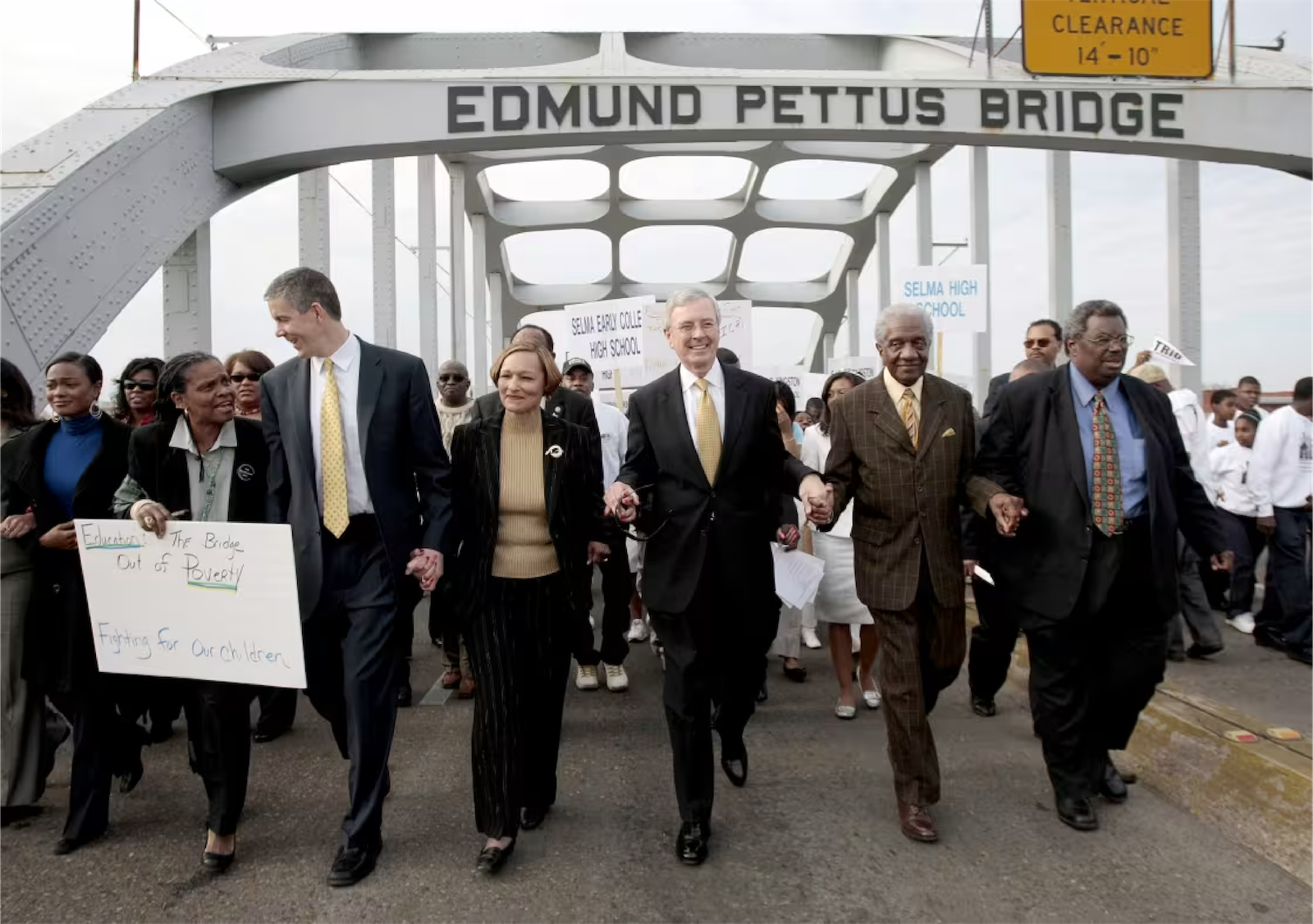
When the teachers arrived at the courthouse, Sheriff Jim Clark and law enforcement harassed and shoved Reese and the others. Reese recalled being jabbed down the steps and denied even the performative courtesy of arrest. In the end, the teachers regrouped and marched to Brown Chapel, where they were celebrated. Reese later said the action was the first time teachers had marched for voting rights in the United States, and the National Park Service similarly describes it as the first time a professional organization in Selma took such a public stand. Whether one emphasizes the local or national firstness, the central point holds: the march changed the chemistry of the campaign.
Reese said that after the teachers marched, other occupational groups followed: undertakers, beauticians, and others. Students who had already been risking arrest now saw their own teachers in the streets. The barrier between the respectable and the insurgent began to break down. That mattered enormously in a Southern town where white supremacy depended not only on terror but on disciplined social compartmentalization. Reese’s teachers’ march punctured that order. It told Black Selma that protest was not the property of the desperate alone. It belonged to the credentialed, the employed, the churchgoing, and the professionally vulnerable too.
That may be Reese’s single most underrated achievement. He helped move the movement from the margins of community respectability into its center. In doing so, he gave Selma a broader civic base and made the campaign harder to dismiss as the work of a small militant fringe. It is one thing for a regime to brutalize the poor and unemployed, ugly as that already is. It is another for the world to watch that regime brutalize its teachers.
Bloody Sunday, nonviolence, and the discipline of endurance
When Americans hear Selma, they usually think first of Bloody Sunday, March 7, 1965. Reese was among the leaders involved in the campaign that culminated in that march, and later accounts from the Guardian and other sources identify him as one of the organizers and participants associated with the first attempt across the Edmund Pettus Bridge. The National Park Service places him among the movement’s key organizers during the Selma-to-Montgomery campaign, while later commemorations repeatedly recognized him as one of the foot soldiers and leaders whose courage on that terrain helped force federal action.
What made Frederick D. Reese formidable was not only that he could face violence. It was that he could keep a movement coherent after violence arrived.
Yet Reese’s historical value is not exhausted by the iconic imagery of state violence. His oral history is compelling precisely because it dwells on what came after the beatings and tear gas. He remembered the disbelief, the injuries, and the deep question that spread among participants: should nonviolence remain the movement’s method after such savagery? That question is essential to the history. Nonviolence can be romanticized after the fact, as though it were an effortless moral consensus. Reese tells us it was not. It had to be re-chosen under conditions of rage and pain.
He recalled King calling Brown Chapel that evening and then the arrival, later that night, of supporters from outside Alabama who had seen the violence on television and came to Selma to stand with local activists. Reese described the emotional effect as exhilarating. Hope returned. Resolve steadied. In his memory, that influx of solidarity helped save nonviolence at a moment when retaliatory violence may have seemed, to some, more emotionally legible. This is another place where Reese’s importance shows up in full. He was not merely a participant in a clash. He was one of the local leaders responsible for converting trauma into renewed discipline.
That discipline had national consequences. The violence on Bloody Sunday, amplified by television and followed by an expanding coalition of clergy, citizens, and activists, accelerated the pressure that would lead to passage of the Voting Rights Act of 1965. Reese’s role in that arc is best understood not as singular heroism but as cumulative leadership. He helped organize the campaign before the bridge, endure the crisis on the bridge, and stabilize the movement after the bridge. That sequence matters more than any single image.
In an era obsessed with the viral moment, Reese’s example is clarifying. He teaches that a movement wins not simply by producing a shocking image, but by having enough internal structure to survive the shock.
Pastor, educator, civic man
One of the most revealing things about Reese is that he did not become less local after Selma became globally legible. He continued serving as pastor of Ebenezer Missionary Baptist Church for roughly half a century, according to AP reporting on his death, statements from Rep. Terri Sewell, and other contemporary accounts. That long pastorate matters because it suggests his authority was not episodic. He was not simply a man who had been important once. He remained embedded in the moral and civic life of Selma over decades.
The National Park Service also emphasizes his long career as an educator at R.B. Hudson High School and his later public service on the Selma City Council. These details can sound routine beside the drama of 1965, but that would be a misreading. In Black Southern political history, the ability to move from movement leadership into sustained institutional stewardship is a major part of the story. Reese did not treat civil rights as a finished event achieved once federal legislation passed. He appears to have understood that the work of justice after 1965 required ongoing service in schools, churches, and city government.
That continuity is one reason he deserves more attention than he usually gets. Too often, the civil-rights movement is narrated as an uprising that peaks in the mid-1960s and then fades into commemoration. Reese’s life complicates that arc. He stayed with the city. He remained pastor. He taught. He entered local governance. He kept doing the less cinematic labor of democratic maintenance. The throughline is unmistakable: the same man who fought voter suppression also worked inside the long aftermath of formal legal change.
This is not just biographical filler. It speaks directly to his significance. Reese helps us see that Black political leadership in the South was never only about confrontation. It was also about institutional continuity. Protest cracks open possibility; institutions decide whether possibility can last. Reese seems to have believed in both.
Recognition, memory, and the politics of who gets remembered
In 2016, the Congressional Gold Medal was awarded to the foot soldiers of the 1965 voting-rights marches, and Reese accepted the honor alongside John Lewis on behalf of those who marched. House reporting on the ceremony framed the award as recognition of the sacrifices that helped secure the Voting Rights Act. Coverage from The Washington Post and The Guardian noted the bittersweet nature of the occasion: while Selma veterans were being honored, many of them were simultaneously warning that the Voting Rights Act had been weakened after the Supreme Court’s 2013 decision in Shelby County v. Holder and that Congress had failed to fully restore its protections. Reese’s public presence at that ceremony linked memory and unfinished struggle in one frame.
The symbolism was powerful. A man who had helped create one of the defining moral confrontations of American democracy stood in the Capitol receiving the nation’s highest congressional honor while the law that emerged from that confrontation was under renewed stress. The Guardian quoted Reese’s gratitude at the ceremony, but the surrounding coverage made clear that commemoration was not enough. This tension runs through any honest account of his legacy. Reese belongs to a generation of activists whose victories are often celebrated in language more robust than the policies now used to defend them.
That broader context sharpens the question of remembrance. Why is Reese less widely known than King, Lewis, or even some other Selma figures? Partly because national memory privileges archetypes: the prophet, the martyr, the singular icon. Reese was something slightly harder for popular culture to package. He was organizationally central, morally authoritative, and publicly visible, but he was not built for celebrity myth. His genius lay in coalition maintenance, tactical timing, and local legitimacy. Those are indispensable traits in real political life, but they are less legible to a culture that prefers clean protagonists.
And yet, in another sense, Reese has not been forgotten so much as under-taught. He appears in official National Park Service interpretation, in movement oral histories, in congressional commemorations, in reporting on anniversaries, and even in popular retellings such as Ava DuVernay’s Selma, where he was portrayed by E. Roger Mitchell. The problem is not absence from the archive. The problem is that the archive’s lesson has not fully entered the mainstream civic imagination.
What Reese teaches, if we pay attention, is that local Black leadership did not merely support the movement. It authored major parts of it.
Why Frederick D. Reese matters now
It would be easy, and a little lazy, to end with generic praise. Reese was courageous. Reese was committed. Reese was a giant. All true. But what makes him especially relevant now is more specific than that. He matters because he understood that disenfranchisement is not an abstraction. It is a system made of schedules, offices, tests, injunctions, gatekeepers, and intimidation. He also understood that resistance must be equally concrete. You need institutions. You need trusted messengers. You need strategic escalation. You need middle-class buy-in without abandoning the poor. You need moral language that can organize as well as inspire. Reese knew all of that.
His life also complicates the habit of treating voting rights as a settled chapter rather than an active democratic condition. The 2016 Congressional Gold Medal ceremony made that tension explicit: Selma veterans were being celebrated even as voting-rights protections remained contested in modern America. Reese’s legacy is therefore not only historical. It is diagnostic. He helps explain how democracy fails at the local level and how it can be rebuilt from the local level too.
There is something else worth saying, especially in a time when civic language often swings between cynicism and branding. Reese represented a mode of Black leadership that was deeply serious without being performative. He was plainly capable of public symbolism; after all, he helped make one of the most symbolically potent campaigns in American history. But his leadership did not depend on aestheticized defiance. It depended on trust. People followed him because he had standing in the church, in the schools, in the movement, and in the city. He had, in the old sense of the phrase, earned the right to ask others to risk something.
That is perhaps the cleanest way to describe his significance. Frederick D. Reese was a leader whose credibility was cumulative. It was built in classrooms, sanctuaries, meetings, and streets over time. When he asked Selma’s teachers to march, they did. When he signed the invitation to King, it carried the weight of a local movement that had already proved its seriousness. When he stood in the aftermath of Bloody Sunday and helped hold nonviolence together, he did so as someone whose authority had already been tested.
American democracy has always depended, more than it likes to admit, on figures like that: people who are not merely eloquent about freedom, but administratively, spiritually, and strategically competent in its pursuit. Reese was one of them. He deserves to be remembered not just as a Selma veteran or a foot soldier, though he was both. He deserves to be remembered as a chief local architect of the campaign that made Selma a turning point in American political life.
When Reese died on April 5, 2018, at age 88, the obituaries correctly noted that he had invited King to Selma, pastored Ebenezer Missionary Baptist Church for decades, and helped lead one of the most consequential voting-rights campaigns in U.S. history. But even that tidy summary can understate the deeper truth. Frederick D. Reese did not simply witness a democratic breakthrough. He helped design it.
And maybe that is the line worth carrying forward. In the American story, some people become symbols because they are seen. Others become indispensable because they make the seeing possible. Frederick D. Reese was one of the latter. Selma became Selma, in no small part, because he knew that freedom needed more than courage. It needed a plan.
More great stories
Elizabeth Catlett Never Separated Art From Freedom
April 1, 2026
No Comments
Paul Robeson Was Too Much for America
April 1, 2026
No Comments